Poem for a Tuesday — “She Who Reconciles” by Rainer Maria Rilke
She who reconciles the ill-matched threads
of her life, and weaves them gratefully
into a single cloth —
it’s she who drives the loudmouths from the hall
and clears it for a different celebration
where the one guest is you.
In the softness of evening
it’s you she receives.
You are the partner of her loneliness,
the unspeaking center of her monologues.
With each disclosure you encompass more
and she stretches beyond what limits her,
to hold you.
— from Rilke’s Book of Hours, translated by Anita Barrows and Joanna Macy. Riverhead Books: New York, 1996, I 17, p. 64.
Rainer Maria Rilke (1875-1926) was a Bohemian-Austrian poet and novelist. He was the only son of an unhappy marriage. His mother mourned the death of an earlier daughter. During Rilke’s early years, she sought to recover the lost girl through the boy. According to Rilke, he had to wear “fine clothes” and “was a plaything [for his mother], like a big doll.” He attended military school and trade school before studying literature, art history, and philosophy in Prague and Munich. He was a mystic, proto-modernist, and early proponent of psychoanalysis. He traveled extensively throughout Europe and Russia before settling in Switzerland. At the time of his death from leukemia, his work was largely unknown to the reading public, but his posthumous followers have been many. He is now considered the most lyrical and influential of the German early modernists.
Sabbath Day Thoughts — “The Least of These” Matthew 25:31-46
Bob stopped typing. There it was again, an insistent knocking, down at the front door. It was Saturday morning. Marge and Paul had driven south for a weekend of Christmas shopping with her sister in Albany. Bob was working on his sermon, but he had deleted more than he had written. He pushed back his desk chair and ventured downstairs.
There on the doorstep was the short, round form of Junior Miller. Bob remembered the Christmas Eve that Junior had been born, more than twenty years ago, now. Bob had been called to the hospital to visit the newest member of his flock. Junior’s almond-shaped eyes and rosebud mouth confirmed what his parents had learned: Down Syndrome. But the boy had been a delight. Sure, he struggled with school. Sure, he took some bullying. But his kind nature was unstoppable. This morning, Junior looked extra round. A down jacket stretched across his belly, snow boots reached almost to his knees, a bright wool handknit hat and matching scarf and mittens were keeping out the cold.
“Why Junior! What brings you to my door so bright and early?”
Junior pulled down the scarf to free his mouth and leaned in, “Pastor Bob, I had a dream.”
Bob’s eyebrows shot up, like they do when he is intrigued. “A dream. You don’t say. You want to come in and tell me about it?”
Junior shook his head emphatically, no! “Pastor Bob! It was God, he said he was going to see me today. I don’t have time to visit with you.”
Bob nodded appreciatively. “Hmm. Well, where do you think you’ll find God?”
Junior pushed back his knit cap and looked up and down the street. “God didn’t say. Any ideas?”
Bob looked left and right. It had snowed a lot overnight. The plows had been out to clear the lane, but the trees were bowed beneath the wintry weight. Bob squinted against the snowy glare, “Well, Junior. I’m not sure where you’ll find Jesus, but I’m certain he’s out there. Be sure to send him my way. I could use some help with my sermon.”
Junior nodded, turned around, and marched off in search of Jesus.
Junior had only gone a few blocks when he saw old Mrs. Trombley. Every week she came to the dairy where Junior worked and bought the same thing: a dozen eggs, a half-gallon of milk, and one of Mrs. Underhill’s freshly-baked bear claw pastries. This morning, Mrs. Trombly was shoveling snow. A wall of the white stuff had drifted against the back of her car. You could barely make out the bumper.
“Hi, Mrs. Trombly! It’s me, Junior.”
Mrs. Trombley leaned on her shovel to catch her breath. Her cheeks were bright red and she looked kind of sweaty. Junior hadn’t noticed before, but Mrs. Trombley seemed to be shrinking. Her back curved inside her old winter coat. She had to look up to see his face. “Why Junior, good morning! How do you like all this snow?”
Junior took her question seriously. “Pretty nice, I guess.”
Mrs. Trombley looked at the big drift behind her car. “Lots of work if you ask me. Burt always does this, but he had surgery last week. That means I’m on deck.”
Junior nodded. He really needed to get going if he was going to see Jesus, but he stopped. “Here, Mrs. Trombley. Give me that.” Junior took the snow shovel. It took a while to dig out the car and shovel the walk while Mrs. Trombley went back inside to tend Burt. Junior left the snow shovel next to the front door and hurried off to continue his search.
Outside the church, Junior saw Christine Lebowski. She had been the prettiest girl in his high school class. A cheerleader, too. She had married the captain of the football team, but Junior wasn’t invited to the wedding. In fact, Christine and her friends had sometimes made fun of Junior. They called him the ‘tard and poked fun at his round belly which, as a child, bore a striking resemblance to Winnie the Pooh’s.
Christine was pushing a stroller, the lightweight, folding kind that you use in the summer months. There was a chubby baby inside that was every bit as blonde and blue-eyed as Christine. The baby looked happy, but Christine did not. In fact, she looked like she had been crying. Her eyes were red and swollen. She had a soggy Kleenex clenched in one hand. Junior had never seen Christine cry.
Junior followed Christine into the church. There she turned right, into the food pantry. Junior really needed to look for Jesus, but the fact that Christine Lebowski was crying tugged at his tender heart. He watched out of the corner of his eye while Christine took the baby out of the stroller and strapped it across her chest into one of those Snugli carriers while the food pantry volunteers loaded up her stroller with bags of food. As Christine shoved the overloaded stroller over the threshold and back outside, Junior heard an alarming, “Crack!” The stroller collapsed, sending groceries everywhere. Christine was really crying now.
Junior stepped up. “Hey, Christine.”
The sad woman looked around, noticing for the first time that Junior was there. “Uh, Junior. Sorry, I’ve made a big mess.”
Junior bent down and gathered the groceries back into their shopping bags. The bags were heavy and Christine with her baby didn’t look like any match for the load.
“I can help.” Junior said. That made Christine cry even more. He walked them home. Junior was surprisingly strong from his work at the dairy, but even he had to stop a few times to rebalance the load.
Along the way, Christine told him that she was alone now. Her husband said he didn’t want to be tied down with a baby. She was working at the Ron Dack Market when her Mom could watch the baby, but some months that just wasn’t enough. Junior just listened. At the door to her apartment, Christine said, “Gee, Junior. You are my knight in shining armor today.” This made Junior blush.
It was already early afternoon, but if Junior hurried, he could make it for the free lunch at the Good News Café. He arrived just as Tubby Mitchell was locking up.
“Junior!” the older man said, “You are my last customer today.” Tubby loaded up a plate with mashed potatoes, ham, green beans, and a generous slab of sheet cake. Junior ate with gusto, telling Tubby between bites all about his dream.
“Have you seen Jesus, Tubby?” Junior wanted to know.
Tubby looked out the window with a far away look in his eyes and sighed. “You know, Junior, I see him most days.”
This amazed Junior. “Jeezum Crow, Tubby! Really?”
Tubby smiled sadly, “Yup. I think I served him lunch about twenty minutes ago. If you hurry, you might catch him.” He nodded up the street, toward the center of town.
Junior pushed most of his cake into his mouth then pulled on his down coat and woolen cap. Tubby wound Junior’s scarf around his short neck while Junior jammed his hands into his mittens. “Oh boy! Thanks, Tubby!” Junior shouted over his shoulder as he dashed off up the street.
But Junior didn’t see Jesus or God almighty or even an angel. Dejected, he sat on a bench at the busy intersection in the center of town. Junior watched every car and inspected every pedestrian, hoping for a glimpse of the Lord.
The only thing of interest was Hank Tebow, who was always interesting. In the summer months, Hank wielded a spray bottle of Windex and a squeegee to make some easy money by washing the windshields of tourists while they idled at the light. In winter months, Hank wore big insulated coveralls and mostly just watched what passed for traffic in the village. Some days were bad, and he would yell at the cars until the police moved him along. Other days, like today, Hank dispensed jokes, the kind a six-year-old might tell.
“Hey, Junior! Knock, knock!”
Junior generally like this kind of joke, “Who’s there?”
“Snow.”
“Snow who?”
“Snow use. I forgot my name again!”
Junior laughed, “Good one, Hank.”
Junior resumed his search for Jesus while Hank scrounged a few cigarette butts from the sidewalk and tried unsuccessfully to share his jokes with pedestrians hurrying past. Junior noticed that Hank didn’t have any gloves or mittens. His hands were stained with nicotine and his nails were grimy, like Junior’s after a morning of work with the animals at the dairy. Hank’s bald head was hatless and his wispy beard didn’t seem to offer much protection for his face. Already the shadows were getting long. Junior would go to his parents for dinner, but Hank would probably be out there for hours. Junior stood up. He unwound the scarf, pulled the hat from his head, and yanked off his mittens. He tugged his coat sleeves down to cover his bare hands.
“Hey, Hank!” He yelled, “Knock, knock!”
Delighted that someone would join him in a little fun, Hank hurried over, “Who’s there?”
“Tank.”
“Tank who?”
“You’re welcome!” Junior said as he pushed his warm knitwear into Hank’s hands. They did some more laughing and Junior left. It was starting to get dark as Junior walked to his parents’ house. He had seen plenty of people that day, but where was Jesus?
The next morning, Junior arrived early at church. He knocked on Pastor Bob’s study door, then let himself in. He took a dejected seat on the couch. Bob stopped what he was doing.
“So, how did the Jesus hunt go, Junior?”
“Not so good.” Looking disappointed, Junior told Bob all about his day.
Bob listened and then chose his words carefully, “You know, Junior, I suspect that you saw plenty of Jesus yesterday.”
“Huh?”
“And Junior, I suspect that all those people you helped, they saw Jesus, too.”
Junior’s brow creased in concentration. “I need to think about that,” he said, rising from his seat and venturing out into the hallway.
At the door, Junior turned back, “How about you, Pastor Bob? Did Jesus help you with your sermon?”
Bob laughed, “Well, he sent his Holy Spirit to help me out. I expect we’ll do just fine.”
While Bob finished up his prayers of the people, Junior Miller found a quiet place to think.
This story was inspired by Leo Tolstoy’s classic work of short fiction, “Where Love Is, There God Is Also.”
Matthew 25:31-46
31“When the Son of Man comes in his glory, and all the angels with him, then he will sit on the throne of his glory. 32All the nations will be gathered before him, and he will separate people one from another as a shepherd separates the sheep from the goats, 33and he will put the sheep at his right hand and the goats at the left. 34Then the king will say to those at his right hand, ‘Come, you that are blessed by my Father, inherit the kingdom prepared for you from the foundation of the world; 35for I was hungry and you gave me food, I was thirsty and you gave me something to drink, I was a stranger and you welcomed me, 36I was naked and you gave me clothing, I was sick and you took care of me, I was in prison and you visited me.’ 37Then the righteous will answer him, ‘Lord, when was it that we saw you hungry and gave you food, or thirsty and gave you something to drink? 38And when was it that we saw you a stranger and welcomed you, or naked and gave you clothing? 39And when was it that we saw you sick or in prison and visited you?’ 40And the king will answer them, ‘Truly I tell you, just as you did it to one of the least of these who are members of my family, you did it to me.’ 41Then he will say to those at his left hand, ‘You that are accursed, depart from me into the eternal fire prepared for the devil and his angels; 42for I was hungry and you gave me no food, I was thirsty and you gave me nothing to drink, 43I was a stranger and you did not welcome me, naked and you did not give me clothing, sick and in prison and you did not visit me.’ 44Then they also will answer, ‘Lord, when was it that we saw you hungry or thirsty or a stranger or naked or sick or in prison, and did not take care of you?’ 45Then he will answer them, ‘Truly I tell you, just as you did not do it to one of the least of these, you did not do it to me.’ 46And these will go away into eternal punishment, but the righteous into eternal life.”
We walk on starry fields of white And do not see the daisies; For blessings common in our sight We rarely offer praises. We sigh for some supreme delight To crown our lives with splendor, And quite ignore our daily store Of pleasures sweet and tender.
Our cares are bold and push their way Upon our thought and feeling. They hand about us all the day, Our time from pleasure stealing. So unobtrusive many a joy We pass by and forget it, But worry strives to own our lives, And conquers if we let it.
There’s not a day in all the year But holds some hidden pleasure, And looking back, joys oft appear To brim the past’s wide measure. But blessings are like friends, I hold, Who love and labor near us. We ought to raise our notes of praise While living hearts can hear us.
Full many a blessing wears the guise Of worry or of trouble; Far-seeing is the soul, and wise, Who knows the mask is double. But he who has the faith and strength To thank his God for sorrow Has found a joy without alloy To gladden every morrow.
We ought to make the moments notes Of happy, glad Thanksgiving; The hours and days a silent phrase Of music we are living. And so the theme should swell and grow As weeks and months pass o’er us, And rise sublime at this good time, A grand Thanksgiving chorus.
Ella Wheeler Wilcox (1850-1919) began writing poetry at age eight. Her first published work appeared when she was fourteen years old in the New York Mercury. She devoted herself to a life of writing and hosted a literary circle at her home on the Connecticut Sound, Bungalow Court. Her work was at times scandalous for her day. Her collection of love poems was rejected by a Chicago publisher on grounds that it was immoral. It was later published in 1883 with the racy title Poems of Passion. When her poems sold 60,000 copies in two years, her reputation was established as a bestselling writer, even if critics disparaged her work. A natural advocate and enthusiast, Ella was an early spokesperson for animal rights and practiced vegetarianism. In 1918, she traveled to France in support of the war effort to read and lecture for soldiers in the Allied camps.
Poem for a Tuesday — “This Morning” Raymond Carver
This morning was something. A little snow lay on the ground. The sun floated in a clear blue sky. The sea was blue, and blue-green, as far as the eye could see. Scarcely a ripple. Calm. I dressed and went for a walk — determined not to return until I took in what Nature had to offer. I passed close to some old, bent-over trees. Crossed a field strewn with rocks where snow had drifted. Kept going until I reached the bluff. Where I gazed at the sea, and the sky, and the gulls wheeling over the white beach far below. All lovely. All bathed in a pure cold light. But, as usual, my thoughts began to wander. I had to will myself to see what I was seeing and nothing else. I had to tell myself this is what mattered, not the other. (And I did see it, for a minute or two!) For a minute or two it crowded out the usual musings on what was right, and what was wrong — duty, tender memories, thoughts of death, how I should treat with my former wife. All the things I hoped would go away this morning. The stuff I live with every day. What I’ve trampled on in order to stay alive. But for a minute or two I did forget myself and everything else. I know I did. For when I turned back i didn’t know where I was. Until some birds rose up from the gnarled trees. And flew in the direction I needed to be going.
in Ploughshares, vol. 11, no. 4, 1985.
Raymond Carver was best known for his sublime short stories. He had working class roots, growing up in rural Washington where his hard-drinking father worked in a sawmill and his mother waited tables. At age nineteen, while working in a California sawmill, he met and married sixteen-year-old Maryann Burk. His interest in writing was stoked by undergraduate work at Chico State University, where he was mentored by John Gardner and Richard Cortez Day. Carver supported his family as a delivery man, janitor, and library assistant, often rushing to complete his tasks so that he could spend time writing. Carver struggled with alcohol addiction, quipping once that he gave up writing and took to full-time drinking. He mastered his addiction with the help of Alcoholics Anonymous. His first short story collection, Will You Please Be Quiet, Please?, was published in 1976. It was shortlisted for the National Book Award. He died of lung cancer at the age of fifty.
Sabbath Day Thoughts — “Blessed and Entrusted” Matthew 25:14-30
You’ll find Rupert tending the huge outdoor grill for his church’s annual chicken barbeque. His preparations start weeks in advance. He gathers ingredients for his secret sauce. He procures the mesquite chips that get soaked and sprinkled on the coals to impart that special smoky flavor. He makes the big run to Sam’s Club for all that chicken. Folks are so glad that Rupert shares his talent that, on the day of the barbeque, they line up around the block. The chicken always sells out. It’s his church’s biggest mission fund raiser of the year.
Sharon is the Field Marshall of her church’s annual Christmas Bazaar. Her talents for organization and communication are impressive. She contacts all the crafters months in advance to ensure there will be a beautiful selection of handmade goods. She sees to it that the men’s group cuts greens and makes beautiful evergreen wreaths to sell. She gets the bakers baking a bounty of Christmas cookies, brewing coffee, and making cocoa for the snack table. On the day of the Bazaar, Sharon has volunteers lined up from early to late. Every year, people say it can’t get any better, but somehow with Sharon’s leadership, it does.
Sam is his church’s most faithful servant. Now that he is retired, he rises early every Tuesday, eats his breakfast, and heads down to the church office to put his handyman talents to work. There, the secretary hands him a list of things that need his attention: lightbulb in the fellowship hall needs changing, toilet in the men’s bathroom needs plunging, grass could use mowing. Sam takes his list and gets busy. You can hear him whistling around the church as he tends to his “honey-dos.” At lunchtime, he walks home with a pleased smile, eats a big bowl of soup, and takes a nap.
Every church has them—good and faithful servants who get busy, sharing their talents to serve the Lord and bless the rest of us.
Our gospel lesson today has long been called the Parable of the Talents. In Jesus’s story, three servants were “entrusted” with talents. In the first century, a talent was a great weight of silver, between seventy-five and ninety pounds. A single talent was equivalent to twenty year’s wages for a day laborer. The first slave received 100 years’ wages in one lump sum, the second slave 40 years’ wages. Even the last and least able slave received great wealth, 20 years’ pay dropped in his lap. This tremendous windfall was entrusted without instructions or supervision.
The Greek word translated here as entrusted, paradidomai, has a couple of meanings. Paradidomai means to hand something over, to make a gift of something valuable. But paradidomai is also used to describe how a rabbi hands down a teaching tradition, a sort of passing the torch of spiritual authority to disciples. Back when this story was first told, Jesus was entrusting his ministry to his disciples.
In the long history of interpretation of this parable, the word talent has taken on new meaning. John Chrysostum, the fourth century Bishop of Constantinople was the first to suggest that the talents of the parable are gifts and abilities. Each of us is blessed with unique and precious capabilities that bring us joy and bless others, like the real-life examples that I gave at the start of my message—Rupert the grill master, Sharon the majordomo, and Sam the handyman. Chrysostum’s interpretation of this parable has been so influential over the centuries that the common understanding of “talent’ no longer means a great weight of silver. It means our God-given and self-developed potential.
In Jesus’s story, two servants found purpose in their gift. They traded and took risks to increase what they had been given. Perhaps one bought a small flock and shrewdly shepherded, bred, and traded his sheep and goats, until he was rich with animals, wool, and meat. Perhaps the other purchased a small vineyard. He grew grapes, dried raisins, and made the finest wine that was in the greatest of demand. The slaves were blessed by the undertaking, filled with satisfaction and delight in their accomplishment. They were eager to share their incredible success when the Master returned.
I think we can all share stories of the blessing we experience when our God-given gifts are developed to their fullest potential and used in ways that bring goodness to the lives of others. I know that Rupert the grill master felt that the annual chicken barbeque was the highlight of his summer. Sharon the Field Marshall of the Christmas Bazaar rejoiced mightily every time the sale set a new record in raising funds for mission. Sam the Handyman sensed that he had found real satisfaction in retirement by keeping things running smoothly at church so that folks could show up on Sunday morning and be blessed.
For the third servant of the parable, it was a different story. He responded to the Master’s gift with fear, as if it were a big unwanted burden – more curse than blessing. We can imagine Jesus telling the long version of the parable. The slave waited for the cover of darkness and then lugged that great weight of silver to an unlikely place, quietly dug a pit, and buried it deep. After that, he lived every day of the long waiting time in worry and anxiety, always looking over his shoulder. Would someone steal the treasure? Was today the day when the Master would return? When the Master finally appeared, the third slave was filled with resentment. First, he insulted his Master, then he handed off the talent like it was a hot potato. Good riddance! There was no blessing for the third slave in the talent, no blessing in the waiting, and no blessing in the Master. His rejection of opportunity, his rejection of blessing, left him banished to the outer darkness.
It’s important to remember that Jesus was using hyperbole – a rhetoric of exaggeration —to make a point about the necessity for disciples to continue the ministry that he was entrusting to them. The dramatic description of the third slave wailing and languishing in the outer darkness reminded Jesus’s friends that although there would be fear and danger in the wake of his crucifixion, there could be blessing. If only they simply kept working, kept sharing, kept the faith, they would find joy for themselves and others.
If we set aside the scary hyperbole for a moment, we can see that this story is about trust, blessing, potential, and joy. Church folk tend to be a talented lot. Some have the prodigious gift of music. Others have the knack for building and fixing things. Some are wonderful cooks. Some are wonderfully caring or gifted in the offering of prayer. Some are natural leaders, while others are great followers and worker bees. We may not have the grilling gifts of Rupert or the organizational prowess of Sharon or the fix-it ingenuity of Sam, but we are each uniquely entrusted with abilities and qualities that make us the people we are. So much potential! Those talents are God-given and made for sharing. God doesn’t give us a checklist of missions to be accomplished, but the Lord trusts that we will be busy in his purpose.
Here’s the delightful truth of the parable. When we sing in the choir or share special music, it’s a blessing! When we put on our apron and fire up the oven for the bake sale, it’s a blessing. When we share our teaching gifts with the kids, it’s a blessing! When we share our caring gifts as a deacon, our devotional gifts on the prayer chain, or our knack for compassion at the Food Pantry, what is it? A blessing! When talented people get busy, the blessings abound. It’s a blessing for us and it’s a blessing to others. Praise the Lord for those talented Presbyterians!
The exclamation point of this parable is the Master’s joy. Jesus’s story suggests that when faithful disciples use their talents to get busy in God’s purpose, God finds delight. We put a smile on the face of the Great Almighty. Heaven breaks forth with the sound of rejoicing. Even better, when we are blessed by using our gifts—and others are blessed by us—then we are welcomed with praise into the joy of the Master. “Well done, good and faithful servants!” You might even say, that when talents are plied and blessing abounds, our world begins to look and feel like God’s Kingdom where the joy will never end. Don’t we want to be a part of that joy?
Every church has them—good and faithful servants who get busy, sharing their talents to serve the Lord and bless the rest of us. The Ruperts. The Sharons. The Sams. People like us! May we use our talents wisely. And may the Master’s joy abound!
Resources:
Carla Works. “Commentary on Matthew 25:14-30” in Preaching This Week, Nov. 13, 2011. Accessed online at workingpreacher.org.
David Schnasa Jacobsen. “Commentary on Matthew 25:14-30” in Preaching This Week, Nov. 19, 2017. Accessed online at workingpreacher.org.
Dirk G. Lange. “Commentary on Matthew 25:14-30” in Preaching This Week, Nov. 16, 2008. Accessed online at workingpreacher.org.
Greg Carey. “Commentary on Matthew 25:14-30” in Preaching This Week, Nov. 16, 2014. Accessed online at workingpreacher.org.
Matthew 25:14-30
14“For it is as if a man, going on a journey, summoned his slaves and entrusted his property to them; 15to one he gave five talents, to another two, to another one, to each according to his ability. Then he went away. 16The one who had received the five talents went off at once and traded with them, and made five more talents. 17In the same way, the one who had the two talents made two more talents. 18But the one who had received the one talent went off and dug a hole in the ground and hid his master’s money. 19After a long time the master of those slaves came and settled accounts with them. 20Then the one who had received the five talents came forward, bringing five more talents, saying, ‘Master, you handed over to me five talents; see, I have made five more talents.’ 21His master said to him, ‘Well done, good and trustworthy slave; you have been trustworthy in a few things, I will put you in charge of many things; enter into the joy of your master.’ 22And the one with the two talents also came forward, saying, ‘Master, you handed over to me two talents; see, I have made two more talents.’ 23His master said to him, ‘Well done, good and trustworthy slave; you have been trustworthy in a few things, I will put you in charge of many things; enter into the joy of your master.’ 24Then the one who had received the one talent also came forward, saying, ‘Master, I knew that you were a harsh man, reaping where you did not sow, and gathering where you did not scatter seed; 25so I was afraid, and I went and hid your talent in the ground. Here you have what is yours.’ 26But his master replied, ‘You wicked and lazy slave! You knew, did you, that I reap where I did not sow, and gather where I did not scatter? 27Then you ought to have invested my money with the bankers, and on my return, I would have received what was my own with interest. 28So take the talent from him and give it to the one with the ten talents. 29For to all those who have, more will be given, and they will have an abundance; but from those who have nothing, even what they have will be taken away. 30As for this worthless slave, throw him into the outer darkness, where there will be weeping and gnashing of teeth.’
Sabbath Day Thoughts — “Lamps Lit” Matthew 25:1-13
We don’t like to wait. It can make us feel grouchy, frustrated, annoyed, and bored. Americans spend an average of thirty-two minutes waiting at the doctor’s office, twenty-eight minutes waiting at airport security, and twenty-one minutes waiting for our significant other to get ready to go out. All that waiting adds up. As a nation, Americans spend thirty-seven billion hours waiting in line each year. The bad news is that New York state has the longest waiting times in the country. A survey of twenty-five New York communities found that our average wait time in stores is six minutes and fifty-one seconds. That sounds about right. The worse news is that our patience is growing shorter as digital technology, like smart phones and on-demand streaming services, lead us to expect instant gratification. The average person grows frustrated after waiting sixteen seconds for a webpage to load or twenty-five seconds for a traffic signal to change. Does any of this sound familiar?
Our gospel reading today reveals that the struggle to wait isn’t limited to twenty-first century New York. Jesus told this parable of the Ten Bridesmaids to his disciples as they gathered one evening on the Mt. of Olives, overlooking Jerusalem. It was the final week of Jesus’ earthly life. Powerful enemies in Jerusalem were conspiring to bring about his arrest and execution. Jesus knew what awaited him at the end of the week, even if his friends were unwilling to accept it. And so, he told a story of a wedding banquet too long in coming and bridesmaids who missed out on the celebration.
In Jesus’s day, when a young girl reached marriageable age, her parents would seek an appropriate bridegroom. First, a contract, stating terms of the dowry, would be agreed upon. Then, at the end of a year-long engagement, the bridegroom would collect his bride, paying her parents the bride price and bringing his new wife home to the house of his father. On the blessed night of the wedding, bridesmaids waited at the father’s house. With lamps lit, they would go forth singing and rejoicing, leading the couple to the marriage tent, where their wedding vows would be consecrated. After the wedding, a festive weeklong party began.
In Jesus’ story, the wedding party didn’t go according to plan. The groom was delayed. As the long hours dragged on after dark and the bridesmaids waited, they fell asleep and their lamps burned low. When the shout at last went up, “The bridegroom is near!”, the maids rose to tend their flames, but only half the girls had anticipated the wait and brought extra oil. While five maids went out with glowing lamps to rejoice with the wedding party, the others ran off to bang on the door of the local oil merchant. When they returned to the father’s house, it was too late. The door was closed and there would be no late entries.
This is not my favorite parable. For one thing, it takes a lot of explaining. For another, I’d like to soften its sharp edges. Let there be a super-abundance of oil to share. Let the bridegroom throw open the doors and welcome the latecomers to the party. But Jesus knew that his story required sharp and uncomfortable edges to get our attention. We can bet that every disciple who listened to Jesus on the Mt. of Olives sat up straight and opened their ears.
In Jesus’ day, the wedding feast was a common metaphor for the beautiful feast of the Kingdom of God that would come at the end times. Jesus’s friends knew Jesus was the bridegroom, the Messiah, sent to usher in a new age of righteousness and holy living. But there would be no wedding feast that week. Instead of a wedding procession of joyful bridesmaids with lamps aglow, there would be a funeral procession. Jesus, beaten, bloody, and broken, would be paraded through the streets to his brutal execution.
Jesus hoped that his friends would live with a sense of urgent patience, even after he would be taken from them. God’s Kingdom would come, even after long delay. Jesus hoped his friends would live like those five wise bridesmaids, well-equipped and ready to serve, even if the shout went up at midnight. The disciples, who listened to Jesus and looked out across the Kidron Valley to the holy city, glowing with the light of thousands of household lamps, would have heard Jesus’ story as a bold exhortation to wait with patience and vigilance through the long years to come.
One of the great challenges of preaching this parable is that people like us don’t have a sense of expectant urgency when it comes to Judgment Day. We leave that to the evangelicals, and even they don’t do it very well. We don’t wake up each morning, wondering if this is it, if the Lord will come in glory. We struggle to have a teaching like this feel relevant and useful for faithful living. We don’t like to wait six minutes and fifty-one seconds at the grocery. We can’t be bothered to waste our time looking at the apocalyptic clock, waiting for it to strike midnight.
But what if this parable isn’t just about Judgment Day? After all, in Matthew’s gospel, Jesus begins his ministry with the warning that the Kingdom of Heaven has come near. Professor Dirk Lange, who serves as assistant general secretary at the Lutheran World Federation, teaches that Jesus’s return is a “now” event. Let me explain. The appearance of the risen Lord on the Emmaus Road was a true experience of Christ’s return. Our monthly celebration of the Lord’s Supper is an ongoing wedding banquet with Jesus at the table. The vulnerable people whom we encounter—Jesus called them the least of these, his little brothers and sisters—they are an ongoing revelation of the Jesus who walks among us, inviting our compassion and help. Perhaps the question for our faithful waiting isn’t, “Is this the Day of Judgement?” Our question is better phrased, “How will I see Jesus today? Will I be ready to serve him? Will my lamp be lit?”
I’m going to suggest three ways that we can keep our lamps lit in this waiting time. Are you ready?
We begin by spending daily time with Jesus. We place him at the center of our lives with a faithful pattern of prayer and devotion. We deepen our understanding through reading scripture and spiritual writing. We praise him through worship and song. Those daily attentions in this waiting time assure us that the Lord is always with us, if only we will attend.
We can also take the time to see the Jesus who is revealed in vulnerability in the world around us. We see him at the Food Pantry picking up his monthly box. She awaits our visit in the corridors of assisted living and nursing homes. He’s learning about Jesus in Sunday School. She looks out her window and watches us head to church, wondering if we will ever invite her to join us. The bridegroom is near if we will only have eyes to see him.
Jesus’s parable suggests that it is not enough for us to patiently wait. We also need to be prepared for action. The wise bridesmaids heard the cry and leapt up to trim their wicks, fill their lamps, and greet the bridegroom. Will we shine our light before others (Mt. 5:16)? Carla Works, a New Testament scholar at Wesley Theological Seminary, says that, “To live in vigilance means for disciples to do the tasks that they have been appointed in preparation for the Master’s coming.” We know what we are called to do, but will we do it? Will we feed hungry people? Will we visit those who need our love? Will we teach Sunday School? Will we invite a friend or neighbor to church? Are our lamps lit? How will we greet the bridegroom?
I suspect that even if we heed Jesus’s difficult teaching, we still won’t like waiting. We’ll still grow grouchy, frustrated, annoyed, and bored as we wait in line at the grocery store. That’s because researchers say that the human attention span is a whopping eight seconds, one second shorter than that of a goldfish. But our waiting can be transformed as we pray for others and take time to attend to the hidden Jesus who walks among us still. Perhaps this world can look a little more like the promised Kingdom of Heaven if we keep our lamps lit and shine that light before others.
Dirk Lange, “Commentary on Matthew 25:1-13” in Preaching This Week, Nov. 9, 2008. Accessed online at workingpreacher.org. Greg Carey, “Commentary on Matthew 25:1-13” in Preaching This Week, Nov. 9, 2014. Accessed online at workingpreacher.org.
Matthew 25:1-13
“Then the kingdom of heaven will be like this. Ten bridesmaids took their lamps and went to meet the bridegroom. 2Five of them were foolish, and five were wise. 3When the foolish took their lamps, they took no oil with them; 4but the wise took flasks of oil with their lamps. 5As the bridegroom was delayed, all of them became drowsy and slept. 6But at midnight there was a shout, ‘Look! Here is the bridegroom! Come out to meet him.’ 7Then all those bridesmaids got up and trimmed their lamps. 8The foolish said to the wise, ‘Give us some of your oil, for our lamps are going out.’ 9But the wise replied, ‘No! there will not be enough for you and for us; you had better go to the dealers and buy some for yourselves.’ 10And while they went to buy it, the bridegroom came, and those who were ready went with him into the wedding banquet; and the door was shut. 11Later the other bridesmaids came also, saying, ‘Lord, lord, open to us.’ 12But he replied, ‘Truly I tell you, I do not know you.’ 13Keep awake therefore, for you know neither the day nor the hour.
in Ted Kooser, Delights and Shadows, Port Townsend: Copper Canyon Press, 2004.
Ted Kooser is a poet, editor, publisher, and winner of the Pulitzer Prize for Poetry. He depicts everyday images from rural life that serve as extended metaphors for the human condition. Kooser taught high school English before pursuing a career in insurance. He wrote for an hour and a half before work every morning. By the time he retired, he had published seven books of poetry. Poet Edward Hirsch once wrote, “There is a sense of quiet amazement at the core of all Kooser’s work.”
Sabbath Day Thoughts — “The Great Multitude” Rev. 7:9-17
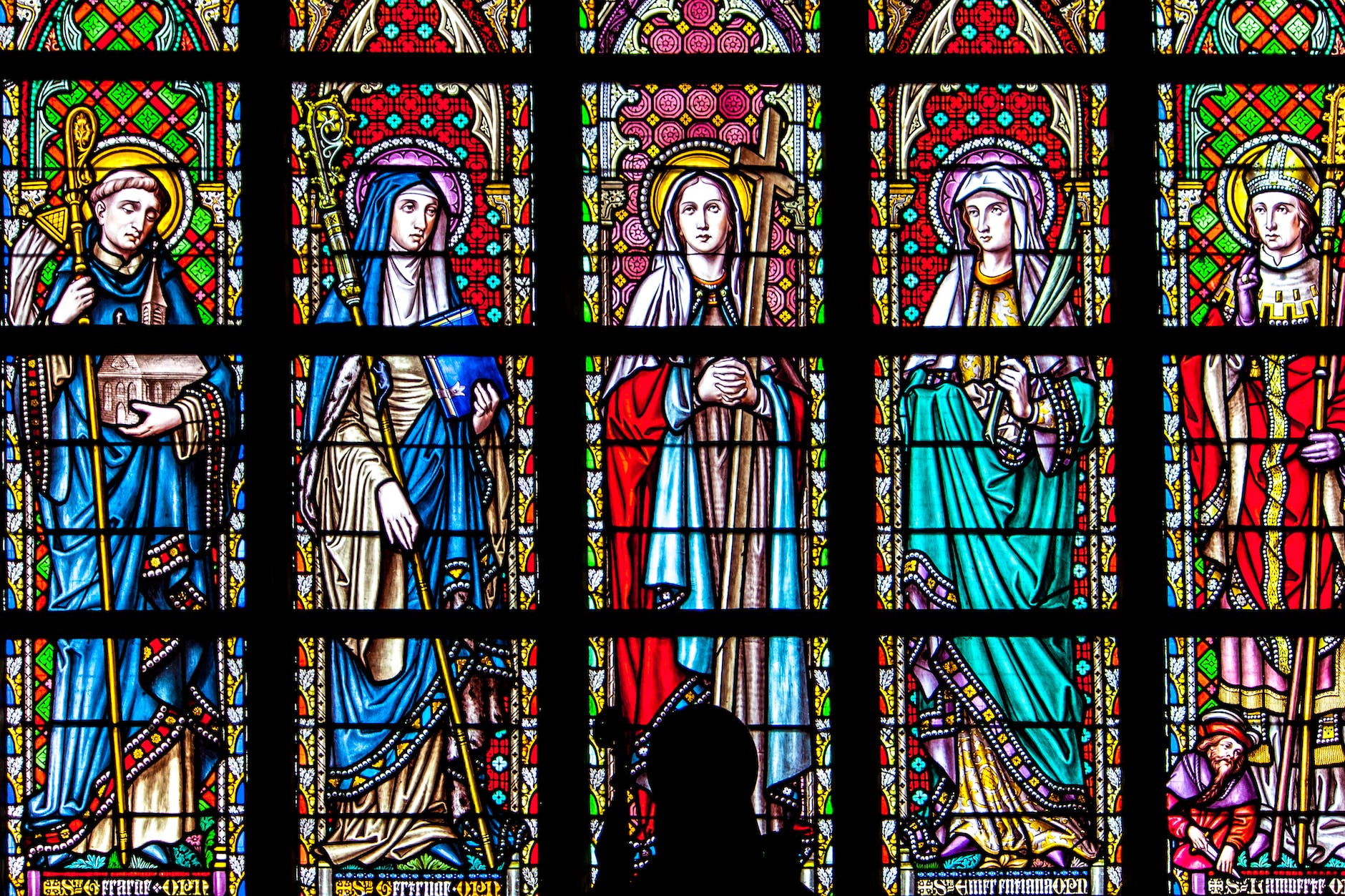
When our neighbors at St. Bernard’s talk about saints, they point to people of exceptional piety, heroes of the faith who have been martyred, worked miracles, or had singular spiritual experiences. The process of becoming a Catholic saint is lengthy. First, a local bishop investigates the candidate’s life and writings for evidence of heroic virtue. Then the findings are sent to the Vatican. There, a panel of theologians and the cardinals evaluate the evidence. If the panel approves, the pope proclaims that the candidate is venerable, a role model of Catholic virtues. If the person is responsible for a posthumous miracle, then the saint is beatified—honored as holy by a particular group or region. In order for someone to be considered a true saint and canonized, there must be proof of at least one more posthumous miracle- the healing of a pilgrim at the grave site, a mass vision, a statue weeping. Canonized saints are the center of worship, devotion, and prayer, like praying to St. Anthony to help you recover your lost car keys.
We don’t share this understanding of saints in our tradition. Since the Reformation of the 16th century, we have insisted that God alone must be the focus of our worship, devotion, and prayer. By studying the use of the title “saint” in scripture, Martin Luther pointed out that the true meaning of “saint” had nothing to do with exceptional piety. Instead, it was all about faith. When the Apostle Paul wrote to his church in Philippi, he greeted the “saints,” all members—men, women, youth, children, both slaves and freeborn. All were holy, not because of their impressive spiritual accomplishments, but by their faith in the Lord Jesus Christ.
On All Saints Sunday, we take time to remember and celebrate this beautiful, broad understanding of the great multitude of faithful people, who, having lived their lives in faith, now live eternally with God. We are especially mindful of those saints whom we have lost in the past year, like our friends Jean Fitzgerald and Henry Schwalenstocker. But we also bring to mind those sainted people who have made a quiet and faithful difference in our lives: the parents who introduced us to Jesus, the mentors who called us to fully utilize our God-given gifts, the caregivers who prayed for us when we could not pray for ourselves. These saints will never attract the notice of a panel of theologians and cardinals, but they worked gentle goodness in our lives that blesses us to this day.
In today’s reading from the Book of Revelation, John of Patmos described his apocalyptic vision of the heavenly throne room, where God and the Lamb were ceaselessly praised and glorified. Before the throne, worshipers of every land, language, nation, race, time, and place were assembled, a great and countless multitude. All were clothed in robes of dazzling white. All rejoiced, waving palm fronds in victory. All joined their voices with the heavenly host to proclaim, “Blessing and glory and wisdom and thanksgiving and honor and power and might be to our God forever and ever! Amen.” Can we imagine it?
John says that God “sheltered” those who worshipped. The Greek word for shelter skenosei means to stretch a protective covering over something, like a roof keeping out the weather, or a tent protecting us from a summer storm, or the wings of a mama bird shielding her chicks. Those who worship are safe. They hunger and thirst no more. With the Lamb as their shepherd, the vast flock is guided to the waters of life. Every sorrow comes to an end; every tear is tenderly dried. The great multitude has found shelter, nurture, guidance, life, and comfort with God.
I’m sure that, among the saints who worshipped before the throne, John of Patmos saw people of remarkable spiritual accomplishment like those canonized saints, but John’s vision would have largely comprised little-known saints, like the beloved ones, mentors, friends, and caregivers who have had such a powerful, positive impact upon our lives. Those who rejoiced before the throne may have been a lot like us: everyday saints, who faithfully worship God, trust in our Good Shepherd, and leave a legacy of faith for the generations to come.
This church has had many such saints. Their photos are not hanging in the gallery of pastors in the hallway. They don’t have a plaque on the pipe organ or bell tower. But they faithfully shared themselves in ways that made a difference in the life of this church and the unique history of Saranac Lake.
Among our first members were Emma and Theodore Hanmer. As newlyweds, they came to Saranac Lake in 1889 from Black Brook, where Ted had driven a stagecoach and apprenticed as a boat builder. It didn’t take long for him to move past apprentice to master boat builder with his own workshop on Lake Street, where he specialized in crafting guide boats. Ted’s boats weighed about 80 pounds, yet they could safely carry a load of a half-ton, including three people. One of Ted’s handcrafted boats sold for about $65 in 1900. Today they are priceless. Neither Ted nor Emma ever served as an elder or a deacon, but they worshipped weekly and raised eight children in the church. If you ask me, that’s a remarkable accomplishment.
Another early member of the church, whom you’ll never hear celebrated by local historians, is Edmund Horton. He became our fourth elder in 1902. Ed had a gift for growing things. In 1903, he opened Horton’s Greenhouses and Florist Shop at the present site of Nona Fina Restaurant. A vintage ad in the Adirondack Daily Enterprise has some snappy copy to promote Ed’s plants and creations. It reads, “What better gift than flowers? They’ll return a little care with gorgeous blooms. . . give someone a living gift of flowers. Every glance at them will be a reminder of your thoughtfulness.” Early pictures of the sanctuary, beautifully decked out with poinsettias, ferns, Easter lilies, and big bouquets, reflect the talents of Ed Horton, a legacy that we celebrate every time we take a bouquet of flowers to someone who needs a little extra love.
You’ve probably never heard of longtime members Florence and Arthur Utting. They lived and worked for many years in the Spaulding Block, an impressive three-story brick building that stood at the corner of River and Main Streets, where the Verizon store is now located. Arthur ran a grocery store on the first floor and Florence had a vanity store right next door. She sold “fancy goods, crockery, and stationary.” In the church’s early days, the Board of Trustees may have been charged with the oversight of our church building, but it was often the Women’s League that did the work of care, cleaning, and improvements. When the church coffers were empty in 1902, it was Florence Utting who came up with $100 to buy new carpeting, paint the walls, and repair the seats. Thank you, Florence!
As I finish this message, I’d like to lead us in a brief reflection about how we might share our time, talents, and treasure with the church, in keeping with the legacy of those quiet saints who have made a difference. Like those faithful ones I have just described—and like the saints in John’s vision, we have found shelter in God. We have claimed the Lord as our shepherd. We trust that we, too, will one day celebrate in that far brighter light on that far better shore.
Let’s begin with thinking about our time. Perhaps, like the Hanmers, we’ll commit ourselves to weekly worship and prayer. We’ll bring our kids to Sunday School. We’ll show up for Bible Studies. We’ll frequent potlucks. We’ll come out for movie nights. We’ll shovel snow or mow the lawn. We’ll do those everyday tasks that sometimes go unnoticed. What will sharing your time look like?
How will we share our talents? Perhaps, like Ed Horton, we’ll serve as an elder. Maybe we’ll exercise our green thumbs with landscaping in the churchyard or growing vegetables in the church garden. Our love for worship and our gifts for order may lead us to serve as a Sanctus volunteer, ensuring that the church is ready for Sunday mornings. We could share gifts of caring as deacons, express our love for children as Sunday School teachers or Youth Group leaders, or bless the church with music in the choir. What will sharing your talents look like?
How will we share our treasure? Today we’ll submit pledges to support the church’s operating budget. We may also choose to follow the example of Florence Utting and provide financial resources for building projects. We could consider a memorial gift in honor of a beloved one. We may even think about a legacy, including the church in our financial planning to bless the generations to come. What will sharing our treasure look like?
On All Saints Sunday, we celebrate the great multitude that rejoices before the heavenly throne, people like Emma and Ted Hanmer, Ed Horton, and Florence and Arthur Utting. Unsung heroes, they shared their time, talents, and treasure to serve God and bless this church. This Sunday, we choose how we will also share of ourselves in gratitude for the shelter we have found in the Good Shepherd. We will most likely never be canonized, and yet there is a place for us before the throne, to rejoice amid the great multitude. May it be so. Amen.
Resources:
“Resident of Saranac Lake Is Only Remaining Builder of Adirondack Guide Boat.” Adirondack Daily Enterprise, June 24, 1935.
“Old Adirondacker of Guide Boat Fame Dies.” Adirondack Daily Enterprise, April 19, 1957.
Evelyn Outcalt and Judy Kratts. “A History of the First Presbyterian Church of Saranac Lake,” July 25, 1990.
Anna M.V. Bowden. “Commentary on Rev. 7:9-17” in Preaching This Week, Nov. 5, 2023. Accessed online at workingpreacher.org.
Micah D. Kiel. “Commentary on Rev. 7:9-17” in Preaching This Week, Nov. 5, 2017. Accessed online at workingpreacher.org.
Walter F. Taylor, Jr. “Commentary on Rev. 7:9-17” in Preaching This Week, Nov. 2, 2014. Accessed online at workingpreacher.org.
Revelation 7:9-17
9After this I looked, and there was a great multitude that no one could count, from every nation, from all tribes and peoples and languages, standing before the throne and before the Lamb, robed in white, with palm branches in their hands. 10They cried out in a loud voice, saying, “Salvation belongs to our God who is seated on the throne, and to the Lamb!” 11And all the angels stood around the throne and around the elders and the four living creatures, and they fell on their faces before the throne and worshiped God, 12singing, “Amen! Blessing and glory and wisdom and thanksgiving and honor and power and might be to our God forever and ever! Amen.” 13Then one of the elders addressed me, saying, “Who are these, robed in white, and where have they come from?” 14I said to him, “Sir, you are the one that knows.” Then he said to me, “These are they who have come out of the great ordeal; they have washed their robes and made them white in the blood of the Lamb. 15For this reason they are before the throne of God, and worship him day and night within his temple, and the one who is seated on the throne will shelter them. 16They will hunger no more, and thirst no more; the sun will not strike them, nor any scorching heat; 17for the Lamb at the center of the throne will be their shepherd, and he will guide them to springs of the water of life, and God will wipe away every tear from their eyes.”







 Joann White