Sabbath Day Thoughts — “The Great Multitude” Rev. 7:9-17
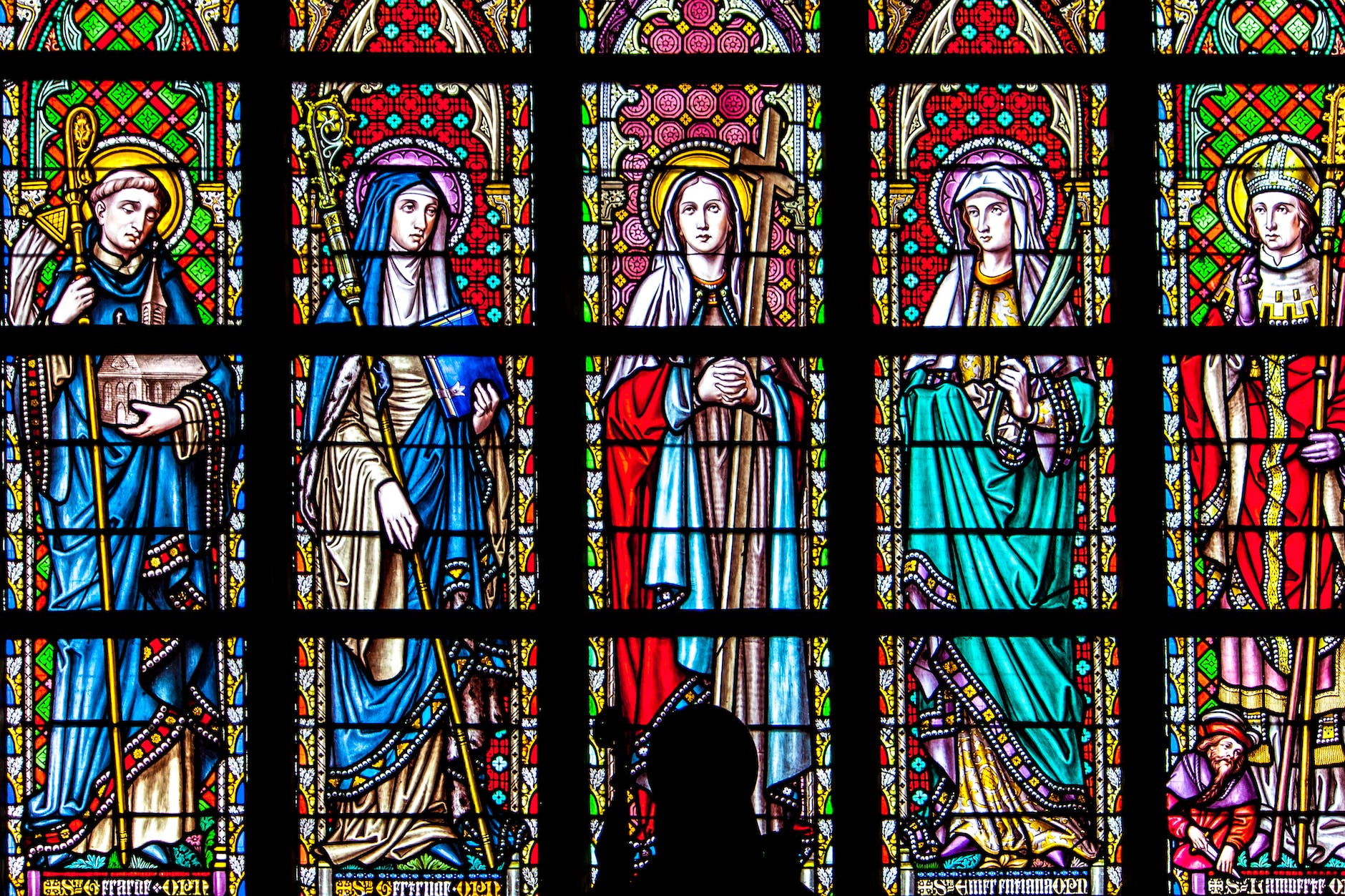
When our neighbors at St. Bernard’s talk about saints, they point to people of exceptional piety, heroes of the faith who have been martyred, worked miracles, or had singular spiritual experiences. The process of becoming a Catholic saint is lengthy. First, a local bishop investigates the candidate’s life and writings for evidence of heroic virtue. Then the findings are sent to the Vatican. There, a panel of theologians and the cardinals evaluate the evidence. If the panel approves, the pope proclaims that the candidate is venerable, a role model of Catholic virtues. If the person is responsible for a posthumous miracle, then the saint is beatified—honored as holy by a particular group or region. In order for someone to be considered a true saint and canonized, there must be proof of at least one more posthumous miracle- the healing of a pilgrim at the grave site, a mass vision, a statue weeping. Canonized saints are the center of worship, devotion, and prayer, like praying to St. Anthony to help you recover your lost car keys.
We don’t share this understanding of saints in our tradition. Since the Reformation of the 16th century, we have insisted that God alone must be the focus of our worship, devotion, and prayer. By studying the use of the title “saint” in scripture, Martin Luther pointed out that the true meaning of “saint” had nothing to do with exceptional piety. Instead, it was all about faith. When the Apostle Paul wrote to his church in Philippi, he greeted the “saints,” all members—men, women, youth, children, both slaves and freeborn. All were holy, not because of their impressive spiritual accomplishments, but by their faith in the Lord Jesus Christ.
On All Saints Sunday, we take time to remember and celebrate this beautiful, broad understanding of the great multitude of faithful people, who, having lived their lives in faith, now live eternally with God. We are especially mindful of those saints whom we have lost in the past year, like our friends Jean Fitzgerald and Henry Schwalenstocker. But we also bring to mind those sainted people who have made a quiet and faithful difference in our lives: the parents who introduced us to Jesus, the mentors who called us to fully utilize our God-given gifts, the caregivers who prayed for us when we could not pray for ourselves. These saints will never attract the notice of a panel of theologians and cardinals, but they worked gentle goodness in our lives that blesses us to this day.
In today’s reading from the Book of Revelation, John of Patmos described his apocalyptic vision of the heavenly throne room, where God and the Lamb were ceaselessly praised and glorified. Before the throne, worshipers of every land, language, nation, race, time, and place were assembled, a great and countless multitude. All were clothed in robes of dazzling white. All rejoiced, waving palm fronds in victory. All joined their voices with the heavenly host to proclaim, “Blessing and glory and wisdom and thanksgiving and honor and power and might be to our God forever and ever! Amen.” Can we imagine it?
John says that God “sheltered” those who worshipped. The Greek word for shelter skenosei means to stretch a protective covering over something, like a roof keeping out the weather, or a tent protecting us from a summer storm, or the wings of a mama bird shielding her chicks. Those who worship are safe. They hunger and thirst no more. With the Lamb as their shepherd, the vast flock is guided to the waters of life. Every sorrow comes to an end; every tear is tenderly dried. The great multitude has found shelter, nurture, guidance, life, and comfort with God.
I’m sure that, among the saints who worshipped before the throne, John of Patmos saw people of remarkable spiritual accomplishment like those canonized saints, but John’s vision would have largely comprised little-known saints, like the beloved ones, mentors, friends, and caregivers who have had such a powerful, positive impact upon our lives. Those who rejoiced before the throne may have been a lot like us: everyday saints, who faithfully worship God, trust in our Good Shepherd, and leave a legacy of faith for the generations to come.
This church has had many such saints. Their photos are not hanging in the gallery of pastors in the hallway. They don’t have a plaque on the pipe organ or bell tower. But they faithfully shared themselves in ways that made a difference in the life of this church and the unique history of Saranac Lake.
Among our first members were Emma and Theodore Hanmer. As newlyweds, they came to Saranac Lake in 1889 from Black Brook, where Ted had driven a stagecoach and apprenticed as a boat builder. It didn’t take long for him to move past apprentice to master boat builder with his own workshop on Lake Street, where he specialized in crafting guide boats. Ted’s boats weighed about 80 pounds, yet they could safely carry a load of a half-ton, including three people. One of Ted’s handcrafted boats sold for about $65 in 1900. Today they are priceless. Neither Ted nor Emma ever served as an elder or a deacon, but they worshipped weekly and raised eight children in the church. If you ask me, that’s a remarkable accomplishment.
Another early member of the church, whom you’ll never hear celebrated by local historians, is Edmund Horton. He became our fourth elder in 1902. Ed had a gift for growing things. In 1903, he opened Horton’s Greenhouses and Florist Shop at the present site of Nona Fina Restaurant. A vintage ad in the Adirondack Daily Enterprise has some snappy copy to promote Ed’s plants and creations. It reads, “What better gift than flowers? They’ll return a little care with gorgeous blooms. . . give someone a living gift of flowers. Every glance at them will be a reminder of your thoughtfulness.” Early pictures of the sanctuary, beautifully decked out with poinsettias, ferns, Easter lilies, and big bouquets, reflect the talents of Ed Horton, a legacy that we celebrate every time we take a bouquet of flowers to someone who needs a little extra love.
You’ve probably never heard of longtime members Florence and Arthur Utting. They lived and worked for many years in the Spaulding Block, an impressive three-story brick building that stood at the corner of River and Main Streets, where the Verizon store is now located. Arthur ran a grocery store on the first floor and Florence had a vanity store right next door. She sold “fancy goods, crockery, and stationary.” In the church’s early days, the Board of Trustees may have been charged with the oversight of our church building, but it was often the Women’s League that did the work of care, cleaning, and improvements. When the church coffers were empty in 1902, it was Florence Utting who came up with $100 to buy new carpeting, paint the walls, and repair the seats. Thank you, Florence!
As I finish this message, I’d like to lead us in a brief reflection about how we might share our time, talents, and treasure with the church, in keeping with the legacy of those quiet saints who have made a difference. Like those faithful ones I have just described—and like the saints in John’s vision, we have found shelter in God. We have claimed the Lord as our shepherd. We trust that we, too, will one day celebrate in that far brighter light on that far better shore.
Let’s begin with thinking about our time. Perhaps, like the Hanmers, we’ll commit ourselves to weekly worship and prayer. We’ll bring our kids to Sunday School. We’ll show up for Bible Studies. We’ll frequent potlucks. We’ll come out for movie nights. We’ll shovel snow or mow the lawn. We’ll do those everyday tasks that sometimes go unnoticed. What will sharing your time look like?
How will we share our talents? Perhaps, like Ed Horton, we’ll serve as an elder. Maybe we’ll exercise our green thumbs with landscaping in the churchyard or growing vegetables in the church garden. Our love for worship and our gifts for order may lead us to serve as a Sanctus volunteer, ensuring that the church is ready for Sunday mornings. We could share gifts of caring as deacons, express our love for children as Sunday School teachers or Youth Group leaders, or bless the church with music in the choir. What will sharing your talents look like?
How will we share our treasure? Today we’ll submit pledges to support the church’s operating budget. We may also choose to follow the example of Florence Utting and provide financial resources for building projects. We could consider a memorial gift in honor of a beloved one. We may even think about a legacy, including the church in our financial planning to bless the generations to come. What will sharing our treasure look like?
On All Saints Sunday, we celebrate the great multitude that rejoices before the heavenly throne, people like Emma and Ted Hanmer, Ed Horton, and Florence and Arthur Utting. Unsung heroes, they shared their time, talents, and treasure to serve God and bless this church. This Sunday, we choose how we will also share of ourselves in gratitude for the shelter we have found in the Good Shepherd. We will most likely never be canonized, and yet there is a place for us before the throne, to rejoice amid the great multitude. May it be so. Amen.
Resources:
“Resident of Saranac Lake Is Only Remaining Builder of Adirondack Guide Boat.” Adirondack Daily Enterprise, June 24, 1935.
“Old Adirondacker of Guide Boat Fame Dies.” Adirondack Daily Enterprise, April 19, 1957.
Evelyn Outcalt and Judy Kratts. “A History of the First Presbyterian Church of Saranac Lake,” July 25, 1990.
Anna M.V. Bowden. “Commentary on Rev. 7:9-17” in Preaching This Week, Nov. 5, 2023. Accessed online at workingpreacher.org.
Micah D. Kiel. “Commentary on Rev. 7:9-17” in Preaching This Week, Nov. 5, 2017. Accessed online at workingpreacher.org.
Walter F. Taylor, Jr. “Commentary on Rev. 7:9-17” in Preaching This Week, Nov. 2, 2014. Accessed online at workingpreacher.org.
Revelation 7:9-17
9After this I looked, and there was a great multitude that no one could count, from every nation, from all tribes and peoples and languages, standing before the throne and before the Lamb, robed in white, with palm branches in their hands. 10They cried out in a loud voice, saying, “Salvation belongs to our God who is seated on the throne, and to the Lamb!” 11And all the angels stood around the throne and around the elders and the four living creatures, and they fell on their faces before the throne and worshiped God, 12singing, “Amen! Blessing and glory and wisdom and thanksgiving and honor and power and might be to our God forever and ever! Amen.” 13Then one of the elders addressed me, saying, “Who are these, robed in white, and where have they come from?” 14I said to him, “Sir, you are the one that knows.” Then he said to me, “These are they who have come out of the great ordeal; they have washed their robes and made them white in the blood of the Lamb. 15For this reason they are before the throne of God, and worship him day and night within his temple, and the one who is seated on the throne will shelter them. 16They will hunger no more, and thirst no more; the sun will not strike them, nor any scorching heat; 17for the Lamb at the center of the throne will be their shepherd, and he will guide them to springs of the water of life, and God will wipe away every tear from their eyes.”
 Joann White