Rise Up!

Sabbath Day Thoughts — “Rise Up!” Mark 16:1-8

In three weeks, when we traditionally celebrate Good Shepherd Sunday, our cousins in the Orthodox tradition will commemorate the Sunday of Myrrh-bearing Women. They have been doing so since the fifth century when John Chrysostom, the Bishop of Constantinople, first honored those women who went to the tomb, armed with burial spices and anointing oil. In Orthodox churches on the Sunday of Myrrh-bearing Women, censers will be filled with smoking incense, and the priest will swing them with a practiced arm, venerating all four sides of the altar, the congregation, the bread and wine of communion, and the church itself. Prayers will remember the faithful witness of the women. The sermon may even make the connection between the myrrh-bearers and the long history of women who have served the church. The hymn of the day will be introduced with the words, “The women disciples bring myrrh unto Christ. And I bring a hymn as [if] it were myrrh unto them.”

Our Orthodox cousins also remember the myrrh-bearing women with a long tradition of iconography, sacred art that is used as an invitation to prayer and reflection. Perhaps you have seen the icons. Mary Magdalene, Mary the mother of James, and Salome are depicted at the tomb. The holy messenger in dazzling white points to the empty graveclothes, proclaiming that Jesus has risen. The women, with heads covered and flowing robes, carry ceramic flasks of oil. Their faces are wide-eyed with fear and lined with tears. One of the women is often painted with her back to the angel, as if poised to run. She looks back over her shoulder, torn between learning what has happened to Jesus and succumbing to holy terror.

After the sabbath, when the myrrh-bearers rose early, purchased spices, and walked to the tomb, they were well-acquainted with death. In first-century Israel, tending the dead was women’s work. It fell to women to prepare bodies for the grave: washing, anointing with oil, and wrapping in a simple linen shroud. For three days, women accompanied the body, walking to the tomb each morning, singing psalms, and sharing tears and cries of mourning. The myrrh-bearers had buried many people and tended many bodies: elderly parents, aged husbands, dear friends, solitary neighbors, and in a world where only one in five children lived to adulthood, they had buried children, many children.

Jesus warned the disciples that death waited in the Holy City. But the week before the women had rejoiced and danced into Jerusalem. Filled with hope, they sang and played their drums, waved palm branches and rejoiced to be in the company of the Messiah. That week the city turned hostile, even murderous.  On the night of the Passover, the women saw Jesus betrayed, abandoned, and led off like a lamb to the slaughter. On Friday, the women followed their bloody, broken Lord as he stumbled beneath the terrible burden of the cross. From a distance, they watched while soldiers gambled and the mob taunted and mocked. As the sun failed and darkness covered the land, they saw Jesus surrender his spirit. As the day grew late and the sabbath neared, two of the women followed Joseph of Arimathea.  They watched him claim the body, wrap it in linen, and hastily stow it in a rock-hewn tomb. All through the Sabbath, the women sat with their grief and loss. They weren’t sure who they were anymore, what their purpose was, or how they could go on. But as the rosy promise of a new week crept above the eastern horizon, they found the courage to do what women always did when a beloved one died. They purchased their burial spices and anointing oil and walked to the tomb.

/

We are not myrrh-bearers in the traditional sense of the word. We leave it to the mortuary or the crematorium to tend to the bodies of our dead. Yet we are not strangers to death. We know what it is like to walk to the tomb, to face squarely our loss and pain, our disbelief and defeat. We know the untimely death of our beloved ones. We know the death of our endeavors: the marriage that flounders and fails; the business that goes under; the degree we never finish. We know the death of friendships and kinships: the forgiveness we never extend, the trust that is betrayed, the selfish interest that drives home the killing wedge. We know death writ large upon the world stage: our planet groaning beneath the burden of our abuse, the blood of Palestinians and Israelis crying from the ground of a broken land, the lament of refugees longing for welcome and home. In the dark hours before dawn, we know how the myrrh-bearers felt. We know the unbearable grief. We may even wonder who we are, what our purpose is, or how we can go on.

/

When the women arrived at the tomb, the stone was rolled back. They hesitated in fear outside, each too frightened to go in alone, and so they decide to venture in together, a fearful little band bound by their love for Jesus and their common duty as myrrh-bearers. Mary Magdalene, Mary the Mother of James, and Salome entered the tomb, anticipating death. But there in the cold stone crypt, still smelling of blood and suffering, the women were shocked to find life. A holy messenger shared the good news that God could take all the evil of their world and work from it a miracle of life.

In the hours before dawn, as the earth rolled on to meet the morning and the last stars faded from the western sky, Jesus rose. He stretched and stood, testing his bruised body.  He stepped out of the tomb and into the garden, breathing deep the cool of the dying night. God’s amazing love had broken the power of sin and death. 

Mary Magdalene whispered, “Jesus is alive,”

Mary the mother of James gasped, “Jesus has been raised, just as he promised.”

Salome dared to hope, “Jesus has gone ahead to Galilee. We’ll see him there.”

/

On Easter morning, we dare to imagine that if God can raise Jesus from dead, then surely there is hope for us and all the ways that we are well-acquainted with death. We can trust that, just as God was at work to overcome the world’s sin and hate to raise Jesus, God is at work even now to help and to heal, to raise up the promise of new life.

Yes, we know the grief that comes with the death of our beloved ones, but we also trust that we are raised with Christ. The promise of the life everlasting and the heavenly shore awaits. Rise up!

Yes, we are well-acquainted with failure, but God is faithful and a new day dawns. One day we may love again, or find fresh purpose, or hear the knock of opportunity. Rise up!

Yes, we know the death of friendship and kinship, but if God can win the victory over sin, then maybe with the Lord’s assistance we can pick up the phone or write that letter or ask for help. Rise up!

Yes, we know global death and destruction, but if Jesus is raised, then maybe there is hope for our world yet. We can learn to tread lightly on God’s good earth. Peace can break out in the midst of war. The homeless poor can find home at last. Rise up!

We are well-acquainted with death, but on Easter morning, we join the myrrh-bearers, with great hope and holy fear, for with God the last word is always life.

/

Mary Magdalene, Mary the mother of James, and Salome came to the tomb in the traditional women’s role of myrrh-bearer; yet, they soon had a new vocation. Commissioned by God to be the first gospel-bearers, they rose up. They dropped their flasks of oil, lifted their skirts, and fled back into Jerusalem. Somewhere along the way, they overcame their fear and found their voices. They shared their good news with Peter and the disciples, saying, “Death does not have the last word. God has won the victory! Jesus is risen!”

/

I suspect that our cousins in the Orthodox tradition are right. Those myrrh-bearers are worthy of our gratitude and remembrance on at least one Sunday a year. They may even have something to teach us. If three women can overcome their fear to rise up and launch a tidal wave of hope and love that laps the shores of today, then think what we can do. We may be well-acquainted with death, but oh the life, sweet life! Let’s trade our myrrh for the gospel, my friends. There is good news to share. Rise up!

Resources

C. Clifton Black. “Commentary on Mark 16:1-8,” in Preaching This Week (Narrative Lectionary), March 27, 2016. Accessed online at Commentary on Mark 16:1-8 – Working Preacher from Luther Seminary

Greek Orthodox Diocese of America. “Learn: Sunday of The Myrrhbearers.” Accessed online at https://www.goarch.org/myrrhbearers-learn

Kaufman Kohler. “Burial” in Jewish Encyclopedia. Accessed online at https://www.jewishencyclopedia.com/articles/3842-burial#anchor6.

Nelson Rivera. “Theological Perspective on Mark 16:1-8” in Feasting on the Gospels: Mark. Louisville: Westminster John Knox Press, 2014.

John Sanidopolous. “Sunday of the Myrrhbearers Resource Page,” Orthodox Christianity: Then and Now, April 30, 2017. Accessed online at https://www.johnsanidopoulos.com/2017/04/sunday-of-myrrhbearing-women-resource.html

Oliver Yarbrough. “Homiletical Perspective on Mark 16:1-8” in Feasting on the Gospels: Mark. Louisville: Westminster John Knox Press, 2014.


Mark 16:1-8

16When the sabbath was over, Mary Magdalene, and Mary the mother of James, and Salome bought spices, so that they might go and anoint him. 2And very early on the first day of the week, when the sun had risen, they went to the tomb. 3They had been saying to one another, “Who will roll away the stone for us from the entrance to the tomb?” 4When they looked up, they saw that the stone, which was very large, had already been rolled back. 5As they entered the tomb, they saw a young man, dressed in a white robe, sitting on the right side; and they were alarmed. 6But he said to them, “Do not be alarmed; you are looking for Jesus of Nazareth, who was crucified. He has been raised; he is not here. Look, there is the place they laid him. 7But go, tell his disciples and Peter that he is going ahead of you to Galilee; there you will see him, just as he told you.” 8So they went out and fled from the tomb, for terror and amazement had seized them; and they said nothing to anyone, for they were afraid.
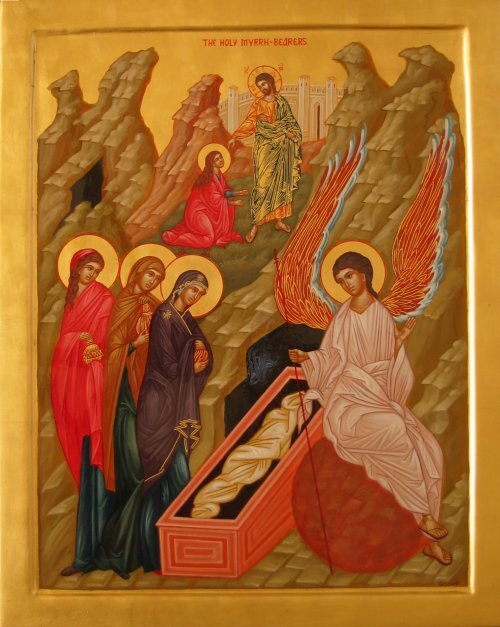

“The Holy Myrrh-bearers.” Accessed online at https://www.allsaintstoronto.ca/services-events/soo-gdthh-2ptfc-lng35-c8gjx-xaf3p

Extravagant Love

Sabbath Day Thoughts — “Extravagant Love” Mark 11:1-11, 14:3-9

There are many ways to express love. In Japan, where public displays of affection are frowned upon, you might show your love for your husband by preparing an elaborate lunch and carefully packing it into a bento box to be unpacked later in the break room at work. In Fiji, if you are looking to make a special connection with your father-in-law or seek the forgiveness of someone whom you have wronged, then you would present them with the gift of a tabua—the ivory tooth of a sperm whale. In India, your love for someone and your hope that they might have good health and longevity is expressed in fasting on their behalf. In Alaska, the Tlingit people say that you know someone really loves you when they bring you dried fish.

We have our own ways of expressing love. When someone takes the time to learn our best-loved recipes and cook our favorite meal, we know we are loved. When a doting grandma plies her knitting needles or handpieces a quilt for us, we know we are loved. When a devoted dad spends hours teaching us how to play catch, build models, or tackle quadratic equations, we know we are loved. When someone proposes to us on the jumbotron at Yankee stadium in front of all those baseball fans, we know we are loved.

I suspect each of us has warm memories of feeling specially loved. Those loving moments can bring a smile to our worst day or feel like a lighthouse, guiding us through a storm. Love expressed at the right time, in the right way, may be just what we need to persevere and prevail over the hardship and sorrow that touch every life.

Our reading from Mark’s gospel describes a remarkable and timely act of love.

Jesus and his friends came to Jerusalem to celebrate Passover. The week began with a parade. On Palm Sunday, Jesus, humble and riding on a donkey like the long-promised Prince of Peace (Zech 9:9), traveled up to the Holy City. The pilgrims that surrounded Jesus celebrated, rejoicing with psalms of praise and waving palm branches as if Jesus were one of the Maccabees, newly returned from vanquishing their enemies. They spread their cloaks upon the road, like Israel’s old-time generals pledging allegiance to the new king.

But that week, Jesus would be plagued by the challenge and critique of powerful enemies. Scribes and Pharisees, chief priests and elders, all did their best to discredit and shame Jesus in front of the crowds that seemed to love him so. Soon the city’s mood would turn murderous. Soon his opponents would plot his death. As the week drew to a close, there would be another parade. Jesus, broken and bloodied, would drag a crossbeam through the streets of Jerusalem to his execution. The fans who had welcomed him with pleas of “Hosanna! Save us!” would utterly reject him, shouting “Crucify him!”

Between the Palm Sunday and Good Friday parades, a beautiful thing happened. As Jesus and his friends dined at the house of Simon the Leper in Bethany, their dinner party was interrupted by an uninvited guest: an unnamed woman. She broke open an alabaster jar and poured anointing oil on Jesus. The spikenard was pressed from plants that grew in the foothills of the Himalayas. It had been transported 4,000 miles overland by caravan to Israel. So valuable was this oil that a laborer would need to work 300 days to cover the expense. In today’s economy, where a day laborer might earn $15 an hour, the oil would cost $36,000. Poured out in a single, wildly generous stream, the oil flowed down upon Jesus’ head and over the collar of his robe. The conversation fell silent as the room filled with the sweet fragrance of unimaginable love and generosity.

In first-century Israel, anointing with oil was a gesture of love. In welcoming a guest, a host would offer water for the washing of hands and feet and a few drops of oil to bless the head. In the history of Israel, anointing with oil was a sign of God’s love and blessing for a chosen ruler. When the Prophet Samuel laid eyes on David, he broke out the anointing oil and poured it out on the boy who would one day be king. And, as Jesus indicated, oil was used to anoint the body of a beloved one, purifying and preparing the dead for the grave.

Mark tells us that the men who broke bread with Jesus were outraged by the woman’s action. Indeed, they scolded and shamed her like a bad child or a simpleton. But I suspect that their anger flared less from any genuine concern for the poor and more from the realization that she had done without a single word what they had not. She acted as host, extending a courtesy that Simon the Leper failed to practice. She took on the historically male role of prophet and proclaimed Jesus the Messiah. And she named the elephant in the room: the week would end in death. In the verses leading up to this story, Jesus’ enemies plotted his arrest and execution. In the verses following this story, Judas would accept a bribe to bring about betrayal. In three days, in the time of crisis, not one of the men reclining around the dinner table would come to Jesus’ defense.

Jesus came to the woman’s defense. He spends four verses praising the appropriateness and the timeliness of what she did. Jesus knew the dark truth that he’d soon be hanging from a cross. As the precious oil flowed down, I imagine that Jesus felt extravagantly loved. Like a Japanese husband opening his carefully packed lunchbox. Like a Tlingit person, feasting on the gift of dried fish. Like a child wrapped in Grammy’s homemade quilt. In the darkness of that night, Jesus might have felt as if the sun were shining on him.  Perhaps it was the last time in his earthly life that Jesus felt truly loved—special, safe, treasured, appreciated, and understood.

We instinctively know that there is nothing better than extravagant love.  We seize it in the moment and wrap it around us like a fiery mantle of glory.  We hold it in our hearts as a remedy for the days when we are bullied at school or our best friend decides they’re not going to talk to us anymore or the boss is expecting the impossible or the nightly news leaves us shaking in our boots. Extravagant love is our lifeline in a world where folks want to set limits and attach strings, like the dinner guests buzzing like a nest of angry hornets about the foolishness and waste of what the woman did for Jesus.

Our world tends to limit love, to mete it out in tablespoons, to reserve it for those who “earn” it or “deserve” it, to lavish it upon the successful and the popular and the beautiful. But the unnamed woman with her alabaster jar of costly nard reminds us that God doesn’t work that way. Jesus didn’t work that way.  Jesus lavished his love upon six-year-olds and sinners.  He poured out his love upon unnamed women and Judas.  He lavished his love upon the blind and lame, the deaf and demented, the paralyzed and possessed.  Jesus poured out his life in extravagant love for you and for me.  Jesus taught us that our highest and only calling in life is to love God and neighbor and self with all that we have and all that we are. 

When we get right down to it, the woman with the alabaster jar knew, Jesus knew, we know that our essential calling is to love extravagantly.  It’s only our brokenness that makes us want to turn away from the invitation to love.  It’s only our sinfulness that prompts us to attach the strings, break out the tape measure, turn a harsh eye of judgment to the world around us, and debate who is really worthy of our generous and loving intent. But we, my friends, are called to love without counting the cost.

The woman with the alabaster jar disappears from the pages of scripture. We never see or hear from her again. Although all four gospels report that a woman anointed Jesus, they don’t agree upon who she was or why she did it or even what part of his body got anointed. Was it the head or was it the feet? But we remember her and the rightness and timeliness of her love. I like to imagine that after she left the home of Simon the Leper, with cheeks flushed by the shame heaped upon her by the men, she shook off the criticism. She held in her heart the words of Jesus. She knew that she had done a beautiful thing. Later, she imagined that as Jesus hung upon the cross, he held onto her love, that it guided him like a lighthouse through the storm, like a lifeline amid the pain and unfathomable sorrow. She continued to love with body, mind, spirit, and every last denarii, despite what the critics had to say.

Let us love extravagantly.

Resources:

Jouette Basler. “Exegetical Perspective on Mark 14:3-9” in Feasting on the Gospels: Mark. Louisville: Westminster John Knox Press, 2014.

Paul S. Berge, “Commentary on Mark 11:1-11, 14:3-9” in Preaching This Week: Narrative Lectionary, April 1, 2012. Accessed online at Commentary on Mark 11:1-10, Mark 14:3-11  – Working Preacher from Luther Seminary

C. Clifton Black. “Commentary on Mark 11:1-11, 14:3-9” in Preaching This Week: Narrative Lectionary, March 20, 2016. Accessed online at Commentary on Mark 11:1-11 or Mark 14:3-9 – Working Preacher from Luther Seminary

Thomas Currie. “Theological Perspective on Mark 14:3-9” in Feasting on the Gospels: Mark. Louisville: Westminster John Knox Press, 2014.

Carmen Nanko-Fernandez. “Pastoral Perspective on Mark 14:3-9” in Feasting on the Gospels: Mark. Louisville: Westminster John Knox Press, 2014.

Editorial Team. “Exploring Affection: How Different Cultures Show Love” in Better Help, March 21, 2024.


Mark 11:1-11, 14:3-9

11When they were approaching Jerusalem, at Bethphage and Bethany, near the Mount of Olives, he sent two of his disciples 2and said to them, “Go into the village ahead of you, and immediately as you enter it, you will find tied there a colt that has never been ridden; untie it and bring it. 3If anyone says to you, ‘Why are you doing this?’ just say this, ‘The Lord needs it and will send it back here immediately.’” 4They went away and found a colt tied near a door, outside in the street. As they were untying it, 5some of the bystanders said to them, “What are you doing, untying the colt?” 6They told them what Jesus had said; and they allowed them to take it. 7Then they brought the colt to Jesus and threw their cloaks on it; and he sat on it. 8Many people spread their cloaks on the road, and others spread leafy branches that they had cut in the fields. 9Then those who went ahead and those who followed were shouting,

“Hosanna!Blessed is the one who comes in the name of the Lord!
10Blessed is the coming kingdom of our ancestor David!
Hosanna in the highest heaven!”

11Then he entered Jerusalem and went into the temple; and when he had looked around at everything, as it was already late, he went out to Bethany with the twelve.

3While he was at Bethany in the house of Simon the leper, as he sat at the table, a woman came with an alabaster jar of very costly ointment of nard, and she broke open the jar and poured the ointment on his head. 4But some were there who said to one another in anger, “Why was the ointment wasted in this way? 5For this ointment could have been sold for more than three hundred denarii, and the money given to the poor.” And they scolded her. 6But Jesus said, “Let her alone; why do you trouble her? She has performed a good service for me. 7For you always have the poor with you, and you can show kindness to them whenever you wish; but you will not always have me. 8She has done what she could; she has anointed my body beforehand for its burial. 9Truly I tell you, wherever the good news is proclaimed in the whole world, what she has done will be told in remembrance of her.”


Photo by eberhard grossgasteiger on Pexels.com

The End Is the Beginning

Sabbath Day Thoughts — “The End Is the Beginning” Mark 13:1-8, 24-37

Sometimes the end is the beginning.

Glenn was a young boy when he was terribly injured by a fire at school. Doctors warned his parents that Glenn would likely die, and even if he did survive, the burns to his lower body were so significant that he would be severely handicapped. When he was eventually discharged from the hospital, Glenn had no motor function in his lower body. He was confined to a wheelchair, his thin legs unable to walk.

Kris was a successful thirty-one-year-old actress and photographer, with a growing portfolio of film, advertising, and stage acting credits. She was living her dream when she woke up feeling like she had been hit by a truck. The doctor thought she was having gallbladder trouble—too much rich food and good wine, but tests said otherwise. On Valentine’s Day 2003, Kris was diagnosed with a rare, incurable sarcoma, stage four cancer that was attacking her liver and lungs.

Edward grew up loving the outdoors. His earliest memories were of hiking, rock climbing, and sailing with his father, who was an avid adventurer. By the time he was a teenager, Edward had learned to sky dive and earned a blackbelt in Shotokan karate. After college, he climbed big mountains in Nepal, before enlisting in the military as a paratrooper. In 1996, while on a training mission in Kenya, Edward’s parachute failed to fully open. He survived the fall by landing on the pack on his back, but three vertebrae were crushed by the impact, ending his career as a paratrooper.

Jesus knew his ministry was coming to an end. It was his final week in Jerusalem. The critics attacked him daily, seeking to discredit his teaching. The Romans, always concerned by the threat of insurrection at Passover, were looking for an excuse to set a public example of what happens to dissidents. The chief priests and scribes were plotting Jesus’ arrest and execution. Before the week was out, Jesus would be dead. His followers would scatter, mourning their dashed dreams and failed hopes.

The words that Jesus spoke in today’s lesson from Mark have long been called the little apocalypse. Those frightening images of war, earthquake, famine, the sun going dark, the stars falling from the sky, sound like the end of the world. They sound like the inner chaos and the outer tumult that would soon engulf Jesus’ friends. Their hopes and dreams and messianic expectations were coming to an end. But according to Jesus, God wasn’t finished with them yet. Amid the chaos, uncertainty, and fear, the Kingdom would come. The Son of Man drew near. Indeed, the fearful events of the coming days would be but the birth pangs of a new creation.

We’ve all had times when we felt we were at the end. A marriage begun with the greatest of love grows cold, distant, and dissolves in divorce. The workplace that brought us professional fulfillment and put food on the table hands us a pink slip. Our kid makes some bad choices and winds up alienated from us and in a world of trouble. The doctor gives us that difficult diagnosis, the one that makes our heart skip a beat. No one escapes those unexpected and unwanted “ends” that leave us mourning our dashed dreams and failed expectations. When we are at the end, it is hard to have hope for tomorrow. It’s hard to know what to do. With our plans for the future on permanent hold, we cannot return to the way things used to be, and we cannot imagine how we might move ahead.

Jesus knew that his followers would need words of encouragement to guide them through the days to come when his arrest and crucifixion would feel like the worst end imaginable to their beautiful dream of discipleship. So, he told them the parable of a man going on a journey, who left his slaves in charge of the household. Not knowing the date or time of their master’s homecoming, the servants were called to live with vigilance, as if their master were returning tomorrow. In the years to come, the disciples would need to keep hope alive by working together, encouraging and supporting one another, trusting that although the beautiful dream of Jesus’ earthly ministry had come to an end, God was up to something new and they could be a part of it, showing up each day and doing what was expected of them.

Fred Rogers was notorious for saving quips and quotes that he found inspiring. His wife Joanne said that he clipped them out of newspapers or magazines or copied them from books and kept them in his wallet, next to his neatly folded bills, or in the pages of his planner. After Fred’s death, Joanne and his friends at their production company Family Communications Incorporated were asked to compile a volume of their favorite quotes from Fred, the words that had made them sit up and pay attention or that had struck a chord with Fred’s viewers on “Mr. Roger’s Neighborhood.” The resulting book, The World According to Mr. Rogers, was an instant bestseller, filled with the sort of practical wisdom and kindness that Fred so embodied. One of my favorite quotes from Fred is “Often when you think you’re at the end of something, you’re at the beginning of something else. I’ve felt that many times. My hope for all of us is that the ‘miles we go before we sleep’ will be filled with all the feelings that come from deep caring—delight, sadness, joy, wisdom—and that in all the endings of our life, we will be able to see the new beginnings.” It reminds me of Jesus with his disciples on the Mount of Olives, knowing that his friends’ world was about to end, hoping that they would understand that God would make a new beginning.

The disciples did, indeed, learn that the end can be the beginning. On the far side of Good Friday, there was an Easter Sunday miracle. Jesus rose. He sent his friends forth into the world with the good news of a love that is stronger than death. Yes, life brings endings, but sometimes the end can be the beginning.

I want to circle back to the people I mentioned at the beginning of this message, people who experienced lifechanging, unwanted endings. Glenn, who was terribly injured by a fire at school, decided that he didn’t want to live his life in a wheelchair. One day, left alone in the yard, he overturned his chair, dragged himself over to the fence, pulled himself up, and tried to walk. He did this every day, slowly regaining the ability to stand and walk haltingly. He began to walk to school and eventually to run. He went to college and made the track team. In February 1934, in Madison Square Garden, Glenn Cunningham ran the world’s fastest mile.

Kris Carr, who received that frightening cancer diagnosis, decided that even if her disease was incurable, she would learn to live with it to the best of her ability. She read up on the power of healthy nutrition, exercise, a good support network, clean living, meditation and prayer to help in treating cancer. In fact, she became an expert in the lifestyle that physicians now understand is essential in fighting cancer. Kris decided to share that learning with others. She has written nine NY Times bestselling books and been the subject of the documentary “Crazy Sexy Cancer.” Kris says that her most treasured accomplishment is being able to help people take back their health and feel more empowered. Two decades after her diagnosis, Kris is still going strong.

Edward, who crushed three vertebrae in a parachuting accident, spent eighteen months in intensive rehabilitation.  He recovered and went on to become one of the youngest climbers ever to reach the summit of Mount Everest. Better known by his family knick-name “Bear,” he went on to star in seven seasons of the Discovery Channel’s series “Man vs. Wild,” which became one of the most-watched shows on the planet, reaching an estimated 1.2 billion viewers. Bear Grylls describes his Christian faith as the “backbone” of his life, saying, “You can’t keep God out. He’s all around us, if we’re just still enough to listen.”

Just as the disciples—and Glenn, Kris, and Bear—learned, I trust that we, too, will see that our ends just may be beginnings. On the far side of our loss and chaos, on the far side of our dashed dreams and withered hopes, new life stirs. It may not be easy. It may feel slow in coming. But even now God is at work. God is always up to something new, and we can be a part of it. May it be so.

Resources

–. “He suffered severe leg burns as a kid but that didn’t stop Cunningham from winning an Olympic medal” in Scroll, June 15, 2020. Accessed online at https://scroll.in/field/964606/he-suffered-severe-leg-burns-as-a-kid-but-that-didnt-stop-cunningham-from-winning-an-olympic-medal

Glenn Cunningham, the child who was told would never walk again (youtube.com)

Kris Carr. “Celebrating a Decade Thriving with Cancer” in HuffPost, Feb. 21, 2013. https://www.huffpost.com/entry/living-with-cancer_b_2663548

https://kriscarr.com/about#

John Cole. “Pastoral Perspective on Mark 13:1-8” in Feasting on the Gospels: Mark. Louisville: Westminster John Knox Press, 2014.

Ira Brent Driggers. “Commentary on Mark 13:1-8, 24-37” in Preaching This Week (Narrative Lectionary), March 17, 2024. Accessed online at https://www.workingpreacher.org/commentaries/narrative-lectionary/end-of-the-age-2/commentary-on-mark-131-8-24-37-3

Bear Grylls. Mud Sweat and Tears. London and New York: William Morrow, 2013.

Fred Rogers. The World According to Mr. Rogers. New York: Hyperion, 2004.

Lisa Stein. “Living with Cancer: Kris Carr’s Story” in Scientific American, July 16, 2008. https://www.scientificamerican.com/article/living-with-cancer-kris-carr/


Mark 13:1-8, 24-37

13As he came out of the temple, one of his disciples said to him, “Look, Teacher, what large stones and what large buildings!” 2Then Jesus asked him, “Do you see these great buildings? Not one stone will be left here upon another; all will be thrown down.”

3When he was sitting on the Mount of Olives opposite the temple, Peter, James, John, and Andrew asked him privately, 4“Tell us, when will this be, and what will be the sign that all these things are about to be accomplished?” 5Then Jesus began to say to them, “Beware that no one leads you astray. 6Many will come in my name and say, ‘I am he!’ and they will lead many astray. 7When you hear of wars and rumors of wars, do not be alarmed; this must take place, but the end is still to come. 8For nation will rise against nation, and kingdom against kingdom; there will be earthquakes in various places; there will be famines. This is but the beginning of the birthpangs.

24“But in those days, after that suffering,

the sun will be darkened,and the moon will not give its light,
25and the stars will be falling from heaven,and the powers in the heavens will be shaken.

26Then they will see ‘the Son of Man coming in clouds’ with great power and glory. 27Then he will send out the angels, and gather his elect from the four winds, from the ends of the earth to the ends of heaven.

28“From the fig tree learn its lesson: as soon as its branch becomes tender and puts forth its leaves, you know that summer is near. 29So also, when you see these things taking place, you know that he is near, at the very gates. 30Truly I tell you, this generation will not pass away until all these things have taken place. 31Heaven and earth will pass away, but my words will not pass away.

32“But about that day or hour no one knows, neither the angels in heaven, nor the Son, but only the Father. 33Beware, keep alert; for you do not know when the time will come. 34It is like a man going on a journey, when he leaves home and puts his slaves in charge, each with his work, and commands the doorkeeper to be on the watch. 35Therefore, keep awake—for you do not know when the master of the house will come, in the evening, or at midnight, or at cockcrow, or at dawn, 36or else he may find you asleep when he comes suddenly. 37And what I say to you I say to all: Keep awake.”


Photo by Ana Arantes on Pexels.com

Wholehearted Love

Sabbath Day Thoughts — “Wholehearted Love” Mark 12:28-44

Progressive Insurance has been having some fun at the expense of young home owners. Have you seen the ads? Dr. Rick “coaches” young adults in letting go of the behaviors that are turning them into their parents. In one ad, he stands next to a dumpster with a young woman who introduces her peers to her tissue box covers. You know the kind made from plastic mesh that has been embroidered with yarn. Dr. Rick reminds her that tissues come in their own boxes, and the tissue box covers go into the dumpster.

Next up is a young man who has been holding onto odd pieces of wooden crown molding because you never know when you might need them.

“I do,” quips Dr. Rick, “Never.” Into the dumpster the crown molding goes.

Another man is next. He proudly displays the automobile floor mats that he has saved.

“Do you still own that car?” Dr. Rick asks. The answer is no and into the dumpster the floor mats go.

Finally, a woman bravely stands next to Dr. Rick. She is holding a large stack of plastic tubs, the kind that margarine comes in. She bravely says, “I know now that plastic is meant for recycling, not for saving my leftovers.”

“This is a big moment, people,” Dr. Rick celebrates.

The tag line on the ad is that Progressive can’t save us from becoming our parents, but they can save us a bundle on our home owner’s insurance. I can’t vouch for the truth of that claim—I’m not a Progressive customer. But I do know that I’ve laughed at the ad and its ability to call into question our assumptions and ways of doing things that may not be the best.

In our gospel reading this morning, Jesus calls into question the assumptions of his followers. It’s a lengthy teaching that begins as a scribe, impressed by Jesus’ teaching in the Temple courts, challenged the Lord to name which of the 613 laws of the Torah was the most important to observe. We all know Jesus’ answer by heart. We are to love the Lord our God with all our heart, soul, mind, and strength; and we are to love our neighbor as ourselves. As our gospel lesson continues, we are given a glimpse of life in the Temple during that Passover week. Some worshippers have gotten the imperative to love right. They embody that greatest commandment. While others have fallen short.

Jesus first considered the scribes. For first century Israel, they were models of faithfulness as experts in the Torah. As the scribes enter the courts of the Temple, wearing beautiful, flowing, fringed robes, a way cleared before them. In a sign of respect, other worshippers lowered their voices and bowed their heads. Every so often a scribe would pause in his self-importance to offer a perfunctory prayer. Flowery, empty phrases were heaped up, without heart or soul. The disciples, with their secret longing for greatness, would have been impressed by the scribes, but Jesus saw that they had gotten it all wrong. 

With their long years of study, the scribes knew what God required of them: wholehearted love for God and neighbor, especially their most vulnerable of neighbors, especially widows. Because they were unable to inherit, widows were dependent upon the guardianship of others. It was not uncommon for a first century husband to appoint in his will a Jewish legal expert—a scribe—to be the executor of his estate. This gave the executor authority to oversee the widow’s financial well-being. A corrupt scribe found legal ways to swindle a widow out of the provision that had been made for her. According to Jesus, the scribes were devouring for their own benefit the meager means left to the widow. At the heart of it, they loved neither God nor neighbor.

Jesus then wandered into the outer courts and took a seat opposite the treasury and watched the people. The Mishnah tells us that the treasury consisted of thirteen large metal boxes outside the Court of the Women. Those metal boxes had an unusual shape, broad at the bottom and very small at the top, so no one could reach a hand down in and take money out.  A large gift made a loud noise as it was dropped, coin by coin, into the funnel and clinked to the bottom.  A small gift to the treasury made very little noise.

Of all the gifts made, Jesus saw one as the most extraordinary, but his praise must have sounded ridiculous to the disciples. To begin with, the gift was made by a lowly and vulnerable widow, and the gift this widow made was very, very small.  She gave two lepton, two tiny copper coins. Added together, those coins were worth 1/64th of the daily wage for a laborer. In light of today’s minimum wage for New York state of $15 an hour. The woman’s gift would have been $1.88. In the grand scheme of Temple economics, the widow’s gift was practically worthless. 

Yet, as only Jesus could, he saw into the widow’s heart and realized that she had made an extraordinary gift—everything she had to live on.  The words Jesus used for her offering are holon ton bion autaes, it literally means that she gave, “her whole life.” She alone, of all the worshippers in the Temple, truly loved God with all her heart, soul, mind, and strength.

It isn’t a Progressive ad, but as example stories go, Jesus couldn’t be any clearer. Don’t be like the scribes, whose piety is a big show, whose care for the vulnerable is a sham. Be like the widow, who gives her all for God, even when she has so little. From our twenty-first century vantage point, it’s hard to imagine how counter-cultural—even offensive—this teaching would have been. Instead of patterning themselves after some of the most powerful and spiritually influential people in the nation, the disciples were to identify with someone who was marginal and lowly. This extended example story about the scribes and the widow would have felt like a slap in the face, designed to reorient the disciples to the way of God’s Kingdom.

For those who were poor and vulnerable, however, Jesus’ words would have felt like a treasured affirmation. God wants our whole selves. We can give that, even if we are little, at-risk, even worthless in the eyes of the world. It’s an invitation to live wholeheartedly for God, which according to Jesus also demands that we live wholeheartedly for others.

Rufus M. Jones, one of the most influential Quaker thinkers of the 20th century, taught that, “God’s life and our lives are bound together, as a vine with branches, as a body with members, so corporate are we that no one can give a cup of cold water to the least person in the world without giving it to God.” Our love and care for neighbors flows from our love for God. Indeed, love is the moral debt we owe to our neighbors, no matter how unworthy we may perceive them to be, because they bear the image of God—male and female, young and old, rich and poor, sinner and saint, widows or even young home owners who are becoming their parents. All are deserving of our love. All are an opportunity to put into action our love for God Almighty.

I imagine that as Jesus called his friends over with praise for the poor widow, he was thinking of another gift soon to be made. The widow’s gift anticipated the offering that the Jesus himself would make.  Within days, Jesus would be arrested, unjustly tried, tortured, and condemned to death.  Within days, Jesus would carry the cross through the streets of Jerusalem.  Within days, he would hang on the cross, flanked by criminals, jeered at by spectators.  Within days, Jesus would pour out his very life for the redemption of our world.  Jesus would give his whole life—holon ton bion autaes—for us.  It’s humbling and reorienting to realize that God has given it all for us.

Every Sunday—especially during the season of Lent when we reflect upon the cross—offers us the chance to be renewed in the way of love. We find the courage to make the counter-cultural choice for love when we begin to consider the enormity of God’s self-giving love for us, a love that was revealed in our Lord Jesus. We turn away from the ways that our piety has become like that of the scribes: showy, perfunctory, empty hearted, empty-headed, and empty handed. On our good days, we may even dare, like that poor widow to give our whole selves—holon ton bion autaes—in love for the Lord, who has given so much for us, who comes to us in the guise of our neighbors.

May we go forth to love wholeheartedly.

Resources:

N. Clayton Croy. “Commentary on Mark 12:28-44” in Preach This Week (Narrative Lectionary), March 6, 2016. Accessed online at Commentary on Mark 12:28-44 – Working Preacher from Luther Seminary

Ira Brent Driggers. “Commentary on Mark 12:28-44” in Preach This Week (Narrative Lectionary), March 10, 2024. Accessed online at Commentary on Mark 12:28-44 – Working Preacher from Luther Seminary

Ashley Fetters Maloy. “Afraid of becoming your parents? Dr. Rick comes to the rescue, smartly satirizing a generational divide” in The Washington Post, March 16, 2021. Accessed online at The story behind Dr. Rick of the Progressive insurance ads – The Washington Post

Victor McCracken. “Theological Perspective on Mark 12:28-34” in Feasting on the Word: Year B, Vol. 4. Louisville: Westminster John Knox Press, 2009.

Progressive Insurance ad Bing Videos


Mark 12:28-44

28One of the scribes came near and heard them disputing with one another, and seeing that he answered them well, he asked him, “Which commandment is the first of all?” 29Jesus answered, “The first is, ‘Hear, O Israel: the Lord our God, the Lord is one; 30you shall love the Lord your God with all your heart, and with all your soul, and with all your mind, and with all your strength.’ 31The second is this, ‘You shall love your neighbor as yourself.’ There is no other commandment greater than these.” 32Then the scribe said to him, “You are right, Teacher; you have truly said that ‘he is one, and besides him there is no other’; 33and ‘to love him with all the heart, and with all the understanding, and with all the strength,’ and ‘to love one’s neighbor as oneself,’ —this is much more important than all whole burnt offerings and sacrifices.” 34When Jesus saw that he answered wisely, he said to him, “You are not far from the kingdom of God.” After that no one dared to ask him any question.

35While Jesus was teaching in the temple, he said, “How can the scribes say that the Messiah is the son of David? 36David himself, by the Holy Spirit, declared,

‘The Lord said to my Lord,
“Sit at my right hand,until I put your enemies under your feet.”’

37David himself calls him Lord; so how can he be his son?” And the large crowd was listening to him with delight.

38As he taught, he said, “Beware of the scribes, who like to walk around in long robes, and to be greeted with respect in the marketplaces, 39and to have the best seats in the synagogues and places of honor at banquets! 40They devour widows’ houses and for the sake of appearance say long prayers. They will receive the greater condemnation.”

41He sat down opposite the treasury, and watched the crowd putting money into the treasury. Many rich people put in large sums. 42A poor widow came and put in two small copper coins, which are worth a penny. 43Then he called his disciples and said to them, “Truly I tell you, this poor widow has put in more than all those who are contributing to the treasury. 44For all of them have contributed out of their abundance; but she out of her poverty has put in everything she had, all she had to live on.”


Climate Change and the Cornerstone

Sabbath Day Thoughts -“Climate Change and the Cornerstone” Mark 12:1-12

The numbers are in. Worldwide, this February was the warmest February on record. Across Europe, ski resorts closed when snow melted to mud from France to Bosnia to Italy. Wildfires, spurred by record heat, killed 133 people in Chile. In Tokyo, the cherry blossoms were out a full month earlier. When the numbers are confirmed in a couple of weeks by the U.S. National Oceanic and Atmospheric Administration, this February will mark the ninth consecutive month in which the temperature record has been broken. The world is warming.

We don’t need to travel to Bosnia, Chile, or Tokyo, to affirm that climate change is real. Consider Lake Champlain. Matthew Vaughan, chief scientist with the Lake Champlain Basin Program, reports that from 1816 until 1950 the lake froze over almost every winter. Now, the lake freezes about once in four years. By 2050, we can expect the lake to freeze only once in a decade. The last time the lake froze was five years ago in March 2019. That’s bad news for our cold-water fish, like lake trout and Atlantic salmon. It’s bad news for swimmers, boaters, and wildlife, too, as toxic bacterial and algae blooms increase with the warming water.

Here in the Tri-Lakes we are feeling the changes. No snow meant no Winter Fun Day this year. How crummy is that?! Warming winters have brought a surge in ticks and tick-borne illness, like Lyme Disease and anaplasmosis. Heavy rain, characterized by a storm of two inches or more, is falling more frequently. Last year, we saw record-breaking rain in the summer and road closures from flooding in the winter. This past week, we saw hazy skies as smoke swept south from Canada, which in the past year has recorded record-setting wildfires fires in Alberta, British Columbia, the Northwest Territories, Nova Scotia, Ontario, and Quebec.

If you are like me, you live here because it is glorious. We love our little corner of God’s good earth. In fact, we feel amazingly close to God in all this beauty. But, let’s face it, the good earth is changing, and it has us worried.

Our reading from Mark’s gospel tells the worrisome story of some wicked tenants who occupy a vineyard and refuse to honor the claims of the vineyard owner. As Jesus related this story, he was in Jerusalem for the Passover. Things weren’t going so well. Sure, he had made a triumphal entry to the city, but it got complicated fast. Scandalized by the corruption and greed that he saw in the Temple courts, Jesus had turned over tables and disrupted business. That made him some powerful enemies. Chief priests, scribes, and elders confronted Jesus and challenged his authority. Soon the minions of Herod would try to entrap him with questions about paying taxes, and the religious and economic elite of Jerusalem—the Sadducees—would be in his face with questions about the resurrection.

Jesus answered his critics with this tough, exaggerated story of judgment. A landowner lovingly planted a beautiful vineyard and entrusted his good creation to tenants before going away on a long journey. From the start, there was trouble. The tenants held the absentee landlord in contempt and seemed to think the vineyard existed to serve their own economic interests. Any landowner in his right mind would have evicted the tenants and called in the law to teach them a painful, violent lesson. But Jesus described a landowner who didn’t know when to quit. Merciful to the point of foolishness, he repeatedly sent servants, prophets, messengers—even a beloved son—to confront the tenants with the truth and return them to the right path. But sending those messengers didn’t work in the story any more than it would work that Passover week in Jerusalem. As Jesus spoke about the violence that the beloved son encountered in the vineyard, Jesus was alluding to the violence that he soon would endure: Jesus himself outside the walls of the city, nailed to a cross, and breathing his last. As Jesus concluded his parable, he invited his critics to pass judgment. Mark says that they knew that Jesus was talking about them; they were behaving like wicked, greedy tenants, holding God in contempt, bent on rejecting and murdering the beloved son.

Eric Baretto, who teaches New Testament at Luther Seminary in St. Paul, teaches that parables, especially parables of judgment like this one, are meant to shock the conscience—kind of like when your parents used to give you the “Come to Jesus” talk. We listen to this parable and we side with the vineyard owner. We are outraged by the treatment of the messengers and the son. But the shock to our conscience is that we are actually the tenants, profiting from the vineyard, denying and abusing anyone who confronts us with uncomfortable truth, treating God with contempt.

Nowhere does this feel more uncomfortably true than when we consider our warming planet, this glorious vineyard that has been entrusted to our care. It is a scientific fact that we are the cause of the increased greenhouse gas emissions that are warming our planet. NASA reports that the four major gases that contribute to the Greenhouse Effect are all driven by human activity. Carbon dioxide is generated by burning fossil fuels and deforestation. Methane is emitted by the livestock we eat. It comprises seventy to ninety percent of the natural gas we burn, and it leaks from fossil fuel production and transportation. Nitrous oxide is released during fertilizer production and use, as well as in the burning of vegetation. Chlorofluorocarbons do not exist in nature—they are entirely of industrial origin: refrigerants, solvents, and spray-can propellants. We are the problem. We’ve been bad tenants, feeling entitled to profit from the planet. We don’t heed the warning cry of the prophetic voices that call for change. Jesus might caution us that Judgment Day is coming.

Jesus followed his tough parable by quoting Psalm 118: the stone that the builders rejected would become the cornerstone. In other words, even though all those powerful critics would reject Jesus, God would have the last word. The cornerstone is the first stone set during the building process. Every stone in a structure is set in relation to the cornerstone. In the ancient world, it was believed that the position of stars and planets regulated life, fortune, and success; therefore, cornerstones were commonly placed facing the Northeast because it was thought that this location would bring harmony and prosperity to the building and its owners. A ceremonial ritual marked the placement of the cornerstone. Builders would place a sacrifice, such as wine, grain, water, or even blood, atop the cornerstone and dedicate it to their gods. Jesus’ words about the cornerstone tell us that his death would be the offering that would mark the building of something new. He would be the cornerstone, because he had been and would always be aligned with God’s creative intention when the world was first spoken into being.

Jesus’ allusion to the cornerstone was a hard-to-hear invitation to critics to not be so hasty in their rejection of him. It was an uncomfortable reminder that God is the great architect and builder of their world. Not the chief priests, scribes, and elders, not the Herodians or even the Sadducees. God Almighty had a plan that they could either honor or reject, building their lives around the cornerstone or choosing to go their own way at great peril and impending judgment.

Perhaps this morning, Jesus’ words about the vineyard and the cornerstone can serve as an invitation to us. We can continue to exploit our planet for personal profit at great peril to ourselves and our children and grandchildren—and all creation. Or, we can be reoriented in our custody of the vineyard that God has entrusted to our care. We can trade our wicked tenancy for a faithful reverence. We can work to honor the beauty and balance, the vulnerability and limit, of a world created from the very stuff of God.

What might it look like for us to faithfully tend the Lord’s vineyard? Dr. Janel Hanrahan, associate professor of atmospheric sciences at Northern Vermont University, has devoted her professional life to studying the effects of our warming world on the Great Lakes and Lake Champlain. She says there is plenty to worry about out there. But “the best thing about climate change is that humans are the cause. So that means that we also have a huge role in what happens moving forward.”

Even simple measures taken in our own homes can reduce our greenhouse gas emissions and make us better stewards of the planet. Bring your own reusable cup or coffee mug instead of using single use plastics or disposable paper products. Change up the lighting by replacing inefficient bulbs with high quality LEDs that use a fraction of the energy. Turn down the thermostat by two degrees, cutting energy use and saving three to five percent on the heating bill. Wash clothes in cold water. Most of the energy used in doing a load of laundry comes from warming the water itself. Bike more, walk more, and drive less. Eat less meat and dairy. Use your voice. Write, call, or visit government representatives about environmental issues—like Caroline Dodd did this past week, participating in the Adirondack Park Lobby Day in Albany.

This vineyard we inhabit isn’t ours. It belongs to God, who shaped it with great patience and infinite love over billions of years. We can honor that—or reject it at great peril to the planet and all creation. We can choose to adopt simple everyday measures that tread lightly on the earth. We can model this good tenancy for our children. We can share it with our neighbors. We can demand it of our elected officials. We can lay the cornerstone for a future where we fulfill God’s expectation that we will care well for the vineyard. May it be so.

Resources:

Eric Baretto. “Exegetical Commentary on Mark 12:1-12” in Feasting on the Gospels: Mark. Louisville: Westminster John Knox Press, 2014.

Chloe Bennett. “First installment of state climate assessment points to a warming Adirondacks” in The Adirondack Explorer, Jan. 18, 2024. Accessed online at https://www.adirondackexplorer.org/stories/state-climate-report-adirondacks

Brianna Borghi. “Why Lake Champlain isn’t freezing over as often as it used to” in NBC 5 News, Feb. 23, 2024. Accessed online at https://www.mynbc5.com/article/why-lake-champlain-isnt-freezing-over-as-often-as-it-used-to/39194456

Jake Spring. “Spring came early: February likely warmest on record amid climate change” in Reuters, Feb. 29, 2024. Accessed online at https://www.reuters.com/business/environment/spring-came-early-february-likely-warmest-record-amid-climate-change-2024-02-29/

Kat Kerlin. “18 Simple Things You Can Do About Climate Change” in Climate Change, Jan. 8, 2019. Accessed online at https://climatechange.ucdavis.edu/climate/what-can-i-do/18-simple-things-you-can-do-about-climate-change

NASA. “The Causes of Climate Change: Human activities are driving the global warming trend observed since the mid-20th century.” Accessed online at  https://climate.nasa.gov/causes/#:~:text=Human%20Activity%20Is%20the%20Cause,air%20to%20make%20CO2.

Dean Thompson. “Homiletical Commentary on Mark 12:1-12” in Feasting on the Gospels: Mark. Louisville: Westminster John Knox Press, 2014.

Bill Whittaker. “The Little-Known Purpose of the Cornerstone,” July 24, 2019. Accessed online at https://www.billwarch.com/blog/the-little-known-purpose-of-the-cornerstone/


Mark 12:1-12 [13-17]

12Then he began to speak to them in parables. “A man planted a vineyard, put a fence around it, dug a pit for the wine press, and built a watchtower; then he leased it to tenants and went to another country. 2When the season came, he sent a slave to the tenants to collect from them his share of the produce of the vineyard. 3But they seized him, and beat him, and sent him away empty-handed. 4And again he sent another slave to them; this one they beat over the head and insulted. 5Then he sent another, and that one they killed. And so it was with many others; some they beat, and others they killed. 6He had still one other, a beloved son. Finally he sent him to them, saying, ‘They will respect my son.’ 7But those tenants said to one another, ‘This is the heir; come, let us kill him, and the inheritance will be ours.’ 8So they seized him, killed him, and threw him out of the vineyard. 9What then will the owner of the vineyard do? He will come and destroy the tenants and give the vineyard to others. 10Have you not read this scripture:

‘The stone that the builders rejectedhas become the cornerstone;
11this was the Lord’s doing,and it is amazing in our eyes’?”

12When they realized that he had told this parable against them, they wanted to arrest him, but they feared the crowd. So they left him and went away.


Photo by Centre for Ageing Better on Pexels.com