Sabbath Day Thoughts — “Rise Up!” Mark 16:1-8
In three weeks, when we traditionally celebrate Good Shepherd Sunday, our cousins in the Orthodox tradition will commemorate the Sunday of Myrrh-bearing Women. They have been doing so since the fifth century when John Chrysostom, the Bishop of Constantinople, first honored those women who went to the tomb, armed with burial spices and anointing oil. In Orthodox churches on the Sunday of Myrrh-bearing Women, censers will be filled with smoking incense, and the priest will swing them with a practiced arm, venerating all four sides of the altar, the congregation, the bread and wine of communion, and the church itself. Prayers will remember the faithful witness of the women. The sermon may even make the connection between the myrrh-bearers and the long history of women who have served the church. The hymn of the day will be introduced with the words, “The women disciples bring myrrh unto Christ. And I bring a hymn as [if] it were myrrh unto them.”
Our Orthodox cousins also remember the myrrh-bearing women with a long tradition of iconography, sacred art that is used as an invitation to prayer and reflection. Perhaps you have seen the icons. Mary Magdalene, Mary the mother of James, and Salome are depicted at the tomb. The holy messenger in dazzling white points to the empty graveclothes, proclaiming that Jesus has risen. The women, with heads covered and flowing robes, carry ceramic flasks of oil. Their faces are wide-eyed with fear and lined with tears. One of the women is often painted with her back to the angel, as if poised to run. She looks back over her shoulder, torn between learning what has happened to Jesus and succumbing to holy terror.
After the sabbath, when the myrrh-bearers rose early, purchased spices, and walked to the tomb, they were well-acquainted with death. In first-century Israel, tending the dead was women’s work. It fell to women to prepare bodies for the grave: washing, anointing with oil, and wrapping in a simple linen shroud. For three days, women accompanied the body, walking to the tomb each morning, singing psalms, and sharing tears and cries of mourning. The myrrh-bearers had buried many people and tended many bodies: elderly parents, aged husbands, dear friends, solitary neighbors, and in a world where only one in five children lived to adulthood, they had buried children, many children.
Jesus warned the disciples that death waited in the Holy City. But the week before the women had rejoiced and danced into Jerusalem. Filled with hope, they sang and played their drums, waved palm branches and rejoiced to be in the company of the Messiah. That week the city turned hostile, even murderous. On the night of the Passover, the women saw Jesus betrayed, abandoned, and led off like a lamb to the slaughter. On Friday, the women followed their bloody, broken Lord as he stumbled beneath the terrible burden of the cross. From a distance, they watched while soldiers gambled and the mob taunted and mocked. As the sun failed and darkness covered the land, they saw Jesus surrender his spirit. As the day grew late and the sabbath neared, two of the women followed Joseph of Arimathea. They watched him claim the body, wrap it in linen, and hastily stow it in a rock-hewn tomb. All through the Sabbath, the women sat with their grief and loss. They weren’t sure who they were anymore, what their purpose was, or how they could go on. But as the rosy promise of a new week crept above the eastern horizon, they found the courage to do what women always did when a beloved one died. They purchased their burial spices and anointing oil and walked to the tomb.
/
We are not myrrh-bearers in the traditional sense of the word. We leave it to the mortuary or the crematorium to tend to the bodies of our dead. Yet we are not strangers to death. We know what it is like to walk to the tomb, to face squarely our loss and pain, our disbelief and defeat. We know the untimely death of our beloved ones. We know the death of our endeavors: the marriage that flounders and fails; the business that goes under; the degree we never finish. We know the death of friendships and kinships: the forgiveness we never extend, the trust that is betrayed, the selfish interest that drives home the killing wedge. We know death writ large upon the world stage: our planet groaning beneath the burden of our abuse, the blood of Palestinians and Israelis crying from the ground of a broken land, the lament of refugees longing for welcome and home. In the dark hours before dawn, we know how the myrrh-bearers felt. We know the unbearable grief. We may even wonder who we are, what our purpose is, or how we can go on.
/
When the women arrived at the tomb, the stone was rolled back. They hesitated in fear outside, each too frightened to go in alone, and so they decide to venture in together, a fearful little band bound by their love for Jesus and their common duty as myrrh-bearers. Mary Magdalene, Mary the Mother of James, and Salome entered the tomb, anticipating death. But there in the cold stone crypt, still smelling of blood and suffering, the women were shocked to find life. A holy messenger shared the good news that God could take all the evil of their world and work from it a miracle of life.
In the hours before dawn, as the earth rolled on to meet the morning and the last stars faded from the western sky, Jesus rose. He stretched and stood, testing his bruised body. He stepped out of the tomb and into the garden, breathing deep the cool of the dying night. God’s amazing love had broken the power of sin and death.
Mary Magdalene whispered, “Jesus is alive,”
Mary the mother of James gasped, “Jesus has been raised, just as he promised.”
Salome dared to hope, “Jesus has gone ahead to Galilee. We’ll see him there.”
/
On Easter morning, we dare to imagine that if God can raise Jesus from dead, then surely there is hope for us and all the ways that we are well-acquainted with death. We can trust that, just as God was at work to overcome the world’s sin and hate to raise Jesus, God is at work even now to help and to heal, to raise up the promise of new life.
Yes, we know the grief that comes with the death of our beloved ones, but we also trust that we are raised with Christ. The promise of the life everlasting and the heavenly shore awaits. Rise up!
Yes, we are well-acquainted with failure, but God is faithful and a new day dawns. One day we may love again, or find fresh purpose, or hear the knock of opportunity. Rise up!
Yes, we know the death of friendship and kinship, but if God can win the victory over sin, then maybe with the Lord’s assistance we can pick up the phone or write that letter or ask for help. Rise up!
Yes, we know global death and destruction, but if Jesus is raised, then maybe there is hope for our world yet. We can learn to tread lightly on God’s good earth. Peace can break out in the midst of war. The homeless poor can find home at last. Rise up!
We are well-acquainted with death, but on Easter morning, we join the myrrh-bearers, with great hope and holy fear, for with God the last word is always life.
/
Mary Magdalene, Mary the mother of James, and Salome came to the tomb in the traditional women’s role of myrrh-bearer; yet, they soon had a new vocation. Commissioned by God to be the first gospel-bearers, they rose up. They dropped their flasks of oil, lifted their skirts, and fled back into Jerusalem. Somewhere along the way, they overcame their fear and found their voices. They shared their good news with Peter and the disciples, saying, “Death does not have the last word. God has won the victory! Jesus is risen!”
/
I suspect that our cousins in the Orthodox tradition are right. Those myrrh-bearers are worthy of our gratitude and remembrance on at least one Sunday a year. They may even have something to teach us. If three women can overcome their fear to rise up and launch a tidal wave of hope and love that laps the shores of today, then think what we can do. We may be well-acquainted with death, but oh the life, sweet life! Let’s trade our myrrh for the gospel, my friends. There is good news to share. Rise up!
Resources
C. Clifton Black. “Commentary on Mark 16:1-8,” in Preaching This Week (Narrative Lectionary), March 27, 2016. Accessed online at Commentary on Mark 16:1-8 – Working Preacher from Luther Seminary
Greek Orthodox Diocese of America. “Learn: Sunday of The Myrrhbearers.” Accessed online at https://www.goarch.org/myrrhbearers-learn
Kaufman Kohler. “Burial” in Jewish Encyclopedia. Accessed online at https://www.jewishencyclopedia.com/articles/3842-burial#anchor6.
Nelson Rivera. “Theological Perspective on Mark 16:1-8” in Feasting on the Gospels: Mark. Louisville: Westminster John Knox Press, 2014.
John Sanidopolous. “Sunday of the Myrrhbearers Resource Page,” Orthodox Christianity: Then and Now, April 30, 2017. Accessed online at https://www.johnsanidopoulos.com/2017/04/sunday-of-myrrhbearing-women-resource.html
Oliver Yarbrough. “Homiletical Perspective on Mark 16:1-8” in Feasting on the Gospels: Mark. Louisville: Westminster John Knox Press, 2014.
Mark 16:1-8
16When the sabbath was over, Mary Magdalene, and Mary the mother of James, and Salome bought spices, so that they might go and anoint him. 2And very early on the first day of the week, when the sun had risen, they went to the tomb. 3They had been saying to one another, “Who will roll away the stone for us from the entrance to the tomb?” 4When they looked up, they saw that the stone, which was very large, had already been rolled back. 5As they entered the tomb, they saw a young man, dressed in a white robe, sitting on the right side; and they were alarmed. 6But he said to them, “Do not be alarmed; you are looking for Jesus of Nazareth, who was crucified. He has been raised; he is not here. Look, there is the place they laid him. 7But go, tell his disciples and Peter that he is going ahead of you to Galilee; there you will see him, just as he told you.” 8So they went out and fled from the tomb, for terror and amazement had seized them; and they said nothing to anyone, for they were afraid.
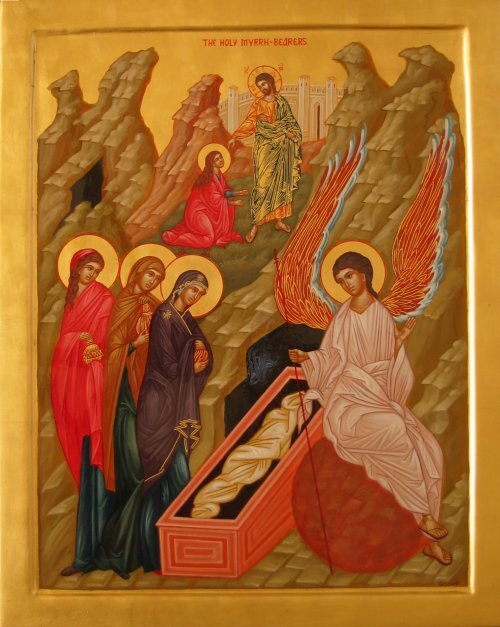
“The Holy Myrrh-bearers.” Accessed online at https://www.allsaintstoronto.ca/services-events/soo-gdthh-2ptfc-lng35-c8gjx-xaf3p
 Joann White