Sabbath Day Thoughts — “Threading the Needle” Mark 10:17-31
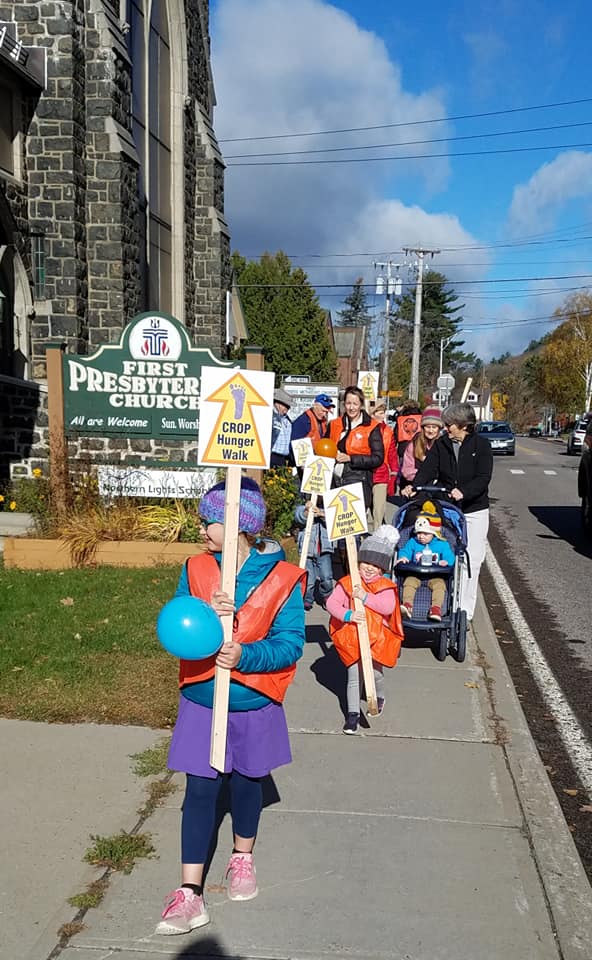
Next Saturday, walkers from this church will join our ecumenical neighbors in the annual Saranac Lake CROP Walk. We’ll be raising funds for the international hunger programs of Church World Service and the Interfaith Food Pantry here at home. CROP walkers say, “We walk because they walk.” It’s an acknowledgment of our solidarity with global neighbors who daily walk for food, water, work, school, and firewood. The average distance that women in the developing world walk every day for water for their families is 3.4 miles. Elma Kassa of Ethiopia walks for water. Although Elma would like to go to school, she cannot because she helps her mother wash clothes to support the family. Four times every day, Elma collects water, using a five-gallon clay jar. Perhaps next Saturday as walkers stride down LaPan Highway from the Alliance Church to our church, they can think of Elma, with her heavy clay jar atop her head.
CROP Walks seek to eradicate hunger. That’s a formidable task. The Global Hunger Index tracks the state of hunger worldwide, country by country. Their 2024 report shows that little progress has been made in reducing hunger since 2016. Forty-two countries still experiencing alarming or serious hunger. Globally, 733 million people lack access to sufficient calories, and 2.8 billion people cannot afford a healthy diet. Acute food insecurity and the risk of famine are on the rise, and starvation is proliferating as a weapon of war. Worldwide, 148 million children are stunted, 45 million children are wasted, and almost 5 million children die before age five from hunger-related causes. The situation is most severe in Burundi, Yemen, and Niger—and it is on the rise in Afghanistan, Argentina, and Mongolia. Hunger kills more than nine million people each year, more than AIDs, malaria, and tuberculosis combined. 3.1 million of those deaths are children.
People are hungry in the United States. The USDA estimates that 44.2 million Americans nationwide live in food insecure households. These are homes where meals are skipped or kids are sent to school without breakfast because there aren’t sufficient resources to put food on the table. 28% of households with children indicate that kids were not eating enough because families could not afford food, thanks to inflated prices and the end of federal pandemic relief support. Feeding America reports that more than 53 million people turn to food banks, food pantries, and meal programs for help. That’s one-third more than prior to the pandemic. Our food pantry volunteers will tell you that the Saranac Lake pantry downstairs is a busy place on Saturday mornings, serving all kinds of neighbors—seniors, single moms, traditional families, and people living with homelessness, mental illness, developmental disabilities, or physical handicaps.
Jesus’ encounter with the rich man invites us to consider the responsibilities of our relative affluence in a world plagued by persistent hunger. Breathless after his run, kneeling in the dust of the road at Jesus’ feet, the rich man wanted to know what he must do to inherit eternal life. This righteous man was relieved to hear Jesus reciting the instructions of the Torah—no murder, adultery, stealing, lying, or defrauding. Be sure to honor your parents. The man had kept all these commandments from his youth, and he must have done so with great earnestness and integrity, because Jesus loved him for it and invited him to become a disciple.
There was only one thing lacking. Although the man was expert in keeping the Torah, he seemed to have fallen short in tzedakah or almsgiving, one of the most essential principles of Jewish piety. Our Jewish ancestors believed that, ultimately, everything belongs to God. While God could have created a world where everyone had exactly the same distribution of God’s bounty, God chose not to do so. Instead, some, like the rich man, were given much, while others had little. This uneven distribution of resources was how God invited faithful people to join their purpose to God’s purpose, to live lovingly and generously so that God’s goodness could abound for all. Faced with Jesus’ invitation to sell what he owned for the blessing of his impoverished neighbors, the rich man turned his back on a life with Jesus and went away grieving.
When it comes to wealth, we don’t consider ourselves rich, certainly not rich enough to be labeled “the rich man” or “the rich woman.” But when we see ourselves through the eyes of the world, we are more than blessed. The average daily wage in the United States is about $162. Developing countries with unstable political and economic conditions do not fare nearly so well. In Nepal, the average daily wage is $3.75; in Sudan, it’s $2.71; and in Afghanistan, people try to survive on less than a dollar a day. I have said it before, and I suspect that I will say it again, my friends. We are blessed—we are rich.
I’m not saying that we don’t work hard to earn what we have. We may spend long years striving in tough jobs to give our families the sort of home life and advantages that we wish them to have. I see a lot of hard workers when I look out at our pews on Sunday mornings. But I wonder if we see our relative wealth in the same way that Jesus invited the rich man to think of his money. Our relative affluence is a generous gift from God to bless our lives and to bless the lives of our impoverished neighbors. I wonder what our household expenditures might look like if Jesus were writing the checks. Today Jesus gives the rich man—and us—an uncomfortable reminder that we are meant to share God’s blessing with others. When we do so, we get a foretaste of God’s Kingdom, where all are welcomed to the bountiful feast that Jesus has prepared.
I want to share how our participation in the CROP Walk can allow us to be a blessing to our neighbors, near and far. Our CROP dollars will help world neighbors like Moize Munenwa Joseph, one of over 800 people in Tanzania who participated in a CWS-sponsored vegetable farming program. Moize learned valuable farming skills like seed selection, pest control, and farm cleanliness. This helped him to improve his harvest and increase his income. Now Moize is sharing what he learned with others in his community. Moize says, “I can take care of my family and ensure we consume healthy food.”
Our CROP dollars can help world neighbors like Hak Nhy in Cambodia. For generations, her family has lived off crops from their vegetable farm. Challenges from climate change and the pandemic affected their harvest, leaving Hak and her family with barely enough to eat or sell. Hak enrolled in a Church World Service gardening program that taught her how to plant a more productive and nutritious garden. Hak says, “I have [gained] skills and knowledge on vegetable gardening, adapting to the changing weather conditions, and compost making.” Her family now has a better diet and her garden’s increased harvest allows her to sell surplus vegetables.
Our CROP dollars also help world neighbors like Alodia González, who lives in rural Paraguay. Alodia’s family struggled to have a stable income until she participated in a CWS training that focused on planting seeds and food production. Alodia learned about beekeeping and making honey. She also learned to organize and launch a community garden. Alodia says, “With a good production of honey, we are generating significant income to support our families. With the garden, we are able to eat lettuce and other vegetables produced by us.”
Our CROP dollars can be the kind of blessing that Jesus had hoped the rich man might share with his impoverished neighbors. I’m not talking about selling everything we have and giving it all away this morning. The good news for us is that even a modest gift that is well within our budgets can make a big difference in the lives of our needy neighbors. A $20 pledge can provide chickens for a family—chickens are a lasting resource for eggs and meat. $60 is enough to help three families with seeds and training for home gardening. They’ll have better nutrition and the extra income that comes with plenty of veggies. A $161 pledge would be enough to enable a farmer to plant an acre of sweet potatoes, to provide both food and income. Are we feeling especially generous? $1,499 buys the whole farm—seeds, meat animals, and training to provide a family with reliable sources of food and income to meet their needs for years to come.
The rich man may have turned away from Jesus, saddened by the invitation to discipleship that Jesus shared with him. But I suspect that this morning, as we consider the call to discipleship and the impact of CROP Walk, we are getting inspired, eager even, to make a difference in the lives of hungry neighbors. We are blessed, my friends, so that we might be a blessing to others. May we go forth to follow Jesus, sharing generously of our abundance to make a difference in the lives of our hungry neighbors.
Resources
Concern Worldwide. “Global Hunger Index 2024.” Accessed online at 2017 Global Hunger Index: The Inequalities of Hunger (concern.net)
Mehdi Punjwani. “Average salary in the U.S. in 2024” in USA Today, Sept. 26, 2024. Accessed online at Average Salary in the U.S. in 2024 (usatoday.com)
World Data. “Average income around the world” October 2024. Accessed online at https://www.worlddata.info/average-income.php
Church World Service. CWS (cwsglobal.org)
Mark G. Vitalis-Hoffman. “Commentary on Mark 10:17-31” in Preaching This Week, Oct. 11, 2015. Accessed online at Commentary on Mark 10:17-31 – Working Preacher from Luther Seminary
David Lose. “Commentary on Mark 10:17-31” in Preaching This Week, Oct. 14, 2012. Accessed online at Commentary on Mark 10:17-31 – Working Preacher from Luther Seminary
Matt Skinner. “Commentary on Mark 10:17-31” in Preaching This Week, Oct. 11, 2009. Accessed online at Commentary on Mark 10:17-31 – Working Preacher from Luther Seminary
To make a donation: https://events.crophungerwalk.org/cropwalks/event/saranaclakeny
Mark 10:17-31
17 As he was setting out on a journey, a man ran up and knelt before him and asked him, “Good Teacher, what must I do to inherit eternal life?” 18 Jesus said to him, “Why do you call me good? No one is good but God alone. 19 You know the commandments: ‘You shall not murder. You shall not commit adultery. You shall not steal. You shall not bear false witness. You shall not defraud. Honor your father and mother.’ ” 20 He said to him, “Teacher, I have kept all these since my youth.” 21 Jesus, looking at him, loved him and said, “You lack one thing; go, sell what you own, and give the money to the poor, and you will have treasure in heaven; then come, follow me.” 22 When he heard this, he was shocked and went away grieving, for he had many possessions.
23 Then Jesus looked around and said to his disciples, “How hard it will be for those who have wealth to enter the kingdom of God!” 24 And the disciples were perplexed at these words. But Jesus said to them again, “Children, how hard it is to enter the kingdom of God! 25 It is easier for a camel to go through the eye of a needle than for someone who is rich to enter the kingdom of God.” 26 They were greatly astounded and said to one another, “Then who can be saved?” 27 Jesus looked at them and said, “For mortals it is impossible, but not for God; for God all things are possible.”
28 Peter began to say to him, “Look, we have left everything and followed you.” 29 Jesus said, “Truly I tell you, there is no one who has left house or brothers or sisters or mother or father or children or fields for my sake and for the sake of the good news 30 who will not receive a hundredfold now in this age—houses, brothers and sisters, mothers and children, and fields, with persecutions—and in the age to come eternal life. 31 But many who are first will be last, and the last will be first.”
 Joann White