Sabbath Day Thoughts — Beyond Fear John 20:19-23; Psalm 23
For 1,200 years, people have been walking the Camino de Santiago, the Way of St. James. It’s a network of trails that snake across Europe, leading to the Great Cathedral of Santiago de Compostela in northwestern Spain. According to tradition, the Apostle James the Great (the son of Zebedee) was the first to take the gospel to Spain, traveling to the Iberian Peninsula on the frontier of the Roman Empire and sharing the good news of Jesus Christ. When James returned to Jerusalem, he ran afoul of King Herod Agrippa, who ordered the evangelist to be beheaded, making him the first of the apostles to be martyred. James’ followers collected his body and took it by boat to Spain, where it still lies entombed in the Great Cathedral.
In the Middle Ages, as the black death swept across Europe and the Moors swept across the Mediterranean, the church encouraged pilgrims to travel to Santiago as an act of devotion that was a safer alternative to Jerusalem. Some were even prescribed the journey as penance for sin. William Wey of Eton College in England made the pilgrimage in 1456. In his account of his journey, William wrote, “Whoever has come on pilgrimage to the church of St. James, son of Zebedee, at any time, has one-third of all his sins remitted.” There must have been many people looking for absolution because William noted the diversity of the pilgrims: “They included English, Welsh, Irish, Normans, Bretons, and others.” Medieval pilgrims set out on foot from across the continent, some with little more than a pilgrim’s staff and the clothes on their backs. Along the way, they were tended by monastic hostels and refuges that provided food and a safe night’s lodging.
Nowadays, pilgrims walk the Way of St. James for many reasons. About 43% of people continue to walk for spiritual reasons, as an act of devotion, a time or prayer, or a rite of penance. Others, who may be spiritual but not religious, say they are seeking. A middle-aged man who is a self-confessed couch potato says he walked the Camino to find peace with the grief of his past. A newly graduated college student says that she walked for discernment, hoping she would find direction and purpose for her professional path. An overburdened youth counselor took a break from her practice because she needed to shed the non-stop needs of others and make time for herself. In June, Duane and I will embark on the pilgrim path that leads from Portugal to Santiago as an act of devotion, prayer, and spiritual renewal.
John’s Gospel tells us that James the Son of Zebedee was frightened. With his fellow apostles, he hid behind a locked door on Easter evening for fear of persecution. Mary Magdalene had returned early in the day with the amazing and joyous news that she had seen the risen Lord. God had broken the power of sin and death. But on Easter evening, Mary’s good news had not made a dent in the disciples’ despair. They feared arrest, torture, execution. They feared the cross.
Fear—and its friends worry and anxiety—are an essential part of being human. We need fear to galvanize us to take action, to make bold choices, and to prompt our personal growth. But when fear drives our bus, we can get into trouble. Fear, worry, and anxiety can keep us from getting a good night’s sleep, have a negative impact on our job performance, and undermine our relationships with colleagues, friends, and beloved ones. Fear can generate a host of unpleasant physical symptoms, too: muscle tension, headache, upset stomach, lightheadedness, diarrhea, and increased heart rate and respiration. Chronic fear and worry prompt our sympathetic nervous system to release stress hormones, raise our blood sugar, and boost our tri-glycerides. Unchecked fear can lead to chronic health problems, everything from irritable bowel syndrome to asthma and heart disease. For 57 million Americans, chronic fear takes the form of crippling anxiety that compromises their ability to live full and balanced lives.
To be human is to live with fear. That must be why God’s presence in the midst of our fear is one of the most persistent of God’s promises in scripture. When the aging, childless, patriarch Abraham cried out to God in fear that he would die and be forgotten, God answered, “Do not be afraid, I am your shield” (Gen. 15:1). When the Israelites feared that they would perish at the hands of their enemies in the wilderness, God promised, “Do not lose heart or be afraid or panic or be in dread, for it is the Lord who goes with you to fight for you and give you victory” (Deut. 20:1-4). When Joshua and the people prepared to cross over into the unknown land that God had given to them, God again encouraged them, “Do not fear or be dismayed. It is the Lord who will be with you. He will not fail or forsake you” (Deut. 31:7-8). God kept those promises. Abraham and Sarah gave birth to Isaac. The Israelites endured the wilderness with manna in the morning, quails at nightfall, and protection from fierce enemies. With God’s help, Joshua and the twelve tribes took possession of that land that flowed with milk and honey. Even today, as we face our fears, we are likely to keep them at bay with the promises of scripture. We pray with the words of the Psalmist, “Yea, though I walk through the valley of the shadow of death I will fear no evil, for Thou art with me.”
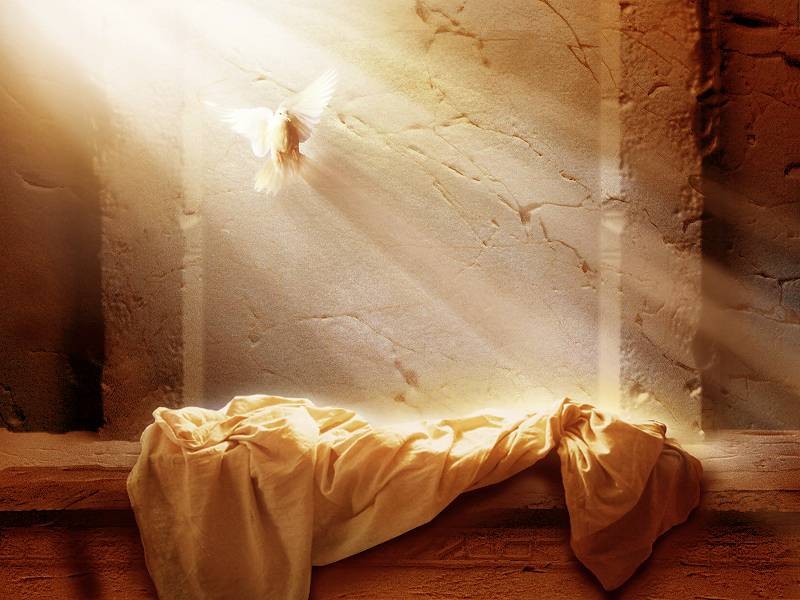
Those fearful disciples found a remedy for their fear on Easter evening. Neither a locked door nor the overwhelming terror of persecution could keep Jesus out. There he was in their midst, bringing repeated words of peace and the assurance that he truly was with them, ready to share his wounds to make his point. The apostles’ fear transformed to joy with alleluias, tears of happiness, and words of praise filling that upper room.
What happened next has piqued the interest of Bible scholars ever since. Some call it the Little Pentecost. Like God in the Garden of Eden puffing the breath of life into Adam and Eve, Jesus breathed on his friends. As the Spirit of Jesus filled the disciples, they became a new creation. They found the courage to be sent as Jesus was sent—out into a world that might reject them, that might persecute them. James the Son of Zebedee found his thoughts turning to the edges of the empire, to the wilds of Iberia and the people who waited in fear for the assurance of God’s presence and love.
We all live with fear. This morning, we may even have some fears that are related to the “s” word—that’s right sabbatical. Elders and deacons may feel a little overwhelmed by impending new responsibilities. Church staff may feel worried about not having the boss around for direction or moral support. We may all feel worried about Sunday mornings—other voices in the pulpit. Men! They’ll have different styles of worship leadership—and who knows what songs we’ll be forced to sing. We may feel anxious that we won’t have our pastor to listen to our concerns, visit us when we are under the weather, or preside at a memorial service.
I’ll even confess some of my personal fears. I worry that no one will come to church in my absence, or that you’ll all opt out of the special learning opportunities of this sabbatical time for the church. I worry about leaving our dog Gybi with family while we fly off to walk the Way of St. James. And what if in our trekking across Portugal and Spain, Duane or I are injured? This sabbatical is an amazing opportunity for pastor and parish alike. But even wonderful opportunities can stir fear within us. Can’t they?
Perhaps we can find a remedy for our fears in the example of James the Son of Zebedee, who left his fear behind and went forth to the Roman frontier with good news that would transform Iberia, news that still inspires pilgrims to walk the Way of St. James today (at least 42% of us). We can remember that the Spirit of Jesus breathes in us, comforting and encouraging, inspiring and leading. We can move past our fears because Christ will be with us and in us, even closer than the beating of our own hearts. We have what it takes to face everything that the next fifteen weeks will bring our way because Jesus is with us.
I want to finish up my message with some words of assurance. I’ll be naming some situations that may arise in the coming weeks. Then you’ll respond with the words, “the Lord will be with us.” Are we ready?
When worship isn’t led exactly as we would like, or we are forced to sing a new hymn, the Lord will be with us.
When announcements don’t make it into the bulletin, or no one signs up for Coffee Hour, the Lord will be with us.
When we get out of our comfort zone to meet in small groups or retreat to Montreal or join a Sermon on the Trail, the Lord will be with us.
When our muscles ache and our feet are sore from a long day of hiking, the Lord will be with us.
When we take a wrong turn, and we miss our dog and our friends and our family and our church, the Lord will be with us.
In all this and more, who will be with us? That’s right – the Lord!
May we find the ability to move beyond all those fears, worries, and uncertainties in the sure and certain knowledge that the Lord is with us, his very Spirit breathes in us. We will survive sabbatical—we may even thrive—because the Lord will be with us.
Resources
Kristin John Largen. “Theological Perspective on John 20:19-33” in Feasting on the Gospels: John, vol. 2. Westminster John Knox Press, 2015.
E. Elizabeth Johnson. “Pastoral Perspective on John 20:19-33” in Feasting on the Gospels: John, vol. 2. Westminster John Knox Press, 2015.
Susan Grove Eastman. “Exegetical Perspective on John 20:19-33” in Feasting on the Gospels: John, vol. 2. Westminster John Knox Press, 2015.
Paul Simpson Duke. “Homiletical Perspective on John 20:19-33” in Feasting on the Gospels: John, vol. 2. Westminster John Knox Press, 2015.
James Johnston. “STEPS: Why People Walk the Camino de Santiago.” Accessed online at https://www.youtube.com/watch?v=bzPmdAd0Oek&t=485s
–. Harvard Health Publications. “Anxiety and Physical Illness,” July 1, 2008. Accessed on-line at health.harvard.edu.
Jillian Reid. “Medieval pilgrim shell tokens & St James’ Way” in The Blog of the London Museum, April 24, 2024. Accessed online at https://www.londonmuseum.org.uk/blog/medieval-pilgrim-shell-tokens-and-st-james-way/
John 20:19-23
19 When it was evening on that day, the first day of the week, and the doors were locked where the disciples were, for fear of the Jews, Jesus came and stood among them and said, “Peace be with you.” 20 After he said this, he showed them his hands and his side. Then the disciples rejoiced when they saw the Lord. 21 Jesus said to them again, “Peace be with you. As the Father has sent me, so I send you.” 22 When he had said this, he breathed on them and said to them, “Receive the Holy Spirit. 23 If you forgive the sins of any, they are forgiven them; if you retain the sins of any, they are retained.”
Psalm 23
1 The Lord is my shepherd; I shall not want.
2 He makes me lie down in green pastures;
he leads me beside still waters;
3 he restores my soul.
He leads me in right paths
for his name’s sake.
4 Even though I walk through the darkest valley,
I fear no evil,
for you are with me;
your rod and your staff,
they comfort me.
5 You prepare a table before me
in the presence of my enemies;
you anoint my head with oil;
my cup overflows.
6 Surely[e] goodness and mercy shall follow me
all the days of my life,
and I shall dwell in the house of the Lord
my whole life long.


 Joann White