“Live Forever”

Sabbath Day Thoughts – John 6:51-58

“So Jesus said to them, “I assure you: Unless you eat the flesh of the Son of Man and drink His blood, you do not have life in yourselves. Anyone who eats My flesh and drinks My blood has eternal life, and I will raise him up on the last day. — John 6:53-54

We want to live forever.

Some turn to cryonics in pursuit of immortality.  At death, their bodies or heads are subjected to low-temperature freezing with liquid nitrogen.  Then, they are stored with the speculative hope that advances in science will one day allow them to be resurrected or digitally replicated.  That will cost you about $80,000.

Others, in their quest for prolonged life, resort to calorie restriction.  Citing the evidence of lab animals that live longer when their food intake is cut by half, calorie restrictors limit their daily diet to about 1,400 calories and maintain below-normal body weight.  For a six-foot-tall man, that’s about 144 pounds, for a five-foot six-inch woman, 108 pounds.  They say that their reduced body mass needs less energy to maintain and cuts their risk for age-related disease.

We may roll our eyes at the extreme practices of cryonics and calorie restricting, but we will gladly try whatever the doctor tells us will extend our lives.  We’ll get outside and exercise daily, year after year.  We’ll floss our teeth and eat our veggies. We may even quit smoking, give up red meat, and watch less television.  What have you been doing in pursuit of longevity and that fountain of youth?

In our reading from John’s gospel, Jesus told his listeners in the synagogue in Capernaum that anyone who eats his flesh and drinks his blood will live forever.  Jesus’ Jewish listeners found his words both puzzling and repulsive.  To begin with, it sounds like an invitation to cannibalism—Eeeewww!  On top of that, the most essential dietary restriction of the Torah was the prohibition on eating blood.  Blood, the life of an animal, belonged to God alone.  In the Temple, blood was poured out in sacrifice to atone for sins.  In the slaughter of farm animals, blood was covered with earth as a memorial to God.  According to Leviticus seventeen, the person who ate blood was cut off from God and the people.  It is little wonder that those folks in Capernaum were shocked and offended by Jesus’ sermon.

When we hear Jesus’ hard teaching, we need to remember the story of the Israelites, and their forty years of wilderness wandering.  Back then, the people were fed by God, who sent bread and meat from heaven—manna and quails—so that the people might live.  Given that context, we are able to imagine Jesus as bread or manna or flesh, the spiritual food sent from heaven so that we might live.  We also understand that Jesus spoke in metaphor.  When Jesus talked about eating his flesh and drinking his blood, we hear in those cryptic words the institution of the Lord’s Supper.  Each month we break the bread and lift the cup—eating and drinking the body and blood of Christ—in remembrance of Jesus.  We further realize that Jesus’ saving death on the cross was like the ultimate outpouring of bloody sacrifice, an offering that atoned for the sins of the world.  When we put that all together, we “get” what Jesus is saying here.  But for “outsiders” like those in the Capernaum synagogue, for outsiders like our unchurched neighbors today, it all sounds like a gruesome and incomprehensible mystery.

Given the public fascination with cryonics, calorie restricting, and daily habits that may promote longevity, it seems that even those of us who get what Jesus is saying, find it hard to trust his promise that we will live forever.  We have had tough experiences of death: the slow and painful demise of parents or the shocking accidental or untimely death of those who are young and vibrant.  We have been traumatized by near-death experiences of our own.  We are skeptical about highly publicized and lucrative accounts of those who have returned from death—from Pastor Todd Burpo’s book Heaven Is for Real to neurosurgeon Eben Alexander’s autobiographical work Proof of Heaven.  When it comes to living forever, we wonder.  We peer through a glass dimly.  We won’t truly know until we are there, in the midst of the great what’s next.

Throughout history, the best Christian minds have sought to unravel for us the great mystery of the life eternal.  In the fourth century, John Chrysostum taught about today’s reading from John 6, saying that in Jesus, God became flesh, condescending to live among us.  When we partake in communion, eating and drinking the body and blood of Christ, we participate in God’s great, out-reaching love.  We are commingled with Christ—inseparably mixed and joined.  The “life, breath, and fire that terrify the devil” are imparted to us.  We become a part of the life of Christ—and that life is eternal, reaching beyond the grave.

John Calvin in unraveling the mystery of John six eloquently wrote that in “becoming the Son of Man for us, Jesus has made us sons [and daughters] of God with him; that by his descent to earth, Jesus has prepared an ascent to heaven for us; that by taking on our mortality, Jesus has conferred his immortality upon us.”  We live forever because in Jesus of Nazareth, God has freely and graciously chosen to open for us the way to eternal life.  How good is that?

I wish that I could tell you exactly what to expect in the great what’s next—hand you a detailed map, or email you a link to click, or paint you a beautiful watercolor—but I haven’t been there.  Yet I find insight and anticipation when I ponder the metaphors that Jesus used to talk about it.  When the Lord warned his disciples of his coming death, he said that he was going to his Father’s House.  Jesus was drawing on the everyday reality of the Beth Ab, the home where many generations gathered under the extended roof of a patriarch and matriarch—elders, adults, children, and grandchildren, unwed aunts, disabled brothers, widows, orphans, slaves, and vulnerable neighbors, all living together with mutual regard and loving care.  Jesus also liked to use the metaphor of the Great Banquet—like the Lord’s Supper on steroids—where all will be gathered in the love and generous hospitality of God, a feast with the finest food, the best conversation, and the greatest of joy.

We know that with the Father’s House and the Great Banquet Jesus was using earthly metaphors to try to describe an incomprehensible, holy reality.  Yet Jesus’ words assure us that in that sweet bye and bye we will be perfectly loved, warmly welcomed, and completely accepted.  We will be totally at home—safe and sound, nurtured, fed, and filled with joy.  I like the sound of that.  If that is what living forever is all about, then I want in.  How about you?

Lord, give us this flesh to eat.  Lord, give us this blood to drink.  Lord, let us live forever.  When we read John’s gospel, we hear, again and again, the way to eternal life.  It’s pretty simple.  We don’t have to be sinless—and according to John Calvin, thanks to our total depravity, we couldn’t be sinless, even if we wanted to be.  We don’t have to undertake heroic works of mission, taking the gospel to drug-infested neighborhoods or to a remote village in the Amazon.  We don’t have to be more pious than anyone else, making the journey of a thousand miles on our knees.  We don’t have to pay $80,000 to be frozen in liquid nitrogen and warehoused until the time is right.  We don’t need to drastically reduce our calorie intake.  We don’t have to floss or give up red meat or shoot for 10,000 steps daily, even though those habits might be good for us.  None of that will make us live forever.

According to John’s gospel, according to Jesus, all that is needed to live forever is belief.  We simply need to trust that a God who loves us enough to become incarnate for us, to live with us, and to die for us, isn’t going to leave us hanging for an eternity.  For God so loved the world that he gave us Jesus, so that everyone who believes in him will not perish but have eternal life (Jn. 3:16).  The “yes” that we speak to God’s immeasurable love for us opens the door to eternity.  It’s that simple.  Does anyone want to share a yes with me this morning?  Let’s hear it.  Yes!

Karoline Lewis, who teaches at Luther Seminary in Minneapolis, reminds us that, for those of us who believe, our eternal life with God has already begun.  We, who wish to live forever, are already on our way.  In our lives as people of faith, as our relationship with Jesus is nurtured in the breaking the bread and lifting the cup, there is “an abiding, a unity, a reciprocity, and oneness.”  Forever is tasted, here and now, as we live with God in the moment.  That is a promise that we can trust for eternity. 

One day, we shall arise in that far brighter light on that far better shore.  The great mystery will come to an end and we will see clearly and know fully the immeasurable love that God has for us.  We’ll walk with the Lord.  We’ll take up residence in the Father’s House.  We’ll find our seat at the Great Banquet.  All will be perfectly and ultimately well.  I hope to see you there.  Amen.

Resources:

Calvin, John.  Institutes of the Christian Religion, vol. 2. Philadelphia: Westminster Press, 1977. 4.xvii.2.

Lewis, Karoline.  “A Living Bread” in Dear Working Preacher, Aug. 9, 2015.  Accessed online at www.workingpreacher.org.

Hendricks, Michael. “The False Science of Cryonics” in MIT Technology Review, Sept. 15, 2015. Accessed online at www.technologyreview.com.

Grabski, Isabella. “Can Calorie Restriction Extend Your Lifespan?” in Science in the News: Harvard University Graduate School of Arts and Sciences, Aug. 2, 2020.  Accessed online at sitn.hms.harvard.edu

Meeks, Wayne. “Exegetical Perspective on John 6:51-58” in Feasting on the Word, Year B, vol. 3. Louisville: Westminster John Knox Press, 2009.


Morse, Christopher. “Theological Perspective on John 6:51-58” in Feasting on the Word, Year B, vol. 3. Louisville: Westminster John Knox Press, 2009.



Photo by Adam Kontor on Pexels.com

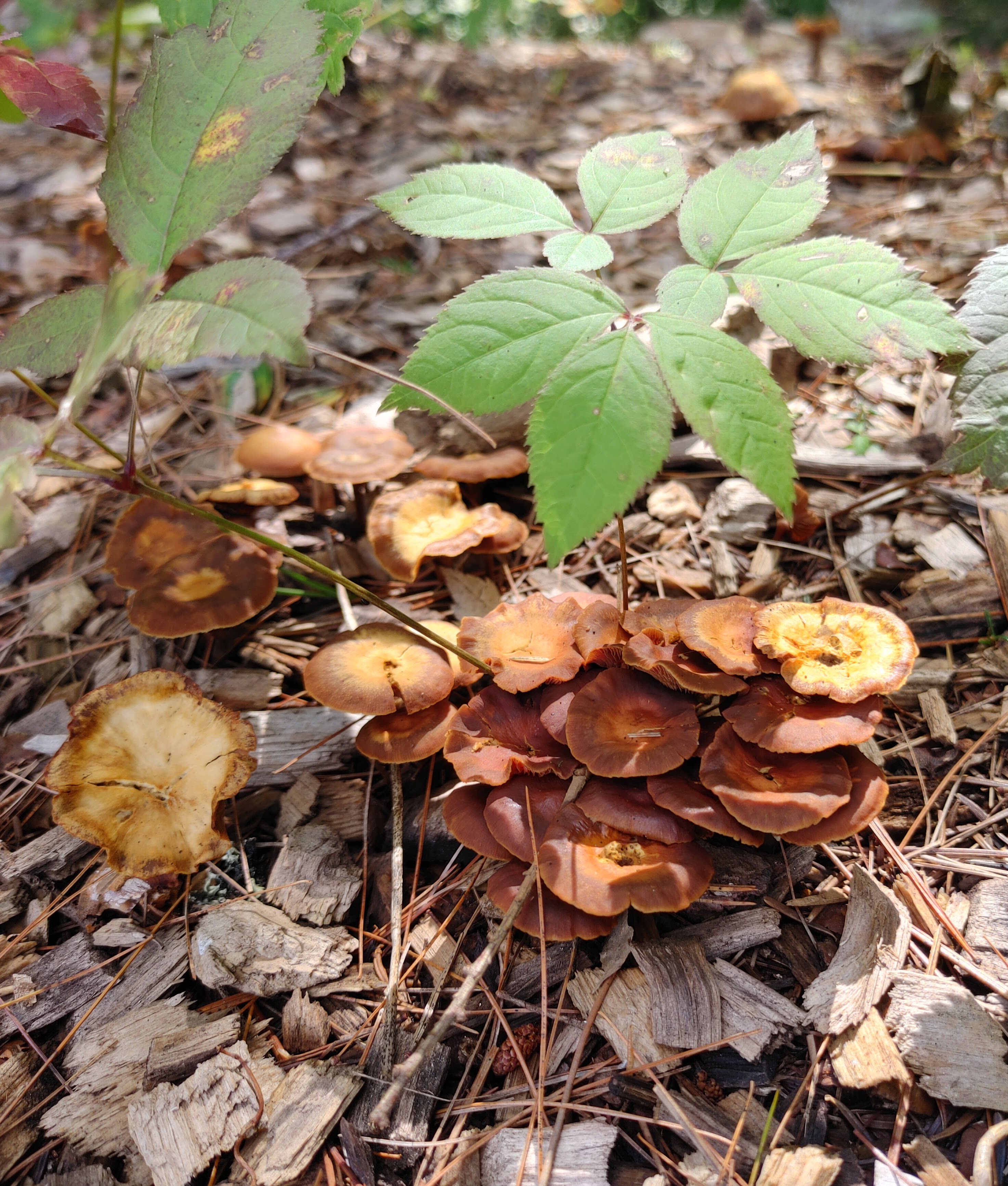
Mushrooms Galore!

A wet July has made for an explosion of mushrooms. A walk in the woods can dazzle the eye with a bold assortment of mycelial life underfoot. According to Dianna Smith, a New Hampshire-based naturalist and mushroom enthusiast, mushrooms and trees have symbiotic relationships. Trees give mushrooms the sugars that they need to survive while mushrooms release valuable nutrients from the materials they decompose. The mushrooms that we spy along the trail are a bit like flowers, emerging from a vast underground network that has been compared to the Internet (aka the Wood-wide Web). This underlying mycelium can be long-lived and massive. A colony of Armillaria solidipes mushrooms in the Malheur National Forest of Eastern Oregon is believed to be 2,400 years old and spans an estimated 2,200 acres. I’m not sure how old or vast the mycelial network is here in the Adirondacks, but these trailside finds made for a fascinating walk. The heavens may sing the glory of God, but on a warm August day, so can the forest floor.


Mushrooms

by Sylvia Plath

Overnight, very
Whitely, discreetly,
Very quietly

Our toes, our noses
Take hold on the loam,
Acquire the air.

Nobody sees us,
Stops us, betrays us;
The small grains make room.

Soft fists insist on
Heaving the needles,
The leafy bedding,

Even the paving.
Our hammers, our rams,
Earless and eyeless,

Perfectly voiceless,
Widen the crannies,
Shoulder through holes. We

Diet on water,
On crumbs of shadow,
Bland-mannered, asking

Little or nothing.
So many of us!
So many of us!

We are shelves, we are
Tables, we are meek,
We are edible,

Nudgers and shovers
In spite of ourselves.
Our kind multiplies:

We shall by morning
Inherit the earth.
Our foot’s in the door.

from Sylvia Plath’s first collection: The Colossus and Other Poems, published by Vintage, New York (1998, ed.)

“Live in Love”

Sabbath Day Thoughts – “Live in Love” – Ephesians 4:25-5:2

We need love. The groundbreaking research of behavioral scientists like Harry Harlow and John Bowles determined that humans have a hard-wired biological need to experience love. Their findings revealed that babies who are deprived of contact comfort and love during the first six months of life suffer long-lasting harm. Even into adulthood, they can experience psychological damage that increases the likelihood of depression, anxiety, and difficulty in relationships. We also need to give love. Each of us has an innate need to love and care for others. It’s what compels us to pinch the cheeks of babies, say “Aww!” when we see a cute puppy, or make a generous donation to the Crisis Care Nursery when we hear about those at-risk orphans. It’s safe to say that God created us with the intent of giving and receiving love.

No one was better versed in the importance of love for human development than broadcaster and Presbyterian minister Fred Rogers. Once a lonely child himself with respiratory issues, Fred was sensitive to the insecurities and needs of children. The love and affirmation of his grandfather, the original Mr. McFeely, helped Fred through those early years. As the grown-up Fred saw the vapid humor and violence of children’s television, he thought, surely, we can do better. He resolved to use tv to encourage kids to know that they mattered. From 1968 until 2001, his show “Mr. Roger’s Neighborhood” was broadcast nationally on public television. In 895 episodes, Mr. Rogers was all about love. Fred said, “Knowing that we can be loved exactly as we are gives us all the best opportunity for growing into the healthiest people.”

The Apostle Paul, in his letter to the Ephesians also emphasized the importance of love. The apostle spent more than two years in the busy Aegean port of Ephesus sharing the good news, spending five hours daily in the lecture hall of Tyrannus, relating the story and teachings of Jesus. All that gospel, coupled with extraordinary miracles, made for a vibrant and growing church. In summarizing the Way of Jesus, Paul exhorted his friends to “live in love.” He began by describing all the things that love is not: dishonesty, harbored anger, thievery, malicious gossip, and slander. Wise pastor that he was, Paul knew that these behaviors undermine the fabric of a community.

We can attest to the truth of Paul’s teaching. Dr. Ramani Durvasula, author of Should I Stay or Should I Go? says that dishonesty undermines trust, the primary connective tissue of a relationship. Without trust and the sense of safety that it brings, our relationships cannot grow in a healthy manner. Likewise, Dr. Randi Gunther cautions that unresolved anger can sabotage our connections with those we care about, whether our anger manifests as nitpicking, withdrawal, snapping, or tantrums. Once we are in an angry interaction, we can rapidly go from friends to adversaries, unable to see beyond our emotional survival. We resort to distance for our emotional safety and resist working through the conflict to get at the underlying feelings and concerns. We also all know from personal experience how painful it is to be targeted by gossip. It spreads lies, tarnishes reputations, and ruins relationships. Dishonesty, harbored anger, and sins of speech, when these destructive behaviors become endemic to a family, community, or church, they create an unsafe emotional space where no one truly feels welcomed, accepted, or loved.

Paul expected better of the Ephesians—and us. He reminds us that our true purpose is agape, the generous, other-interested love that acts out of concern for the well-being of others. Dr. Jaime Clark-Soles, who teaches at Southern Methodist University, describes agape as “kenotic love,” from the Greek word kenosis, which means to “pour out.” In agape we pour out ourselves in the best interest of others. There isn’t anything in it for us. Agape is self-sacrificing, forgiving, and kind.

Agape is a healer and a community builder. A Penn State study considered the effect of feeling loved upon individuals. They asked subjects to report the brief experiences of love and connection that they had in everyday life: a caring text, a meaningful interaction with a friend, a sweet kindness from a family member, the random niceness of strangers. The researchers learned that the subjects who had more experiences of love and connection also had significantly higher levels of psychological well-being, including feelings of optimism and purpose.

Fred Rogers didn’t need a scientific study to tell him that. He simply believed that all people feel better and are happier when loved. In his testimony before a Senate panel in 1969, Rogers described the ethic that undergirded his children’s programming, saying, “I give an expression of care every day to each child, to help him realize that he is unique. I end the program by saying, ‘You’ve made this day a special day, by just your being you. There’s no person in the whole world like you, and I like you, just the way you are.’ And I feel that if we… can only make it clear that feelings are mentionable and manageable, we will have done a great service for mental health. I think that it’s much more dramatic that two men [be portrayed] working out their feelings of anger — much more dramatic than showing… gunfire. I’m constantly concerned about what our children are seeing.”

Like Fred Rogers, we instinctively know the power of kindness and love to build-up one another, but we sometimes struggle to be loving. We get really angry. Sometimes it is justified. We can be less than honest or may resort to lies because we don’t want to hurt someone’s feelings, we don’t want to represent ourselves in a bad light, or we want to try to stay in control of a situation where we feel out of our depth. We can use language in ways that hurt, whether we speak rashly, raise our voices, betray a confidence, or put someone down so that we can feel better about who we are. We hear Paul’s wise exhortation to “live in love,” but it isn’t always easy.

We are only able to forge the capacity to be a people who live in agape when we consider the example of Jesus. His life was a long unfolding of agape. In agape, Jesus chose to heal hurting people on the sabbath day, even when the scribes insisted that he was violating the Torah. In agape, Jesus welcomed sinners, scandalizing the Pharisees. In agape, Jesus was crucified, taking on the sin of the world and reconciling us to God and one another. In agape, Jesus forgave even his executioners as they nailed him to the cross and gambled for his robe. Jesus poured out his life in “kenotic love.” It is when we ponder the enormity of what Jesus has done for us that we begin to understand agape. It is in following Jesus, what Paul described as being “imitators” of Jesus, that agape begins to take shape in our lives. We care, we share kindness, we forgive, we learn to live in love.

Researchers say that agape is good for us. Dr. Raj Raganathan, who teaches at the University of Texas, has found that when we express love and compassion for others, it makes us happier. In a study, students were given a gift of either $5 or $20 with the instruction that they could do with it as they wish, either spending it on themselves or spending it on someone else. The study found that those students who chose to spend their windfall on others grew happier than those who kept it for themselves, regardless of whether they were spending $5 or $20. That desire to love and care that each of us is born with brings happiness when it is generously exercised. Our agape helps others, and yet we benefit, too. I suspect that Jesus and the Apostle Paul knew that, too.

In one of his last public addresses, Fred Rogers delivered the commencement speech for Dartmouth University’s Class of 2002. Mr. Rogers shared one of his favorite stories, seeking to impart the ethic of other-interested love and care that he hoped those best and brightest of young people would embrace. The story was about the Seattle Special Olympics. There were nine “differently-abled” contestants for the hundred-yard dash. They assembled at the starting line and at the sound of the gun, they took off. But not long afterward, one little boy stumbled and fell. He hurt his knee and began to cry. The other eight children heard him crying, slowed down, turned around, and ran back to him. One little girl with Down Syndrome bent down and kissed the boy, saying, “This’ll make it better”. And the little boy got up. Then, all the runners linked their arms and joyfully walked to the finish line together. Everyone in the crowd stood up, clapped, whistled, and cheered for a long, long time. Mr. Rogers said that deep down we know that what matters in this life is more than winning for ourselves. What really matters is helping others win, too. Even if it means slowing down and changing our course now and then. He went on to quote Anicius Manlius Severinus Boethius, the last of the great Roman philosophers, who said, “Oh happy race of mortals, if your hearts are ruled, as is the universe, by love.”

Sisters and brothers, let us live in love.

Resources:
Clark-Soles, Jaime. “Exegetical Perspective on Eph. 4:25-5:2” in Feasting on the Word, Year B. vol. 3. Louisville: Westminster John Knox Press, 2009.

Gunther, Randi. “How Anger Affects Intimate Relationships” in Psychology Today, August 30, 2019. Accessed online at psychologytoday.com.
Ward, Richard F. “Homiletical Perspective on Eph. 4:25-5:2” in Feasting on the Word, Year B. vol. 3. Louisville: Westminster John Knox Press, 2009.

–. “Fred Rogers” in Biography. Accessed online at biography.com.
Penn State. “Feeling Loved in Everyday Life Linked with Improved Well-being” in Science Daily, Nov. 25, 2019. Accessed online at sciencedaily.com.
Rogers, Fred. “Dartmouth College Commencement Speech, 2002 in Rev Speech to Text Services. Accessed online at https://www.rev.com/blog/transcripts/fred-rogers-mr-rogers-commencement-speech-transcript-2002-at-dartmouth-college.
Raghnathan, Raj. “The Need to Love” in Psychology Today, Jan. 8, 2014. Accessed online at psychologytoday.com.
–. “About Fred” in Fred Rogers Center for Early Learning and Children’s Media at St. Vincent College. Accessed online at https://www.fredrogerscenter.org/about-fred.


Why Mister Rogers Took Pictures of the People He Met - Biography
Image accessed online at https://www.biography.com/news/why-mister-rogers-took-pictures-people-new-friends

“Rejoice Always”

A Memorial Reflection in Celebration of the Life of the Rev. Richard F. Stone

“Rejoice always!
Pray constantly.
Give thanks in everything,
for this is God’s will for you in Christ Jesus.
Don’t stifle the Spirit.
Don’t despise prophecies,
but test all things.
Hold on to what is good.
Stay away from every kind of evil. Now may the God of peace Himself sanctify you completely. And may your spirit, soul, and body be kept sound and blameless for the coming of our Lord Jesus Christ. He who calls you is faithful, who also will do it.”

– 1 Thessalonians 5:16-24


Rejoice always? Rejoice while the delta variant surges across the unvaccinated heartland and we return to our masks. Hunh?  Rejoice while Republicans and Democrats debate whether January sixth was an armed insurrection or a reverent, if illicit, tour of the Capitol.  Hmmm.  Rejoice while Simone Beils struggles with the stress of athletic excellence and bows out of Olympic events that she once mastered with ease.  Really?  Rejoice while we gather in sorrow.  Rejoice as we miss a beloved husband, father, pastor, and friend.  Rejoice as we sense a Dick Stone-shaped hole in our hearts.  I’m not so sure.

“Rejoice always.”  When the Apostle Paul wrote that exhortation to his beloved flock in Thessalonica, they didn’t feel that they had much to celebrate.  Thessalonica was a culturally Greek city, where a bevy of Greco-Roman gods were worshipped.  In fact, Thessalonica was a haven for the Imperial Cult.  The Roman senate had declared the emperor the newest of gods and mandated that all should worship, sacrifice, and give generously to the emperor to ensure their personal wellbeing and the good of the empire.  Thessalonica was an unlikely place to plant a church, especially a community that heralded as the Messiah a man convicted and crucified for insurrection against the empire: Jesus of Nazareth. 

Paul first came to Thessalonica after spending time in jail in Philippi.  In Thessalonica, Paul found a kind and generous welcome among the Greeks, who had eager ears to hear his good news of a God who loves us enough to take on flesh and live among us and show us the way of salvation.  They marveled at the Christ, who loves us enough to die for us, who promises that God’s holy love is eternal, who is always eager to welcome us—no matter what—both here and now and in that far brighter light on that far better shore.  Not everyone in Thessalonica welcomed Paul or his gospel.  He met with violent resistance from the synagogue and was driven out of the city.  But Paul’s tender followers persisted in Thessalonica, experiencing the sort of scorn and persecution that had led Paul to flee for his life.  In the refuge of Athens, Paul heard of his little flock’s trouble, so he wrote to them saying, “Rejoice always.”

Paul reminded his people that joy isn’t found in the superficial circumstances of our lives: the masks and the virus positivity rate, the incessant squabbles of partisan politics and the false, hateful brotherhood of white supremacy, the thrill of Olympic gold and the euphoria we find when everything is coming up roses.  Joy is found in God’s love that was revealed to us in Jesus, a love that walks with us through the long days of our lives and holds for us the promise of salvation.  Paul cast a joyous vision of the fulfillment of joy to come, writing to his persecuted friends, “For the Lord Himself will descend from heaven with a shout, with the archangel’s voice, and with the trumpet of God, and the dead in Christ will rise first. Then we who are still alive will be caught up together with them in the clouds to meet the Lord in the air and so we will always be with the Lord” (1 Thess. 4:16-17).  Although we know persecution, although we know grief and hardship, we have a holy welcome and an imperishable inheritance.  In that truth there is abundant joy, enough to make us want to “rejoice always!”

My friend and colleague Dick Stone knew the joy of which Paul wrote, the joy that we choose, even when it feels like life is giving us more lemons than we can possibly squeeze into lemonade.  Dick found joy in the Lord.  Jesus was his shepherd, friend and constant companion.  Dick found the quiet joy of prayer and meditation.  He feasted on the Word, whether tackling seminary studies at Princeton, prepping for his weekly sermons, or meeting with the ecumenical clergy.  Dick expressed his love and joy for the Lord in a life devoted to God’s service.  There was joy in serving the saints of Bellona, Hornell, and Canton.  There was joy in caring for vulnerable neighbors through the Church and Community Program that he worked to establish in Canton.  There was joy in providing clean water for African villages through the shallow well initiative of the Marion Medical Mission.  It’s hard to believe, but there was joy in moderating the Presbytery of Northern New York.

Dick found joy in Jeanne, his partner in life, love, and ministry.  They forged a family and a home together in sunshine and, at times, in sorrow.  Especially in retirement, the two were inseparable.  You might have seen them strolling the village on a Thursday evening Art Walk, or sharing a lunch out at a local eatery, or seated next to one another in a pew, worshipping the God who brought them joy. 

How grateful Dick was that the circle of joy and love that he shared with Jeanne spilled over to a new generation.  Lisa, Mark, and Kirk were the apple of his eye.  He loved and was proud of you and the strong, independent, successful adults that you have become.  He delighted in those grandchildren.  Dick acknowledged that he struggled with the challenge of being a pastor and a family man.  As he prepared to retire from his 30-year pastorate in Canton, Dick told a local reporter, “I’ve said to my children many, many times, ‘All I ask of you is to believe I tried to do the best I could at that time in my life.  I might have been dead wrong, but please believe that I tried my best.’”

Dick lived with good cheer, faithfulness and a modicum of rejoicing – even when it may not have seemed that there was much to rejoice about.  On the third Sunday of Advent in 1996, after the untimely death of Kirk, Dick returned to leadership in Canton, to lead the people he loved in worship.  I can only begin to imagine the ponderous weight of climbing into the pulpit on that Sunday with a broken heart, still reeling with grief.  The theme he chose for worship that day?  “Rejoice always!” 

Jeanne shared with me Dick’s sermon notes for that message.  Those of you who knew Dick’s penmanship can imagine how indecipherable those notes truly are.  But I was able to make out that Dick began that message as I did this one, with all the reasons that joy seems like a bad and unlikely choice.  I may not have been able to read Dick’s handwriting, but I know that he went on to claim the hope that Paul held out to his friends in Thessalonica.  Dick trusted that, in every circumstance, even the most bitter of family tragedies, God was with him.  Dick knew that God can take all our loss and tears and grief and bless it, redeem it, and summon from it a miracle of new life.  Dick believed that death is the ultimate healer.  There is a far brighter light on that far better shore where the unbridled joy of the Kingdom of God awaits.  If God is for us, who can be against us?  Again, we will say rejoice.

We who love Dick can find solace in the very promise that Dick trusted.  No life is without sorrow, from the persecution of the Thessalonians to the grief that we share this afternoon.  Yet amid the tears there is joy.  Listen!  The archangel has called.  The trumpet has sounded.  Dick, God’s good and faithful servant, has risen with unbridled joy to meet the Lord he so dearly loves.  One glorious day, we shall all be caught up together.  “Rejoice always!”  Again, I will say, rejoice!


Photo by Pavel Danilyuk on Pexels.com

“Ordinance on Arrival”

Poem for a Tuesday – by Naomi Lazard

“Welcome to you
who have managed to get here.
It’s been a terrible trip;
you should be happy you have survived it.
Statistics prove that not many do.
You would like a bath, a hot meal,
a good night’s sleep. Some of you
need medical attention.
None of this is available.
These things have always been
in short supply; now
they are impossible to obtain.

This is not

a temporary situation;
it is permanent.
Our condolences on your disappointment.
It is not our responsibility
everything you have heard about this place
is false. It is not our fault
you have been deceived,
ruined your health getting here.
For reasons beyond our control
there is no vehicle out.”


Naomi Lazard is an American poet, children’s literature author, and playwright. She is the winner of two Fellowships from the National Endowment for the Arts and a former president of the Poetry Society of America. Her poem “Ordinance on Arrival” appears in A Book of Luminous Things, ed. Czeslaw Milosz (New York: Harcourt Brace & Company, 1996), p. 304.


“When a foreigner resides among you in your land, do not mistreat them. The foreigner residing among you must be treated as your native-born. Love them as yourself, for you were foreigners in Egypt. I am the LORD your God.

Leviticus 19:33-34.

Photo by Quang Nguyen Vinh on Pexels.com

“Soul Food”

Sabbath Day Thoughts — John 6:24-35

We live in an increasingly unchurched world, filled with spiritually hungry people.  The Barna Group reports a rapid rise in churchlessness in America. In the 1990s, thirty percent of people indicated that they had no affiliation with a religious community.  A decade later, that number had edged upward to thirty-three percent.  Four years later, the number of churchless people had jumped alarmingly to forty-three percent of Americans.  This year, Gallup reported that, for the first time in eight decades of collecting data on churches, membership has dropped below fifty percent of the population to forty-seven percent.  In the northeast, including places like Saranac Lake, the percentage of people who do not connect with faith communities is likely even higher.  This leap in people who have no religious affiliation encompasses every demographic: men and women; adults, youth, and children; rich and poor; people of every race and ethnicity; those who identify as conservative, moderate, and progressive.

Despite their departure from church, people are spiritually hungry.  They long for a connection to the sacred.  They are eager for deeper meaning and holy purpose.  Two-thirds of the churchless identify as spiritual people.  They believe in God, have a sense that God is at work in the world, and long for an authentic relationship with the Holy.  Fifty-seven percent of those who are churchless insist that faith is “very important in their lives today.”  The connection they seek with God is right up there with family, vocation, and their social network as the most vital and formative aspect of their daily experience.

It’s a paradox.  Traditional religious structures are in decline, but the world is filled with spiritually hungry seekers.  We see them everywhere.  They dabble in the trappings of other faiths.  They hang Tibetan prayer flags.  They burn incense and learn yoga.  They seek the Creator in the creation.  They say they find God on the mountain top or commune with God in the garden.  They seek the fulfillment of their spiritual longing in a quest for personal excellence, hiring life coaches and making best-sellers of the latest New-Age, self-help guides.  If asked, they will say they are spiritual but not religious, as if religion is something distasteful, like lima beans or liver.  But if all the data gathered by the Barna Group and the Gallup poll is correct, those seekers aren’t finding what they need.  Instead, they feel an increasing existential longing.  All that spiritual seeking has failed to satisfy the deepest hunger of their soul.

Our reading from the sixth chapter of John’s gospel describes Jesus’ encounter with a crowd of spiritually hungry people. Just the day before, Jesus had satisfied the hunger of a great crowd of people, multiplying five loaves and two fish to feed 5,000—with twelve baskets of leftovers to spare.  As the spiritually hungry crowd approached Jesus, they were eager for yet another miracle. “What sign are you going to perform?” they asked.  They longed to know that God was still at work in the world.  They needed to believe that, just as God had once provided manna for their ancestors in the wilderness, God was active and engaged in their lives: loving, caring, and meeting their physical needs and deepest longings.

Jesus invited the crowd to go deeper, to look beyond the manna that was provided in the wilderness and the picnic they had enjoyed the day before.  They could eat all the manna, all the barley loaves, and all the dried fish in the world, yet they would still be hungry.  The bread they truly needed was the one whom God had sent into the world to satisfy their deepest hungers.  When the fourth century pastor and theologian John Chrysostum taught on this passage, he put these words in Jesus’ mouth, “It is not the miracle of the loaves that has struck you with wonder, but the being filled.”  In Jesus, God had become the bread of life, entering the world to satisfy their deepest spiritual hunger.  Instinctively, the people knew Jesus to be right, demanding “Give us this bread always!”

Two thousand years later, the faithful minority, whom George Barna would call the “churched,” we continue to feed upon Jesus, the bread of life.  We worship him with praise and thanksgiving.  We feast on him with Bible Study, book groups, and Sunday sermons.  We bring our hopes and dreams, our pain and woe, to him in prayer.  We seek him in community, whether gathering for a Zoom Coffee hour, walking together in a sermon on the trail, or serving him in the least of these who are our neighbors.  When we share in the Lord’s Supper, breaking the bread and lifting the cup, we remember Jesus, the bread of life.  We remember his saving death on the cross, and we remember that Jesus lives in those who go forth to be the Body of Christ, the bread of life for a spiritually hungry world.  17th century mathematician and philosopher Blaise Pascal taught that, “There is a God-shaped vacuum in the heart of every man which cannot be filled by any created thing, but only by God, the Creator made known to us through Jesus.”  We who feast upon the bread of life can testify that God alone can satisfy the spiritual hunger of humanity.

It is likely that when the Barna Group and the Gallup Poll next take the spiritual temper of America, they will find us hungrier than ever.  The COVID-19 Crisis has taken a terrible spiritual toll on humanity.  Mental health professionals have described this past year and a half as a collective experience of trauma that will have long-lasting effects upon us all.  Beyond the deaths of more than 613,000 people, we are experiencing what can only be called a spiritual crisis.  41.5% of us are reporting symptoms of anxiety or depression.  We have sought to fill our deep needs with that which does not satisfy.  We have been drinking heavily and eating too much, with an average reported pandemic weight gain of more than thirty pounds.  We have seen the largest rise in drug overdoses in more than twenty years.  A study by Harvard University of children aged seven to fifteen found that, with the stress and social isolation of the pandemic, two-thirds of our kids had clinically significant symptoms of anxiety and depression.  Now, more than ever, folks of every demographic need the bread of life.  They need to know that God continues to provide manna in the wilderness and bread from heaven and soul food amid the pandemic.

Researchers say that some of the best resources in addressing the present crisis are to be found in places like this, in the churches which people have been leaving in record numbers for decades.  It begins with our connection to that Higher Power, who grants us meaning and purpose, but it is more.  A rich spiritual life, which features daily prayer and reflection, can actually change our brains.  The amygdala is that primal part of our brain that drives us to fight or flee and keeps us in a state of chronic stress.  Scientists say that the amygdala actually shrinks with the cultivation of a daily practice of prayerful spirituality; conversely, the pre-frontal cortex, that portion of our brain that drives higher reasoning and problem solving, gets healthier.  It thickens and grows.  Think about that: being a part of church can actually better equip our brains to respond to crises like COVID-19.

The social engagement of church, the coming together of the body of Christ, is likewise a powerful help in this time of crisis. The church is a network of caring individuals who will love and accept us in all our frailty.  Look around.  These are people who pray for us amid our troubles.  They show up with a casserole when we are too overwhelmed to cook.  They forgive us when we are crabby, critical, and hard-to-love.  They are in our corner, rooting for us, when we feel most at odds with the world.  Caring connections like these are a powerful antidote for our feelings of depression and anxiety.  It seems that church is a lot less like lima beans and liver than the churchless 53% of the population thinks.  Church, as the body of Christ, can be bread for a spiritually hungry world.

Perhaps today, we can hear in a new and breathtakingly relevant way Jesus’ words, “I am the bread of life.  No one who comes to me will ever be hungry, and no one who believes in me will ever be thirsty again.”  We may live in a spiritually hungry world, but we have Jesus.  We have what is needed to meet that deep need, to fill that “God-shaped vacuum in the heart.”  This week, we could do something real and tangible to address the deep longing that sends our neighbors out in pursuit of prayer flags and life coaches.  We could tell someone about our friend Jesus.  We could pray with a hurting family member.  We could come to church, bring a friend, and sit among those who love us like the Lord does.  We could tune in for Wednesday’s online communion service and feast, once again, upon the bread of life and resolve to go forth as bread for a hungry world.  May it be so.  Amen.

Resources:

George Barna and David Kinnaman, Churchless. Carol Stream: Tyndale, 2014.

Jeffrey M. Jones, “U.S. Church Membership Falls Below Majority for First Time,” Gallup News, March 29, 2021.  Accessed online at news.gallup.com/poll/3341963/

Sparks, O. Benjamin. “Pastoral Perspective on John 6:24-35” in Feasting on the Word, Year C, vol. 2. Louisville: Westminster John Knox Press, 2009.

Morse, Christopher. “Theological Perspective on John 6:24-35” in Feasting on the Word, Year C, vol. 2. Louisville: Westminster John Knox Press, 2009.

Guynup, Sharon. “Why ‘Getting Back to Normal’ May Actually Feel Terrifying” in National Geographic: Corona Virus Coverage May 20, 2021. Accessed online at national geographic.com.

Hylen, Susan. “Commentary on John 6:24-35” in Preaching This Week, Aug. 5, 2018.  Accessed online at http://www.workingpreacher.org.

Photo by Bruno Thethe on Pexels.com

Cosmic Hand Holding

Midweek Moment

“Yet I am always with You;
You hold my right hand.
You guide me with Your counsel,
and afterward You will take me up in glory.”

Psalm 73:23-24(HCSB)

As psalms go, it isn’t the prettiest. In fact, much of it is existential angst about the prosperity and popularity of the arrogant and wicked, which apparently was as commonplace in the Biblical world as it sometimes feels in ours. But sandwiched amid the despair and disappointment are two verse of sheer grace. The psalm writer describes God in tender terms. Like a caring guardian and guide, God walks with us, holding our hand and providing the wise words that are needed most. There’s a beautiful promise, too, of honor and glory to come.

Unless we live a very charmed life, we all have days when we could use a holy friend to hold our hand and whisper reassurance. At the risk of sounding like a whiney psalmist, I’ll admit that there are day when I wouldn’t mind being first in line for the cosmic handhold, even if my problems are universally “first world” and smack of privilege. I work too much. I minister to folks in crisis. I cry most days over the dog who died in January. I have a parent undergoing surgery. I’m so sick of COVID that my eyelid begins to twitch when I hear the possibility of new mask mandates. I live in an historic home amid an ocean of honey-dos (Please, Lord, let the bathroom be finished sometime soon). The slugs are taking over the garden — and the deer just ate my daylily buds, which were liberally sprayed with deer repellant last night. Really? That’s my moment of existential angst.

How about you? Take a second and let it rip. I won’t tell anyone.

But maybe today, amid the despair, disappointment, and Delta-variant, we can claim the psalmist’s truth: God holds our hand and walks alongside. Can you imagine it? Take a quiet moment. Place one hand in the other. Breathe deeply, use your imagination, and listen with the ear of your heart. God is with you, like a patient and loving parent; like your best friend from elementary school; like Jesus, who called his disciples his friends. Thanks be to God.

Photo by Pixabay on Pexels.com

“Courage”

Poem for a Tuesday – “Courage” by Anne Sexton

“It is in the small things we see it.
The child’s first step,
as awesome as an earthquake.
The first time you rode a bike,
wallowing up the sidewalk.
The first spanking when your heart
went on a journey all alone.
When they called you crybaby
or poor or fatty or crazy
and made you into an alien,
you drank their acid
and concealed it.

Later,
if you faced the death of bombs and bullets
you did not do it with a banner,
you did it with only a hat to
cover your heart.
You did not fondle the weakness inside you
though it was there.
Your courage was a small coal
that you kept swallowing.
If your buddy saved you
and died himself in so doing,
then his courage was not courage,
it was love; love as simple as shaving soap.

Later,
if you have endured a great despair,
then you did it alone,
getting a transfusion from the fire,
picking the scabs off your heart,
then wringing it out like a sock.
Next, my kinsman, you powdered your sorrow,
you gave it a back rub
and then you covered it with a blanket
and after it had slept a while
it woke to the wings of the roses
and was transformed.

Later,
when you face old age and its natural conclusion
your courage will still be shown in the little ways,
each spring will be a sword you’ll sharpen,
those you love will live in a fever of love,
and you’ll bargain with the calendar
and at the last moment
when death opens the back door
you’ll put on your carpet slippers
and stride out.”

Anne Sexton won the Pulitzer Prize for poetry in 1967 for her book Live or Die. This poem is found in Claiming the Spirit Within, ed. Marilyn Sewell, Boston: Beacon Press, 1996. p. 320.

Photo by Lisa on Pexels.com

Crazy Math

Sabbath Day Thoughts — John 6:1-14

We are well acquainted with miracle stories.

A thirty-five-year-old nun, serving as the principal of a girl’s school in Calcutta, heard Jesus’ “call within her calling:” to abandon her teaching and go forth into the city’s slums to tend the poorest and sickest of people. She completed a six-month course in basic medical care, traded her nun’s habit for a sari, and left her convent behind so that she could be the hands and feet of Jesus for those whom she saw were unwanted, unloved, and uncared for. She tended lepers dying in the street, fed maimed children who begged for a living, and cared for women forced into lives of prostitution. All that need of the streets of Calcutta plus one poorly trained nun should have been a formula for failure. Yet by some crazy cosmic math, two years later Sister Mary Teresa was joined by twelve like-minded nuns and together they launched the Missionaries of Charity. Today, there are 5, 167 sisters of the Missionaries of Charity, serving the poorest of the poor in 758 communities in 139 countries.

In 1990, Tom Logan was visiting Dr. John Knowle’s, a missionary doctor at the Ekwendeni Hospital in Malawi. The two men came across the pump and raw materials to build a shallow well, delivered by the Malawi government years before but never installed. Knowing that waterborne disease from foul, open, community water sources was the leading cause of death for Malawi’s young children, the two men were shocked and angered. “Why don’t you install it?” Logan wanted to know. Dr. Knowles responded, “Why don’t you install it, Tom?” And so was launched the shallow well program of the Marion Medical Mission. That first year, Logan installed thirteen wells. Marion Medical Mission now installs more than 3,000 wells each year in partnership with local villages and leaders. Thirty years after Tom’s bold question, “Why don’t you install it?”, four million people in Malawi, Tanzania, and Zambia now have safe, clean drinking water, thanks to the shallow well program.

Millard and Linda Fuller were self-made millionaires before they were thirty. Instead of retiring and living large, the Fullers sold most of their possessions and moved to Koinonia Farm, the Christian community founded by pastor and Bible scholar Clarence Jordan. Aware of the need for adequate housing for the poor of rural Georgia, the Fullers teamed with Jordan to develop the concept of “partnership housing.” Those in need would work side-by-side with volunteers to build decent, affordable homes. The first partnership home built was for Beau and Emma, who lived with their five children in an unpainted, uninsulated shack without any plumbing. Two years later in 1976, the Fullers founded Habitat for Humanity, International, which now works in all fifty states and more than seventy countries. Habitat has helped more than thirty-five million people achieve their dream of “safe, decent, and affordable shelter.”

We are well-acquainted with miracle stories. Today’s reading may be the best-known miracle story of all. The feeding of the 5,000 is told by all four gospel writers. Today we get to hear it from John’s perspective. Jesus had been teaching his disciples on the hillside above the Sea of Galilee when he looked up to see a huge crowd on the move. They were in need of his wise words and healing touch. It was also late in the day, and there were no resources at hand to meet their physical hunger.

To test his friends, Jesus asked how they could feed the multitude. Philip surveyed the throng and knew that their need for bread far exceeded the financial resources they had on hand. Andrew did some reconnaissance and came up with five small loaves of barley bread and two little dried fish—resources that weren’t even his to share. The other ten disciples were silent, clearly thinking that they were powerless in the face of such need—there was nothing that they could do about it. The twelve disciples likely expected that would be the end of the discussion.

Jesus confounded those expectations. He took their meager provisions, blessed them, and shared them as if it were Thanksgiving dinner at Grandma’s house with all the fixings. Then, by some crazy and holy math, five loaves plus two fish equaled enough to feed 5,000 men and their families, with leftovers to spare. That vast, hungry crowd was miraculously fed in body, mind, and spirit. Praise the Lord!

Well-acquainted as we are with miracle stories. We are also familiar with times when we have felt like we needed a personal miracle, like when we lost our job, like when our marriage was on the rocks, like when the doctor gave us that scary diagnosis, or like when we were lost in grief. Given the history and crazy math behind faithful people who accomplished extraordinary things with the Lord’s help, we might think that when life gets overwhelming, or crisis strikes, or the rug is pulled out from beneath our feet, we would have faith and trust that the Lord will make a way and see us through. But we can tend to be a little like the disciples. Like Philip, we can only see all the ways that we are woefully inadequate to meet the moment. Like Andrew, we hope someone else can provide what is needed to fix our problem. Like the other ten disciples, we shake our heads, we throw up our hands, and think it is hopeless. The need overwhelms us. We want to give up. We want to run away. We want to crawl into bed, pull up the covers, and retreat into denial. There may be miracles out there, but we cannot imagine that any amount of multiplication or distribution could meet our need. We say, “Jesus, where is my miracle? Jesus, where are my loaves and fish? Jesus, where are my leftovers to spare?”

Miracles often begin with the smallest of faithful acts. A thirty-five-year-old nun with inadequate training decides to go out and help just one leper, one child, one woman, one person at a time. Tom Logan and his friends install a long-forgotten shallow well. The Fullers help their impoverished neighbors build a concrete block house with indoor plumbing. Jesus says grace—he blesses five barley loaves—the bread of the poor. He prays over two salty, dried fish. It starts small. It starts with just one simple faithful act. We can do that. We can launch our hopeful intent into that impossible void. We can place our little bit into the hands of Jesus. We can trust that some crazy math can begin to unfold. Somehow, with the Lord’s help, we find that we have what is needed to face the impossible. Really and truly, it is a miracle.

We know that’s true because there are miracles who walk among us, people who have defied and confounded every expectation. The widow, who wakes each morning to an empty house and the pall of grief, yet finds the courage to set that aside, smile, care for her family, and help her neighbor, she is a miracle. She and Jesus are doing some crazy math. The youth who rises above the dysfunction and alcoholism of his parents to get an education and forge a professional identity, he is a miracle. He and Jesus are doing some crazy math. The impoverished neighbor who finds ways to share with others and be generous with family and still put a little something in the offering plate each Sunday, they are a miracle. They are doing some crazy math with Jesus. Thank God, everywhere we look, miracles of multiplication and blessing and abundance are unfolding if we will only have eyes to see.

So maybe this week, in that best-known of Jesus’ miracles, and in the stories of Teresa and Tom and Millard and Linda, and in those indomitable spirits who live next door or bump into us in Top’s or sit next to us in church, we can find a little hope. We really are well-acquainted with miracles. We can find the courage to stand on our ground. We can throw back the covers and get out of bed. We can take the first simple step. We can place our little bit in the hands of Jesus and trust in the crazy math to come.

Resources:
Bryant, Robert A. “Exegetical Perspective on Mark 6:30-34, 53-56” in Feasting on the Word, Year B, vol. 3. Louisville: John Knox Press, 2009.

Yust, Karen Marie. “Pastoral Perspective on Mark 6:30-34, 53-56” in Feasting on the Word, Year B, vol. 3. Louisville: John Knox Press, 2009.
Johns, Cheryl Bridges. “Homiletical Perspective on Mark 6:30-34, 53-56” in Feasting on the Word, Year B, vol. 3. Louisville: John Knox Press, 2009.

–. “Mother Teresa” in Biography, Feb. 24, 2020. Accessed online at biography.com.
–. “Habitat’s Story” in Habitat for Humanity, International. Accessed online at habitat.org.
–. “Who We Are: The Beginning” in Marion Medical Mission. Accessed online at mmmater.org.

Photo by Ivan J. Long on Pexels.com

The Hammock

Poem for a Tuesday

The Hammock by Li-Young Lee

“When I lay my head in my mother’s lap
I think how day hides the stars,
the way I lay hidden once, waiting
inside my mother’s singing to herself. And I remember
how she carried me on her back
between home and the kindergarten,
once each morning and once each afternoon.

I don’t know what my mother’s thinking.

When my son lays his head in my lap, I wonder:
Do his father’s kisses keep his father’s worries
from becoming his? I think, Dear God, and remember
there are stars we haven’t heard from yet:
They have so far to arrive. Amen,
I think, and I feel almost comforted.

I’ve no idea what my child is thinking.

Between two unknowns, I live my life.
Between my mother’s hopes, older than I am
by coming before me, and my child’s wishes, older than I am
by outliving me. And what’s it like?
Is it a door, and good-bye on either side?
A window, and eternity on either side?
Yes, and a little singing between two great rests.”

L-Young Lee, “The Hammock,” in The New Bread Loaf Anthology of Contemporary American Poetry, ed. Michael Collier and Stanley Plumley (Hanover: University Press of New England, 1999), 153.

Photo by Mateusz Dach on Pexels.com