Sabbath Day Thoughts — “Farewell Blessing” Luke 24:44-53
The language of blessing is deeply ingrained in our culture. Even children who have never attended Sunday School learn from an early age that when someone sneezes, they should respond with a simple “Bless you.” In the Middle Ages, that blessing may have been shared to ward off the bubonic plague, but nowadays, those words have passed into the repertoire of polite things to say in company.
We may use the phrase “You have been blessed” as an acknowledgment of the good things in someone’s life, from good health to the birth of a grandchild. We raise a fiftieth anniversary glass to the celebration of a long and happy marriage with the words, “You have been blessed!” And in the world of professional basketball, whether the Celtics, Heat, Lakers or Nuggets win the championship, we’ll hear athletes rejoicing with the words, “We have been blessed.”
I have also noticed that we use the language of blessing when someone makes a well-intended effort that falls short. The late Dot Shene was visually impaired, but she never let that slow her down in the kitchen. One Christmas, she gave me a loaf of her famous (or should that be infamous) cheese bread. As Dot handed me the loaf, the late Norma Neese stood behind her, giving me a look that said, “Don’t eat it!” Sure enough, the well-intended loaf was a curious mix of gooey under-baking, caustic lumps of baking soda, and wads of cheese. Bless Dot’s little heart!
There was a lot of blessing going on in our reading from Luke’s gospel. First, the risen Lord revealed to his disciples how his ministry, death, and resurrection were anticipated in the Hebrew scriptures. Then, they journeyed outside Jerusalem and over the Mt. of Olives to Bethany. There Jesus took his leave, promising that, although he was returning to the Father, he would soon send a holy helper to be with them always. As Jesus ascended, he blessed his disciples. They responded by blessing God, praising and worshipping Jesus and God Almighty, right there in Bethany and in the coming days in the Jerusalem Temple.
The biblical understanding of blessing has nothing to do with sneezing, professional basketball, or good intentions. On the contrary, the Hebrew word for blessing—barak—is all about relationship. Blessing is a statement of favorable relationship between two parties. It could be two people, two nations, God and an individual (like Abraham), or God and a chosen people (like Israel). Blesing, barak, is found in the goodness and benefit that prospers when two parties come together with mutual concern and regard.
All blessing begins with God, who has chosen to be in relationship. God, who is sovereign and all-powerful, didn’t need to create the world, but God did. Genesis 1 wraps language around God’s choice for relationship. God spoke words that forged the earth and its creatures, from fish to birds to wild animals to humankind. After each act of creation, God proclaimed God’s work to be good—and then God blessed it. All creation was forged to be in relationship with the Creator.
In Genesis 12, God called Abraham and Sarah to leave their home in Haran and travel to a new land. God promised to bless them, to travel with them and be in relationship with them. God said, “I will make of you a great nation, and I will bless you and make your name great, so that you will be a blessing. . . in you all the families of the earth shall be blessed.” This is the pattern that God established in Genesis. God blesses us and sends us forth to bless others – to be in good, loving, mutual, beneficial relationship with the neighbors we meet on life’s journey.
Jesus’ parting blessing in our reading from Luke’s gospel was a reminder of the disciples’ relationship with God through him, yet it also brought to mind that charge to Abraham and Sarah—to be the blessing of others. Jesus didn’t call his followers to a Promised Land where only the children of Abraham would be welcomed and blessed. Rather, Jesus sent his followers from Jerusalem out to “all nations.” Blessing would be found in loving God and in loving neighbor. That’s the great commandment, and it is all about blessing. The Book of Acts reveals that many, who were once considered outsiders to God’s love, were blessed as the disciples went forth to “all nations.” Samaritans, Ethiopians, Romans, Syrians, Greeks, all would be welcomed, accepted, helped, healed, and fed.
This church takes seriously the calling to be a blessing to others, even as we are blessed by God’s love for us. One of the most gratifying ways that I have seen that blessing unfold in my time in Saranac Lake has been in our deepening relationship with the Food Pantry. We began with the pack basket at the side entrance and the invitation to donate canned- and dry goods. We expanded with the 2-cents-a-meal offering and the annual Souper Bowl Sunday that the kids lead. We have seen an increasing number of church members share their time and love at the Food Pantry, whether they are putting together food boxes on Saturday mornings, responding to emergency calls for food, or serving on the Board of Directors. Then, we got the bright idea to supplement the food that the pantry offers its patrons by providing fresh vegetables, and so our Jubilee Garden was born. Finally, when it was time to renovate the basement, we saw the unique opportunity to provide the Food Pantry with a new and improved permanent home in the heart of the village. Yesterday, as I visited with Anne Cooney at the pantry, she assured me that in the new location downstairs, the number of people who are coming to the pantry has doubled. Now, that is a blessing!
Jesus knew, as he sent his disciples forth to bless the world, that they themselves would be blessed. When the disciples reached out and shared God’s love, there would be goodness and joy for them, too. Strangers would become friends. Outsiders would be welcomed in. Church families would provide the nurture and support that were needed in times of rejection and persecution. There would be shared meals, helping hands, and plenty of laughter. Those blessed by their love of God would be a blessing to others and somehow find themselves feeling blessed more than they thought possible.
One of my seminary professors Claude-Marie called this phenomenon “Mission in Reverse.” As a young adult, Claude-Marie traveled from her native France to South Africa, where she served as a missionary in Lesotho and Soweto at the height of Apartheid. It was a daunting mission for the young French woman, but she found joy in meeting families, teaching children, and learning a strange new language that included clicks and pops. Her advocacy for her black parishioners led to her eventual arrest and torture by the powerful and secretive South African Bureau of State Security, yet even so decades later, Claude-Marie still rejoices in remembering the goodness of those relationships with the Sotho and Zulu people.
We have experienced this “mission in reverse,” finding blessing and delight as we reach out and bless others. Those among us who volunteer at the food pantry or grow vegetables at the garden can testify about that. In fact, I’d like to invite us to a little celebration of the blessings. I’ll share some of the ways that we have felt blessed in our ministry, and we’ll all respond with the words, “We are blessed.”
Our relationships with fellow volunteers have deepened, and we have found new appreciation for one another’s gifts. We are blessed!
We have made new friends on Saturday mornings among our neighbors in need, rejoicing together in the little victories and sorrowing together through times of hardship. We are blessed!
We have known the sweetness of working the earth. We are blessed!
We have celebrated the advent of earth worms and the texture of soil that is just right for planting—moist and cohesive, a little like good chocolate cake. We are blessed!
At the garden, we have gotten to know people of all ages, many of whom have never set foot in a church, and perhaps never will. We are blessed!
We have marveled at fiery radishes, prolific zucchini, an abundance of beans, and the treasure of Adirondack tomatoes. We are blessed!
Best of all, we have felt that we are living into God’s purpose, that the blessing we have found in God’s love for us shines through to the world around us. We are blessed!
On this Ascension Sunday, we are indeed blessed, my friends. Let us go forth to live as a blessing to others.
Resources:
Kent Harold Richards. “Bless/Blessing” in The Anchor Bible Dictionary, Vol. 1, New York: Doubleday, 1992. Pages 753-755.
Greg Carey. “Commentary on Luke 24:44-53” in Preaching This Week, May 18, 2023. Accessed online at workingpreacher.org.
Jennifer Kaalund, “Commentary on Luke 24:44-53” in Preaching This Week, May 21, 2020. Accessed online at workingpreacher.org.
Troy Troftgruben. “Commentary on Luke 24:44-53” in Preaching This Week, May 14, 2015. Accessed online at workingpreacher.org.
Luke 24:44-53
44 Then he said to them, “These are my words that I spoke to you while I was still with you—that everything written about me in the law of Moses, the prophets, and the psalms must be fulfilled.” 45 Then he opened their minds to understand the scriptures, 46 and he said to them, “Thus it is written, that the Messiah is to suffer and to rise from the dead on the third day 47 and that repentance and forgiveness of sins is to be proclaimed in his name to all nations, beginning from Jerusalem. 48 You are witnesses of these things. 49 And see, I am sending upon you what my Father promised, so stay here in the city until you have been clothed with power from on high.” 50 Then he led them out as far as Bethany, and, lifting up his hands, he blessed them. 51 While he was blessing them, he withdrew from them and was carried up into heaven. 52 And they worshiped him and returned to Jerusalem with great joy, 53 and they were continually in the temple blessing God.
Poem for a Tuesday — “Love Poem Earth” by Shu Ting
I love earth
Just as I love my wordless father
Earth breathing warmth with its rivers of blood
Earth fermenting with sweat, fertile with oil
Quickening slightly under the strong plow and bare feet
Rising and falling from heat at the heart’s core
You must shoulder bronze statues, monuments, museums
But sign the last judgment on the line of the fault.
My frost-crusted, mud-coated, sun-cracked earth
My stern, generous, indignant earth
Earth granting me skin color and language
Earth granting me wisdom and strength
I love earth
Just as I love my compassionate mother
Robust earth covered with kissprints from the sun’s lips
Collector of leaf-layers, of sprouts springing up after sprouts
Time and again abandoned by man, never abandoning man
Creating each sound, each color, each curse
And still you are called dirt.
My lead-lustred, red-pooled, white-spotted earth
My rough, lonely, untended earth
Earth granting me love and hate
Earth granting me pain and joy
Father grants me an infinite dream
Mother grants me a sensitive heart
The lines of my poems
are the sounds of the gramtree grove
Day and night sending out to the earth
its incessant shower of loveseed
— in Smoking People, chapbook 19. The Beloit Poetry Journal, vol. 39, no. 2, Winter 1988/1989, page 20.
Shu Ting is a modern Chinese poet associated with the Misty Poets, a group of 20th-century Chinese writers whose work speaks to the restrictions on art during the Cultural Revolution. After her father was accused of ideological aberrance, he moved the family to the countryside to avoid government scrutiny. She began writing poetry at age 27 and published in the underground journal Jīntiān. During the “anti-spiritual pollution” movement of the 1980s, Shu and other writers were deemed subversive and faced strong criticism from the state.
Sabbath Day Thoughts — “The Spirit of Truth” John 14:15-21
Mother’s Day became a national holiday in 1914 after decades of advocacy and letter writing by West Virginian Anna Jarvis. Anna wanted to honor the unsung love and hard work of mothers everywhere. She was especially inspired by her own mother Ann Maria Reeves Jarvis, a lifelong advocate for peace, healthcare, and compassion for vulnerable people.
Ann Maria had eleven children, but only four lived to adulthood. The others died of communicable diseases, like typhoid and scarlet fever, that were prevalent in her Appalachian homeland. In the mid-1850s, Ann Maria organized Mother’s Day Work Clubs to combat the unsanitary living conditions that bred disease. When the Civil War broke out, her community straddled the border of North and South, with local families supporting both the Union and Confederate causes. When solders at a nearby prisoner of war camp began to die from the same diseases that had taken the lives of her children, Jarvis and her volunteers took action. Work parties were organized to address the unsanitary conditions and women were urged to care for all prisoners, regardless of their national sympathies. After the war, Ann Maria Reeves Jarvis’s work turned to peacemaking as she organized mothers of former Union and Confederate soldiers to celebrate “Mothers’ Friendship Day” to mollify ongoing Union-Confederate rivalries.
After Ann Maria’s death in 1907, her daughter Anna organized a campaign to establish a national day to honor mothers, like her own. She urged supporters to wear a white carnation (her mother’s favorite flower), dine with family, take their mothers to church, or write letters to their mothers. Anna launched the first Mother’s Day celebration on May 10, 1908 at the St. Andrew’s Methodist Episcopal Church in Grafton, WV. Within a few short years, many churches, towns, and even states had started celebrating Mother’s Day. Six years later, President Wilson signed a proclamation, establishing the second Sunday in May as Mother’s Day forever.
When it comes to God, we often refer to God as Father (like Jesus did) and we also refer to Jesus as the Son. Some people have long argued that the third member of the Trinity, the Holy Spirit, is feminine. Indeed, faithful people have been debating the question of the gender of the Holy Spirit for eons.
Our Jewish ancestors in the faith used feminine language for the Spirit. The wind from God that hovered over the waters of chaos in creation—Ruach in Hebrew—is definitely feminine. So is the Spirit of Wisdom—Ruach Khodesh. She is described in Proverbs 3, standing in the marketplace and calling us to trust in the Lord with all our heart and lean not on our own understanding. Likewise, the Shekinah, the glory and presence of God that was seen in the Tabernacle and the Temple, is feminine.
The jury is out on whether Jesus characterized the Spirit as having gender. He sometimes used the male term Parakletos – meaning Advocate or Counselor – to describe the Spirit as he did in today’s scripture reading. But Jesus more often used the term Pneuma for Spirit, which is gender-neutral.
The earliest churches, the Eastern Orthodox and Syriac, taught that the Spirit is feminine. Early church fathers like Theophilus of Antioch and Irenaeus led that charge. The feminine understanding of the Spirit persists in those branches of Christianity today.
It wasn’t until relatively late, with the emergence of the Roman church, that the Holy Spirit became in their understanding, officially male, perhaps coinciding with the movement to limit the leadership of women as evangelists and pastors. The question seemed settled for the western church until the Reformation when our cousins in the Moravian Brethren, led by Count von Zinzendorf, reasserted the principle that the Spirit was decidedly feminine.
The debate rages on today. That titan of twentieth century biblical studies Jürgen Moltmann argued for the feminine Spirit. Messianic Jews, so well-grounded in the Hebrew scriptures, see the Spirit as their Jewish ancestors did—feminine. Our Presbyterian confessions use plenty of male language for that third person of the Trinity, yet our seminaries are always careful to point out the differing opinions of scripture and tradition. Even Vatican II couldn’t shift the Catholics away from their masculine understanding of the Spirit. And if you read William P. Young’s bestseller The Shack, or watched the blockbuster film version of the book, then you would have seen the Holy Spirit portrayed as a semi-transparent Asian woman named Sarayu, a Hindu name meaning refreshing wind. Lord, have mercy. What do you think about the Holy Spirit?
In our reading from John’s gospel, Jesus promised his friends that although he would soon be leaving them, he would send the Holy Spirit to abide with them always. It was the night of the Last Supper. Feet had been washed, the Passover supper dishes had been cleared away, and Judas had departed to betray his friend. Jesus shared a final discourse, speaking important words to help the disciples face the crisis that would soon be upon them. We, who know what it is like to lose a beloved parent or mentor or friend, can imagine the distress and worry that gripped Jesus’ listeners as they imagined a world without him in their midst.
Jesus assured his friends that they would not be orphaned. Another Advocate – the Holy Spirit – would come to lead them in understanding, obedience, and love. The Spirit would be the love and wisdom of Jesus that dwelled with them, helping them to obey his command to love God and one another. I would imagine that Jesus’ words sounded both consoling and puzzling to disciples who still struggled to understand that the Messiah would soon die.
In two weeks on Pentecost Sunday, we’ll gather before worship in the Great Hall to celebrate the arrival of the Holy Spirit. We’ll wear red and brandish our dry and brittle palms, left over from Palm Sunday. As our Pentecost fire consumes the palms, we’ll imagine the transformation of the disciples. Then we’ll process with singing into the sanctuary. It’s our Presbyterian nod to the Spirit, well-orchestrated and conducted decently and in order.
As Presbyterians, the Spirit may be our least-appreciated member of the Trinity. One Sunday while I was a seminarian, I was attending a Presbyterian church on the southside of Chicago that was experiencing an outpouring of the Spirit. I was intrigued to see what might transpire in worship until a young woman stood up in the middle of a good sermon and began to prophesy. Her eyes rolled back. She uttered strange words in a harsh voice and spoke in incomprehensible tongues until she fell over in the pew. I wasn’t sure if what I saw was the Spirit or mental illness. It was deeply uncomfortable, eerie, and puzzling. I suspect that the first disciples were equally ill-at-ease with this promise of a mysterious advocate that would come to them and live in them. Perhaps we share some of that discomfort this morning.
Jaime Clark-Soles, a New Testament scholar at the Perkins School of Theology, reminds us that Jesus’s words to his disciples regarding the coming Spirit were intended to be deeply pastoral and consoling—perhaps even a little bit mothering. She points out that Jesus calls the Spirit “another” Advocate. Implied in this statement is the fact that Jesus is the first Advocate, so filled with love for us that he was willing to suffer death to reconcile us to God. Because the Spirit is another Advocate, we can trust that the Spirit also comes with the love of Jesus, with gifts of healing and peace, forgiveness and mercy. Because the Spirit transcends the limits of time and physicality, the Spirit grants us the same advantages that it granted to those first disciples. They were able to live and learn from Jesus first hand. We, by the power of the Holy Spirit, are able to hear and know the will and the way of Christ, here and now.
Perhaps on this Mothers’ Day, some of our Presbyterian discomfort with the Holy Spirit can be bridged if we embrace the feminine. I’m with Jesus; I think God and the Holy Spirit are beyond gender. But I also think the Holy Spirit is a lot like a good mother. The disciples probably would have felt a lot less worried about this coming Spirit if their thoughts turned to their own mothers or to other women of their day who were a lot like Ann Maria Reeves Jarvis, the inspiration for our first Mother’s Day.
We, too, can feel a little more at home with the Holy Spirit if we remember the love not only of Ann Maria Reeves Jarvis but also of the exceptional mothers that we have known. They have deeply loved their vulnerable children. They have worked for the health and wholeness of their local communities. They have reached out across social and political divides to simply help and heal and care. They have sought the peace and reconciliation of people alienated and estranged from one another. In the good mothering that we have known from our own mothers, grandmothers, big sisters, and those who have been like mothers to us, there is a taste of the Spirit’s work to bring blessing to our lives. Thank you, Jesus.
Maybe the Holy Spirit isn’t so scary after all. Happy Mother’s Day, my friends, Amen.
Resources:
Craig R. Koester. “Commentary on John 14:15-21” in Preaching This Week, May 17, 2020. Accessed online at workingpreacher.org.
Samuel Cruz. “Commentary on John 14:15-21” in Preaching This Week, May 21, 2017. Accessed online at workingpreacher.org.
Jaime Clark-Soles. “Commentary on John 14:15-21” in Preaching This Week, May 27, 2008. Accessed online at workingpreacher.org.
15”If you love me, you will keep my commandments. 16And I will ask the Father, and he will give you another Advocate, to be with you forever. 17This is the Spirit of truth, whom the world cannot receive, because it neither sees him nor knows him. You know him, because he abides with you, and he will be in you.
18”I will not leave you orphaned; I am coming to you. 19In a little while the world will no longer see me, but you will see me; because I live, you also will live. 20On that day you will know that I am in my Father, and you in me, and I in you. 21They who have my commandments and keep them are those who love me; and those who love me will be loved by my Father, and I will love them and reveal myself to them.”
The inspiration for the first Mother’s Day Ann Maria Reeves Jarvis.
Poem for a Tuesday — “From Blossoms” by Li-Young Lee
From blossoms comes
this brown paper bag of peaches
we bought from the boy
at the bend in the road where we turned toward
signs painted Peaches.
From laden boughs, from hands,
from sweet fellowship in the bins,
comes nectar at the roadside, succulent
peaches we devour, dusty skin and all,
comes the familiar dust of summer, dust we eat.
O, to take what we love inside,
to carry within us an orchard, to eat
not only the skin, but the shade,
not only the sugar, but the days, to hold
the fruit in our hands, adore it, then bite into
the round jubilance of peach.
There are days we live
as if death were nowhere
in the background; from joy
to joy to joy, from wing to wing,
from blossom to blossom to
impossible blossom, to sweet impossible blossom.
in 180 More Extraordinary Poems for Every Day, New York: Random House, 2005, page 143.
Li-Young Lee is a poet, essayist and memoirist. His work is marked by the spare elegance of traditional Chinese poets and the mystical edge of Eliot, Keats, and Rilke. He thoughtfully and sensitively explores themes of family, spirituality, and belonging. Lee’s family fled political persecution in China and Indonesia before emigrating to the United States, where his father attended seminary and became a Presbyterian minister. As a student at the University of Pittsburgh, Lee began writing poetry and discovered his life’s work. He received the American Book Award for his lyrical memoir The Wingéd Seed: A Remembrance. In an interview with Tina Chang of the American Academy of Poets, Lee reflected, “If you rigorously dissect it, you realize that everything is a shape of the totality of causes. What’s another name for the totality of causes? The Cosmos. So, everything is a shape of Cosmos or God. It feels like something bigger than me—that I can’t possibly fathom but am embedded in.”
Sabbath Day Thoughts — “A Royal Priesthood” 1 Peter 2:2-10
There is a national clergy shortage. Some of that is attributable to COVID-19. The pandemic led religious leaders across the country to resign. Some may have been close enough to retirement to simply hang up their collars while others felt that the increased workload, frayed relationships, and political divisions brought on by the pandemic made ministry intolerable. They felt burned out, citing deteriorating spiritual, physical, emotional, and vocational health. The researchers at the Barna group found a 17% jump in clergy leaving full-time ministry, with half of pastors under forty-five considering a career change.
It is likely that the pandemic simply sped up changes that were already underway for churches. For a number of years now within mainline denominations, more pastors have been leaving or retiring from ministry than there are candidates under care. In other words, fewer young people are going to seminary and preparing to enter the ministry. The same is true for the Catholic church, and even for Jewish congregations. In Catholic dioceses like Buffalo, one priest serves as many as six parishes. Considering the lengthy investment of time, energy, and expense in pursuing graduate education, the clergy shortage is not likely to turn around any time soon.
Churches are seeking ways to function without a pastor, whether they are sharing clergy, turning to lay pastors, or relying on people in the pews. Even that has its challenges. Researchers at the Religious News Service have learned that the pandemic has had a significant negative affect on church volunteerism. Before the pandemic, about 40% of regular congregation members volunteered at church. Post-pandemic, that percentage has shrunk to a mere 15%. That’s true even for active churches like this one, where we currently have vacancies on session and deacons, and a handful of volunteers are doing yeoman’s work to make sure that we have Sunday School classes for the kids.
When the Apostle Peter wrote to those first churches in Asia Minor, they were in the midst of their own staffing crisis. There Peter was in Rome and there they were on the far side of the Aegean and Adriatic Seas without a professional clergy person in sight. For the Jewish Christians, their notion of leadership was dependent on rabbis and priests. These were teaching and sacramental professionals who served as mediators between God and the congregation. For the formerly pagan Christians, their notion of leadership was grounded in the priests and priestesses who presided at rites in local temples. Rabbis, priests, pagan priestesses, all were high status, affluent, and influential members of their communities. And the Christians? They were outsiders, ejected from synagogues, refugees from the pagan temples, and under suspicion as enemies of Rome. It sounds like they could have used a good pastor.
Peter told his listeners that God had done something new in Jesus, something that completely changed the very notion of spiritual leadership. Instead of the Temple in Jerusalem or the Temple of Artemis in Ephesus, God was building a new temple, with Christ as the foundation stone and each Christian as a contributing stone in an entirely new structure. It would be a church, built not of bricks and mortar but of people, people who believed in Christ and found new life and purpose in his service. These living stones would respond to the love and grace of Jesus with spiritual worship: praising God, doing good works, and sharing generously (Heb. 13:15-16).
In this new temple, built on the rock of Jesus, every Christian was a priest, able to have a direct relationship with God. Collectively, they were a royal priesthood, faithful people intent on sharing God’s love with the world. Sure, they might need people like the Apostle Peter to provide training and direction and scriptural interpretation, but they knew and were known by God. They were loved by Jesus. This priesthood of all believers would unleash the greatest tide of church growth ever imagined, transforming Christianity from a marginal, persecuted sect of Judaism to an imperial religion within 300 years. Impressive!
Much later, in the 16th century, our ancestors in the faith would return to this understanding of the priesthood of all believers to reinvigorate and reform the church. By the 16th century, the church had again become dependent upon an elite class of clergy to mediate the people’s relationship with God – from forgiving sins to interpreting scripture. Pointing to Peter’s words, Martin Luther argued that Christians have access to God through faith without the need for earthly mediators. John Calvin went one step further, teaching that in response to God’s love and mercy, we are to be “living sacrifices,” dedicating our character, talent, and property in whatever way best served God. Calvin believed that each of us is particularly gifted for God’s service. When we join those gifts together in that priesthood of all believers, God is glorified and our neighbors are blessed. Luther, Calvin, and others, in reclaiming the royal priesthood of all believers, unleashed a second great tide of church growth, sending Protestantism to the new world and every corner of the globe.
The clergy crisis in American churches isn’t going anywhere. Pessimists see this post-COVID slump as further evidence of ongoing church decline in a world that is increasingly post-Christian. The naysayers see what is happening now as one more downward spiral in the inevitable collapse of denominations, the closing of churches, and the demise of personal belief. But me, I’m an optimist. What if the current circumstance is a calling and an opportunity? What if this is our big chance to be what Peter told those embattled Christians in Asia Minor they were? What if it’s our turn to be the royal priesthood of all believers?
I have reason to hope. Last year, while we were still slogging our way through quarantines and COVID bouts, this church began working with a consultant John Fong, whose services were paid for by a generous grant from the Synod. John, who has an infectious laugh and unbridled enthusiasm, believes that every church can grow. His formula is about as simple as it gets: church growth comes when members engage in simple acts of kindness in the name of Jesus and invite others to join them in that. We have put John’s theory to the test by inviting others to make Resurrection Gardens with us and to Grow a Row of vegetables for the Food Pantry. We have shared the simple kindness of summertime bouquets – fresh picked, beautiful, and ready for you to deliver to friends, family, and neighbors on Sunday mornings. Today, we’re giving the love of Jesus a tasty spin with cookies, sending packages of home-baked goodness out to bless our neighbors.
If you have joined us in these efforts, then you may have smiled at the abundance of fresh vegetables on summery Saturday mornings for our vulnerable neighbors at the Food Pantry. Or, you may have been tickled by the joy that your delivery of a simple bouquet of garden flowers brought to someone who needed it. If you haven’t joined us in reaching out, today is your big chance with the Cookie Bomb. Who doesn’t like cookies – and who wouldn’t like you for bringing them some on behalf of the church?
I trust that, as we take on the mantle of the priesthood of all believers, there will be growth. We’ll grow in faith and understanding as we employ our personal gifts in service to God. Volunteerism will grow – and that volunteer crisis that affects the post-pandemic church just may come to an end, at least in this church. We’ll grow closer to one another as we care and share and practice kindness together. We may even grow in numbers as we extend love and kindness in ways that give glory to God and blessing to neighbor. We are a royal priesthood, my friends. Let’s get busy. Amen.
Resources:
Daniel Deffenbaugh. “Commentary on 1 Peter 2:2-10” in Preaching This Week, May 22, 2011. Accessed online at workingpreacher.org.
Jeannine K. Brown. “Commentary on 1 Peter 2:2-10” in Preaching This Week, May 14, 2017. Accessed online at workingpreacher.org.
Hans Vaatstra. “The Priesthood of All Believers” in Faith in Focus, 2003. Accessed online at christianstudylibrary.org.
Ian Lovett. “Houses of Worship Face Clergy Shortage as Many Resign During Pandemic” in the Wall Street Journal, Feb. 21, 2022. Accessed online at wsj.com.
1 Peter 2:2-10
2 Like newborn infants, long for the pure, spiritual milk, so that by it you may grow into salvation— 3 if indeed you have tasted that the Lord is good.
4 Come to him, a living stone, though rejected by mortals yet chosen and precious in God’s sight, and 5 like living stones let yourselves be built into a spiritual house, to be a holy priesthood, to offer spiritual sacrifices acceptable to God through Jesus Christ. 6 For it stands in scripture:
“See, I am laying in Zion a stone, a cornerstone chosen and precious, and whoever believes in him will not be put to shame.”
7 This honor, then, is for you who believe, but for those who do not believe,
“The stone that the builders rejected has become the very head of the corner,”
8 and
“A stone that makes them stumble and a rock that makes them fall.”
They stumble because they disobey the word, as they were destined to do.
9 But you are a chosen people, a royal priesthood, a holy nation, God’s own people, in order that you may proclaim the excellence of him who called you out of darkness into his marvelous light.
10 Once you were not a people, but now you are God’s people; once you had not received mercy, but now you have received mercy.
Sabbath Day Thoughts — “Living Hope” 1 Peter 1:3-9
On Monday of this past week, President Biden signed a bill putting an end to our National State of Emergency in response to COVID-19. The US Department of Health and Human Services had already determined that their pandemic public health emergency would end in just a few weeks on May 11. Restrictions are easing. Perhaps you didn’t need your mask this week at the hospital. My doctor’s office sent me a letter stating that before I have a colonoscopy in August, I won’t need to take a COVID test. As we emerge from the shadow of the pandemic, we are learning that these past three years have not only been hard on our health, with more than 104 million reported cases of COVID-19, they have also been hard on our hope.
We all need hope. It’s the expectation that we’ll have positive experiences or the confidence that a threatening or negative situation won’t materialize, or if it does, it will ultimately resolve in a good way. When we are hopeful, we believe that our future is going to be better than our present. Hope is tied to optimism and a can-do attitude. It serves as a buffer against negative stressful experiences. Hope motivates us to get out of bed in the morning, feel good about what is next, and plan for the future. Christian hope trusts that we belong to God in life and in death.
Researchers have found that the COVID-19 pandemic put a dent in our American hope. It’s true for all ages. 37% of High School students experienced poor mental health during the pandemic. 44.2% say that they experienced persistent feelings of sadness and hopelessness. A whopping 20% considered suicide. School closures, distanced learning, social isolation, family stress, and fear of illness for themselves or others were contributing factors to those scary numbers.
The pandemic rattled the hope of folks in the workforce, too, whether they were laid off, working from home, or standing on the frontlines of the epidemic. Nurses, for example, saw a 29% increase in feelings of hopelessness, thanks to those high-stress, long hours in crisis. Grocery store workers, first responders, and even clergy have all voiced feelings of hopelessness and despair. We may be emerging from the pandemic, but many are experiencing burn-out or have left their jobs.
Even retirees are feeling less hopeful these days. Research has determined that depression levels among older adults have worsened considerably. Fear of disease, uncertainty about the future, and social distancing are contributing factors. For most seniors, social contacts, like family and friends, community centers, churches, and part-time jobs, are away from home, and when those social lifelines got stretched or cut, their hope suffered. Just ask our friends at Will Rogers who have just experienced another wave of COVID and the consequent lockdown. How is your hope this morning?
Our reading from Peter’s first epistle suggests that those exiles in the Diaspora were short on hope. The Apostle was writing from Rome to Christians in Asia Minor (modern-day Turkey). These were former-Jews and Gentiles, who trusted in Jesus as their Messiah. Their belief had brought suffering. The synagogues had thrown them out with charges of blasphemy. They were alienated from family and friends who would not accept their faith. They were viewed with increasing suspicion by their neighbors, who spread rumors that they drank blood and ate flesh, like first-century vampires. As time passed, Christians attracted the scrutiny of the empire. Local officials were troubled by news of people who reverenced a man executed as an enemy of Rome, and they really didn’t like the Christian refusal to worship Caesar at the imperial shrine. That official scrutiny would eventually explode into persecution. It must have been hard to keep the faith in a world that wanted to change you back, shut you up, and strike you down.
The Apostle Peter had known feelings of hopelessness. He had been the first to see that Jesus was the Messiah, yet an unholy alliance of Temple and empire had dashed those dreams. On Good Friday, Jesus had been publicly, brutally executed. What may have felt just as bad for Peter were his personal failings. Peter had slept when Jesus asked him to wait and pray in the Garden of Gethsemane. When the soldiers came, Peter had taken up the sword, even though Jesus had called for peace. Then, before the cock had crowed twice, Peter had denied Jesus three times. On the first Easter morning, before the women returned from the tomb with their startling news, Peter had been about as hopeless as a man can get. All that changed on Easter evening. There in the Upper Room, behind their locked doors, Jesus had appeared—living, breathing, eating, reaching out. Jesus had given the disciples the gift of hope. Jesus breathed new life into friends who had felt as good as dead.
Today’s verses allow us to listen in as Peter wraps language around what he named “living hope.” He believed that the resurrection allowed Christians to hope, even in times of suffering. We could trust that God would have the last word. Jesus had risen. Christ had won the victory over sin and death! Because we have faith in Jesus, we can trust that God is at work for good in our world and that good will reign triumphant in the world that is to come. That’s right—we have a precious inheritance, imperishable, uncorrupted, unfading, kept in heaven for us. Peter believed that we are called to a living hope. The hope we find in Jesus has legs. Living hope shapes our lives and empowers us to support the lives of those around us. That living hope inspired Peter to preach powerfully, heal the sick, pray with strangers, plant churches, and pick up the pen to write to exiles in the Diaspora who were desperately in need of hope.
Peter knew the importance of hope, an importance that we are still learning to better understand today. Researchers at Harvard University have determined that we reap big benefits when we have high hope. We have more positive emotions. We have a stronger sense of purpose and meaning. We have lower levels of depression. We report less loneliness. We even have better physical health and reduced risk of mortality. That’s right: we have fewer chronic illnesses and lower risk of cancer. We also have fewer sleep problems and stronger relationships. I like to think that when those exiles read and re-read Peter’s words, their hope rose from the embers of isolation and fear. Their hope was fanned into flames that would bring strength and encouragement to face head-on the very real challenges they knew.
The COVID-19 state of emergency is coming to an end, my friends, but those widespread side-effects of loneliness, depression, and hopelessness may be with folks we know for the foreseeable future. We all know people who are suffering lasting effects of the pandemic. They are permanently fearful and unable to relaunch social contacts. They labor joylessly in jobs that no longer feel fulfilling. Their good grades have taken a tumble. They feel lonely or depressed. They are plagued by the fuzzy thinking, fatigue, pain, and shortness of breath of long-COVID. They are our family members, friends, and neighbors.
Peter reminds us this morning that we are called to be the living hope in this post-pandemic world. The hope that we have found in Jesus needs legs. The hope that comes with the resurrection must find expression. When we go forth in hope, we make a difference. Those same researchers who have documented the benefits of hope have also found that hope needs social support. Said simply, to be hopeful, we need hopeful people around us. We need people who show up, share their optimism, speak words of encouragement, and demonstrate their caring. This world needs people like us, who have a living hope.
Churches like this one—small, vital, active, engaged, loving—are hope factories. Indeed, if we are looking for hope, we have come to the right place. When we gather on Sunday mornings, we get inspired by the Word. We feast on the fellowship. We remember that God loves us enough to die for us. We know that we have a friend in Jesus. We feel connected and blessed in the shared prayers, the holy fist-bumps, and the swapping of news. We feel that we are welcomed and cared about. We find the courage and the fresh perspective to go out and face the week in a world that for three years felt long on the state of emergency and short on hope.
Perhaps, like Peter, we can resolve to make a difference this week. We could wear our hope on our sleeves. We can take up the pen or pick up the phone or simply reach out to those who need what we have to give in abundance. We could even invite them to church, welcoming them into this hopeful community that rests in the love of God, revealed to us long ago in Jesus Christ. This world may be plagued by those lasting effects of the pandemic, but we have the antidote. May we go forth to be the living hope.
Resources:
Richard Jensen. “Commentary on 1 Peter 1:3-9” in Preaching This Week, March 30, 2008. Accessed online at workingpreacher.org.
Daniel Deffenbaugh. “Commentary on 1 Peter 1:3-9” in Preaching This Week, May 1, 2011. Accessed online at workingpreacher.org.
Judith Jones. “Commentary on 1 Peter 1:3-9” in Preaching This Week, April 23, 2017. Accessed online at workingpreacher.org.
Camille Preston. “The Psychology of Hope” in Psychology Today, October 24, 2021. Accessed online at psychologytoday.com.
Traci Pedersen. “Why Is Hope So Important?” in PsychCentral, September 26, 2022.
Sherry Everett Jones, et al. “Mental Health, Suicidality, and Connectedness Among HS Students During the COVID-19 Pandemic” US Dept. of Health and Human Services/CDC, April 1, 2022. MMWR, vo. 71, No. 3.
1 Peter 1:3-9
3 Blessed be the God and Father of our Lord Jesus Christ! By his great mercy he has given us a new birth into a living hope through the resurrection of Jesus Christ from the dead 4 and into an inheritance that is imperishable, undefiled, and unfading, kept in heaven for you, 5 who are being protected by the power of God through faith for a salvation ready to be revealed in the last time. 6 In this you rejoice, even if now for a little while you have had to suffer various trials, 7 so that the genuineness of your faith—being more precious than gold that, though perishable, is tested by fire—may be found to result in praise and glory and honor when Jesus Christ is revealed. 8 Although you have not seen him, you love him, and even though you do not see him now, you believe in him and rejoice with an indescribable and glorious joy, 9 for you are receiving the outcome of your faith, the salvation of your souls.
in Rose: Poems by Li-Young Lee. New York: BOA Editions, Ltd., 1986.
Li-Young Lee is a poet, essayist and memoirist. His work is marked by the spare elegance of traditional Chinese poets and the mystical edge of Eliot, Keats, and Rilke. He thoughtfully and sensitively explores themes of family, spirituality, and belonging. Lee’s family fled political persecution in China and Indonesia before emigrating to the United States, where his father attended seminary and became a Presbyterian minister. As a student at the University of Pittsburgh, Lee began writing poetry and discovered his life’s work. He received the American Book Award for his lyrical memoir The Wingéd Seed: A Remembrance. In an interview with Tina Chang of the American Academy of Poets, Lee reflected, “If you rigorously dissect it, you realize that everything is a shape of the totality of causes. What’s another name for the totality of causes? The Cosmos. So, everything is a shape of Cosmos or God. It feels like something bigger than me—that I can’t possibly fathom but am embedded in.”
Sabbah Day Thoughts — Matthew 28:1-10 “Ahead of Us”
Lupe Gonzalo rises at four or five in the morning. She piles into the back of a truck with other farmworkers and is driven to Florida fields in need of harvest. There, she is given a bucket and told to fill it with tomatoes or strawberries or beans as many times as she can during the course of a long day of backbreaking labor. Some days, there are no bathroom breaks, no lunchbreaks, no water breaks. “That’s your job,” Lupe says, “That’s what you’re there to do.” For women, like Lupe, the work carries worse problems than hunger and thirst. Sexual harassment and sexual violence are common—and speaking out about your experience can cost you your job. It feels hopeless.
Manuel Nazario and his people the Weenhayek have fished for a living for longer than anyone can remember. They ply the banks of the Pilcomayo River that rises in the foothills of the Andes in rural Bolivia. They wade in the water and cast nets, just as their ancestors did before them. But these days when he casts his net, Manuel worries. Climate change, irregular rainfall, drought, and runoff from mining operations in the mountains have troubled the waters. His catch is far less plentiful than it once was, and it only seems to be getting worse. He wonders how he will feed the twenty-seven residents of his village, who depend on him for leadership. He feels powerless.
Smitha Krishnan a Dalit—an untouchable—woman, was accustomed to a life lived on the margins of Indian society. As part of the lowest social class, she was unable to draw water from the common well, prevented from attending school, and forbidden from entering temples. Then her husband died, just before the last tsunami. Then, when the storm came, her thatch and mud house, with everything in it, was swept away, including the sewing machine that she used to earn a living as a seamstress. Widowed and homeless with five children to care for, Smitha despairs.
As Mary Magdalene and the other Mary walked to the tomb in the darkness before dawn, they knew how it feels to be hopeless, powerless, and filled with despair. They had accompanied Jesus to Jerusalem for the Passover. Earlier that week, their beloved friend had been welcomed like a conquering hero, with the singing of psalms, waving of palms, and the spreading of cloaks along the way. But with each passing day, tension had mounted. Powerful enemies had emerged among the Pharisees, scribes, and priests. They challenged Jesus’ authority and feared his charismatic appeal to the people. Betrayal had come from within their ranks, as a trusted friend traded his loyalty for thirty pieces of silver. In a trial orchestrated under the cover of darkness, Jesus had been falsely accused, condemned, and turned over to the Romans for execution. At the judgment hall of Pilate, the same crowd that had welcomed Jesus rejected him, shouting for his blood.
On Friday, the Marys watched as the one they had hoped would redeem Israel was beaten, scourged, spat upon, mocked, and marched through the city streets to his brutal death, flanked by criminals. The women knew all about hopelessness, powerlessness, and despair. Even so, on Sunday morning, before the sun had risen in the east, they found the courage to offer a final kindness. In Matthew’s telling of this story, there are no anointing oils or burial spices. Just two women, vulnerable and alone, who came to the grave to hold vigil, to weep and lift their voices in the wailing cry of grief.
We know how it feels to be hopeless, powerless, and despairing. Those feelings find us when we stand at the grave of our beloved. They leave us weeping over unforgiving hearts and broken relationships. They find us as we contend with mental illness. They trouble us as inflation surges and we worry about money. They keep us up at night when we ponder the future of our warming planet, and they rob us of peace as we read of the seemingly unending cycle of gun violence. Some days, it feels like the pain and suffering, the cruelty and greed of our world are more than a match for us. Some days, we feel like the two Marys. Some days, we feel like Lupe Gonzalo, Manuel Nazario, and Smitha Krishnan.
At the tomb, the two Mary learned that hopelessness, powerlessness, and despair are no match for God. The earth shook, the stone rolled away, the guards fainted, and an angel, flashing like lightning in the half-light of dawn, told them a mystery. God’s love had won the victory over sin and death. Jesus lived, and even now he was going on ahead of them to Galilee. There was work to do—good news to share. Then, like a big exclamation point on the angel’s astounding words, there was Jesus! He filled them with joy, quelled their fear, and sent them forth as the first apostles with the assurance that he would be with them, just a step ahead, waiting for them in a world where death no longer had the last word.
Matthew likes to remind us that Jesus is with us. In Matthew’s gospel a holy messenger warms the cold feet of the reluctant Joseph by telling him that Mary’s baby will be Emmanuel, God with us. In Matthew’s gospel, Jesus assured his friends that wherever even two of them gathered in his name, he would be there. In the last parable that Matthew recorded, the Lord told his friends that wherever they encountered people who were hungry or thirsty, sick or in need or imprisoned, he would be there, too. Jesus lives, at our side, in our midst, a step ahead.
As the women ran with fear and joy through the streets of the waking city with news that would forever change the world, they trusted that Jesus was with them. If they had any doubts, if their hopelessness or powerlessness or despair threatened their mission, those feelings were swept aside in the Galilee when Jesus met them and sent them forth to the ends of the earth with good news and great love. Jesus lives. He’s always a step ahead of us. It’s a message that we need now more than ever, as we weep at the grave of untimely death, and lament the brokenness of our relationships, and mourn the future lost to mental illness, and despair over a warming planet and the ubiquitous news of guns in our schools. Yes, there is hopelessness and powerlessness and despair in this world, but there is also Jesus. He walks with us still and calls us to be good news in a world bowed down by the powers of sin and death.
One of the enduring ways that this congregation has followed Jesus amid the world’s hurt and pain is through One Great Hour of Sharing. Whether you saved your change in a fish bank throughout Lent, or you chose to use those offering envelopes, your contributions have brought good news to neighbors in this country and around the world who struggle with those familiar feelings of hopelessness, powerlessness, and despair.
Your offerings allowed Presbyterian Disaster Assistance to work with local partners on the ground in India to help Smitha Krishnan. With our help, Smitha found shelter, a sewing machine, and other essentials. She now lives with her children in a permanent, disaster-resistant home. Smitha says, “Because of gifts to One Great Hour of Sharing, I am able to feed and clothe [my children], and when they get sick, I am able to take care of their medication, too.”
One Great Hour of Sharing also helped Manuel Nazario, that indigenous fisherman in Bolivia. Through a generous grant from Presbyterian Disaster Assistance, Manuel’s people are learning new ways to thrive, despite climate change and environmental degradation. Working with local partners, the Weenhayek people are developing irrigation systems and collecting rainwater. They have seeds and gardening tools. They are learning to grow fruits and vegetables organically and sustainably. With a diversified diet and enough to eat, they no longer depend on the traditional practice of casting their nets to ensure their future.
One Great Hour of Sharing has helped Lupe Gonzalo, too. The Presbyterian Hunger Program partners with farmworkers to ensure that those who bring food to our tables do not go hungry or work in inhumane circumstances. We support the Coalition of Immokalee Workers, a human-rights organization that works to bring safety and justice to the fields where our food is grown. Lupe appreciates our generosity. She says, “For us farmworkers, the support from Presbyterians across the country has meant the world to us . . . we don’t feel like we’re alone . . . we’re walking together.”
On Easter morning, Jesus, continues to go on ahead of us, my friends, sending us forth to be bearers of good news. He’s out there still. And when we rise to respond to his calling, there is something Christ-like in us, something that no grave can ever contain. Jesus awaits. Let’s go forth to make this world a little less hopeless, powerless, and filled with despair.
Resources
Greg Carey. “Commentary on Matthew 28:1-10” in Preaching This Week, April 9, 2023. Accessed online at workingpreacher.org.
Melinda Quivik. “Commentary on Matthew 28:1-10” in Preaching This Week, April 20, 2014. Accessed online at workingpreacher.org.
Kathryn Schifferdecker. “The Foundation of Christian Hope” in Dear Working Preacher, April 2, 2023. Accessed online at workingpreacher.org.
David Lose. “Easter Courage” in Dear Working Preacher, April 16, 2014. Accessed online at workingpreacher.org.
–. “A New Day for Farm Workers” in Special Offerings: One Great Hour of Sharing. Accessed online at pcusa.org.
–. “Restoring Dignity to India’s Most Oppressed” in Special Offerings: One Great Hour of Sharing. Accessed online at pcusa.org.
Matthew 28:1-10
28 After the Sabbath, as the first day of the week was dawning, Mary Magdalene and the other Mary went to see the tomb. 2 And suddenly there was a great earthquake, for an angel of the Lord, descending from heaven, came and rolled back the stone and sat on it. 3 His appearance was like lightning and his clothing white as snow. 4 For fear of him the guards shook and became like dead men. 5 But the angel said to the women, “Do not be afraid, for I know that you are looking for Jesus who was crucified. 6 He is not here, for he has been raised, as he said. Come, see the place where he lay. 7 Then go quickly and tell his disciples, ‘He has been raised from the dead, and indeed he is going ahead of you to Galilee; there you will see him.’ This is my message for you.” 8 So they left the tomb quickly with fear and great joy and ran to tell his disciples. 9 Suddenly Jesus met them and said, “Greetings!” And they came to him, took hold of his feet, and worshiped him. 10 Then Jesus said to them, “Do not be afraid; go and tell my brothers and sisters to go to Galilee; there they will see me.”
Throughout Lent and into Holy Week, I’ve been sharing weekly devotions based upon my travels to the Middle East. This is the sixth and final meditation in the series.
“So they took Jesus, and carrying the cross by himself he went out to what is called the Place of the Skull, which in Hebrew is called Golgotha.There they crucified him and with him two others, one on either side, with Jesus between them.”
— John 19:16b-18
The Via Dolorosa — Way of Sorrow — follows the path that tradition tells us Jesus walked to the cross. The practice of walking the Via Dolorosa dates to the fourth century when Byzantine pilgrims gathered across the Kidron Valley on the Mount of Olives, descended to the Garden of Gethsemane, climbed the road to Jerusalem, and followed the steps of Jesus to the cross. Over the centuries, stops or stations were added to the walk as travelers paused at places that scripture or local lore maintained that Jesus had also stopped, like the spot where Simon of Cyrene was pressed into service to carry the cross (Luke 23:26) and the location where Veronica is believed to have wiped the face of the suffering Christ with her kerchief.
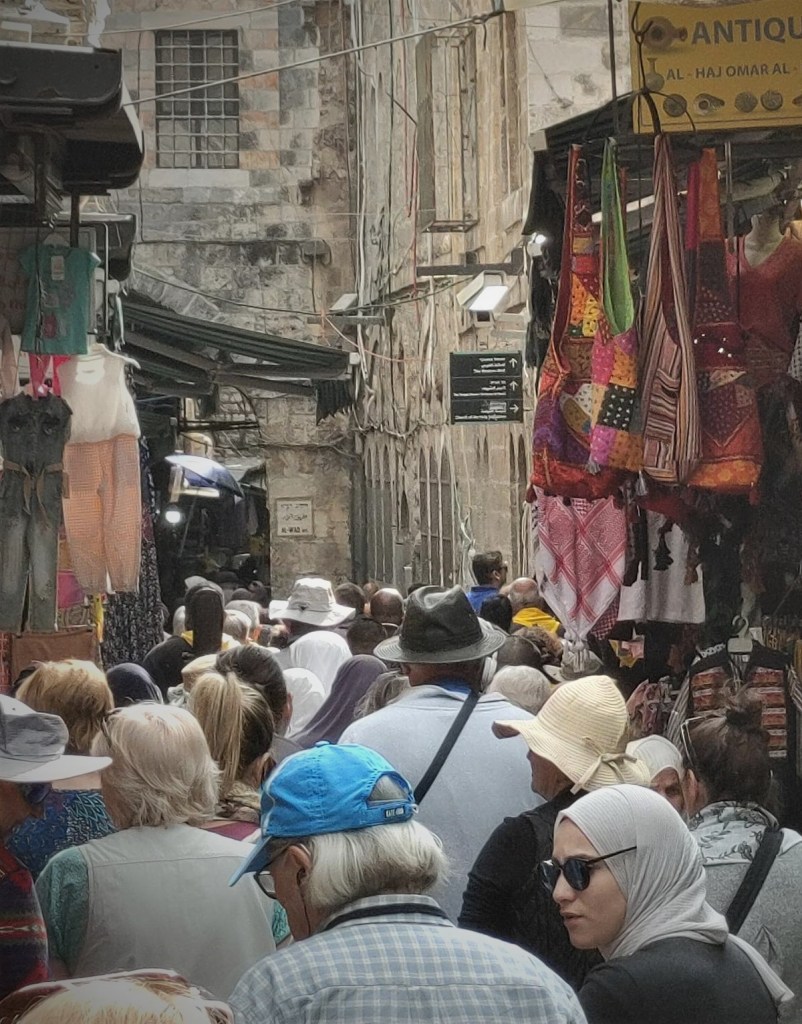
Walking the Via Dolorosa today will take you along narrow, cobbled streets worn smooth by the centuries. Modern-day pilgrims move to the rhythm of reverence and remembrance. Some carry symbolic crosses and sing sorrowful songs. Others stop to mark the stations with prayerful solemnity. Amid the heady aromas of fresh baked bread and Arabic coffee, tourists pause to haggle with shopkeepers over the price of fresh juice or hand-woven carpets. In the quantum-moment, Jesus still walks the way of immeasurable sorrow and limitless love — bloody, battered, dying.
How will you walk with Jesus along the way of sorrow?
Please pray with me . . .
Almighty God, we are pilgrims all, walking the Via Dolorosa and following Jesus’s path to the cross. Quiet our minds and open our understanding to the way of sorrow that Jesus chose to walk. May we dare to imagine his pain, to feel the weight of the cross, to hear the insults hurled. As we face our sorrow and the sorrow of our world, may we hear your voice, calling us by name. Raise us from death to life and send us forth with good news of a love that is stronger than death. Amen.
“His executioners made vulgar jokes about Him, called Him filthy names, taunted Him, smacked Him in the face, flogged Him with the cat, and hanged Him on the common gibbet—a bloody, dusty, sweaty, and sordid business.” — Dorothy L. Sayers
“When Christ calls a man, he bids him to come and die.”— Dietrich Bonhoeffer
“Christmas and Easter can be subjects for poetry, but Good Friday, like Auschwitz, cannot. The reality is so horrible it is not surprising that people should have found it a stumbling block to faith.”― W.H. Auden
“The dripping blood our only drink, The bloody flesh our only food: In spite of which we like to think That we are sound, substantial flesh and blood– Again, in spite of that, we call this Friday good.” ― T.S. Eliot








 Joann White