Unlikely Heroes

Sabbath Day Thoughts — “Unlikely Heroes” Mark 12:38-44

On December fourth, the eastern New York region of the American Red Cross will hold their “real heroes” celebration. It’s an annual dinner that honors Central and Northern New York residents whose acts of heroism or volunteerism have assisted those in need within their communities. It’s a feel-good evening of fun, food, and fundraising that honors everyday people who do extraordinary things.

This year, the Adult Good Samaritans Hero Award goes to four people who saw a car veer off the road and into a retention pond in the town of Clay. Tom Drumm and Lasaros Milian swam to the submerged car, removed the driver, and brought her to safety. Then, once on shore, Judy Kilpatrick and D. Paul Waltz provided further aid until emergency responders arrived.

The Community Impact Hero Award will go to Syracuse Mayor Ben Walsh. To stem the tide of gun violence in the city, Walsh pledged one million dollars of the city’s budget to meeting the crisis head-on. He created the Mayor’s Office to Reduce Gun Violence. The office has implemented a coordinated strategy to work with residents, law enforcement, and other community stakeholders. The innovative effort includes the Safer Streets initiative, which works directly with gang members to keep them out of trouble.

The Disaster Services Hero Award goes to two women: Melissa Roy and Danielle Martin. They coordinate the Community Schools Program for the City of Rome. Like our local Community Schools Program, Melissa and Danielle work year ‘round with at-risk families to ensure that students are fed, cared for, and successful in school, equipping them to become productive, engaged, and healthy citizens. When an EF4 Tornado tore through Rome on July 17, leaving a swath of destruction through south Rome and into the downtown, Melissa and Danielle worked non-stop alongside the Red Cross to feed the community and distribute much-needed supplies.

These unlikely heroes have shown courage, dedication, and character through their selfless acts to assist their neighbors.

Our gospel lesson this week introduced us to an unlikely hero. Jesus and his followers were in Jerusalem for that fateful, final Passover celebration. While visiting the Temple, the Lord took a break from teaching to do some people watching. Jesus’ friends must have been surprised by what he noticed.

First, Jesus considered some of the wealthiest and most influential people in the Temple courts: the scribes. These experts in the Torah played an important role in the life of Israel. They were highly educated to equip them to interpret the scriptures. They served as judges, rendering justice in Israel’s courts. They were also spiritual leaders, whose authority was passed down in families from generation to generation. Who wouldn’t want to be a scribe—privileged by birth, literate, wealthy, and respected? As they strode through the Temple courts in their costly robes and blessed the people with their flowery prayers, the scribes had the respect and adulation of the pilgrims who had come from across the Roman Empire for the Passover.

Jesus, however, wasn’t impressed. As only he could, Jesus saw beyond the fine clothes and eloquence to the very heart of the scribes, and he didn’t like what he saw. In a patriarchal world where women did not have property or inheritance rights, widows depended on the fairness and generosity of their husband’s heir to provide for them as they aged. In cases of neglect or abuse, a case could be brought before the scribes for justice. Or, in a case where there was no clear heir, property could be held in trust by the scribes, until a minor boy child reached adulthood. Although the scribes were well-versed in the Bible’s imperative to care for their vulnerable neighbors, Jesus saw that these Torah-experts were enriching themselves at the widows’ expense, devouring their houses by taking bribes, making biased rulings, and spending for their own benefit what they held in trust. Jesus’ indictment of the powerful and well-respected scribes would have shocked his listeners.

If the disciples were surprised by Jesus’ scorn for the Scribes, then they would have been even more amazed by his praise for the poor widow at the Temple’s Treasury, outside the Court of the Women. The Mishnah tells us that the treasury consisted of thirteen large metal boxes with an unusual shape, broad at the bottom and very narrow at the top, a bit like an inverted funnel, a shape that ensured that you couldn’t reach a hand down in to take money out.  In those days long before paper money, a large gift of coins dropped into the narrow mouth of the treasury made a loud noise as it rattled down to the bottom. A small gift dropped into the treasury made very little sound.

The gift Jesus’ widow made was very, very small. She gave two lepton, two tiny coins, worth 1/64th of the daily wage for a laborer. In today’s economy, where a day laborer earns $14.54 an hour, this woman’s gift was worth $1.82. In the grand scheme of Temple economics, the widow’s gift was practically worthless. Yet, Jesus saw into the widow’s heart and realized that she had made an extraordinary gift. In Greek, the words Jesus used for her offering are holon ton bion autaes, it literally means that she gave “her whole life.” She dedicated her time, her talents, her leptons, all she had and all that she would ever be to God. It was a gesture of radical love and trust, an offering of tremendous gratitude in the midst of loss and grief.  She gave her very self to the Lord.

I know it has been a tough week for many of us. Last week, I asked us to remember that, no matter what the outcome of the election would be, half of us would be disappointed. I reminded us that God is with us in the chaos and encouraged us to be gentle with one another. This week, my phone and computer have blown up with calls, texts, emails, and messages from folks, far and wide, who are deeply dismayed. I hear you, especially those who feel that the “scribes” have won the day to the detriment of the “poor widows” of our nation.

On Wednesday, I went to the local Department of Social Services. They facilitate assistance to people in need. I was accompanying an incredibly hardworking neighbor, who provides for a large, extended family. They had lost their SNAP benefits because they worked too much overtime. Sitting in that sterile, institutional office, across the desk from an overworked and under-resourced social worker, I pondered the crumbs that we throw to the poor. I couldn’t help but realize how incredibly privileged I am. I have more education than most people would probably ever want. I own a home. I never worry about whether I can put food on the table, if I have clothes to wear, or if I can repair my used car. I imagine that most of us are like me. Whether we like it or not, our lives, in terms of material resources, bear a closer resemblance to the scribe than they do the poor widow of today’s reading. What a terrible privilege and awesome responsibility that is!

I’ve been thinking about those real heroes, the ones that the Red Cross will honor on December fourth. They don’t fly or have superpowers. They don’t wear red capes and tights. I suspect they are a lot like us—ordinary people who dare to care and respond. Tom, Lasaros, Judy, and Paul saw someone in trouble and sprang into action. Ben Walsh had the gumption to seek to stem the tide of gun violence in his city. Melissa and Danielle’s hearts were touched by neighbors in crisis, and they walked into the breach left by the tornado with food and support.

If the 2024 election and the deep divides in our nation call us to anything, it is to do as much good as we can right where we are, to use the privilege, power, or authority entrusted to us to make a positive, caring, righteous difference in our world. We can be unlikely heroes, like the widow, like those Red Cross honorees. We can give holon ton bion autaes, our whole lives, to the Lord. We can make a difference in the lives of our neighbors, especially those who do not benefit from the advantages that are ours. Are you with me?

When Jesus called his friends over to celebrate the poor widow, I’m sure he was thinking of another gift, a heroic gift, soon to be made. The widow’s gift anticipated the offering that the Jesus himself would make. Within days, Jesus would be arrested and unjustly tried, tortured and condemned to death. Within days, the beaten and bloody Jesus would be marched through the streets of Jerusalem to his execution. Within days, he would hang on the cross, flanked by criminals, jeered at by spectators. Within days, Jesus would give his very life—holon ton bion autaes—for the redemption of our world.

May we dare to be unlikely heroes.

Resources

Jon Moss. “Syracuse anti-violence program making progress, more needs to be done, officials say” in Syracuse.com, June 5, 2024. Accessed online at Syracuse anti-violence program making progress, more needs to be done, officials say – syracuse.com

Sean I. Mills. “Worst tornado in 40 years to hit Oneida County; survey team outlines path, destruction” in Daily Sentinel, July 18, 2024. Worst tornado in 40 years to hit Oneida County; survey team outlines path, destruction | News | romesentinel.com

Micah D. Kiel. “Commentary on Mark 12:38-44” in Preaching This Week, Nov. 11, 2012. Accessed online at Commentary on Mark 12:38-44  – Working Preacher from Luther Seminary

Henry Langknecht. “Commentary on Mark 12:38-44” in Preaching This Week, Nov. 8, 2009. Accessed online at Commentary on Mark 12:38-44  – Working Preacher from Luther Seminary

Karoline Lewis. “Whole Life Living” in Dear Working Preacher, Nov. 1, 2015. Accessed online at Whole Life Living – Working Preacher from Luther Seminary


Mark 12:38-44

38 As he taught, he said, “Beware of the scribes, who like to walk around in long robes and to be greeted with respect in the marketplaces 39 and to have the best seats in the synagogues and places of honor at banquets! 40 They devour widows’ houses and for the sake of appearance say long prayers. They will receive the greater condemnation.” 41 He sat down opposite the treasury and watched the crowd putting money into the treasury. Many rich people put in large sums. 42 A poor widow came and put in two small copper coins, which are worth a penny. 43 Then he called his disciples and said to them, “Truly I tell you, this poor widow has put in more than all those who are contributing to the treasury. 44 For all of them have contributed out of their abundance, but she out of her poverty has put in everything she had, all she had to live on.”


Photo by Klaus Nielsen on Pexels.com

The Beautiful Feast

Sabbath Day Thoughts — “The Beautiful Feast” Isaiah 25:6-9

In October, we revived the pre-pandemic tradition of Committee Night, a monthly evening when the committees of the church gather. The evening begins at 5:30pm with a potluck supper. You never know what will turn up on the dinner table, but it is always good and plentiful. Last week, we had homemade soup, bread, charcuterie, fresh and dried fruit, salad, and a host of desserts, including not one but two birthday cakes for me. What a feast!

We typically transition from the dinner table to our small workgroups around 6:00pm. But as we laughed, swapped stories, and enjoyed the meal, time, as it often does when there is good food and good company, slipped away. About 6:20, I reluctantly shifted us from feast mode to work mode. Committees met, plans were made, and tasks assigned, all in time for choir practice to start at 7pm. That potluck meal felt like a victory as we shrugged off the vestiges of the COVID-19 pandemic and returned to right rhythms of eating, caring, and serving together.

In our reading from Isaiah, God granted the prophet a vision of the beautiful feast in the Kingdom of God. The table overflowed with sumptuous food and the finest of wine. The people of Israel and all the nations of the world rejoiced, feeding on the bounty that God had prepared. Every belly was full, every face flushed with satisfaction. The sound of laughter and song and heartfelt conversation rose in a blessed crescendo. Almighty God, that most generous and loving of hosts, met every hunger, dried every tear, and comforted every sorrow. Then, God had God’s own feast, to the amazement of all. God swallowed up death, ending forever the mortal shroud that parted the holy from the ordinary. What a feast! Isaiah’s vision has prompted hope and delight ever since.

This church is no stranger to the hope and delight that our beautiful feasts can engender. Back in 1927, we called the Rev. Hiram Lyon to serve as our pastor. The recent seminary graduate was a young bachelor with a flair for cooking. On several occasions, he put on summer dinners at Split Rock Farm for the church’s Men’s Club. We don’t know the menu, but since it was a bunch of guys, I think we can trust that there was grilling involved. There is a record, though, of what happened after dinner. The men sat around the campfire until late in the evening, watching the moon rise and the night fall. They pondered the billion stars of the Milky Way and the great mystery of the divine.

Perhaps the church’s fanciest feast took place in 1985. We had building on our minds—the extension of the church to create the Great Hall and the Christian Education classrooms. To share plans and kick-off the church’s fundraising efforts, we hosted a dinner at the Hotel Saranac. Invitations were mailed. Neighbors from the community were invited. I hear the food was excellent and the hall filled with hopeful expectation as we dreamed together about the blessing that would flow for us and for the community when our building effort reached completion.

I may be a little biased, but I think Duane’s and my wedding reception in the Great Hall, almost nineteen years ago now, was another echo of the beautiful feast. It wasn’t fancy. The deacons cooked up seven crockpots of soup. Duane and I provided an abundance of sandwich wraps, cheese and crackers, punch, and a fabulous wedding cake made by Dawne’s sister. Duane’s friends came all the way from Virginia to provide bluegrass music. Little girls twirled around the dancefloor in their princess dresses. And, the golden girls of the United Presbyterian Women sampled and provided commentary on every single soup. What a feast!

It might surprise us to learn that when Isaiah shared God’s hopeful vision of the holy banquet, the Hebrew people didn’t have a lot to celebrate. Gone were the days of unity for the twelve tribes. The northern clans had long ago split to form the Kingdom of Israel. The southern tribes confederated under the banner of Judah. Waves of foreign invasion had wracked the two kingdoms. Indeed, when Isaiah spoke, the northern kingdom had fallen to the Assyrians. Many of their northern kin had been deported, sent to the far corners of the Assyrian Empire. The invaders had almost vanquished Judah, too. They encamped around the walls of Jerusalem and sought to starve the kingdom into submission. Only the forethought of King Hezekiah, whose men had tunneled beneath the city walls to allow access to fresh water and supplies, allowed the hungry city to outlast the siege. As Isaiah spoke the vision of God’s beautiful feast, foreign invaders were again on the horizon. The Babylonian army was rising in the east in what would prove to be an unstoppable tide.

Our beautiful feasts don’t happen in a perfect world. When Hiram Lyon hosted those starry suppers for the Men’s Club, Saranac Lake was at the height of the tuberculosis pandemic. Sanatoriums and cure cottages overflowed with desperately sick neighbors who had come to our village in the hope of a cold air cure. Hiram Lyon knew all about that. He came to the village as a tuberculosis patient, having contracted the disease while a student at Union Seminary in Morningside Heights, NYC. He stayed in the village to pastor our church for ten years and minister to the sick whose experience he had shared.

When we banqueted at the Hotel Saranac and dreamed of a bigger, better building, we weren’t too certain about the future. The church’s Christian Education building—Gurley Hall—had originally been built as a stable and had not withstood the test of time. Under-insulated and poorly heated, it was no longer fit for classes or community use, and our efforts to excavate below the sanctuary to create the Lower Room hadn’t provided nearly enough space for our programs. We were renting space from St. Luke’s and the Methodists. In fact, we debated closing our doors and merging with our neighbors. And then there was the matter of funding. Someone—probably Sally’s husband Bill—had the vision to build, but we definitely didn’t have the money.

When Duane and I danced a bluegrass waltz and the children blew bubbles to bless us in the Great Hall on our wedding day, the church had been through bleak times. There was a full-blown schism with the departure of Pastor Chuck, and we had weathered a lengthy interim with the tough but wise Pastor Carol. People had left the church. We were plagued by poor communication and rival factions. I had inherited a $45,000 budget deficit. We would either make it or we wouldn’t, but we needed to turn the corner fast.

Isaiah’s vision affirms that our beautiful feasts do not happen in a perfect world where everything is blue skies, sunshine, and lollipops. It also affirms that God is present in the midst of our chaos. God longs to feed us, nurture us, dry our tears, and comfort us. The world is filled with war and the threat of war, pandemics, declining mainline churches, and bitter divisions. Yet Isaiah reminds us that God is more than a match for our chaos. God is in the middle of it, fighting to deliver us from all that makes our hearts tremble. Indeed, the God who swallows death whole has raised Jesus from the dead and broken down every barrier that can ever separate us from God’s eternal, unstoppable love. One day, we will all be seated at God’s table, bellies full, laughter ringing, conversation flowing, joy complete. What a feast!

Today, we will celebrate our own feast, here at the Lord’s Table, where generations of Presbyterians have been fed. Our beautiful feast does not happen in a perfect world. Bombs are falling in the Middle East. Children are starving in Gaza and Yemen, Afghanistan and Congo, Somalia and Sudan. We are days away from a hotly contested election that will leave at least half of our neighbors bitterly disappointed, no matter what the outcome. Yet we dare to come to this table, to remember that God is with us even when the world is at its most chaotic. God longs to comfort the grieving, feed the hungry, and dry the tears that flow. The Lord holds out to us the hope that one day all people, all nations, will gather at God’s banquet table—peaceful, beloved, and satisfied. Lord, speed the day!

This morning, like Isaiah, we engage in a prophetic act. As we share the Lord’s Supper, and we pledge our gifts to support the church in the coming year, we acknowledge that we do not live in a perfect world. But with God’s help, we can nudge this world a little closer to the Kingdom. With God’s help, we can live with hope and delight. With God’s help, we can feed the hungry, give drink to the thirsty, and bless the children. With God’s help, we can build a world where all are welcomed to the table. What a feast it will be! Amen.

Resources

Evelyn Outcalt and Judy Kratts. A History of the First Presbyterian Church of Saranac Lake, written in celebration of the church’s centenary, July 25, 1990.

Anathea Portier-Young. “Commentary on Isaiah 25:6-9” in Preaching This Week, Nov. 1, 2015. Accessed online at Commentary on Isaiah 25:6-9 – Working Preacher from Luther Seminary

Amy Erickson. “Commentary on Isaiah 25:6-9” in Preaching This Week, Nov. 4, 2012. Accessed online at Commentary on Isaiah 25:6-9 – Working Preacher from Luther Seminary

Julianna Claasens. “Commentary on Isaiah 25:6-9” in Preaching This Week, Nov. 1, 2009. Accessed online at Commentary on Isaiah 25:6-9 – Working Preacher from Luther Seminary

Corinne Carvalho. “Commentary on Isaiah 25:6-9” in Preaching This Week, Nov. 7, 2021. Accessed online at Commentary on Isaiah 25:6-9 – Working Preacher from Luther Seminary


Isaiah 25:6-9

6 On this mountain the Lord of hosts will make for all peoples
    a feast of rich food, a feast of well-aged wines,
    of rich food filled with marrow, of well-aged wines strained clear.
And he will destroy on this mountain
    the shroud that is cast over all peoples,
    the covering that is spread over all nations;
    he will swallow up death forever.
Then the Lord God will wipe away the tears from all faces,
    and the disgrace of his people he will take away from all the earth,
    for the Lord has spoken.
It will be said on that day,
    “See, this is our God; we have waited for him, so that he might save us.
    This is the Lord for whom we have waited;
    let us be glad and rejoice in his salvation.”


Photo by Bave Pictures on Pexels.com

Threading the Needle

Sabbath Day Thoughts — “Threading the Needle” Mark 10:17-31

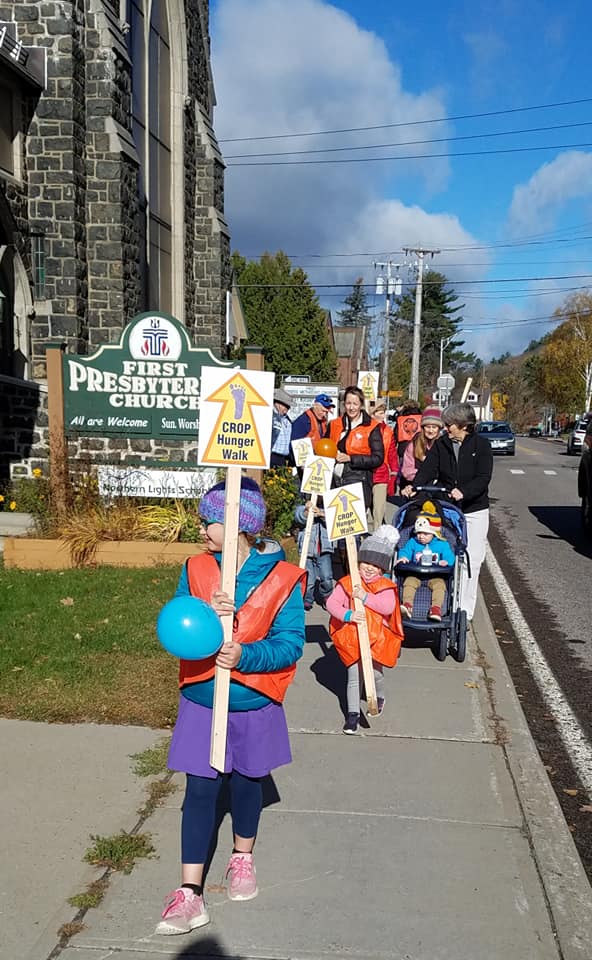
Next Saturday, walkers from this church will join our ecumenical neighbors in the annual Saranac Lake CROP Walk. We’ll be raising funds for the international hunger programs of Church World Service and the Interfaith Food Pantry here at home. CROP walkers say, “We walk because they walk.” It’s an acknowledgment of our solidarity with global neighbors who daily walk for food, water, work, school, and firewood.  The average distance that women in the developing world walk every day for water for their families is 3.4 miles. Elma Kassa of Ethiopia walks for water. Although Elma would like to go to school, she cannot because she helps her mother wash clothes to support the family.  Four times every day, Elma collects water, using a five-gallon clay jar.  Perhaps next Saturday as walkers stride down LaPan Highway from the Alliance Church to our church, they can think of Elma, with her heavy clay jar atop her head.

CROP Walks seek to eradicate hunger.  That’s a formidable task.  The Global Hunger Index tracks the state of hunger worldwide, country by country. Their 2024 report shows that little progress has been made in reducing hunger since 2016. Forty-two countries still experiencing alarming or serious hunger. Globally, 733 million people lack access to sufficient calories, and 2.8 billion people cannot afford a healthy diet. Acute food insecurity and the risk of famine are on the rise, and starvation is proliferating as a weapon of war. Worldwide, 148 million children are stunted, 45 million children are wasted, and almost 5 million children die before age five from hunger-related causes. The situation is most severe in Burundi, Yemen, and Niger—and it is on the rise in Afghanistan, Argentina, and Mongolia. Hunger kills more than nine million people each year, more than AIDs, malaria, and tuberculosis combined. 3.1 million of those deaths are children. 

People are hungry in the United States. The USDA estimates that 44.2 million Americans nationwide live in food insecure households. These are homes where meals are skipped or kids are sent to school without breakfast because there aren’t sufficient resources to put food on the table. 28% of households with children indicate that kids were not eating enough because families could not afford food, thanks to inflated prices and the end of federal pandemic relief support. Feeding America reports that more than 53 million people turn to food banks, food pantries, and meal programs for help. That’s one-third more than prior to the pandemic. Our food pantry volunteers will tell you that the Saranac Lake pantry downstairs is a busy place on Saturday mornings, serving all kinds of neighbors—seniors, single moms, traditional families, and people living with homelessness, mental illness, developmental disabilities, or physical handicaps.

Jesus’ encounter with the rich man invites us to consider the responsibilities of our relative affluence in a world plagued by persistent hunger.  Breathless after his run, kneeling in the dust of the road at Jesus’ feet, the rich man wanted to know what he must do to inherit eternal life. This righteous man was relieved to hear Jesus reciting the instructions of the Torah—no murder, adultery, stealing, lying, or defrauding. Be sure to honor your parents. The man had kept all these commandments from his youth, and he must have done so with great earnestness and integrity, because Jesus loved him for it and invited him to become a disciple.

There was only one thing lacking. Although the man was expert in keeping the Torah, he seemed to have fallen short in tzedakah or almsgiving, one of the most essential principles of Jewish piety.  Our Jewish ancestors believed that, ultimately, everything belongs to God.  While God could have created a world where everyone had exactly the same distribution of God’s bounty, God chose not to do so. Instead, some, like the rich man, were given much, while others had little. This uneven distribution of resources was how God invited faithful people to join their purpose to God’s purpose, to live lovingly and generously so that God’s goodness could abound for all. Faced with Jesus’ invitation to sell what he owned for the blessing of his impoverished neighbors, the rich man turned his back on a life with Jesus and went away grieving.

When it comes to wealth, we don’t consider ourselves rich, certainly not rich enough to be labeled “the rich man” or “the rich woman.” But when we see ourselves through the eyes of the world, we are more than blessed. The average daily wage in the United States is about $162. Developing countries with unstable political and economic conditions do not fare nearly so well. In Nepal, the average daily wage is $3.75; in Sudan, it’s $2.71; and in Afghanistan, people try to survive on less than a dollar a day. I have said it before, and I suspect that I will say it again, my friends. We are blessed—we are rich.

I’m not saying that we don’t work hard to earn what we have. We may spend long years striving in tough jobs to give our families the sort of home life and advantages that we wish them to have. I see a lot of hard workers when I look out at our pews on Sunday mornings. But I wonder if we see our relative wealth in the same way that Jesus invited the rich man to think of his money. Our relative affluence is a generous gift from God to bless our lives and to bless the lives of our impoverished neighbors. I wonder what our household expenditures might look like if Jesus were writing the checks. Today Jesus gives the rich man—and us—an uncomfortable reminder that we are meant to share God’s blessing with others.  When we do so, we get a foretaste of God’s Kingdom, where all are welcomed to the bountiful feast that Jesus has prepared.

I want to share how our participation in the CROP Walk can allow us to be a blessing to our neighbors, near and far. Our CROP dollars will help world neighbors like Moize Munenwa Joseph, one of over 800 people in Tanzania who participated in a CWS-sponsored vegetable farming program. Moize learned valuable farming skills like seed selection, pest control, and farm cleanliness. This helped him to improve his harvest and increase his income. Now Moize is sharing what he learned with others in his community. Moize says, “I can take care of my family and ensure we consume healthy food.”

Our CROP dollars can help world neighbors like Hak Nhy in Cambodia. For generations, her family has lived off crops from their vegetable farm. Challenges from climate change and the pandemic affected their harvest, leaving Hak and her family with barely enough to eat or sell. Hak enrolled in a Church World Service gardening program that taught her how to plant a more productive and nutritious garden. Hak says, “I have [gained] skills and knowledge on vegetable gardening, adapting to the changing weather conditions, and compost making.” Her family now has a better diet and her garden’s increased harvest allows her to sell surplus vegetables.

Our CROP dollars also help world neighbors like Alodia González, who lives in rural Paraguay. Alodia’s family struggled to have a stable income until she participated in a CWS training that focused on planting seeds and food production. Alodia learned about beekeeping and making honey. She also learned to organize and launch a community garden. Alodia says, “With a good production of honey, we are generating significant income to support our families. With the garden, we are able to eat lettuce and other vegetables produced by us.”

Our CROP dollars can be the kind of blessing that Jesus had hoped the rich man might share with his impoverished neighbors. I’m not talking about selling everything we have and giving it all away this morning. The good news for us is that even a modest gift that is well within our budgets can make a big difference in the lives of our needy neighbors.  A $20 pledge can provide chickens for a family—chickens are a lasting resource for eggs and meat. $60 is enough to help three families with seeds and training for home gardening. They’ll have better nutrition and the extra income that comes with plenty of veggies. A $161 pledge would be enough to enable a farmer to plant an acre of sweet potatoes, to provide both food and income. Are we feeling especially generous? $1,499 buys the whole farm—seeds, meat animals, and training to provide a family with reliable sources of food and income to meet their needs for years to come.

The rich man may have turned away from Jesus, saddened by the invitation to discipleship that Jesus shared with him. But I suspect that this morning, as we consider the call to discipleship and the impact of CROP Walk, we are getting inspired, eager even, to make a difference in the lives of hungry neighbors.  We are blessed, my friends, so that we might be a blessing to others. May we go forth to follow Jesus, sharing generously of our abundance to make a difference in the lives of our hungry neighbors.

Resources

Concern Worldwide. “Global Hunger Index 2024.” Accessed online at 2017 Global Hunger Index: The Inequalities of Hunger (concern.net)

Mehdi Punjwani. “Average salary in the U.S. in 2024” in USA Today, Sept. 26, 2024. Accessed online at Average Salary in the U.S. in 2024 (usatoday.com)

World Data. “Average income around the world” October 2024. Accessed online at https://www.worlddata.info/average-income.php

Church World Service. CWS (cwsglobal.org)

Mark G. Vitalis-Hoffman. “Commentary on Mark 10:17-31” in Preaching This Week, Oct. 11, 2015. Accessed online at Commentary on Mark 10:17-31  – Working Preacher from Luther Seminary

David Lose. “Commentary on Mark 10:17-31” in Preaching This Week, Oct. 14, 2012. Accessed online at Commentary on Mark 10:17-31  – Working Preacher from Luther Seminary

Matt Skinner. “Commentary on Mark 10:17-31” in Preaching This Week, Oct. 11, 2009. Accessed online at Commentary on Mark 10:17-31  – Working Preacher from Luther Seminary

To make a donation: https://events.crophungerwalk.org/cropwalks/event/saranaclakeny


Mark 10:17-31

17 As he was setting out on a journey, a man ran up and knelt before him and asked him, “Good Teacher, what must I do to inherit eternal life?” 18 Jesus said to him, “Why do you call me good? No one is good but God alone. 19 You know the commandments: ‘You shall not murder. You shall not commit adultery. You shall not steal. You shall not bear false witness. You shall not defraud. Honor your father and mother.’ ” 20 He said to him, “Teacher, I have kept all these since my youth.” 21 Jesus, looking at him, loved him and said, “You lack one thing; go, sell what you own, and give the money to the poor, and you will have treasure in heaven; then come, follow me.” 22 When he heard this, he was shocked and went away grieving, for he had many possessions.

23 Then Jesus looked around and said to his disciples, “How hard it will be for those who have wealth to enter the kingdom of God!” 24 And the disciples were perplexed at these words. But Jesus said to them again, “Children, how hard it is to enter the kingdom of God! 25 It is easier for a camel to go through the eye of a needle than for someone who is rich to enter the kingdom of God.” 26 They were greatly astounded and said to one another, “Then who can be saved?” 27 Jesus looked at them and said, “For mortals it is impossible, but not for God; for God all things are possible.”

28 Peter began to say to him, “Look, we have left everything and followed you.” 29 Jesus said, “Truly I tell you, there is no one who has left house or brothers or sisters or mother or father or children or fields for my sake and for the sake of the good news 30 who will not receive a hundredfold now in this age—houses, brothers and sisters, mothers and children, and fields, with persecutions—and in the age to come eternal life. 31 But many who are first will be last, and the last will be first.”


Sowing the Seeds of Peace

Sabbath Day Thoughts — “Sowing the Seeds of Peace” Zech. 8:3-17

Since 1940, churches have observed a world-wide communion on this first Sunday of October. It’s a sign of our unity in Christ. As we gather at the table, we remember that we are made one in Christ. And as we go forth from worship, we resolve to take the unity, peace, and love of Christ with us, so that our actions in our families, communities, and beyond might anticipate and promote the unity that God longs to see for our world.

That first World Communion Sunday was a prophetic act, undertaken in a time that was descending into worldwide violence. In October 1940, France had fallen to Hitler’s invading army. The Vichy government had just proclaimed the end of Jewish status, denying their Jewish citizens the most essential of rights and freedoms. Concentration camps across German-occupied Europe were filled with men and women, conscripted into forced labor in inhuman conditions. Hitler was meeting with Mussolini at the Brenner Pass in the Alps, where they devised plans for world domination. Within days, the Blitz would rain bombs on the streets of London, Bristol, and Coventry, England.

World Communion this year coincides with the anniversary of the Hamas terror attack on southern Israel. On October 7, 2023, 1,195 Israeli civilians were killed and more than 200 were taken hostage. In response, the Israeli Defense Forces launched a war against Hamas in Gaza. 41,431 Palestinians have been killed, more than half of them women and children. 1,706 Israeli soldiers have died. About 120 journalists, reporting on the war, have lost their lives, as have 224 humanitarian aid workers and 179 United Nations Relief Workers (UNRWA). 60% of the people in Gaza have lost a family member this past year. This week, we held our breath while Israel took the fight to Lebanon, targeting Hamas and the anti-Israeli militant group Hezbollah, which is equipped by Iran. Predictably, the Iranian response launched 180 missiles into Israel’s airspace. It is estimated that 1.2 million people were displaced in Lebanon this week, fleeing the escalating violence.

We do not know what will happen in the coming year as Israel continues their offensive and Iran responds. We do not know what will happen as Vladimir Putin pursues his grievous war against the people of Ukraine. We do not know what will happen as Yemen’s Houthi rebels launch missiles at passing cargo ships. We do not know what the future holds for the civil war in famine-ridden Sudan. We do know that we need World Communion today every bit as much as we did when it was initiated in 1940.

Our reading from the Prophet Zechariah promises peace and abundant life for people in a time of struggle and wavering hope. Written in the year 522BCE, the Israelite people lived in a landscape that had been scarred by war. Some of the people were newly returned from years of exile in Babylon. Clans that had been separated by more than half a century of captivity were learning how to be family again. And they were seeking to do so amid trying circumstances. Fields and orchards had gone fallow. Trade routes were disrupted. The city of Jerusalem lay in ruins—its walls breached and the temple burned to the ground. When the Persian Empire defeated Babylon, the people had rejoiced as they were sent home to their Promised Land with resources and the blessing to rebuild. But where would they start? Who could do the work? Would the land ever again flow with milk and honey?

Into this trying time, God spoke a word of encouragement and hope through the Prophet Zechariah. God promised a rebuilt Jerusalem, where the streets would be filled with blessing: everyone would live to a ripe old age and the sounds of children laughing and playing would ring out. God would sow the seeds of peace, and there would be a harvest of abundance: grape vines heavy with ripe fruit, golden fields waving with ripe grain, rain falling to water the land, a people living as a blessing to the nations. Can we imagine how good those words sounded to the people who heard Zechariah speak?

The people would play their own part in bringing that peaceful abundance to pass. There would be the hard physical work of tending fields and flocks, raising up the walls, and rebuilding the Temple. And, according to Zechariah, there would be some demanding personal work. The people would need to sow their own seeds of peace. They would need to speak truth and ensure that justice was passed at the court of the city gate. They would need to turn from evil and work for the good of all their neighbors. They would need to put an end to the lies that divided communities and prevented justice in the land. God would plant seeds of peace, and so must God’s people, sowing peace and justice one household, one neighborhood, one city at a time. This was the Lord’s vision, God’s best hope for God’s people.

It’s a beautiful vision that God continues to hold out to faithful people all around the world this morning. Even now, God is sowing seeds of peace. God envisions a world where Israel, Hamas, Hezbollah, and Iran will come to the table of peace. God sees a time when the people of Ukraine and Russia will beat their weapons of war into plowshares and pruning hooks. God dreams of the time when famine-stricken and civil-war-torn places like Yemen and Sudan will end their strife and the people will eat the bread of peace. The seeds of peace will grow and flourish in a world-wide harvest, the lion shall lie down with the lamb, and the people will know war no more. Lord, hasten the day!

We do not know what will happen this year in all those conflict-ridden, war-torn, frightening places, but this morning we do know that there is work for us to do. God’s people always have a role to play in bringing God’s hopeful sowing of the seeds of peace to an abundant harvest. Zechariah told us so. It starts here with our personal resolve to do the things that make for peace. Are we ready?

First, we are to speak truthfully to one another, not only expressing what is true, factual, and responsible but also listening to the truths of others. As truth is spoken and ears are opened. We find a way to move forward, past times of division and misunderstanding.

Next, we are to ensure justice for all people, whether it is the court of public opinion, our local town courts, or our broader legal system. In the words of the late Rev. Dr. Martin Luther King, jr., “No justice, no peace.” We all, especially those among us who are marginalized, impoverished, and at-risk, deserve our day in court and justice for all.

We also need to rethink our definition of neighbor. If we accord the honor and care of “neighbor” only to those who look like us, think like us, and act like us, then we are doomed to always live in the land of “us and them.” Can we instead dare to find common ground and work together for a world community where everyone is a neighbor and a beloved child of God?

Finally, we cannot honor lies as truth, or as Zechariah puts it, we cannot “love perjury.” That calls for personal vigilance that calls out old family stories that perpetuate division and misunderstanding. That calls for communities that refuse to scapegoat vulnerable people, like immigrants or minorities, blaming them for all our social, civic, and economic ills. That calls for doing our due diligence to ensure that we do not repeat stories that are not factual, whether we heard it on the street, saw it on social media, or watched it on television. As long as we accept lies as truth, we cannot live in peace. Can I get an amen?

This morning, the Prophet Zechariah reminds us that God has sown the seeds of peace. The Lord, through the Prophet Zechariah, has even given us a roadmap to the things that make for peace. It starts with us, my friends. The only question remaining on this World Communion Sunday is, “Will we do our part in bringing God’s generous sowing of peace to a full and abundant harvest that is a blessing to all?”  Zechariah–and the Lord–hope that our answer is a resounding, “Yes!”

Resources:

PCUSA. “A Sowing of Peace” Presbyterian Peacemaking Program. Louisville: PCUSA, 2024.

David Petersen. Haggai and Zechariah 1-8. Philadelphia: Westminster Press, 1984.

Peter C. Craigie. Twelve Prophets, vol. 2. Philadelphia: Westminster Press, 1985.

AP News. “What to know about fighting in Lebanon and Gaza” in The Associated Press, October 5, 2024. Accessed online at https://apnews.com/article/israel-lebanon-what-to-know-hezbollah-incursion-c44358cb4c70db69bdab4b254cb2ed76

–. “Casualties of the Israel–Hamas war” in Wikipedia, the online encyclopedia, October 4, 2024. Accessed online at Casualties of the Israel–Hamas war – Wikipedia


Zechariah 8:3-17 (HCSB)

The Lord says this: “I will return to Zion and live in Jerusalem. Then Jerusalem will be called the Faithful City, the mountain of the Lord of Hosts, and the Holy Mountain.” The Lord of Hosts says this: “Old men and women will again sit along the streets of Jerusalem, each with a staff in hand because of advanced age. The streets of the city will be filled with boys and girls playing in them.” The Lord of Hosts says this: “Though it may seem incredible to the remnant of this people in those days, should it also seem incredible to Me?”—this is the declaration of the Lord of Hosts. The Lord of Hosts says this: “I will save My people from the land of the east and the land of the west. I will bring them back to live in Jerusalem. They will be My people, and I will be their faithful and righteous God.” The Lord of Hosts says this: “Let your hands be strong, you who now hear these words that the prophets spoke when the foundations were laid for the rebuilding of the temple, the house of the Lord of Hosts. 10 For prior to those days neither man nor beast had wages. There was no safety from the enemy for anyone who came or went, for I turned everyone against his neighbor. 11 But now, I will not treat the remnant of this people as in the former days”—this is the declaration of the Lord of Hosts. 12 “For they will sow in peace: the vine will yield its fruit, the land will yield its produce, and the skies will yield their dew. I will give the remnant of this people all these things as an inheritance. 13 As you have been a curse among the nations, house of Judah and house of Israel, so I will save you, and you will be a blessing. Don’t be afraid; let your hands be strong.” 14 For the Lord of Hosts says this: “As I resolved to treat you badly when your fathers provoked Me to anger, and I did not relent,” says the Lord of Hosts, 15 “so I have resolved again in these days to do what is good to Jerusalem and the house of Judah. Don’t be afraid. 16 These are the things you must do: Speak truth to one another; make true and sound decisions within your gates. 17 Do not plot evil in your hearts against your neighbor, and do not love perjury, for I hate all this”—this is the Lord’s declaration.


Photo by Binyamin Mellish on Pexels.com

True Abundance

Sabbath Day Thoughts — “True Abundance” John 10: 7-10

Plastic is perhaps the greatest pollution threat to our planet. In the past fifty years, it has become the primary material used in our packaging industry, replacing paper, cardboard, metal, and glass. One million plastic water bottles are purchased every minute worldwide. Five trillion plastic bags are used each year. 460 million tons of plastic are produced annually, and that production is anticipated to increase by one-third in the next five years.

Plastic is an environmental threat. Whether we bury plastic in landfills or dump it untreated into our waters, plastic is slow to biodegrade, taking twenty to five hundred years to decompose. A plastic bag buried in a landfill is estimated to take 1,000 years to breakdown. There is an estimated 75 to 199 million tons of plastic waste currently in our oceans, with a further 33 billion pounds of plastic entering the marine environment every single year. Ocean wildlife mistake plastic waste for prey. Unable to digest the plastic they eat, fish, turtles, and birds suffer internal injuries and starvation. A sperm whale that washed up at the Wakatobi National Park in Indonesia in December 2018 had more than a thousand pieces of plastic in its stomach.

When plastic biodegrades, it lingers in the environment as microplastics—tiny plastic particles less than five millimeters in size that make their way into water, farmland, and the food we eat. Studies have found that our personal annual consumption of microplastics is equivalent to eating 50 plastic bags per year or one credit card each week. The chemicals in these microplastics are linked to a bevy of health concerns, like reproductive problems, obesity, organ disease, developmental delays in children, and chronic inflammation.

Plastics sure are convenient. Just about everything—our breakfast yogurt, laundry detergent, shower gel, and ice cream—is neatly and durable packaged. But our dependence upon plastic is a problem for the planet, perilous to wildlife, and bad for our health. It’s a twenty-first century problem, yet I like to think that on this Care for Creation Sunday Jesus might have some first century wisdom to help us rethink our relationship with plastic.

In our reading from John’s gospel, Jesus characterized himself as the “good shepherd,” drawing upon a key metaphor from the Hebrew Bible. In Ezekiel 34, evil and corrupt kings were characterized as bad shepherds of the people, who ruled with force and harshness, scattering and destroying the flock. God promised to rescue the flock of Israel from their evil rulers. God would be Israel’s good shepherd. God would seek the lost, gather the scattered, and feed the people on rich pasture.

Jesus had seen some bad shepherding for the people of Israel. Herod Antipas, Herod Philip, and Pontius were all Roman appointed rulers. Their mission was to collect taxes to fill the emperor’s treasury and put down any whiff of rebellion. Instead of shepherding the people, they exploited them to line their own pockets and ensure their position and power. Even the chief priest in the temple was a Roman appointee, part of an elite class religious professionals who had controlled the worship life of Israel since the Roman invasion.

Jesus saw the suffering of his people at the hands of bad shepherds and longed to fulfill God’s plan to shepherd them. Jesus promised his friends “abundant” life. The Greek word that Jesus used for abundant is perisson. It means a life that is more, a life that is over and above what we have come to expect. An abundant life provides enough to meet our needs. Think of Jesus feeding the multitudes, welcoming outsiders, and healing the sick. Jesus’ abundance surpassed this, not in ways that would grant political power or bring fabulous wealth. Jesus wanted his followers to find more life, eternal life, in his Father’s Kingdom, a life that could not be bound by time or space or even death. Abundant life is blessed now as we live a balanced life with love for God and neighbor. Abundant life is blessed eternally as we anticipate that far brighter light on that far better shore. Abundant life is found in Christ the good shepherd.

One of the great challenges that we face in our world today is that we have forgotten what true abundance looks like. Jessica Maudlin, who heads the PCUSA’s Earth Care Congregations initiative and resources the ecumenical thinktank Creation Justice Ministries, cautions that we confuse true abundance with excess, with acquiring more stuff than we will ever use and consuming more than our world can sustain. Our excess is an idolatry that lulls us into thinking that we save ourselves when only God can do that. Our excess threatens the planet that has been entrusted to our care. Our excess is a failure to love our neighbors to come—the generations who must live with the legacy of what our excess leaves behind.

On this Care for Creation Sunday, Jesus might invite us to be reoriented, to trade our excess for his true abundance. It may not be easy. We begin by affirming that Jesus is our good shepherd, who has provided for us the blueprint for true abundance. As we rely upon the Lord instead of ourselves, we learn to shift our priorities from acquiring more and stockpiling excess to ensuring that there is enough for ourselves, our neighbors, and the wild world around us. We can follow Jesus by becoming better shepherds of our resources, so that the abundant life promised by the Lord is a promise for the planet and for generations to come.

I want to circle back to all those concerning facts about plastics that I mentioned at the start of this message because I think it’s a place where we need to—and can—make a difference. We can begin by reducing our plastic consumption. If you google the words “plastic footprint calculator,” you’ll find some useful web-based tools that will help you track how much plastic you use each year and guide you in thinking about ways to use less. Check it out. We can also purchase the new generation of bioplastics. Made from corn or bamboo, bioplastics are a little pricey, but they compost and biodegrade easily in landfills.

We can also move away from single-use plastics by reusing. Carry a water bottle or a reuseable coffee cup. Remember to keep a stash of cloth shopping bags in your car. Invest in a durable stainless-steel straw and skip the plastic straws used in convenience stores. Bring your own containers for leftovers when you dine out.

We can get better about recycling. Only 14% of plastics get recycled. You know what happens to the other 86%. Look for a trash service that recycles. Sort it yourself and make sure you get everything in the right receptacles at the transfer station. Did you know that you can now recycle plastic bags and wraps locally? The Women’s Civic Chamber is collecting clean, dry plastic bags. Partnering with Trex, a company that makes composite decking, they’ll turn our bags and wrappers into park benches. You can donate yours at collection bins at Nori’s, Woods and Waters, Kinney Drugs, and Harrietstown Town Hall. They started this in May and have already collected enough plastic—1,000 pounds—to make the first bench. Trex reclaims about a billion pounds of plastic each year.

We can also try removing the plastics that we find. Take a bag along on your neighborhood walk and pick up the trash. This morning as I took Gybi around the block, I picked up: a chip bag, a wrapper for Chips Ahoy, a single-use water bottle, a big bottle for Arnold Palmer (aka iced tea mixed with lemonade), a zip lock bag, a candy dispenser, and a plastic mini-basketball—and there were two plastic bags filled with poop from another dog (at least I hope it was a dog). If you are hitting the trail or paddling the waters, take care to ensure that everything that comes in with you goes back out—and pick up what others leave behind. And don’t forget that our fall highway clean-up will be scheduled in the coming weeks. We’ll be collecting trash along Rte. 186 in Lake Clear. There will be plenty of plastic: soda bottles, carry-out containers, masks, compact disks, diapers, and more. Sign up to help out and see who can collect the most plastic.

Well, my friends, an abundant life doesn’t need to include an abundance of plastic. It just needs the good shepherd. With our careful shepherding of resources, the abundant life promised by the Lord can be a promise for the planet and for generations to come. May it be so.

Resources

Aaron Marbone. “Building benches with plastic” in Adirondack Daily Enterprise, May 11, 2024. Accessed online at Building benches with plastic | News, Sports, Jobs – Adirondack Daily Enterprise

Jessica Maudlin, et al. “Plastic Jesus: Real Faith in a Synthetic World,” in Creation Justice Ministries, Earth Day Sunday 2024. Accessed online at Plastic Jesus – CREATION JUSTICE MINISTRIES

Statista. “Global Plastic Packaging Industry—statistics and facts.” Accessed online at statista.com

United Nations Environmental Program. “Our Planet Is Choking in Plastic,” an interactive  resource for individuals, schools, and teachers in UNEP Interactives, 2024. Accessed online at https://unep.org/interactives/beat-plastic-pollution.

–. Plastic Footprint Calculator. Plastic Bank. Accessed online at Plastic Footprint Calculator – Plastic Bank


John 10:7-10

So again Jesus said to them, “Very truly, I tell you, I am the gate for the sheep. All who came before me are thieves and bandits, but the sheep did not listen to them. I am the gate. Whoever enters by me will be saved and will come in and go out and find pasture. 10 The thief comes only to steal and kill and destroy. I came that they may have life and have it abundantly.


Photo by Catherine Sheila on Pexels.com

Come as a Child

Sabbath Day Thoughts — “Come as a Child” Mark 9:30-37

Perhaps the only positive outcome of the COVID-19 pandemic was a temporary decrease in the number of American children living in poverty. Federal economic security programs kept 53 million people above the poverty line in both 2020 and 2021. Child tax credits, increased food assistance, the extension of unemployment benefits, and three rounds of stimulus checks drove child poverty down to an all-time low of 5.2%. With the expiration of these programs in 2022, child poverty was again on the rise. According to the Annie E. Casie Foundation, 16% of American children now live in poverty. That’s 11.6 million kids. New York’s child poverty rates are among the worst in the nation. We rank forty-first out of the fifty states.

The likelihood of child poverty is higher here in the North Country. In Franklin County, 21.3% of our children live in poverty. Those numbers are higher for families of color. About 32% of racial ethnic children live below the federal poverty line. The impact of child poverty can last a lifetime. Impoverished families have less access to healthy food and quality medical care. A poverty diet is high in processed foods, fat, and carbohydrates. That’s a recipe for childhood obesity. Children in poverty are more likely to live in substandard housing, experience homelessness, and be exposed to crime and substance abuse in at-risk neighborhoods. Children in poverty have lower readiness when entering school and are more likely to have developmental challenges. Families in poverty live in chronic stress that leaves kids feeling anxious, depressed, and frightened.

When we further consider families who work in low wage jobs that lift them above the federal poverty threshold but don’t pay enough to meet monthly expenses, then we begin to see the enormity of the child poverty crisis. The Ouimette family of AuSable Forks is a case in point. William works for the town of Jay’s highway department and also serves as a volunteer firefighter. Miranda is a stay-at-home mom to their three kids between the ages of 6 and 9. William says, “It’s harder and harder for people just to get by on a job like working for the state or the town or anything now.” The Ouimettes struggle to pay for essential things like car repairs and new items for their kids. They fear they will be priced out of the home where their family has resided for generations.

Child poverty is nothing new. In Jesus’ day, 90% of people lived in poverty with little resource for rising above the circumstance of their birth. Within that impoverished time, children were particularly vulnerable. They were considered the lowest status members of society. Children lacked legal standing and protection as individuals and were instead deemed the property of their fathers. Indeed, children could be sold into slavery to settle a father’s debts. Although children were seen as a gift from God, a safeguard against extreme poverty in old age, children were expected to be unconditionally obedient and subject to the strict discipline of parents. The Book of Proverbs instructs, “Those who spare the rod hate their children, but those who love them are diligent to discipline them.” According to Exodus and Leviticus, the punishment for children who curse their parents or fail to honor them was death – judgment and stoning by the community. In the Gentile world, unwanted newborns were routinely exposed, left out in the open to die—or to be taken in by strangers and raised as slaves or prostitutes.

Given the low standing of children in the disciples’ world, we can imagine the shock that they felt when Jesus placed a child among them as someone to be welcomed and emulated. In today’s gospel reading, Jesus warned his friends of the suffering and death that would await him in Jerusalem. But along the way to Capernaum, instead of discussing better ways to protect Jesus and guard against betrayal, the twelve argued about who among them was the greatest. They compared genealogies and miracles, sermons and bank accounts, patrons and illustrious acquaintances, all in an effort to assert their personal worth. That child that Jesus held in his arms didn’t make any sense. Why would Jesus identify with a child? Why would he expect them to welcome and serve the lowest status person in the room?

Biblical scholar J.D.M. Derrett says that when Jesus scooped the little child up in his arms, Jesus was engaging in a symbolic act. In the Hebrew tradition, receiving or placing someone else’s child on your knee or in your embrace in front of the witnessing community was a rite of adoption.  We see this in the Book of Genesis, when the childless Sarah and Rebecca brought their servant women to their husbands to conceive children, insisting that those children would be born “on their knees” as rightful sons of the patriarchs. If J.D.M. Derrett is right, then Jesus was saying that the most vulnerable of people, like children, especially belong to Jesus. The disciples could not love and honor him without loving and honoring them.

Beyond that simple call to humble service, Jesus was reminding his friends, many of whom had left their families behind to follow him, that he had adopted them. They were his children. As his sons and daughters, they must demonstrate toward him the obedience, honor, and respect that they would a father. The disciples were meant to be brothers and sisters in Jesus’ family, not rivals for greatness. That tender embrace that the child found in Jesus’ arms reflected the love and support that the disciples found in Christ, who welcomed them, not because of their great achievements, but simply because he chose to love them, regardless of their status. In that unconditional love, they would find the courage and inspiration to be servants of all.

As messages go, today’s reading is clear. The “least of these” are deserving of the service and welcome that we would extend to the Lord. When we see vulnerable neighbors, we are to think of Jesus, responding with the sort of compassion and care that were the hallmark of Jesus’ earthly ministry. Beyond that, Jesus would have his followers see that in God’s Kingdom there is no us and them—no low-status children and high-status disciples. Rather, we are all God’s children. The social and psychological constructs that we create to assert our greatness—that separate rich from poor, have from have-nots, first world from third world—those constructs are false dichotomies. We are kin, all children of an infinitely loving God. We belong to one another, just as we belong to God.

If the pandemic taught us anything, it is that we can end childhood poverty. If we can lower the rate of childhood poverty to 5.2% in only two years, imagine what we could do if people really cared, if we had public policy that regarded vulnerable children the way that Jesus embraced that child. There is enough. We just lack the social and political will to make a lasting difference in the lives of families who need it most. We do not believe that every child is deserving of unconditional love and welcome. We pitch a paltry ten percent of our federal budget at programs that address poverty while income inequality in our nation—the gap between rich and poor—grows and grows and grows. Lord, have mercy upon us.

Jesus thinks his disciples can do better. We can do better. He imagines a world where no child lives in poverty. It’s a world where our most vulnerable neighbors are known and held, blessed and helped. It’s a world where disciples realize that true greatness is found not in our professional titles or advanced degrees, not in our big bank accounts or public accolades, not in our athletic prowess or our physical beauty. It’s a world where the greatest of all are servants of all. It’s a world that looks a lot like his Father’s Kingdom. He hopes that we will imagine that world, too. May it be so.

Resources

Danilo Trisi. “Government’s Pandemic Response Turned a Would-Be Poverty Surge into a Record Poverty Decline” in Center on Budget and Policy Priorities Reports, August 29, 2023. Accessed online at Government’s Pandemic Response Turned a Would-Be Poverty Surge Into a Record Poverty Decline | Center on Budget and Policy Priorities (cbpp.org)

Alek LaShomb. “Efforts to Address Child Poverty in New York’s North Country” in WCAX News, June 14, 2024. Accessed online at Efforts to address child poverty in New York’s North Country (wcax.com)

Courtney V. Buggs. “Commentary on Mark 9:30-37” in Preaching This Week, Sept. 22, 2024. Accessed online at Commentary on Mark 9:30-37 – Working Preacher from Luther Seminary

Micah D. Kiel. “Commentary on Mark 9:30-37” in Preaching This Week, Sept. 20, 2015. Accessed online at Commentary on Mark 9:30-37 – Working Preacher from Luther Seminary

C. Clifton Black. “Commentary on Mark 9:30-37” in Preaching This Week, Sept. 19, 2021. Accessed online at Commentary on Mark 9:30-37 – Working Preacher from Luther Seminary

Thomas P. Napoli. “New York Children in Need,” a report of the Office of the NYS Comptroller, May 2024. Accessed online at Report Titl (ny.gov)


Mark 9:30-37

30 They went on from there and passed through Galilee. He did not want anyone to know it, 31 for he was teaching his disciples, saying to them, “The Son of Man is to be betrayed into human hands, and they will kill him, and three days after being killed, he will rise again.” 32 But they did not understand what he was saying and were afraid to ask him. 33 Then they came to Capernaum, and when he was in the house he asked them, “What were you arguing about on the way?” 34 But they were silent, for on the way they had argued with one another who was the greatest. 35 He sat down, called the twelve, and said to them, “Whoever wants to be first must be last of all and servant of all.” 36 Then he took a little child and put it among them, and taking it in his arms he said to them, 37 “Whoever welcomes one such child in my name welcomes me, and whoever welcomes me welcomes not me but the one who sent me.”


Photo by Pixabay on Pexels.com

Speech Pathology (Taming the Tongue)

Sabbath Day Thoughts — “Speech Pathology” James 3:1-12

In the weekly Blast, I asked, “What is the most powerful part of the body?” Is it our brawny biceps? Our muscular legs that run up mountains? Our broad backs that shoulder heavy loads? According to the Apostle James, the most powerful part of the body is the tongue.

James may have a point. A review of 166 studies on the impact of verbal abuse on children found that the words of parents can have negative consequences that last a lifetime. Children who experience yelling, threats, belittling, humiliation, and name calling at home may be plagued by depression, aggression, conduct disorders, and anger. They are more likely to be abusive with siblings and other children and act out with delinquent behaviors at school and in community.   Verbal abuse has lasting impact upon a child’s health with increased rates of substance abuse, eating disorders, obesity, and heart disease.

Beyond the family, words can shape how we feel about our neighbors. With the rise of immigration to the United States from the Mediterranean, eastern Europe, and Asia in the late 19th century, there was a rise in anti-immigrant hate speech. Political pundits and yellow journalists alleged that these new arrivals were taking American jobs. They advanced false theories that immigrants were intellectually inferior, subhuman, criminal. In 1891 when the Chief of Police in New Orleans was found dead, the local immigrant community was blamed. Nineteen Sicilian-Americans were put on trial. Although they were found innocent, an angry mob of 10,000 broke into the jail, dragged eleven of the men from their cells, and lynched them.

In this digital age, our words can have far-reaching impact and destructive outcomes as misinformation, fake news, and big lies flood cyberspace. During the 2020 election cycle, Russian trolls sought to amplify mistrust in the American electoral process. They denigrated mail-in-voting, alleged irregularities in local elections, and made false accusations of voter fraud. These false claims were picked up by some mainstream media outlets. The goal of the Russians was to suppress voter turn-out, sow anxiety and distrust, and call into question our free and fair elections. It worked. In 2022, 56% of respondents to a CNN poll indicated that they have “little or no confidence” that elections represent the will of the people.

According to the Apostle James, the destructive power of the tongue is nothing new. Writing to first-century Christians across the Roman Empire, James compared our tongues to bits that control horses, rudders that guide sailing ships, and flames that can ignite a major conflagration. Bit, rudder, flame, the tongue. These little things can have dramatic impact for good or evil. It all depends on how you choose to use them.

James was revisiting and expanding an earlier teaching of his big brother Jesus. In the twelfth chapter of Matthew’s gospel, Jesus challenged his critics among the Pharisees: “How can you speak good things when you are evil?  For out of the abundance of the heart the mouth speaks.  The good person brings good things out of a good treasure, and the evil person brings evil things out of an evil treasure.  I tell you, on the day of judgment you will have to give an account for every careless word you utter; for by your words, you will be justified, and by your words, you will be condemned.”  Jesus understood that our words reveal our character, shape our lives in community, and impact our eternal relationship with God.

When James wrote his warning about the destructive power of the tongue, he had seen first-hand the consequences of irresponsible, manipulative, and destructive words. James had seen families torn apart as Israel’s traditionalists denigrated and rejected their Christian kin. James had witnessed false teachers who tried to convince Christians that they must undergo circumcision and observe the Torah. He had also seen angry and destructive words used to inspire anti-Christian persecution. James himself walked with a permanent limp from injuries he sustained when an angry mob, opposed to his gospel teaching, attacked him in the Temple. They severely beat him, threw him down a flight of stairs, and left him for dead. We can understand why James taught, “the tongue is placed among our members as a world of iniquity; it stains the whole body, sets on fire the cycle of life, and is itself set on fire by hell.”

James’ strong words and bold images are enough to make us bite our tongues. But I don’t believe that the apostle wanted to silence us. Rather, James hoped that his readers would use their words responsibly as sound teachers and good neighbors. After all, the tongue can tap into the good treasure of a faithful heart to create, build up, heal, and redeem. In Genesis, God is described as speaking the world into creation. “Let there be light!” In the prologue to John’s gospel, Jesus is described as the Word—God’s Word—made flesh, full of grace and truth, sent into the world to save it. Our words can be destructive, and yet they can also be powerfully good, constructive, faithful, and loving. We can build up what has been torn down.

If verbal abuse can undermine a child, then a judicious use of praise can build them up. Studies have found that a single word, like “Wow!”, or even a gesture, like a high five, can make kids feel good about themselves. Sincere praise can motivate a child to persevere in a tough task and inspire them to learn pro-social behaviors like helping, collaborating, and sharing positive feedback with others. Children who receive appropriate praise for hard work and progress are more likely to develop healthy self-esteem and less likely to suffer from depression.

What we have to say can also play a powerful role in building bridges in communities. We can counteract anti-immigrant hate speech by pointing to real-life examples, like our neighbors in Utica where 17,000 refugees have been resettled since 1979. Today, one in five Uticans is a refugee or child of refugees. They have come from all over the world: Myanmar, Afghanistan, Ukraine, Cambodia, Vietnam, the Balkans, and more. Downtown Utica is filled with international restaurants, churches, community centers, and businesses. The influx of immigrants has been credited with saving the dying rustbelt community. Filmmaker Loch Pillipps, who made the documentary film “Utica: The Last Refuge,” says, “There’s a big passion gap on this issue [of immigration]. The minority of people in this country who are against refugee resettlement are super loud. This is a really industrious population that figures out how to fix places up and make the community better. They saved this town.”

In the lead up to the contentious 2024 election, the words of the Apostle James are an encouragement to use our own words judiciously. That begins by learning from responsible journalism and not social media. In talking to those whose opinions may differ from our own, we can stick to facts and have responsible discussions that include listening as well as sharing our opinions. We can refrain from malicious gossip that vilifies those who disagree with us. We can let our votes do the talking, trusting that, despite what the Russians might have us believe, we live in the greatest democracy in the world where every vote counts. My friend the Rev. Scott Paul-Bonham cautions that we should also remember that in this highly divisive political climate, close to half of Americans will be greatly disappointed when the dust settles on the 2024 election. Can we respond to their despair with compassion, reaching out with kind words that build bridges and remind us that we belong to one another? It might sound like a difficult challenge, but I suspect that the Apostle James and his brother Jesus would tell us that we are up to it.

In the year before Roman soldiers destroyed the Jerusalem Temple, James was hauled before a kangaroo court by his opponents and ordered to deny the gospel. Knowing that he had at last come to the end of his journey, the aging, lame apostle shared the good news for the last time before being put to the sword. It is said that, even as he faced death, James spoke with such integrity and loving conviction that many who heard came to believe. Amen.

Resources

Gwen Dewar. “The effects of praise on kids: 10 Evidence-based tips for better outcomes” in Parenting Science, 2024. Accessed online at https://parentingscience.com/effects-of-praise/.

Gabriel R. Sanchez and Keesha Middlemass. “Misinformation is eroding the public’s confidence in democracy” in The Brookings Institute: Governance Studies Media Office, July 26, 2022. Accessed online at Misinformation is eroding the public’s confidence in democracy (brookings.edu)

Jules Struck. “‘They saved this town’: Refugees poured into Utica and cleared the rust from a dying industrial city” in Syracuse Magazine, May 27, 2022. Accessed online at ‘They saved this town’: Refugees poured into Utica and cleared the rust from a dying industrial city – syracuse.com

The Bronfenbrenner Center (Cornell University). “The Long-Term Underappreciated Damage of Verbal Abuse” in Psychology Today, October 10, 2023. Accessed online at https://www.psychologytoday.com

Library of Congress. “Under Attack: Immigration and Relocation in United States History” Classroom Materials. Accessed online at  Under Attack | Italian | Immigration and Relocation in U.S. History | Classroom Materials at the Library of Congress | Library of Congress

James Boyce. “Commentary on James 3:1-12” in Preaching This Week, Sept. 13, 2015. Accessed online at Commentary on James 3:1-12 – Working Preacher from Luther Seminary

Margaret Aymer. “Commentary on James 3:1-12” in Preaching This Week, Sept. 16, 2018. Accessed online at Commentary on James 3:1-12 – Working Preacher from Luther Seminary

Sandra Hack Polaski. “Commentary on James 3:1-12” in Preaching This Week, Sept. 16, 2012. Accessed online at Commentary on James 3:1-12 – Working Preacher from Luther Seminary


James 3:1-12

Not many of you should become teachers, my brothers and sisters, for you know that we who teach will face stricter judgment. For all of us make many mistakes. Anyone who makes no mistakes in speaking is mature, able to keep the whole body in check with a bridle. If we put bits into the mouths of horses to make them obey us, we guide their whole bodies. Or look at ships: though they are so large and are driven by strong winds, yet they are guided by a very small rudder wherever the will of the pilot directs. So also the tongue is a small member, yet it boasts of great exploits.

How great a forest is set ablaze by a such a small fire! And the tongue is a fire. The tongue is placed among our members as a world of iniquity; it stains the whole body, sets on fire the cycle of life, and is itself set on fire by hell. For every species of beast and bird, of reptile and sea creature, can be tamed and has been tamed by the human species, but no one can tame the tongue—a restless evil, full of deadly poison. With it we bless the Lord and Father, and with it we curse people, made in the likeness of God. 10 From the same mouth comes a blessing and a curse. My brothers and sisters, this ought not to be so. 11 Does a spring pour forth from the same opening both fresh and brackish water? 12 Can a fig tree, my brothers and sisters, yield olives or a grapevine figs? No more can salt water yield fresh.


Photo by Andrea Piacquadio on Pexels.com

Be Opened

Sabbath Day Thoughts — “Be Opened” Mark 7:24-37

When I came to Saranac Lake in January 2005, we needed a new sign for the church. The old sign was made many years ago by Skip’s Dad. The wooden boards were lovingly hand-routed and painted. But too many Adirondack winters had taken their toll. Session debated the size, shape, and color of the replacement sign. But what inspired most discussion was the message we included, which felt a little radical at the time, “All are welcome.”

When session decided to broadcast that message, we were remembering the years of conflict that we were leaving behind. We wanted to send a hopeful, healing message to the community, a message to inspire those who felt a little like outsiders to come on in. I know that it worked on at least one occasion. One Sunday, a couple of out-of-town visitors in full motorcycle gear joined us for worship. They wore black jackets, chaps, and big motorcycle boots. The back pew had never seen so much leather.  In visiting with them after the service, they said that they had wanted to go to church somewhere in Saranac Lake but felt a little uncomfortable about their appearance. They finally decided that any church that put “All are welcome” on the sign was their best bet for warm hospitality. I hope that we lived up to their expectations.

In Jesus’ day, religious traditionalists had strong opinions about who was and was not welcome, not only in church but also in God’s Kingdom. Mark’s seventh chapter explores this question of God’s acceptance and welcome. In the verses leading up to today’s reading, Jesus was under attack by the Pharisees and scribes. Those religious traditionalists looked at Jesus’ disciples, saw their failure to observe rituals of purity, like handwashing before eating, and decided that neither the disciples nor Jesus was holy enough. In their opinion, failure to keep the traditions of the elders rendered the disciples unclean and unwelcome in the eyes of God.

In some of the boldest teaching of his ministry, Jesus denounced this narrow-minded belief. Jesus argued that it is what comes out of a person that separates them from God and neighbor. God was less concerned about handwashing or a kosher diet and more concerned about idolatry, adultery, theft, hypocrisy, slander, and malice.

The two encounters in today’s gospel reading probably stretched even Jesus’ understanding of God’s welcome. After his clash with his opponents, Jesus withdrew to the seaside city of Tyre beyond the Galilee, seeking a quiet place to pray and find refreshment. But the word soon got out. It wasn’t long before there was a knock on the door. Jesus was beseeched for healing, and he wasn’t very happy about it.

The woman who implored Jesus to heal her child had three strikes against her.  She was a Gentile, outside the covenant between God and Israel. Not only was she a Gentile, she was the worst sort of Gentile—a Syro-Phoenician. The evilest woman in the Hebrew scriptures, Jezebel, was a Syro-Phoenician princess who brought idolatry and immorality to the reign of her Israelite husband King Ahab. What’s even worse, this woman was flouting the bounds of good behavior. In a time and place when women didn’t speak to men outside their family, she was on her knees, imploring a strange man to do her a favor. Utterly scandalous!  Jesus had every reason to say, “No.” Indeed, the Pharisees and scribes, with whom Jesus had recently argued, would have congratulated him on his good judgment. When Jesus called the woman a “dog,” he sounded a lot more like them than he did like the Jesus we know and love. Didn’t he?

The gospel might have stayed good news only for Jews if the Syro-Phoenician woman hadn’t challenged Jesus. She demanded just a few crumbs of God’s welcome for Gentile dogs, like her sick child. In response, we glimpse a shift in Jesus’ understanding. He sees that, in his Father’s Kingdom, this woman didn’t belong under the table, begging for table scraps. In his Father’s Kingdom, she had a place at the table, alongside the children of Israel. The proof of Jesus’ insight came immediately. Jesus blessed her for her bold speech, in Greek—her logos, her word, her wisdom—and he sent her home. There she found her child waiting, right as rain.

Perhaps Jesus struggled with the boldness of God’s welcome because he soon encountered another healing request that would have been out-of-bounds for scribes and Pharisees. As Jesus returned to Galilee, he traveled through the Decapolis, the ten city-states to the east of the sea.  These communities, planted three hundred years earlier when Alexander the Great claimed Israel for his empire, were largely Gentile and culturally Greek. When those Greek neighbors brought to Jesus a man who was hearing- and speech-impaired, Jesus didn’t rebuke them or call them dogs. Instead, the suffering man got a private audience. There was touching and spitting, speaking and sighing. Jesus’ word, “Ephphatha”—be opened—may have been part of the man’s healing experience, but perhaps it was also part of Jesus’ own healing experience—and a calling to all who would be his followers. “Ephphatha”—be opened. Don’t build fences or set limits on God’s love.

Mark’s seventh chapter is a great comfort to us. We, who have lived enough or have the depth of faith to acknowledge our personal sinfulness and brokenness, can rejoice in the promise that God loves and welcomes us, despite our painful pasts and our present mistakes. We are welcome, and there isn’t anything that we can do that will render us unlovable or irredeemable. Jesus has done the hard work on the cross so that even though our sins abound, his righteousness prevails. There is a place for us at the table. Thank you, Lord.

Yet Mark’s seventh chapter is a challenge to us. Part of our human sinfulness is that we always want to draw lines, create in-groups and out-groups. We see it in high school cliques. We see it in partisan politics. We even see it in our penchant to form factions within churches or denominations. There lurks within each of us the scribe or Pharisee, who keeps watch, rushes to judgment, and wants to limit God’s love. Today’s reading suggests that God invites us to get over ourselves and get out of God’s way so that healing may abound. God’s great longing is for a church and a world where no one feels like they have to beg for table scraps when it comes to God’s love and mercy.

I’m not sure that when session approved the words, “All are welcome,” for the sign out front that we thought we were making a bold theological statement, right out of the seventh chapter of Mark’s gospel. We just wanted folks to worship with us. We may have even wanted to send a friendly message to those who had left us, with whom we had quarreled so bitterly in the dark, divided days of our past. But perhaps when we chose that message, God was working on us. God was summoning us to open up, to see the immensity of God’s love and welcome.

I suspect that if Jesus were sitting in the back pew today, wearing his motorcycle leathers, he would remind us that God isn’t finished with us. There are other people out there whom God calls us to welcome, folks who will test our limits and make us feel uncomfortable. I bet they will have tattoos and body piercings. They’ll probably love people whom we don’t think they should love. I imagine that some of them will be developmentally disabled or mentally ill or physically impaired. They’ll probably have big, obnoxious placards in their front yards for candidates from that other political party. They’ll drive gas-guzzling Cadillac Escalades or energy-efficient Teslas. They’ll stand in line in front of us at Stewart’s and make us wait while they buy cigarettes and a billion lottery tickets. The’ll stumble up Broadway after a long night at the Rusty Nail.

Be opened, my friends. God’s love is bigger than we can imagine.

Resources

Alyce McKenzie. “Commentary on Mark 7:24-37” in Preaching This Week, Sept. 6, 2009. Accessed online at Commentary on Mark 7:24-37 – Working Preacher from Luther Seminary

Matt Skinner. “Commentary on Mark 7:24-37” in Preaching This Week, Sept. 9, 2012. Accessed online at Commentary on Mark 7:24-37 – Working Preacher from Luther Seminary

C. Clifton Black. “Commentary on Mark 7:24-37” in Preaching This Week, Sept. 5, 2012. Accessed online at Commentary on Mark 7:24-37 – Working Preacher from Luther Seminary

Courtney V. Buggs. “Commentary on Mark 7:24-37” in Preaching This Week, Sept. 8, 2024. Accessed online at Commentary on Mark 7:24-37 – Working Preacher from Luther Seminary

Joann White. “Everyone Gets Healed,” Sept. 9, 2012.


Mark 7:24-37

24 From there he set out and went away to the region of Tyre. He entered a house and did not want anyone to know he was there. Yet he could not escape notice, 25 but a woman whose little daughter had an unclean spirit immediately heard about him, and she came and bowed down at his feet. 26 Now the woman was a gentile, of Syrophoenician origin. She begged him to cast the demon out of her daughter. 27 He said to her, “Let the children be fed first, for it is not fair to take the children’s food and throw it to the dogs.” 28 But she answered him, “Sir, even the dogs under the table eat the children’s crumbs.” 29 Then he said to her, “For saying that, you may go—the demon has left your daughter.” 30 And when she went home, she found the child lying on the bed and the demon gone.

31 Then he returned from the region of Tyre and went by way of Sidon toward the Sea of Galilee, in the region of the Decapolis. 32 They brought to him a deaf man who had an impediment in his speech, and they begged him to lay his hand on him. 33 He took him aside in private, away from the crowd, and put his fingers into his ears, and he spat and touched his tongue. 34 Then looking up to heaven, he sighed and said to him, “Ephphatha,” that is, “Be opened.” 35 And his ears were opened, his tongue was released, and he spoke plainly. 36 Then Jesus ordered them to tell no one, but the more he ordered them, the more zealously they proclaimed it. 37 They were astounded beyond measure, saying, “He has done everything well; he even makes the deaf to hear and the mute to speak.”


Photo by Kevin Bidwell on Pexels.com

Parting Words

Sabbath Day Thoughts — “Parting Words” 1 Kings 2:1-12

When someone leaves a significant legacy or accomplishes great things, we say that they leave some big shoes to fill. It can be daunting for those who follow them to match those impressive achievements.

When the legendary founder and director of Apple, Steve Jobs, retired for health reasons, investors doubted that the tech giant could continue its outstanding growth and innovation. But longtime chief operating officer Tim Cook was up to the challenge. In the five years since Cook stepped into leadership, Apple’s total return has been more than 360%. That means $100 invested in 2019 would be worth $460.46 today. At the same time, Apple has continued to innovate, introducing Airpods, Apple watch, and the dustbin MAC Pro—a powerful computer in a tiny cylindrical enclosure

Unfortunately, there are plenty of stories of successors who fail to live up to the standard set by those they replace. Chief Executive Officer Jeffrey Immelt spent sixteen years reimagining GE. He sold off slow-growth, low-tech, non-industrial components of the conglomerate and doubled GE’s investment in research and development. GE became the poster child for how modern companies could take an entrepreneurial approach to management and achieve long-term growth. When Jeffrey Immelt stepped down, longtime GE executive John Flannery stepped up to lead. Flannery had his own ideas for change, but those plans quickly went south. Disappointing financial results led to Flannery’s departure after only 14 months.

Following in the footsteps of a legend is no cake walk. In the business world, successors to longstanding CEOs may share a similar background and work history to the giants that they replace; however, they tend to turn in worse financial performances. That leads to shorter tenures—5.3 years for a successor versus 13.7 years for their predecessor. And those departures often are not pretty. About 35% of successors are forced out by their Boards of Directors in “involuntary departures,” without any plan for who will succeed them.

In our final lesson on David, the long-serving monarch was passing the torch to his son Solomon. Those were some big shoes to fill. Anointed to one day rule over Israel while just a shepherd boy with a heart for God, David had gone on to vanquish the giant Goliath and become an ingenious military leader who did what King Saul could not: defeat the Philistines. David had united Israel’s twelve tribes to forge a nation of growing wealth and status in the Ancient Near East. From Jerusalem, David had woven a network of impressive alliances and trading connections.

David’s son Solomon did not have a particularly strong claim to the throne. He was the eldest son of David’s ninth wife Bathsheba with any number of older brothers. This was at a time when the oldest male child was typically the heir apparent. That honor fell to David’s son Adonijah, who had already received the blessing of some powerful supporters, like the influential priest Abiathar and Joab, commander of David’s army. Solomon wasn’t like his powerful father. Solomon never tended a flock, never defeated a giant, never even went into battle. He was bookish, a creature of the royal court. When in 1 Chronicles 28, David gathered the leaders of Israel and introduced Solomon as his successor, David said that God almighty had chosen the boy to sit on the throne. But there must have been a few who heard the news and wondered if when God called Solomon, God had gotten a wrong number.

Solomon is not alone in facing a daunting challenge. We have all had experiences when we have needed to fill some big shoes. We may have even had some big questions about our worthiness or competence to fulfill that new role.

There is nothing like parenting to make us feel like we need to fill some big shoes, especially if we had exceptional parents ourselves. Remember when you first held your child? Remember the utter vulnerability of your little one and the immensity of your love for that little nugget? Pondering the long years of commitment and responsibility to come were enough to make ours head spin. Somehow, as parents, we put one foot in front of the other, even if we aren’t sure where we are going or how we will get there.

Perhaps we have been like Tim Cook of Apple or John Flannery of GE. We’ve been tapped to step into the big shoes of a workplace hero. The boss retires and we are the heir apparent. Or Mom and Pop want to pass the family business on to us. Or we put together our best resume, endure some tough rounds of interviews, and land the corporate job of our dreams. Suddenly it is the first day of work and we find ourselves wondering, “What have I gotten myself into?”

It happens with the turn of generations, too. Our parents pass on, as do the aunts and uncles. One day, we realize we are it. We are the matriarch or the patriarch. Younger family members begin calling us for advice. They name their kids after us. They ask us to take on family responsibilities, like hosting the holiday dinner or presiding at their non-church weddings.

We know how it can be to be to feel overwhelmed and ill-equipped. Don’t we?

As Solomon faced the daunting task of following in his father’s footsteps, David gave some parting words of advice. The king began with an exhortation to be strong and courageous. Who wouldn’t want to hear that? David then emphasizes the importance of keeping God at the center of life by following God’s instructions and worshipping and loving the Lord alone. That’s sound advice in any circumstance. Don’t forget those who are loyal, like Barzillai, reward them. Of course!

What David said next sounds less appealing. It’s advice that emerged from a cultural world of blood vengeance that is very different from our own, unless we are a mafia boss. Take care of Joab and Shimei. David’s words sound bloodthirsty, but they are Ancient Near East statecraft at its finest. Joab had supported Abiathar’s failed bid for the kingship. Joab had also twice murdered other generals to consolidate his power at times when David was vulnerable and could not retaliate. Shimei had publicly disrespected and cursed David. Shimei could stir sedition in the transition of power. Now, as the torch was being passed, Solomon would need to act fast, ending their lives and the threats that they posed to his reign.

Solomon acted on the advice of his father. He loved the Lord and built the Temple that would keep God at the heart of Israel. In his own way, Solomon was strong and courageous, too. Joab was executed while clinging to the horns of the altar in the Lord’s tabernacle. And Shimei was kept on a short leash in Jerusalem until he broke his house arrest and was executed. The family of Barzillai was given land in Jerusalem.

Solomon filled David’s big shoes. Like his father, he reigned over Israel for forty years. Not only did he build the Temple, but he also employed architects and builders to construct the royal palace, siege walls for the city of Jerusalem, and a network of fortified cities throughout the land. He defeated the Syrians giving Israel control over a vast network of overland trading routes. He formed an alliance with the Phoenicians that expanded Israel’s economic power. Solomon’s wisdom and judgment became as legendary as his father’s charismatic leadership and military accomplishments. He was legendary. He left big shoes to fill.

What about us? What about those of us who ponder what it means to step up and out as parents, or professionals, or family leaders and fill some big shoes. I’d like to spin some midrash and put some words in David’s mouth, sharing some advice that speaks to us here and now. Are we ready?

David speaks . . .

“Be strong and take courage. I’m not talking about muscles or might. I’m talking about growing fully and truly into the person God created you to be. You are unique. You have God-given gifts and abilities. Use them in service to God and others.

Keep the Lord at the center of your life. Build your family around God. Begin your workday with an appeal to the almighty. Remember that when the going gets tough, you are never in it alone. The Lord is with you and is always strong to save.

Take care of business. Don’t be like me. Don’t let old wounds, past hurts, and bad behaviors fester for the next generation to resolve. Remember the words of the One Minute Manager—it won’t be written for another 3,000 or so years, but stay with me. Pay attention every day and take one minute to offer correction to others. Take one minute to offer praise.

Finally, stop measuring yourself against what has gone before. Stop measuring yourself against me. There are always big shoes to fill. Yet you are not the same as the one who preceded you, any more than Solomon was the same as me (David). Yet you can make your mark in your own way. You can establish your own legacy.”

Well, my friends, the world of opportunities beckons. It’s time to step up and step out. Let’s fill those big shoes.

Resources:

J. Robinson. The Cambridge Bible Commentary: 1 Kings. London: Cambridge Press, 1972.

C.F. Keil and F. Delitzsch. 1 and 2 Kings. Peabody, MA: Hendrickson Publishers, 1989.

Per-Ola Karlsson, Martha Turner, and Peter Gassmann. “Succeeding the long-serving legend in the corner office” in Leadership, Summer 2019, Issue 95. Accessed online at https://www.strategy-business.com/article/Succeeding-the-long-serving-legend-in-the-corner-office

Shu-Tsen Ko. “Predecessors set the bar for both succeeding leaders and their employees” in Lead Read Today, November 13, 2018, Fisher College of Business, Ohio State University. https://fisher.osu.edu/blogs/leadreadtoday/blog/predecessors-set-the-bar-for-both-succeeding-leaders-and-their-employees

Rebecca Zucker. “How to Succeed When You Have Big Shoes to Fill” in Harvard Business Review, Feb. 17, 2020. Accessed online at How to Succeed When You Have Big Shoes to Fill (hbr.org)


1 Kings 2:1-12

2When David’s time to die drew near, he charged his son Solomon, saying: 2“I am about to go the way of all the earth. Be strong, be courageous, 3and keep the charge of the Lord your God, walking in his ways and keeping his statutes, his commandments, his ordinances, and his testimonies, as it is written in the law of Moses, so that you may prosper in all that you do and wherever you turn. 4Then the Lord will establish his word that he spoke concerning me: ‘If your heirs take heed to their way, to walk before me in faithfulness with all their heart and with all their soul, there shall not fail you a successor on the throne of Israel.’ 5“Moreover you know also what Joab son of Zeruiah did to me, how he dealt with the two commanders of the armies of Israel, Abner son of Ner, and Amasa son of Jether, whom he murdered, retaliating in time of peace for blood that had been shed in war, and putting the blood of war on the belt around his waist, and on the sandals on his feet. 6Act therefore according to your wisdom, but do not let his gray head go down to Sheol in peace. 7Deal loyally, however, with the sons of Barzillai the Gileadite, and let them be among those who eat at your table; for with such loyalty they met me when I fled from your brother Absalom. 8There is also with you Shimei son of Gera, the Benjaminite from Bahurim, who cursed me with a terrible curse on the day when I went to Mahanaim; but when he came down to meet me at the Jordan, I swore to him by the Lord, ‘I will not put you to death with the sword.’ 9Therefore do not hold him guiltless, for you are a wise man; you will know what you ought to do to him, and you must bring his gray head down with blood to Sheol.” 10Then David slept with his ancestors, and was buried in the city of David. 11The time that David reigned over Israel was forty years; he reigned seven years in Hebron, and thirty-three years in Jerusalem.12So Solomon sat on the throne of his father David; and his kingdom was firmly established.


Photo by Ingo Joseph on Pexels.com

A House Divided

Sabbath Day Thoughts — “A House Divided” 2 Sam. 18:5-9, 15, 31-33

Jill hasn’t seen her Mom in a decade. Both of Jill’s parents have struggled with alcoholism. Addiction cast a long, painful shadow over her childhood. When Jill started her own family, she hoped that things might change. She scheduled times for her mother to visit with the kids, but there were so many no-shows or last-minute cancellations. The last straw came when Jill’s Mom offered to watch the kids for the evening so that Jill and her husband could see a concert. When they arrived home near midnight, they found Mom passed out on the couch. The kids had never gotten dinner, and the baby was crying in a dirty diaper.

Carl is estranged from his father. Dad left the family when Carl was only eight years old. There were years of shared custody with Carl bouncing back and forth between his parents. But Carl’s father has a new family with a younger wife and small children. Carl’s dad was always too busy to come to Carl’s baseball games and didn’t show up for graduation. When Carl sees his father doting on those younger children, it hurts Carl’s heart. He doesn’t understand why his Dad doesn’t love him or make time for him.

Jenny and her brother Sam stopped speaking after their parents died. Sam always felt that Jenny was their favorite. They always sang Jenny’s praises, she was included in special vacations, and she received generous gifts, including a down payment for her home. When it was time to settle their parent’s estate, Sam learned that there was nothing left. Jenny had power of attorney and had spent his inheritance on a pricey renovation of her own home.

If we come from a family with painful, broken relationships, we are not alone. Seventy to eighty percent of Americans consider their families to be dysfunctional. Issues of violence, abuse, neglect, and addiction create a toxic, traumatic environment for children. Unhealthy boundaries, the inability to give love, and poor communication also lead to breakdowns in families and leave a lasting legacy of guilt and shame. One in four people experience estrangement from a family member. One in ten people say that they have a cut off, a total disconnection, in a relationship with a parent or a child. Our homes have been divided in painful ways, and we can feel powerless to change.

Our reading from Second Samuel is a final sad chapter in a lengthy tale of dysfunction in the family of King David. Last week, we learned that David’s misconduct was to have lasting consequences for his house. This week, it proves to be true. It started with David’s treatment of the women in his life. In his bid to forge alliances and secure his dynasty, David acquired eight wives and at least eleven concubines. In a patriarchal world, where women had no standing apart from their menfolk, we can imagine the bitter rivalry and hurt feelings in David’s house as younger, more nubile women were constantly added to David’s harem. Those bitter feelings passed to children, who longed for the love of an absent and unavailable father.

The trouble with David’s second son Absalom was nine years in the making. When older half-brother and heir-apparent Amnon raped Absalom’s sister Tamar, Absalom hoped that his father David would remedy the injustice. But David didn’t. Amnon was his favorite son, so the king was unwilling to enforce any discipline. After two years of waiting for his father to act, Absalom took justice into his own hands. He struck down Amnon and fled to the neighboring Kingdom of Geshur. David ignored him. After three years, David’s general Joab engineered a reconciliation between father and son. Absalom moved home, but his father continued to ignore him. After four more years of this, Absalom left Jerusalem for Hebron. There he launched a conspiracy to usurp his father.

It almost worked. David with his loyalists fled Jerusalem just ahead of Absalom’s advancing forces. The rebellious son moved into the royal palace and raped his father’s concubines. The victory was short-lived. Absalom’s upstart army was no match for David’s seasoned warriors. In the bloodbath that unfolded in the forest of Ephraim, Absalom’s escape was foiled when his abundant tresses caught in the downward reaching branches of an oak tree. It didn’t take long for Joab and his armor bearers to dispatch the rebel, repeatedly running him through with their spears.

The sad, sad tale ends with the sound of a father’s remorse. David cries, “My son, Absalom! My son, my son, Absalom! If only I had died instead of you!” We can well imagine the self-recrimination behind David’s lamentation. If only he had punished Amnon when he violated Tamar. If only he had protected and comforted his daughter. If only he had been truly reconciled with Absalom. If only he had not allowed Absalom to languish in the vacuum left by too little love, too little kindness, too little attention.

Our family dysfunction seems pretty tame when compared to David’s household. In fact, this is such an unpleasant chapter in David’s story that we might like to skip right over it, but that wouldn’t provide us with the real picture of David, who may have had a heart for God but also made a mess of his own family. In tackling this terrible tale head-on, we are granted the opportunity to ponder our own families. I’d like to suggest a few lessons that we can glean from today’s reading—with hope that they might be helpful as we seek wholeness in the midst of dysfunction

A first lesson is that we all need helpful people and caring places where we can find support and healing. Poor Absalom, raised in a household that pitted wife against wife and child against child! Poor Absalom, waiting for justice for his sexually abused sister! Poor Absalom, longing year after year for the love of his father. Absalom needed caring people with whom he could work through his trauma. Absalom needed a safe and caring place where he could find the love that his father would never provide. Sometimes we need mentors or counselors, pastors or churches, that can help us to heal. We who have known our own broken families, we who have done our own healing work, we can offer the caring presence and unconditional love that help to mend hurting hearts.

We may also find healing when we decide to make different choices for our lives and families. Absalom repeated his father’s sins. He had Amnon killed, much as David had Uriah killed. Absalom raped his father’s concubines, just as David raped Bathsheba. The apple didn’t fall far from that tree. Yet we can choose to not repeat the sins of others. We have the power to remember, reflect, and opt to behave in very different ways. Those of us, who never knew a parent’s approval, can make sure our kids know that they are loved unconditionally. Those who grew up in households with poor communication and deep, dark secrets can opt to live in the light and speak the truth. We who are plagued by shame and guilt can grab ahold of God’s mercy and trust that the grace of our Lord Jesus is always sufficient for us.

We can also rethink family. In some cases where there is intractable abuse or unresolved addiction, in some cases where there is untimely death or even suicide, we don’t find a satisfactory resolution for the pain and brokenness of our families. Yet it may still be possible to find some measure of peace and healing through the families that we make. When Jesus’s family thought he was crazy and wanted to end his ministry by taking him back home to Nazareth, Jesus found in his friends and disciples the kinship and love that he needed. Jesus pointed to his companions and said, “Here are my mother, and brothers, and sisters.” May we find and be for one another the families of necessity that help us to heal, grow, and endure.

Finally, we can remember that we are not alone in the struggle. God is with us. God knows how it feels to be despised and rejected. God knows how it feels when addiction or greed or violence becomes the self-destructive idol of our beloved one. God knows what it is like to lose a grown son. God weeps with David over the loss of Absalom. God weeps with Jill over the chronic problem of her Mom’s alcoholism. God weeps with Carl over his absentee Dad. God weeps with Sam over the betrayal of his sister Jenny. God weeps with us in the chaos of trauma and dysfunction. We can trust that we have a holy helper. Thanks be to God.

Seventy to eighty percent of Americans may consider their families to be dysfunctional, but there is hope for us yet. May we find the helping people and places that we need. May we make some different choices for our lives. May we forge from those around us the family of our necessity. May we trust that God holds the hope and healing for a better tomorrow for our families.

Resources

Ted A. Smith. “Commentary on 2 Sam18:5-9, 15, 31-33” in Preaching This Week, August 9, 2009. Accessed online at Commentary on 2 Samuel 18:5-9, 15, 31-33 – Working Preacher from Luther Seminary

Robert Hoch. “Commentary on 2 Sam18:5-9, 15, 31-33” in Preaching This Week, August 12, 2012. Accessed online at Commentary on 2 Samuel 18:5-9, 15, 31-33 – Working Preacher from Luther Seminary

Ralph W. Klein. “Commentary on 2 Sam18:5-9, 15, 31-33” in Preaching This Week, August 9, 2015. Accessed online at Commentary on 2 Samuel 18:5-9, 15, 31-33 – Working Preacher from Luther Seminary

Timothy Adkins-Jones. “Commentary on 2 Sam18:5-9, 15, 31-33” in Preaching This Week, August 8, 2021. Accessed online at Commentary on 2 Samuel 18:5-9, 15, 31-33 – Working Preacher from Luther Seminary

Soulaima Gourani. “What Does Having A ‘Real’ Family Mean?” in Forbes Magazine, Nov. 24, 2019. Accessed online at What Does Having A “Real” Family Mean? (forbes.com)

Kui Mwai. “Why So Many People (Myself Included) Are Experiencing Family Estrangement” in Vogue: Culture, May 2, 2024. Accessed online at Why So Many People (Myself Included) Are Experiencing Family Estrangement | Vogue


Photo by Liza Summer on Pexels.com