The Cross or the Gun?

Sabbath Day Thoughts “The Cross or the Gun?” Matthew 21:1-11

We heard news this week of yet another school shooting. On Monday, a former student shot out the glass doors of The Covenant School in Nashville. Armed with two assault rifles and a handgun, they began shooting indiscriminately. Police, tipped off about the attack, were on the scene in eleven minutes.  The shooter was dead at fourteen minutes. In the aftermath, we learned that three nine-year-old students and three staff members had been killed.

It’s the latest incident in a long series of school shootings that have prompted our thoughts, prayers, and tears. There have been 456 shootings at schools since the attack on Columbine High School in 1999. It’s part of a larger epidemic of gun violence that has infected our nation. There have been 134 mass shootings in America so far this year, taking the lives of 196 people and wounding a further 470. The growing violence and mounting death toll are an intolerable fact of life in this country, a fact that we have grown hardened to. There seems to be a lack of political will to bring real change, perhaps most clearly demonstrated by Tennessee Congressman Andy Ogles, who represents the district of The Covenant School. He offered his thoughts and prayers for the families of victims this week while defending his controversial Christmas card showing him and his family posing with assault rifles in front of their Christmas tree.

Today in Nashville, there is a small shrine that has taken shape outside The Covenant School with flowers, balloons, stuffed animals, and messages of remembrance and love. Flags are flying at half-staff as an expression of mourning. Families are grieving and planning funerals. Palm Sunday worship is underway. Worshippers wave palms and sing “Hosanna” in the Palm Sunday parade. Today in Nashville and all across our country gun violence is the leading cause of death for our children.

That first Palm Sunday parade was a peaceful protest against the violent occupation of Israel. New Testament scholar John Dominic Crossan teaches that there were two parades that Passover week in Jerusalem. One parade approached the city from the east. There Pontius Pilate and the Roman Army rode into the Holy City from Caesarea Maritima.  At Passover, when the Jewish people remembered the deliverance of their ancestors from slavery in Egypt, it was always prudent to beef up the security in the Holy City, just in case anyone had Messianic pretentions. Pilate’s parade waved the imperial standard of the Roman Empire. Pilate and his officers were mounted on splendid war horses. Foot soldiers marched in cadence, armed with swords and knives, spears and javelins. A twenty-first century version of Pilate’s parade would have those soldiers brandishing M4s and driving Bradley armored fighting vehicles with TOW missile launchers and twenty-five-mm chain guns that can fire 100 rounds per minute.

Jesus’s parade was carefully staged to be the antithesis of Pilate’s. Instead of riding a war horse, Jesus rode a donkey, just like the Prince of Peace that the Prophet Zechariah had promised would one day come to break the battle bow and put an end to war (Zech. 9). Jesus’s “soldiers” spread their cloaks on the ground, like the generals who once hailed Jehu their king. They brandished palms, like the jubilant crowds that welcomed Judas Maccabeus after he defeated the Greeks. Instead of marching songs, the pilgrims sang hosanna and blessing. This was no violent insurrection, it was a peaceful revolution that anticipated the Kingdom where love for God and neighbor would be the rule of the land, where God’s people would beat their swords into ploughshares and their spears into pruning hooks.

Anyone who has ever gone out early to claim your favorite sidewalk spot for the Winter Carnival Parade can testify that parades need people. We look on and clap, smile, sing, wave, and get swept up in the grand celebration.  Jesus’s parade would have had enthusiastic onlookers and participants, those who knew him, had heard him teach, had experienced his miracles, and those who asked, “Who is this?”  Pilate’s parade would have had its own audience, a crowd that turned out to watch the pomp and welcome the procurator. Some may have been collaborators. Some may have profited from the occupation. Most probably turned out because we all love parades, and we grow numb to everyday injustice. Some days, any excuse is a good one if it will appease the powerful and make the best of a bad situation.

A great irony of Holy Week is the great shifting of allegiance. Those who danced in Jesus’ parade would abandon the ranks. They traded their songs of hosanna for shouts of “Crucify him!” The Prince of Peace would meet a violent end—beaten, scourged, mocked, crucified. On Good Friday, as Jesus was marched to the cross, it would feel as if Pilate’s parade had prevailed.

On Palm Sunday, we are caught between the two parades. We know the Way of Jesus. We can quote, “Blessed are the peacemakers! Turn the other cheek! Love your neighbor!” There is no question about what Jesus expects of those who will march with him.

Yet we live in a culture that is addicted to violence. We see it in the cop shows that dominate prime time tv and the video games that preoccupy our kids. We see it in our national obsession with guns. The United States is the only nation in the world where civilian guns outnumber people. There are 120 guns in private ownership for every 100 Americans. The annual number of US deaths from gun violence is eighteen times the average rate in other developed countries. With numbers like that, it should be no surprise that no other developed nation has mass shootings at the same scale or frequency as we do.

On Palm Sunday in America, we are caught between parades: one leads to love and life and the other has been a source of immeasurable heartbreak and death.

Shane Claiborne is an author and founder of The Simple Way, a new monastic community in Philadelphia. He’s one of the best spokespeople I know in describing the tension between life as we know it and life as Jesus calls us to live. In his book Beating Guns: Hope for People Who Are Weary of Violence, Shane argues that we have a gun problem and a heart problem in this country. With artist and blacksmith Michael Moore, he dramatizes the biblical call to beat our swords into ploughshares by turning guns into garden implements. In gun-blighted communities, they invite mothers who have lost their children to guns to come and weep and beat AR-15’s into rakes and shovels. It’s a carefully staged antithesis to our national love affair with the gun. It’s a little like Jesus’s carefully staged peaceful ride into the Holy City, a ride that invited—and still invites—the world to turn from death to life.

In response to the shooting at The Covenant School this week, Shane wrote, “As a devoted Christian, I am convinced that the gun and the cross give us two very different versions of power. One is about being ready to die. The other is about being ready to kill. There comes a point where we cannot serve two masters. We cannot love our enemies as Christ commands, and simultaneously prepare to kill them.” I know that there are people who feel that they are devout Christians who will argue with Shane. They will say that guns are the best way to keep America safe. They will insist that we should arm teachers in classrooms—even though there were teachers who had guns at The Covenant School. They will feel great sorrow at mass shootings. They will think about it. They will pray. They will quote Jesus and send out Christmas cards with their nine-year-olds brandishing assault weapons. But when all is said and done, the choice is really quite simple.  Will we choose the gun or will we choose the cross? Will we march with Pilate or will we follow Jesus?

There was a parade on Thursday in Nashville. More than 1,000 people—children, teens, parents—turned out. They entered the capitol building and lined the hallways. They chanted simple slogans like, “Save our children,” “Never again,” and “Not one more.” They filled the gallery of the legislative chamber, holding signs that said, “I’m nine years old” and “Gun Reform Now.” Some carried pictures of the victims of Monday’s shooting. There are more protests planned for the coming days in Tennessee, including a student-led march on the capitol scheduled for tomorrow. I’m sure it will be quite a parade. I’m sure Jesus will be there.

Resources

Adam Tambourin. “Large crowds gather in protest at the Capitol” in Axios, March 31, 2023. Accessed online at https://www.axios.com/local/nashville/2023/03/31/large-crowds-gather-in-protest-at-the-capitol

Jonathan Mattise, Travis Loller, and Holly Meyer. “Nashville shooter who killed 6 drew maps, surveilled school.” AP News, March 28, 2023. Accessed online at https://apnews.com/article/nashville-school-shooting-covenant-school-5da45b469ccb6c9533bbddf20c1bfe16

Ariana Baio. “Tennessee lawmaker defends 2021 Christmas card of children brandishing guns in wake of Nashville shooting.” The Independent, March 29, 2023. Accessed online at https://www.msn.com/en-us/news/crime/tennessee-lawmaker-defends-2021-christmas-card-of-children-brandishing-guns-in-wake-of-nashville-shooting/ar-AA19bISA

Kara Fox, Krystina Shveda, Natalie Croker, and Marco Chacon. “How US gun culture stacks up with the world,” CNN News, March 28, 2023. Accessed online at https://www.cnn.com/2021/11/26/world/us-gun-culture-world-comparison-intl-cmd/index.html

Shane Claiborne. “Christ, Not Guns: A Reflection on the Nashville Shooting” in Red Letter Christians, March 31, 2023. Accessed online at https://www.redletterchristians.org/christ-not-guns-a-reflection-on-the-nashville-shooting/

Veronice Miles. “Pastoral Perspective on Matthew 21:1-11” in Feasting on the Word, Year A, vol. 2. Louisville: Westminster John Knox Press, 2010.

Andrew Prior. “Tell the Story” in One Man’s Web: Becoming Human in Australia, April 13, 2014. Accessed online at https://onemansweb.org/tell-the-story-matthew-21-1-11.html

David Ewart. “Matthew 21:1-11” in Holy Textures Year A, 2011. Accessed online at https://www.holytextures.com/2011/03/matthew-21-1-11-year-a-lent-6-palms-palm-sunday-sermon.html


Matthew 21:1-11

When they had come near Jerusalem and had reached Bethphage, at the Mount of Olives, Jesus sent two disciples, 2saying to them, “Go into the village ahead of you, and immediately you will find a donkey tied, and a colt with her; untie them and bring them to me. 3If anyone says anything to you, just say this, ‘The Lord needs them.’ And he will send them immediately.” 4This took place to fulfill what had been spoken through the prophet, saying, 5“Tell the daughter of Zion, Look, your king is coming to you, humble, and mounted on a donkey, and on a colt, the foal of a donkey.” 6The disciples went and did as Jesus had directed them; 7they brought the donkey and the colt, and put their cloaks on them, and he sat on them. 8A very large crowd spread their cloaks on the road, and others cut branches from the trees and spread them on the road. 9The crowds that went ahead of him and that followed were shouting, “Hosanna to the Son of David! Blessed is the one who comes in the name of the Lord! Hosanna in the highest heaven!” 10When he entered Jerusalem, the whole city was in turmoil, asking, “Who is this?” 11The crowds were saying, “This is the prophet Jesus from Nazareth in Galilee.”


Image credit: Alexis Marshall WPLN News. Accessed online at https://wpln.org/post/episodes/community-responds-to-the-covenant-school-shooting/

Jesus Wept

Sabbath Day Thoughts — “Jesus Wept” John 11:1-45

We all know grief. It finds us as children when our best friend forever moves far away, or when our first pet crosses the rainbow bridge, or when that grandparent who always made us feel so special dies. Grief also finds us in adulthood. We grieve the end of our college studies, the loss of a favorite job, or our move from a favorite home. We grieve the lost future that accompanies infertility or the end of a once-hopeful marriage. Nothing truly prepares us for the grief of losing a parent, even when we know the time has come. Grief accompanies us as we age. We mourn the loss of identity that comes as our years of professional work draw to a close.  There is grief in our diminishing ability, when we can’t get around like we used to or we can’t seem to remember like we once did. There is the brokenhearted grief in losing our beloved to death.

Grief packs an emotional wallop. It may come upon us in intense waves of profound sadness, yearning, and tears. It can trouble us with feelings of panic and anxiety. We may find that the little things that once brought quiet joy or pleasure to our everyday living no longer move us.  Food can lose its taste. Comedies no longer move us to laughter. We have no interest in playing music or going for a hike. Grief can mess with our minds, making it hard to concentrate and replacing certainty with confusion or forgetfulness. Grief sometimes looks like anger as we cast blame or lash out at those who just don’t get it.

Grief is often little understood, appreciated, or accommodated in our culture. The average length of bereavement leave from a workplace is one to three days.  Just a quick break to get all that paperwork out of the way, host out of town guests, handle the phone calls, and respond to cards. Just a few days to figure out our finances and get the kids settled. Dr. Mary-Frances O’Conner, professor of psychology at the University of Arizona studies grief.  O’Connor has found that grief is lingering and difficult because it calls for essential changes in our brains that can take a while to make. That old saying that when we lose a spouse or a beloved child, it is like losing a piece of ourselves is both emotionally and biologically true.  Our brains struggle to evolve a new set of rules for operating in a world that is no longer complete.

Our reading from John’s gospel brings us a lengthy story of grief. As tensions had mounted in Judea, Jesus and his disciples had retreated to relative safety across the Jordan. But then a letter arrived from Mary and Martha with news that Jesus’ dear friend Lazarus was near death. Jesus needed to come immediately. If it seems that Jesus is callous in tarrying two days before heading to Bethany, it might help us to know that Lazarus was probably already dead – the euphemism that Jesus used, saying that Lazarus had fallen asleep is elsewhere used in scripture to speak of death. Indeed, when Jesus and his friends arrived in Bethany after two days delay and a long day of travel, they found that Lazarus was really dead, four days in the tomb.

The scene that John describes as Jesus arrives in Bethany is overwhelming. First, Jesus encountered Martha, sounding hurt, betrayed, and a little hopeful. Then, Jesus met Mary, who was filled with despair, tears, and “If only you had been here, Lord.” All that took place as grieving neighbors listened and professional mourners wailed. Before long, Jesus was at the tomb where the enormous capstone had sealed the beloved but decomposing Lazarus in darkness. Through all this, we witness the emotional turmoil going on within Jesus. We learn the extent of Jesus’ love for the dead man, who must have been like a brother from another mother. John says that Jesus was greatly disturbed in spirit and deeply moved. A closer translation of the original Greek words tells us that Jesus’ spirit groaned. He felt agitated, upset, troubled, even incensed. Jesus wept. He lamented. He grieved right along with Mary and Martha.

We affirm that Jesus is fully human and fully God, but it is perhaps only in the handful of scenes like this that we appreciate what it means for Jesus to share our humanity. Jesus knows what it is like to feel as we do, to suffer as we do. Jesus knows how it feels to be heartbroken and sad, troubled and shaken up, yearning, bereft and a little angry. Jesus’ tears and grief speak to us.  Indeed, his choice to be with Mary and Martha, his deep feelings for Lazarus, his compassionate care for those who mourn, all these details are an assurance for those of us who call Jesus our friend.  We recognize that Jesus is truly with us in our times of painful loss and all-encompassing grief.

When our BFF moves away and we are sure we will never ever find again a friend so dear, Jesus weeps with us.

When the love light dims, the spouse walks out, and our dreams die, Jesus weeps with us.

When we lose our job, we aren’t sure how to pay the bills, and we don’t know what to do next, Jesus weeps with us.

When we lose our ability, and we cannot do what was once so easy, and we aren’t sure who we are anymore, Jesus weeps with us.

When our beloved one dies and we feel like we have truly lost our other half, Jesus weeps with us.

In all our brokenhearted hurt and deepest grief, the Lord weeps with us.

Jesus accompanied Mary, Martha, and the mourners to the tomb. There, he commanded that the stone be removed. Then, he called Lazarus, four-days-dead, to rise and come out. We can only imagine the shock, yielding to joy, as the no-longer-dead man stood in the doorway of death and greeted the friends who unbound him. A few verses later as John 11 draws to a close, we learn the costliness of this miracle. When Jesus’ opponents heard the news, they resolved that he must be die. Lazarus rising is a miracle that anticipates and precipitates the crucifixion. It would not be long before Jesus’ friends would weep for him.

In our times of grief, we long for the sort of miracle that Jesus worked in Bethany—spectacular and immediate. Give us back our loved one, Jesus. Restore our diminishing abilities, Lord. Fix our irreparable marriages. Give us back our job with a pay raise to boot. Every once in a while, the extraordinary does happen. That new treatment works. The coach gives us a second chance.  Our ex realizes they’ve made a huge mistake. We thank our lucky stars, and sometimes we may even thank God.

More often, our miracles slowly unfold. The Lord who weeps with us awakens us to hope and, bit by bit, we find renewed and abundant life, even in the presence of death. Our brains change. Those intense waves of grief come less frequently. We begin to sleep through the night. One day, we are surprised to hear the sound of our own laughter. There may still be a hole in our hearts, but we find that, with the Lord’s help, we can live around it. Just outside the edge of our awareness, we hear Jesus. He calls to us with great compassion and patience, saying, “Come out!” Somehow, we rise and begin again.

That scholar of grief, Mary-Frances O’Connor, says that the best way for us to be with people who grieve is a lot like what Jesus did for his friends Martha and Mary, the non-miraculous work, that is. We listen to them. We allow them to name their experience. We share our feelings. We weep with them. We show up and walk with them as it all sinks in, and the grief waves roll on, and their brains change. We hold onto hope when the future cannot be seen. We trust that at the right time, in the right way, they will come out. May it be so. Amen.

Resources

Berly McCoy. “How Your Brain Copes with Grief and Why It Takes Time to Heal,” NPR Science and Health, Dec. 20, 2021. Accessed online at npr.org

Adrian A. Fletcher. “Honoring Grief and Coping with Loss” in Psychology Today, August 9, 2022. Accessed online at psychologytoday.org.

Meda Stamper. “Commentary on John 11:1-45” in Preaching This Week, April 10, 2011. Accessed online at workingpreacher.org.

Robert Hoch. “Commentary on John 11:1-45” in Preaching This Week, April 6, 2014. Accessed online at workingpreacher.org.

Jennifer Garcia Bashaw. “Commentary on John 11:1-45” in Preaching This Week, March 26, 2014. Accessed online at workingpreacher.org.


Luke 11:1-45

11 Now a certain man was ill, Lazarus of Bethany, the village of Mary and her sister Martha. Mary was the one who anointed the Lord with perfume and wiped his feet with her hair; her brother Lazarus was ill. So the sisters sent a message to Jesus, “Lord, he whom you love is ill.” But when Jesus heard it, he said, “This illness does not lead to death; rather, it is for God’s glory, so that the Son of God may be glorified through it.” Accordingly, though Jesus loved Martha and her sister and Lazarus, after having heard that Lazarus was ill, he stayed two days longer in the place where he was.

Then after this he said to the disciples, “Let us go to Judea again.” The disciples said to him, “Rabbi, the Jews were just now trying to stone you, and are you going there again?” Jesus answered, “Are there not twelve hours of daylight? Those who walk during the day do not stumble because they see the light of this world. 10 But those who walk at night stumble because the light is not in them.” 11 After saying this, he told them, “Our friend Lazarus has fallen asleep, but I am going there to awaken him.” 12 The disciples said to him, “Lord, if he has fallen asleep, he will be all right.” 13 Jesus, however, had been speaking about his death, but they thought that he was referring merely to sleep. 14 Then Jesus told them plainly, “Lazarus is dead. 15 For your sake I am glad I was not there, so that you may believe. But let us go to him.” 16 Thomas, who was called the Twin, said to his fellow disciples, “Let us also go, that we may die with him.”

17 When Jesus arrived, he found that Lazarus had already been in the tomb four days. 18 Now Bethany was near Jerusalem, some two miles away, 19 and many of the Jews had come to Martha and Mary to console them about their brother. 20 When Martha heard that Jesus was coming, she went and met him, while Mary stayed at home. 21 Martha said to Jesus, “Lord, if you had been here, my brother would not have died. 22 But even now I know that God will give you whatever you ask of him.” 23 Jesus said to her, “Your brother will rise again.” 24 Martha said to him, “I know that he will rise again in the resurrection on the last day.” 25 Jesus said to her, “I am the resurrection and the life. Those who believe in me, even though they die, will live, 26 and everyone who lives and believes in me will never die. Do you believe this?” 27 She said to him, “Yes, Lord, I believe that you are the Messiah, the Son of God, the one coming into the world.”

28 When she had said this, she went back and called her sister Mary and told her privately, “The Teacher is here and is calling for you.” 29 And when she heard it, she got up quickly and went to him. 30 Now Jesus had not yet come to the village but was still at the place where Martha had met him. 31 The Jews who were with her in the house consoling her saw Mary get up quickly and go out. They followed her because they thought that she was going to the tomb to weep there. 32 When Mary came where Jesus was and saw him, she knelt at his feet and said to him, “Lord, if you had been here, my brother would not have died.” 33 When Jesus saw her weeping and the Jews who came with her also weeping, he was greatly disturbed in spirit and deeply moved. 34 He said, “Where have you laid him?” They said to him, “Lord, come and see.” 35 Jesus began to weep. 36 So the Jews said, “See how he loved him!” 37 But some of them said, “Could not he who opened the eyes of the blind man have kept this man from dying?”

38 Then Jesus, again greatly disturbed, came to the tomb. It was a cave, and a stone was lying against it. 39 Jesus said, “Take away the stone.” Martha, the sister of the dead man, said to him, “Lord, already there is a stench because he has been dead four days.” 40 Jesus said to her, “Did I not tell you that if you believed you would see the glory of God?” 41 So they took away the stone. And Jesus looked upward and said, “Father, I thank you for having heard me. 42 I knew that you always hear me, but I have said this for the sake of the crowd standing here, so that they may believe that you sent me.” 43 When he had said this, he cried with a loud voice, “Lazarus, come out!” 44 The dead man came out, his hands and feet bound with strips of cloth and his face wrapped in a cloth. Jesus said to them, “Unbind him, and let him go.”

45 Many of the Jews, therefore, who had come with Mary and had seen what Jesus did believed in him.


Photo by Pixabay on Pexels.com

The Call to Serve

Throughout Lent, I’ll be sharing weekly devotions based upon my travels to the Middle East. Today’s meditation is the fifth in the series.

“Jesus knew that the Father had given everything into His hands, that He had come from God, and that He was going back to God. So, He got up from supper, laid aside His robe, took a towel, and tied it around Himself. Next, He poured water into a basin and began to wash His disciples’ feet and to dry them with the towel tied around Him.”

—John 13:3-5

The traditional site of the Last Supper is found on Mount Zion in the neighborhood of Jerusalem known as the City of David. In Jesus’ day, it would have been a prosperous neighborhood, home perhaps to an affluent follower of Jesus who made his residence available for the Passover celebration. As early as the year 130 CE, there was a “little church of God” in this location, most likely a house church where Christians gathered discretely in a time when they were strongly persecuted. Many churches have since stood on this spot. Two were destroyed by fire in the years 614 and again in 965. The current building was constructed by the Franciscans in 1335. The “Upper Room,” commemorated as the location of the Last Supper, is simply constructed with vaulted ceiling, Gothic arches, and white-washed-walls. It’s been sacred to Christians, Jews, and Muslims. The Tomb of David is housed in the lower level of the same building, and from 1524 to 1948 the building housed a mosque.

What Jesus chose to do as the Passover meal began was the work of the lowest status member of a household, a labor normally undertaken by a menial servant or slave. Jesus washed the disciples’ feet. Perhaps we can imagine him in the golden glow of oil lamps as he rolled up his sleeves, fell to his knees, and moved from one of his followers to another. He cradled their road-weary heels, poured water to wash away the grime of the day, and then gently toweled them dry. The busy chatter that precedes the Passover seder would have fallen silent, the disciples profoundly uncomfortable to have a high-status rabbi like Jesus serving them.

It was an object lesson in humility, setting the example of self-giving love and humble service. Within twenty-four hours, Jesus would set an even greater example, giving his life for the sins of the world.

How will you follow Jesus in the way of humble service?

Please pray with me . . .

Gentle and humble Lord, may love put us on our knees today. Amen.


“Do you wish to rise? Begin by descending. You plan a tower that will pierce the clouds? Lay first the foundation of humility.”–Augustine

“Miss no single opportunity of making some small sacrifice, here by a smiling look, there by a kindly word; always doing the smallest right and doing it all for love.”
―Therese of Lisieux

“I am persuaded that love and humility are the highest attainments in the school of Christ and the brightest evidences that He is indeed our Master.”–John Newton

“I cannot do all the good that the world needs. But the world needs all the good that I can do.”― Jana Stanfield


https://commons.wikimedia.org/wiki/File:Cenacle_corner_2.jpg

Passage

Poem for a Tuesday — “Passage” by Denise Levertov

The spirit that walked upon the face of the waters
walks the meadow of long grass;
green shines to silver where the spirit passes.

Wind from the compass points, sun at meridian,
these are forms the spirit enters,
breath, ruach, light that is witness and by which we witness.

The grasses numberless, bowing and rising, silently
cry hosanna as the spirit
moves them and moves burnishing

over and again upon mountain pastures
a day of spring, a needle’s eye
space and time are passing through like a swathe of silk.

in Oblique Prayers, New Castle upon Tyne: Bloodaxe Books, 1986, p. 80.


When British-American poet Denise Levertov was five years old, she declared she would be a writer. At the age of 12, she sent some of her poems to T. S. Eliot, who replied with a two-page letter of encouragement. Her father Paul Levertov was a Russian Hasidic Jew who taught at the University of Leipzig. During the First World War, he was held under house arrest as an enemy alien by virtue of his ethnicity. After emigrating to the UK, he converted to Christianity and became an Anglican priest. Denise said, “My father’s Hasidic ancestry, his being steeped in Jewish and Christian scholarship and mysticism, his fervor and eloquence as a preacher, were factors built into my cells.” She was described by the New York Times as, “the most subtly skillful poet of her generation, the most profound, the most modest, the most moving.” She wrote and published twenty-four books of poetry.


Photo by Pok Rie on Pexels.com

Now I See!

Sabbath Day Thoughts — “Now I See” John 9:1-38

It’s been twenty years since the death of Fred Rogers. Fred was a college student, home on break, when he saw his first television set and immediately recognized it as a powerful tool for communication and education. Fred later worked as a program manager for Pittsburgh’s first public television station, but he attended seminary classes on his lunch hour. He was ordained by the Presbytery of Pittsburgh in 1963 with the unusual charge to do ministry through mass media. In describing his sense of vocation, Fred felt he was called to use every talent that had ever been given to him—writing, music, puppetry, faith, kindness—in the service of children and their families.

From 1968 to 2001, Rogers ministered to pre-school children through 896 episodes of “Mr. Rogers’ Neighborhood.” Fred tapped into his past experience as a chubby, chronically sick, lonely kid to help children face their own childhood fears and insecurities. He tackled tough topics, like divorce and the assassination of Robert Kennedy. He explored how good people could sometimes do things that weren’t so good. Through his puppet Daniel Tiger, Rogers even voiced the grief and alienation that children feel when they sense they are unwanted or unloved. Those 896 visits to “Mr. Rogers’ Neighborhood” were an extended tutorial in the core Christian values of caring, inclusion, and kindness.

In our reading from John’s gospel, we meet a visually-impaired man, who had known little of caring, inclusion, or kindness before he met Jesus. Born blind in a world where disability was attributed to sin, people took one look at this man and presumed that either he, as an unborn child, or his parents had violated the Torah and invited the wrath of God. His disability rendered him unclean, unable to enter the Temple to worship or to work and associate with his Torah-observant neighbors. He was forced to beg for a living from a mat stationed outside a gateway to the Temple. There, he hoped that some would do a good deed—a mitzvah— on their way to prayer by placing a coin in his bowl.

Then one day, Jesus and his friends were leaving the Temple. Spotting the disabled man, the disciples asked Jesus a rabbinic question, looking for Jesus to interpret the scriptures, “Who sinned, Rabbi, this man or his parents?” But Jesus refused to engage their assumption that disability was the result of sin. Instead, Jesus stopped, spit into his hand, added some dirt to make a muddy paste and applied it to the man’s sightless eyes. Next, he instructed the man to wash in the Pool of Siloam, more than half a mile away. Jesus didn’t even stick around to see the outcome of his kindness.

What happened next was an extended public debate involving the neighbors, the man’s parents, and some powerful religious leaders.  Reading this story again this week through the lens of Mr. Rogers’ neighborliness and caring got me thinking about the visually-impaired man—and how the characters in this story are blind to who he really is. To the disciples, the man is an opportunity for a teaching moment. To the neighbors, unable to recognize him even though the man has been in their midst for years, the man is his disability. To the parents, who should be in the man’s corner, he is a source of shame and danger. To the Pharisees and Temple leaders, the man is a sinner, so they ban him from the Temple. A teaching moment, a disability, an embarrassment, a sinner? No one truly sees this man.

It’s tempting to judge the neighbors, the parents, the Pharisees, and Judeans, until we look in the mirror and see our own inability to see. We constantly make assessments and assumptions about one another. Even the best of us makes assumptions that spring from our understanding of gender, ability, race, age, and political convictions, beliefs that we often acquire very early—in our homes, our schools, our communities, and even our churches. We all carry pictures in our heads, whether we want to or not. The big rainbow flag that Duane and I have on our porch may lead you to make some judgments about us, just as the enormous Trump banner that our neighbor has been flying since 2015 may lead you to make some judgments about him. 

In 1922, psychologist and researcher Walter Lippman coined the term “stereotype” to name our inherent bias and prejudice.  We all have a cognitive framework that we fit people into. Indeed, it feels natural, normal, dependable, and comfortable to slip people into that cognitive framework. The trouble is that it isn’t true because we don’t take the time to really consider or understand who people truly are. Lippman rightly described our stereotypes and prejudice as a casual cruelty. We do not see people. We don’t take the time to go deeper, to understand, to know. We can be blind.

The only person in today’s story who truly sees the visually impaired man is Jesus. It’s right there in the first verse, “As Jesus walked along, he saw a man blind from birth.” The Greek word here for “saw” is ʽorao, meaning to perceive, to know, to have spiritual perception or insight. Behold, Jesus saw the blind man and knew that this man was someone to hold onto, hold close, hold up. Jesus saw the blind man and knew his vulnerability and loneliness, his shame and grief, his isolation and hurt. Jesus saw the blind man and recognized not a disability, not a scandal, not a sinner, but instead someone intended to glorify God.

If Jesus and Fred Rogers were here with us this morning, they might invite us to wonder together. Can we imagine a world where we do not fit people into those convenient mental frameworks of gender, ability, age, race, or politics? It would be a world where we “see” that all people deserve our compassionate care and all have the inherent capacity to give God the glory. It is a world where, in our true and authentic interactions with others, we come to know one another better, and we learn to serve God more truly. That’s what they call the Kingdom.

I think that Fred Rogers did his best to give us a foretaste of that world. He did that by calling us his neighbors. Not his friends, not his little learners, not his flock. His neighbors. He wanted us to honor that great commandment to love God and neighbor. He, like Jesus, wanted us to see one another, in all our frailty and difference, and to know that we are loveable, that we owe one another the debt of noticing, caring, welcoming, and sharing kindness.

 In subtly subversive ways, Fred showed us who our neighbors are. When pools were still segregated in some parts of our country, Mr. Rogers invited the Black policeman Officer Clemmons to dip his feet into a kiddie pool with him. The two even dried off using the same towel.

In Mr. Rogers’ Neighborhood, Lady Elaine Fairchild taught us that girls could move past the gender limits placed upon them. They could become managers, doctors, mayors, or even astronauts.

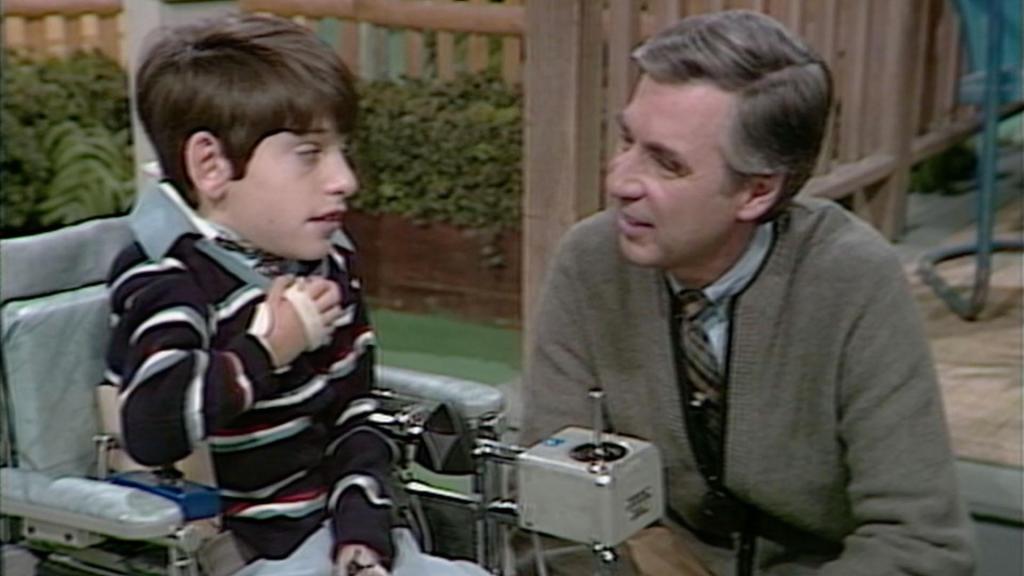
In a time when families of children with disabilities were fighting for access to schools and facilities for their children, Mr. Rogers featured children with disabilities on his show.  One was a seven-year-old quadriplegic boy, Jeff Erlanger. They had met two years earlier when young Jeff was scheduled to undergo major surgery and asked his parents if they could first arrange for him to meet Mr. Rogers. They wrote to Fred and he made time during a promotional visit to Milwaukee to meet with the family. Afterward, they continued to keep in touch.  When Jeff made his appearance on Fred’s show, he explained how his electric wheelchair worked and why he needed it. Then Jeff and Fred sang a duet of that corny-but-deeply-true Mr. Rogers’ song, “It’s You I Like.”

When later asked by a reporter why their five-year-old child would want to meet Fred Rogers before undergoing major surgery, Howard and Pam Erlanger explained that Jeff “always said that Mister Rogers told him that he was special and that he was just fine the way he was, and it gave him confidence and it made him feel good, and Mister Rogers just seemed to love him.” It was as if Mr. Rogers could really “see” Jeff, kind of like the way that Jesus could “see” the blind man. Fred Rogers beheld Jeff, knew that this child was someone to hold onto, hold close, hold up.

Nearly twenty years later, when Fred was inducted into the Television Hall of Fame, Jeff surprised him, rolling onto stage to present the award. In true Mr. Rogers’ form, Fred got so excited that he ran up onto the stage and hugged Jeff as if they were the only two people in the auditorium. “On behalf of millions of children and grown-ups,” Jeff said in presenting the award to Fred, “It’s You I like.”

It’s a beautiful day in the neighborhood, my friends. It’s a day, like every day, made for us to notice and care, love and share. May we go forth to truly see and serve our neighbors.

Resources:

Jason Fraley. “Remembering Mr. Rogers Twenty Years after the Death of Our Favorite Neighbor” in WTOP News, Feb. 27, 2023. Accessed online at wtop.com.

Robert Hoch. “Commentary on John 9:1-41” in Preaching This Week, March 30, 2014. Accessed online at workingpreacher.org.

Osvaldo Vena. “Commentary on John 9:1-41” in Preaching This Week, March 26, 2017. Accessed online at workingpreacher.org.

Shea Tuttle. “Seven Lessons from Mr. Rogers that Can Help Americans Be Neighbors Again” in Greater Good Magazine, July 13, 2018. Accessed online at greatergood.berkeley.edu.

Maxwell King. “How ‘Mister Rogers’ Neighborhood’ Championed Children with Disabilities” in Guideposts. Accessed online at http://www.guideposts.org

–. “About Fred Rogers” in Mister Rogers’ Neighborhood. Accessed online at misterrogers.org.


John 9:1-38

As he walked along, he saw a man blind from birth. 2His disciples asked him, “Rabbi, who sinned, this man or his parents, that he was born blind?” 3Jesus answered, “Neither this man nor his parents sinned; he was born blind so that God’s works might be revealed in him. 4We must work the works of him who sent me while it is day; night is coming when no one can work. 5As long as I am in the world, I am the light of the world.” 6When he had said this, he spat on the ground and made mud with the saliva and spread the mud on the man’s eyes, 7saying to him, “Go, wash in the pool of Siloam” (which means Sent). Then he went and washed and came back able to see.

8The neighbors and those who had seen him before as a beggar began to ask, “Is this not the man who used to sit and beg?” 9Some were saying, “It is he.” Others were saying, “No, but it is someone like him.” He kept saying, “I am the man.” 10But they kept asking him, “Then how were your eyes opened?” 11He answered, “The man called Jesus made mud, spread it on my eyes, and said to me, ‘Go to Siloam and wash.’ Then I went and washed and received my sight.” 12They said to him, “Where is he?” He said, “I do not know.”

13They brought to the Pharisees the man who had formerly been blind. 14Now it was a sabbath day when Jesus made the mud and opened his eyes. 15Then the Pharisees also began to ask him how he had received his sight. He said to them, “He put mud on my eyes. Then I washed, and now I see.” 16Some of the Pharisees said, “This man is not from God, for he does not observe the sabbath.” But others said, “How can a man who is a sinner perform such signs?” And they were divided. 17So they said again to the blind man, “What do you say about him? It was your eyes he opened.” He said, “He is a prophet.” 18The Jews did not believe that he had been blind and had received his sight until they called the parents of the man who had received his sight 19and asked them, “Is this your son, who you say was born blind? How then does he now see?” 20His parents answered, “We know that this is our son, and that he was born blind; 21but we do not know how it is that now he sees, nor do we know who opened his eyes. Ask him; he is of age. He will speak for himself.” 22His parents said this because they were afraid of the Jews; for the Jews had already agreed that anyone who confessed Jesus to be the Messiah would be put out of the synagogue. 23Therefore his parents said, “He is of age; ask him.” 24So for the second time they called the man who had been blind, and they said to him, “Give glory to God! We know that this man is a sinner.” 25He answered, “I do not know whether he is a sinner. One thing I do know, that though I was blind, now I see.” 26They said to him, “What did he do to you? How did he open your eyes?” 27He answered them, “I have told you already, and you would not listen. Why do you want to hear it again? Do you also want to become his disciples?” 28Then they reviled him, saying, “You are his disciple, but we are disciples of Moses. 29We know that God has spoken to Moses, but as for this man, we do not know where he comes from.” 30The man answered, “Here is an astonishing thing! You do not know where he comes from, and yet he opened my eyes. 31We know that God does not listen to sinners, but he does listen to one who worships him and obeys his will. 32Never since the world began has it been heard that anyone opened the eyes of a person born blind. 33If this man were not from God, he could do nothing.” 34They answered him, “You were born entirely in sins, and are you trying to teach us?” And they drove him out.

35Jesus heard that they had driven him out, and when he found him, he said, “Do you believe in the Son of Man?” 36He answered, “And who is he, sir? Tell me, so that I may believe in him.” 37Jesus said to him, “You have seen him, and the one speaking with you is he.” 38He said, “Lord, I believe.” And he worshiped him.


https://www.pbs.org/video/mister-rogers-neighborhood-its-you-i-like/

Click the link above to hear Jeff and Fred singing “It’s You I Like.”

Who Do You Say That I Am?

Throughout Lent, I’ll be sharing a weekly devotion that draws on my travels to the middle east. Here is the fourth.

“But you,” Jesus asked them, “who do you say that I am?” Simon Peter answered, “You are the Messiah, the Son of the living God!”—Matthew 16:15-16

Peter’s profession of faith came as Jesus and the disciples walked from the Sea of Galilee to Caesarea Philippi. The city served as the administrative headquarters of Herod Philip, the Roman-appointed client king who ruled on behalf of the emperor in the region east of Gailee in modern-day northern Israel, Lebanon, and southern Syria. This was largely Gentile territory, with relatively few Jewish subjects. Consequently, Herod Philip pursued a policy of Hellenization. In other words, he encouraged imperial traditions and the worship of a pantheon of gods.

As Jesus and his friends walked, they would have been in the company of pagan pilgrims.  Caesarea Philippi was home to a spectacular white marble shrine, built by Herod the Great in 20BC to honor the emperor. There, those who were loyal to the emperor offered sacrifices and made financial gifts to curry favor with the powers of Rome. 

Caesarea Philippi was also home to an ancient fertility cult. The central source of the Jordan River erupted from the mouth of a cave at a rock formation known as the Gates of Hell. It was believed to be a gateway to the underworld and became the site of an open-air temple. For centuries, farmers seeking abundant harvests or bountiful flocks had come there to sacrifice goats to the god Pan. It is even alleged that the site was a place of child sacrifice.

Walking among travelers who sought the favor of many gods, Peter dared to affirm the one God of Israel and acknowledge Jesus as beloved Son and Lord. It was a bold and courageous proclamation, prophetic and scandalous, even treasonous.

Who do you say that Jesus is?

Please pray with me . . .

Lord Jesus, you are the Son of the one true God. In a world where we are tempted to worship many things—money, power, nation, sports, celebrity, and more—may we know that you alone are God.  May our words and works affirm our trust in you this day.  Amen.


“Sometimes your only available transportation is a leap of faith.” — Margaret Shepard

“Courage is almost a contradiction in terms. It means a strong desire to live, taking the form of a readiness to die.”

G.K. Chesterton

“Man’s mind is like a store of idolatry and superstition; so much so that if a man believes his own mind, it is certain that he will forsake God and forge some idol in his own brain.” — John Calvin


By gugganij – Own work, CC BY-SA 3.0, https://commons.wikimedia.org/w/index.php?curid=3992796

Acceptance Speech

Poem for a Tuesday — “Acceptance Speech” by Lynn Powell

The radio’s replaying last night’s winners
and the gratitude of the glamorous,
everyone thanking everybody for making everything
so possible, until I want to shush
the faucet, dry my hands, join in right here
at the cluttered podium of the sink, and thank

my mother for teaching me the true meaning of okra,
my children for putting back the growl in hunger,
my husband, primo uomo of dinner, for not
begrudging me this starring role—

without all of them, I know this soup
would not be here tonight.

And let me just add that I could not
have made it without the marrow bone, that blood—
brother to the broth, and the tomatoes
who opened up their hearts, and the self-effacing limas,
the blonde sorority of corn, the cayenne
and oregano who dashed in
in the nick of time.

Special thanks, as always, to the salt—
you know who you are—and to the knife,
who revealed the ripe beneath the rind,
the clean truth underneath the dirty peel.

—I hope I’ve not forgotten anyone—
oh, yes, to the celery and the parsnip,
those bit players only there to swell the scene,
let me just say: sometimes I know exactly how you feel.

But not tonight, not when it’s all
coming to something and the heat is on and
I’m basking in another round
of blue applause.

in 180 More Extraordinary Poems for Every Day, ed. Billy Collins. New York: Random House, 2005, p. 99.


Lynn Powell is a poet, writer of creative non-fiction, and educator. She has been awarded an NEA Fellowship in Poetry, the Felix Pollak Prize in Poetry, the Studs and Ida Terkel Author Award, the Brittingham Prize in Poetry, 4 Ohio Arts Council Excellence Awards, and the Great Lakes Colleges Association New Writers Award. She lives in Oberlin, Ohio, where she teaches creative writing and serves as the director of Oberlin College’s Writers-in-the-Schools program.


Photo by Angela Khebou on Pexels.com

Thirsty

Sabbath Day Thoughts — “Thirsty” Exodus 17:1-7

We all fall into catastrophic thinking from time to time. Something doesn’t seem right and worst-case scenarios play out in our minds, over and over again, provoking anxiety and sending us into a panic. When I lived in Washington, DC, snow in the forecast sent the entire metro area into a frenzy of catastrophic thought.  Neighbors rushed out to the grocery stores to buy up every loaf of bread, every gallon of water, and every roll of toilet paper.  Then, as snow began to fall and streets turned slick, drivers would give up and abandon their vehicles, leaving cars haphazardly parked along the shoulder while they hoofed it home.

Our catastrophic thinking may not be nearly so apocalyptic.  When our teen is late in getting home from a date, we imagine them lying in a ditch or pulled over by the police. When the doctor’s office calls to schedule an appointment to follow up on our test results, we think the worst – we must have a serious illness or they want to put us on a diet. When our employer announces that it’s time to reorganize at work, we’re ready to head for the unemployment line.

Catastrophic thinking preoccupies us, saps our emotional and rational energy.  It’s tough on our bodies, boosting our blood pressure and respiration, and flooding our system with stress hormones. Catastrophic thinking doesn’t feel good. Our tummies churn, our thoughts race, and we can’t sleep.  Catastrophic thinking is especially hard on those we live with. We may take our anxiety out on our beloved ones with a short temper and sharp tongue.  We may even infect them with our catastrophic thinking; soon they are imagining the worst, right along with us.

Our reading from the Book of Exodus tells us that the Israelites were doing some catastrophic thinking. In fairness to them, their circumstances were truly stress-inducing.  They were in the Sinai Wilderness, a desert landscape where temperatures could soar over 100 degrees and rainfall was infrequent. For the month of December, the rainiest month of the year, the average rainfall in the Sinai is a whopping two-tenths of an inch.  The Israelites in that desert were dependent upon springs and oases to sustain them and their livestock, but at the end of a long day of travel, they arrived at Rephidim, where they expected to find a spring and instead found no water. No water for drinking. No water for their flocks. No water for their children. No water for cooking. No water for bathing. No water at all.

The human body can last about 100 hours without water in normal circumstances, but in a hot and sunny spot like the Sinai, they might be fortunate to last about half that time. Their tongues felt swollen and dry, clinging to the roofs of their mouths.  The children began to cry. The sheep began to bleat. Even the camels were looking ornery. The catastrophic thinking kicked in.

“Our water reserves won’t last the night. The sun is going to roast us. We’ll never find water in this wasteland.  We’ll have to set the flocks free to fend for themselves.  We’ll have to resort to drinking our urine. We’ll cradle our dying children. Someday they’ll find our bleached bones and tell the terrible tale of what happens to foolish people who turn their back on the Nile.”

They took all their angry anxiety, aggression, and stress to Moses, and soon he was doing some of his own catastrophic thinking.  “How am I supposed to find water in the desert? I’ve got a mutiny on my hands. They’re sharpening their knives.  They’re gathering stones. I won’t last the night. They’re coming for me.”

Our catastrophic thinking can be problematic. It can undermine our workplaces. One manager complained to the Harvard Business Review that every time she tried to delegate to her employees, things went sideways. She was sure they would fail to deliver, or they might miss deadlines, or they could do things the wrong way. Rather than mentoring her workers as they learned new skills and allowing them to make mistakes, her catastrophic thinking would kick in.  Imagining the poor sales that would ensue and the criticism she would face from her boss and the possibility of taking a hit to her reputation, she would take back all the work she had shared in an endless cycle of overwork and anxiety.

Catastrophic thinking can impact our relationships.  We put off returning the phone call to our friend who is always imagining the worst and foretelling gloom and doom. We start editing what we share with the parent who spirals into a frenzy of anxiety at the sort of everyday setback that happens to everyone.  If a spouse goes catastrophic every time that we try to share our feelings, we learn to keep them to ourselves.

Catastrophic thinking can even affect churches. I’ve known churches that refuse to host healing groups like NA and AA because something at church might get dirty or broken or stolen. I’ve known churches that refuse to try new programs for fear that it could demand too much work, take too much time, or bring too much change. And then, there is the catastrophic thinking that surrounds the introduction of new music—often rejected with the insistence that it’s too hard to sing, makes us uncomfortable, and will surely cause a mass stampede for the exit with worshippers vowing never to return.

It probably shouldn’t surprise us that when the Israelites got so anxious about water, it wasn’t the first time they went catastrophic.  When Pharaoh’s army had pursued them to the shores of the Reed Sea, they all thought they were goners.  Then, when the water at Mara was bitter and undrinkable, they thought that was it. When provisions got scarce and their bellies growled, they were certain they would starve to death. But those things didn’t happen.

Instead, each of those scary and overwhelming circumstances had turned into an opportunity for them to know the presence and the goodness of God. On the shores of the Reed Sea, God had interceded, standing between Pharoah’s forces and the people while Moses raised his staff above the waters—which parted, allowing the Israelites to escape.  Then, when the water was so bitter, God had told Moses how to make it sweet. And when the people were hungry, God had brought quails into the camp in the evening and rained down manna every morning.  All that adversity wasn’t easy or fun or pleasant or wanted, but again and again, the people had learned that they were not alone in the wilderness.  They had a holy traveling companion, who cared and provided and would not abandon them, even when catastrophe struck.

One of my favorite memes that I have posted more than once on my Facebook page goes like this: “On particularly rough days, I like to remind myself that my track record for getting through bad days so far is 100%, and that’s pretty good.” I believe that, like the Israelites, we have a holy traveling companion, who is with us in the midst of those moments that make us want to call our friend and start complaining.  We have a holy friend, who walks us through those experiences that make us infect our spouse with our anxiety. We are not alone on those days that make us want to stay in bed with the covers over our heads. Life does bring adversity, there’s no questioning that, but our track record for getting through it so far is pretty good, because we are not alone. We may not have manna showering us from the heavens, or water springing from a rock, or quails flying into the soup pot, but we can trust that God is with us because in Jesus, God chose to walk this lonesome valley and face head-on the catastrophe of the cross.

God’s goodness and grace find us in the middle of our catastrophic thinking. Sometimes it is a feeling of peace that surpasses all understanding. Sometimes it is in the comfort of scripture.  Sometimes it is in the caring person who simply sits with us and holds our hand. Sometimes it is in the deacon who shows up with a hot dish. Sometimes it is in the people who pray for us, sending out a holy hotline to the Almighty. Sometimes it is in the leader who casts the hopeful vision for life on the far side of our woe.  Sometimes it is in the family member who talks us off the ledge.  We all get thirsty.  We all go catastrophic from time to time, but God is with us and there is water.

When God sent Moses to Horeb to find water to ease the people’s thirst, God instructed him to take along some of the elders of Israel. On the mountain, in the presence of those witnesses, water gushed forth from the rock, and the crisis was averted. The people drank, the children drank, the flocks drank. There was water for cooking. There was water for bathing. There was water enough for all. 

I like to think that those elders, who watched the water spring forth, never forgot that moment. When times were tough and disaster loomed, they took a deep breath and nipped their catastrophic thinking in the bud. They remembered the goodness of God.  Then, they turned to their anxious people, and pointed to the presence of God, who brings water in the desert.  May we, who have witnessed the goodness of God, do the same. 

Resources:

Julianna Claasens. “Commentary on Exodus 17:1-7” in Preaching This Week, March 23, 2014. Accessed online at workingpreacher.org.

Anathea Portier-Young. “Commentary on Exodus 17:1-7” in Preaching This Week, October 1, 2017. Accessed online at workingpreacher.org.

Callie Plunkett-Brewton. “Commentary on Exodus 17:1-7” in Preaching This Week, September 28, 2014. Accessed online at workingpreacher.org.

Ron Carucci. “Stress Leads to Bad Decisions” in The Harvard Business Review, August 29, 2017.

Ron Breazeale. “Catastrophic Thinking” in Psychology Today, March 25, 2011. Accessed online at http://www.psychologytoday.com.


Exodus 17:1-7

17 From the wilderness of Sin the whole congregation of the Israelites journeyed by stages, as the Lord commanded. They camped at Rephidim, but there was no water for the people to drink. 2 The people quarreled with Moses and said, “Give us water to drink.” Moses said to them, “Why do you quarrel with me? Why do you test the Lord?” 3 But the people thirsted there for water, and the people complained against Moses and said, “Why did you bring us out of Egypt, to kill us and our children and livestock with thirst?” 4 So Moses cried out to the Lord, “What shall I do for this people? They are almost ready to stone me.” 5 The Lord said to Moses, “Go on ahead of the people and take some of the elders of Israel with you; take in your hand the staff with which you struck the Nile and go. 6 I will be standing there in front of you on the rock at Horeb. Strike the rock, and water will come out of it, so that the people may drink.” Moses did so, in the sight of the elders of Israel. 7 He called the place Massah and Meribah, because the Israelites quarreled and tested the Lord, saying, “Is the Lord among us or not?”


Photo by Antonio_22 on Pexels.com

Turn Aside

Throughout Lent, I’ll be sharing a weekly devotion that draws on my travels to the middle east. Here is the third.

“Then Moses said, ‘I must turn aside and look at this great sight and see why the bush is not burned up.’ When the Lord saw that he had turned aside to see, God called to him out of the bush, ‘Moses, Moses!’ And he said, ‘Here I am.’ Then he said, “Come no closer! Remove the sandals from your feet, for the place on which you are standing is holy ground.’” — Exodus 3:3-5

Today we visit St. Catherine’s Monastery in the Sinai Peninsula of Egypt, the traditional site of the burning bush. On your way to St. Catherine’s, you’ll climb through a beautiful but harsh desert landscape of blowing sand, jagged cliffs, and plastic water bottles, tossed by travelers. Bedouin settlements cluster around springs. Disinterested shepherds cradle cellphones and watch shaggy flocks of sheep and goats. At the racetrack, a runaway camel, fast and cagey, brays and evades his captors. It’s a stunning place to visit, but how do people live here? It’s a testament to tenacity, ingenuity, and tradition.

When Moses tended the flock of his father-in-law Jethro here, he may have been regretting his change in careers.  He had traded his role as Prince of Egypt for that of a nomadic shepherd in the Sinai Wilderness.  It was hot, hard, lonely work with plenty of time to think about the mistakes he had make, like killing that Egyptian overseer. Then, he saw something remarkable, a bush that appeared to burn but was not consumed. As he turned aside to explore the mystery, Moses discovered that he was on holy ground and that God had a holy purpose for his life: leading the Hebrew people to freedom.

Wherever you may walk today, remember that it is on holy ground, and God has a holy purpose for you.

What might you need to turn aside from today so that you can have eyes to see and ears to hear God’s holy purpose for your life?

Please pray with me . . .

God of our ancestors, we turn aside from the preoccupations of our life to attend to your presence. Grant us eyes to see the bush that burns for us. Take off our shoes.  Give us ears to hear the purpose that you would have us undertake.  When you call our name, may we answer, “Here I am.” We pray through Christ our Lord, who was and is and is to come. Amen.


“‘You would not have called to me unless I had been calling to you,’ said the Lion.” — C.S. Lewis

“The place God calls you to is the place where your deep gladness and the world’s deep hunger meet.” — Frederick Buechner

“I think it would be well, and proper, and obedient, and pure, to grasp your one necessity and not let it go, to dangle from it limp wherever it takes you.” — Annie Dillard


Sinai Trail, St. Catherine’s Monastery, Egypt

Taste

Poem for a Tuesday — “Taste” by Joann White

All sweet on my tongue

all golden blue-sky

day all thrumming with

song all slide ’round my

mouth all trickle down

my chin all here all

now all this all gone.


Joann White is a writer, pastor, spiritual director, and enthusiast of wild places. Sometimes she finds God in the moment, like in eating an apple. She says she isn’t a poet, but Ross Gay makes her want to be.


Photo by Tom Swinnen on Pexels.com