The Tangled Web

Sabbath Day Thoughts — “The Tangled Web” 2 Samuel 11:1-15

The abuse of power is the misuse of our authority. We may oppress other people or coerce them to do wrong. It can happen in politics, in the workplace, or even in our own homes. The 18th century French philosopher Montesquieu, who was the first to formulate the separation of powers in government, once wrote, “Constant experience shows us that every man invested with power is apt to abuse it, and to carry his authority as far as it will go.”

On the American political front, perhaps the most notorious late-twentieth-century example of abuse of power was Watergate. In 1972, President Richard Nixon and his reelection committee engaged in illegal clandestine operations and got caught. On June 17th of that year, five burglars were arrested by plainclothes police officers in the Democratic National Headquarters on the sixth floor of the Watergate office building. The team was planting listening devices and photographing files. In the investigation that followed, forty government officials were indicted. Eight went to jail, including White House staff members HR Haldeman and John Erlichman, as well as Attorney General John Mitchell. When tape recordings linked the President to the burglary and cover-up, Nixon resigned, saying that he no longer had “a strong enough political base” with which to govern.

Power is abused in the workplace. 41.4% of workers say that they have experienced psychological aggression and bullying on the job. We’ve had bosses who intentionally embarrass workers, mock their mistakes, spread stories, shout, blame, and threaten. It may go so far as sabotaging someone’s career or manipulating co-workers to join in the abuse, creating a toxic workplace. Does any of this sound uncomfortably familiar? In one study, more than half of women reported that they have been victims of unwanted sexual behavior at work. That’s an unfortunate reality that was long kept quiet until the #MeToo movement made it headline news. Powerful people in the entertainment industry, like Harvey Weinstein and Bill Cosby, have lost high-profile court cases for sexually exploiting vulnerable women.

Our scripture reading this morning is all about the abuse of power. When the Israelites demanded a king, God warned them of the consequences (1 Sam. 8). Sounding a lot like Montesquieu, God had cautioned that a king would lord it over them: take their sons and deploy them in endless battles, take their daughters “to become perfumers, cooks, and bakers,” take the best of their harvest, vineyards, slaves, and livestock. Despite this, the people clamored for a king to rule over them. Things hadn’t gone so well with the first king, Saul, but then Samuel anointed David, the shepherd boy with a heart for God.

At first, it seemed that the Lord had been overly pessimistic about human nature. David proved his loyalty to Israel and God. He defeated Goliath. He led the Israelite troops in their defeat of their enemies. He lamented the deaths of Saul and Jonathan. He earned the loyalty and respect of all twelve tribes. He sang and danced with holy joy before the Ark of the Covenant.

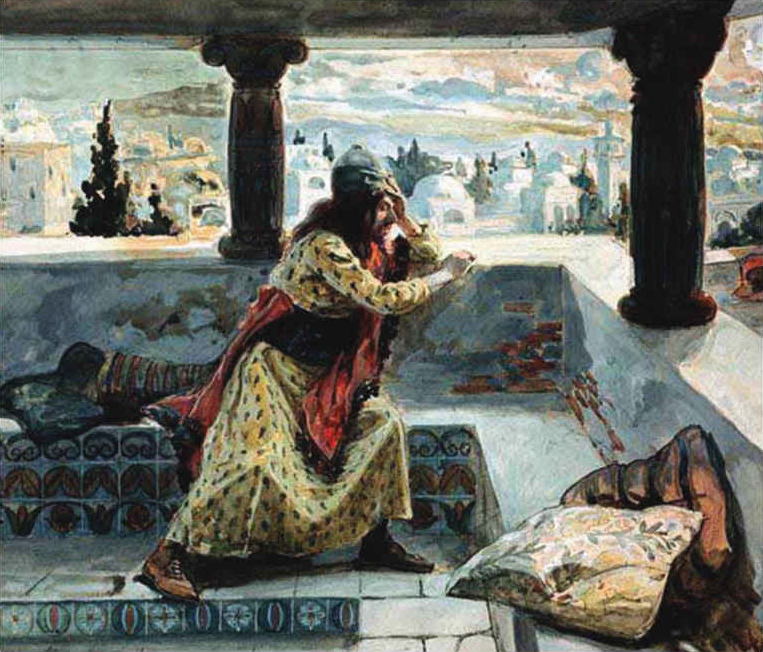
Yet as our reading begins, we encounter a middle-aged David. The bored king used his royal privilege to remain behind while Joab and the army lay siege to Rabbah. Unable to sleep, David spent an evening spying on his neighbors from the roof of his palace. He saw a young woman, Bathsheba, engaged in the ritual bath of purification that was practiced by observant women after their monthly cycle. Enthralled by Bathsheba’s beauty, the king sent guards to bring her to the palace where he sexually exploited her and then threw her away, sending her back to home.  David believed that his power and her shame would force her to keep the secret of his abuse. When the violated Bathsheba later sent word that she was pregnant, David further exploited his power with the proxy murder of Uriah, after the man proved to be so righteous that he would not break his vow of celibacy for battle, even when pressured to do so by his king.

It’s a terrible story. As it reaches its inevitable conclusion, David feels that all the mischief has been managed. He shows no signs of remorse. And the pregnant Bathsheba ends up married to the man who raped her and murdered her husband, a man who already had eight wives and concubines, as well as sexual access to all the servants, slaves, and prostitutes of his kingdom.

It’s interesting to look at the history of interpretation for this story. Scholars and preachers have portrayed Bathsheba as a scheming seductress, who wantonly induces the king’s desire. They have also suggested that this is a simple case of temptation, that the beauty of Bathsheba overcame the king’s better judgment, and one mistake led to another. We have even been subjected to a Hollywood retelling that casts David and Bathsheba as star-crossed lovers whose irresistible affections set into motion tragic events. Let’s be honest. Those ways of looking at the story are all ways of blaming the victim, of making the righteous Bathsheba responsible for the sexual assault that she endured when David’s guards showed up at her door to take her into custody.

Some things never change. Police and District Attorneys will tell you how very difficult it is to prosecute rape cases. Victims are characterized as promiscuous sluts. Their clothing or demeanor is said to have been “just asking for it.” And the victims themselves struggle with the shame of making public their experience of abuse—even as they are re-traumatized by cross-examination, publicity, and innuendo in the court of public opinion.

The story of David’s actions also reveals that the abuse of power has multiple victims. Bathsheba is obviously wronged. But so are the guards who must collect and deliver Bathsheba on the king’s orders. They know what will happen when she is left alone in the company of the king, without a father or husband to protect her. General Joab is caught in David’s terrible web. He must engineer the death of Uriah, a valiant and loyal soldier under his command, or face the consequences of disobeying a direct order from his king. Even the Ammonites, Israel’s enemies, are implicated as they are used to fire the arrows that will bring to fruition David’s murderous scheme.

Abuses of power have many victims. President Richard Nixon’s bid to ensure his continued power may have targeted the DNC, but look at all the people who were caught in his tangled web: the five Cuban ex-patriots who enacted the burglary, the forty White House officials who were indicted, the eight men who went jail because they acted on the President’s orders, and ultimately the American people whose trust in free and fair elections was undermined by the realities of political intrigue and abuse.

The same is true in our workplaces. Executives who exploit their power to dip into the corporate till exploit the trust of their board, rob their shareholders, and draw their families into their malfeasance. Workplace bullies harm not only the colleagues they abuse, but also their co-workers who are coopted into shunning the victim, covering up for the boss’s sins, or perpetrating their own abuse in a jobsite that becomes dog-eat-dog. Workers who are sexually harassed are wronged—and so are their spouses or their boyfriends or girlfriends, so are their children.

Perhaps what is most disturbing about how we have historically responded to stories like the one we are considering today is that it reveals our tendency to want to protect those who are in power, especially if their power serves our own interest. We blame Bathsheba instead of David. We give the pilfering CEO a golden parachute, and they move on to their next six-figure job where they do the same thing. We make excuses for the rage-a-holic boss, saying he’s just having a bad day, or she is going through a rough time at home, or look at how productive they are, making money for the company. We justify the antics of favorite politicians, thinking that while we don’t like what they say or do, at least they will ensure that the policies we prefer will be enacted.

In our summer sermon series, David has been our hero in the faith, but this week, as the power he wields goes to his head, David becomes our anti-hero. Indeed, his actions are the antithesis of our Lord Jesus, who came with the power of God almighty and chose to use that holy power to help and heal. Instead of lording it over the people, Jesus lived with and for the people, showing them the better way of love. And when he ran afoul of the powers of empire and temple, Jesus revealed the limitless breadth of that love, surrendering his power and laying down his life on the cross for us. Jesus set an example that continues to call us to responsibly use the authority that has been placed in our hands.

It is time for us to stop enabling abusers. It is time for us to honestly look at biblical stories like David and Bathsheba. It is time for us to honestly look at political and workplace misconduct and name those actions for what they truly are: abuses of power. It really is that simple. May we go forth to hold power responsibly and demand that others do the same.

Resources

Manuela Priesemuth. “Time’s Up for Toxic Workplaces” in Harvard Business Review, June 19, 2020. Accessed online at https://hbr.org/2020/06/times-up-for-toxic-workplaces

Coline de Silans. “Power tripping: what to do when someone misuses their authority at work,” in Welcome to the Jungle, Sept. 22, 2020. Accessed online at https://www.welcometothejungle.com/en/articles/preventing-power-tripping-abuse-at-work

Rick Perlstein. “Watergate Scandal” in Britannica, July 24, 2024. Accessed online at https://www.britannica.com/event/Watergate-Scandal

Richard W. Nysse. “Commentary on 2 Sam. 11:1-15” in Preaching This Week, July 26, 2009. Accessed online at  Commentary on 2 Samuel 11:1-15 – Working Preacher from Luther Seminary

Gennifer Brooks. “Commentary on 2 Sam. 11:1-15” in Preaching This Week, July 29, 2018. Accessed online at Commentary on 2 Samuel 11:1-15 – Working Preacher from Luther Seminary

Timothy L. Adkins-Jones. “Commentary on 2 Sam. 11:1-15” in Preaching This Week, July 25, 2021. Accessed online at Commentary on 2 Samuel 11:1-15 – Working Preacher from Luther Seminary

Wil Gafney. “Commentary on 2 Sam. 11:1-15” in Preaching This Week, July 26, 2015. Accessed online at Commentary on 2 Samuel 11:1-15 – Working Preacher from Luther Seminary


2 Samuel 11:1-15

11 In the spring when kings march out to war, David sent Joab with his officers and all Israel. They destroyed the Ammonites and besieged Rabbah, but David remained in Jerusalem.

One evening David got up from his bed and strolled around on the roof of the palace. From the roof he saw a woman bathing—a very beautiful woman. So David sent someone to inquire about her, and he reported, “This is Bathsheba, daughter of Eliam and wife of Uriah the Hittite.”

David sent messengers to get her, and when she came to him, he slept with her. Now she had just been purifying herself from her uncleanness. Afterward, she returned home. The woman conceived and sent word to inform David: “I am pregnant.”

David sent orders to Joab: “Send me Uriah the Hittite.” So Joab sent Uriah to David. When Uriah came to him, David asked how Joab and the troops were doing and how the war was going. Then he said to Uriah, “Go down to your house and wash your feet.” So Uriah left the palace, and a gift from the king followed him. But Uriah slept at the door of the palace with all his master’s servants; he did not go down to his house.

10 When it was reported to David, “Uriah didn’t go home,” David questioned Uriah, “Haven’t you just come from a journey? Why didn’t you go home?”

11 Uriah answered David, “The ark, Israel, and Judah are dwelling in tents, and my master Joab and his soldiers are camping in the open field. How can I enter my house to eat and drink and sleep with my wife? As surely as you live and by your life, I will not do this!”

12 “Stay here today also,” David said to Uriah, “and tomorrow I will send you back.” So Uriah stayed in Jerusalem that day and the next. 13 Then David invited Uriah to eat and drink with him, and David got him drunk. He went out in the evening to lie down on his cot with his master’s servants, but he did not go home.

14 The next morning David wrote a letter to Joab and sent it with Uriah. 15 In the letter he wrote:

Put Uriah at the front of the fiercest fighting, then withdraw from him so that he is struck down and dies.


Photo by Andrea Piacquadio on Pexels.com

Lust

Sabbath Day Thoughts — “Lust” 2 Samuel 11

This is the fourth message in a Lenten Sermon Series on the Seven Deadly Sins.

We don’t often talk about lust in church.  Passion and sexuality are God-given gifts, part of our essential being, and key to God’s best hope for the creation.  They can be the crown and ultimate fulfillment of our most committed and caring relationships.  Yet, when misused and expressed as lust, passion and sexuality can have destructive consequences.

Consider adultery. Until a few decades ago, adultery was still a criminal offense in many countries where Christianity is the dominant religion. Adultery is technically illegal in 21 states in the US. New York is one of the few states that considers cheating on your spouse to be a sin. Idaho, Massachusetts, Michigan, Oklahoma, and Wisconsin, among others, have felony charges against it. Most couples marry with the expectation of fidelity, and yet extramarital affairs persist.  22% of married men and 14% of married women have committed adultery.  Adultery, as a breach of marital trust, is emotionally traumatic for both spouses.  17% of marriages that go through an incident of cheating end in divorce.

Lust among Millennials is expressed in hookup culture, which has replaced traditional dating on college campuses.  In hookup culture, relationships are purely physical and very brief—a few minutes, a couple of hours, or overnight.  Sexual intimacy is followed by no further communication or connection that could lead to attachment.  Often, drinking is involved.  One in three students characterize hookups as “traumatic” or “very difficult to handle.”  One in ten students say that they have been sexually coerced or assaulted.  Professor Lisa Wade of Tulane University says that hookup culture is “a punishing emotional landscape where caring for others or even simple courtesy seem inappropriate.”

The most prevalent expression of lust in our culture is pornography. More than 90% of young men report that they watch porn with some regularity. The world’s largest pornography website Pornhub reports that 90 billion videos are watched on their site every day by 64 million visitors. $3,000 is spent every minute. Research suggests that porn is bad for our committed relationships.  A 2016 study by the University of Oklahoma found that divorce rates double when pornography enters the marriage.  56% of divorce cases cite obsessive interest in porn as a contributing factor.

According to Aristotle, lust is an irrational, insatiable desire for pleasure that increases the more it is exercised. Thomas Aquinas taught that lust is a “voluptuous emotion” that “unloosens the human spirit and sets aside all reason.” In his Inferno, Dante Alighieri portrayed unrepentant lustful souls in Hell, eternally buffeted and driven by the force of a whirlwind. From antiquity through the 19th century, artistic depictions of lust are typically female.  Maybe we can blame it on Prudentius, who in the fifth century described the deadly sin of lust as “lavish of her ruined fame, loose-haired, wild-eyed, her voice a dying fall, lost in delight.”

In our modern understanding, we acknowledge the harmful unrestrained, sometimes escalating, sexual impulse of lust.  Yet, we also recognize the interpersonal abuse of lust. Our Friday night hookup isn’t regarded as a person with social and emotional needs to be respected or reverenced.  They are just a means to get our “rocks off” (as the Rolling Stones once said).  Jesus understood this.  That’s why he taught that when we look at others with lust, we have committed adultery in our hearts (Matthew 5:27-28).  In lust, we dehumanize and objectify others, looking only for our self-satisfaction.  Lust can also lead to the abuse of power.  The #METOO Movement shined a spotlight on successful men, like Harvey Weinstein, who used their personal, professional power to coerce women into sex.  In Old Hollywood, they called it the casting couch.  Now, we know it’s rape.

Our biblical paradigm of lust is King David.  While the younger men went off to war, the aging king let his eyes roam and his lust call the shots.  He abused his power to use Bathsheba to gratify his needs.  Then, when there were consequences, he hatched a series of plots to escape responsibility. Uriah was summoned home to sleep with his wife, but when the younger man proved too honorable, things got darker yet as the king engineered his death.  David may not have shot the arrow that took Uriah’s life, but he was the murderer, nonetheless.  History and Hollywood have suggested that Bathsheba was somehow to blame for the King’s lust.  But we know better.  I like to point out that the only sound we hear from Bathsheba in this terrible tale is her wailing of lamentation for the husband she loved.

We find the remedy for our lust in chastity.  Chastity has gotten a bad rap, conjuring up images of prudish men and women with their shirts buttoned up and a withering gaze for anything flirty.  So, perhaps I should begin with what chastity is NOT.  Chastity is not abstinence, although in practicing chastity, we may make choices for abstinence at different times in our lives.  Chastity is not sexual repression, pushing down within ourselves or punishing ourselves for our natural sexual impulses.  Chastity is not refusing to think about or talk about sex, as if sex isn’t a normal, natural part of being human.  Unfortunately, we tend to project all those unnatural, unhealthy qualities onto the virtue of chastity.

Aristotle taught that chastity uses rational principles to govern and bring into order our sexual desire.  He saw it as a natural discipline to be learned and practiced, saying, “as the child should live according to the direction of his tutor, so the appetitive element (lust) should live according to rational principle.”  In Christian thinking, chastity is more than just thinking our way past our sexual impulses.  Robert Kruschwitz, a Senior Scholar at Baylor University, says, “Chastity is a habit of reverence for oneself and others that enables us to use our sexual powers intelligently in the pursuit of human flourishing and happiness.”  I’ll break that down.  In chastity, we are at peace with our bodies and our sexuality—we see their God-given nature.  Then, we bring a loving reverence for ourselves and others to our intimacy.  We honor ourselves as creatures made in the image of God (Gen. 1:26), and we revere the image of God in others.  We bring love and respect to our intimate encounters for the sake of the other person’s good and ultimate happiness.  In chastity, those sexual impulses that we all experience are governed by Christ’s great commandment that we love God—and we love others as we love ourselves.  When we get right down to it, chastity is a choice to live in love. To bring agape to our sexuality.

Our biblical model of chastity is Joseph, the youngest son of Israel’s Patriarch Jacob (Genesis 39).  After Joseph was sold into slavery by his jealous older brothers, he was bought by Potiphar, the Captain of the Egyptian Guard.  Joseph served as Potiphar’s personal attendant, and the bond between the two men grew so close that Potiphar entrusted Joseph with his entire household. All was well that ended well until Potiphar’s wife cast her lusty gaze upon the well-built, handsome young Hebrew.  She commanded Joseph, “Sleep with me!”  Joseph refused the temptation, seeing that if he said “Yes,” he would betray the kindness and generosity of Potiphar and the love and goodness of God, who had blessed Joseph amid his misfortune. 

We can push back against the harmful consequences of lust in our society by practicing the virtue of chastity.  G.K. Chesterton taught that “chastity, like any value or virtue, is a positive thing that you gain, not something that you give up.”  Indeed, this notion of chastity as a gift or quality earned after moral struggle dates back to the 13th century.  Thomas Aquinas was said to have fought long against the temptation of lust.  According to tradition, when Aquinas prevailed, the angels gave him a rope belt as a sign of his victory.  Soon after his death, his followers began to wear chastity cords in hopes of a similar victory over lust.  Aquinas’s chastity belt is preserved today at the Cathedral in Cheiri, Italy.

In the absence of Thomas Aquinas, chastity belts, and the intercession of angels, there are some steps that we can take to nurture our formation in chastity.  We can acknowledge that lust and sexual urges are part of who we are.  We can learn to recognize what our triggers are, whether it is loneliness, a work trip, porn, or a fraternity party with too much alcohol.  We can be attentive to and mindful of our thoughts and physical state, and then we can choose not to act on those impulses.  It helps to have a small circle of trusted, honest, confidential friends who can hold us accountable, with whom we can share our temptation and find encouragement.  We can find role models who inspire us in the way of chastity at its best, whether it is Jesus or Thomas Aquinas or Captain America, who waited so long for his best-gal Peggy.  We can also accept that chastity, like any other virtue, is one that we can fall from.  Even Jimmy Carter admitted that he had felt lust and committed adultery in his heart.  And yet we trust that even as we fall, the grace of our Lord Jesus is sufficient for us.  We can begin again.  Perhaps most important of all, we need to talk about lust and chastity with our children and grandchildren, who will one day find themselves in the midst of that emotionally punishing landscape of hookup culture.

Well, my friends, we’ve done it.  We have talked about lust in church.  The roof has not fallen in.  Instead, we’ve taken an honest look at the world out there, where the God-given gifts of passion and sexuality have gotten misdirected into adultery, pornography, and hookups.  Lust may abound, but so can chastity.  Let’s choose chastity.  Let’s make that reasoned, respectful, loving choice for ourselves.  Let’s make it for the sake of others.  Let’s teach it to our children.  Amen.

Resources:

Lisa Wade. “The Rise of Hookup Culture on American College Campuses” in Scholars Strategy Network, August 25, 2017. Accessed online at scholars.org.

Alexandra Solomon. “What Hookup Culture Means for the Future of Millennial Love” in Psychotherapy Network, Oct. 5, 2020.  Accessed online at psychotherapynetworker.org.

Content Team. “Adultery” in Legal Dictionary.  Accessed online at legaldictionary,com.

David Schultz. “Divorce rates Double When People Start Watching Porn” in Science, August 26, 2016.  Accessed online at science.org.

Content Team. “Porn Addiction” in Psychology Today.  Accessed online at psychologytoday.com.

Robert B. Kruschwitz. “Chastity as a Virtue” in Christian Reflection, 2016.  Accessed online at baylor.edu.

Adam Jeske. “The Seven Deadly Sins: Lust” in InterVarsity, March 15, 2014.  Accessed online at intervarsity.org.

Aristotle. Nichomachean Ethics, Book 3, Ch. 12. Accessed online at virtuescience.com.

Thomas Aquinas. Summa Theologiae. Accessed online at newadvent.org.


2 Samuel 11:1-18, 22-27

11 In the spring of the year, the time when kings go out to battle, David sent Joab with his officers and all Israel with him; they ravaged the Ammonites, and besieged Rabbah. But David remained at Jerusalem.

2 It happened, late one afternoon, when David rose from his couch and was walking about on the roof of the king’s house, that he saw from the roof a woman bathing; the woman was very beautiful. 3 David sent someone to inquire about the woman. It was reported, “This is Bathsheba daughter of Eliam, the wife of Uriah the Hittite.” 4 So David sent messengers to get her, and she came to him, and he lay with her. (Now she was purifying herself after her period.) Then she returned to her house. 5 The woman conceived; and she sent and told David, “I am pregnant.”

6 So David sent word to Joab, “Send me Uriah the Hittite.” And Joab sent Uriah to David. 7 When Uriah came to him, David asked how Joab and the people fared, and how the war was going. 8 Then David said to Uriah, “Go down to your house, and wash your feet.” Uriah went out of the king’s house, and there followed him a present from the king. 9 But Uriah slept at the entrance of the king’s house with all the servants of his lord and did not go down to his house. 10 When they told David, “Uriah did not go down to his house,” David said to Uriah, “You have just come from a journey. Why did you not go down to your house?” 11 Uriah said to David, “The ark and Israel and Judah remain in booths; and my lord Joab and the servants of my lord are camping in the open field; shall I then go to my house, to eat and to drink, and to lie with my wife? As you live, and as your soul lives, I will not do such a thing.” 12 Then David said to Uriah, “Remain here today also, and tomorrow I will send you back.” So Uriah remained in Jerusalem that day. On the next day, 13 David invited him to eat and drink in his presence and made him drunk; and in the evening he went out to lie on his couch with the servants of his lord, but he did not go down to his house.

14 In the morning David wrote a letter to Joab, and sent it by the hand of Uriah. 15 In the letter he wrote, “Set Uriah in the forefront of the hardest fighting, and then draw back from him, so that he may be struck down and die.” 16 As Joab was besieging the city, he assigned Uriah to the place where he knew there were valiant warriors. 17 The men of the city came out and fought with Joab; and some of the servants of David among the people fell. Uriah the Hittite was killed as well. 18 Then Joab sent and told David all the news about the fighting; 22 So the messenger went and came and told David all that Joab had sent him to tell. 23 The messenger said to David, “The men gained an advantage over us, and came out against us in the field; but we drove them back to the entrance of the gate. 24 Then the archers shot at your servants from the wall; some of the king’s servants are dead; and your servant Uriah the Hittite is dead also.” 25 David said to the messenger, “Thus you shall say to Joab, ‘Do not let this matter trouble you, for the sword devours now one and now another; press your attack on the city and overthrow it.’ And encourage him.”

26 When the wife of Uriah heard that her husband was dead, she made lamentation for him. 27 When the mourning was over, David sent and brought her to his house, and she became his wife, and bore him a son. But the thing that David had done displeased the Lord.


James Tissot, “David Sees Bathsheba Bathing,” https://www.newworldencyclopedia.org/d/images/3/3a/King_David_Bathsheba_Bathing.jpg