Sabbath Day Thoughts — “In the Midst of Chaos” Matthew 24:1-14
Our world is feeling especially chaotic these days.
It’s been a week since the United States and Israel launched a war against Iran. The images have been alarming: Tehran’s Mehrabad airport on fire, plumes of black smoke rising from the city, rescuers digging through the rubble of a girls’ school in search of survivors. According to Central Command, the US has struck more than 3,000 targets inside Iran. The strikes have killed at least 1,200 people, and nearly 300 people have been killed in Lebanon since Monday when Israel began strikes against suspected Hezbollah sites. Six National Guard soldiers have been killed. Nearly every country across the Middle East has sustained damage from missile hits, drone strikes, or shrapnel. Yesterday, the president warned that the crisis will escalate, saying the US will strike Iran “very hard” with “complete destruction and certain death” for targeted groups.
We are feeling chaos closer to home like surging gas prices, volatile economic markets, and beloved ones deploying to conflict zones. Christian nationalist churches are preaching a false gospel that the escalating conflict in the Middle East is part of God’s plan to bring on the apocalypse. All the while, there has been a different kind of war unfolding on the home front as concerned citizens and protesters square off against Homeland Security agents. Whistles blow, protest songs ring out, placards wave, tear gas cannisters and threats fly, and force is used—sometimes deadly. Even here in the North Country, immigrant neighbors are disappearing, snatched by ICE or Border Patrol and whisked away to crowded detention centers.
We all know daily chaos, too. The cold virus that just won’t quit. The overcrowded schedule. The relationships stretched thin. The never-ending work. The soaring grocery and gas prices. The worries for our children. Our chaos abounds and it can be hard to know how to live in the middle of all that.
Jesus lived in chaotic times. Jesus lived in an occupied nation. Israel was ruled by Roman-appointed client kings, who did the emperors bidding. Soldiers were garrisoned throughout the land from Capernaum—Jesus’ home base in the Galilee—to the Antonia Fortress—right next to the Jerusalem Temple. There were exorbitant taxes as the people paid for the costs of their occupation and the lavish lifestyles of their appointed rulers. Civil disobedience was ruthlessly dispatched with crucifixion to humiliate dissidents and terrorize communities.
Even the spiritual life of the Israelites was shaped by the chaos of occupation. The High Priests, who controlled the inner workings of the Temple, were also Roman appointees. They came from ancient, affluent priestly families that sat at the top of the social and religious hierarchy of Jerusalem. In the gospels, two High Priests shared top billing. Annas was appointed by Quirinius in the year 6 when Jesus was just a boy and removed from power by Valerius Gratius in the year 15. Yet he remained immensely influential. He controlled a leading faction of the Sanhedrin (the governing council of the Temple). Five of his sons would also serve as High Priests.
Equally powerful was Caiaphas, the son-in-law of Annas. He served as High Priest at the time of Jesus’ death, holding office for almost twenty years. According to the first-century Jewish historian Josephus, Caiaphas had a particularly close and cordial relationship with Pontius Pilate. It was Caiaphas who determined that it would be better for Jesus to be executed than for the wrath of Rome to fall upon the nation. So powerful was the Roman hold upon the High Priest, that, according to Josephus, the priestly vestments were held at the Roman headquarters in the Antonia Fortress. High holy days, like Passover, were strictly controlled by Rome.
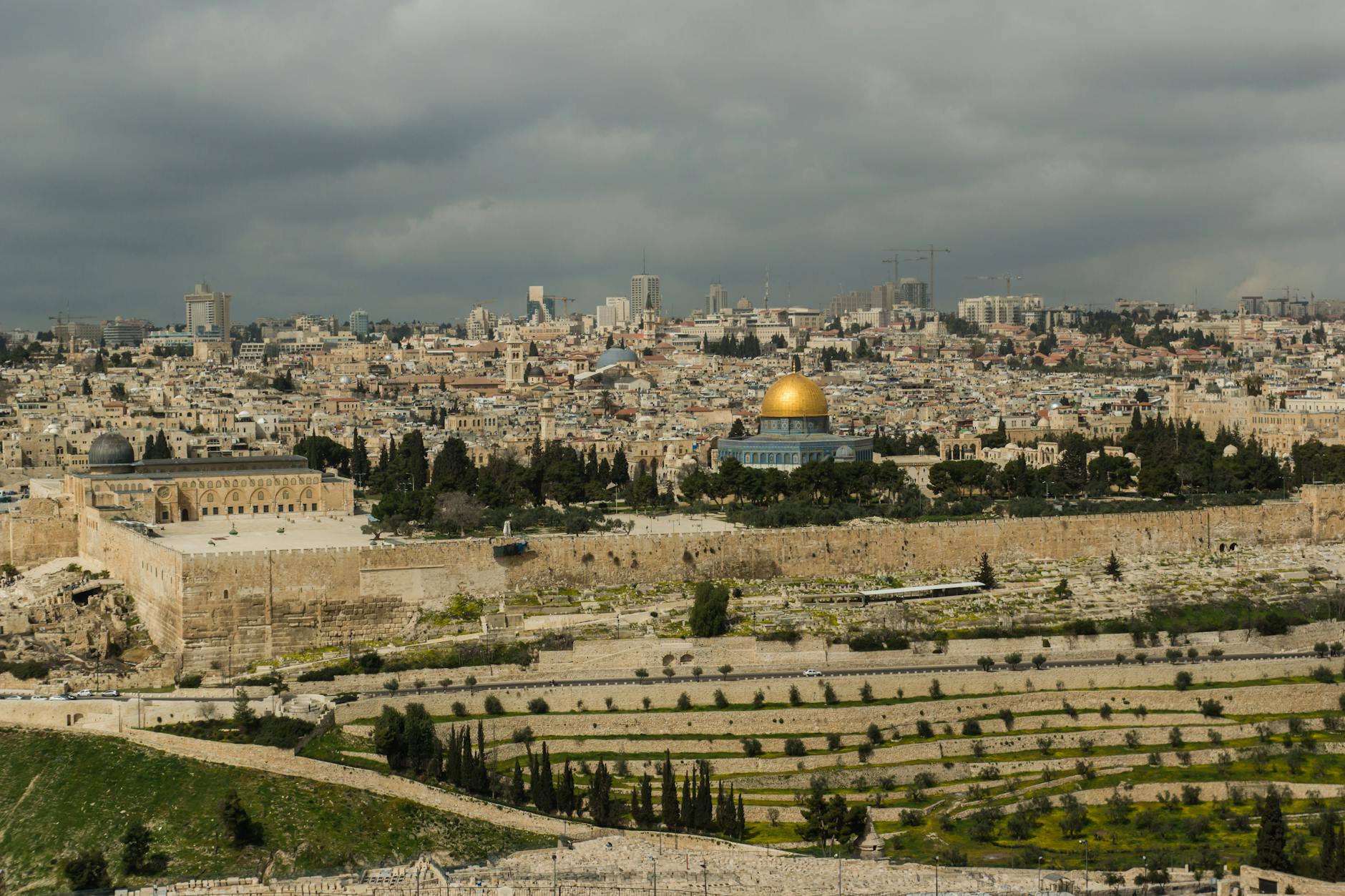
After a day in the Temple, as they returned to their lodgings in Bethany, a disciple pointed across the Kidron Valley to the magnificent walls of the Temple, crowning Jerusalem. While the disciples marveled at the beauty of their religious center, Jesus saw the future. The Temple razed to the ground. Famine and earth quake stalking the land. Corrupt, self-serving rulers. And his followers persecuted, tortured, and executed.
Whether we are first century Israelites or twenty-first century Americans, chaos does not feel good. When the bombs fall, we lament civilian deaths, mass destruction, and the rising specter of a third World War. When protesters are abused and immigrants detained, we fear for our public safety and the preservation of constitutional rights. When we are sick or sick and tired, when there aren’t enough hours in the day, when we have more month than money, when tempers are short and love is stretched thin, we feel overwhelmed and anxious. Sometimes this world’s chaos leaves us feeling powerless, even hopeless. We are tempted to tune out and shut down, just to make it through the day.
In today’s reading, Jesus shared wisdom about living in chaotic times. Amid all the fearsome realities that the disciples and the early church would face, Jesus urged his disciples to stand firm in their faith. When false leaders arose with selfish ideologies and big promises, the disciples should trust in God instead. When fear threatened to close them down and shut them up, they were to keep calm and carry on. When chaos brought hatred and betrayal, they must choose the better way of love. For it is only love that has the power to save in the midst of chaos. The disciples would need those words of wisdom. By the end of the week, Jesus would be hanging on a cross, and they would be scattered amid the chaos.
I suspect that if we heed Jesus’ wisdom, we’ll find encouragement and a roadmap for how to live in the midst of our present chaos. We start by standing firm in the faith. As I’m always telling the church’s children, any good relationship takes time, attention, and good communication. We tend our relationship with God by feasting upon the Word in scripture, whether we frequent the Wednesday Bible Study, join in Lenten Learning, ponder the weekly sermon, or enjoy the quiet discipline of reading our Bibles. We build our relationship with God through prayer. Perhaps we’ll serve as a link in the prayer chain or attend to the prayer list in the bulletin. Maybe we’ll open our hearts during the prayers of the people or set aside some quiet moments daily, to pour out our cares and listen quietly for the comfort and leading of the Spirit.
As we seek God in scripture and prayer, trust grows. We remember the promise that Jesus made to his disciples at the conclusion of Matthew’s gospel, that he would be with them always, to the end of the age. When chaos threatens to overwhelm us, we hold to the promise that Jesus is with us. We can face the evening news, the overcrowded schedule, and the rising costs because we are not alone. The future belongs to God and we can trust that there will be a better tomorrow.
As we stand firm in faith and grow in our trust of God, we find that we can carry on. We see that we are part of a community of brave and faithful people who call the world to that better tomorrow that Jesus holds for us. We live in ways that anticipate that future. We gather on Sunday mornings to worship and praise, then we go forth into the week to be like Christ, whether we are feeding hungry people, comforting friends in crisis, welcoming strangers, standing with immigrant neighbors, visiting those who are sick or homebound, or speaking the truth in love. When we carry on and get into some good trouble together, hope finds a toehold in the midst of our chaos. We kindle the fire of love—and we know that love, not bombs or bullets or the stock market or Homeland Security, only love can bring lasting peace and salvation for our world.
I wish I could promise that the chaos is going to be better at this time next week. But if I did, I would just be one of those false prophets that Jesus warned his friends about. The war in Iran will undoubtedly escalate. There will be civilian casualties, and we will likely lose more of our own troops. We may shake the last of that cold virus, but the markets will continue to struggle and those gas prices are certain to rise. Kristi Noem may have lost her job at Homeland Security, but the outlook for our immigrant communities will remain bleak. We will live in the midst of chaos, but take courage, my friends. We got this. Stand firm in the faith, trust God, carry on, and love—always love. Amen.
Resources
Matt Skinner. “Walking the Palm Sunday Path: A Lenten Sermon Series for 2026” in Preaching Series, January 21, 2026. Accessed online at https://www.workingpreacher.org/preaching-series/walking-the-palm-sunday-path-in-lent-a-sermon-series-for-2026
Jessie Yeung, Sophie Tanno. “Everything we know on the eighth day of the US and Israel’s war with Iran” in CNN News, March 7, 2026. Accessed online at https://www.msn.com/en-us/news/world/everything-we-know-on-the-eighth-day-of-the-us-and-israel-s-war-with-iran/ar-AA1XHgna?ocid=msedgntp&pc=W251&cvid=69ac63a3ee9343808a0aacc504be01e0&ei=21
Julia Frankel. “Country by country, here’s how the unfolding war is affecting the Middle East and beyond” in Associated Press World News, March 6, 2026. Accessed online at https://apnews.com/article/iran-us-war-israel-strait-or-hormuz-deaths-f1619c6bfbbd5fe10857ff0af073aa0e
Corey J. Sanders. “Commentary on Luke 19:28-40” in Preaching Series, Jan. 22, 2026. Accessed online at https://www.workingpreacher.org/preaching-series/sermon-series-matthew-241-14-jesuss-temple-discourse
Rodney Sadler, Jr. “Exegetical Perspective on Matthew 24:1-14” in Feasting on the Gospels: Matthew, vol. 2. WJKP, 2013.
“Annas” and “Caiaphas” in the Anchor Bible Dictionary, vol. 1, A-C. Yale U. Press, 1992.
Matthew 24:1-14
As Jesus came out of the temple and was going away, his disciples came to point out to him the buildings of the temple. 2 Then he asked them, “You see all these, do you not? Truly I tell you, not one stone will be left here upon another; all will be thrown down.”
3 When he was sitting on the Mount of Olives, the disciples came to him privately, saying, “Tell us, when will this be, and what will be the sign of your coming and of the end of the age?” 4 Jesus answered them, “Beware that no one leads you astray. 5 For many will come in my name, saying, ‘I am the Messiah!’ and they will lead many astray. 6 And you will hear of wars and rumors of wars; see that you are not alarmed, for this must take place, but the end is not yet. 7 For nation will rise against nation and kingdom against kingdom, and there will be famines and earthquakes in various places: 8 all this is but the beginning of the birth pangs. 9 “Then they will hand you over to be tortured and will put you to death, and you will be hated by all nations because of my name. 10 Then many will fall away, and they will betray one another and hate one another. 11 And many false prophets will arise and lead many astray. 12 And because of the increase of lawlessness, the love of many will grow cold. 13 But the one who endures to the end will be saved. 14 And this good news of the kingdom will be proclaimed throughout the world, as a testimony to all the nations, and then the end will come.


 Joann White