Be Loved

Sabbath Day Thoughts — “Be Loved” Matthew 3:13-17

Baptism of the Lord Sunday often gets ministers thinking about baptisms they have been involved with over the years. One of my most memorable baptisms was during the height of the pandemic. A local neighbor, who was often down on his luck and suffered from serious mental illness, stopped by my office regularly for pastoral care or help from the deacons’ fund. I’ll call him Fred (not his real name). As the COVID lockdown ground on and Fred became increasingly isolated, he asked if I would baptize him.

In our tradition, baptism is typically done in the midst of Sunday worship with the pastor, the person being baptized, and the whole congregation participating in the rite. Could we baptize when we couldn’t even gather for worship? Could I welcome Fred into a congregation that had never met him face-to-face or contended with his odd behaviors? I also suspected that Fred had been baptized before and, for church purposes, he didn’t need any further sprinkling. Yet I also recognized that Fred’s baptismal request was about more than a sacramental action.

I said, “Yes,” and the session approved. We livestreamed the service so that anyone who wished could join us virtually. There were only 4 of us in the Great Hall of the church for the baptism: me, Fred, Duane, and one of Fred’s friends, who responded to every element of the brief baptismal service with loud choruses of “Praise the Lord!” and “Thank you, Jesus!” and “Hallelujah!” It was memorable. Perhaps more than any other baptism, I was keenly aware that this baptism was about love. Fred, who struggled and suffered so profoundly with mental illness, needed to know that God loved him.

In our gospel lesson today, we heard the voice of God, thundering from the heavens as Jesus emerged from the waters of his baptism. God said, “This is my Son, the Beloved, with whom I am well pleased.” We’ve heard this story so often that we never stop to think that as Jesus emerged from the muddy Jordan, he hadn’t even begun his ministry. He hadn’t preached a single sermon. He hadn’t cleansed any lepers or healed any paralytics. He hadn’t cast out any demons or restored sight to blind eyes. He hadn’t changed the water to wine or multiplied the loaves and the fish. All those praiseworthy actions were yet to unfold. 

In the eyes of the world, Jesus hadn’t done a darn thing to deserve God’s love. He was just a poor, pious carpenter from a backwater town in Galilee. But Jesus didn’t have to do a single thing to earn God’s love. God’s love was simply there, in abundance, sailing down from the heavens, thundering over the waters. As the newly baptized Jesus basked in that holy love, he was filled with love. He longed for his neighbors to know their belovedness and to live as God’s beloved people.

The love that God pronounced over Jesus in his baptism became the driving force of his ministry. Rabbi Jesus taught that faithful living is really all about love, saying, “Love the Lord your God with all your heart, mind, soul, and strength; and love your neighbor as yourself.”  Jesus instructed his disciples that they must love one another as he had loved them. Jesus reached out to the world with God’s love, his every act a miracle of love: healing the sick, forgiving the sinner, welcoming outcasts, teaching women, blessing children, speaking tough truth to power, and raising the dead to new life. Jesus poured himself out in love.

Indeed, the beloved son gave his life, so that we might know that we are all God’s beloved children. We don’t have to do a darn thing to earn God’s love. It’s simply there for us, in abundance, sailing down from the heavens, thundering over the waters of our own baptisms, living and breathing in Jesus Christ.

Many of us go through life out of touch with our belovedness. At times, it is because we are not loved very well by others. We grow up in families where love is conditional. It all depends on how attractive we are, how neat we keep our room, how good our report card is, or how well we perform on the athletic field. Sometimes we have personal experiences where our love and trust are ill-used. Those entrusted with our care abuse us. The one to whom we gave our heart breaks it. The friend who held our confidence betrays it. At other times, we forget our belovedness because we live in a society where the measure of our worth isn’t determined by how God sees us, but by the size of our paycheck, the car we drive, the title we bear, the color of our skin, our gender, or our convictions. And then there are the times when we lose our sense of being beloved because we haven’t been very loving.  We’ve hurt others; we’ve committed sins; we’ve rejected God’s love. Life and personal experience wear us down, leaving us alienated and estranged, forgetful that we are beloved. We fail to realize that God’s love is simply there for us, always there for us. God whispers to each of us, “You are my beloved child. With you I am well pleased.”

The late Henri Nouwen spent much of his life as an educator, teaching at Notre Dame, Yale, and Harvard, but Nouwen eventually left his vocation as an educator to share his life with people who lived with intellectual and physical disabilities at the L’Arche Daybreak Community in Toronto. In his book The Life of the Beloved, Nouwen described his encounter with Janet, a developmentally disabled woman who struggled to know her belovedness. One day, Janet came to Nouwen, saying, “Henri, can you bless me?” He responded by making a little cross on her forehead. She said, “Henri, it doesn’t work. No, that is not what I mean.” Embarrassed, Nouwen said, “I gave you a blessing.” She said, “No, I want to be blessed.” Nouwen kept thinking, “What does she mean?”

They had a little worship service at the Daybreak Community. All the residents were gathered there. After the service Henri told his little congregation, “Janet wants a blessing.” He was wearing his alb, a white robe with long sleeves, and Janet came forward and said, “I want to be blessed.” Janet put her head against Henri’s chest, and he spontaneously put his arms around her and held her. Looking right into Janet’s eyes, Henri said, “Blessed are you, Janet. You know how much we love you. You know how important you are. You know what a good woman you are.”  Janet looked back and said, “Yes, yes, yes, I know,” and suddenly all sorts of energy seemed to return to her as feelings of alienation and sadness left her. She realized that she was beloved and blessed.

When Janet went back to her seat, others said, “I want that kind of blessing, too.”  The residents, one by one, came to Father Nouwen and he embraced and blessed them. John, a big, burly, able-bodied staff member said, “Henri, can I have a blessing, too?” Nouwen put his hands on John’s shoulders and said, “John, you are blessed. You are a good person. God loves you. We love you. You are important.”

Henri Nouwen learned from his neighbors at L’Arche that we all need to be loved. We all need to be assured of our belovedness. As followers of Christ, we are called to remind others that they are precious and beloved. We share God’s love with one another, and that holy love becomes the driving force of our life’s ministry. We become a blessing for our families, our church, and our community. The love of God that surrounds us in our baptisms is meant to move through us. Our every act can become a small miracle of love that brings healing, welcome, forgiveness, good news, and new life to our broken world.

My buddy Fred, whom I baptized in that unorthodox-pandemic-livestreamed sacrament, seemed happier and more at peace after his baptism. Aware of his isolation, I would pick up Chinese food from time to time and walk up to Fred’s apartment for lunch with him. We talked a lot about Jesus and what it means to be loved and how hard it is to live with mental illness. About a year after his baptism, Fred suffered a grand mal seizure and died alone in his apartment. I am confident that he knew that he was loved and that he was welcomed home with the words, “You are my beloved Son.”

My friends, we are beloved, and we don’t have to do a darn thing to earn that love.  God’s love is simply there for us, a holy blessing that surrounds us, sailing down from the heavens, thundering in the waters of our baptism, echoed in the voice of the beloved community.  May we go forth in love to be a blessing to others.

Resources:

Eric Barreto. “Commentary on Matthew 3:13-17” in Preaching This Week, Jan. 9, 2011. Accessed online at https://www.workingpreacher.org/commentaries/revised-common-lectionary/baptism-of-our-lord/commentary-on-matthew-313-17-7

Diane Chen. “Commentary on Matthew 3:13-17” in Preaching This Week, Jan. 8, 2023. Accessed online at https://www.workingpreacher.org/commentaries/revised-common-lectionary/baptism-of-our-lord/commentary-on-matthew-313-17-6

Kari Alldredge. “Commentary on Matthew 3:13-17” in Preaching This Week, Jan. 11, 2026. Accessed online at https://www.workingpreacher.org/commentaries/revised-common-lectionary/baptism-of-our-lord/commentary-on-matthew-313-17-7

Henri Nouwen. The Life of the Beloved. Crossroad Publishing Company, 1992.


Matthew 3:13-17

13 Then Jesus came from Galilee to John at the Jordan, to be baptized by him. 14 John would have prevented him, saying, “I need to be baptized by you, and do you come to me?” 15 But Jesus answered him, “Let it be so now, for it is proper for us in this way to fulfill all righteousness.” Then he consented. 16 And when Jesus had been baptized, just as he came up from the water, suddenly the heavens were opened to him and he saw God’s Spirit descending like a dove and alighting on him. 17 And a voice from the heavens said, “This is my Son, the Beloved, with whom I am well pleased.”
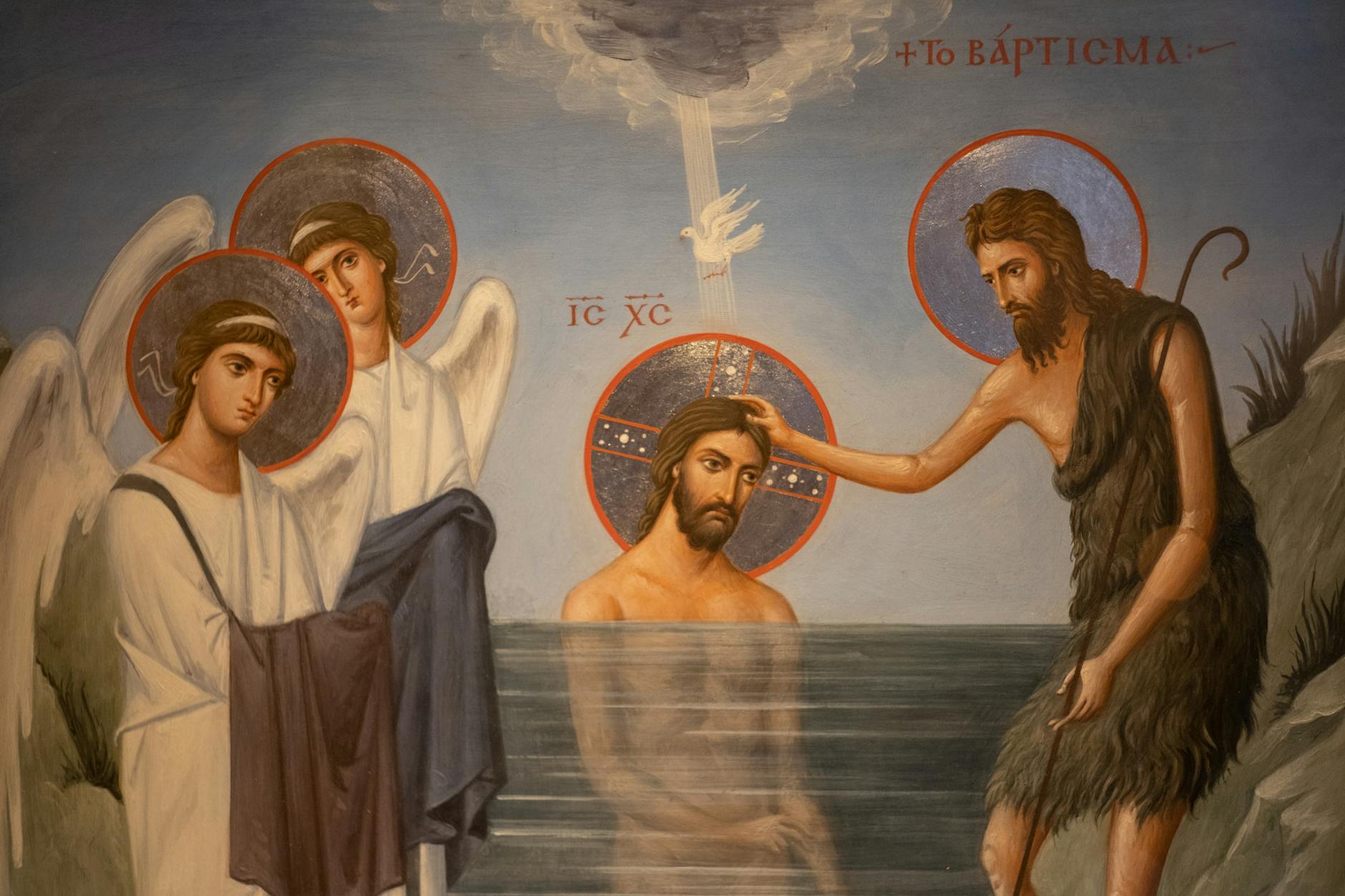

Photo by Ron Lach on Pexels.com

Torn Open

Sabbath Day Thoughts — “Torn Open” Mark 1:4-11

Elena Bernal was not looking forward to the holidays. The sixty-six-year-old was widowed three years ago in December. Home feels quiet and lonely now, especially at Christmas. Elena breaks down in tears, just thinking about her loss. “We grew up together,” she says of her late husband, “We met in middle school. I miss him so much.”

The world is in the midst of a loneliness epidemic. A Meta-Gallup poll released in October conducted in 142 countries found that one quarter of the world’s population reports feeling very or fairly lonely. The statistics are even higher in the United States. In May, the Surgeon General Dr. Vivek Murthy released a report indicating that half of Americans report experiencing loneliness.

There are a number of reasons for our national surge in loneliness. In this post-pandemic world, more people are working and learning remotely. We’re communicating more remotely, too, with Facetime and Zoom replacing meetings, visits, and face-to-face gatherings. Larger societal changes further contribute to the problem of loneliness. The social media boom, which presents a distorted, idealized vision of the daily life of others, has us scrolling on our phones rather than picking up our phones to make a call to our friends and family. More of us live alone these days. In 1960, only 13% of Americans lived by themselves. Today that number has more than doubled to 29% of us. We may feel it is tougher to form genuine connections, too. In 1972, 45% of us trusted our neighbors. In the midst of the increasing political and social division of our nation, only about 30% of us now say that our neighbors are trustworthy.

Loneliness is bad for our health. It puts us at increased risk for depression, anxiety, addiction, self-harm, and even suicide. The Surgeon General’s report indicates that loneliness increases the risk of premature death by 26%. It’s worse for us than obesity or inactivity. Dr. Murthy compares loneliness to smoking fifteen cigarettes a day. It increases our risk of heart disease by 29%, our risk of stroke by 32%, and among the elderly, the risk of dementia doubles. Feelings of loneliness have seen the greatest increase among those aged 19 to 29. Half of young adults say that in the last week no one had taken more than a few moments to reach out to them or express any sort of genuine care.

If the Meta-Gallup poll and the US Surgeon General are right, then addressing the epidemic of loneliness and isolation is critical to the world’s well-being.

I suspect that there were feelings of loneliness and isolation at play in the crowds who came to hear the fiery preaching of John the Baptist. John spoke boldly of existential loneliness, the alienation and isolation that come when we feel that we are separated from God and our neighbors. In fact, John proclaimed a bold message of repentance, of returning to right relationship with God and community.

Jesus came to the muddy banks of the River Jordan.  He took a seat among the crowds and listened to what John had to say.  Throngs of pilgrims, the whole Judean countryside, had come to gawk at John and listen to his bold exhortation. If we listen up this morning, we can almost hear the rough voice of the Baptizer, the song of the river, and the murmuring of the entranced crowds. Compelled by the power of John’s message, Jesus kicked off his sandals, set aside his staff, bag, and traveling cloak.  He waded into the gritty Jordan to John’s side, and he was baptized. 

We’re told that when Jesus emerged from the river, something extraordinary happened.  The sky was torn open (sxizomenous).  In the Hebrew understanding of the world, the sky was a solid dome, the firmament, established by God at creation.  The Israelites believed that we lived on this side of the firmament while God was on the other. Separate. Holy. Distant. Apart. The Prophet Isaiah gives us a feeling for this separation between God and humanity. When the Israelites lived in exile in Babylon, Isaiah cried out to God, “O, that you would tear open the heavens and come down!” (Isaiah 64:1).  At Jesus’ baptism, God tore open the heavens. God entered into the world to reshape it through this humble carpenter from Galilee.

Jesus went forth from his baptism to live a torn-open life, a life marked by compassion and a willingness to be vulnerable with and for others. He identified with those who lived as outsiders. He called fishermen, tax collectors, and peasants to be his disciples. He broke bread with sinners. Jesus advocated for the powerless – welcoming women to his ministry and blessing the children. Jesus healed, ending the physical, social, and spiritual isolation of lepers, demoniacs, and the disabled. The torn-open Jesus confronted empire and Temple, those who wielded brutal power over others, with the promise of a coming Kingdom where power would be used to help and to heal.

Jesus’s choice for a torn-open life was most clearly revealed in his death on the cross. Even as he underwent unimaginable suffering, he thought of others. He welcomed a repentant thief to paradise. He prayed for God to forgive his executioners. Let’s face it. On the cross, Jesus was literally torn open. Nails brutally pierced his hands and feet. A spear was thrust through his side and into his vital organs.  It’s messy and brutal and awful. And we learn the lengths that God will go for our sake, the limitless love of a torn-open God.

At the moment of Christ’s death, we are reminded of his baptism. The curtain in the Temple that sequestered the holy of holies was torn open from top to bottom. We do not hear God’s voice speaking from the heavens, “This is my Son the Beloved;” rather, a Roman soldier at the foot of the cross, who witnessed the compassion and dignity with which Jesus died, pronounced, “Surely, this man was God’s son.” In living a torn-open life, Jesus granted us a vision of the world that God would have us make. It’s a world where faithful people choose to make a difference by facing head-on all that has separated us from God and one another. It’s world where we trust that on the far side of the world’s worst, new life will rise, and we have a role to play in that new creation.

Michael Rogness, who taught preaching for many years at Luther Seminary, likes to point out that to be baptized is to follow Jesus. We, who were sprinkled as infants, confirmed as teens, or chose baptism as adults, have embarked on a life of discipleship. That doesn’t mean that we are perfect or exceptionally pious, walk on water or know every chapter and verse of scripture. Rather, discipleship is that choice for a torn-open life of compassion and caring. It prompts us to feed hungry neighbors, welcome strangers, embrace those who feel like outsiders, and bless children. The torn-open life is a calling to help, to heal, and to love. Always love.

Our choice to follow Jesus in this torn-open life may be the antidote for the world’s epidemic of loneliness. According to the Surgeon General, social connection is the most important tool in overcoming social isolation. Human beings who are embedded in a web of concerned and caring individuals thrive. Our interest and caring for others are as essential to our well-being—and theirs—as the air we breathe and the food we eat. Medical science confirms that the world becomes healthier, physically and mentally, when people are respected and valued, looked after and look out for. Our loving care and interest in others, our choice to be torn open, changes us and changes others. Loneliness ends. We find meaning, purpose, motivation, and hope. We begin to see the world that Jesus would have us make, where the barriers that separate us from our neighbors and disconnect us from God are torn open.

Elena Bernal’s Christmas was a lot better than she expected. She accepted an invitation to attend Christmas lunch at the Serving Seniors Wellness Center in Cortez Hills where she lives. Serving Seniors is a nonprofit organization that is dedicated to helping low-income seniors. They provide nutritious food, but they believe the social interaction and hospitality that are shared when they break bread together is even more important. Elena ran into an old friend Gwendolyn King at the lunch. The two women visited and shared news as they enjoyed a traditional holiday meal. Alan Busteed, looking dapper in a three-piece suit, moved from table to table playing carols on his violin and taking requests. As Elena left, she was given a Christmas present and a $10 gift card. It was nice, really nice.

The Serving Seniors Wellness Center has a banner that hangs above the buffet. It reads, “Remember, you are a citizen of the world, and everybody needs you. You’ll find happiness in the giving of yourself.” If you ask me, it sounds a lot like a torn-open life.

Resources

Tammy Murga. “Christmas Day can be lonely, quiet for many. Serving Seniors made it a fun one for these San Diegans,” in The San Diego Union-Tribune, Dec. 25, 2023. Accessed online at https://www.sandiegouniontribune.com/

Dr. Vivek Murthy, Julianne Holt-Lunstad, et al. Our Epidemic of Loneliness and Isolation: The Surgeon General’s Advisory on the Healing Effects of Social Connection and Community. Washington, DC: Office of the Surgeon General, May 2, 2023. Accessed online at https://www.hhs.gov/sites/default/files/surgeon-general-social-connection-advisory.pdf

Paul S. Berge. “Commentary on Mark 1:4-11” in Preaching This Week, January 8, 2012. Accessed online at workingpreacher.org.

Michael Rogness. “Commentary on Mark 1:4-11” in Preaching This Week, January 8, 2012. Accessed online at workingpreacher.org.

Adrianna Rodriguez. “Americans Are Lonely and It’s Killing Them” in USA Today, Dec. 24, 2023. Accessed online at https://www.usatoday.com.

Theresa Coleman. “2023: The Year of the Loneliness Epidemic” in The Week Magazine, December 9, 2023. Accessed online at https://theweek.com.


Mark 1:4-11

4John the baptizer appeared in the wilderness, proclaiming a baptism of repentance for the forgiveness of sins. 5And people from the whole Judean countryside and all the people of Jerusalem were going out to him, and were baptized by him in the river Jordan, confessing their sins. 6Now John was clothed with camel’s hair, with a leather belt around his waist, and he ate locusts and wild honey. 7He proclaimed, “The one who is more powerful than I is coming after me; I am not worthy to stoop down and untie the thong of his sandals. 8I have baptized you with water; but he will baptize you with the Holy Spirit.” 9In those days Jesus came from Nazareth of Galilee and was baptized by John in the Jordan. 10And just as he was coming up out of the water, he saw the heavens torn apart and the Spirit descending like a dove on him. 11And a voice came from heaven, “You are my Son, the Beloved; with you I am well pleased.”


Photo by Pixabay on Pexels.com