Jackie Carl Gets a New Name

Sabbath Day Thoughts — “Jackie Carl Gets a New Name” Isaiah 9:2-7 and Psalm 22:9-10

for Tillie Blackbear

“Jeezum Crow! That boy has gotten up to a lot of mischief over the years, but this takes the cake.” It was Ruth Underhill. Pastor Bob had gotten an emergency call, summoning him to Ruth’s farm, and it hadn’t taken much imagination to surmise that the “emergency” was related to Ruth’s grandson Jackie Carl. The boy just seemed to be made for trouble.

At the farm, Bob wasn’t surprised to see that Tubby Mitchell had also been summoned to respond to the crisis. Tubby sat at the kitchen table, studying his cup of black coffee, and while Ruth poured Bob his own cup, she launched into Jackie Carl’s latest escapade. It had involved the outside brick wall of the high school gym and a lot of spray paint. To Jackie Carl’s credit, the graffiti was not profane, just rude and wildly inappropriate.

“You name it, I’ve tried it,” Ruth continued, “Counseling, tough love, heart-to-hearts, prayer, bribery.” She threw up her hands. “Nothing works. Nothing!”

Now Bob was studying his coffee cup as assiduously as Tubby was. In the silence that followed, Bob could hear the kitchen clock ticking. Bob thought about all the trouble that Jackie Carl had gotten into over the years. When the boy was only in second grade, Bob suspected him of swiping the special comb that Eugenia Bergstrom used every Sunday to straighten the fringe on the altar cloth. An exhaustive search had eventually found it, tangled in the mane of a stuffed lion down in the Sunday school room. Then, there had been the time in middle school when Jackie Carl had blown out the exhaust system in his school bus by wedging an enormous potato into the tailpipe. Lately, Bob had heard about fights—two black eyes for the boy who had called Jackie Carl a red-headed loser. When Bob thought about it, the only time he’d seen Jackie Carl truly happy in the past year had been on the lacrosse field, the teenager’s lanky, freckled legs dashing down the field at a blistering pace, cradling the ball, dodging defenders, and launching a shot with a fierce intensity that made even the most steadfast of keepers shrink in fear.

Ruth wasn’t done. “I blame it on his father. We haven’t seen hide nor hair of him in five years. Five years! At least when he was in prison, we knew where he was. Why my daughter took up with him I’ll never understand. You know, the one time he did visit, he spent the whole time smoking cigarettes on the front porch and staring at his phone. He may have named the boy after himself, but he has never shown a lick of interest in the child.”

Tubby sadly nodded along. Tubby had been thinking, too. He remembered meeting the six-year-old Jackie Carl, all knobby knees, freckles, and carroty hair. The boy had called Tubby out of his grief for his dead son, and the two had forged a special bond as the boy tagged along to fish, camp, and hunt. Each morning of those trips, Tubby and Jackie Carl would begin the day by praying together the Haudenosaunee prayer of thanksgiving with its beautiful celebration of the unity of creation, “Now our minds are one.” For Tubby and his wife Irene, the boy had helped to heal the hole left in their hearts when Todd died in Iraq.

Tubby thought about himself, too, he’d lost his parents at a young age in a car accident, casualties of those days when addiction had been so prevalent on the reservation. Tubby knew there was a good chance that he would have ended up as wild and unsettled as Jackie Carl if it hadn’t been for his grandfather. The legendary wilderness guide had driven north to the reservation from his cabin outside the village and taken Tubby home with him. Tubby’s grandfather had always made sure that Tubby knew who he was, Tionatakwente of the Kanien’kehaka people, the great eastern door of the Iroquois confederacy, but Tubby suspected that Jackie Carl had no idea who he was. Tubby and Bob locked eyes across the table and an unspoken agreement passed between the two men.

Bob leaned forward, “How can we help, Ruth?”

This unlocked a shower of tears from Ruth, who could run her dairy farm with an iron fist but couldn’t tame her grandson. Between sobs, Ruth stammered, “I don’t know I don’t I don’t I don’t know.”

Tubby sighed and reached across the table to lay his hand on Ruth’s, “I’ve got an idea, Ruth. Let me talk to Irene about it.”

When Tubby opened the door to the cabin, he was greeted by the scent of balsam and baking. He had cut a six-foot Christmas tree and brought it home where Irene had worked her magic, winding it with lights, hanging ornaments, and topping it with an enormous God’s Eye that their son Tod had long ago made in Sunday school—bright yarn was woven around crossed sticks to remind them of God’s watchful care and protection. Irene was pulling a tray of Christmas cookies from the oven. Her cheeks were flushed and her long hair, bound by a red ribbon the nape of her neck, was shot through with gray.

Tubby leaned in to steal a too-hot cookie. He remembered the first time he saw Irene up on the reservation. He had known immediately that she would be his wife. Tubby wasn’t sure what his grandfather had said to the Clan Mother to convince her it would be ok for Irene to marry his grandson, but it worked. Their wedding day, when he had seen her in her ribbon skirt, shawl, and beaded moccasins, had been one of the happiest moments of his life. Tubby blew on his cookie.

“I’ve been thinking,” he said, venturing a cautious bite.

Irene raised her eyebrows. “Thinking? That’s always trouble.”

Tubby nodded, “It’s about Jackie Carl.”

Irene smiled indulgently. “Ah. More trouble.”

Tubby started again, “Well, it’s not just about Jackie Carl. It’s about Todd, too.” Irene’s brow creased, thinking about the beautiful son they had lost in Iraq. She waited for her husband to continue.

Tubby searched for the right words. “Irene, maybe kinship isn’t just about blood. Jackie Carl needs us. Maybe in ways that Todd never did. Ruth Underhill, she needs our help. Maybe God is calling us to something new.”

One by one, Irene transferred cookies to the cooling rack, plying her spatula until the baking sheet was empty. Christmas always made Irene think of Todd. Could there be that kind of space in her heart for someone else, especially someone who was so troubled? She thought of her own parents and elders on the reservation. They told long ago stories of the healing of families that followed times of war. Beloved ones lost in battle left a hole that was sometimes filled by others—even prisoners of war—who were adopted into the clan. Still today, it wasn’t unusual to expand families in unexpected ways.

Irene turned the thought over in her mind and picked up a cookie. She took a bite. Maybe the question shouldn’t be why but why not. Why not a hot-headed teen with fiery red hair? Irene put down her spatula, “Tionatakwente, are you asking if we should adopt Jackie Carl into the clan?”

Tubby looked expectant.

Irene nodded, “Well, I’d better call my Auntie. Lord knows, that boy sure could use a new name.”

Jackie Carl was no stranger to the res. As a boy at the Powwow, he had relished eating stew with thick chunks of venison, made tender by slow cooking. His small feet had shuffled along with the men as they moved to the rhythm of the Thunder Dance. Each year right after school let out, Tubby would drive them north to the St. Lawrence to fish for enormous Muskies that lurked in weeds and promised the fight of a lifetime. Jackie Carl had learned to love lacrosse on the res, the beauty of precision passing, the crack of stick against stick, the cry of “Aho!” when the ball swished into the back of the net. Last summer, Jackie Carl had helped Tubby as the firekeeper at the sweat, carefully passing super-heated rocks with a pitchfork from the fire to the pit at the center of the lodge.

Sometimes on the reservation, Jackie Carl forgot. He forgot that his father didn’t love him. He forgot that his mother had left him. He forgot that he felt angry and rootless on most days, despite his grandmother’s efforts to provide what his parents could not.

Jackie Carl had never been on the reservation for the Midwinter Ceremony. The five days of praying, eating, dancing, and games conflicted with school, but this year, Ruth Underhill made an exception, sending him north in the back seat of Tubby’s Kingcab. Irene had been cooking for the feast for days: golden rounds of Bannock, sweet cornmeal pudding, roasted squash mixed with butter and maple syrup, and vats of potato and macaroni salad. Just thinking about it made Jackie Carl’s stomach growl. On that first day, they had pulled up in front of an inauspicious looking ranch house. Tubby put the car in park, and Irene turned to the boy. “This is my Auntie’s house. She’s the Clan Mother. Are you ready?” Jackie Carl nodded, “Yep,” and they went inside.

A teen about Jackie Carl’s age answered the door, showed them where to leave their shoes, and pointed them toward a closed door, saying only, “They’re waiting.” Inside, it took Jackie Carl’s eyes a minute to adjust to the dark. Windows had been covered with blankets and the only light came from a low fire that burned in the fireplace. This must have been what it felt like in the longhouse, Jackie Carl thought. A circle of Kanien’kehaka people sat on the floor, but just enough room had been left for the three of them. Jackie Carl, Tubby, and Irene took a seat.

 At the head of the circle sat the oldest woman that Jackie Carl had ever seen. “Auntie,” Irene spoke up, “we bring you a gift.” She held out a pouch of tobacco, which was passed around the circle to the waiting matriarch. She gave it an appreciative sniff before mixing it with red willow bark and packing it into the bowl of a medicine pipe. The lit pipe slowly passed from neighbor to neighbor around the circle. To Jackie Carl, the silence of that room felt like an eternity, but for Tubby and Irene it felt like they were settling back into the ancient rhythms of their ancestors.

Finally, the Auntie spoke in Mohawk, then in English for Jackie Carl’s benefit. “What is it you seek, my children?”

Irene answered, “We’ve come to claim the right of adoption. The hole that was left in our clan when Todd was killed needs to be filled. We claim Jackie Carl, that he might have all the rights and status that would have been Todd’s.” There were sounds of affirmation around the circle, followed again by an appreciative silence.

At last, with what might have been a twinkle in her eye, the Auntie said, “It’s about time, Irene. What took you so long?”

The Auntie turned her bright eyes on Jackie Carl, “And what do you have to say about it, young man?”

Before she had even finished speaking, Jackie Carl was nodding, “Yes,” so filled with feeling that he could not find the words or trust his voice. Jackie Carl looked to Tubby and Irene, their faces filled with love, their eyes brimming with tears. Tubby placed a hand on Jackie Carl’s shoulder and for the first time in his life, the boy felt like he had a Dad.

“Very well!” the Auntie continued, “You need a name. A real name.” As if the name Jackie Carl had only been a placeholder for the true life that was about to unfold.

They sat once more in silence. The pipe was filled and passed around the circle again. After a long while, the Auntie spoke. Pointing first to the orange glow of the coals on the hearth and then to the carroty color of Jackie Carl’s hair, she said. “You, my child, are Atsila. That means fire.”

An appreciative chorus of “Aho” and laughter greeted her proclamation. “Atsila,” Jackie Carl tried the sound of his new name. It felt like the moment when the Muskie hits your line and you know you’ve hooked a big one. “Atsila.” It felt like the instant your lacrosse shot slips past the keeper and into the cage. “Atsila.” It felt like the sleepy peace that comes when your belly is full of Bannock, venison stew, and cornmeal pudding. “Atsila.” It felt like home.


Isaiah 9:2-7

The people who walked in darkness
    have seen a great light;
those who lived in a land of deep darkness—
    on them light has shined.
You have multiplied exultation;
    you have increased its joy;
they rejoice before you
    as with joy at the harvest,
    as people exult when dividing plunder.
For the yoke of their burden
    and the bar across their shoulders,
    the rod of their oppressor,
    you have broken as on the day of Midian.
For all the boots of the tramping warriors
    and all the garments rolled in blood
    shall be burned as fuel for the fire.
For a child has been born for us,
    a son given to us;
authority rests upon his shoulders,
    and he is named
Wonderful Counselor, Mighty God,
    Everlasting Father, Prince of Peace.
Great will be his authority,
    and there shall be endless peace
for the throne of David and his kingdom.
    He will establish and uphold it
with justice and with righteousness
    from this time onward and forevermore.
The zeal of the Lord of hosts will do this.

Psalm 22:9-10

Yet it was you who took me from the womb;
    you kept me safe on my mother’s breast.
10 On you I was cast from my birth,
    and since my mother bore me you have been my God.


Photo by Cody Hammer on Pexels.com

The Least of These

Sabbath Day Thoughts — “The Least of These” Matthew 25:31-46

Bob stopped typing. There it was again, an insistent knocking, down at the front door. It was Saturday morning. Marge and Paul had driven south for a weekend of Christmas shopping with her sister in Albany. Bob was working on his sermon, but he had deleted more than he had written. He pushed back his desk chair and ventured downstairs.

There on the doorstep was the short, round form of Junior Miller. Bob remembered the Christmas Eve that Junior had been born, more than twenty years ago, now. Bob had been called to the hospital to visit the newest member of his flock. Junior’s almond-shaped eyes and rosebud mouth confirmed what his parents had learned: Down Syndrome. But the boy had been a delight. Sure, he struggled with school. Sure, he took some bullying. But his kind nature was unstoppable. This morning, Junior looked extra round. A down jacket stretched across his belly, snow boots reached almost to his knees, a bright wool handknit hat and matching scarf and mittens were keeping out the cold.

“Why Junior! What brings you to my door so bright and early?”

Junior pulled down the scarf to free his mouth and leaned in, “Pastor Bob, I had a dream.”

Bob’s eyebrows shot up, like they do when he is intrigued. “A dream. You don’t say. You want to come in and tell me about it?”

Junior shook his head emphatically, no! “Pastor Bob! It was God, he said he was going to see me today. I don’t have time to visit with you.”

Bob nodded appreciatively. “Hmm. Well, where do you think you’ll find God?”

Junior pushed back his knit cap and looked up and down the street. “God didn’t say. Any ideas?”

Bob looked left and right. It had snowed a lot overnight. The plows had been out to clear the lane, but the trees were bowed beneath the wintry weight. Bob squinted against the snowy glare, “Well, Junior. I’m not sure where you’ll find Jesus, but I’m certain he’s out there. Be sure to send him my way. I could use some help with my sermon.”

Junior nodded, turned around, and marched off in search of Jesus.

Junior had only gone a few blocks when he saw old Mrs. Trombley. Every week she came to the dairy where Junior worked and bought the same thing:  a dozen eggs, a half-gallon of milk, and one of Mrs. Underhill’s freshly-baked bear claw pastries. This morning, Mrs. Trombly was shoveling snow. A wall of the white stuff had drifted against the back of her car. You could barely make out the bumper.

“Hi, Mrs. Trombly! It’s me, Junior.”

Mrs. Trombley leaned on her shovel to catch her breath. Her cheeks were bright red and she looked kind of sweaty. Junior hadn’t noticed before, but Mrs. Trombley seemed to be shrinking. Her back curved inside her old winter coat. She had to look up to see his face. “Why Junior, good morning! How do you like all this snow?”

Junior took her question seriously. “Pretty nice, I guess.”

Mrs. Trombley looked at the big drift behind her car. “Lots of work if you ask me. Burt always does this, but he had surgery last week. That means I’m on deck.”

Junior nodded. He really needed to get going if he was going to see Jesus, but he stopped. “Here, Mrs. Trombley. Give me that.” Junior took the snow shovel. It took a while to dig out the car and shovel the walk while Mrs. Trombley went back inside to tend Burt. Junior left the snow shovel next to the front door and hurried off to continue his search.

Outside the church, Junior saw Christine Lebowski. She had been the prettiest girl in his high school class. A cheerleader, too. She had married the captain of the football team, but Junior wasn’t invited to the wedding. In fact, Christine and her friends had sometimes made fun of Junior. They called him the ‘tard and poked fun at his round belly which, as a child, bore a striking resemblance to Winnie the Pooh’s.

Christine was pushing a stroller, the lightweight, folding kind that you use in the summer months. There was a chubby baby inside that was every bit as blonde and blue-eyed as Christine. The baby looked happy, but Christine did not. In fact, she looked like she had been crying. Her eyes were red and swollen. She had a soggy Kleenex clenched in one hand. Junior had never seen Christine cry.

Junior followed Christine into the church. There she turned right, into the food pantry. Junior really needed to look for Jesus, but the fact that Christine Lebowski was crying tugged at his tender heart. He watched out of the corner of his eye while Christine took the baby out of the stroller and strapped it across her chest into one of those Snugli carriers while the food pantry volunteers loaded up her stroller with bags of food. As Christine shoved the overloaded stroller over the threshold and back outside, Junior heard an alarming, “Crack!” The stroller collapsed, sending groceries everywhere. Christine was really crying now.

Junior stepped up. “Hey, Christine.”

The sad woman looked around, noticing for the first time that Junior was there. “Uh, Junior. Sorry, I’ve made a big mess.”

Junior bent down and gathered the groceries back into their shopping bags. The bags were heavy and Christine with her baby didn’t look like any match for the load.

“I can help.” Junior said. That made Christine cry even more. He walked them home. Junior was surprisingly strong from his work at the dairy, but even he had to stop a few times to rebalance the load.

 Along the way, Christine told him that she was alone now. Her husband said he didn’t want to be tied down with a baby. She was working at the Ron Dack Market when her Mom could watch the baby, but some months that just wasn’t enough. Junior just listened. At the door to her apartment, Christine said, “Gee, Junior. You are my knight in shining armor today.” This made Junior blush.

It was already early afternoon, but if Junior hurried, he could make it for the free lunch at the Good News Café. He arrived just as Tubby Mitchell was locking up.

“Junior!” the older man said, “You are my last customer today.” Tubby loaded up a plate with mashed potatoes, ham, green beans, and a generous slab of sheet cake.  Junior ate with gusto, telling Tubby between bites all about his dream.

“Have you seen Jesus, Tubby?” Junior wanted to know.

Tubby looked out the window with a far away look in his eyes and sighed. “You know, Junior, I see him most days.”

This amazed Junior. “Jeezum Crow, Tubby! Really?”

Tubby smiled sadly, “Yup. I think I served him lunch about twenty minutes ago. If you hurry, you might catch him.” He nodded up the street, toward the center of town.

Junior pushed most of his cake into his mouth then pulled on his down coat and woolen cap. Tubby wound Junior’s scarf around his short neck while Junior jammed his hands into his mittens. “Oh boy! Thanks, Tubby!” Junior shouted over his shoulder as he dashed off up the street.

But Junior didn’t see Jesus or God almighty or even an angel. Dejected, he sat on a bench at the busy intersection in the center of town. Junior watched every car and inspected every pedestrian, hoping for a glimpse of the Lord.

The only thing of interest was Hank Tebow, who was always interesting. In the summer months, Hank wielded a spray bottle of Windex and a squeegee to make some easy money by washing the windshields of tourists while they idled at the light. In winter months, Hank wore big insulated coveralls and mostly just watched what passed for traffic in the village. Some days were bad, and he would yell at the cars until the police moved him along. Other days, like today, Hank dispensed jokes, the kind a six-year-old might tell.

“Hey, Junior! Knock, knock!”

Junior generally like this kind of joke, “Who’s there?”

“Snow.”

“Snow who?”

“Snow use. I forgot my name again!”

Junior laughed, “Good one, Hank.”

Junior resumed his search for Jesus while Hank scrounged a few cigarette butts from the sidewalk and tried unsuccessfully to share his jokes with pedestrians hurrying past. Junior noticed that Hank didn’t have any gloves or mittens. His hands were stained with nicotine and his nails were grimy, like Junior’s after a morning of work with the animals at the dairy. Hank’s bald head was hatless and his wispy beard didn’t seem to offer much protection for his face. Already the shadows were getting long. Junior would go to his parents for dinner, but Hank would probably be out there for hours. Junior stood up. He unwound the scarf, pulled the hat from his head, and yanked off his mittens. He tugged his coat sleeves down to cover his bare hands.

“Hey, Hank!” He yelled, “Knock, knock!”

Delighted that someone would join him in a little fun, Hank hurried over, “Who’s there?”

“Tank.”

“Tank who?”

“You’re welcome!” Junior said as he pushed his warm knitwear into Hank’s hands. They did some more laughing and Junior left. It was starting to get dark as Junior walked to his parents’ house. He had seen plenty of people that day, but where was Jesus?

The next morning, Junior arrived early at church. He knocked on Pastor Bob’s study door, then let himself in. He took a dejected seat on the couch. Bob stopped what he was doing.

“So, how did the Jesus hunt go, Junior?”

“Not so good.” Looking disappointed, Junior told Bob all about his day.

Bob listened and then chose his words carefully, “You know, Junior, I suspect that you saw plenty of Jesus yesterday.”

“Huh?”

“And Junior, I suspect that all those people you helped, they saw Jesus, too.”

Junior’s brow creased in concentration. “I need to think about that,” he said, rising from his seat and venturing out into the hallway.

At the door, Junior turned back, “How about you, Pastor Bob? Did Jesus help you with your sermon?”

Bob laughed, “Well, he sent his Holy Spirit to help me out. I expect we’ll do just fine.”

While Bob finished up his prayers of the people, Junior Miller found a quiet place to think.

This story was inspired by Leo Tolstoy’s classic work of short fiction, “Where Love Is, There God Is Also.”


Matthew 25:31-46

31“When the Son of Man comes in his glory, and all the angels with him, then he will sit on the throne of his glory. 32All the nations will be gathered before him, and he will separate people one from another as a shepherd separates the sheep from the goats, 33and he will put the sheep at his right hand and the goats at the left. 34Then the king will say to those at his right hand, ‘Come, you that are blessed by my Father, inherit the kingdom prepared for you from the foundation of the world; 35for I was hungry and you gave me food, I was thirsty and you gave me something to drink, I was a stranger and you welcomed me, 36I was naked and you gave me clothing, I was sick and you took care of me, I was in prison and you visited me.’ 37Then the righteous will answer him, ‘Lord, when was it that we saw you hungry and gave you food, or thirsty and gave you something to drink? 38And when was it that we saw you a stranger and welcomed you, or naked and gave you clothing? 39And when was it that we saw you sick or in prison and visited you?’ 40And the king will answer them, ‘Truly I tell you, just as you did it to one of the least of these who are members of my family, you did it to me.’ 41Then he will say to those at his left hand, ‘You that are accursed, depart from me into the eternal fire prepared for the devil and his angels; 42for I was hungry and you gave me no food, I was thirsty and you gave me nothing to drink, 43I was a stranger and you did not welcome me, naked and you did not give me clothing, sick and in prison and you did not visit me.’ 44Then they also will answer, ‘Lord, when was it that we saw you hungry or thirsty or a stranger or naked or sick or in prison, and did not take care of you?’ 45Then he will answer them, ‘Truly I tell you, just as you did not do it to one of the least of these, you did not do it to me.’ 46And these will go away into eternal punishment, but the righteous into eternal life.”


Photo by Karolina Grabowska on Pexels.com

Put to the Test

Sabbath Day Thoughts — “Put to the Test” Matthew 4:1-11

It had seemed like the natural thing to do.  After all, Moses had spent forty days and nights fasting on the mountain of God before he had returned with the stone tablets of the ten commandments.  Elijah had humbled himself for forty days in the wilderness after battling the prophets of Baal. He had come away with a new vision for his prophetic work. If it had been right for Moses and Elijah, why not him?  No sooner had God’s voice stopped ringing from the heavens above the waters of his baptism, than he felt it—the tug of the Spirit, leading him away from the Jordan’s banks and guiding him high into the hills of the Judean desert.

It hadn’t been easy. The sun was brutal, and even though the grotto was sheltered, the days were far hotter there than in the Galilee, and the nights were surprisingly cold. Some days, the wind blew in from the Transjordan with the harsh whirl of stinging sand.  There were snakes and scorpions. One night, jackals howled nearby, dreaming of an easy meal. He saw a sand cat, warily trotting with belly low and enormous ears swiveling for sounds of threat. She paused and blinked at him with amber eyes, a dead lizard dangling from her mouth. “Have you brought me a gift?” he asked before she scuttled away to a hidden den.

He wasn’t sure when he first realized that he was not truly alone. The first temptation seemed so innocuous. “Jesus, I’m famished.  When was the last time we ate, anyway?  Don’t you need a little something to renew your strength and reinvigorate your prayers? Even the Israelites found a little manna in the desert.  Why not turn this stone to bread and relieve our hunger?” 

His stomach growled at the suggestion.  It would be easy.  Anyone who would one day turn five loaves and two fish into a feast for thousands could certainly whip up a tasty treat for two from a stone.  Who would know anyway? 

But then he thought about his ancestors: the Israelites in Sinai nourished with bread from heaven; Elijah under the broom tree, fed by an angel; Moses on the mountaintop, sustained by God only knows what.  He sighed. If there were to be an end to his fast there in the wilderness, it would be up to God and not the rumbling of his belly or the wiles of the Adversary. 

The answer to the question, when he found it, came from the Torah, “One does not live by bread alone, but by every word that comes from the mouth of the Lord.”  He suspected that it would not be the last time that he would be hungry, but he trusted that God would provide. He returned to his prayers.

/

It didn’t stop. In a dizzy disorienting whirl of color and light, he found that, although he was still way up high, the wilderness was far behind.  He looked out over a busy city.  A crowded labyrinth of streets marched down a hill, crammed with shops and vendors and pedestrians.  A haze of dust and the smoke of cooking fires hung upon the air. On one side, a steep valley fell away to a deep wadi, water-filled and gleaming.  Below him were giant flagstones, marble columns, and people, many, many people: pilgrims in travel-worn cloaks, proud scribes in fine robes, threadbare beggars crying out for alms, lordly priests with bejeweled breastplates.

He sat down with a thump, his legs dangling over the edge of the parapet, knowing exactly where he was.  He had been dedicated here at 8 days old, the priest wielding a small, sharp, curved knife to mark him as a child of Abraham.  He had camped out here when he was only twelve, sitting among the teachers for days, filled with questions and an eagerness to learn and teach.  Year after year, he had made pilgrimage here, to remember the Passover, to pay the tax, to offer an acceptable sacrifice.  Jesus was in his Father’s House, the Temple in Jerusalem.  He had just never seen it from this vantage before, from the very pinnacle. 

“Magnificent, isn’t it?” his companion asked with sincere admiration.  “You are the Messiah, God’s beloved one.  All this is yours by right.  Let’s get the party started. Reveal yourself right now in power and glory.  Let’s humble those scribes and priests.  Let’s liberate those people.  Let’s heal those beggars.  Let’s clean house.  Step out and claim your rightful place.  You know what the Psalmist said, ‘God will lift you up.’” 

Jesus thought.  Below him in the court of the Gentiles, he heard the shouts of moneylenders and the cries of animals to be sacrificed.  A display of holy power and protection here and now would do more to affirm his identity as the Messiah than years of preaching and teaching and healing in the hinterlands.  Why not put these arrogant priests and self-centered scribes in their places?  Why not claim what was rightfully his and restore righteousness to the Father’s House?  He could see it.

But as Jesus looked out over Jerusalem’s narrow streets, he remembered the story of his forefather David. The King of Israel, sweat-soaked, half-naked, and exhausted, had sung and danced before the Lord with all his might, bringing the Ark of the Covenant up to the holy city, limping and leaping before God and all the people.  Surely, the way of the Messiah was like that, one of complete devotion and absolute humility, not power and pride.  The way of God’s Son would be to do God’s bidding and not the other way around.  “No,” Jesus answered with a rueful shake of his head, “I’ll not put God to the test.”  He bowed his head and closed his eyes.

/

It wasn’t over.  “Come with me,” his Adversary invited. They were back in the wilderness where his companion was leaning in the shade at the mouth of the grotto. With a quick upward jerk of his chin, he pointed to the trail that threaded up the hillside to the very top of the mountain.  Jesus rose on wobbly legs, stepped out, and stood blinking in the harsh sun. The air was clear and super-heated, rippling out at the brim of the world. The stones were hot beneath his sandals. ‘Let’s climb,” his friend smiled. Together they threaded their way to the summit, where a broad flat boulder waited like a throne.  With a bow and a sweep of his arm, his companion invited him to climb on high. He did.

Jesus caught his breath and took in the world around him.  In the distance, the Jordan was a muddy snake winding across the landscape, cutting a narrow green swath through the valley.  Clouds on the far western horizon hinted at the presence of the great sea, where the merchants sailed and Leviathan swam.  To the north, he caught sight of the silver-blue Sea of Galilee, harp-shaped, nestled beneath the Golan Heights.  Far beyond that, the mountains of Lebanon rose with their snow-covered caps glinting in the midday sun.  To the south, the salt wastes stepped down to the Dead Sea.  Beyond that, yawned the Sinai desert, its saw-toothed peaks and barren sands stretching all the way to Africa.  Jesus drank deep the desert air and looked with awe at his Father’s world. 

“Amazing, isn’t it?” It was his companion, at his elbow now.  “But there is so much grief and poverty, hunger and heartlessness out there.  And the Romans, ugh. Why not make it yours?  Why not change the way things are?  Free the captives, feed the hungry, welcome the stranger, heal the sick.  It is all yours for the taking.  All that is required is just one small thing: a little bending of the knees, the slightest bowing of the head, a few prayers, a little incense burned. Worship me. What are we waiting for?”

Jesus looked out over the beautiful broken world at his feet.  He thought about the hurting people he had seen everywhere—hungry, fearful, dirt poor, ground down.  What was he waiting for?  Why not rise to his friend’s charge and set things straight?  Couldn’t the end justify the means?

But as Jesus looked over the Promised Land, gleaming like a green and tan jewel, he remembered that God alone had the power to create this world. God alone had the authority to give this land as a blessing to the people. God alone would be the architect of its salvation, and God alone would determine that path.  Whatever it might be. 

Unbidden, the words of Moses were on his tongue, “Worship the Lord your God, and serve only him.”  With an uneasy sense of hard things yet to come, Jesus waved off his tempter. “Enough. Away with you. Get behind me.”

/

Jesus stood strong in the noonday sun on the summit, his shadow so small that it flitted out only as the wind surged through his linen robe. The sand cat crouched in the shade of a boulder, dozing in the heat with whiskers twitching. Jesus felt clear as the five springs at Jericho, bubbling up from the depths below the sand.  He felt empty and open as new amphorae, awaiting the first pressing of the finest grapes from the new harvest. He felt like Moses astride Sinai with two stone tablets. He felt like Elijah stalking off to trouble the Northern Kingdom. He felt ready for what would come.

Resources:

Audrey West. “Commentary on Matthew 4:1-11” in Preaching This Week, Feb. 10, 2008. Accessed online at workingpreacher.org.

David Lose. “Commentary on Matthew 4:1-11” in Preaching This Week, March 13, 2011. Accessed online at workingpreacher.org.

Judith James. “Commentary on Matthew 4:1-11” in Preaching This Week, March 9, 2014. Accessed online at workingpreacher.org.


Matthew 4:1-11

Then Jesus was led up by the Spirit into the wilderness to be tempted by the devil. 2He fasted forty days and forty nights, and afterwards he was famished. 3The tempter came and said to him, “If you are the Son of God, command these stones to become loaves of bread.” 4But he answered, “It is written, ‘One does not live by bread alone, but by every word that comes from the mouth of God.’” 5Then the devil took him to the holy city and placed him on the pinnacle of the temple, 6saying to him, “If you are the Son of God, throw yourself down; for it is written, ‘He will command his angels concerning you,’ and ‘On their hands they will bear you up, so that you will not dash your foot against a stone.’” 7Jesus said to him, “Again it is written, ‘Do not put the Lord your God to the test.’” 8Again, the devil took him to a very high mountain and showed him all the kingdoms of the world and their splendor; 9and he said to him, “All these I will give you, if you will fall down and worship me.” 10Jesus said to him, “Away with you, Satan! for it is written, ‘Worship the Lord your God, and serve only him.’” 11Then the devil left him, and suddenly angels came and waited on him.


Photo Credit: Dennis Jarvis, accessed online at https://www.flickr.com/photos/archer10/34955863901/

God Is with Us

“Look, the virgin shall conceive and bear a son, and they shall name him Emmanuel, which means, God is with us.” – Matthew 1:23

The first time I saw Mary, she was a still a girl, walking with a water jar perfectly balanced on top of her head.  She walked with grace and purpose, as if an inner light guided her steps.  Our eyes met, and I felt an instant sense of recognition, as if we knew one another in some deep and ancient way.  My heart was beating like the wings of a hummingbird, and my mouth felt strange and dry.  “What are you looking at, Joseph?”  my mother called.  “Oh, mother,” I answered, a little dazed, “I think I just saw my wife.”  My sisters laughed and began to tease, “Joseph is in love!  Joseph wants a wife!”  But my mother didn’t laugh.  She looked at me thoughtfully, as if measuring the weight of my words.  She shaded her eyes against the early morning light and looked at Mary, her small, slight figure made strangely tall by the water jug.

I was not much more than a boy at the time, but already I had strong hands and broad shoulders from working with my father.  We were carpenters.  You name it; we made it – benches, tables, doors, yokes, plows, troughs, even a rudder for your boat.  We were known for our honesty and skill.  No one was rich in Galilee in those days, except maybe the tax collectors.  Half of all we earned went to fill the coffers of the Roman Empire.  Sometimes late at night, I would hear my mother whispering her worries – how would they pay their taxes, put food on the table, and afford a bride price so that I could someday marry?  My father Jacob was a righteous man.  He said, “If God could provide a ram when Father Abraham was prepared to sacrifice Isaac, then God will certainly provide for us.  God is with us!”

I loved the Sabbath day best.  On Fridays, as sundown neared, my father would look up and say, “Shabbat shalom!  The peace of the Sabbath be with you, my son!”  We would put aside our work, bathe, anoint our heads with a few drops of precious oil, wrap ourselves in our tallits, and pray.  Then, after dinner, we would listen as father told wonderful stories of God’s saving work for our people – leading them out of slavery in Egypt, delivering them from the Philistines by the hand of our forefather David, and bringing them home from exile in Babylon.  Always, he finished the evening with the words, “Children, never forget – God is with us!”

As time passed, I worked hard and grew strong.  Always, I kept my eyes open for Mary, and sometimes I saw her, returning from the cistern or buying in the market.  I tried my very best to hide my interest, but always the beating of my heart like a hammer on a workbench sent a flush to my cheeks.  Soon my sisters would notice and the teasing would begin anew: “Joseph is in love!  Joseph wants a wife!”  Then one day, as my father and I were walking home, we passed our street and continued walking to a different part of Nazareth.  Thinking of my mother’s fresh bread, hot from the oven, ready for our supper, I said, “But Abba, where are you going?  Mother will wonder what is keeping us.”  My father gave me a knowing look, “Joseph, I think we should stop and visit with Joachim and Anna on the way home. What do you think?”  All the blood drained from my face.  Joachim and Anna were Mary’s parents.  We were going to Mary’s house!  I must have looked like I was ready to run away because my father linked his arm through mine and said, “Yes, Joseph!  I think a little visit would be quite nice.”

Mary’s house was at the very edge of Nazareth.  Her parents had a small olive grove, and in the middle of their grove stood an ancient press carved out of bedrock where the ripe fruit was rendered into precious oil.  My father strode into their yard and called out, “Brother Joachim, Sister Anna, shalom!”  The door opened, and Anna shooed a number of small children out into the yard, all curious eyes and smiling faces.  They seemed to be expecting us.  The table was set, and the wonderful aromas of baking bread, goat stew, and garlic filled the house.  There with her mother was Mary.  I noticed how grown up she had gotten, taller than her mother now, with her beautiful long hair covered like a grown woman.

We took seats at the table with Joachim while Anna and Mary buzzed about, bringing savory dishes for us to taste.  I wanted to say shalom, but when I opened my mouth, nothing came out, except a funny little noise like the mewling of a kitten.  Thank goodness that everyone ignored me.  I closed my mouth and pretended to be very interested in what Joachim and my father had to say.  On and on, they talked, about weather, olives, fishing, and taxes.  Anna and Mary disappeared into the yard when a loud squawking suggested that the children were up to no good with the chickens. 

As we were preparing to leave, my father said to Joachim, “Your oldest girl, what is her name?”  “Ah!”  Joachim smiled, “Mary!  The apple of my eye!  Strong, beautiful, kind, righteous, hardworking!  Such a treasure!”  “Mary,” my father said thoughtfully, “She must be getting old enough to think about a husband.”  At this, I immediately felt sweat pouring down my sides and collecting in a large puddle on the bench.  “Yes, a husband!” Joachim answered, as if he had never thought of this before.  “But where is one to find a husband worthy of my Mary in all of Nazareth?”  I began to feel dizzy, and my hammering heart threatened to explode right out of my chest.  I could tell that Joachim’s attention had shifted to me, so I looked at the floor and held my breath.  “Yes,” my father said in that same thoughtful tone, “Where indeed?  Perhaps the Lord will provide.  God is with us!  Well, Joachim, we must be on our way.”  We stood up and the men embraced.  I blushed as I heard Joachim whisper to my father, “He doesn’t talk much, does he?” and my father whispered back, “No, but he is like Mary, strong and well made, kind, righteous, and hardworking.”  As we walked back down the lane away from Mary’s house, my father casually asked, “Joseph, don’t you think Mary would make a fine wife?”  Suddenly I found my tongue, “Yes, Father, the very best!”

A week later, we went back to Mary’s house with my whole family.  The rabbi and two witnesses came along.  My father brought more money than I had ever seen.  How he had saved it from the tax collectors, I will never know.  He paid the bride price for Mary, the rabbi blessed our betrothal, and the witnesses said, “Amen!”  It was official now – I would be Mary’s husband and she would be my wife.  I don’t know who was more frightened, Mary or me.  Joachim poured wine for us, and my father raised a glass, saying, “L’ Chaim! God is with us!”  Out in the yard, I could hear my sisters singing with Mary’s sisters, “Joseph is in love!  Joseph has a wife!”  In a year’s time, we would celebrate our marriage.  For now, Mary would stay in her parent’s house and continue to learn and grow, while my father and I would prepare a place for her in our house, adding a room to our home. That night, by the light of the oil lamp, I began to work on a special project, a wedding gift for Mary, a cradle where we would rock our first child.

I’m not sure when I began to wonder if something was wrong.  One day I saw Mary’s mother in the market with her younger children.  When I called out, “Anna, shalom!” she nodded and hurried off.  The neighbors began to whisper, and when I approached, they would fall silent.  I no longer saw my strong and graceful Mary returning from the cistern, a water jar perfectly balanced on her head.  Then one night Joachim knocked at our door.  He looked tired and worried.  “Jacob, come walk with me,” he waved to my father, and the two men strolled off into the warm night air.

The next morning, I noticed that my father had the same tired and worried look that I had seen on Joachim’s face.  It was a Friday, and all day long he was quiet, as if deep in thought.  As the evening drew near, for the first time in my life, I was the first to say, “Shabbat shalom!  The peace of the Sabbath be with you, father!”  “Ah, Joseph,” he smiled back, “It is good to remember the Sabbath day.  God is with us.”  We went home to bathe and pray and eat.  After dinner, my father told stories, strange stories of our ancestors: Abraham and Sarah blessed with a baby in their old age; Tamar, who tricked her father-in-law Judah into giving her the child she deserved; Ruth, the Moabite, who came to Israel a poor widow, only to become the great-grandmother of a king.  One by one, the children fell asleep, and then my mother went in to bed, and only my father and I were left, seated in silence in the flickering lamplight.

My eyes were heavy with sleep when my father said, “Joseph, Mary is with child.”  At once I was wide awake, trying to make sense of what I had heard.  He continued with great seriousness, “You know, Joseph, in places like Jerusalem, they may not honor the old ways and wait for the wedding day, but we are not like that here.  You have brought shame upon this family and upon your bride.”  My mind was reeling, trying to understand.  “Mary is with child?”  I asked.  My father raised his eyebrows and opened his hands in a little gesture, as if to say, “What did you expect?”  “But father,” I blurted out, “we didn’t, it’s impossible, no!”  My father only shook his head, “Yes, Joseph.  It is true.”  His shoulders slumped, and with a long sigh he buried his face in his rough hands.  I couldn’t breathe.  I couldn’t think.  It felt as if the walls of the house were closing in around me.  I jumped up, sending my chair over backwards, and ran out into the streets of Nazareth.

For hours I walked, trying to puzzle it out.  My father thought that I had been with Mary, and we had conceived a child, but I knew otherwise.  That meant that Mary had been with someone else.  But who?  And how?  And why?  It made no sense.  Mary, so strong and kind and righteous, would never dishonor her family or our betrothal.  Would she?  Perhaps I had been wrong about her, blinded by love.  Perhaps she was laughing at me.  She didn’t want to marry me at all, and this was the only way she could get out of it.  What should I do?  Righteousness required that I tell the truth and release Mary from our engagement.  Then she would be free to marry the father of her child.  But what if he was a dishonorable man and rejected her?  Then she would have to depend upon the good will of her family to support her.  I knew of women who had been turned out by their families, who were forced to earn their keep on the streets as prostitutes.  I had even heard stories of angry husbands who, when confronted with their wives’ adultery, demanded that they be stoned.  I thought of my beloved Mary publicly shamed, or selling herself for a living with a baby on her hip, or broken, bleeding, and dying upon the ground, and my heart broke.  I began to weep, shaking my fist at the night sky, lamenting the loss of our future together and the end of my dreams for a happy home with my wonderful bride.

When I got back to the house, my father had gone to bed.  I sat at the table and stared at the oil lamp.  My eyes became heavy, and I nodded.  Before I knew it, my head was on the table, sound asleep.  “Joseph!”  Was I dreaming?  “Joseph!”  I heard a voice.  “Joseph!”  I looked around, and there was an angel, a messenger from God, fiery and bright!  I hid my face in fear.  “Joseph, son of David, do not be afraid to take Mary as your wife, for the child conceived in her is from the Holy Spirit.  She will bear a son, and you are to name him Jesus, for he will save his people from their sins.  All this took place to fulfill what had been spoken by the Lord through the prophet:  ‘Look, the virgin shall conceive and bear a son, and they shall name him Emmanuel, which means, God is with us.’”  Suddenly, I was wide-awake.  I looked around the room, now empty and quiet.  I tried to think.  I had heard of angels appearing to my forefathers, to Jacob and to Joshua and to Isaiah.  Was this truly an angel appearing to me?  Could a virgin conceive?  Would God choose Mary and me to raise a holy child, a child to become the great salvation of our people?

I remembered the ancient stories of God’s saving work for Israel.  I remembered God’s faithfulness.  My father always said, “God is with us,” but until that moment, I don’t think I truly knew what he meant.  God is always at work in the lives of faithful people, seeking their wholeness and redemption.  Now God was asking me to be a part of God’s great plan, to create a safe place, a holy family, where a Messiah could grow.  In that moment, I knew what I must do.  I put out the lamp and went to bed, slipping into a troubled sleep where I dreamt of royal stars rising in the east and astrologer kings crossing desert sands with rare gifts.

When I awoke the next morning, my father was already up, wrapped in his tallit, praying the ancient prayers.  I took out my tallit, touched it to my lips, and we prayed together.  When we finished, I turned to my father and said, “Abba, it’s time that I brought my bride home.  I think I can have Mary’s cradle ready just in time to welcome a son.”  My father smiled.  “Ah, Joseph, I see you are indeed a righteous man.  It will be good to welcome your wife into our home.”  He gripped me in a big bear hug that squeezed the air right out of my lungs.  “So,” he said as we prepared to break our fast, “You think it’s going to be a boy, do you?  Have you given any thought to the name Emmanuel?  God is with us!”

This story is from my upcoming book Testament.


Photo by Clem Onojeghuo on Pexels.com

Bent Over

Sabbath Day Thoughts — “Bent Over” Luke 13:10-17

It was the best sermon I had ever heard.  Shall I start with the voice?  Rich and melodic, captivating.  Within moments, I felt as if I had known him all my life.  He read the Torah with such love, as if he were feasting on every word.  And when he opened the scriptures to us, they came alive.  I could feel the compassion and mercy of God in ways that I had never felt before, as if even I were a beloved child of God.  The synagogue at Capernaum was quiet. Every ear strained to hear every sound.  When Rivka’s baby began to fuss, we all said, “Shhhh!” not wanting to miss a word.

But then it stopped.  Without warning or “Amen,” there were simply no more words.  Worshippers began to buzz and turn restlessly in their seats.  Slowly things got louder, like a wave of sound rising from the best seats at the front of the sanctuary and rolling back to where I stood, mostly hidden, in the doorway.  My husband Moshe placed a hand upon my back and cursed under his breath.  “Lord, help us! It’s you, Mahalath. He sees you.  I knew we never should have come.”

I should tell you about my back.  It started the year our second child was born, a sweet and ruddy boy to join an older brother.  I was still hale and strong.  With one child bouncing on my hip and another sleeping in a sling at my breast, I worked alongside Moshe. We brought in the barley harvest and shook olive branches to rain down a harvest of ripe fruit. I milked the goats, fed chickens, ground grain at the wheel, and spun wool into yarn.  Young and able with the handsome Moshe at my side and our beautiful boys, I was the envy of many, and that may have been part of the problem.  You know the ways of jealousy and the dangers of the evil eye.

One day, I bent to lift the bread from the oven, and I couldn’t stand up.  My back writhed like it was being squeezed in a vice, and my whole body seized in pain.  I couldn’t breathe.  I couldn’t move.  I dropped to my knees, sending the loaves into the fire.  The world grew dim and then went black.

I’m not sure how long I was in darkness.  I awoke to the sound of my children crying.  Moshe hovered over me, looking worried.  A Greek physician from Sepphoris had been brought to attend me. 

“Ah!  You are awake!” the doctor said matter-of-factly.  He dribbled a vile tasting liquid into the corner of my mouth.  “Drink it all, dear,” he said with kindness. “It will help with the pain.”  I gagged it down, blinking back tears, and slipped into a sleep troubled by dreams of fire, serpents, and burned bread.

When I awoke, Moshe was sitting at my side, holding my hand.  Our boys had climbed into the bed with me.  Their small hands clutched the folds of my tunic. Their cheeks were red with worry and weeping.  “Ugh!” I moaned.

Moshe leaned in, “Mahalath, stay still.  The Greek says that you have been possessed by the spirit of the python.  You must save your strength to fight.”

Now, I had heard that in Delphi, on the far side of the Great Sea, the Greeks worship the sun god.  Poseidon speaks through priestesses possessed by the spirit of the python.  Twisted, bent, and rigid, they prophesy all day long.  For the right price, they might even tell you of a bright future.  But that had nothing to do with me. I loved Yahweh.  I was a beloved daughter of Israel, or so I thought.

I did fight.  I found my feet again.  I learned to live with pain.  I tended my children.  I did my best to keep our home and fields, but I never stood up straight again. Our neighbors said that I was “bent over,” as if I were a broken reed or a tree snapped by a windstorm. With every year, my back bent more noticeably, and as my shoulders rounded and my spine folded in on itself, my perspective grew small, narrow, and limited. 

My affliction made me unwelcome at the synagogue, for only someone cursed by Yahweh could look as I did.  But each week, I would wait at the back, hovering in the doorway, hoping for the smallest crumb of blessing.  Our neighbors stopped including us, uncomfortable with my woe and believing the worst.  One day, the neighborhood children began to call me names. At first, they did so behind my back; eventually, they did so to my face.  In time, most people just called me “Bent Over Woman,” as if I didn’t even have a real name.  I prayed always, hoping that if I could find the right words, I might be set free from this prison that my body had become.

So, while I could tell you that he preached the best sermon I had ever heard, and I could tell you that Rivka’s baby fussed, and I could tell you that the preaching stopped and the sound of whispering and unrest rolled to me like a restless wave, I could not tell you what he looked like, or why Rivka’s baby fussed, or why the rabbi stopped speaking, or why the sound of my restless neighbors rolled toward me.  Because the only thing that I could see was what I always see: my feet.

Moshe reached a protective arm around my back and held my hand.  “Mahalath,” he whispered, “He’s waving to you!  He wants you to come forward.”

I tried to turn and leave, but Moshe held me fast.  “Mahalath,” he urged, “What have we got to lose?” 

What did we have to lose?  It doesn’t get much worse than living in constant pain, shunned by your neighbors, and excluded from your church.  It doesn’t get much worse than being called Bent Over Woman.  My life had become an agony of loneliness and suffering.  With Moshe at my side, I walked to the front.

If it was quiet when the rabbi spoke, it was deathly still as I stood before him.  Every eye in the synagogue was fixed on me.  Every breath was held.  Even Rivka’s baby was silent. 

Then, this rabbi did a most unusual thing.  He squatted down on his haunches, down into my limited field of vision, and he looked up into my face.  He was sun-browned, as if he worked in the fields.  Fine lines creased the corners of his eyes, which were a deep, bottomless brown.  He smiled and his kind eyes sparkled with interest and concern. Next, he said the most ridiculous thing that I had ever heard, “Woman, you are set free from your ailment.”  Didn’t he see what everyone else saw: my hideous bent-over back?  Someone snickered. Moshe took a protective step closer.

What happened next is still being talked about in Capernaum.  The rabbi stood up and placed his two broad, strong hands on my poor crippled back.  What I noticed first was warmth, like the sun on a winter day bringing a blessing to your upturned face.  Slowly it flowed out from his hands, spreading down to the tips of my toes and reaching up to the top of my head.  It was then that I realized that my pain was gone.  The spirit of the python that had held me tight in its grip had departed!  I took a deep breath and then another. Then, for the first time in eighteen years, I stood up.  I gasped and shouted bold cries of “Alleluia!” and “Thanks be to the Holy One of Israel!” I hugged Moshe, then I hugged the rabbi as my neighbors watched in shocked silence.

Not everyone was happy.  The synagogue leader was scandalized that I had entered the sanctuary, and the rabbi had healed on the sabbath.  But the rabbi would hear none of it, for surely, even one such as I deserved the mercy that is shown to an ox or mule. 

With a wink, the rabbi turned to me. “Mahalath,” he called me by name. “Mahalath, I think I just finished my sermon for today.”

I practically danced toward the door of the synagogue, followed by the rabbi and Moshe.  Out they went, but before I left, I turned to my neighbors, the ones who for eighteen years had ignored me, gossiped about me, called me names, and failed to show me the courtesy one might extend to a barnyard animal.  I looked them in the eyes and said, “By the way, my name is not Bent-Over-Woman.  My name is Mahallath. You are welcome to come break your fast with us today.”

The synagogue erupted in cheers and praise.  That sabbath evening, Jesus dined with us, and so did all of Capernaum. The pot never emptied, the bread seemed to multiply, and the wine never failed. But that is a miracle to tell on another day.  I rejoiced—and so did the whole village with me—in the wonderful things that Jesus was doing.


Luke 13:10-17

10 Now he was teaching in one of the synagogues on the Sabbath. 11 And just then there appeared a woman with a spirit that had crippled her for eighteen years. She was bent over and was quite unable to stand up straight. 12 When Jesus saw her, he called her over and said, “Woman, you are set free from your ailment.” 13 When he laid his hands on her, immediately she stood up straight and began praising God. 14 But the leader of the synagogue, indignant because Jesus had cured on the Sabbath, kept saying to the crowd, “There are six days on which work ought to be done; come on those days and be cured and not on the Sabbath day.” 15 But the Lord answered him and said, “You hypocrites! Does not each of you on the Sabbath untie his ox or his donkey from the manger and lead it to water? 16 And ought not this woman, a daughter of Abraham whom Satan bound for eighteen long years, be set free from this bondage on the Sabbath day?” 17 When he said this, all his opponents were put to shame, and the entire crowd was rejoicing at all the wonderful things being done by him.


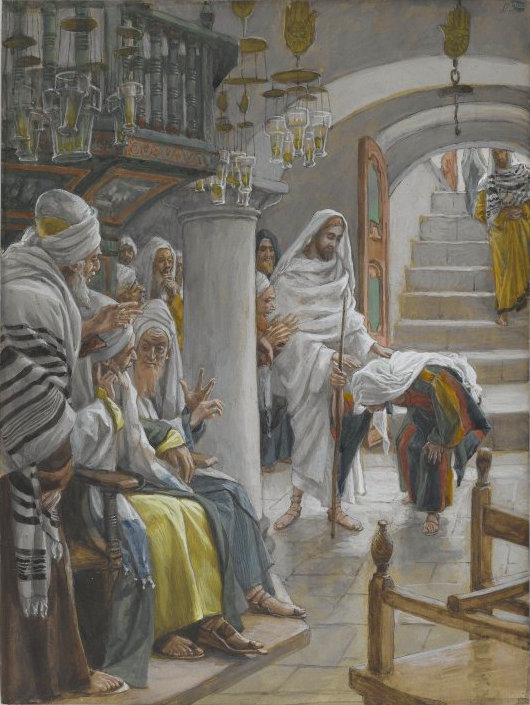
James Tissot, “The Woman with an Infirmity of Eighteen Years” (La femme malade depuis dix-huit ans), Public domain, via Wikimedia Commons, in the collection of the Brooklyn Museum.

From Sheep to Shepherd

Sabbath Day Thoughts — “From Sheep to Shepherd” Acts 9:36-43

The noise was deafening.  Widows of every age surrounded me.  Some cast back their heads in ululation.  Others sobbed in lament.  Some pressed upon me the work of her hands, pointing to a finely woven flax tunic, a weighty woolen shawl, or the fine tracery of crimson embroidery threaded along the cuff of a sleeve.  “Help us, help us! Who will help us?” they pleaded.  I looked over to the husband, who sat on a bench in the courtyard, nearly catatonic with grief.

I was still fairly new to this apostle thing.  In fact, I had considered giving up after the resurrection.  In all honesty, I had proven to be a fairly worthless disciple.  I thought I knew it all.  I slept when I should have been praying.  I ran when I was needed to stand my ground.  In the Chief Priest’s courtyard, I had cursed in fear and panic, insisting that I didn’t know the Lord, had never met him, had nothing to do with him.  If the resurrection had convinced me of anything, it was of the greatness of God, the holiness of my Lord Jesus, and my utter worthlessness as a disciple.

In fact, I had returned to my home in Galilee and the familiar work of fishing.  The waves on the water, the heft of the net in my hands, the rise and fall of the boat under sail.  But I had proven to be a failure even at what was my birthright.  Then, in the early morning on the rocky shore with the smoke of the charcoal fire in my eyes and the taste of grilled fish and fresh bread on my tongue, the risen Lord had restored me to my purpose.  “Do you love me?” he asked.  “Tend my flock,” he commanded.  For the love of Jesus, I was trying.

Now if ever there were sheep without a shepherd, these women were it.  Across the Great Sea, the Greeks and Romans do things differently, but here we live by the Old Ways. Our women do not have inheritance rights.  The death of a husband or a grown son leaves a woman at the mercy of a new patriarch, and some are by no means merciful.  That was obvious.  A toothless crone with two canes wailed at my elbow.  A cross-eyed woman with an addled brain babbled for my attention.  An emaciated young mother, with two small children clinging to her skirt, sobbed hopelessly.  A bald woman with a goiter the size of a pomegranate held up an intricately woven kerchief.

From their stories, it was clear that Tabitha – or I should say Dorcas – had been their shepherd.  She had clothed them, fed them, and provided for them from her own purse. Her death was a tragedy for all.  It started with a cough, followed by the spike of a fever.  Her breathing had grown labored, her breath fetid.  Within a few days, she was gone. Now these lost sheep surrounded me with their tears and the ridiculous expectation that I should raise the dead.  They pushed me up the stairs, shoved me into the upper room, closed the door, and continued their non-stop racket.

The room was dark.  I crossed to the window, parted the curtains, and opened the shutters, flooding the room with light and a sea breeze.  Near the window, where the light was the best, stood a loom, threaded with a work in progress. Across the room, the body lay on a bed, shrouded by a woolen pall.  I peeled back the cloth.  Dark curls, like soft clouds, surrounded a kind face with creases left behind by years of smiles.  She wore a simple linen tunic.  Her hands were folded on her chest above her heart and she held an olive-wood cross.  So natural and peaceful.  I placed my hand on hers and shrank back from the cold flesh, inert and lifeless.

I began to pace, as is often the case when I am worried, anxious, or angry.  What was I doing?  Who was I to raise the dead? What would happen when I failed, as I undoubtedly would? I had agreed to tend the flock, but I didn’t sign up for this.  All those expectations of the keening widows pressed in on me. I felt like I was the one wrapped in a pall, a shroud of their lament. I began to hyperventilate. “Feed my sheep?” I wheezed. “Thanks a lot, Jesus.”

“What seems to be the problem, Peter?” I knew that voice better than my own. He stood with his back to the window, his face in shadows. The sunshine, flooding into the room, seemed to shimmer and surge around his silhouette. I stopped hyperventilating.

“Jesus!” I shouted, half-angry, half-relieved. “C’mon. you don’t expect me to raise this woman.  Do you? I can’t do it!  I can’t!”  It may have been my imagination, but the wailing in the hallway outside the room seemed to escalate.

Jesus nodded, as he often did when I stated the obvious. “No, you can’t do it, Peter.”

This wasn’t helping my confidence at all.  I paced some more while he watched. I stopped and pointed at him accusingly, “You could do it!  You raised Jairus’s daughter.  I was there.  I saw her smile.  I saw her stretch her arms up to be held.  How about the widow of Nain’s son, hopping off his funeral byre as if her were embarrassed to be caught napping? Remember, Lazarus?  Three-days-dead and stinking, you called him out of the tomb.  You can do it!  You can do it!  But I’m not you.”

Jesus agreed, “No, you’re not.”

I paced some more.  I couldn’t do it, but Jesus could.  I shot a look at him where he was now leaning with an elbow on the window sill, and I swear, he raised his eyebrows like he does when he is waiting for me to draw an obvious conclusion.  I stopped.

“Are you really here, Lord?”

Now, he was smiling. “Didn’t I promise to be with you always, Peter, even to the end of the age?” 

He had made that promise.  He had even sent his Holy Spirit as a perpetual reminder.  As Jesus pushed away from the window and took a step closer to me, I felt the Spirit ripple within me. It was obvious. I turned away from Jesus and looked over at the peaceful and thoroughly dead Tabitha—or should I say Dorcas?  “I can’t do it,” I said again, “but you can.”

I moved toward the bed.  The sun warmed my back and moved along my limbs. I stepped closer still to the body and my shadow fell across her face.  I raised my arms with power and words of authority that were mine, but not mine, sounded loud.  “Tabitha!  Get up!”

The first thing I noticed was the slow throb of a vein, pulsing at her temple. Next, her chest began to gently rise and fall with the soft swell of her breath. Her mouth opened in an enormous yawn and a hand fluttered up to cover it.  Here eyelids blinked open, once, twice.  “O, Jesus!  You came!” she smiled.

I whirled around to see if the Lord was still behind me at the window. The room was empty.  The curtains fluttered in the sea breeze, the threads dangling from the loom danced in the shifting air.  Beyond the door, the keening of the women was undiminished and someone had broken out a shofar, blowing long, slow, mournful notes. 

I bent down and took the hand of the no-longer-dead woman. She was still clutching the olive wood cross but had kicked off the woolen shroud and was wiggling her toes.  I helped her up. “Sister,” I said to the puzzled Tabitha, “I know some people who will be happy to see you.” 

As I opened the door and guided her through, there was a moment of stunned silence.  Then, mourning shifted to joy.  There were glad shouts of recognition and fervent alleluias.  Tears of joy streamed down jubilant faces. The crone brandished her canes in celebration.  The fool sang a psalm of rejoicing.  The two children danced, hand-in-hand with their mother.  The woman with the goiter could only repeat, again and again, “Glory be to the great God of Israel, holy be His name!”  Arms reached out to Tabitha, touching, hugging, holding.  Tabitha was swept downstairs and out into the streets in a parade of rejoicing that they are still talking about in Joppa to this day.

I lingered in the upper room, leaning against the sill where the Lord’s elbow had rested, watching the celebration on the street below.  I still felt that I was not very good at this apostle thing. Thank goodness that no one had been in the room with me to witness my panic. But I learned that it is not so much about me as it is about Jesus.  Nine times out of ten, I can’t do what is asked of me.  I can’t rise to the expectations that they have for me.  But Jesus can, and even when I walk through the darkest valley, he is with me.


Acts of the Apostles 9:36-43

36 Now in Joppa there was a disciple whose name was Tabitha, which in Greek is Dorcas. She was devoted to good works and acts of charity. 37 At that time she became ill and died. When they had washed her, they laid her in a room upstairs. 38 Since Lydda was near Joppa, the disciples, who heard that Peter was there, sent two men to him with the request, “Please come to us without delay.” 39 So Peter got up and went with them, and when he arrived, they took him to the room upstairs. All the widows stood beside him, weeping and showing tunics and other clothing that Dorcas had made while she was with them. 40 Peter put all of them outside, and then he knelt down and prayed. He turned to the body and said, “Tabitha, get up.” Then she opened her eyes, and seeing Peter, she sat up. 41 He gave her his hand and helped her up. Then calling the saints and widows, he showed her to be alive. 42 This became known throughout Joppa, and many believed in the Lord. 43 Meanwhile, he stayed in Joppa for some time with a certain Simon, a tanner.


Photo by Karolina Grabowska on Pexels.com

Unfailing

Sabbath Day Thoughts – 1 Kings 17:7-15

He toddled after me.  Bare feet kicked pebbles and stirred small storms of dust.  He was practicing his words.  “Deshe,” he said, handing over a tuft of dry grass, brittle with drought.  I added the grass to my basket. 

Giza etz?” he said tentatively, holding up a stick, just the right size for kindling.  Into the basket it went. 

Perach.” He smiled shyly, extending a tiny wilted bouquet of chamomile, clenched in his small fist. 

Such a good boy!  So generous!  I tucked the flowers behind my ear and scooped him up, holding him next to my heart.  I could feel his little ribs beneath his robe and see the delicate throb of a vein, pulsing at his temple.

It hadn’t always been like this.  My husband, like his father and his father’s father, had gone to sea.  We Phoenicians are a seafaring people, weaving a vast web of trade that spans the Great Sea from Sidon to Cyrene, Rome, Malta, and beyond.  We pluck fish from the ocean depths, harvest rare pearls from the Gulf of Arabia, and hew great ships from the cedars of Lebanon.  For men, it is an adventurous but dangerous life, always at the mercy of wind and wave.  For women, it brings loneliness.  Always the siren call of the water pulls our men back.  Always, there is the waiting.

They said my husband was killed by a lightning strike.  First the rigging caught, then the weathered decking.  When the fire reached the amphorae of olive oil in the hull, it launched a ball of fire into the sky, worthy of the Great Lighthouse of Alexandria.  I don’t know if he drowned or if he burned, but I do know the tight cage of fear that had held my heart ever since.

Our son was weeks old.  There was no patriarch to take us in, no kindly kinsman to offer protection.  In Zarephath, my neighbors made the sign of the evil eye behind my back, worried that my misfortune would rub off on them.  The large amphorae of flour, oil, and salt fish that my husband had left behind slowly emptied, despite every economy.  I had grown slight with hunger and my milk had eventually failed.

I was collecting wood for a final fire, a last loaf to be baked, a little oil to be poured out.  My child, perched on my hip, looked at me with enormous eyes set in wan cheeks that had once been chubby.  As my eyes filled with tears, he demanded to be put down, little arms pushing and legs kicking.  With both feet on the ground, he stretched up a hand for me to hold. 

Ezra, Ama!” (Help, Mama!) he said.  He tugged on my hand, pulling me homeward.  Help?  Whose help?

We saw him outside the city gate.  He looked like he had been sleeping rough for a long time.  His tunic was rumpled, the armpits stained with rings of sweat.  His beard was enormous and wild.  Bits of straw clung to his shaggy hair.  He held a long, sturdy, wooden staff, the sign of a patriarch or a . . .

Navi!” (prophet), my little boy said.  His hands clapped with delight and chuckles swelled his small, empty belly.

Hearing my child, the prophet turned with a sharp look, taking in our skinny forms.  “Shalom!” he greeted us, “Please, could I trouble you for some water?”

All the wadis had gone dry with drought, but within the walls of Zarephath, our deep well remained true.  It was a simple thing to fulfill his request, but as I nodded and turned to do so, he stopped me.

“And please, a little bread with that?  Surely, you have a little something to share with Yahweh’s messenger.”

I thought of the handful of flour and trickle of oil at the bottom of my jars, and the fear that clenched my heart held even tighter.  Of all the people in Zarephath to ask for help, why choose us?  Our poverty was obvious. 

Lechem?” (bread), my son said, pointing to the prophet.

I sighed.  “You do not know what you ask, my friend.  My cupboard is bare.  We are headed home to eat our final few morsels and call it quits.”

But the prophet wouldn’t take my no for an answer.  “Please!” he insisted, sounding both compassionate and authoritative, “Don’t be afraid.  Make me a small loaf, bring it here; then, bake for yourself and the boy.  Yahweh will bless you!”

It made no sense.  Why would I ever consider such a thing at the expense of my child?  Yet, my son seemed to have reached a different conclusion.

Lechem, AmaLechem!” (Bread, Mama!  Bread!).  He stomped his feet, pointed at the prophet, and pulled me toward home.

It was against my better judgment.  I stirred the coals from last night’s fire.  I fed it with tufts of grass, which caught with a soft chuff.  I carefully added our sticks and watched as tongues of flame leapt up.  I scooped out most of the last of our meal, mixed it with water, and kneaded it into a smooth cake.  I stretched it thin, rubbed it with the last of the oil and slapped it onto the baking stone, now so hot that it sizzled beneath the oiled dough.  The fragrance of baking bread made our stomachs roar as the little loaf puffed and turned golden.  With skilled fingers, I plucked an edge and flipped it over, revealing a well-browned bottom.

“What am I doing?” I asked my son.  His cheeks had pinked with the fire’s warmth.

Lechem, Ama!  Lechem!” he repeated, pointing back to the city gate.

I wrapped the loaf in a cloth and slipped it into my basket.  I filled a cup with water and stood swaying in the doorway, basket in one hand, cup in the other.  “Stay or go?” I wondered.  My son made the decision for me, stomping off on his short legs to the city gate where the prophet waited.  I followed, questioning my every step.

I don’t know what I was expecting.  A choir of angels?  The peal of thunder?  A heavenly affirmation?  What I got when we found the prophet, waiting outside the gate, was a thank you.  “Now, go and do the same thing for yourself,” the prophet instructed.  He dismissed us with a nod, said his blessing, and began to devour his loaf with grimy hands.

I picked up my boy, balancing him on my hip as I walked slowly home.  I had heard that Yahweh, the great God of Israel, is a generous god with unfailing love for the lost and the poor.  Yet here we were, the widow, the orphan, and a stranger, clinging to life by our fingernails, preparing to eat our last bread before returning to our ancestors.  Maybe my neighbors were right.  Maybe the gods Baal and Asherah had cursed me.  Maybe I deserved what was surely coming in the days ahead.

By now, we were home.  I set my child down and pushed the door open.  He walked over to the great flour jar, taller than he was, and patted it with both hands.  “Lechem, AmaLechem?”  He sounded hopeful.

“Yes, my love, bread.” I answered.  I tied an apron on and pushed back my sleeves.  I crossed the floor and pried the heavy clay top off the amphora. 

Below, my son was stamping his feet.  “Lechem, lechem, lechem!”

I was so shocked by what I saw within that I dropped the clay top.  It hit the hard earthen floor with a dull thud and split in two.  There, within the amphora, finely milled flour rose all the way to the top.  I plunged my hands in, and felt the silky dryness slipping through my fingers.

My son had moved to the oil jar.  Again, he placed his palms on the rounded sides.  He patted with his small hands and sang in a tattoo rhythm, “Shemen zayitShemen zayit!” (Olive oil! Olive oil!).

I pried off the top and gasped.  The oil jar was filled to the brim, the first pressing, fragrant, clear, and golden green.  A few bubbles rose to the top and rested on the surface, as if freshly filled.  My boy was laughing now, spinning with childish delight until he plopped down onto his bottom with a breathless thud.

I sat down next to my son, dizzy with hunger and mystery.  Perhaps Baal and Asherah had cursed me.  But Yahweh, the holy and almighty One of Israel, had blessed me.  In an instant, the certainty of our death had changed to the promise of life.  My heart felt funny, felt wild and free, felt like the cage that had bound it since the death of my husband had been sprung.  I put my hands to my head to stop the world from spinning.  As my son crawled into my lap, I laughed and cried until I felt empty and filled with a peace that I had not known since my husband’s death.

Perhaps it was the generosity of Yahweh that made me do it.  When God is so good, how can you keep it to yourself?  I picked up my son and went back to the city gate where we found the prophet dozing in the sun.  Crumbs from my little loaf dotted his beard.  A smear of oil had been wiped on the front of his tunic. 

I put down my boy and he nudged the prophet’s sandal with his little bare foot.  “Navi?”  I asked.

He opened an expectant eye.  “Call me Elijah.”

“Elijah, my son and I would like you to stay with us.  Will you come?”  The boy smiled.  He reached out one hand to the prophet and with the other pointed home.

The prophet rose and brushed the crumbs from his beard.  He balanced his staff against the city wall then reached down to pick up my son, who settled comfortably into his arms.  The Prophet Elijah smiled, “We thought you would never ask.”


Photo by Marina Leonova on Pexels.com