Unprepared

Sabbath Day Thoughts — “Unprepared” Matthew 3:1-12

It was finals week. An entire semester’s worth of work depended upon some big tests. I was cramming for my exams, making the most of reading week. I felt good about my impending tests. Then, I suddenly realized that there was one exam that I was completely unprepared for. I don’t know how it escaped my attention, but there on my schedule was a course that I had overlooked for an entire semester. I hadn’t gone to class. I didn’t know the professor. I hadn’t read the books. How could I possibly pass that test? Like all college students, I began to panic. What if I stayed awake all night and skimmed the reading? I didn’t own the books! Could I borrow someone’s notes? I didn’t know who was in the class! It did not look good. I was unprepared.

Perhaps you have had that nightmare or something like it. I’m told that many professions are plagued by their version of the school dream. The contractor dreams of an overlooked job that must be done immediately. The caterer has a nightmare about a huge wedding that never made it onto their calendar. The business manager dreams of a surprise audit. I can testify that the pastor’s nightmare entails going to a new church on Sunday morning and discovering that you are expected to preach, and when you look down, you notice that you are naked.

Psychologists tell us that these dreams are typically provoked by unresolved anxiety or feelings of inadequacy. When we are stressed and overwhelmed, our brains work overtime to cope, even in our sleep. We awaken with our hearts pounding, feeling sweaty and gripped with self-critical worry. The experts say we should pay attention to dreams like this. It could be a wake-up call from our subconscious, telling us to attend to a particular issue, make a big decision, or change our course of action.

I bet John the Baptist had school dreams. He was born to prepare the way of the Lord, but the more John tried to live into his calling, the more he noticed that the folks who came out to the Judean Wilderness to hear him preach were totally unprepared. The messiah was coming with his baptism of fire and his winnowing fork in hand! God’s great redemption of humankind was about to unfold! But the people, they were eating, drinking and being merry, as if they had all the time in the world and could not be bothered to do their homework.

Even the piety experts, the Pharisees and Sadducees, were slackers. They may have been savants on the requirements of the Torah, but as far as John was concerned, they were a brood of vipers. They talked a good game about loving the Lord, but their actions spoke louder than words. The righteous deeds that were typically born of a transformed heart—like caring for vulnerable widows and orphans, feeding the hungry, and loving their neighbors—those deeds were nowhere to be seen. Where was the good fruit?! “Repent!” John cried, trying to infect his listeners with enough of his anxiety and urgency to inspire them to turn their lives around.

We aren’t strangers to anxiety in this Christmas season. No other time of the year is so steeped in preparation and timeworn tradition. There’s a lot to do, and we’ve got to get it done before Christmas Day. Our to-do list is as long as our arm: gifts to buy and the tree to decorate, cookies to bake and old family recipes to duplicate, packages to wrap and charitable giving to do, parties to attend and guests to host. Every year, right about this time, we wonder, “How will we ever get it all done?” As I talk about the Christmas juggernaut that is bearing down upon us, arriving in exactly eighteen days, perhaps you are feeling a little infected with John the Baptist’s anxiety, perhaps you are feeling like you just woke up from a bad school dream.

Our seasonal Study Group is reading Advent in Plain Sight by Jill Duffield. In our reading from Thursday, Dr. Duffield recounted attending a small group meeting at church a number of years ago when she was a young adult.  Their pastor asked them what they thought about Advent. The responses focused on the baby Jesus, the infant so tender and mild. Folks were thankful for the incarnation, the breaking of barriers between heaven and earth, the confidence that God is with us—Emmanuel! I’m sure everyone in the group had that good feeling you get when you know the answer to the question that the professor asks in class.

But right about then, the pastor went a little John-the-Baptist on them. He blurted out, “No one ever thinks of the Second Coming!” It’s true. In this Advent season, we look back, remembering and giving thanks for the baby Jesus. But Advent means coming. We are also called to look ahead, to anticipate the ultimate fulfillment of the great redemption that God has begun in Jesus. We are talking about End Times, Judgment Day, the Kingdom of God, the apocalypse. We’re talking about the inevitable fact that each of us, one day, will meet our maker. The ultimate final exam awaits us all—and we don’t have much say about when that will happen. Are our hearts pounding? Are we feeling a little sweaty and gripped with self-critical anxiety? Then John the Baptist and I have achieved our mission.

We are really good at preparing for the baby Jesus, aren’t we? Just look around the church—the purple paraments, the greens, the Advent Wreath, the Christmas tree in the Great Hall. But on the second Sunday of Advent, John the Baptist shows up, like a bad school dream, and he thinks we are unprepared. John wants us to temper our nostalgic looking back with some prophetic looking ahead. He calls us once again to prepare the way of the Lord, to live today as if Jesus were coming tomorrow, to bear fruit worthy of our repentance.

For John the Baptist’s listeners on the banks of the Jordan, all those years ago, preparing the way of the Lord began with a change of heart. They heard the truth of John’s words and knew they could do better. They returned to God, wading into the waters of the Jordan in an outward sign of their inward repentance. I like to think that their watery rite was followed by some fruitful living. They were kinder to their families. They prayed fervently, worshipped ardently, and feasted on God’s word. They lived with a renewed compassion, service, and love for the world around them that can only come from a life lived with God.

On this second Sunday of Advent, we, too, can have a change of heart. We can draw near to God even as God draws near to us. 18 days and counting. We won’t be wading in the Jordan, but amid all our Christmas preparations, I trust that we’ll find the quiet moment today to commit our purpose to God’s purpose. We’ll resolve to love the Lord our God with all our heart, mind, soul, and strength, and we’ll go forth to love our neighbors as ourselves. We’ll bear fruit worthy of that repentance. The basket at the side entrance will fill with cans of corn for the ecumenical holiday boxes for neighbors in need. Our shallow well gifts will provide clean drinking water for many villages in sub-Saharan Africa. We’ll invite a hurting friend to attend the Longest Night Service with us this Wednesday. We’ll set an extra place at the Christmas dinner table for someone who might otherwise be alone. When that final exam comes, we’ll be ready.

Prepare the way of the Lord, my friends, make his paths straight.

Resources:

Adam England. “What Does It Mean When You Dream about Being Back in School?” in Very Well Mind, Oct. 30, 2025. Accessed online at verywellmind.com.

Catherine Sider Hamilton. “Commentary on Matthew 3:1-12” in Preaching This Week, Dec. 7, 2025. Accessed online at https://www.workingpreacher.org/commentaries/revised-common-lectionary/second-sunday-of-advent/commentary-on-matthew-31-12-7

Arland J. Hultgren. “Commentary on Matthew 3:1-12” in Preaching This Week, Dec. 8, 2013. Accessed online at https://www.workingpreacher.org/commentaries/revised-common-lectionary/second-sunday-of-advent/commentary-on-matthew-31-12-3

Stanley Saunders. “Commentary on Matthew 3:1-12” in Preaching This Week, Dec. 9, 2007. Accessed online at https://www.workingpreacher.org/commentaries/revised-common-lectionary/second-sunday-of-advent/commentary-on-matthew-31-12-6

James Boyce. “Commentary on Matthew 3:1-12” in Preaching This Week, Dec. 4, 2022. Accessed online at https://www.workingpreacher.org/commentaries/revised-common-lectionary/second-sunday-of-advent/commentary-on-matthew-31-12-2


Matthew 3:1-12

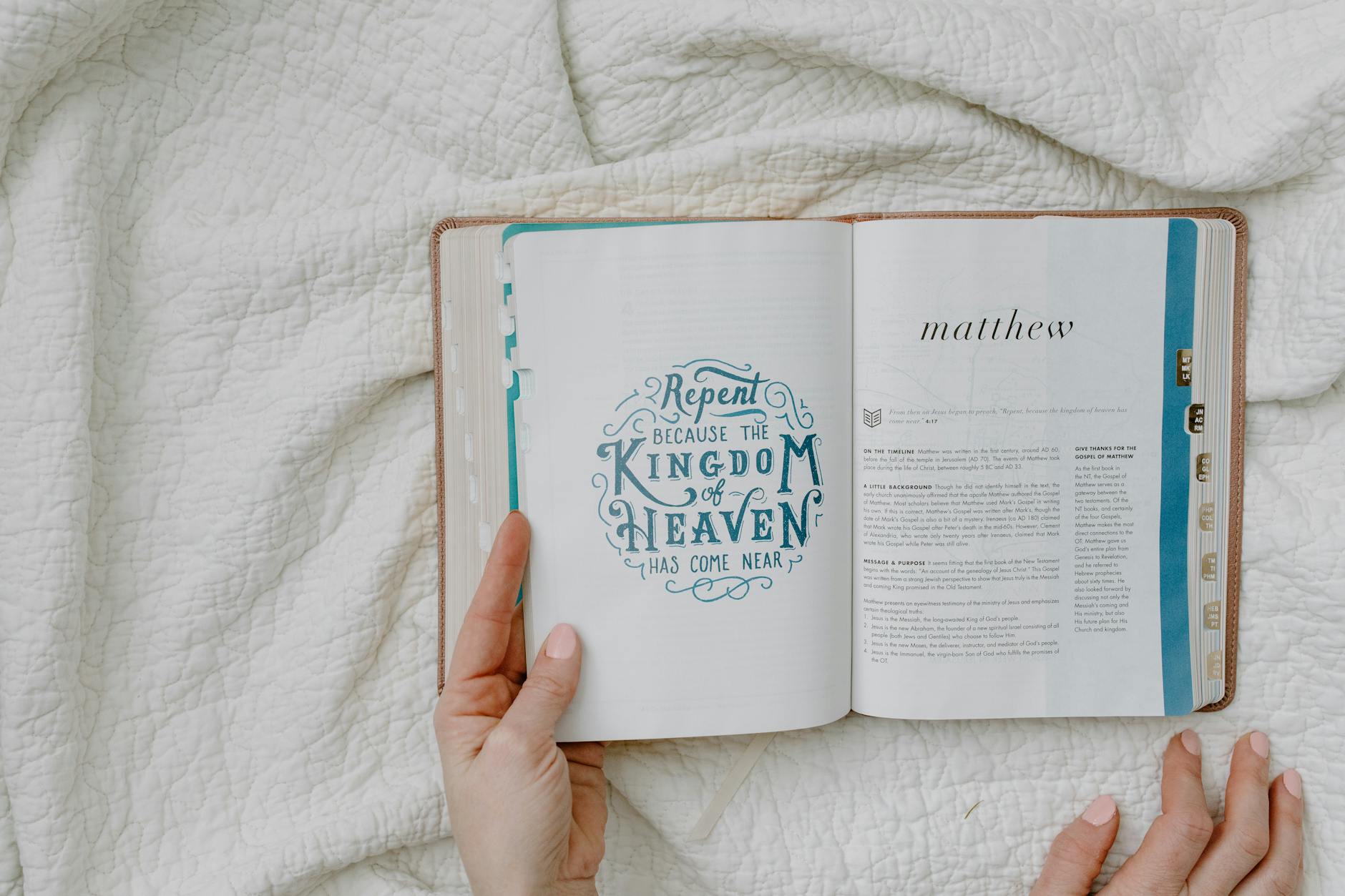
1 In those days John the Baptist appeared in the wilderness of Judea, proclaiming, “Repent, for the kingdom of heaven has come near.” This is the one of whom the prophet Isaiah spoke when he said,

“The voice of one crying out in the wilderness:
‘Prepare the way of the Lord;
    make his paths straight.’ ”

Now John wore clothing of camel’s hair with a leather belt around his waist, and his food was locusts and wild honey. Then Jerusalem and all Judea and all the region around the Jordan were going out to him, and they were baptized by him in the River Jordan, confessing their sins.

But when he saw many of the Pharisees and Sadducees coming for his baptism, he said to them, “You brood of vipers! Who warned you to flee from the coming wrath? Therefore, bear fruit worthy of repentance, and do not presume to say to yourselves, ‘We have Abraham as our ancestor,’ for I tell you, God is able from these stones to raise up children to Abraham. 10 Even now the ax is lying at the root of the trees; therefore every tree that does not bear good fruit will be cut down and thrown into the fire.

11 “I baptize you with water for repentance, but the one who is coming after me is more powerful than I, and I am not worthy to carry his sandals. He will baptize you with the Holy Spirit and fire. 12 His winnowing fork is in his hand, and he will clear his threshing floor and will gather his wheat into the granary, but the chaff he will burn with unquenchable fire.”


Photo by Tara Winstead on Pexels.com

Poems for the Season of Christmas

Sabbath Day Thoughts — Verse for the First Sunday in Christmas

“O Lord, You Were Born” 

— Ann Weems 

Each year about this time I try to be sophisticated 

and pretend I understand the bored expressions 

relating to the “Christmas spirit.” 

I nod when they say “Put the Christ back in Christmas.” 

I say yes, yes, when they shout “Commercial” and 

“Hectic, hectic, hectic.” 

After all, I’m getting older, 

and I’ve heard it said, “Christmas is for children.” 

But somehow a fa-la-la keeps creeping out…. 

So I’ll say it: 

I love Christmas tinsel 

and angel voices that come from the beds upstairs 

and the Salvation Army bucket 

and all the wrappings and festivities and special warm feelings. 

I say it is good, 

giving, 

praising, 

celebrating. 

So hooray for Christmas trees 

and candlelight 

and the good old church pageant. 

Hooray for shepherd boys who forget their lines 

and Wise Men whose beards fall off 

and Mary who giggles. 

O Lord, you were born! 

O Lord, you were born! 

And that breaks in upon my ordered life like bugles blaring. 

and I sing “Hark, the Herald Angels” 

in the most unlikely places. 

You were born 

and I will celebrate! 

I rejoice for the carnival of Christmas! 

I clap for the pajama-clad cherubs 

and the Christmas cards jammed in the mail slot. 

I o-o-o-oh for the turkey 

and ah-h-h-h for the Christmas pudding 

and thank God for the alleluias I see in the faces of people 

I don’t know 

and yet know very well. 

O Lord, there just aren’t enough choirboys to sing what I feel. 

There aren’t enough trumpets to blow. 

O Lord, I want bells to peal! 

I want to dance in the streets of Bethlehem! 

I want to sing with the heavenly host! 

For unto us a Son was given 

and he was called God with Us. 

For those of us who believe, 

the whole world is decorated in love! 


“Christmas at Sea” 

—Robert Louis Stevenson 

The sheets were frozen hard, and they cut the naked hand; 

The decks were like a slide, where a seaman scarce could stand; 

The wind was a nor’wester, blowing squally off the sea; 

And cliffs and spouting breakers were the only things a-lee. 

They heard the surf a-roaring before the break of day; 

But ’twas only with the peep of light we saw how ill we lay. 

We tumbled every hand on deck instanter, with a shout, 

And we gave her the maintops’l, and stood by to go about. 

All day we tacked and tacked between the South Head and the North; 

All day we hauled the frozen sheets, and got no further forth; 

All day as cold as charity, in bitter pain and dread, 

For very life and nature we tacked from head to head. 

We gave the South a wider berth, for there the tide-race roared; 

But every tack we made we brought the North Head close aboard: 

So’s we saw the cliffs and houses, and the breakers running high, 

And the coastguard in his garden, with his glass against his eye. 

The frost was on the village roofs as white as ocean foam; 

The good red fires were burning bright in every ‘long-shore home; 

The windows sparkled clear, and the chimneys volleyed out; 

And I vow we sniffed the victuals as the vessel went about. 

The bells upon the church were rung with a mighty jovial cheer; 

For it’s just that I should tell you how (of all days in the year) 

This day of our adversity was blessed Christmas morn, 

And the house above the coastguard’s was the house where I was born. 

O well I saw the pleasant room, the pleasant faces there, 

My mother’s silver spectacles, my father’s silver hair; 

And well I saw the firelight, like a flight of homely elves, 

Go dancing round the china-plates that stand upon the shelves. 

And well I knew the talk they had, the talk that was of me, 

Of the shadow on the household and the son that went to sea; 

And O the wicked fool I seemed, in every kind of way, 

To be here and hauling frozen ropes on blessed Christmas Day. 

They lit the high sea-light, and the dark began to fall. 

“All hands to loose topgallant sails,” I heard the captain call. 

“By the Lord, she’ll never stand it,” our first mate Jackson, cried. 

…”It’s the one way or the other, Mr. Jackson,” he replied. 

She staggered to her bearings, but the sails were new and good, 

And the ship smelt up to windward just as though she understood. 

As the winter’s day was ending, in the entry of the night, 

We cleared the weary headland, and passed below the light. 

And they heaved a mighty breath, every soul on board but me, 

As they saw her nose again pointing handsome out to sea; 

But all that I could think of, in the darkness and the cold, 

Was just that I was leaving home and my folks were growing old. 


“The Sheep Herd” 

—Sister Mariella 

I am a shepherd—I have hated 

The smell of damp sheep in the rain, 

The pain 

Of clouted shoes on weary feet, 

The silly barking of watchdogs in the night, 

The blinding light 

Of summer suns on hillsides without shade. 

Nor anything I did not wish was not 

From hoar-frost on the meadow grass 

To dizzy stars that blinked on stupidly and bright. 

Last night 

I went with other men who tended sheep 

Over to Bethlehem to see— 

We did not know just what we’d come to see 

Who’d followed up a cloud of singing wings. 

Until we came to where a young girl held 

A little baby on her lap and smiled. 

She made me think of flowers, 

White flowers on long stems and blue night skies. 

Nothing happened— 

But today 

I have been shaken with the joy 

Of seeing hoar-frost wings 

Atilt upon tall grasses; the sun 

Upon the sheep, making their gray backs white 

And silvery 

Has hurt me with its beauty, and I heard 

The sound of the barking watchdogs break 

The tolling bells against the quiet hills. 


“Boxed” 

—Ann Weems 

I must admit to a certain guilt 

about stuffing the Holy Family into a box 

in the aftermath of Christmas. 

It’s frankly a time of personal triumph when, 

each Advent’s eve, I free them (and the others) 

from a year’s imprisonment 

boxed in the dark of our basement. 

Out they come, one by one, 

struggling through the straw, 

last year’s tinsel still clinging to their robes. 

Nevertheless, they appear, 

ready to take their place again 

in the light of another Christmas. 

The Child is first 

because he’s the one I’m most reluctant to box. 

Attached forever to his cradle, he emerges, 

apparently unscathed from the time spent upside down 

to avoid the crush of the lid. 

His mother, dressed eternally in blue, 

still gazes adoringly, 

in spite of the fact that 

her features are somewhat smudged. 

Joseph has stood for eleven months, 

holding valiantly what’s left of his staff, 

broken twenty Christmases ago 

by a child who hugged a little too tightly. 

The Wise Ones still travel, 

though not quite so elegantly, 

the standing camel having lost its back leg 

and the sitting camel having lost one ear. 

However, gifts intact, they are ready to move. 

The shepherds, walking or kneeling, 

sometimes confused with Joseph 

(who wears the same dull brown), 

tumble forth, followed by three sheep 

in very bad repair. 

There they are again, 

not a grand set surely, 

but one the children (and now the grandchildren) 

can touch and move about to reenact that silent night. 

When the others return, 

we will wind the music box on the back of the stable 

and light the Advent candles 

and go once more to Bethlehem. 

And this year, when it’s time to pack the figures away, 

we’ll be more careful that the Peace and Goodwill 

are not also boxed for another year! 


Ann Barr Weems was the daughter or a Presbyterian minister and the wife of a Presbyterian minister. She served as an elder with the Trinity Presbyterian Church in St. Louis. Ann was a noted writer, speaker, liturgist and worship leader. Among her seven published books or collections of poems, meant to be used in worship, in personal devotions, and in discussions, are Kneeling in Jerusalem, Kneeling in Bethlehem and the best-selling Psalms of Lament. She is also the author of the critically-acclaimed poem, “Balloons Belong in Church,” about her then four-year old son, Todd, who brought an orange balloon with pink stripes to church school one Sunday morning. Both poems shared here are from Kneeling in Bethlehem.

Robert Louis Stevenson was a Scottish novelist, essayist, poet, and travel writer. He spent time in Saranac Lake in pursuit of a cold air cure for tuberculosis. Lighthouse design was the family’s profession; Robert’s grandfather and uncles were all in the same field. His maternal grandfather, with whom he was quite close, was a Presbyterian minister. Stevenson once wrote, “Now I often wonder what I inherited from this old minister. I must suppose, indeed, that he was fond of preaching sermons, and so am I, though I never heard it maintained that either of us loved to hear them. Stevenson’s Christmas poem was first published in the Scots Observer, 1888.

Sister Mariella Gable was a Benedictine sister and an English professor at the College of Saint Benedict from 1928-73. She was also a Dante scholar, poet, editor and writer. She tirelessly promoted the cause of two then little-known authors, Flannery O’Connor and J.F. Powers, and introduced audiences in the United States to such Irish writers as Frank O’Connor, Sean O’Faolain, Mary Lavin, and Bryan MacMahon through her many essays and anthologies. “The Sheep Herd” was first published in 1946.


Photo by Elina Fairytale on Pexels.com

The Voice from the Margins

Sabbath Day Thoughts — “The Voice from the Margins” Luke 3:1-18

The Christmas preparations have been underway in the village for weeks. First, our lampposts were hung those giant sparkly snowflakes. Then, Berkely Green sprouted a bevy of Christmas trees. Salvation Army bell ringers with their red kettles are stationed at the post office and Kinney’s. Shopkeepers have decked their windows with lights and greens and tempting wares that we just might need to purchase for our beloved ones. Sparkle Village returned to the town hall with those wonderful one-of-a-kind crafts and gifts.

We have been preparing for Christmas at church, too. The Advent wreath has emerged from its basement lair to hang above the chancel and call us to worship weekly. Cherise has done yet another amazing job of greening our sanctuary and doors. Some of us are reading our way to Christmas. Perhaps you took home an Advent devotional, or you are gathering on Thursdays for lunch and book discussion. Scott and the choir have been hard at work on a spectacular anthem for Christmas Eve. The kids, under the direction of Ms. Kim, are preparing to delight us with a special play next week.

I know that there have been plenty of preparations on our home fronts, too. We may be working out final details on travel plans or preparing to welcome guests. Our front doors are sporting wreaths and our eves are dripping with Christmas lights. We are hanging favorite ornaments on our Christmas trees—candy canes, antique glass balls, and golden macaroni wreaths made by little hands long ago. We’ve been shopping, and if we are very organized, we are wrapping. If the baking hasn’t begun yet, it will soon—Christmas cookies, fruitcakes, panettone, stollen, and our favorite family recipes. If you are like me, there is joy in the preparation, a remembering of Christmases past and an anticipation of the holiday to come.

On this second Sunday in Advent, the gospel reading brings us John the Baptist, who gives us an earful about preparing the way of the Lord. When I served the Community Church in Morton Grove, I would tag along with my head of staff Michael Winters to attend a lectionary group. These were seasoned pastors who preached weekly and met to discuss the scripture and work on their sermons. The second Sunday of Advent was near, and we had just read together the reading I shared a minute ago—John the Baptist calling us a brood of vipers and exhorting us to repent. There was a long moment of silence following the reading, then Rev. Debbie spoke up, “Don’t you wish we only had to preach on John once a year for Baptism of the Lord Sunday in January? Who wants to hear about John at Christmas?”

John certainly wasn’t dressed for the holidays and his diet of locusts and wild honey hardly sounds like a tasty Christmas dinner. In 1457, Donatello cast a larger-than-life bronze statue of John the Baptist for the Cathedral in Siena, Italy. In Donatello’s imagination, John has unkempt hair and the burning eyes of a fanatic. He’s impossibly thin, a skeleton with skin, all lean muscle and sinew. He’s clothed in matted furs that part at the side to show bare flesh. His long, bony fingers extend, as if pointing the way to Christ, the stronger one who will follow. The statue is eerie, unsettling, discomforting. There is no bow big enough to dress John up and put him under our Christmas trees. Let’s face it, we would never invite John the Baptist to Christmas dinner because he would be certain to shout, wouldn’t wear a tie, and would probably smell like the wilderness he just rolled out of. No. At Christmas, we prefer the baby Jesus, the holy infant so tender and mild to the disconcertingly wild, wooly, and radical John.

The sermon that John gave doesn’t sound like something you want to read in a Christmas card. Let me channel my inner John . . .

Dear Brood of Vipers,

What is wrong with you?!

Don’t you know that God is coming? That’s right Yahweh, the great I AM. He’s really topped himself this time, dared to wrap himself in flesh and walk among us. He’s on the loose!

And you?! You’re oblivious! You just go on living large. It’s all about you, isn’t it?

And what about this world? God help us! Nation taking up arms against nation. Neighbor trash-talking neighbor. What about the poor, the orphan, the refugee, the folks who struggle to put food on the table or a roof over their heads?

Stop, people! Just stop. Turn it around before it’s too late. You need to remember who is really in charge around here and it’s not you. It’s God Almighty. So straighten up and fly right. Be prepared!

Got it? Good!

Yours truly,

John

On this second Sunday of Advent, the ill-mannered, ill-timed, wild-and-crazy John the Baptist breaks into our lives and throws a big fat monkey wrench into our Christmas customs and timeworn traditions. Truth be told, we need John. We need him to startle us out of our Christmas complacency and call us away from our ordinary lives to a time and place of awareness and anticipation. We need John to urge us to leave, if only for a little bit, our kitchens and Christmas trees, our on-line shopping and office parties, our school books and family festivities. We need John to remind us of the reason for the season and tell us what it really means to prepare the way of the Lord. We need John’s encouragement to repent (metanoia), to thoughtfully and honestly reflect upon our lives, redirect our actions and energies, and re-commit ourselves to God-centered living. We need John to remind us that, no matter what the circumstance of our lives may be, we can be redeemed and renewed. We can come back to God because every year at Christmas, we are reminded that God comes to us with help and healing and love beyond our wildest imaginings.

Our Advent book this year is Season’s Greetings, an imaginative collection of Christmas letters from those who were there at the first Christmas. The author, my friend Ruth Boling, invites us to imagine John as “one of those wacky inflatable air dancers outside a car dealership.” You know those annoying windsocks that rise and fall and gyrate in unexpected ways that captivate our attention? According to my friend Ruth, John says, “I’m here to do that. To get you and everyone else to stop racing around on your Christmas hamster wheels, to get you to take notice and to study what I—wacky inflatable air dancer—am pointing toward. Here, people of God, is the one you want to be chasing . . . Don’t be a hamster, or a lemming, or an idiot. See, here is the one who came to redeem and restore.” It’s Jesus.

In the coming weeks of Advent, the frenzied pace of our Christmas preparations will build to a crescendo. That Kanoodle Ultimate Champion game that we purchased online for our grandchildren will be backordered, and we’ll scramble for a last-minute gift. Grandma’s recipe for authentic German stollen will disappear, and we’ll spend hours trying unsuccessfully to duplicate her kitchen magic through guesswork. Our Christmas trees will dry up and shed boatloads of needles, and we’ll wake up in the middle of the night to worry that our house might burn down. Our children will grow SO excited that they will not sleep a wink on Christmas Eve, and neither will we.

Amid the crazy-hamster-wheel-joy of this Advent season, may we listen for the voice from the margins. The Baptizer still calls out in the wilderness. May the wild one summon us away from the holiday rush to quiet moments with God for reflection, redirection, and renewal. Prepare the way of the Lord, my friends, make his paths straight.

Resources

Troy Troftgruben. “Commentary on Luke 3:1-6” in Preaching This Week, Dec. 8, 2024. Accessed online at Commentary on Luke 3:1-6 – Working Preacher from Luther Seminary

David Lose. “Commentary on Luke 3:1-6” in Preaching This Week, Dec. 6, 2009. Accessed online at Commentary on Luke 3:1-6 – Working Preacher from Luther Seminary

Audrey West. “Commentary on Luke 3:1-6” in Preaching This Week, Dec. 5, 2021. Accessed online at Commentary on Luke 3:1-6 – Working Preacher from Luther Seminary

Ruth Boling. Season’s Greetings: Christmas Letters from Those Who Were There. Nashville: Upper Room books, 2024.


In the fifteenth year of the reign of Tiberius Caesar, when Pontius Pilate was governor of Judea, and Herod was ruler of Galilee, and his brother Philip ruler of the region of Ituraea and Trachonitis, and Lysanias ruler of Abilene, during the high priesthood of Annas and Caiaphas, the word of God came to John son of Zechariah in the wilderness. He went into all the region around the Jordan, proclaiming a baptism of repentance for the forgiveness of sins, as it is written in the book of the words of the prophet Isaiah,

“The voice of one crying out in the wilderness:
‘Prepare the way of the Lord;
    make his paths straight.
Every valley shall be filled,
    and every mountain and hill shall be made low,
and the crooked shall be made straight,
    and the rough ways made smooth,
and all flesh shall see the salvation of God.’ ”

John said to the crowds coming out to be baptized by him, “You brood of vipers! Who warned you to flee from the coming wrath? Therefore, bear fruits worthy of repentance, and do not begin to say to yourselves, ‘We have Abraham as our ancestor,’ for I tell you, God is able from these stones to raise up children to Abraham. Even now the ax is lying at the root of the trees; therefore every tree that does not bear good fruit will be cut down and thrown into the fire.”

10 And the crowds asked him, “What, then, should we do?” 11 In reply he said to them, “Whoever has two coats must share with anyone who has none, and whoever has food must do likewise.” 12 Even tax collectors came to be baptized, and they asked him, “Teacher, what should we do?” 13 He said to them, “Collect no more than the amount prescribed for you.” 14 Soldiers also asked him, “And we, what should we do?” He said to them, “Do not extort money from anyone by threats or false accusation, and be satisfied with your wages.”

15 As the people were filled with expectation and all were questioning in their hearts concerning John, whether he might be the Messiah, 16 John answered all of them by saying, “I baptize you with water, but one who is more powerful than I is coming; I am not worthy to untie the strap of his sandals. He will baptize you with the Holy Spirit and fire. 17 His winnowing fork is in his hand to clear his threshing floor and to gather the wheat into his granary, but the chaff he will burn with unquenchable fire.”

18 So with many other exhortations he proclaimed the good news to the people.


Donatello, John the Baptists, 1457, Duomo di Siena.

Christmas Bells

Poem for a Tuesday — “Christmas Bells” by Henry Wadsworth Longfellow

I heard the bells on Christmas Day
Their old, familiar carols play,
    And wild and sweet
    The words repeat
Of peace on earth, good-will to men!

And thought how, as the day had come,
The belfries of all Christendom
    Had rolled along
    The unbroken song
Of peace on earth, good-will to men!

Till ringing, singing on its way,
The world revolved from night to day,
    A voice, a chime,
    A chant sublime
Of peace on earth, good-will to men!

Then from each black, accursed mouth
The cannon thundered in the South,
    And with the sound
    The carols drowned
Of peace on earth, good-will to men!

It was as if an earthquake rent
The hearth-stones of a continent,
    And made forlorn
    The households born
Of peace on earth, good-will to men!

And in despair I bowed my head;
“There is no peace on earth,” I said;
    “For hate is strong,
    And mocks the song
Of peace on earth, good-will to men!”

Then pealed the bells more loud and deep:
“God is not dead, nor doth He sleep;
    The Wrong shall fail,
    The Right prevail,
With peace on earth, good-will to men.”

in A Christmas Treasury of Yuletide Stories and Poems, ed. James Charlton and Barbara Gilson (New York: Guild America Books, 1976), pp. 302-303.


Luke 2:14

“Glory to God in the highest,
And on earth peace, goodwill toward men!”


Henry Wadsworth Longfellow was the most popular poet of his day. Born in Portland in 1807, his grandfather was the congressman and Revolutionary War hero General Peleg Wadsworth. His father Stephen Longfellow was a lawyer and founder of Bowdoin College, where Henry studied, met his lifelong friend Nathaniel Hawthorn, and graduated in 1825. Henry taught at Bowdoin and later at Harvard College. He was such an admired figure during his life that his seventieth birthday in 1877 was celebrated across the nation with parades, speeches, and the reading of his poetry. “Christmas Bells,” written in 1863, reflects Longfellow’s grief over the Civil War and the death of his wife Frances “Fanny” Appleton.


Photo by u0420u043eu043cu0430u043du043eu0432 u0412u043bu0430u0434u0438u043cu0438u0440 on Pexels.com

Christ the Savior Is Born!

Sabbath Day Thoughts — “Christ the Savior Is Born” Luke 2:1-7

Every Christmas Eve, we host a family-friendly service of worship at church for the children and those feeling a bit childlike. This Christmas, we shared the stories of the Angel Gabriel, the shepherds Reuben and Simka, and the Wise Ones. Merry Christmas, my friends!

“The Most Important Message”

As told by Gabriel

Greetings, favored ones! Do I have a story to tell you! Whew! Let me catch my breath. I just flew in from the great beyond.

(Takes a seat in the rocker and pretends to take a big drink from a goblet).

That’s much better. How very nice to meet you! I’m the Angel Gabriel, God’s finest messenger. Whenever there is important news to share, you can count on me to get the word out.

Many, many years ago, God had the most important message of all to share. It was a very difficult time in the life of the Hebrew people. King Herod was in charge and he had to be the greediest and the grouchiest king ever. He loved to build fancy palaces, and who do you think had to pay for them? The people! Herod got richer and richer, but the people got poorer and poorer.

The people dreamed of the day when a true king would come to Israel. In fact, God had long ago promised to send a special child who would grow up to be their king.  This child would speak God’s words to the people. This child would teach them how to love God and love one another.  This child would be holy.  The people so longed for the birth of this child that they used to sing about it,

Sings: “O come, O come, Emmanuel, and ransom captive Israel…”

Do you know what Emmanuel means?  It means “God with us.”  This special child to be born to the Hebrew people would remind them that God was with them, even when their lives felt very hard.

One day, God knew that the time was right for this special baby to be born.  Of course, there was only one messenger who could carry news that important: me!

God said, “Gabriel, I have an extra special mission for you.  Go to the village of Nazareth in Galilee.  There you will find a young woman named Mary.”

I have to say that when I heard I had to go to Nazareth, I wondered if God had the right destination. Nazareth! You know what they say about Nazareth: can anything good come from there? It was just a poor and sleepy little village, filled with farmers and carpenters and shepherds. And how would I find the right Mary?   It had to be the most popular name for girls in all of Israel. 

I must have looked like I was confused because God smiled at me. My heart got all warm, my halo began to glow, and I just knew that God had it all figured out. 

God said, “Go to young Mary, who is engaged to the carpenter Joseph, who is descended from the house of King David.  Tell her that I have chosen her from among all the women in Israel to bear a holy child.” 

Well, I was ready to fly off right away, but God stopped me and said, “Gabriel, don’t forget to tell Mary that her baby boy will be the Messiah. She is to name him Jesus because he will save the people from their sins.”

So off I went to Nazareth.  The village was even more miserable than I remembered.  It didn’t seem like a very promising place for the Messiah to be born, but God always knows what God is doing.  Even humble beginnings can lead to great things. 

In Nazareth, I found Mary.  Her mother had sent her to the well to collect water for her family. I must have been a very surprising sight.  Mary looked ready to run away, but I told her, “Do not be afraid, Mary, for you have found favor with God.”  That got her attention.

Mary wasn’t much more than a girl, but as I looked into her eyes, I could tell that she was very special.  She was kind and generous. She liked to laugh, and she was very patient with her little brothers and sisters. Best of all, Mary loved God with all her heart.  I knew she was just right for the special mission that God had given her, so I told her, the Holy Spirit would be at work within her and she would give birth to the holy child that the people had longed for all through the long years.

Even though it sounded a little scary and really impossible to have such a special baby, Mary thought hard about the message that I had given her from God.  Then she gave the answer that God was counting on, “Here I am, Lord.  I’m ready to be the mother of that special child.”  Do you remember what that child would be named?

(wait as if to hear the name Jesus)

Right you are!  Jesus!

Well, you know me—God’s finest messenger. Time to deliver some more important news. Gotta go, but I have arranged for some special people to come and tell you all about the birth of that special child Jesus. 

Shalom, my friends!

The Shepherds Hear Good News”

2 shepherds are seated at the campfire.  One sings,

“Go tell it on the mountain, over the hills and everywhere;

Go tell it on the mountain that Jesus Christ is born!”

Reuben:  Hey, we’ve got company!  Come on over, watch out for the lambs.  Take a seat by our campfire. 

Simka:  Did Gabriel send you? I bet you want to hear the story about that special night.  The night when the skies were filled with choirs of angels. They sang for us, sharing good news of great joy.

Reuben:  Those holy sounds are still ringing in my ears. 

Simka: Allow me to introduce myself.  I’m Simka, a shepherd by trade. 

Reuben:  And I’m Reuben.  We tend sheep and goats.  We spend most of our time with the flocks. 

Simka: We have to keep them moving so that they find green grass to nibble, clean water to drink, shade from the noonday sun, and shelter for the night. 

Reuben: (brandishes his staff) Sometimes, I have to keep them safe, too – protect them from wild dogs or even lions. 

Simka: It’s hard work being a shepherd – it takes patience and bravery.  At night, we shepherds bring our flocks together. 

Reuben: We light a small fire, share a meal, tell stories, and take turns watching the animals.  Can’t you just imagine us with the other shepherds at the campfire with our flocks gathered around us? 

Simka: Well, the story that we’re about to tell you is the best story ever.  I know because I was there.

Reuben: So was I!  One night, on the hills just outside of Bethlehem, we were spending the night with our flocks.

Simka: It was dark and quiet on the hillside – just like every night. Then suddenly, there was a great light, shining and sparkling in the sky.  

(Gestures to the sky, pointing to where the angels appeared.)

Reuben: We looked up and saw an angel, a messenger from the Lord. The glory of God shone down upon us, all shimmery and beautiful and good. 

Simka: We were so amazed that we were also very frightened. Nothing like this had ever happened to us before, and we didn’t know whether to cry or laugh or run away – or maybe all three!

Reuben:  The angel could see just how frightened and uncertain we were, so the angel said to us, (speaks in a loud angel voice) “Don’t be afraid. I bring you good news which will be a great joy to all people. Today, in the town of Bethlehem, a Savior has been born, Christ the Lord. This will be the sign for you: you will find the baby wrapped in swaddling clothes and lying in a manger.” 

Simka:  Suddenly, there was a huge crowd of heaven’s angels with the first angel.  They filled the whole sky with their light and their wonderful song, “Glory to God in the highest and peace to God’s people on earth.”  The memory of those angel voices still gives me the shivers!

Reuben: When the angels had left and gone back to the heavens, we looked at one another in amazement.  We pinched ourselves to make sure that we were really awake. 

Simka: Then, we began to wonder.  Could this baby be THE BABY?  You know, the special baby that God had promised to our people, a baby who was God’s child, who would grow up to be a great king for our people. 

Reuben: There was only way to find out. We had to go to Bethlehem and see for ourselves. We left our sheep on the hillside and hurried into the village.

Simka: When we got to Bethlehem, we looked around until we found Mary and Joseph in the stable.  And there he was! The baby Jesus was lying in the manger.

Reuben: It was just as the angel had promised!  This was our newborn king!  Seeing him filled us with hope. We celebrated and told Mary and Joseph all the things that the angels had said about the child.

Simka: Even the animals seemed to find joy and peace in the presence of the baby. I think even the camels were smiling! As wereturned to our flocks, we were filled with joy.  We sang and praised God at the top of our lungs. 

Reuben: The villagers thought we had stopped at the tavern for a libation, but we were just filled with the Holy Spirit.  God had sent a holy child who would be the savior of our people. 

Simka:  Do you know who that child was?

(cups her hand to her ear and waits to hear, “Jesus.”)

That’s right, Jesus!  Holy be his name!

Reuben sings:

“Go tell it on the mountain, over the hills and everywhere;

Go tell it on the mountain that Jesus Christ is born!”

The Wise Ones Seek the Newborn King

Props: a Bible Atlas, bincoulars

The Scene: Two wise men stand at the front of the sanctuary.  One is pondering a Bible Atlas.  The other scans the horizon with the binoculars.

Balthazar (with Atlas):  I wonder what happened to Melchior.  We sent him over to Blue Moon more than an hour ago for bagels and coffee.  I’m hungry!

Caspar (with binoculars):  You know his sense of direction. I bet he got lost.

Balthazar: Hey, Caspar, put those binoculars down. We’ve got company.

Caspar: Greetings honored guests!  (bows humbly)  I’m Caspar, the youngest and most handsome of the Magi. If only Melchior had returned, we would invite you to share breakfast with us.

Balthazar (grandly):  Allow me to introduce myself.  I am Balthazar, the wisest of the Magi.  Give me a star chart and a telescope and I can take you from one end of the Milky Way to the other – and back. 

Caspar:  I am only a young and humble learner, yet even I can tell you the secret language of the heavens.  (Listens carefully.)  Ah!  Alpha Centauri just ordered brunch!  Hey! She ordered lox for her bagels! Why didn’t I think of that? I hear the lox is so good at Blue Moon, too!

Balthazar (rolls eyes):  We have spent many, many years learning the mysteries of the heavens. Great Kings call on us for advice.  They wouldn’t so much as launch a ship or build a palace without checking with us first to see if it was in the stars. 

Caspar:  As long as you’re here and we’re waiting for Melchior with the coffee, allow us to tell you about our greatest journey ever.  Back in our homeland Persia, we saw a star.  (points to the heavens) 

Balthazar (stands extra tall with importance):  This was a special star, the star of a king. The heavens were telling us that a child was to be born who would be the king of the Jews!  God had promised this child to the people from of old – a Messiah, a Prince of Peace who would lead the people in paths of peace. 

Caspar:  Like a beacon, the star called us across the desert sands to Israel:  (speaking with the voice of the star) “Balthazar, Caspar, Melchior!  Come, come to Israel to see the little tiny Hebrew King!”

Balthazar (rolls eyes):  So, we left Persia with a great caravan to meet and worship the newborn king.  We brought special treasures, gifts to honor the baby king. 

Caspar:  Gold! Hah, hah!  A king’s ransom!

Balthazar:  Frankincense!  A fragrant offering fit for the holiest of children!

Caspar:  Myrrh! Ooh-hooo! The rarest of oils to anoint the greatest of kings!

Balthazar:  At last, our caravan came to Jerusalem, the holy city.  We stopped at King Herod’s Palace, seeking the newborn king.  But alas!  Herod the Great new nothing of our Messiah.

Caspar:  He was very interested, though, in what we had to say. 

Balthazar:  Herod gave us directions to Bethlehem, the city of David.  Long ago, the Hebrew prophets had foretold that from Bethlehem the true heir of King David would one day arise.

Caspar:  That Herod, what a great guy!  He even wanted us to come back when we found the little king so that he could give him a special present.

Balthazar:  Across the miles from Jerusalem to Bethlehem, we rode our camels through shepherd’s fields and olive groves.  Ahead of us in the night sky, rode the star of wonder.  It led us to the strangest of places.

Caspar:  You see, we believed that we would find the holy child in a great palace, swaddled in silks and tended by an army of nannies.  But God had something different in mind. 

Balthazar:  We found the little king in the humblest of homes.  He had been born in a stable, surrounded by camels, sheep, goats, chickens, and oxen!  His mother was the youngest of maids, not much more than a girl.  Her husband Joseph was a humble craftsman, a carpenter by trade.

Caspar (in awe):  Yet the star stopped and shone its beautiful light upon that humble dwelling, upon that tender babe.  The heavens had brought us to the Lord of the Universe!

Balthazar (confessing):  Even I, the mighty Balthazar – the wisest of the Magi – was overcome by the wonder of that moment and the holiness of the child.

Caspar:  We fell to our knees in worship.  Then we shared our royal gifts.

Balthazar:  We would have stayed in Bethlehem forever to worship him.  Yet we were warned in a dream to leave, to return home by another way.

Caspar:  The heavens told us to avoid King Herod at all costs!  It seems he wasn’t such a nice guy after all.

Balthazar:  Returning by another way brought us to your lovely village, honored guests.

Caspar:  Hey!  I think I smell coffee!  (points to the back of the church) Look!  It’s Melchior.  Hey, can you go back and add lox to my order!

(The Wise Men depart with singing)

“Star of wonder, Star of night, Star with royal beauty bright,

westward leading, still proceeding, guide us to thy perfect light!”


Luke 2:1-20

2In those days a decree went out from Emperor Augustus that all the world should be registered. 2This was the first registration and was taken while Quirinius was governor of Syria. 3All went to their own towns to be registered. 4Joseph also went from the town of Nazareth in Galilee to Judea, to the city of David called Bethlehem, because he was descended from the house and family of David. 5He went to be registered with Mary, to whom he was engaged and who was expecting a child. 6While they were there, the time came for her to deliver her child. 7And she gave birth to her firstborn son and wrapped him in bands of cloth, and laid him in a manger, because there was no place for them in the inn. 8In that region there were shepherds living in the fields, keeping watch over their flock by night. 9Then an angel of the Lord stood before them, and the glory of the Lord shone around them, and they were terrified. 10But the angel said to them, “Do not be afraid; for see—I am bringing you good news of great joy for all the people: 11to you is born this day in the city of David a Savior, who is the Messiah, the Lord. 12This will be a sign for you: you will find a child wrapped in bands of cloth and lying in a manger.” 13And suddenly there was with the angel a multitude of the heavenly host, praising God and saying, 14“Glory to God in the highest heaven, and on earth peace among those whom he favors!”[ 15When the angels had left them and gone into heaven, the shepherds said to one another, “Let us go now to Bethlehem and see this thing that has taken place, which the Lord has made known to us.” 16So they went with haste and found Mary and Joseph, and the child lying in the manger. 17When they saw this, they made known what had been told them about this child; 18and all who heard it were amazed at what the shepherds told them. 19But Mary treasured all these words and pondered them in her heart. 20The shepherds returned, glorifying and praising God for all they had heard and seen, as it had been told them.]


Photo by Vinu00edcius Vieira ft on Pexels.com

For All People

Sabbath Day Thoughts — “For All People” Luke 2:8-20

Zuph was crying again. The poor boy.  His silent mouth was slack and open. Every so often, he would draw a deep shuddering breath.  His eyes brimmed with tears which spilled down his cheeks and fell onto his tunic.  Zupf had been with me for a year.  His father had been forced to sell him to Ari the tax collector to cover his debt.

I remember the day Zupf arrived.  His father and mother, putting on a brave face, had brought him to my camp. His father tried to comfort him, “Zupf it’s only for six years at the most.  Sooner if there is a time of Jubilee.” 

But there was no Jubilee in Israel in those days, not since the Romans had arrived forty years ago.  They had put an end to our petty skirmishes and infighting, but they had done so with an iron fist.  Now we were home to Caesar’s legions, and we paid a pretty tax to house, clothe, and feed the very people who occupied us.  God forbid that you couldn’t afford the tax.  You could end up like Zupf.  Just yesterday news had arrived from his father.  Zupf’s mother had died in childbirth.  The boy was bereft. He hadn’t spoken a word, but these tears, they came and went, like a great tide of grief rising to overflow.

I stirred the campfire and placed a hand of comfort on Zupf’s shoulder.  My movement woke the young dog that Zupf snuggled in his lap.  Zupf was training him with my two dogs to work the sheep, but the pup’s best work was done right here, at the campfire at night, offering solace to the boy.  The young dog’s tail thumped, and he raised his head to lick the tears from Zupf’s cheeks.

“Come now, Zupf,” I tried to comfort him.  “Perhaps Ari the tax collector will let you go home to visit your father for a day or two.  The dogs and Dodo and I can watch the flocks.”  But Zupf continued to weep.  Who could blame him?

At the sound of his name, our fellow shepherd Dodo stirred.  He was an ancient Nabatean, one of the desert people. As a youth, he had worked with camels, accompanying the great caravans that crossed the Eastern Desert and the Sinai Wilderness.  But camels are a young man’s work. A whiff of age or weakness and the camels will not honor your voice, feigning deafness and indifference to the touch and words that once called them to work. Rather than beat the beasts, Dodo had left them. Ari the tax collector had found him in Jericho and hired him to tend sheep and goats with us. Dodo spoke little, and when he did, in the tradition of the Nabati, he spoke mostly in verse, bits of poetry rolling from his tongue at the strangest of times, like a cool wind in the desert.

In response to my suggestion that Ari the tax collector might let Zupf visit his father, Dodo shook his head and said, “Tsssst, Gad. Do not fill the boy with false hope.”

“To look for kind favors from misers

is like fertilizing date palms during harvest

or like boiling hoes to produce broth,

milking billy goats instead of camel’s udders —

who ever heard of milk from testicles?”

I laughed out loud and Zupf looked a little brighter.

I was no debt slave nor a Nabatean poet. Indeed, my family has tended flocks on these hills from before the days of David. It takes great skill to do the job well. The spring grass soon withers and fades. Only those who have spent their lives on this land know where grass lingers or where water springs from the bedrock. Only those who are born to it know the wisdom of gathering the flocks at night and sheltering in caves.  A small fire at the mouth of the grotto, a circle of sleeping shepherds, and our sheepdogs keep the four-legged and two-legged predators at bay. Sometimes there is danger. A thief once knifed me in the back while I slept, but his blade glanced off my ribs and my dog fought him off, chasing him into the darkness.

My father named me Gad, which means lucky. On that night, I lived up to my name.  But there is little honor in being a shepherd in these troubled times.  We once tended our own flocks, but since the Roman’s arrived, the rich get richer and the poor, well, you know what happens to the poor. My grandfather was the last of our line to own his animals, a fine collection of sheep and goats, rich with milk and fleece and meat.  Now, I see the ancestors of those fine beasts, all in the massive flock of Ari the tax collector. Ari tells me I am lucky to have a job and his patronage.  He wags his finger at me, “Unclean shepherds like you, Gad, where would you be without me? Who would have you?”

It was then that I noticed the disquiet of the animals.  My dogs were up.  Panting, they paced back and forth across the entrance to the grotto, whining and drooling.  The flock, too, sensed some strangeness in the night. First one, then another, and then every beast was bleating and baaahing and filling the cave with a storm of noise. Zupf stopped crying. Dodo shifted and cast a suspicious eye at the night sky, murmuring,

“When spirits in the darkness walk,

the heart of the beast kneels.”

Now every hair on my head rose like palm fronds before the scirocco.  The stars swirled and danced in the darkness of the heavens.  A low vibration thrummed against my ears and shook dust loose from the roof of the grotto. My dogs stopped and dropped with their bellies to the ground and heads up, alert, as if listening to a silent command.

Then we saw it, beyond the pale of the fire’s light, a radiant figure drew near. His robes flashed with brilliance.  His face was so dazzling that I could only look in small glimpses from the corner of my eyes. He smiled at us with a genuine warmth, as if the company of shepherds was the most desirable thing in the world.

“Do not be afraid,” he said, “I bring you good news that will cause great joy for all the people. Today in the town of David a Savior has been born to you; he is the Messiah, the Lord. This will be a sign to you: You will find a baby wrapped in cloths and lying in a manger.”

All at once, the swirling stars stood fixed. The heavens surged with a heavenly host, bright beings rejoicing together, “Glory to God in the highest heaven, and on earth peace to those on whom his favor rests.”

Whether it lasted a moment or an eternity, I cannot say. Perhaps we had slipped beyond time and into the eternal realm.  Abruptly, the celebration stopped, and there we were, three poor shepherds around a dying fire. Zupf’s eyes had gone wide with wonder. My dogs stood expectant at the grotto’s mouth. The sheep and goats settled, chewing and shifting in the dark.

It was Dodo who broke the silence.  He creaked to his feet, drew his camel’s hair mantle around his shoulders, and leaned upon his staff.

“I seek the bright promise.

The heavens speak

good news for all people.

Am I not a man?”

We did something that I have never done in all my shepherding life.  We left my dogs to guard the flock alone, regardless of the consequences that Ari the tax collector might exact if he knew we had deserted our posts.  Then, Dodo limping along with his staff, Zupf trailing his young dog, and I made haste to Bethlehem. 

There in the grotto behind the inn, where they stable the beasts, we found things exactly as the angel had promised: a wondrous child, swaddled in linen and tucked into a stone feeding trough. Even the beasts knelt in quiet reverence of the babe.  We told our story and watched in adoration until the first hint of dawn softly touched the eastern horizon.

We returned to our flocks, each wrapped in a world of silent thought. Zupf’s mood had lightened. He tossed a stick for his dog, the two youngsters playing across the fields with a quiet joy that I had never seen in the year since Zupf had come to me.  I weighed the musing of my heart.  How could it be that God would bring such good news to us, the biggest nobodies in all of Israel? I looked out as the first rays of the sun rose about the rim of the earth and brightened the dusty hills.  Perhaps God’s thoughts were not like human thoughts.  I straightened my back. Maybe there was still honor in shepherding. Maybe, in the eyes of Yahweh, I truly was lucky. I laughed out loud at the thought, joy cascading within me like the waterfall at ein Gedi.

Dodo the Nabatean stopped and raised his hands to greet the new day.

“Like the camel

scenting water

in the desert waste,

I fall headlong

into the arms

of God.”

Author’s note: This story was inspired by the murals of the Shepherds’ Field Chapel in Bethlehem, the tradition of nabati poetry, and a rogue camel at the Bedouin race track. The first poem is a traditional one by the nabati poet Hmidan al-Shwe’n. The others are original.

Resources

Ronald J. Allen. “Commentary on Luke 2:8-20” in Preaching This Week, Dec. 25, 2015. Accessed online at workingpreacher.com.

C. Clifton Black. “Commentary on Luke 2:8-20” in Preaching This Week, Dec. 25, 2017. Accessed online at workingpreacher.com.

Alia Yunis. “Preserving Arabia’s Bedouin Poetry” in Aramco World, May/June 2021. Accessed online at aramcoworld.com.


Luke 2:8-20

8 Now in that same region there were shepherds living in the fields, keeping watch over their flock by night. 9 Then an angel of the Lord stood before them, and the glory of the Lord shone around them, and they were terrified. 10 But the angel said to them, “Do not be afraid, for see, I am bringing you good news of great joy for all the people: 11 to you is born this day in the city of David a Savior, who is the Messiah, the Lord. 12 This will be a sign for you: you will find a child wrapped in bands of cloth and lying in a manger.” 13 And suddenly there was with the angel a multitude of the heavenly host, praising God and saying,

14 “Glory to God in the highest heaven,
and on earth peace among those whom he favors!”

15 When the angels had left them and gone into heaven, the shepherds said to one another, “Let us go now to Bethlehem and see this thing that has taken place, which the Lord has made known to us.” 16 So they went with haste and found Mary and Joseph and the child lying in the manger. 17 When they saw this, they made known what had been told them about this child, 18 and all who heard it were amazed at what the shepherds told them, 19 and Mary treasured all these words and pondered them in her heart. 20 The shepherds returned, glorifying and praising God for all they had heard and seen, just as it had been told them.


Photo by Kamran Gholami on Pexels.com

Love Came Down at Christmas

I’ll share with you my first Christmas memory.  It has nothing to do with Jesus, shepherds, or Magi – or even St. Nicholas.  I was four years old.  My father was working in sales for 3M, and he must have been doing well, because that year my family moved out of a cramped two-bedroom starter home into a brand-new home. A home with hardwood floors that we could slide on in our stockinged feet.  A home with a stone and glass fireplace between the living room and family room, where our Christmas stockings could be hung, and Santa could squeeze down the chimney.

Christmastime in southeastern Pennsylvania seems to be infrequently white, but that Christmas it snowed, and snowed, and snowed some more.  All day long, while my mother was busy in the kitchen whipping up a holiday feast and my Grandmommie White sat in front of the fire with her knitting, the snow fell, changing our neighborhood from a familiar suburban subdivision into a strange landscape of winter white. 

My mother’s parents and grandmother (also known as Grammy, Pop, and Nana) were on their way to our new home for a Christmas visit.  They were coming from rural New Jersey, where Grammy and Pop had been dairy farmers.  They were literally traveling over the Delaware River and through Penn’s Woods.  Pop was a Buick man.  Although I have no recollection of the car he was driving that year, I’m sure it was enormous, boat-like, possibly with fins and bright silver hubcaps.  This was, of course, before the day of all-season-radial tires and all-wheel-drive SUVs.  I am certain that Pop’s Buick was a dream for a Sunday-after-church drive, but it was not a vehicle of choice for a long snowy journey.

All day long, we waited, and we waited, and we waited, for Grammy, Pop, and Nana to arrive as we watched the snow grow deeper.  Although my Dad made a number of forays out to shovel the deepening snow, we didn’t see the snowplow.  Nor did we see any cars venturing down the long hill that led from Route 202 to the new house on Buckingham Drive that we called home.  I suspect my Mom was worried.

Pop, in the meantime, was intrepidly inching his Buick along the road to Doylestown.  It was an impressive accomplishment, especially since he probably had plenty of backseat-driving-advice from Nana, by far the most formidable and opinionated member of the family.  Born Anna Elisabeth Stelzenmuller to German immigrant parents in Flatbush Brooklyn, Nana had long ago ditched her German roots.  She went instead by the Americanized name “Betty.”  She was a hairdresser and fashion icon, in the days before anyone had ever heard of fashion icons.  She always smelled of the exotic scent of Shalimar.  Nana as hair stylist had spent many years on her feet – and she had the feet to prove it.  They were all arthritic knobs and bunions, corns and tough callouses.  Yet, somehow Nana packaged those beauties into the most fashionable of footwear – pointy-toed pumps of sumptuous suede or patent leather with kitten heels and bows or buckles. 

Pop’s Buick made it all the way to Doylestown.  At the top of the long, steep Berkshire Road that led down to our home, Pop took one look at the unplowed, snowy depths, pulled over, and ordered, “Everyone out.  We walk from here.”  They did just that.  Pop was loaded down with presents.  Grammy carried at least one pie and undoubtedly a Jello salad.  And my Nana following in their wake in her fashionable shoes.  I remember the knock on the door and my family gathering around to welcome them in from the cold.  We were all full of laughter and tears and wonder.

I remember what happened next, too.  My Grandmommie White had put down her knitting.  She was a nurse by trade and knew exactly what was needed to thaw frozen feet.  She filled the tea kettle to warm water on the stove.  Once it was piping hot, she filled a basin, took a soft towel, and then she knelt at my Nana’s feet.  She took off my Nana’s now ruined shoes, and then she began to massage and wash those terrible, ugly feet – bunions, bulges, callouses, and all.  Most Christians practice the rite of footwashing at Easter, as they remember the Last Supper that Jesus shared with his friends.  But that year, my Grandmommie washed feet at Christmas.

Thinking back to that Christmas many years ago, I’ll tell you what I learned: Christmas is about love.  It’s about the kind of love that makes you inch your way through a snowstorm in a big old Buick. It’s about the kind of love that frets all day in the kitchen while you think about your kin, traveling hazardous roads.  It’s about the kind of love that sends you walking through deep snow with a big white fuzzy dog with a pink bow clamped under your arm to give to your first granddaughter.  It’s the kind of love that sends you to your knees to wash feet, even Nana’s feet. 

Over the years, I’ve learned that all that love gives us a taste of the Holy Love that came down to us at Christmas.  In our love for one another is the echo of God-made-flesh, of God born to poor peasant parents, of God who chose to draw first breath in the barnyard muck, surrounded by sheep and goats, donkeys and oxen, camels, hens and doves.  Love came down at Christmas in a tiny babe, the Christ-child, who would one day teach the world what it truly means to love – big-hearted, open-armed, without limits. 

May your Christmas be filled with love.


Luke 2:1-7

1 In those days a decree went out from Emperor Augustus that all the world should be registered. 2 This was the first registration and was taken while Quirinius was governor of Syria. 3 All went to their own towns to be registered. 4 Joseph also went from the town of Nazareth in Galilee to Judea, to the city of David called Bethlehem, because he was descended from the house and family of David. 5 He went to be registered with Mary, to whom he was engaged and who was expecting a child. 6 While they were there, the time came for her to deliver her child. 7 And she gave birth to her firstborn son and wrapped him in bands of cloth, and laid him in a manger, because there was no place for them in the inn.


Photo by freestocks.org on Pexels.com