Sabbath Day Thoughts — “Big Dreams” Matthew 1:18-25
Eugenia Bergstrom pulled the last batch of Christmas cookies from the oven. Her cheeks had that rosy glow that comes from working all morning in a kitchen superheated by holiday baking. She pushed a damp strand of hair out of her eyes and surveyed her work: crispy gingerbread men, Lingonberry hearts, peanut butter kisses, and sugar cookie stars flooded with bright royal icing. There would be plenty for the church cookie swap and extra for Christmas when her daughter Ella and son Lukas would be home for the holidays.
Christmas was Eugenia’s absolute favorite. Her husband Sten died in a hunting accident when the kids were little, just five and seven. Eugenia had done her best to be both mother and father, especially at Christmas. Each December, they would drive over to the “Kut-It-Yourself Christmas Grove” and pick a tree. Once they were home, out came the homemade ornaments: popcorn and cranberry garland, macaroni wreaths, popsicle stick reindeer, yarn-wrapped God’s eyes. After Christmas dinner, they would have a little toast, Eugenia sipping a tiny glass of sherry and the kids raising fizzy cups of sparkling cider. “To Poppa,” they raised their glasses. Looking back, Eugenia sometimes wondered if she had really made Christmas special, or if she had just forced merriment into the Poppa-shaped hole in their hearts that had been left by Sten’s death.
The phone rang. Eugenia swiped the face of her cellphone at least six times before the call connected. “Hello?”
“Eugenia, it’s Pastor Bob.” She instinctively turned north, as if she could see two doors down to the Presbyterian Church.
“Oh, Bob. I thought you might be one of the kids. What’s up?”
“Marge wanted me to check in and see if you would join us for Christmas dinner. Paul will be home from school, and Marge is making ham and scalloped potatoes.”
Eugenia thought of the decadent layers of thinly sliced potatoes, heavy cream, and gruyere cheese. “Bob, I thought you were watching your cholesterol.”
As he often did around Eugenia, Bob felt a little like a naughty child. “Well,” he hurried on, “It’s only one day. You know it’s Paul’s very favorite dish. Hey, I won’t tell the doctor if you won’t. But really, Eugenia, we hope you’ll join us.” She often did.
“Sorry to disappoint, Bob, but my kids will be home this year. Lukas is coming from San Diego with his family. Ella has asked for a few days off from the hospital. We are having a real family Christmas.”
Bob found this interesting. The “kids,” who were well into their forties by now, hadn’t been home in years. “What great news!” he said.
Eugenia had no time for Bob and his chitchat. She looked at her watch. “I’ve got beds to make and the ornaments to get down from the attic. Bye.” Eugenia punched the red “end call” button with authority.
Bob looked at his phone and immediately dialed his wife Marge. “Hon, guess who is coming home for Christmas, Ella and Lukas Bergstrom! No Eugenia at our table this year.”
Marge, who was as skeptical as Bob was trusting, snorted into the phone. “Phhh. I’ll believe that when I see it.”
The next day brought an old-fashioned Nor’easter, dumping two feet of snow that wrapped the village in Christmassy magic overnight. Eugenia stood on her porch with her pug Calvin and contemplated digging some pathways for him to wander for his morning business. Just then, José Rodriguez from the church pulled up with his plow, gave a wave, and began clearing the driveway. Right behind him in her SUV was his wife Heather. She parked and climbed out, followed by the twins. While Heather slogged her way through the snow to the porch, the twins plied dueling snow shovels and cleared the front walk.
“Eugenia!” Heather greeted her older friend, “Isn’t it beautiful? I’m always dreaming of a white Christmas and just look at this!”
“I’ve been looking at it. I may dream about a lot of things, but a white Christmas isn’t one of them.” Eugenia answered.
“O, Eugenia! You know you love it. But hey, we want you to come over for Christmas dinner. José is going to deep fry a turkey on our outdoor patio stove. Sooooo good.”
Eugenia doubted that deep fried turkey could ever be good, but she smiled and patted Heather’s arm. “What a treat that will be. I’m afraid I have to decline. Lukas and Ella will be home for Christmas this year.”
“Really? Well, isn’t that nice?” In the fifteen years that Heather had lived in the village, Heather had never met either Ella or Lukas. They certainly had never been home for Christmas.
Eugenia saw that José had not only plowed the driveway, he had also cleaned off her car. And those twins had dug a labyrinth of trails for Calvin the pug to wander on his morning perambulation. Eugenia cleared her throat, “Duty and doo-doo await, Heather. Thank you, dear.”
Heather and the twins piled back into the SUV, José honked the horn on the truck, and Calvin tugged at the end of his leash, eager to explore his new trails.
On Christmas Eve morning, Eugenia was back in the kitchen, apron tied tight around her skinny frame. Lukas and family were already aboard a redeye flight out of San Diego. Ella’s shift at the trauma center would finish up at 1pm, and she would be headed north soon afterward. Eugenia was making the final plans for the Christmas Julbord, their traditional holiday buffet. Swedish meatballs? Check! Christmas ham? Check! Pickled herring? Present and accounted for! Smoked salmon? Ready! Potato casserole? Yes! Lussekatter buns? Yes! Eugenia had even gotten some sparkling cider. It was going to be perfect.
The first call came mid-morning. It was Lukas. She could barely hear him above a racket of static and amplified announcements in the background. “Momma!” he shouted into the phone.
“Lukas!” Eugenia shouted back.
“Momma, we’re grounded in Denver. Big storm in the Rockies.”
“Oh no!” Eugenia felt her heart sink. “It sounds like you won’t be home in time for the Christmas Eve service.”
“Momma,” Lukas shouted above the din, “Momma, you don’t understand. Turn on your tv. No one is going anywhere. The airline says they can rebook us for Saturday morning.”
Eugenia’s mind turned over the news, “But Lukas, you were only going to stay until Sunday. How can you come one day and go home the next? Is that even possible?”
“Not really, Momma. I’m so sorry. I think we’ll wait things out here in Colorado. Maybe we can get in some skiing. But let’s look at the calendar for a summer visit when we won’t have to worry about winter storms.” Eugenia could hear someone paging Lukas in the background. “I’ve gotta’ go, Momma. Love you.” The call ended.
Eugenia was buttoning her best blouse, the silk one with the smart bow tie, when the second call came. As she did every Christmas, Eugenia was one of the Christmas readers. She knew her lection practically by heart, having run it through in front of the mirror at least a dozen times. Eugenia peered at her phone. Uh oh. It was Ella.
“Momma?”
“Ella, what’s wrong? Why aren’t you on the road?”
“I’m still at the hospital trauma center. We’ve had a multi-vehicle accident on the throughway. It’s a mess, and I’m short-staffed. I’m going to be here all night.” Ella sounded tired. Eugenia had been proud when Ella landed the head of nursing job, but it hadn’t left her daughter with much of a life. It seemed like she was on duty or on call for every major holiday, but this year was supposed to be different.
“Isn’t there anyone who can cover for you, Ella? I’m just about to head to church. You could go home and rest then drive up first thing in the morning. I bet you could be here by noon. The Julbord will be waiting.”
“I’m sorry, Momma. I’ve got three nurses out with flu, more already on vacation, and this latest incident has got us scrambling. Maybe Friday? I don’t know. I’ll try. Love you.”
Eugenia looked down at her feet, where Calvin the pug was looking up at her with adoring eyes. She bent down and picked him up. He licked her face while she scratched under his fat chin. “Thank you for the kisses, Calvin. Looks like it’s just you and me again this year.”
On Christmas morning, Eugenia stood on the porch in her winter boots and down coat while Calvin sniffed and wandered through his front yard labyrinth. Maybe she should just sell the house and move into one of those senior apartments on the other side of town. Why was she hanging on to the old place anyway? Why was she keeping traditions that no one seemed to appreciate or have time for. She sighed and turned to go back inside. “Calvin, come!” she called. The fat little dog ran up the steps and through the front door.
The first knock on the door came at 4:00pm. She was heating the ham. Already the crockpot with Swedish meatballs and the buffet with herring, salmon, and Lussekatter were waiting for her in the dining room. Calvin sat watching her every move, licking his chops from time to time in anticipation of the tasty treats that he would sample later.
“Now, who in the world could that be?” Eugenia wondered, making her way to the front door.
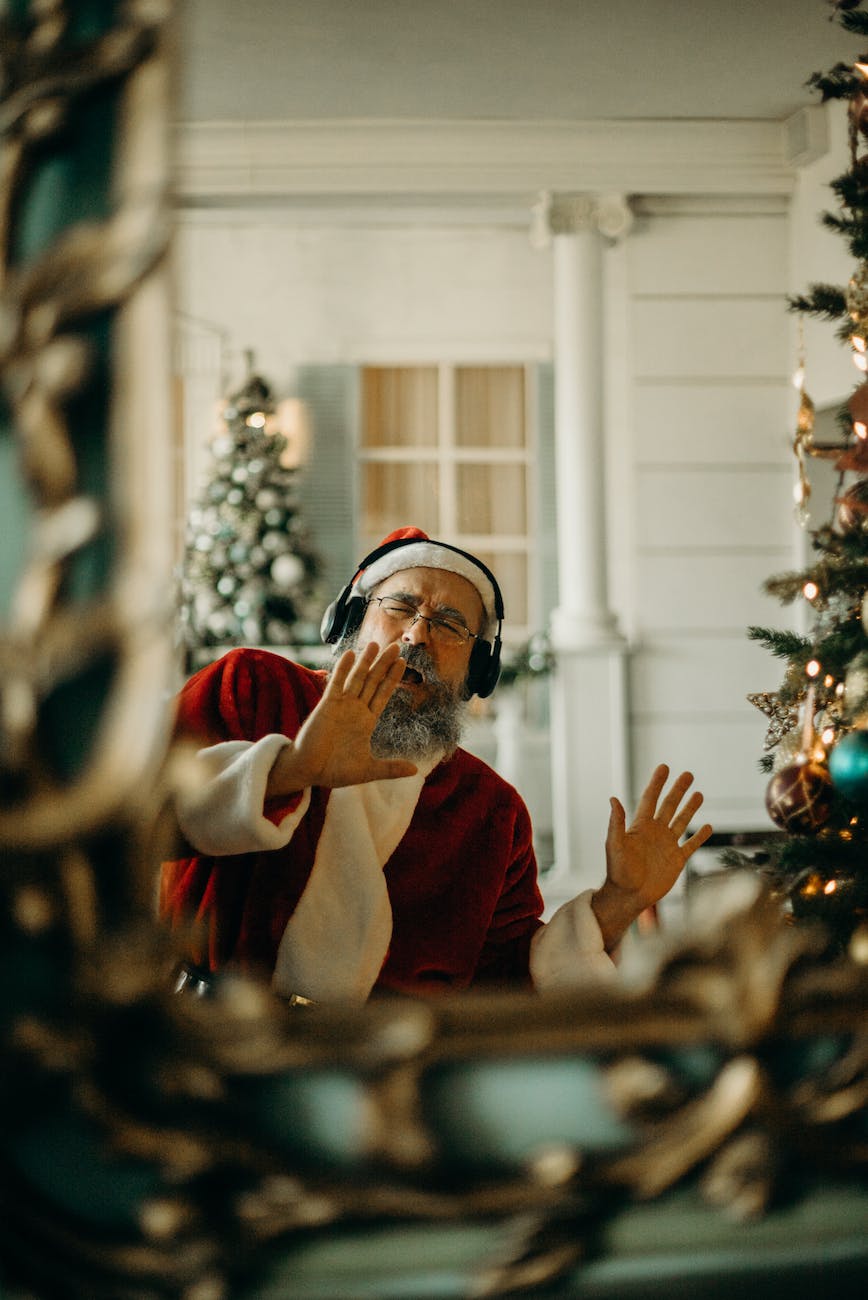
It was Pastor Bob with Marge and Paul. Marge was carrying a well-swaddled casserole of scalloped potatoes and Bob was wearing a Santa hat. Paul, who had always had a sweet spot for the irascible Eugenia, gave her a hug.
“Ho, ho, ho!” Bob thundered while Paul rolled his eyes. “We were hoping to join you for Christmas dinner.”
Marge walked past Eugenia into the dining room and placed her potatoes on the buffet. “Smells great in here, Eugenia,” she called over her shoulder.
Feeling both flustered and pleased, Eugenia poured glasses of sherry for Bob and Marge and a flute of sparkling cider for Paul. She set three more places at the table. Just as she was checking the temperature on the ham, the doorbell rang again. She bustled into the hallway, saying in mock irritation, “What is this? Grand Central Station?”
On the porch was the entire Rodriguez family—Heather, Jose, and all five kids. Jose held a platter with an immense deep fried turkey that smelled delectable. “Merry Christmas!” all seven family members shouted at once. Heather pushed the kids into the foyer where boots, coats, hats, and gloves were jettisoned while Jose gave Eugenia a kiss on the cheek and began to recount the details of deep frying a turkey.
It was, perhaps, the nicest Christmas that Eugenia had celebrated, at least since Sten had died. Pastor Bob said the blessing. Then they all lifted their glasses of sherry and sparkling cider. But instead of saying, “To Poppa,” Bob said, “To our hostess with the mostest, Eugenia!”
“Here, here! To Eugenia!” every glass was lifted.
Later while Pastor Bob washed dishes and Eugenia dried, they visited about this and that. “You know, Bob, after Sten died, I always felt like I had to somehow make the perfect family.”
Bob listened, “Hmm.” He prompted her to go on.
“But sometimes families aren’t perfect.”
“I hear you, Eugenia.”
“But maybe family isn’t just about flesh and blood.” Eugenia paused to look out into the living room where the Rodriguez twins were tossing a ball for Calvin. “Maybe it’s also about the families God gives us. The families we make. Don’t you agree?”
Bob paused and nodded. He was glad that his glasses were fogged by steam rising from the sink because he suddenly felt a little teary. He dried his hands on his apron and put a brotherly arm around Eugenia’s narrow shoulders. “I couldn’t agree more, Eugenia. Merry Christmas.”
Matthew 1:18-25
18 Now the birth of Jesus the Messiah took place in this way. When his mother Mary had been engaged to Joseph, but before they lived together, she was found to be pregnant from the Holy Spirit. 19 Her husband Joseph, being a righteous man and unwilling to expose her to public disgrace, planned to divorce her quietly. 20 But just when he had resolved to do this, an angel of the Lord appeared to him in a dream and said, “Joseph, son of David, do not be afraid to take Mary as your wife, for the child conceived in her is from the Holy Spirit. 21 She will bear a son, and you are to name him Jesus, for he will save his people from their sins.” 22 All this took place to fulfill what had been spoken by the Lord through the prophet:
23 “Look, the virgin shall become pregnant and give birth to a son,
and they shall name him Emmanuel,”
which means, “God is with us.” 24 When Joseph awoke from sleep, he did as the angel of the Lord commanded him; he took her as his wife 25 but had no marital relations with her until she had given birth to a son, and he named him Jesus.

 Joann White