Sabbath Day Thoughts — “Joseph’s Dream” Genesis 41:14-36
This summer, the Seed Saver’s Exchange in Decorah, Iowa celebrated its 50th anniversary with a national seed swap day, lessons in grafting apple trees, an heirloom plant sale, tomato tasting, and orchard tours. It all got started in 1975 when Diane Wheatley was entrusted with two heirloom seed varieties, Grandpa Ott’s Blue Morning Glories and German Pink Tomatoes. Diane’s great-grandparents brought the seeds to the US when they immigrated from Bavaria in 1884.
Diane and her husband Kent knew other families who preserved family seeds and stories. They reached out to form a network of gardeners interested in preserving biodiversity by growing heirloom seeds in their gardens and farms. Today, on their 890-acre farm in Winneshiek County, the Wheatley’s have the nation’s largest nongovernmental seed bank with more than 20,000 varieties of seed that they store and grow.
It’s a good thing that people like the Wheatleys are so committed to saving seeds and their stories. In the last century, the world has lost 75% of its edible plant varieties. Nowadays, roughly half of America’s cropland—170 million acres—is planted with genetically engineered crops with seeds that can’t be saved and replanted. That lack of biodiversity makes for a fragile agricultural system. Genetically modified crops are more vulnerable to changing climate, as well as certain pests and diseases. Agricultural experts are sounding the alarm that we need the biodiversity of heirloom plants to safeguard our food supply.
In our reading from Genesis, Pharoah had two disturbing dreams that sprang from the world of ancient Egyptian agriculture. At the center of Pharoah’s dream was the Nile. Ancient Egyptians called the Nile “Ar,” meaning “black,” a reference to the rich, dark sediment that the Nile’s waters carried from the Horn of Africa northward and deposited in Egypt when the river flooded its banks each year in late summer. That surge of water and nutrients turned the Nile Valley into productive farmland, and made it possible for Egyptian civilization to develop in the midst of a desert. In fact, the Egyptians were the first to practice agriculture on a large scale, growing wheat, barley, and flax. Ancient Egyptian farmers developed a system called basin irrigation, digging channels and filling fields with flood water. There it would sit for a month until the soil was saturated and ready for planting to grow the abundance that would sustain people and livestock.
But in Pharoah’s dream, trouble was brewing along the Nile. The king’s late-night vision of ugly, skinny cows devouring fat, sleek cows and withered, blighted grain consuming plump, good grain so troubled Pharoah that he summoned all the Magi of Egypt to interpret his dream. When they failed to discern the meaning, the king sent for a Hebrew prisoner, Joseph, who had a reputation for wise interpretation. With God’s help, Joseph listened to Pharaoh’s dream and anticipated catastrophe for Egypt’s economy and people: seven years of plenty would be followed by seven years of drought and starvation. There was no escaping it. The nation and the people would suffer.
Around the world this morning, millions of people face the sort of agricultural crisis and food scarcity anticipated by Pharaoh’s dream. The World Food Programme reports that we are in a world food crisis. 319 million people in 67 countries face acute hunger. The world’s largest hunger crisis is in the Democratic Republic of Congo, where 23.4 million people are severely hungry and over 6 million people have been displaced by civil war. Somalia is on the brink of famine with 10 million people in crisis. In Gaza, over half a million people are facing catastrophic famine. With acute malnutrition worsening rapidly, an estimated 132,000 of Gaza’s children under 5 are at risk of death. Pharaoh’s dream is our world’s nightmare in which war, climate change, a sluggish global economy, and a worldwide surge in refugees are fueling the global food crisis.
In response to Pharoah’s nightmares, Joseph began to do his own dreaming. He cast the vision of a future for Egypt in which the catastrophe of drought and starvation could be alleviated by careful planning. For Joseph’s plan to work, Pharaoh would need to take immediate action. One fifth of all grain harvested for the next seven years must be saved and safeguarded, creating an abundance that could feed the people and their livestock through the climate crisis to come. Most leaders would reject a seven-year 20% cut to their nation’s bottom line, but the frightening portent of Pharoah’s dream opened his ears. The king saw that careful planning for the future was needed, and Joseph was the man to do it. The king freed him from prison and appointed him chief overseer of the nation with authority to put his grain saving plan into action. If we were to continue to read in Genesis, we would learn that Joesph’s dream saved not only Egypt but also Israel as Joseph’s Hebrew brothers came to Egypt in search of grain.
The world needs people like Joseph. They look at the global reality of hunger, and they act wisely to avert catastrophe. For more than forty years, this church has partnered with Church World Service to help hungry neighbors here in the US and all around the world. Like Joseph, Church World Service has a goal of building a world where there is enough for all. One of the ways Church World Service does this is through the Seeds of Hope program. In Guatemala they are helping families in Quiché and Quetzaltenango grow and care for their own gardens. They have provided a variety of vegetable seeds, like coriander, radish, beets, chard, and spinach. They have also helped 590 families build gardens and 30 to build greenhouses. The garden program has been so successful, that Church World Service has worked with villages to develop community markets, where neighbors buy and sell their products to one other. Seeds of hope has allowed communities to grow and flourish together.
Church World Service is also working with global neighbors to adapt to a warming climate, which has led to droughts, floods, and unpredictable weather patterns. Farming practices that were once stable are no longer effective and smaller harvests have left families with less to eat and sell. In Tanzania, CWS is working with farmers to boost productivity and profits. Charles Dzombo participated in a program that taught him to grow sweet potatoes to supplement the grain, mangos, and maize that he already grew. The sweet potato vines thrived. In fact, Charles made a profit of three times his investment and did so in half the time of other crops. The extra money has allowed him to meet his household needs, maintain a stable food supply, and even purchase a goat. Charles now trains 25 other local farmers. He says, “Now that I have tasted the goodness of planting sweet potatoes, I am going to make it a priority.”
The world needs people like Joseph, who look at the global reality of hunger and act wisely to avert catastrophe. Half a world away from the 319 million people who experience acute hunger, we may feel powerless to make a helping, healing difference. But we can. Just think of Diane Wheatley who held in her hand two heirloom seeds from her Grandpa Ott and dreamed of the Seed Savers Exchange which, fifty years later, preserves the biodiversity of our farms for the generations to come.
What would it look like for us to be a Joseph? We begin local, right here in our basement. We can volunteer to help neighbors with more month than money through the Food Pantry. If we like to get our hands dirty, and maybe try growing some heirloom seeds, we can help in the Church’s Jubilee Garden. Last weekend, Ann and John harvested a bumper crop of potatoes, squash, Swiss chard, tomatoes, hot peppers, and more to the delight of our food pantry neighbors. There was even a little left over for us. If we aren’t into gardening, there is always the opportunity to make monthly food offerings, like soup and crackers or peanut butter and jelly, to stock the Pantry’s shelves. And don’t forget two-cents-a-meal on communion Sundays. That spare change adds up with half staying local with the food pantry and half going to the Presbyterian Hunger Program for hungry people across the nation.
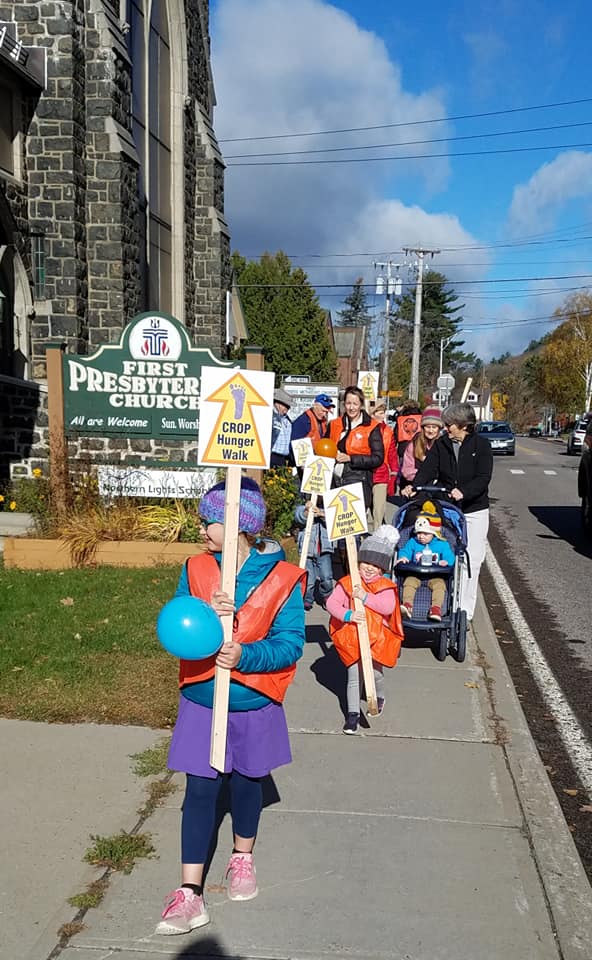
If we want to be Joseph for the world, we have the perfect opportunity on October 19 when our church will host the Saranac Lake CROP Walk. We pledge our support, lace up our sneakers, and hit the streets to raise funds and awareness about hunger. Last year, CROP Walk raised more than $6,000 for the work of Church World Service, supporting their innovative agriculture programs around the world. Who plans to walk this year? Who plans to pledge?
The world needs more Joseph’s this morning, my friends. The world needs more Josephs who will save seeds to preserve biodiversity and roll up their sleeves to feed hungry neighbors. The world needs more Josephs who will mentor Guatemalan gardeners and teach Tanzanians the profitable art of planting sweet potatoes. The world needs more Josephs who care about the 319 million acutely hungry people in this world and are willing to make a difference. How about it?
Resources
Patrick J. Kiger. “Why the Nile River Was So Important to Ancient Egypt” in History, July 12, 2021. Accessed online at https://www.history.com/articles/ancient-egypt-nile-river
Church World Service. “A Sweet Investment Brings Success” and “Seeds of Hope for Nutritional Food Security Program in Guatemala” in Stories of Change. Accessed online at https://cwsglobal.org/our-work
World Food Programme. A global food crisis. Accessed online at https://www.wfp.org/global-hunger-crisis
–. “Seed Savers Exchange Celebrates 50 Years.” Accessed online at https://seedsavers.org/sse-50th-anniversary/
Von Rad, Gerhard. Genesis. Philadelphia: Westminster Press, 1972.
Brueggemann, Walter. Genesis. Interpreter Commentary Series. Atlanta: John Knox Press, 1982.
Creation Justice Ministries. “Sowing Seeds: Prophetic Action to Climate-Changed Lands,” 2023.
Genesis 41:14-36
14 Then Pharaoh sent for Joseph, and he was hurriedly brought out of the dungeon. When he had shaved himself and changed his clothes, he came in before Pharaoh. 15 And Pharaoh said to Joseph, “I had a dream, and there is no one who can interpret it. I have heard it said of you that when you hear a dream you can interpret it.” 16 Joseph answered Pharaoh, “It is not I; God will give Pharaoh a favorable answer.” 17 Then Pharaoh said to Joseph, “In my dream I was standing on the banks of the Nile, 18 and seven cows, fat and sleek, came up out of the Nile and fed in the reed grass. 19 Then seven other cows came up after them, poor, very ugly, and thin. Never had I seen such ugly ones in all the land of Egypt. 20 The thin and ugly cows ate up the first seven fat cows, 21 but when they had eaten them no one would have known that they had done so, for they were still as ugly as before. Then I awoke. 22 I fell asleep a second time,[a] and I saw in my dream seven ears of grain, full and good, growing on one stalk, 23 and seven ears, withered, thin, and blighted by the east wind, sprouting after them, 24 and the thin ears swallowed up the seven good ears. But when I told it to the magicians, there was no one who could explain it to me.”
25 Then Joseph said to Pharaoh, “Pharaoh’s dreams are one and the same; God has revealed to Pharaoh what he is about to do. 26 The seven good cows are seven years, and the seven good ears are seven years; the dreams are one. 27 The seven lean and ugly cows that came up after them are seven years, as are the seven empty ears blighted by the east wind. They are seven years of famine. 28 It is as I told Pharaoh; God has shown to Pharaoh what he is about to do. 29 There will come seven years of great plenty throughout all the land of Egypt. 30 After them there will arise seven years of famine, and all the plenty will be forgotten in the land of Egypt; the famine will consume the land. 31 The plenty will no longer be known in the land because of the famine that will follow, for it will be very grievous. 32 And the doubling of Pharaoh’s dream means that the thing is fixed by God, and God will shortly bring it about. 33 Now therefore let Pharaoh select a man who is discerning and wise and set him over the land of Egypt. 34 Let Pharaoh proceed to appoint overseers over the land and take one-fifth of the produce of the land of Egypt during the seven plenteous years. 35 Let them gather all the food of these good years that are coming and lay up grain under the authority of Pharaoh for food in the cities, and let them keep it. 36 That food shall be a reserve for the land against the seven years of famine that are to befall the land of Egypt, so that the land may not perish through the famine.”

 Joann White