Limitless Compassion

Sabbath Day Thoughts — “Limitless Compassion” Luke 13:10-17

Jimmy has spent most of his life feeling invisible. Born with developmental disability and a host of physical issues, he spent most of his childhood in foster care. He attended school, riding in a special bus and learning in special classrooms. Other kids called him names: retard, freak, spazz, dumbo. Nowadays, Jimmy is largely ignored as he stands outside his group home to watch the cars drive past. Eyes look past him as if he isn’t even there.

Heather feels invisible. Every day at lunch she sits in the corner of the cafeteria by herself. She wears outdated hand-me-downs and packs her lunch in a re-used brown paper bag. In gym class, no one picks her for their team. When it’s time for group projects, no one wants to work with her. She sees cliques of friends laughing in the hallways and wishes she were part of that. Eyes look past or around her as if she isn’t even there.

Bert and Jean feel invisible. They had been retired for a number of years when the pandemic forced them to also step back from their civic commitments. Their phone used to ring off the hook. But now, not so much. Many of their friends have passed on. Their kids and grandkids are just so busy. Some weeks, the Meals on Wheels driver is their only conversation partner. They don’t get out much, but when they do, eyes look past or around them as if they aren’t even there.

The world is filled with neighbors who feel alienated, invisible, and alone. You might think that would awaken a mass wave of empathetic outreach, but it doesn’t. Social scientists say our disregard for vulnerable others is a psychological phenomenon known as “compassion collapse.” Dr. Caryl Cameron, director of the Empathy and Moral Psychology Lab at Penn State University, writes that “People tend to feel and act less compassionately for multiple suffering victims than for a single suffering victim…. Precisely when it seems to be needed the most, compassion is felt the least.”

There are reasons for that. We are finite beings with limited resources. We may feel that our action (or inaction) doesn’t make a difference, so we withdraw. Or, we sometimes don’t get involved to protect ourselves. In the face of widespread tragedy and need, it becomes crushing to take on the pain of others. We grow numb and feel powerless.

The bent over woman was invisible to her neighbors. She had felt alone and unseen for eighteen years. In the world of the first century, she was a marginalized person—someone who lived outside the community of the righteous because she was physically deformed, spirit-possessed, and a woman. Anyone who has ever had a bad back can imagine the terrible discomfort that she must have felt: muscle spasms; neck pain; difficulty in rising, standing, or walking; the inability to look up and out at the world around her. At some point in her long years of suffering, compassion collapse kicked in for her community. She stopped being a neighbor and simply become the “bent over woman.” She would not have been seated in church on the day that Jesus preached. Instead, she would have been excluded, waiting at the entrance, hoping that someone would see her and speak a kind word into her life of suffering.

Only one person in the synagogue saw the bent over woman. It was Jesus. As only Jesus could, he instantly knew her suffering and need, and his heart went out to her with a limitless compassion that stretched the bounds of what was socially and religiously acceptable in his day. Carolyn Sharp, who teaches Hebrew Bible at Yale, notes that what one could or couldn’t do on the sabbath day was hotly contested in the first century. In fact, the Mishnah Shabbat, a collection of rabbinic teachings, forbade 39 different kinds of labor on the sabbath: sowing fields, baking, building, traveling, and more. It did not forbid healing. In fact, rabbis generally agreed that in life threatening situations, it was acceptable to heal. The rabbis divided, though, over whether healing for non-critical conditions, like being bent over, was permitted.

That’s a long walk to say that Jesus saw the woman and chose to act in controversial, even scandalous, ways. First, he invited her into the sanctuary, into the community of the righteous—to the Moses Seat—where he had been teaching. Then, Jesus did something even more provocative. He laid his hands on her bent over back and raised her up straight, freeing her from the disability that had long held her in bondage. Jesus next concluded his sermon for the day with an interpretation of scripture that silenced the critics. If God would permit a farmer to unbind, water, and feed livestock on the sabbath day, then surely it was permitted to free a woman from the spirit that had long bound her. Jesus gave the bent over woman a proper name, “Daughter of Abraham,” a sister to all the worshipers that day.

The world is filled with invisible people. Like Jimmy, they live with disability. Like Heather, they are friendless school-aged kids. Like Bert and Jean, they are elderly and alone. They are the non-English speaking workers who clean our hotel rooms or pick our crops. They are the economically challenged neighbors who frequent the Food Pantry or collect the empty cans and bottles after rugby weekend. They’d like to be seen, but eyes look past or around them as if they aren’t even there.

Jesus’ scandalous actions in a crowded synagogue one sabbath morning call us to see our invisible neighbors, to welcome them into the heart of the community, to make a caring and healing difference in their lives. Thomas Merton wrote that compassion is the keen awareness of the interdependence of all things. We cannot find wholeness—shalom—apart from community, and communities cannot be whole until the outsider, the excluded, and the marginalized are welcomed, accepted, valued, and included. In a world where some characterize compassion and empathy as weakness, today’s teaching from Jesus is a bold contradiction and a call to action.

Of course, there’s only one problem: compassion collapse. In a world where need can be ubiquitous, our compassion can be overwhelmed. We say, what can one person do in the face of such large-scale pain? We grow numb. We close our eyes. People become invisible. What are we to do?

Peter W. Marty, editor of the Christian Century, says that he builds compassion for those who live in difficult circumstances through the simple practice of imagining what it’s like to walk in their shoes. He does this when he encounters people in daily life who perform jobs that he’s not sure he could manage or tolerate for even a day. Whether it’s an individual enduring dangerous work conditions, tedious assignments, a hostile environment, or depressingly low wages, Marty tries to picture trading his life for theirs. It quickly his alters perspective and shifts his assumptions about how easy or hard life can be for those who undertake hazardous or dispiriting work that often goes unnoticed, work for which we typically feel indifference.

Researchers David DeSteno and Daniel Lim have conducted research to learn how we can have more resilient compassion. Through a series of studies, Lim and DeSteno identified a few factors that enliven our compassion and enhance our capacity to act. It begins with the belief that small steps can make a difference. We can’t solve all the problems of the world, but we can make a simple difference in the life of someone who needs our encouragement and support. It also helps to remember our own experiences of adversity. Remembering our past challenges, suffering, or need motivates us to accompany others. Finally, our personal practice of prayer and meditation can help us to be present to those invisible neighbors. Taking the time to pray and reflect allows us to trust that our actions serve a holy purpose and God is with us. When we are clean out of compassion, we can borrow some of the limitless compassion of Jesus. The world may be filled with invisible people, but it doesn’t have to be. Jesus believes we can make a difference in the lives of those who feel that they are on the outside looking in, longing for care, connection, and community.  

This week, we’ll encounter them, those invisible neighbors. They’ll be sitting alone in Stewarts. They’ll be smoking outside their group home. They’ll be struggling to carry groceries to the car. They’ll fear they will miss that important doctor’s appointment because they don’t have a ride.

Let’s open our eyes and hearts. Take the time to see your invisible neighbor. Imagine what it’s like to walk in their shoes. Let’s remember our own experiences of adversity and isolation: that bitter break-up, the boss who bullied us, the health crisis we endured, the time we went broke. Let’s allow those suffering times to awaken our empathy for others and build our resolve to act. Undertake small compassionate acts and trust that they make a difference. Smile. Listen. Share a meal. Offer a ride. Bring someone to church. Finally, let’s ground our action in reflection and prayer. Remember Jesus, who healed a bent-over woman on the sabbath day and continues to long for the wholeness and redemption of our world.

Resources

Jared E. Alcantara. “Commentary on Luke 13:10-17” in Preaching This Week, August 24, 2025. Accessed online at https://www.workingpreacher.org/commentaries/revised-common-lectionary/ordinary-21-3/commentary-on-luke-1310-17-6

Jeannine K. Brown. “Commentary on Luke 13:10-17” in Preaching This Week, August 22, 2010. Accessed online at https://www.workingpreacher.org/commentaries/revised-common-lectionary/ordinary-21-3/commentary-on-luke-1310-17

Ira Brent Driggers. “Commentary on Luke 13:10-17” in Preaching This Week, August 25, 2019. Accessed online at https://www.workingpreacher.org/commentaries/revised-common-lectionary/ordinary-21-3/commentary-on-luke-1310-17-4

Annelise Jolley. “The Paradox of Our Collapsing Compassion” in John Templeton Foundation News, Nov. 20,2024. Accessed online at https://www.templeton.org/news/the-paradox-of-our-collapsing-compassion

Peter W. Marty. “A Failure of Compassion” in The Christian Century, June 2024. Accessed online at https://www.christiancentury.org/first-words/failure-compassion

Carolyn J. Sharp. “Commentary on Luke 13:10-17” in Preaching This Week, August 21, 2022. Accessed online at https://www.workingpreacher.org/commentaries/revised-common-lectionary/ordinary-21-3/commentary-on-luke-1310-17-5


Luke 13:10-17

10 Now he was teaching in one of the synagogues on the Sabbath. 11 And just then there appeared a woman with a spirit that had crippled her for eighteen years. She was bent over and was quite unable to stand up straight. 12 When Jesus saw her, he called her over and said, “Woman, you are set free from your ailment.” 13 When he laid his hands on her, immediately she stood up straight and began praising God. 14 But the leader of the synagogue, indignant because Jesus had cured on the Sabbath, kept saying to the crowd, “There are six days on which work ought to be done; come on those days and be cured and not on the Sabbath day.” 15 But the Lord answered him and said, “You hypocrites! Does not each of you on the Sabbath untie his ox or his donkey from the manger and lead it to water? 16 And ought not this woman, a daughter of Abraham whom Satan bound for eighteen long years, be set free from this bondage on the Sabbath day?” 17 When he said this, all his opponents were put to shame, and the entire crowd was rejoicing at all the wonderful things being done by him.



Photo by Chris F on Pexels.com

Real Authority

Sabbath Day Thoughts — “Real Authority” Mark 1:21-28

“Let’s get out of here! Floor it!” My friend Amy yelled in my ear. She had a death grip on my arm that would leave finger-shaped bruises.

I sat there frozen while Dr. Spahr tapped on my driver’s side window.

Dr. Spahr was the ultimate authority at CB West. At a time when dress codes were changing and administrators wore khakis, button down shirts, and blue blazers, Principal Spahr always wore a suit, black or charcoal. His somber neckties popped against starched white shirts. His thick, black-framed glasses might be considered hipster nowadays, but back then, they were seriously old school and uncool. He rarely smiled. He prowled the hallways with a ninja-like stealth that would catch you unaware. A trip to Dr. Spahr’s office could result in detention, suspension, or worse.

You did not want to run into Dr. Spahr when you were up to mischief, especially when you were on school property on a weekend night like we were. There was a collective gasp of anguish from my friends when I rolled down the car window. We were doomed.

Our reading from Mark’s gospel establishes Jesus as the new authority in Capernaum. Jesus was reading and interpreting scripture as a guest teacher at the synagogue on the sabbath day. The excellence of his words impressed everyone. Then, when an unclean spirit spoke out in the midst of the congregation, Jesus silenced it and demonstrated even more authority, driving the demon out of the afflicted man and setting him free. It was a synagogue assembly that no one would forget – great preaching and a miraculous healing, all thanks to Jesus who demonstrated a new and unprecedented authority.

The amazement of the people of Capernaum seems a little naïve to us. After all, we’ve been reading Mark’s gospel. We know that at Jesus’s baptism God spoke from the heavens saying, “This is my Son the Beloved.” And when Jesus was walking along the lakeshore, all he had to do was invite those fishermen to join him and they left everything behind. We expect great things from Jesus when he enters the synagogue. But those people in Capernaum? Not so much.

Those low expectations may have stemmed from the fact that there were plenty of “authorities” in Jesus’ day, but Jesus wasn’t one of them. There was a Roman garrison at Capernaum, and the centurion in charge controlled his men and the village. He wielded authority that came from the empire, with foreign occupation and the threat of violence.

Regional power was held by Herod Antipas, the Roman-appointed tetrarch of Galilee and Perea. Herod held authority to rule and collect taxes to support his kingdom and his emperor, oppressing and imprisoning those who might ask questions or resist his demands.

When it came to matters of religion, all eyes turned to the Temple in Jerusalem.  There, priests held an authority that passed from father to son through the long generations. Standing in the middle between the people and God Almighty, a priest could pronounce you clean or unclean, offer sacrifices to atone for your sins, exclude you from the community of the righteous, or welcome you back home.

And when it came to scripture, authority was best left to the scribes, scholars who spent a lifetime studying the Hebrew Bible and memorizing the long history of biblical interpretation known as the traditions of the elders. The scribe’s authority derived from their eloquence, encyclopedic knowledge, and the prestige of the rabbis with whom they had apprenticed.

Roman commanders, client kings, priests, and scribes, these were the voices of authority for the people who had gathered for worship on that Sabbath morning in Capernaum. Yet one sermon from Jesus and one act of healing had people buzzing. Here was a new authority that made them sit up and notice. Here was an authority unlike any they had seen before.

Perhaps the buzz was about the big difference between how Jesus used his power and how all those first century authorities exercised their power. Jesus didn’t use his authority to exert control or curry political favor. He didn’t use his power to amass a fortune or build an impressive reputation. He didn’t use his authority to elevate himself above others or establish his unparalleled expertise. Instead, that sabbath day in Capernaum revealed that Jesus would use his power for others. He reminded those worshippers of God’s great love for God’s people. He chose to reach out with compassion in response to suffering.  In God’s Kingdom, these are the hallmarks of real authority: to speak in ways that make the love of God known and to act in ways that bring healing and wholeness to others. This is the heart of the ministry that God would empower Jesus to pursue.

This is the sixth time that I have preached on this passage. That’s the blessing and challenge of years of experience. I often like to focus on the choice we face when we read this story, the same choice that those worshippers in Capernaum faced. Will we recognize Jesus’ authority for our lives? Will we build a life around him, placing the Lord at the center of our families and workplaces, our civic commitments and even the choices we make in the voting booth. It isn’t an easy thing to do, because it requires us to make some tough decisions about all those other authorities out there, the ones that would like to run our show. Year in and year out, I see this congregation making the tough choice to put God at the center, establishing the priorities that Jesus hoped his first listeners would make.

This time through the lectionary cycle, I have been thinking beyond our choice to affirm Jesus as Lord to questions about our own authority. Whether we are parents or grandparents, teachers or managers, community leaders or healthcare providers, elders or deacons, we have each been entrusted with authority. We choose daily how we will use the power that is at our disposal. Will we make God’s love known? Will we act with compassion to ease the suffering of others? I think these are the most essential questions in the life of faithful people. The choice for love, the practice of compassion, I think this is the heart of the ministry that God would empower us to pursue.

At the start of this message, I left myself rolling down the car window to face the authority of the totally terrifying Dr. Spahr. What kind of principal hangs out at school on a Saturday evening just to spoil the shenanigans of high school pranksters? He was even wearing his suit! Out of the corner of my eye, I saw a can of spray paint roll out from under the passenger seat—a fact that the eagle-eyed Dr. Spahr would be sure to notice.

Dr. Spahr recognized me right away. We went to the same church, and my Mom had taught at the high school for a number of years. Once the window was down, the conversation went something like this.

Dr. Spahr: Why, Joann! What are you doing on school property in the middle of a Saturday night?

Everyone in the car: Nothing!

We were busted. There was no getting around it. I saw a future of detentions ahead of me. If the spray paint was brought into evidence, we were talking suspension. If it became known that although I was in the driver’s seat, I did not have a driver’s license, then who knew what horrors awaited me.

I must have looked pretty pitiful. I was an honors student, but things weren’t great at home, and Dr. Spahr knew it. The acrimony between my parents was showing up in some unfortunate ways in us kids. I wasn’t the only case in point. My brother had been in the dreaded office of Dr. Spahr twice that year, once for fighting and another time for setting off a fire extinguisher in a hallway (which was probably also related to fighting). That really did result in a suspension. My goose was cooked.

Dr. Spahr gave me a long hard look. He peered off into the night through those thick black glasses. He was clearly weighing his options. Finally, he sighed and patted the driver’s side door. “You girls go home,” he said. “I don’t want to hear about any more trouble.” He looked pointedly at what had rolled out from under the seat. We wasted no time, dropping the car into gear and driving off into the dark.

I’ve thought about Dr. Spahr over the years, all that authority at CB West. On at least one Saturday night, he helped a teenager know the love of God and the compassion that Jesus would have us extend to one another.

Resources:

Paul S. Berge. “Commentary on Mark 1:21-28” in Preaching This Week, Jan. 29, 2012. Accessed online at Home – Working Preacher from Luther Seminary

Matt Skinner. “Commentary on Mark 1:21-28” in Preaching This Week, Feb. 1, 2015. Accessed online at Home – Working Preacher from Luther Seminary

Stephen Hultgren. “Commentary on Mark 1:21-28” in Preaching This Week, Feb. 1, 2009. Accessed online at Home – Working Preacher from Luther Seminary

David S. Jacobsen. “Commentary on Mark 1:21-28” in Preaching This Week, Jan. 28, 2024. Accessed online at Home – Working Preacher from Luther Seminary


Mark 1:21-28

21They went to Capernaum; and when the sabbath came, he entered the synagogue and taught. 22They were astounded at his teaching, for he taught them as one having authority, and not as the scribes. 23Just then there was in their synagogue a man with an unclean spirit, 24and he cried out, “What have you to do with us, Jesus of Nazareth? Have you come to destroy us? I know who you are, the Holy One of God.” 25But Jesus rebuked him, saying, “Be silent, and come out of him!” 26And the unclean spirit, convulsing him and crying with a loud voice, came out of him. 27They were all amazed, and they kept on asking one another, “What is this? A new teaching—with authority! He commands even the unclean spirits, and they obey him.” 28At once his fame began to spread throughout the surrounding region of Galilee.


The Debt of Love

Sabbath Day Thoughts — “The Debt of Love” Romans 13:8-14

One of my first forays into volunteering as a young adult was with a community mental health association. I served as an advocate for a similarly aged woman whom I will call Kelly. As a small child, Kelly had caught measles and suffered an extremely high fever that left her with brain damage.  Kelly’s social worker hoped that I would be able to help Kelly learn some healthy habits like grooming, housekeeping, managing money, and having responsible relationships. I thought I was going to make a special friend and make a big difference in her life. I was wrong.

On my first visit to Kelly’s apartment, I was surprised to learn that she had a husband Glen, who was also developmentally disabled. Glen dreamed of being a radio DJ and my entire first visit to that very dirty and chaotic apartment was spent trying to talk over blaring music and Glen’s equally loud DJ patter and whoops. When I invited Kelly to take a walk so that we could hear one another, she said she didn’t like walking. This was just fine.

For my second visit, I arranged for us to go out for dinner at a local Chinese restaurant. Glen was absent when I arrived, hanging out with some of his guy friends. “This is a big improvement!” I thought. But Tammy didn’t look ready to go. Her hair was greasy and tangled. Her blouse was covered in food stains. Her teeth were yellow with tartar. Her breath was very bad. Maybe this was my opportunity to talk about grooming and personal hygiene. But I didn’t get anywhere. Kelly didn’t like showers or toothbrushing and that was her favorite blouse, which perhaps explained why it was so filthy and smelly. We went out to dinner anyway, my confidence in my ability to be an advocate dropping by the minute.

I wish I could tell you that things got better. I tried gifting Kelly with little care packages of shampoos, shower gels, and toothbrushes. We tried a trip to the salon for a new hairstyle. We made a budget. None of this was well received. About six months into our friendship, Kelly split with Glen. At first, they lived together, but she insisted that they were no longer married. She brought new boyfriends home often. Then, one day Glen was gone. Kelly’s next longtime boyfriend Ralph wasn’t developmentally disabled, but he was old enough to be her grandpa. She began to insist that he come along on all our outings, and Ralph couldn’t keep his hands off of Kelly, even though her hygiene hadn’t improved one bit. When I called Kelly’s social worker to raise concerns about Ralph, I learned that I was being judgmental and that it really wasn’t any of my business. I limped along in my volunteering, trying to be a positive influence, but frankly I failed miserably. Whatever obligation I owed Kelly as her advocate never was truly fulfilled. I felt frustrated and disappointed, and I’m pretty sure that Kelly didn’t even like me.

In our epistle reading, the Apostle Paul described the most essential obligation that we owe to one another: love.  “Owe no one anything, except to love one another; for the one who loves another has fulfilled the law.”  The Greek word here for owe, opheilo, means to have a moral or financial obligation to another person.  It is easy for us to imagine that we owe the repayment of a loan. It is equally easy for us to remember times that we have felt indebted to others for the kindness that they offered in our time of need.  It’s more difficult to accept the radical message that Paul suggests: we always owe a debt of love to everyone, everywhere, all the time. 

I have taught before that in Greek there are three words for love—eros is romantic love; phile is brotherly love; and agape is love based upon selfless, sincere appreciation and high regard for the other. Agape is a holy love that reverences the image of God imprinted within each of us.  Paul teaches that we owe one another agape, the pure and disinterested love that emerges from the awareness that we are all beloved children of a loving God. Paul is, of course, paraphrasing the essence of Jesus’s ethical teaching, that we are to love the Lord our God with all our heart, mind, soul, and strength; and we must love our neighbors as we do ourselves.

If you are like me, your head spins with the magnitude of this basic Christian imperative to love.  I think I’ve got it when it comes to loving my family, my friends, and my church, but to owe a debt of pure love to all?  To do no wrong to anyone at any time?  To love the boss who took credit for our initiative, to love the former spouse who abused our trust, to love the neighbor who peddles conspiracy theories and blankets the lawn with political propaganda, to love the Russians, the North Koreans, the terrorists? The very thought is daunting, intimidating, mind blowing. Help us, Paul. Help us, Jesus.

The great Reformed theologian Karl Barth taught that agape is the spiritual relationship with neighbor that is born in our communion with God; agape is the relationship between people that is grounded in the sure and certain knowledge of a loving God.  In agape, we trust that God is at the center of our relationships with one another, and so all our relationships may be charged with the holy. Although we are, indeed, frail and short on love, God is not.  We become capable of selflessly loving one another because God first loves us.

For followers of Jesus, our capacity to love like this is grounded in Christ. God’s love for us is so boundless, so limitless, so deep and wide and wonderful that God would humble Godself to take the form of a simple Jewish tradesman, who was filled with a love so profound that he would suffer the humiliation and agony of death upon a cross to reconcile us with God and one another.  Our ability to love one another springs forth from God’s love for us, and the greatness of that love equips us to be more than we are—more open, more caring, more loving.  God’s love grows within us, summoning us to a loving engagement with the world. 

If I were a young adult back in the DC area again, volunteering with that community mental health association, I’d like to think that I would handle things with Kelly differently. I would let go of the expectations that I should improve her grooming and impart some key lessons in personal hygiene. I might stop trying to bring order to an apartment that looked like a firetrap to me. I would quiet my disapproval of her promiscuity and her interesting choices in men. Instead, I would just try to love Kelly, to see in her the holy image of our infinitely loving God. If all I did was love, maybe Kelly would even like me, but there are no guarantees, and the choice for love is never predicated upon the strings that we might wish to attach.

Loving others selflessly as Paul suggested and Jesus required is hard work. It takes a singular commitment and the daily resolve to love others as God has loved us. Practitioners of mindfulness meditation teach that we can cultivate within ourselves the capacity to love. It takes daily practice, but it’s doable. Perhaps we could even try it right now. Shall we?

We start by acknowledging God’s love for us. Take a moment to bring to your awareness God’s holy love for you, and if anyone is struggling to feel beloved this morning, allow me to be Jesus for you and remind you that you are precious in God’s sight. Feel the love.

Next, we use our imaginations to extend God’s love to others. Look around, my friends, at your neighbors in the pews.  Share that holy love with one another. 

Next, we look beyond the walls of the church to our neighbors in Saranac Lake. Can we imagine love rolling out in waves from the sanctuary this morning as a blessing for the community? Send love forth.

Next, use your imagination to look far into the distance and see the citizens of our world groaning beneath the weight of earthquake in Morocco, or war in Ukraine, or tyranny in North Korea, or hunger in Afghanistan.  Let’s send our agape to the ends of the earth. Let it roll! Can we feel the love?

According to those prayer warriors everywhere, this simple daily discipline can help us to grow in agape. It’s worth a try. What the world needs now is love, sweet love.

The last time I saw Kelly, I had her over to my apartment for dinner. I insisted that Ralph stay home, and at first there was some bad attitude about that. I cooked all Kelly’s favorites: pork chops, green beans, sauerkraut, and stuffing. For dessert, I brought out baked apples, the simplest of sweets, cored and stuffed with brown sugar, cinnamon, and raisins. Kelly smiled, showing her terrible teeth. “My Mom made these,” she said, attending to a private memory that lit her up from within. We were letting go of one another, but perhaps on this last visit I had done something right. Perhaps it was a little bit like love.

Resources

Karl Barth. The Epistle to the Romans. New York: Oxford University Press, 1953.

David McCabe. “Commentary on Romans 13:8-14” in Preaching This Week, Sept. 10, 2023. Accessed online at workingpracher.org.

Mary Hinkle Shore. “Commentary on Romans 13:8-14” in Preaching This Week, Sept. 4, 2011. Accessed online at workingpracher.org.

Elizabeth Shively. “Commentary on Romans 13:8-14” in Preaching This Week, Sept. 7, 2014. Accessed online at workingpracher.org.


Romans 13:8-14

8Owe no one anything, except to love one another; for the one who loves another has fulfilled the law. 9The commandments, “You shall not commit adultery; You shall not murder; You shall not steal; You shall not covet”; and any other commandment, are summed up in this word, “Love your neighbor as yourself.” 10Love does no wrong to a neighbor; therefore, love is the fulfilling of the law.

11Besides this, you know what time it is, how it is now the moment for you to wake from sleep. For salvation is nearer to us now than when we became believers; 12the night is far gone, the day is near. Let us then lay aside the works of darkness and put on the armor of light; 13let us live honorably as in the day, not in reveling and drunkenness, not in debauchery and licentiousness, not in quarreling and jealousy. 14Instead, put on the Lord Jesus Christ, and make no provision for the flesh, to gratify its desires.


Photo by ATC Comm Photo on Pexels.com

Bent Over

Sabbath Day Thoughts — “Bent Over” Luke 13:10-17

It was the best sermon I had ever heard.  Shall I start with the voice?  Rich and melodic, captivating.  Within moments, I felt as if I had known him all my life.  He read the Torah with such love, as if he were feasting on every word.  And when he opened the scriptures to us, they came alive.  I could feel the compassion and mercy of God in ways that I had never felt before, as if even I were a beloved child of God.  The synagogue at Capernaum was quiet. Every ear strained to hear every sound.  When Rivka’s baby began to fuss, we all said, “Shhhh!” not wanting to miss a word.

But then it stopped.  Without warning or “Amen,” there were simply no more words.  Worshippers began to buzz and turn restlessly in their seats.  Slowly things got louder, like a wave of sound rising from the best seats at the front of the sanctuary and rolling back to where I stood, mostly hidden, in the doorway.  My husband Moshe placed a hand upon my back and cursed under his breath.  “Lord, help us! It’s you, Mahalath. He sees you.  I knew we never should have come.”

I should tell you about my back.  It started the year our second child was born, a sweet and ruddy boy to join an older brother.  I was still hale and strong.  With one child bouncing on my hip and another sleeping in a sling at my breast, I worked alongside Moshe. We brought in the barley harvest and shook olive branches to rain down a harvest of ripe fruit. I milked the goats, fed chickens, ground grain at the wheel, and spun wool into yarn.  Young and able with the handsome Moshe at my side and our beautiful boys, I was the envy of many, and that may have been part of the problem.  You know the ways of jealousy and the dangers of the evil eye.

One day, I bent to lift the bread from the oven, and I couldn’t stand up.  My back writhed like it was being squeezed in a vice, and my whole body seized in pain.  I couldn’t breathe.  I couldn’t move.  I dropped to my knees, sending the loaves into the fire.  The world grew dim and then went black.

I’m not sure how long I was in darkness.  I awoke to the sound of my children crying.  Moshe hovered over me, looking worried.  A Greek physician from Sepphoris had been brought to attend me. 

“Ah!  You are awake!” the doctor said matter-of-factly.  He dribbled a vile tasting liquid into the corner of my mouth.  “Drink it all, dear,” he said with kindness. “It will help with the pain.”  I gagged it down, blinking back tears, and slipped into a sleep troubled by dreams of fire, serpents, and burned bread.

When I awoke, Moshe was sitting at my side, holding my hand.  Our boys had climbed into the bed with me.  Their small hands clutched the folds of my tunic. Their cheeks were red with worry and weeping.  “Ugh!” I moaned.

Moshe leaned in, “Mahalath, stay still.  The Greek says that you have been possessed by the spirit of the python.  You must save your strength to fight.”

Now, I had heard that in Delphi, on the far side of the Great Sea, the Greeks worship the sun god.  Poseidon speaks through priestesses possessed by the spirit of the python.  Twisted, bent, and rigid, they prophesy all day long.  For the right price, they might even tell you of a bright future.  But that had nothing to do with me. I loved Yahweh.  I was a beloved daughter of Israel, or so I thought.

I did fight.  I found my feet again.  I learned to live with pain.  I tended my children.  I did my best to keep our home and fields, but I never stood up straight again. Our neighbors said that I was “bent over,” as if I were a broken reed or a tree snapped by a windstorm. With every year, my back bent more noticeably, and as my shoulders rounded and my spine folded in on itself, my perspective grew small, narrow, and limited. 

My affliction made me unwelcome at the synagogue, for only someone cursed by Yahweh could look as I did.  But each week, I would wait at the back, hovering in the doorway, hoping for the smallest crumb of blessing.  Our neighbors stopped including us, uncomfortable with my woe and believing the worst.  One day, the neighborhood children began to call me names. At first, they did so behind my back; eventually, they did so to my face.  In time, most people just called me “Bent Over Woman,” as if I didn’t even have a real name.  I prayed always, hoping that if I could find the right words, I might be set free from this prison that my body had become.

So, while I could tell you that he preached the best sermon I had ever heard, and I could tell you that Rivka’s baby fussed, and I could tell you that the preaching stopped and the sound of whispering and unrest rolled to me like a restless wave, I could not tell you what he looked like, or why Rivka’s baby fussed, or why the rabbi stopped speaking, or why the sound of my restless neighbors rolled toward me.  Because the only thing that I could see was what I always see: my feet.

Moshe reached a protective arm around my back and held my hand.  “Mahalath,” he whispered, “He’s waving to you!  He wants you to come forward.”

I tried to turn and leave, but Moshe held me fast.  “Mahalath,” he urged, “What have we got to lose?” 

What did we have to lose?  It doesn’t get much worse than living in constant pain, shunned by your neighbors, and excluded from your church.  It doesn’t get much worse than being called Bent Over Woman.  My life had become an agony of loneliness and suffering.  With Moshe at my side, I walked to the front.

If it was quiet when the rabbi spoke, it was deathly still as I stood before him.  Every eye in the synagogue was fixed on me.  Every breath was held.  Even Rivka’s baby was silent. 

Then, this rabbi did a most unusual thing.  He squatted down on his haunches, down into my limited field of vision, and he looked up into my face.  He was sun-browned, as if he worked in the fields.  Fine lines creased the corners of his eyes, which were a deep, bottomless brown.  He smiled and his kind eyes sparkled with interest and concern. Next, he said the most ridiculous thing that I had ever heard, “Woman, you are set free from your ailment.”  Didn’t he see what everyone else saw: my hideous bent-over back?  Someone snickered. Moshe took a protective step closer.

What happened next is still being talked about in Capernaum.  The rabbi stood up and placed his two broad, strong hands on my poor crippled back.  What I noticed first was warmth, like the sun on a winter day bringing a blessing to your upturned face.  Slowly it flowed out from his hands, spreading down to the tips of my toes and reaching up to the top of my head.  It was then that I realized that my pain was gone.  The spirit of the python that had held me tight in its grip had departed!  I took a deep breath and then another. Then, for the first time in eighteen years, I stood up.  I gasped and shouted bold cries of “Alleluia!” and “Thanks be to the Holy One of Israel!” I hugged Moshe, then I hugged the rabbi as my neighbors watched in shocked silence.

Not everyone was happy.  The synagogue leader was scandalized that I had entered the sanctuary, and the rabbi had healed on the sabbath.  But the rabbi would hear none of it, for surely, even one such as I deserved the mercy that is shown to an ox or mule. 

With a wink, the rabbi turned to me. “Mahalath,” he called me by name. “Mahalath, I think I just finished my sermon for today.”

I practically danced toward the door of the synagogue, followed by the rabbi and Moshe.  Out they went, but before I left, I turned to my neighbors, the ones who for eighteen years had ignored me, gossiped about me, called me names, and failed to show me the courtesy one might extend to a barnyard animal.  I looked them in the eyes and said, “By the way, my name is not Bent-Over-Woman.  My name is Mahallath. You are welcome to come break your fast with us today.”

The synagogue erupted in cheers and praise.  That sabbath evening, Jesus dined with us, and so did all of Capernaum. The pot never emptied, the bread seemed to multiply, and the wine never failed. But that is a miracle to tell on another day.  I rejoiced—and so did the whole village with me—in the wonderful things that Jesus was doing.


Luke 13:10-17

10 Now he was teaching in one of the synagogues on the Sabbath. 11 And just then there appeared a woman with a spirit that had crippled her for eighteen years. She was bent over and was quite unable to stand up straight. 12 When Jesus saw her, he called her over and said, “Woman, you are set free from your ailment.” 13 When he laid his hands on her, immediately she stood up straight and began praising God. 14 But the leader of the synagogue, indignant because Jesus had cured on the Sabbath, kept saying to the crowd, “There are six days on which work ought to be done; come on those days and be cured and not on the Sabbath day.” 15 But the Lord answered him and said, “You hypocrites! Does not each of you on the Sabbath untie his ox or his donkey from the manger and lead it to water? 16 And ought not this woman, a daughter of Abraham whom Satan bound for eighteen long years, be set free from this bondage on the Sabbath day?” 17 When he said this, all his opponents were put to shame, and the entire crowd was rejoicing at all the wonderful things being done by him.
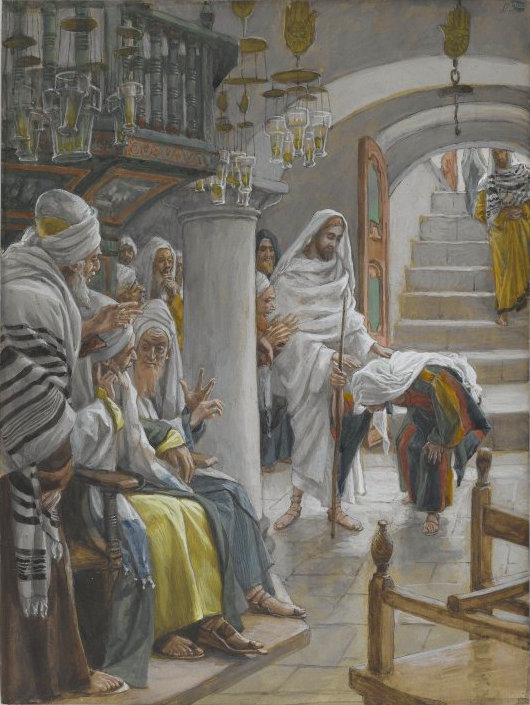

James Tissot, “The Woman with an Infirmity of Eighteen Years” (La femme malade depuis dix-huit ans), Public domain, via Wikimedia Commons, in the collection of the Brooklyn Museum.