Meeting the Gardener

Sabbath Day Thoughts — “Meeting the Gardener” John 20:1-18

The world is filled with weeping places this morning. In northern Nigeria, vulnerable people are hungry. They live with lingering violence of the terrorist organization Boko Haram, which has made international headlines for abductions, murders, and other criminal activity. They’ve been hit by natural and manmade disasters, too. Flooding has caused crops to fail. Corruption and poor governance exploit the poor, serve the rich, and sell justice to the highest bidder. According to Nigerian Peacemaker Peter Egwudah, life in northern Nigeria is a long-running struggle with food insecurity. Hardest hit are women, children, the elderly, and those with disabilities.

The world is filled with weeping places this morning. The family of Kilmar Abrego Garcia is weeping. Kilmar came to the United States illegally from El Salvador in 2011, sent north by his family to escape gang violence there. Here, he has worked construction, married Jennifer Vasquez Sura­—a US citizen, and supported his family. His five-year-old child has autism, is deaf in one ear, and cannot communicate verbally. Kilmar was mistakenly accused of being an MS-13 gang member by a paid informant, who had never met him or even been in the same state. Last month, he was deported to the Terrorism Confinement Center in Tecoluca, El Salvador. Although the courts have called for his release and return, the Abrego Garcia family waits and weeps, unsure if they will ever see their husband and father again.

The world is filled with weeping places this morning. We know those who weep: the neighbor who struggles with a bleak diagnosis, the friend who has lost a job, the parent who laments the untimely death of a child, the family member who wrestles with addiction, the person on a fixed income whose retirement savings have been hard hit by volatile markets. We know those who weep; sometimes we are the ones who weep.

It is hard to see the Lord when we are in our weeping places. Just ask Mary Magdalene. Mary walked to the tomb in the pre-dawn darkness. Her footsteps echoed through the streets of the sleeping city. Her heart was heavy with memories of recent days. A week ago, Jesus had made a triumphal entry to Jerusalem, but things had gone terribly and unthinkably wrong. Powerful opponents had conspired to bring about his arrest through the betrayal of a trusted friend. Injustice had been served by both the Temple court and Pontius Pilate. On Friday, Mary’s world had descended into violence and chaos as her teacher was brutally beaten and scourged, taunted with insults and mockery, reviled in hate, and crucified. Mary wept at the tomb, thinking that the world’s evil had outmatched God’s goodness, and now her Lord was nowhere to be found. Mary wept.

It is hard to see the Lord when we are in our weeping places. When the doctor breaks the bad news or the boss hands us the pink slip, we wonder “Why me, God?” When we are bowed down with grief and cannot see tomorrow, we ask, “Why this, Lord?” When addiction controls our lives and wreaks havoc within our families we ask, “Where are you, God?” When we are gripped by fear and worried about the future, we lament “Lord, why would you let this happen?” In our weeping places, we feel powerless and overwhelmed. In our weeping places, we fear that God is distant and we are alone.

As she raised her voice in lamentation outside the empty tomb, Mary learned that Christ was with her in her weeping place. Eyes blurred by tears and ears closed with grief, Mary first mistook Jesus for the gardener, come to clean up any mess left behind by Friday’s hasty burial. But then her tears came to an end as she heard her name, “Mary,” spoken by that most beloved of voices.

On Easter morning, we remember Mary’s tears, and we proclaim again the beautiful, terrible truth of the incarnation and the cross. God loved us so much that God would become flesh and live among us with mercy, healing, and infinite compassion. God’s love would stop at nothing to be reconciled to us and to reconcile us to one another—willing even suffering death upon a cross. But God’s love wins the victory over sin and death. God shows up in our weeping places with our name upon God’s lips and a purpose for our lives.

On Easter morning, we can face our tears head on, because we see that we are not alone. When the test results arrive and the doctor shakes her head, the risen Lord is with us. When the pink slip is in and the job possibilities are out, the risen Christ is with us. When untimely loss sends us into the valley of the shadow of death, we are not alone for God is with us. When we feel brought low by addiction or hardship, economic chaos or uncertain times, we trust that Jesus is in our midst with a love that is stronger than all the tears our world can serve up.

Bible scholars like to call our attention to the placement of Jesus’ tomb within a garden. They say it recalls God’s amazing work of creation, described in the first chapters of Genesis. They say that in breaking the power of sin and death upon the cross, God made a new creation. The separation between humanity and God came to an end, our alienation from one another is over. As new creations, we can go forth in holy, healed, and unexpected ways. It was true for Mary Magdalene. There in the garden, outside the empty tomb, Jesus the gardener gave Mary a new vocation. She became an evangelist. He sent her forth to a weeping world with a message of resurrection hope, “I have seen the Lord.”

On this Easter Sunday, may we, too, know that we are a new creation. May we, like Mary, see that we have a new vocation. We are sent into the world with the hopeful message that we have seen the Lord. Yes, the world abounds with weeping places, and yet God’s love is stronger than our tears, stronger than the hurt and harm that cause our eyes to fill and our hearts to tremble. As we go forth into the world’s weeping places, we point to the presence of Jesus, who continues to walk among the hurting and broken people of our world who fear they are alone.

Today, we will share the good news of Christ’s presence with the vulnerable people of northern Nigeria through One Great Hour of Sharing. Since 2017, our contributions have supported the work of the Civil Society Coalition for Poverty Eradication (CISCOPE). CISCOPE is at work in northern Nigeria, Sudan, Somalia, and Yemen, places where 20% families experience a severe lack of food. Beyond meeting emergency needs, CISCOPE helps families to find long-range food sufficiency through vegetable seed, agricultural machinery, teaching farming practices, and training for disaster preparedness. 70% of those helped by CISCOPE are women, children, and vulnerable people who have traditionally been ignored.

How do we bear witness to Jesus for families like that of Kilmar Abrego Garcia? It’s challenging in this highly-politicized partisan climate, where one faction characterizes Kilmar as a violent criminal while the other side champions him as a local hero. We can begin by remembering that there are families at the heart of the immigration crisis. Kilmar is the public face of an international tragedy in a world where violence, disaster, and extreme poverty have forced people from homes in places like Central America, Africa, Syria, Afghanistan, and Haiti. They flee in search of safety and opportunity. They come to lands that welcome their undocumented, underpaid labor but prefer that they remain strangers to us, subsisting in the shadows on the scraps of the land of plenty. For Kilmar and those like him around the world, we remember that Jesus, too, was a migrant. We point to the infant messiah, whose parents were forced by threat of political violence to flee their homeland and sojourn in the land of Egypt. What might our policies and actions look like, if we envisioned the infant Jesus caught in the crossfire?

What does pointing to the presence of Jesus look like for the hurting people whom we know, those who fear and mourn, despair and weep? We can begin by going to the tomb, showing up and being present for folks who weep with shared tears and abounding compassion. When the time is right, we can try, like Mary, to share how we have “seen the Lord” in our own times of hardship, loss, and pain. We can bear witness to our hurting friends and neighbors with more than words: with hot meals, honey-dos, and practical support; with abounding prayer, phone calls, and cards; with generous encouragement and lots of listening.

On Easter morning, the world is filled with weeping places, my friends, but it is also filled with the presence of Christ. The Lord has risen; he has risen indeed. We have seen the Lord. Let us go forth to those who weep with the good news of God’s amazing love.

Resources

Ben Finley. “Who is Kilmar Abrego Garcia, the man ICE mistakenly deported to an El Salvador prison?” in The Associated Press, April 18, 2025.

Rich Copley. “How your One Great Hour of Sharing gifts are used” in Presbyterian News Service, April 6, 2022. Accessed online at https://pcusa.org/news-storytelling/news/2022/4/6/how-your-one-great-hour-sharing-gifts-are-used

Joy J. Moore. “Commentary on John 20:1-18” in Preaching This Week, April 21, 2019. Accessed online at https://www.workingpreacher.org/commentaries/revised-common-lectionary/resurrection-of-our-lord-3/commentary-on-john-201-18-10

Alicia D. Myers. “Commentary on John 20:1-18” in Preaching This Week, April 12, 2020. Accessed online at https://www.workingpreacher.org/commentaries/revised-common-lectionary/resurrection-of-our-lord/commentary-on-john-201-18-11

Jason Ripley. “Commentary on John 20:1-18” in Preaching This Week, April 20, 2025. Accessed online at https://www.workingpreacher.org/commentaries/revised-common-lectionary/resurrection-of-our-lord-3/commentary-on-john-201-18-19

Rolf Jacobson. “For Such a Time as This” in Dear Working Preacher, April 5, 2020. Accessed online at https://www.workingpreacher.org/dear-working-preacher/for-a-time-such-as-this

Paul Simpson Duke. “Homiletical Perspective on John 20:11-18” in Feasting on the Gospels, John, vol. 2. Westminster John Knox Press, 2015.


John 20:1-18

20 Early on the first day of the week, while it was still dark, Mary Magdalene came to the tomb and saw that the stone had been removed from the tomb. So she ran and went to Simon Peter and the other disciple, the one whom Jesus loved, and said to them, “They have taken the Lord out of the tomb, and we do not know where they have laid him.” Then Peter and the other disciple set out and went toward the tomb. The two were running together, but the other disciple outran Peter and reached the tomb first. He bent down to look in and saw the linen wrappings lying there, but he did not go in. Then Simon Peter came, following him, and went into the tomb. He saw the linen wrappings lying there, and the cloth that had been on Jesus’s head, not lying with the linen wrappings but rolled up in a place by itself. Then the other disciple, who reached the tomb first, also went in, and he saw and believed, for as yet they did not understand the scripture, that he must rise from the dead. 10 Then the disciples returned to their homes. 11 But Mary stood weeping outside the tomb. As she wept, she bent over to look[a] into the tomb, 12 and she saw two angels in white sitting where the body of Jesus had been lying, one at the head and the other at the feet. 13 They said to her, “Woman, why are you weeping?” She said to them, “They have taken away my Lord, and I do not know where they have laid him.” 14 When she had said this, she turned around and saw Jesus standing there, but she did not know that it was Jesus. 15 Jesus said to her, “Woman, why are you weeping? Whom are you looking for?” Supposing him to be the gardener, she said to him, “Sir,[b] if you have carried him away, tell me where you have laid him, and I will take him away.” 16 Jesus said to her, “Mary!” She turned and said to him in Hebrew,[c] “Rabbouni!” (which means Teacher). 17 Jesus said to her, “Do not touch me, because I have not yet ascended to the Father. But go to my brothers and say to them, ‘I am ascending to my Father and your Father, to my God and your God.’ ” 18 Mary Magdalene went and announced to the disciples, “I have seen the Lord,” and she told them that he had said these things to her.


Start Where You Are At

Sabbath Day Thoughts — “Start Where You Are At” Luke 24:36b-48

Krista comes to church on Sunday mornings feeling worn out. She works full-time. She and her husband are raising three very busy school-age children. Last year, Krista’s Mom died unexpectedly. Krista has been helping her father prepare to sell their family home. Krista is constantly on the move. Working, grocery shopping, cooking, and taxying children to extra-curricular activities. Cleaning out the attic at her Dad’s place, running a yard sale, and making many runs to the dump. She misses her Mom.

Charlie comes to church on Sunday mornings feeling stressed out. It’s his only day off from a job that gets bigger every year. So many people depend upon him. His boss expects him to work miracles of productivity and profit, even when he is desperately short-staffed. His colleagues count on him to cast the vision and manage the team. With a big mortgage and kids soon headed to college, his family needs the substantial paycheck. At some point, a job that once felt interesting and fulfilling began to feel like a recipe for burnout, and there doesn’t seem to be much that he can do about it.

Rita and Nate come to church on Sunday morning feeling worried and afraid. Retired now, they are committed to a legion of community concerns: volunteering at the soup kitchen, caring for pets at the animal shelter, helping out for Winter Carnival, and more. Being retired, they spend a LOT of time together, more than ever before in the course of their long marriage. Between annoying habits and differing opinions, it isn’t always easy. Now, one of them has a health crisis. They are on a long journey through the scary, inhospitable realm of healthcare. It feels overwhelming.

Luke tells us how the disciples felt on Easter evening: filled with fear and doubt. They had made a Passover journey to Jerusalem with their friend and rabbi Jesus, whom they believed to be the Messiah. They entered the city feeling hopeful, triumphant even. Yet, their week had taken a foreboding and sinister turn. Tension mounted, day by day.  Powerful opponents waited in the Temple courts to challenge Jesus’ authority, seeking to entrap and discredit him. When they could not best Jesus with deceitful words, they put a price on his head. For thirty pieces of silver, one of them had betrayed him. A kiss sent Jesus to the cross while everyone ran for their lives, all love and loyalty forgotten. Beyond fear and doubt, Jesus’ friends were filled with despair, grief, and the bitter self-recrimination that comes when we know that we have failed those whom we love most.

They were ready to give up and go home, slipping out of the city in anonymous pairs as soon as the time was right. But Easter morning brought confusion and anxiety. Some of the women returned from the gravesite, telling a curious tale of an empty tomb and heavenly messengers. “He is risen!” cried Mary Magdalene, trying to shake them from the stupor of grief, but they could not listen and did not believe. Later, Cleopas and his companion returned with an equally implausible story of Jesus on the road, opening the scriptures to them and sharing an evening meal. In our reading from Luke’s gospel, the disciples had their own terrifying encounter with the risen Lord. Despite the locked door and the secrecy of their location, Jesus found them and stood among them with the greeting of peace.

When Lucy Lind Hogan, who taught at Wesley Seminary in Washington for many years, teaches about today’s scripture reading, she likes to use five “e” words: encounter, explanation, eating, enlightenment, and exit. It begins with encounter, that sudden appearance and shocking greeting of peace in the upper room. Then there is an explanation: visible wounds are shown and touched to assuage fear and doubt. Next comes the eating; after all, Jesus loved to break bread with all kinds of people, even fearful, failed disciples. As Jesus patiently used the Hebrew scripture to reveal that his suffering, death, and resurrection were all part of God’s plan for the Messiah and the salvation of the world, the disciples found enlightenment. Their minds were opened and they understood. Lastly, Jesus vanished, making an exit, but not before giving his friends a mission that would bring meaning and purpose to their lives.

When we come to church on Sunday mornings, our experience is a lot like the disciples on that first Easter evening. We come filled with a weight of experience and feeling. Like Krista, we may be worn-out, stretched thin, and grieved. Like Charlie, we may be stressed-out, over-worked, and under-supported. Like Rita and Nate, we may feel worried and afraid, ill-equipped to face the crises that come, especially as we age. Take a look around. There’s a lot going on inside us on Sunday mornings. We come to church hoping for whatever it may be that we need to send us back out there into a new week.

Somehow on Sunday mornings at church, we find those five “e’s” of Easter evening. We encounter Jesus. He’s here in the smiles, handshakes, and hugs of those who worship alongside us. We feel his mercy and grace as we confess our sins and know that we are forgiven. Through scripture read, the word proclaimed, and the sharing or prayers, we find our explanation and grow in understanding. At least once a month, we eat with Jesus, breaking the bread and lifting the cup that are his body and blood for us. As worship ends, we go forth enlightened. Even though we arrive feeling worn-out, burned-out, or down and out, we trust that we are loved and we are not alone. As we make our exit, the risen Christ walks with us into a new week, and we find what is needed to begin again. Thanks be to God.

Jesus hoped that his friends would go forth from Easter evening with the willingness to do for others what he had done for them. There was a world of people out there who needed his mission, and the Lord trusted that the men and women who followed him would go forth in his purpose. There were outsiders who needed to be welcomed and children who could use a blessing. There were sick people longing for healing. There were sinners who dreamed of forgiveness, and everywhere so many people needed to know that God loved and accepted them in all their frailty. The disciples could handle that mission. They could simply start where they were at, right there in Jerusalem, extending to one another the mercy that Jesus had extended to them and trusting that Jesus would be known through their witness.

Perhaps we can follow in the footsteps of the disciples this morning. Redeemed and renewed by the risen Lord, we can start where we are at, simply carrying the love, grace, and peace that we find on Sunday mornings out there, to a world that is worn-out, stressed-out, and down and out. For us, taking the love of Christ and the good news of repentance and forgiveness to all nations might look like sharing the faith with Bible stories for our children and grandchildren or inviting a neighbor to come to church.  We can tell the story with more than words. We can share it with helping hands and caring thoughts, inviting someone who struggles to join us for a home-cooked meal or meet us for a cup of coffee.  We can sow the seeds of Christ’s love by choosing to love our hard to love neighbors with patience and compassion. We can bear witness that healing and forgiveness are always possible with God, when we dare to let go of old hurts and allow the past to be the past. We share the hope of new life and the life eternal as we help others begin again – whether that new beginning comes after divorce, or as a new career path is undertaken, or as the slow tide of grief that comes with loss ebbs and flows.  How will we start where we are at? How will we pursue Christ’s mission this week?

I trust that as we go forth in Jesus’s purpose, the world will begin to feel a little less burned-out, stressed-out, down and out — and so will we. People like Krista, who are stretched thin and weighed down by grief, will find helping hands and solace for sadness. People like Charlie, caught in big workplace commitments, will find conversation partners who listen, encourage, and help them to set healthier boundaries. Friends who are struggling, like Rita and Nate, will find caring presence, good advice, and timely help with healthcare and counseling resources. As we pray alongside others and remind them that God is powerful when we are not, we can trust that Christ’s mission continues. The world will know those five “e’s” of Easter evening and experience the blessing we find on Sunday mornings. May it be so.

Resources

Michael Joseph Brown. “Commentary on Luke 24:36b-48” in Preaching This Week, April 14, 2024. Accessed online at Commentary on Luke 24:36b-48 – Working Preacher from Luther Seminary

Lucy Lind Hogan. “Commentary on Luke 24:36b-48” in Preaching This Week, April 22, 2012. Accessed online at Commentary on Luke 24:36b-48 – Working Preacher from Luther Seminary

Jacob Myers. “Commentary on Luke 24:36b-48” in Preaching This Week, April 19, 2015. Accessed online at Commentary on Luke 24:36b-48 – Working Preacher from Luther Seminary


Luke 24:36b-48

36While they were talking about this, Jesus himself stood among them and said to them, “Peace be with you.” 37They were startled and terrified, and thought that they were seeing a ghost. 38He said to them, “Why are you frightened, and why do doubts arise in your hearts? 39Look at my hands and my feet; see that it is I myself. Touch me and see; for a ghost does not have flesh and bones as you see that I have.” 40And when he had said this, he showed them his hands and his feet. 41While in their joy they were disbelieving and still wondering, he said to them, “Have you anything here to eat?” 42They gave him a piece of broiled fish, 43and he took it and ate in their presence. 44Then he said to them, “These are my words that I spoke to you while I was still with you—that everything written about me in the law of Moses, the prophets, and the psalms must be fulfilled.” 45Then he opened their minds to understand the scriptures, 46and he said to them, “Thus it is written, that the Messiah is to suffer and to rise from the dead on the third day, 47and that repentance and forgiveness of sins is to be proclaimed in his name to all nations, beginning from Jerusalem. 48You are witnesses of these things.


Photo by Brett Sayles on Pexels.com

Rise Up!

Sabbath Day Thoughts — “Rise Up!” Mark 16:1-8

In three weeks, when we traditionally celebrate Good Shepherd Sunday, our cousins in the Orthodox tradition will commemorate the Sunday of Myrrh-bearing Women. They have been doing so since the fifth century when John Chrysostom, the Bishop of Constantinople, first honored those women who went to the tomb, armed with burial spices and anointing oil. In Orthodox churches on the Sunday of Myrrh-bearing Women, censers will be filled with smoking incense, and the priest will swing them with a practiced arm, venerating all four sides of the altar, the congregation, the bread and wine of communion, and the church itself. Prayers will remember the faithful witness of the women. The sermon may even make the connection between the myrrh-bearers and the long history of women who have served the church. The hymn of the day will be introduced with the words, “The women disciples bring myrrh unto Christ. And I bring a hymn as [if] it were myrrh unto them.”

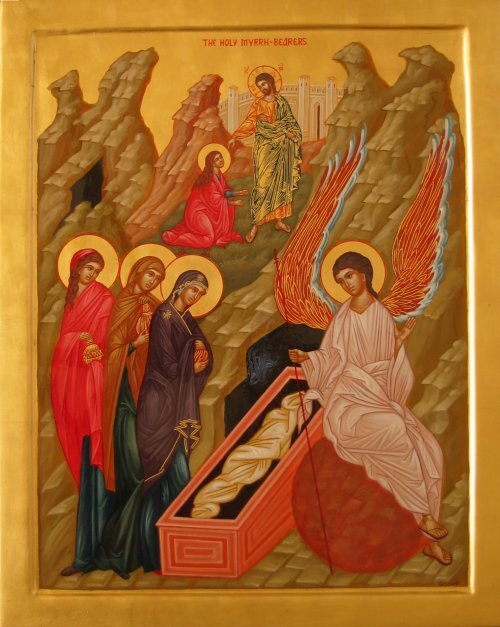
Our Orthodox cousins also remember the myrrh-bearing women with a long tradition of iconography, sacred art that is used as an invitation to prayer and reflection. Perhaps you have seen the icons. Mary Magdalene, Mary the mother of James, and Salome are depicted at the tomb. The holy messenger in dazzling white points to the empty graveclothes, proclaiming that Jesus has risen. The women, with heads covered and flowing robes, carry ceramic flasks of oil. Their faces are wide-eyed with fear and lined with tears. One of the women is often painted with her back to the angel, as if poised to run. She looks back over her shoulder, torn between learning what has happened to Jesus and succumbing to holy terror.

After the sabbath, when the myrrh-bearers rose early, purchased spices, and walked to the tomb, they were well-acquainted with death. In first-century Israel, tending the dead was women’s work. It fell to women to prepare bodies for the grave: washing, anointing with oil, and wrapping in a simple linen shroud. For three days, women accompanied the body, walking to the tomb each morning, singing psalms, and sharing tears and cries of mourning. The myrrh-bearers had buried many people and tended many bodies: elderly parents, aged husbands, dear friends, solitary neighbors, and in a world where only one in five children lived to adulthood, they had buried children, many children.

Jesus warned the disciples that death waited in the Holy City. But the week before the women had rejoiced and danced into Jerusalem. Filled with hope, they sang and played their drums, waved palm branches and rejoiced to be in the company of the Messiah. That week the city turned hostile, even murderous.  On the night of the Passover, the women saw Jesus betrayed, abandoned, and led off like a lamb to the slaughter. On Friday, the women followed their bloody, broken Lord as he stumbled beneath the terrible burden of the cross. From a distance, they watched while soldiers gambled and the mob taunted and mocked. As the sun failed and darkness covered the land, they saw Jesus surrender his spirit. As the day grew late and the sabbath neared, two of the women followed Joseph of Arimathea.  They watched him claim the body, wrap it in linen, and hastily stow it in a rock-hewn tomb. All through the Sabbath, the women sat with their grief and loss. They weren’t sure who they were anymore, what their purpose was, or how they could go on. But as the rosy promise of a new week crept above the eastern horizon, they found the courage to do what women always did when a beloved one died. They purchased their burial spices and anointing oil and walked to the tomb.

/

We are not myrrh-bearers in the traditional sense of the word. We leave it to the mortuary or the crematorium to tend to the bodies of our dead. Yet we are not strangers to death. We know what it is like to walk to the tomb, to face squarely our loss and pain, our disbelief and defeat. We know the untimely death of our beloved ones. We know the death of our endeavors: the marriage that flounders and fails; the business that goes under; the degree we never finish. We know the death of friendships and kinships: the forgiveness we never extend, the trust that is betrayed, the selfish interest that drives home the killing wedge. We know death writ large upon the world stage: our planet groaning beneath the burden of our abuse, the blood of Palestinians and Israelis crying from the ground of a broken land, the lament of refugees longing for welcome and home. In the dark hours before dawn, we know how the myrrh-bearers felt. We know the unbearable grief. We may even wonder who we are, what our purpose is, or how we can go on.

/

When the women arrived at the tomb, the stone was rolled back. They hesitated in fear outside, each too frightened to go in alone, and so they decide to venture in together, a fearful little band bound by their love for Jesus and their common duty as myrrh-bearers. Mary Magdalene, Mary the Mother of James, and Salome entered the tomb, anticipating death. But there in the cold stone crypt, still smelling of blood and suffering, the women were shocked to find life. A holy messenger shared the good news that God could take all the evil of their world and work from it a miracle of life.

In the hours before dawn, as the earth rolled on to meet the morning and the last stars faded from the western sky, Jesus rose. He stretched and stood, testing his bruised body.  He stepped out of the tomb and into the garden, breathing deep the cool of the dying night. God’s amazing love had broken the power of sin and death. 

Mary Magdalene whispered, “Jesus is alive,”

Mary the mother of James gasped, “Jesus has been raised, just as he promised.”

Salome dared to hope, “Jesus has gone ahead to Galilee. We’ll see him there.”

/

On Easter morning, we dare to imagine that if God can raise Jesus from dead, then surely there is hope for us and all the ways that we are well-acquainted with death. We can trust that, just as God was at work to overcome the world’s sin and hate to raise Jesus, God is at work even now to help and to heal, to raise up the promise of new life.

Yes, we know the grief that comes with the death of our beloved ones, but we also trust that we are raised with Christ. The promise of the life everlasting and the heavenly shore awaits. Rise up!

Yes, we are well-acquainted with failure, but God is faithful and a new day dawns. One day we may love again, or find fresh purpose, or hear the knock of opportunity. Rise up!

Yes, we know the death of friendship and kinship, but if God can win the victory over sin, then maybe with the Lord’s assistance we can pick up the phone or write that letter or ask for help. Rise up!

Yes, we know global death and destruction, but if Jesus is raised, then maybe there is hope for our world yet. We can learn to tread lightly on God’s good earth. Peace can break out in the midst of war. The homeless poor can find home at last. Rise up!

We are well-acquainted with death, but on Easter morning, we join the myrrh-bearers, with great hope and holy fear, for with God the last word is always life.

/

Mary Magdalene, Mary the mother of James, and Salome came to the tomb in the traditional women’s role of myrrh-bearer; yet, they soon had a new vocation. Commissioned by God to be the first gospel-bearers, they rose up. They dropped their flasks of oil, lifted their skirts, and fled back into Jerusalem. Somewhere along the way, they overcame their fear and found their voices. They shared their good news with Peter and the disciples, saying, “Death does not have the last word. God has won the victory! Jesus is risen!”

/

I suspect that our cousins in the Orthodox tradition are right. Those myrrh-bearers are worthy of our gratitude and remembrance on at least one Sunday a year. They may even have something to teach us. If three women can overcome their fear to rise up and launch a tidal wave of hope and love that laps the shores of today, then think what we can do. We may be well-acquainted with death, but oh the life, sweet life! Let’s trade our myrrh for the gospel, my friends. There is good news to share. Rise up!

Resources

C. Clifton Black. “Commentary on Mark 16:1-8,” in Preaching This Week (Narrative Lectionary), March 27, 2016. Accessed online at Commentary on Mark 16:1-8 – Working Preacher from Luther Seminary

Greek Orthodox Diocese of America. “Learn: Sunday of The Myrrhbearers.” Accessed online at https://www.goarch.org/myrrhbearers-learn

Kaufman Kohler. “Burial” in Jewish Encyclopedia. Accessed online at https://www.jewishencyclopedia.com/articles/3842-burial#anchor6.

Nelson Rivera. “Theological Perspective on Mark 16:1-8” in Feasting on the Gospels: Mark. Louisville: Westminster John Knox Press, 2014.

John Sanidopolous. “Sunday of the Myrrhbearers Resource Page,” Orthodox Christianity: Then and Now, April 30, 2017. Accessed online at https://www.johnsanidopoulos.com/2017/04/sunday-of-myrrhbearing-women-resource.html

Oliver Yarbrough. “Homiletical Perspective on Mark 16:1-8” in Feasting on the Gospels: Mark. Louisville: Westminster John Knox Press, 2014.


Mark 16:1-8

16When the sabbath was over, Mary Magdalene, and Mary the mother of James, and Salome bought spices, so that they might go and anoint him. 2And very early on the first day of the week, when the sun had risen, they went to the tomb. 3They had been saying to one another, “Who will roll away the stone for us from the entrance to the tomb?” 4When they looked up, they saw that the stone, which was very large, had already been rolled back. 5As they entered the tomb, they saw a young man, dressed in a white robe, sitting on the right side; and they were alarmed. 6But he said to them, “Do not be alarmed; you are looking for Jesus of Nazareth, who was crucified. He has been raised; he is not here. Look, there is the place they laid him. 7But go, tell his disciples and Peter that he is going ahead of you to Galilee; there you will see him, just as he told you.” 8So they went out and fled from the tomb, for terror and amazement had seized them; and they said nothing to anyone, for they were afraid.


“The Holy Myrrh-bearers.” Accessed online at https://www.allsaintstoronto.ca/services-events/soo-gdthh-2ptfc-lng35-c8gjx-xaf3p

Extravagant Love

Sabbath Day Thoughts — “Extravagant Love” Mark 11:1-11, 14:3-9

There are many ways to express love. In Japan, where public displays of affection are frowned upon, you might show your love for your husband by preparing an elaborate lunch and carefully packing it into a bento box to be unpacked later in the break room at work. In Fiji, if you are looking to make a special connection with your father-in-law or seek the forgiveness of someone whom you have wronged, then you would present them with the gift of a tabua—the ivory tooth of a sperm whale. In India, your love for someone and your hope that they might have good health and longevity is expressed in fasting on their behalf. In Alaska, the Tlingit people say that you know someone really loves you when they bring you dried fish.

We have our own ways of expressing love. When someone takes the time to learn our best-loved recipes and cook our favorite meal, we know we are loved. When a doting grandma plies her knitting needles or handpieces a quilt for us, we know we are loved. When a devoted dad spends hours teaching us how to play catch, build models, or tackle quadratic equations, we know we are loved. When someone proposes to us on the jumbotron at Yankee stadium in front of all those baseball fans, we know we are loved.

I suspect each of us has warm memories of feeling specially loved. Those loving moments can bring a smile to our worst day or feel like a lighthouse, guiding us through a storm. Love expressed at the right time, in the right way, may be just what we need to persevere and prevail over the hardship and sorrow that touch every life.

Our reading from Mark’s gospel describes a remarkable and timely act of love.

Jesus and his friends came to Jerusalem to celebrate Passover. The week began with a parade. On Palm Sunday, Jesus, humble and riding on a donkey like the long-promised Prince of Peace (Zech 9:9), traveled up to the Holy City. The pilgrims that surrounded Jesus celebrated, rejoicing with psalms of praise and waving palm branches as if Jesus were one of the Maccabees, newly returned from vanquishing their enemies. They spread their cloaks upon the road, like Israel’s old-time generals pledging allegiance to the new king.

But that week, Jesus would be plagued by the challenge and critique of powerful enemies. Scribes and Pharisees, chief priests and elders, all did their best to discredit and shame Jesus in front of the crowds that seemed to love him so. Soon the city’s mood would turn murderous. Soon his opponents would plot his death. As the week drew to a close, there would be another parade. Jesus, broken and bloodied, would drag a crossbeam through the streets of Jerusalem to his execution. The fans who had welcomed him with pleas of “Hosanna! Save us!” would utterly reject him, shouting “Crucify him!”

Between the Palm Sunday and Good Friday parades, a beautiful thing happened. As Jesus and his friends dined at the house of Simon the Leper in Bethany, their dinner party was interrupted by an uninvited guest: an unnamed woman. She broke open an alabaster jar and poured anointing oil on Jesus. The spikenard was pressed from plants that grew in the foothills of the Himalayas. It had been transported 4,000 miles overland by caravan to Israel. So valuable was this oil that a laborer would need to work 300 days to cover the expense. In today’s economy, where a day laborer might earn $15 an hour, the oil would cost $36,000. Poured out in a single, wildly generous stream, the oil flowed down upon Jesus’ head and over the collar of his robe. The conversation fell silent as the room filled with the sweet fragrance of unimaginable love and generosity.

In first-century Israel, anointing with oil was a gesture of love. In welcoming a guest, a host would offer water for the washing of hands and feet and a few drops of oil to bless the head. In the history of Israel, anointing with oil was a sign of God’s love and blessing for a chosen ruler. When the Prophet Samuel laid eyes on David, he broke out the anointing oil and poured it out on the boy who would one day be king. And, as Jesus indicated, oil was used to anoint the body of a beloved one, purifying and preparing the dead for the grave.

Mark tells us that the men who broke bread with Jesus were outraged by the woman’s action. Indeed, they scolded and shamed her like a bad child or a simpleton. But I suspect that their anger flared less from any genuine concern for the poor and more from the realization that she had done without a single word what they had not. She acted as host, extending a courtesy that Simon the Leper failed to practice. She took on the historically male role of prophet and proclaimed Jesus the Messiah. And she named the elephant in the room: the week would end in death. In the verses leading up to this story, Jesus’ enemies plotted his arrest and execution. In the verses following this story, Judas would accept a bribe to bring about betrayal. In three days, in the time of crisis, not one of the men reclining around the dinner table would come to Jesus’ defense.

Jesus came to the woman’s defense. He spends four verses praising the appropriateness and the timeliness of what she did. Jesus knew the dark truth that he’d soon be hanging from a cross. As the precious oil flowed down, I imagine that Jesus felt extravagantly loved. Like a Japanese husband opening his carefully packed lunchbox. Like a Tlingit person, feasting on the gift of dried fish. Like a child wrapped in Grammy’s homemade quilt. In the darkness of that night, Jesus might have felt as if the sun were shining on him.  Perhaps it was the last time in his earthly life that Jesus felt truly loved—special, safe, treasured, appreciated, and understood.

We instinctively know that there is nothing better than extravagant love.  We seize it in the moment and wrap it around us like a fiery mantle of glory.  We hold it in our hearts as a remedy for the days when we are bullied at school or our best friend decides they’re not going to talk to us anymore or the boss is expecting the impossible or the nightly news leaves us shaking in our boots. Extravagant love is our lifeline in a world where folks want to set limits and attach strings, like the dinner guests buzzing like a nest of angry hornets about the foolishness and waste of what the woman did for Jesus.

Our world tends to limit love, to mete it out in tablespoons, to reserve it for those who “earn” it or “deserve” it, to lavish it upon the successful and the popular and the beautiful. But the unnamed woman with her alabaster jar of costly nard reminds us that God doesn’t work that way. Jesus didn’t work that way.  Jesus lavished his love upon six-year-olds and sinners.  He poured out his love upon unnamed women and Judas.  He lavished his love upon the blind and lame, the deaf and demented, the paralyzed and possessed.  Jesus poured out his life in extravagant love for you and for me.  Jesus taught us that our highest and only calling in life is to love God and neighbor and self with all that we have and all that we are. 

When we get right down to it, the woman with the alabaster jar knew, Jesus knew, we know that our essential calling is to love extravagantly.  It’s only our brokenness that makes us want to turn away from the invitation to love.  It’s only our sinfulness that prompts us to attach the strings, break out the tape measure, turn a harsh eye of judgment to the world around us, and debate who is really worthy of our generous and loving intent. But we, my friends, are called to love without counting the cost.

The woman with the alabaster jar disappears from the pages of scripture. We never see or hear from her again. Although all four gospels report that a woman anointed Jesus, they don’t agree upon who she was or why she did it or even what part of his body got anointed. Was it the head or was it the feet? But we remember her and the rightness and timeliness of her love. I like to imagine that after she left the home of Simon the Leper, with cheeks flushed by the shame heaped upon her by the men, she shook off the criticism. She held in her heart the words of Jesus. She knew that she had done a beautiful thing. Later, she imagined that as Jesus hung upon the cross, he held onto her love, that it guided him like a lighthouse through the storm, like a lifeline amid the pain and unfathomable sorrow. She continued to love with body, mind, spirit, and every last denarii, despite what the critics had to say.

Let us love extravagantly.

Resources:

Jouette Basler. “Exegetical Perspective on Mark 14:3-9” in Feasting on the Gospels: Mark. Louisville: Westminster John Knox Press, 2014.

Paul S. Berge, “Commentary on Mark 11:1-11, 14:3-9” in Preaching This Week: Narrative Lectionary, April 1, 2012. Accessed online at Commentary on Mark 11:1-10, Mark 14:3-11  – Working Preacher from Luther Seminary

C. Clifton Black. “Commentary on Mark 11:1-11, 14:3-9” in Preaching This Week: Narrative Lectionary, March 20, 2016. Accessed online at Commentary on Mark 11:1-11 or Mark 14:3-9 – Working Preacher from Luther Seminary

Thomas Currie. “Theological Perspective on Mark 14:3-9” in Feasting on the Gospels: Mark. Louisville: Westminster John Knox Press, 2014.

Carmen Nanko-Fernandez. “Pastoral Perspective on Mark 14:3-9” in Feasting on the Gospels: Mark. Louisville: Westminster John Knox Press, 2014.

Editorial Team. “Exploring Affection: How Different Cultures Show Love” in Better Help, March 21, 2024.


Mark 11:1-11, 14:3-9

11When they were approaching Jerusalem, at Bethphage and Bethany, near the Mount of Olives, he sent two of his disciples 2and said to them, “Go into the village ahead of you, and immediately as you enter it, you will find tied there a colt that has never been ridden; untie it and bring it. 3If anyone says to you, ‘Why are you doing this?’ just say this, ‘The Lord needs it and will send it back here immediately.’” 4They went away and found a colt tied near a door, outside in the street. As they were untying it, 5some of the bystanders said to them, “What are you doing, untying the colt?” 6They told them what Jesus had said; and they allowed them to take it. 7Then they brought the colt to Jesus and threw their cloaks on it; and he sat on it. 8Many people spread their cloaks on the road, and others spread leafy branches that they had cut in the fields. 9Then those who went ahead and those who followed were shouting,

“Hosanna!Blessed is the one who comes in the name of the Lord!
10Blessed is the coming kingdom of our ancestor David!
Hosanna in the highest heaven!”

11Then he entered Jerusalem and went into the temple; and when he had looked around at everything, as it was already late, he went out to Bethany with the twelve.

3While he was at Bethany in the house of Simon the leper, as he sat at the table, a woman came with an alabaster jar of very costly ointment of nard, and she broke open the jar and poured the ointment on his head. 4But some were there who said to one another in anger, “Why was the ointment wasted in this way? 5For this ointment could have been sold for more than three hundred denarii, and the money given to the poor.” And they scolded her. 6But Jesus said, “Let her alone; why do you trouble her? She has performed a good service for me. 7For you always have the poor with you, and you can show kindness to them whenever you wish; but you will not always have me. 8She has done what she could; she has anointed my body beforehand for its burial. 9Truly I tell you, wherever the good news is proclaimed in the whole world, what she has done will be told in remembrance of her.”


Photo by eberhard grossgasteiger on Pexels.com

“Ahead of Us”

Sabbah Day Thoughts — Matthew 28:1-10 “Ahead of Us”

Lupe Gonzalo rises at four or five in the morning. She piles into the back of a truck with other farmworkers and is driven to Florida fields in need of harvest. There, she is given a bucket and told to fill it with tomatoes or strawberries or beans as many times as she can during the course of a long day of backbreaking labor. Some days, there are no bathroom breaks, no lunchbreaks, no water breaks. “That’s your job,” Lupe says, “That’s what you’re there to do.” For women, like Lupe, the work carries worse problems than hunger and thirst. Sexual harassment and sexual violence are common—and speaking out about your experience can cost you your job. It feels hopeless.

Manuel Nazario and his people the Weenhayek have fished for a living for longer than anyone can remember. They ply the banks of the Pilcomayo River that rises in the foothills of the Andes in rural Bolivia. They wade in the water and cast nets, just as their ancestors did before them.  But these days when he casts his net, Manuel worries. Climate change, irregular rainfall, drought, and runoff from mining operations in the mountains have troubled the waters. His catch is far less plentiful than it once was, and it only seems to be getting worse. He wonders how he will feed the twenty-seven residents of his village, who depend on him for leadership. He feels powerless.

Smitha Krishnan a Dalit—an untouchable—woman, was accustomed to a life lived on the margins of Indian society. As part of the lowest social class, she was unable to draw water from the common well, prevented from attending school, and forbidden from entering temples. Then her husband died, just before the last tsunami. Then, when the storm came, her thatch and mud house, with everything in it, was swept away, including the sewing machine that she used to earn a living as a seamstress. Widowed and homeless with five children to care for, Smitha despairs.

As Mary Magdalene and the other Mary walked to the tomb in the darkness before dawn, they knew how it feels to be hopeless, powerless, and filled with despair. They had accompanied Jesus to Jerusalem for the Passover. Earlier that week, their beloved friend had been welcomed like a conquering hero, with the singing of psalms, waving of palms, and the spreading of cloaks along the way. But with each passing day, tension had mounted. Powerful enemies had emerged among the Pharisees, scribes, and priests. They challenged Jesus’ authority and feared his charismatic appeal to the people. Betrayal had come from within their ranks, as a trusted friend traded his loyalty for thirty pieces of silver. In a trial orchestrated under the cover of darkness, Jesus had been falsely accused, condemned, and turned over to the Romans for execution. At the judgment hall of Pilate, the same crowd that had welcomed Jesus rejected him, shouting for his blood.

On Friday, the Marys watched as the one they had hoped would redeem Israel was beaten, scourged, spat upon, mocked, and marched through the city streets to his brutal death, flanked by criminals. The women knew all about hopelessness, powerlessness, and despair. Even so, on Sunday morning, before the sun had risen in the east, they found the courage to offer a final kindness. In Matthew’s telling of this story, there are no anointing oils or burial spices. Just two women, vulnerable and alone, who came to the grave to hold vigil, to weep and lift their voices in the wailing cry of grief.

We know how it feels to be hopeless, powerless, and despairing.  Those feelings find us when we stand at the grave of our beloved.  They leave us weeping over unforgiving hearts and broken relationships. They find us as we contend with mental illness.  They trouble us as inflation surges and we worry about money. They keep us up at night when we ponder the future of our warming planet, and they rob us of peace as we read of the seemingly unending cycle of gun violence.  Some days, it feels like the pain and suffering, the cruelty and greed of our world are more than a match for us. Some days, we feel like the two Marys. Some days, we feel like Lupe Gonzalo, Manuel Nazario, and Smitha Krishnan.

At the tomb, the two Mary learned that hopelessness, powerlessness, and despair are no match for God. The earth shook, the stone rolled away, the guards fainted, and an angel, flashing like lightning in the half-light of dawn, told them a mystery. God’s love had won the victory over sin and death. Jesus lived, and even now he was going on ahead of them to Galilee. There was work to do—good news to share. Then, like a big exclamation point on the angel’s astounding words, there was Jesus! He filled them with joy, quelled their fear, and sent them forth as the first apostles with the assurance that he would be with them, just a step ahead, waiting for them in a world where death no longer had the last word.

Matthew likes to remind us that Jesus is with us.  In Matthew’s gospel a holy messenger warms the cold feet of the reluctant Joseph by telling him that Mary’s baby will be Emmanuel, God with us. In Matthew’s gospel, Jesus assured his friends that wherever even two of them gathered in his name, he would be there. In the last parable that Matthew recorded, the Lord told his friends that wherever they encountered people who were hungry or thirsty, sick or in need or imprisoned, he would be there, too. Jesus lives, at our side, in our midst, a step ahead.

As the women ran with fear and joy through the streets of the waking city with news that would forever change the world, they trusted that Jesus was with them. If they had any doubts, if their hopelessness or powerlessness or despair threatened their mission, those feelings were swept aside in the Galilee when Jesus met them and sent them forth to the ends of the earth with good news and great love. Jesus lives. He’s always a step ahead of us. It’s a message that we need now more than ever, as we weep at the grave of untimely death, and lament the brokenness of our relationships, and mourn the future lost to mental illness, and despair over a warming planet and the ubiquitous news of guns in our schools. Yes, there is hopelessness and powerlessness and despair in this world, but there is also Jesus. He walks with us still and calls us to be good news in a world bowed down by the powers of sin and death.

One of the enduring ways that this congregation has followed Jesus amid the world’s hurt and pain is through One Great Hour of Sharing. Whether you saved your change in a fish bank throughout Lent, or you chose to use those offering envelopes, your contributions have brought good news to neighbors in this country and around the world who struggle with those familiar feelings of hopelessness, powerlessness, and despair.

Your offerings allowed Presbyterian Disaster Assistance to work with local partners on the ground in India to help Smitha Krishnan. With our help, Smitha found shelter, a sewing machine, and other essentials. She now lives with her children in a permanent, disaster-resistant home. Smitha says, “Because of gifts to One Great Hour of Sharing, I am able to feed and clothe [my children], and when they get sick, I am able to take care of their medication, too.”

One Great Hour of Sharing also helped Manuel Nazario, that indigenous fisherman in Bolivia. Through a generous grant from Presbyterian Disaster Assistance, Manuel’s people are learning new ways to thrive, despite climate change and environmental degradation. Working with local partners, the Weenhayek people are developing irrigation systems and collecting rainwater. They have seeds and gardening tools. They are learning to grow fruits and vegetables organically and sustainably. With a diversified diet and enough to eat, they no longer depend on the traditional practice of casting their nets to ensure their future.

One Great Hour of Sharing has helped Lupe Gonzalo, too. The Presbyterian Hunger Program partners with farmworkers to ensure that those who bring food to our tables do not go hungry or work in inhumane circumstances. We support the Coalition of Immokalee Workers, a human-rights organization that works to bring safety and justice to the fields where our food is grown. Lupe appreciates our generosity. She says, “For us farmworkers, the support from Presbyterians across the country has meant the world to us . . . we don’t feel like we’re alone . . . we’re walking together.” 

On Easter morning, Jesus, continues to go on ahead of us, my friends, sending us forth to be bearers of good news.  He’s out there still. And when we rise to respond to his calling, there is something Christ-like in us, something that no grave can ever contain. Jesus awaits. Let’s go forth to make this world a little less hopeless, powerless, and filled with despair.

Resources

Greg Carey. “Commentary on Matthew 28:1-10” in Preaching This Week, April 9, 2023. Accessed online at workingpreacher.org.

Melinda Quivik. “Commentary on Matthew 28:1-10” in Preaching This Week, April 20, 2014. Accessed online at workingpreacher.org.

Kathryn Schifferdecker. “The Foundation of Christian Hope” in Dear Working Preacher, April 2, 2023. Accessed online at workingpreacher.org.

David Lose. “Easter Courage” in Dear Working Preacher, April 16, 2014. Accessed online at workingpreacher.org.

–. “A New Day for Farm Workers” in Special Offerings: One Great Hour of Sharing. Accessed online at pcusa.org.

–. “Restoring Dignity to India’s Most Oppressed” in Special Offerings: One Great Hour of Sharing. Accessed online at pcusa.org.


Matthew 28:1-10

28 After the Sabbath, as the first day of the week was dawning, Mary Magdalene and the other Mary went to see the tomb. And suddenly there was a great earthquake, for an angel of the Lord, descending from heaven, came and rolled back the stone and sat on it. His appearance was like lightning and his clothing white as snow. For fear of him the guards shook and became like dead men. But the angel said to the women, “Do not be afraid, for I know that you are looking for Jesus who was crucified. He is not here, for he has been raised, as he said. Come, see the place where he lay. Then go quickly and tell his disciples, ‘He has been raised from the dead, and indeed he is going ahead of you to Galilee; there you will see him.’ This is my message for you.” So they left the tomb quickly with fear and great joy and ran to tell his disciples. Suddenly Jesus met them and said, “Greetings!” And they came to him, took hold of his feet, and worshiped him. 10 Then Jesus said to them, “Do not be afraid; go and tell my brothers and sisters to go to Galilee; there they will see me.”


Photo by Jayce Q on Pexels.com

An Idle Tale

Sabbath Day Thoughts — “An Idle Tale” Luke 24:1-12

I was warned when I first came to Saranac Lake that I should NOT expect a full church on Easter.  At the other three churches that I have served, Easter Sunday is a lot like Christmas Eve with people sitting shoulder-to-shoulder, belting out beloved hymns, and eagerly sharing “Alleluias!”  But Saranac Lake?  Not so much.  Snowbirds have flown south for the winter to stay until May for fear of the dreaded Easter-snow.  The two-week-long school break surrounds Easter, and families weary of winter and sick of mud season leave the North Country in stunning numbers to bask their alabaster flesh in the warm glow of Florida sun.  The past few years have been complicated by COVID, sending us online instead of into the pews to celebrate the resurrection.  On Easter Sunday, many of our friends are missing.

But this Easter, I’ve been thinking about those other people who are NOT in church—the unchurched.  They may be like Brittney, a twenty-something young adult raised in church who never made an adult connection to a local congregation in her new community.  On Easter morning, she is still in her jammies, reading a good book or facetiming with a college friend.  The unchurched may be like Tim and Cindy, once faithful attenders at a Catholic Church until the clergy sexual abuse scandal shattered their trust in the institutional church.  On Easter morning, they sleep in, read the New York Times, and have brunch.  The unchurched may be like Mitchell.  He has only been in church for weddings and funerals, occasions when he feels uncomfortable and out of place.  On Easter morning, he is up early to watch soccer on tv.  He wears the jersey of his favorite team, and from his man cave, his wife and children can hear the shouts of victory and the groans of defeat.  For people like Brittney, Tim and Cindy, and Mitchell, Easter sounds like an idle tale—fantastic, mysterious, and hard to believe.

The women on that first Easter morning were accused of telling an idle tale.  They traveled with Jesus from Galilee to Jerusalem for the Passover.  They hoped that Jesus was the Messiah, the Holy One of Israel.  Many of them had been helped and healed by his miraculous power.  But on Friday they witnessed their rabbi being beaten, abused, and crucified.  They heard his dying words.  They saw the blood and water pour from his side.  They watched while Joseph of Arimathea claimed the body, wrapped it in linen, and laid it in a newly cut tomb.  They retreated to the place where they were staying to prepare the spices and ointments.  They prayed and wept all through the sabbath day. Then, early in the deep dawn, when the sun was just a rosy hint lingering below the horizon, they gathered their precious oils and walked through the streets of the city to offer a final kindness to the man they loved, anointing his body for the grave.

At the tomb, the women expected death.  Afterall, they had seen it with their own eyes.  But something fantastic, mysterious, and hard to believe, awaited them.  The stone was rolled away. The body was gone. While they inspected the grave, bowed down with grief and confusion, holy messengers burst in upon them, reminding them of Jesus’ promise of resurrection and challenging them with the question “Why do you look for the one who lives among the dead?” 

Amid the women’s puzzlement and grief, a certainty began to glow like a spark rising from the ashes: Jesus is alive.  In the mixed joy and terror of that belief, they ran through the streets of the waking city and burst into the room where the disciples were still rubbing sleep from their eyes.  All of them began to speak their truth at once, voices rising and falling, alleluias ringing, tears flowing, “The Lord is risen!  He is risen indeed!”

Perhaps we can forgive the disciples for presuming that what the women had to say was an “idle tale,” stuff and nonsense, a fevered delirium.  After all, the men had just woken up.  And they lived in a world where what women had to say couldn’t be admitted as evidence in a court of law.  And according to Luke, there were a lot of women saying the same wild stuff: Mary Magdalene, Joanna, Mary the mother of James, and all those other women who had loved Jesus, provided for him from their purses, and traveled with him throughout his ministry.  All that joy, excitement, and hope that flooded in upon the disciples’ grief and shame made no sense whatsoever.  So, the men failed to remember what Jesus had promised and they refused to believe.  They hushed the women and went back to their dark thoughts and bleak world.

Even if we think that the disciples were embarrassingly clueless on that first Easter morning, we get it.  We expect death.  We have buried our parents and our dear friends.  Sometimes on a day when the world turns black, we bury a child.  We know the death of relationships.  Marriages grow cold.  Friendships end in nonsensical arguments.  Neighbors disconnect over perceived slights or differences of political opinion.  We know the death of opportunity.  The promotion never comes.  The degree is never earned.  The pink slip arrives when we’re too old to start over.  We know death writ large on the world stage. Russia invades Ukraine. Our wild world fails with mass extinction. Hunger walks the land in Yemen, Sudan, and Afghanistan.  We expect death, preoccupied by our dark thoughts and bleak world.  On some days, we can be just as resistant as the disciples to the truth that the women spoke, all those years ago.

On Easter morning, an empty tomb, two holy messengers, and a group of faithful women dare to tell us that death does not have the final word. Don’t get me wrong.  Death is real.  Pain is fierce.  Loss can be overwhelming.  Some days, we are bowed down to the ground in grief.  Yet, God in a lonely tomb in the pre-dawn dark of Easter morning broke the power of sin and death. All the evil, grief, and sin of this world cannot keep Jesus down. Love wins the day.  Jesus rises.  The tomb is empty. God brings life out of death and reconciliation out of division.  New beginnings spring from impossible endings.   It is fantastic, mysterious, and on some days, hard to believe.  But that’s what God does. Alleluia!

That news is so good that it can be mistaken for an idle tale.  But the truth is proven in the living. When we join those women in saying “Yes!” to what God has done in Jesus, we find the possibility of new life.  We are changed, just as the women were changed.  We rise up with the courage to live with love and reconciliation in a broken and dying world.  We move beyond our grief.  We reach out a hand in forgiveness. We ask to be forgiven.  We make a fresh start.  We call for peace. We care for the planet.  We feed the hungry.  We become hope for the hopeless and food for the hungry of heart.  The world is waiting for an Easter transformation. That can only take shape if we dare to speak our truth to those who may dismiss us as bearers of idle tales.

So, let’s do it.  Let’s reach out to the Brittney’s we know, those twenty-somethings who haven’t been back to church since they left home. Let’s remind them of the love, connection, and encouragement that are such a special part of being a church family. 

Let’s reach out to friends like Tim and Cindy, alienated by the sexual misconduct of those who had been entrusted with their spiritual care.  Let’s remind them that God’s heart breaks along with theirs and there are other churches where the love of God is practiced sincerely in word and deed. 

Let’s reach out to the Mitchells of this world.  They may never feel comfortable coming to church, but they may see Jesus.  Every time we share the love of Christ with fresh produce for the Food Pantry, shallow wells for Africa, or a prayer shawl in a time of crisis, we bear a quiet and powerful witness to the transforming, unstoppable love of God and the truth of Easter.  Someday, people like Mitchell might even be a little like the disciple Peter.  They could turn off the Sunday morning sports and venture forth to see for themselves, to look at the evidence and be amazed, even if they aren’t yet willing to accept the truth.

We’ve got a tale to tell, my friends.  Some call it idle, but we know better.  What are we waiting for?  Next Easter, we might just have a few more people in the pews.  Alleluia!


Resources:

Lucy Lind Hogan. “Commentary on Luke 24:1-12” in Preaching This Week, April 17, 2022. Accessed online at https://www.workingpreacher.org/commentaries/revised-common-lectionary/resurrection-of-our-lord-3/commentary-on-luke-241-12-9

Holly Hearon. “Commentary on Luke 24:1-12” in Preaching This Week, April 20, 2019. Accessed online at https://www.workingpreacher.org/commentaries/revised-common-lectionary/resurrection-of-our-lord-3/commentary-on-luke-241-12-6

Michael Joseph Brown. “Commentary on Luke 24:1-12” in Preaching This Week, March 26, 2016. Accessed online at https://www.workingpreacher.org/commentaries/revised-common-lectionary/vigil-of-easter-2/commentary-on-luke-241-12-4

Arland Hultgren. “Commentary on Luke 24:1-12” in Preaching This Week, March 31, 2013. Accessed online at https://www.workingpreacher.org/commentaries/revised-common-lectionary/resurrection-of-our-lord-3/commentary-on-luke-241-12-3

Craig R. Koester. “Commentary on Luke 24:1-12” in Preaching This Week, April 4, 2010. Accessed online at https://www.workingpreacher.org/commentaries/revised-common-lectionary/resurrection-of-our-lord-3/commentary-on-luke-241-12-2


Luke 24:1-12

But on the first day of the week, at early dawn, they came to the tomb, taking the spices that they had prepared. 2 They found the stone rolled away from the tomb, 3 but when they went in, they did not find the body. 4 While they were perplexed about this, suddenly two men in dazzling clothes stood beside them. 5 The women were terrified and bowed their faces to the ground, but the men said to them, “Why do you look for the living among the dead? He is not here, but has risen. 6 Remember how he told you, while he was still in Galilee, 7 that the Son of Man must be handed over to sinners, and be crucified, and on the third day rise again.” 8 Then they remembered his words, 9 and returning from the tomb, they told all this to the eleven and to all the rest. 10 Now it was Mary Magdalene, Joanna, Mary the mother of James, and the other women with them who told this to the apostles. 11 But these words seemed to them an idle tale, and they did not believe them. 12 But Peter got up and ran to the tomb; stooping and looking in, he saw the linen cloths by themselves; then he went home, amazed at what had happened.