God’s Wide Welcome

Sabbath Day Thoughts — “God’s Wide Welcome” Acts 8:4-8, 12, 14-17

On Thursday, the nation said goodbye to our 39th President, Jimmy Carter. The Carter Family was joined at the National Cathedral in Washington by the five living Presidents and dignitaries from around the world. The former peanut farmer and Navy nuclear engineer had started small, serving on the local school board and in the state legislature before rising to national prominence as the Georgia governor.  When the shadow of Watergate left Americans disillusioned with Washington insiders, we turned to Carter, the deeply ethical outsider, to reorient our political landscape.

The diplomatic highlight of Jimmy Carter’s presidency was his effort to achieve peace between Israel and Egypt. In twelve days of secret negotiations at Camp David in September 1978, Carter met with Israeli Prime Minister Menachim Begin and Egyptian President Anwar Sedat. The terms reached between the two nations, called the Camp David Accords, laid the groundwork for the Egypt-Israel Peace Treaty, which Carter witnessed in Washington the following March. The treaty notably made Egypt the first Arab country to officially recognize Israel. More than forty-five years later, the peace agreement between Egypt and Israel is still in effect.

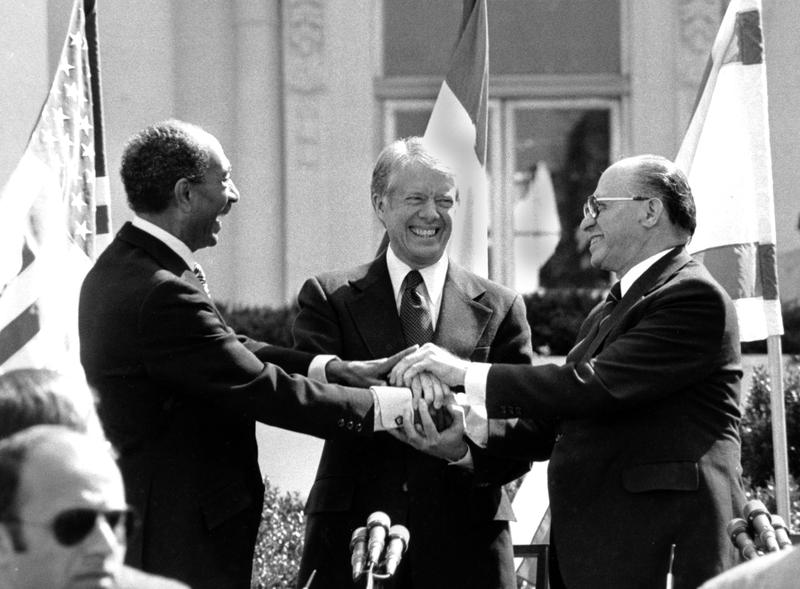
Carter’s initiative in seeking peace was prompted, in part, by his faith. A staunch Christian, Carter saw in Begin and Sadat his brothers, all sons of a common ancestor, the biblical patriarch Abraham. If only their divides could be bridged, the world would be blessed by their kinship, and there would be hope for Middle East peace. Newspapers captured that beautiful promise of peace in a remarkable photo after the signing of the treaty. Begin, Carter, and Sadat stand facing one another, their hands extended to clasp across the circle, kind of like a Little League Team prepping for the big game with a hand sandwich and the cry, “Go team!” The joy on the three men’s faces is still palpable across the years.

When the evangelist Philip went down to Samaria, he may have felt a little like Jimmy Carter trying to bring Arabs and Israelis to the table of peace. When persecution against the early church surged in Jerusalem, Philip and his friends were forced to flee the city and seek another place to share their gospel. By any stretch of the imagination, though, Samaria was an unlikely location to start. Samaritans and Jews had been at odds for centuries. It had started more than a thousand years before when the Hebrew people split into the northern Kingdom of Israel and the southern kingdom of Judah. Samaritans traced their ancestry to the north while Jews looked to south. Both nations worshiped Yahweh and observed the teachings of the Torah, but the Samaritans worshiped God on their holy mountain Gerizim while the Jews believed that God could only be worshiped in the Temple in Jerusalem.

Relations between the neighbors hit a low point during the rule of the Maccabees. In the year 110BCE, the troops of the Jewish King and High Priest John Hyrcanus invaded Samaria, ascended Mt. Gerizim, and destroyed the Samaritan Temple. Later, around the time Jesus was born, Samaritans sneaked into the Jerusalem Temple and scattered human bones, desecrating the space. By the time of Jesus’ ministry, if you wanted to really insult someone, you would call them a Samaritan. That’s what Jesus’ opponents did in John 8:48, saying to the Lord, “You are a Samaritan and have a demon!” That’s some serious biblical trash talk.

Philip the evangelist must have been surprisingly openminded and wildly hopeful to want to test the Samaritan waters. Yet as he shared the good news of God’s love for all people, a love that was revealed in Jesus, something remarkable happened. The Book of Acts tells us that there was healing and joy. The dividing line between Jew and Samaritan vanished. Enemies became friends. Jewish and Samaritan sons and daughters of Abraham, who had long been estranged, found common ground. In the waters of baptism, they became a new sort of family, brothers and sisters, whose eyes had been opened to see that God’s love is big enough to welcome Jews and Samaritans. When the apostles in Jerusalem heard about it, they couldn’t believe it. They had to send Peter and John on a snoop mission to check it out. As the apostles laid hands upon the Samaritans and prayed, the Holy Spirit confirmed that the impossible was true. In Jesus Christ, all divisions had come to an end. Alleluia!

Our world continues to struggle with the sort of deep-seated division that plagued the Jews and Samaritans. We see it on the international stage, where Israeli bombs fall on Gaza and Lebanon, and Hezbollah and Houthi rockets seek to break through Israel’s Iron Dome. We see it in Ukraine, where this week Russian missiles killed at least 13 civilians in the southern city of Zaporizhzhia, and an increasingly beleaguered Ukrainian military lobs longer range rockets into Russia.

We see those deep-seated divisions on our national stage as we characterize one another as red states and blue states, and we have a hard time listening to our differing perspectives. We see it as those who are generational Americans look with suspicion on immigrants, questioning their work ethic, their values, and even their diets.

We have known deep-seated divisions in our personal lives. We like to put a lot of emotional and physical distance between ourselves and those who hurt us. We don’t like to hang out with folks when we find that their core beliefs are different from our own. We tend to avoid those who look different, whether they are covered with a landscape of tattoos or punctuated by multiple piercings, sporting the shaved head and jackboots of the neo-Nazi or wearing the bling-bling of the HipHop gangsta’.

The dividing lines are everywhere. Maintaining them is easy. We don’t have to destroy any sacred sites or scatter any bones to keep the walls up. All we have to do is accept the divisive narrative that is handed to us. All we have to do is harden our hearts and perpetuate the status quo. All we have to do is wash our hands of personal responsibility and forge a world of us and them.

I suspect that the reason that Philip could bridge the divide with the Samaritans was because Jesus did it first. When a Samaritan village refused to welcome Jesus, the disciples implored the Lord to call down fire from heaven to obliterate the community, but Jesus wouldn’t do it. Instead, as we read the gospels, we find Jesus healing a thankful Samaritan leper (Luke 17), offering the water of life to a marginal Samaritan woman (John 4), and shocking everybody by casting the hero of his most beloved parable as a Good Samaritan (Luke 10). Jesus, in his longing to restore the lost sheep of Israel, held out hope for the Samaritans. Perhaps he knew that through a shared trust in him the thousand-year divide between Jew and Samaritan could come to an end. Philip saw that, too. His willingness to step out in the footsteps of Jesus made a world-altering difference.

Jesus is always out ahead of us, my friends, bridging the divides. The question for those of us who call Jesus Lord is, “Do we have the courage to follow him?”

Our scripture reading today suggests that we can. If Philip could go to the Samaritans, if Jimmy Carter could prevail with Israel and Egypt, there is hope for us yet. God’s love is big enough for Jews and Samaritans. God’s love is big enough for Israel and Hezbollah, Russia and Ukraine, red states and blue states, native born and immigrant. God’s love is wide enough to overcome all those deep-seated divisions that mar our own lives. The enemy can become an ally. The differences can be overcome. The hurt can be healed. The stranger may even become a friend. But it won’t happen unless we take the risk: to step out in faith, trusting that Jesus is already there. Are you with Jesus? Are you with me?

At the Carter funeral on Thursday, Steve Ford, the son of former President Gerald Ford, was an unexpected eulogist. Jimmy Carter defeated Gerald Ford in the 1976 presidential election. Their political differences and the outcome of the election should have put an end to the relationship between the two men. It didn’t. In 1981, after Carter’s term in office had ended, Jimmy and Gerald traveled together to attend the funeral of assassinated Egyptian President Anwar Sadat. The two men bonded during the long plane trips, and their professional relationship grew into an enduring friendship. They were both Navy men, had three sons, and a strong faith that Ford was quieter about than Carter was. After that, Jimmy and Gerald spoke regularly, teamed up as co-leaders on dozens of projects, and decided together which events they’d attend and skip in tandem.

The two men made a pact: whoever lived the longest would speak at the other’s funeral. Carter kept his end of the bargain at Ford’s funeral in 2007. On Thursday, from beyond the grave, as Steve Ford read his father’s eulogy for his friend Jimmy, Gerald Ford kept his. Ford spoke about their ability to bridge the divide that once had separated them, saying, “According to a map, it’s a long way between Grand Rapids, Michigan and Plains, Georgia. But distances have a way of vanishing when measured in values rather than miles, and it was because of our shared values that Jimmy and I respected each other as adversaries even before we cherished one another as dear friends.”

May we, too, go forth to follow Jesus, Philip, Jimmy, and Gerald. Let us go forth to bridge those divides.

Resources

Jimmy Carter. The Blood of Abraham. University of Arkansas Press, 1985 (3rd ed. 2007).

Kayla Epstein. “In pictures: Handshakes, smiles and stares as five presidents meet at Carter’s funeral” in BBC News, January 9, 2025. Accessed online at https://www.bbc.com/news/articles/czjdjz3pdd0o.

Calvin Woodward. “Jimmy Carter had little use for the presidents club but formed a friendship for the ages with Ford” in The Associated Press, January 6, 2025. Accessed online at https://www.ap.org/news-highlights/spotlights/2025/jimmy-carter-had-little-use-for-the-presidents-club-but-formed-a-friendship-for-the-ages-with-ford/

Robert W. Wall. “Acts” in The New Interpreter’s Bible, vol. X. Nashville: Abingdon Press, 2002.

Pat McCloskey. “The Rift between Jews and Samaritans” in Ask a Franciscan, May 16, 2020. Accessed online at www.franciscanmedia.org

William Willimon. Acts, Interpretation Bible Commentary. Atlanta: John Knox Press, 1988.


Acts 8:4-8, 12, 14-17

Now those who were scattered went from place to place proclaiming the word. Philip went down to the city of Samaria and proclaimed the Messiah to them. The crowds with one accord listened eagerly to what was said by Philip, hearing and seeing the signs that he did, for unclean spirits, crying with loud shrieks, came out of many who were possessed, and many others who were paralyzed or lame were cured. So there was great joy in that city.

12 But when they believed Philip, who was proclaiming the good news about the kingdom of God and the name of Jesus Christ, they were baptized, both men and women. 

14 Now when the apostles at Jerusalem heard that Samaria had accepted the word of God, they sent Peter and John to them. 15 The two went down and prayed for them that they might receive the Holy Spirit 16 (for as yet the Spirit had not come[c] upon any of them; they had only been baptized in the name of the Lord Jesus). 17 Then Peter and John[d] laid their hands on them, and they received the Holy Spirit.


Photo credit: https://www.britannica.com/event/Camp-David-Accords#/media/1/91061/9162

The Light Shines in the Darkness

Sabbath Day Thoughts — “The Light Shines in the Darkness” John 1:1-18

This is Epiphany Sunday. Things are beginning to look a little less Christmassy around here. The Advent wreath with its Christmas Eve Christ Candle has been returned to its hiding place in the church basement. The wise men have arrived at the nativity set, but this week, they, along with the shepherd, Mary, Joseph, and the baby Jesus, will be wrapped up and boxed away. This is the last Sunday for our poinsettia tree in front of the Lord’s Table, so if you would like to take a plant out to bless someone in need of a little extra love, please do. Soon, the sanctuary greens will come down and the gingerbread houses in the Great Hall will be destined for the trash.

Our Christmas clean-ups are underway at home, too. All the company has gone. Lights and ornaments are being stripped from trees. Mom’s recipe for Christmas trifle has returned to the file box. Those Christmas gifts that didn’t quite fit have been returned or exchanged. The inflatable Santa has gone flaccid on the front lawn. It always feels a little sad, overfed, and wistful as we let go of that most festive of seasons and settle into the long winter’s darkness.

Our gospel reading this morning, also turns away from Christmas. We leave behind the birth stories that launch Matthew and Luke. Instead, we hear the first words of John, who makes an unusual beginning to his gospel. The Bible scholars refer to this morning’s reading as a prologue, a song, or a poem. No matter what you call it, John is definitely different. We meet Jesus, not as a holy infant so tender and mild, but as the eternal Word of God, wrapped in flesh, sent into the world to be life and light for all people.

John’s words sound mystical and magical to us, but John’s first century listeners would have felt at home with the gospel writer’s poetic flight of fancy. For Gentiles, John’s first words “In the beginning” (en Arche) would have spoken to the Greek philosophical belief that an organizing principle or word was the clue that held the universe together. For the Jews, John’s first words, “In the beginning” would have evoked the very first words of the Torah, Genesis 1:1, “In the beginning God created the heavens and the earth.” Gail O’Day, who wrote the book on John for the New Interpreter’s Bible, argues that today’s reading is John’s act of Midrash, a rabbinic teaching that casts the coming of Jesus as a continuation of God’s great work of creation.

It makes sense. In Genesis 1:3-5, God’s begins creation with the words, “Let there be light.” Then, God sees that the light is good and separates the light from the darkness. Centuries after the Torah was compiled, John casts Jesus as that creative Word and original light, saying, “What has come into being in him was life, and the life was the light of all people. The light shines in the darkness, and the darkness did not overtake it.” John’s midrash twist on the creation is that in Jesus, who is the Word, God chose to become flesh and enter into the darkness of our world.

There was plenty of darkness in John’s day. John’s homeland was an occupied territory, a vassal state of the Roman Empire. Most people lived in poverty while contending with imperial taxes. A failed crop meant hunger or even a turn as a debt slave. Illness and disability were often untreatable and could leave you labeled as “unclean” and unwelcome in the synagogue or Temple. Even the religious life of the people had become oppressive, with Temple taxes to pay and Roman appointed elite priests running the show. John’s community was so persecuted that they were forced to flee Israel for sanctuary on the far side of the Mediterranean, in what is now western Turkie.

We are no strangers to darkness. We know the darkness of violence: the interminable war in Ukraine and the ongoing slaughter of Gaza; the unthinkable acts of New Year’s terror in New Orleans and Las Vegas; women who are not safe in their homes and children who are bullied at school.  

We know the darkness of poverty and income inequality: children who depend on school lunches for their only hot meal of the day, two-income families who still cannot make ends meet, households that depend upon the Food Pantry or Grace Pantry, neighbors bankrupted by surgery or a lengthy stay in the hospital.

We know personal darkness: the grief that weighs us down, the family members who are estranged, the illness we can’t shake, the addiction that plagues us or our beloved ones. We feel alone in the dark, far from help and far from God.

The late Rev. Bob Woods once shared a story about a long-ago family road trip to Carlsbad Caverns National Park in New Mexico when his son and daughter were quite young. If you haven’t been there, the caverns are hidden beneath the Chihuahuan Desert, where more than 119 caves were formed when sulfuric acid dissolved the limestone. The caverns are spectacular, eerie, and populated by about 400,000 bats. Down into the caverns, the Woods family walked, guided by a park ranger. At the deepest point, the ranger turned off the light to demonstrate just how dark darkness can be. The little boy began to cry, frightened by the darkness, but his sister comforted him, “Don’t cry. Someone here knows how to turn the lights on.” The little boy felt better, the lights came back on, and the tour continued.

John’s poetic start to his gospel is a lot like those words of encouragement that the big sister spoke to her frightened little brother. Not only does someone know how to turn on the lights, someone has. Jesus has entered our world to shine light in the darkness. Jesus, the Word become flesh, reminds us that we can face the darkness because God is in it with us, shining light that can sustain us, shining light that cannot be overcome. Thanks be to God.

On this second Sunday after Christmas, we who have received Jesus, who trust in his name, who have become children of God, we have a mission. In Jesus, light shines in the darkness, and we are called to be bearers of that light. We are called to reach out to a world that waits in darkness with the good news that we are not alone and darkness does not have the final word.

If we are looking to shine light in the world’s darkness, we have come to the right place. When we bring our food offerings to the pack basket at the side entrance, lace up our sneakers for the CROP Walk, and collect cans of soup and dollars for the Souper Bowl of Caring, light shines in the darkness.

When we grow fresh, healthy produce in our Jubilee Garden, host a free farm stand at the food pantry, and bless our neighbors with bouquets of beautiful flowers, light shines in the darkness.

When we welcome children, teach Sunday School, host Parent’s Night Out, or have fun with the Youth Group, light shines in the darkness.

When we welcome refugees, visit folks who are homebound, and bless neighbors in crisis with the deacons’ fund, light shines in the darkness.

We shine light, trusting that God is more than a match for this world’s darkness.

This week, our Christmas clean-up will continue. Even those of us who wish we could keep the tree forever will be forced by the scourge of falling needles to give it the old heave-ho. We’ll clean out the refrigerator, parting with the last vestiges of our holiday feasts. We’ll step on the scale and decide that we really should try a little New Years restraint. We’ll say goodbye to Christmas, at least for now. But let’s hold on to the light. Shine, my friends, shine.

Resources

Karyn Wiseman. “Commentary on John 1:1-18” in Preaching This Week, Jan. 5, 2014. Accessed online at https://www.workingpreacher.org/commentaries/revised-common-lectionary/second-sunday-of-christmas/commentary-on-john-11-9-10-18-4

Cornelius Platinga. “Theological Perspective on John 1:1-18” in Feasting on the Gospels: John vol. 1. Westminster John Knox Press, 2015.

Philip D. Jamieson. “Pastoral Perspective on John 1:1-18” in Feasting on the Gospels: John vol. 1. Westminster John Knox Press, 2015.

Gail R. O’Day. “Exegetical Perspective on John 1:1-18” in Feasting on the Gospels: John vol. 1. Westminster John Knox Press, 2015.


John 1:1-18

In the beginning was the Word, and the Word was with God, and the Word was God. He was in the beginning with God. All things came into being through him, and without him not one thing came into being. What has come into being in him was life, and the life was the light of all people. The light shines in the darkness, and the darkness did not overtake it.

There was a man sent from God whose name was John. He came as a witness to testify to the light, so that all might believe through him. He himself was not the light, but he came to testify to the light. The true light, which enlightens everyone, was coming into the world.

10 He was in the world, and the world came into being through him, yet the world did not know him. 11 He came to what was his own, and his own people did not accept him. 12 But to all who received him, who believed in his name, he gave power to become children of God, 13 who were born, not of blood or of the will of the flesh or of the will of man, but of God.

14 And the Word became flesh and lived among us, and we have seen his glory, the glory as of a father’s only son, full of grace and truth. 15 (John testified to him and cried out, “This was he of whom I said, ‘He who comes after me ranks ahead of me because he was before me.’”) 16 From his fullness we have all received, grace upon grace. 17 The law indeed was given through Moses; grace and truth came through Jesus Christ. 18 No one has ever seen God. It is the only Son, himself God, who[f] is close to the Father’s heart, who has made him known.


Photo by Matheus Bertelli on Pexels.com

Poems for the Season of Christmas

Sabbath Day Thoughts — Verse for the First Sunday in Christmas

“O Lord, You Were Born” 

— Ann Weems 

Each year about this time I try to be sophisticated 

and pretend I understand the bored expressions 

relating to the “Christmas spirit.” 

I nod when they say “Put the Christ back in Christmas.” 

I say yes, yes, when they shout “Commercial” and 

“Hectic, hectic, hectic.” 

After all, I’m getting older, 

and I’ve heard it said, “Christmas is for children.” 

But somehow a fa-la-la keeps creeping out…. 

So I’ll say it: 

I love Christmas tinsel 

and angel voices that come from the beds upstairs 

and the Salvation Army bucket 

and all the wrappings and festivities and special warm feelings. 

I say it is good, 

giving, 

praising, 

celebrating. 

So hooray for Christmas trees 

and candlelight 

and the good old church pageant. 

Hooray for shepherd boys who forget their lines 

and Wise Men whose beards fall off 

and Mary who giggles. 

O Lord, you were born! 

O Lord, you were born! 

And that breaks in upon my ordered life like bugles blaring. 

and I sing “Hark, the Herald Angels” 

in the most unlikely places. 

You were born 

and I will celebrate! 

I rejoice for the carnival of Christmas! 

I clap for the pajama-clad cherubs 

and the Christmas cards jammed in the mail slot. 

I o-o-o-oh for the turkey 

and ah-h-h-h for the Christmas pudding 

and thank God for the alleluias I see in the faces of people 

I don’t know 

and yet know very well. 

O Lord, there just aren’t enough choirboys to sing what I feel. 

There aren’t enough trumpets to blow. 

O Lord, I want bells to peal! 

I want to dance in the streets of Bethlehem! 

I want to sing with the heavenly host! 

For unto us a Son was given 

and he was called God with Us. 

For those of us who believe, 

the whole world is decorated in love! 


“Christmas at Sea” 

—Robert Louis Stevenson 

The sheets were frozen hard, and they cut the naked hand; 

The decks were like a slide, where a seaman scarce could stand; 

The wind was a nor’wester, blowing squally off the sea; 

And cliffs and spouting breakers were the only things a-lee. 

They heard the surf a-roaring before the break of day; 

But ’twas only with the peep of light we saw how ill we lay. 

We tumbled every hand on deck instanter, with a shout, 

And we gave her the maintops’l, and stood by to go about. 

All day we tacked and tacked between the South Head and the North; 

All day we hauled the frozen sheets, and got no further forth; 

All day as cold as charity, in bitter pain and dread, 

For very life and nature we tacked from head to head. 

We gave the South a wider berth, for there the tide-race roared; 

But every tack we made we brought the North Head close aboard: 

So’s we saw the cliffs and houses, and the breakers running high, 

And the coastguard in his garden, with his glass against his eye. 

The frost was on the village roofs as white as ocean foam; 

The good red fires were burning bright in every ‘long-shore home; 

The windows sparkled clear, and the chimneys volleyed out; 

And I vow we sniffed the victuals as the vessel went about. 

The bells upon the church were rung with a mighty jovial cheer; 

For it’s just that I should tell you how (of all days in the year) 

This day of our adversity was blessed Christmas morn, 

And the house above the coastguard’s was the house where I was born. 

O well I saw the pleasant room, the pleasant faces there, 

My mother’s silver spectacles, my father’s silver hair; 

And well I saw the firelight, like a flight of homely elves, 

Go dancing round the china-plates that stand upon the shelves. 

And well I knew the talk they had, the talk that was of me, 

Of the shadow on the household and the son that went to sea; 

And O the wicked fool I seemed, in every kind of way, 

To be here and hauling frozen ropes on blessed Christmas Day. 

They lit the high sea-light, and the dark began to fall. 

“All hands to loose topgallant sails,” I heard the captain call. 

“By the Lord, she’ll never stand it,” our first mate Jackson, cried. 

…”It’s the one way or the other, Mr. Jackson,” he replied. 

She staggered to her bearings, but the sails were new and good, 

And the ship smelt up to windward just as though she understood. 

As the winter’s day was ending, in the entry of the night, 

We cleared the weary headland, and passed below the light. 

And they heaved a mighty breath, every soul on board but me, 

As they saw her nose again pointing handsome out to sea; 

But all that I could think of, in the darkness and the cold, 

Was just that I was leaving home and my folks were growing old. 


“The Sheep Herd” 

—Sister Mariella 

I am a shepherd—I have hated 

The smell of damp sheep in the rain, 

The pain 

Of clouted shoes on weary feet, 

The silly barking of watchdogs in the night, 

The blinding light 

Of summer suns on hillsides without shade. 

Nor anything I did not wish was not 

From hoar-frost on the meadow grass 

To dizzy stars that blinked on stupidly and bright. 

Last night 

I went with other men who tended sheep 

Over to Bethlehem to see— 

We did not know just what we’d come to see 

Who’d followed up a cloud of singing wings. 

Until we came to where a young girl held 

A little baby on her lap and smiled. 

She made me think of flowers, 

White flowers on long stems and blue night skies. 

Nothing happened— 

But today 

I have been shaken with the joy 

Of seeing hoar-frost wings 

Atilt upon tall grasses; the sun 

Upon the sheep, making their gray backs white 

And silvery 

Has hurt me with its beauty, and I heard 

The sound of the barking watchdogs break 

The tolling bells against the quiet hills. 


“Boxed” 

—Ann Weems 

I must admit to a certain guilt 

about stuffing the Holy Family into a box 

in the aftermath of Christmas. 

It’s frankly a time of personal triumph when, 

each Advent’s eve, I free them (and the others) 

from a year’s imprisonment 

boxed in the dark of our basement. 

Out they come, one by one, 

struggling through the straw, 

last year’s tinsel still clinging to their robes. 

Nevertheless, they appear, 

ready to take their place again 

in the light of another Christmas. 

The Child is first 

because he’s the one I’m most reluctant to box. 

Attached forever to his cradle, he emerges, 

apparently unscathed from the time spent upside down 

to avoid the crush of the lid. 

His mother, dressed eternally in blue, 

still gazes adoringly, 

in spite of the fact that 

her features are somewhat smudged. 

Joseph has stood for eleven months, 

holding valiantly what’s left of his staff, 

broken twenty Christmases ago 

by a child who hugged a little too tightly. 

The Wise Ones still travel, 

though not quite so elegantly, 

the standing camel having lost its back leg 

and the sitting camel having lost one ear. 

However, gifts intact, they are ready to move. 

The shepherds, walking or kneeling, 

sometimes confused with Joseph 

(who wears the same dull brown), 

tumble forth, followed by three sheep 

in very bad repair. 

There they are again, 

not a grand set surely, 

but one the children (and now the grandchildren) 

can touch and move about to reenact that silent night. 

When the others return, 

we will wind the music box on the back of the stable 

and light the Advent candles 

and go once more to Bethlehem. 

And this year, when it’s time to pack the figures away, 

we’ll be more careful that the Peace and Goodwill 

are not also boxed for another year! 


Ann Barr Weems was the daughter or a Presbyterian minister and the wife of a Presbyterian minister. She served as an elder with the Trinity Presbyterian Church in St. Louis. Ann was a noted writer, speaker, liturgist and worship leader. Among her seven published books or collections of poems, meant to be used in worship, in personal devotions, and in discussions, are Kneeling in Jerusalem, Kneeling in Bethlehem and the best-selling Psalms of Lament. She is also the author of the critically-acclaimed poem, “Balloons Belong in Church,” about her then four-year old son, Todd, who brought an orange balloon with pink stripes to church school one Sunday morning. Both poems shared here are from Kneeling in Bethlehem.

Robert Louis Stevenson was a Scottish novelist, essayist, poet, and travel writer. He spent time in Saranac Lake in pursuit of a cold air cure for tuberculosis. Lighthouse design was the family’s profession; Robert’s grandfather and uncles were all in the same field. His maternal grandfather, with whom he was quite close, was a Presbyterian minister. Stevenson once wrote, “Now I often wonder what I inherited from this old minister. I must suppose, indeed, that he was fond of preaching sermons, and so am I, though I never heard it maintained that either of us loved to hear them. Stevenson’s Christmas poem was first published in the Scots Observer, 1888.

Sister Mariella Gable was a Benedictine sister and an English professor at the College of Saint Benedict from 1928-73. She was also a Dante scholar, poet, editor and writer. She tirelessly promoted the cause of two then little-known authors, Flannery O’Connor and J.F. Powers, and introduced audiences in the United States to such Irish writers as Frank O’Connor, Sean O’Faolain, Mary Lavin, and Bryan MacMahon through her many essays and anthologies. “The Sheep Herd” was first published in 1946.


Photo by Elina Fairytale on Pexels.com

Jackie Carl Gets a New Name

Sabbath Day Thoughts — “Jackie Carl Gets a New Name” Isaiah 9:2-7 and Psalm 22:9-10

for Tillie Blackbear

“Jeezum Crow! That boy has gotten up to a lot of mischief over the years, but this takes the cake.” It was Ruth Underhill. Pastor Bob had gotten an emergency call, summoning him to Ruth’s farm, and it hadn’t taken much imagination to surmise that the “emergency” was related to Ruth’s grandson Jackie Carl. The boy just seemed to be made for trouble.

At the farm, Bob wasn’t surprised to see that Tubby Mitchell had also been summoned to respond to the crisis. Tubby sat at the kitchen table, studying his cup of black coffee, and while Ruth poured Bob his own cup, she launched into Jackie Carl’s latest escapade. It had involved the outside brick wall of the high school gym and a lot of spray paint. To Jackie Carl’s credit, the graffiti was not profane, just rude and wildly inappropriate.

“You name it, I’ve tried it,” Ruth continued, “Counseling, tough love, heart-to-hearts, prayer, bribery.” She threw up her hands. “Nothing works. Nothing!”

Now Bob was studying his coffee cup as assiduously as Tubby was. In the silence that followed, Bob could hear the kitchen clock ticking. Bob thought about all the trouble that Jackie Carl had gotten into over the years. When the boy was only in second grade, Bob suspected him of swiping the special comb that Eugenia Bergstrom used every Sunday to straighten the fringe on the altar cloth. An exhaustive search had eventually found it, tangled in the mane of a stuffed lion down in the Sunday school room. Then, there had been the time in middle school when Jackie Carl had blown out the exhaust system in his school bus by wedging an enormous potato into the tailpipe. Lately, Bob had heard about fights—two black eyes for the boy who had called Jackie Carl a red-headed loser. When Bob thought about it, the only time he’d seen Jackie Carl truly happy in the past year had been on the lacrosse field, the teenager’s lanky, freckled legs dashing down the field at a blistering pace, cradling the ball, dodging defenders, and launching a shot with a fierce intensity that made even the most steadfast of keepers shrink in fear.

Ruth wasn’t done. “I blame it on his father. We haven’t seen hide nor hair of him in five years. Five years! At least when he was in prison, we knew where he was. Why my daughter took up with him I’ll never understand. You know, the one time he did visit, he spent the whole time smoking cigarettes on the front porch and staring at his phone. He may have named the boy after himself, but he has never shown a lick of interest in the child.”

Tubby sadly nodded along. Tubby had been thinking, too. He remembered meeting the six-year-old Jackie Carl, all knobby knees, freckles, and carroty hair. The boy had called Tubby out of his grief for his dead son, and the two had forged a special bond as the boy tagged along to fish, camp, and hunt. Each morning of those trips, Tubby and Jackie Carl would begin the day by praying together the Haudenosaunee prayer of thanksgiving with its beautiful celebration of the unity of creation, “Now our minds are one.” For Tubby and his wife Irene, the boy had helped to heal the hole left in their hearts when Todd died in Iraq.

Tubby thought about himself, too, he’d lost his parents at a young age in a car accident, casualties of those days when addiction had been so prevalent on the reservation. Tubby knew there was a good chance that he would have ended up as wild and unsettled as Jackie Carl if it hadn’t been for his grandfather. The legendary wilderness guide had driven north to the reservation from his cabin outside the village and taken Tubby home with him. Tubby’s grandfather had always made sure that Tubby knew who he was, Tionatakwente of the Kanien’kehaka people, the great eastern door of the Iroquois confederacy, but Tubby suspected that Jackie Carl had no idea who he was. Tubby and Bob locked eyes across the table and an unspoken agreement passed between the two men.

Bob leaned forward, “How can we help, Ruth?”

This unlocked a shower of tears from Ruth, who could run her dairy farm with an iron fist but couldn’t tame her grandson. Between sobs, Ruth stammered, “I don’t know I don’t I don’t I don’t know.”

Tubby sighed and reached across the table to lay his hand on Ruth’s, “I’ve got an idea, Ruth. Let me talk to Irene about it.”

When Tubby opened the door to the cabin, he was greeted by the scent of balsam and baking. He had cut a six-foot Christmas tree and brought it home where Irene had worked her magic, winding it with lights, hanging ornaments, and topping it with an enormous God’s Eye that their son Tod had long ago made in Sunday school—bright yarn was woven around crossed sticks to remind them of God’s watchful care and protection. Irene was pulling a tray of Christmas cookies from the oven. Her cheeks were flushed and her long hair, bound by a red ribbon the nape of her neck, was shot through with gray.

Tubby leaned in to steal a too-hot cookie. He remembered the first time he saw Irene up on the reservation. He had known immediately that she would be his wife. Tubby wasn’t sure what his grandfather had said to the Clan Mother to convince her it would be ok for Irene to marry his grandson, but it worked. Their wedding day, when he had seen her in her ribbon skirt, shawl, and beaded moccasins, had been one of the happiest moments of his life. Tubby blew on his cookie.

“I’ve been thinking,” he said, venturing a cautious bite.

Irene raised her eyebrows. “Thinking? That’s always trouble.”

Tubby nodded, “It’s about Jackie Carl.”

Irene smiled indulgently. “Ah. More trouble.”

Tubby started again, “Well, it’s not just about Jackie Carl. It’s about Todd, too.” Irene’s brow creased, thinking about the beautiful son they had lost in Iraq. She waited for her husband to continue.

Tubby searched for the right words. “Irene, maybe kinship isn’t just about blood. Jackie Carl needs us. Maybe in ways that Todd never did. Ruth Underhill, she needs our help. Maybe God is calling us to something new.”

One by one, Irene transferred cookies to the cooling rack, plying her spatula until the baking sheet was empty. Christmas always made Irene think of Todd. Could there be that kind of space in her heart for someone else, especially someone who was so troubled? She thought of her own parents and elders on the reservation. They told long ago stories of the healing of families that followed times of war. Beloved ones lost in battle left a hole that was sometimes filled by others—even prisoners of war—who were adopted into the clan. Still today, it wasn’t unusual to expand families in unexpected ways.

Irene turned the thought over in her mind and picked up a cookie. She took a bite. Maybe the question shouldn’t be why but why not. Why not a hot-headed teen with fiery red hair? Irene put down her spatula, “Tionatakwente, are you asking if we should adopt Jackie Carl into the clan?”

Tubby looked expectant.

Irene nodded, “Well, I’d better call my Auntie. Lord knows, that boy sure could use a new name.”

Jackie Carl was no stranger to the res. As a boy at the Powwow, he had relished eating stew with thick chunks of venison, made tender by slow cooking. His small feet had shuffled along with the men as they moved to the rhythm of the Thunder Dance. Each year right after school let out, Tubby would drive them north to the St. Lawrence to fish for enormous Muskies that lurked in weeds and promised the fight of a lifetime. Jackie Carl had learned to love lacrosse on the res, the beauty of precision passing, the crack of stick against stick, the cry of “Aho!” when the ball swished into the back of the net. Last summer, Jackie Carl had helped Tubby as the firekeeper at the sweat, carefully passing super-heated rocks with a pitchfork from the fire to the pit at the center of the lodge.

Sometimes on the reservation, Jackie Carl forgot. He forgot that his father didn’t love him. He forgot that his mother had left him. He forgot that he felt angry and rootless on most days, despite his grandmother’s efforts to provide what his parents could not.

Jackie Carl had never been on the reservation for the Midwinter Ceremony. The five days of praying, eating, dancing, and games conflicted with school, but this year, Ruth Underhill made an exception, sending him north in the back seat of Tubby’s Kingcab. Irene had been cooking for the feast for days: golden rounds of Bannock, sweet cornmeal pudding, roasted squash mixed with butter and maple syrup, and vats of potato and macaroni salad. Just thinking about it made Jackie Carl’s stomach growl. On that first day, they had pulled up in front of an inauspicious looking ranch house. Tubby put the car in park, and Irene turned to the boy. “This is my Auntie’s house. She’s the Clan Mother. Are you ready?” Jackie Carl nodded, “Yep,” and they went inside.

A teen about Jackie Carl’s age answered the door, showed them where to leave their shoes, and pointed them toward a closed door, saying only, “They’re waiting.” Inside, it took Jackie Carl’s eyes a minute to adjust to the dark. Windows had been covered with blankets and the only light came from a low fire that burned in the fireplace. This must have been what it felt like in the longhouse, Jackie Carl thought. A circle of Kanien’kehaka people sat on the floor, but just enough room had been left for the three of them. Jackie Carl, Tubby, and Irene took a seat.

 At the head of the circle sat the oldest woman that Jackie Carl had ever seen. “Auntie,” Irene spoke up, “we bring you a gift.” She held out a pouch of tobacco, which was passed around the circle to the waiting matriarch. She gave it an appreciative sniff before mixing it with red willow bark and packing it into the bowl of a medicine pipe. The lit pipe slowly passed from neighbor to neighbor around the circle. To Jackie Carl, the silence of that room felt like an eternity, but for Tubby and Irene it felt like they were settling back into the ancient rhythms of their ancestors.

Finally, the Auntie spoke in Mohawk, then in English for Jackie Carl’s benefit. “What is it you seek, my children?”

Irene answered, “We’ve come to claim the right of adoption. The hole that was left in our clan when Todd was killed needs to be filled. We claim Jackie Carl, that he might have all the rights and status that would have been Todd’s.” There were sounds of affirmation around the circle, followed again by an appreciative silence.

At last, with what might have been a twinkle in her eye, the Auntie said, “It’s about time, Irene. What took you so long?”

The Auntie turned her bright eyes on Jackie Carl, “And what do you have to say about it, young man?”

Before she had even finished speaking, Jackie Carl was nodding, “Yes,” so filled with feeling that he could not find the words or trust his voice. Jackie Carl looked to Tubby and Irene, their faces filled with love, their eyes brimming with tears. Tubby placed a hand on Jackie Carl’s shoulder and for the first time in his life, the boy felt like he had a Dad.

“Very well!” the Auntie continued, “You need a name. A real name.” As if the name Jackie Carl had only been a placeholder for the true life that was about to unfold.

They sat once more in silence. The pipe was filled and passed around the circle again. After a long while, the Auntie spoke. Pointing first to the orange glow of the coals on the hearth and then to the carroty color of Jackie Carl’s hair, she said. “You, my child, are Atsila. That means fire.”

An appreciative chorus of “Aho” and laughter greeted her proclamation. “Atsila,” Jackie Carl tried the sound of his new name. It felt like the moment when the Muskie hits your line and you know you’ve hooked a big one. “Atsila.” It felt like the instant your lacrosse shot slips past the keeper and into the cage. “Atsila.” It felt like the sleepy peace that comes when your belly is full of Bannock, venison stew, and cornmeal pudding. “Atsila.” It felt like home.


Isaiah 9:2-7

The people who walked in darkness
    have seen a great light;
those who lived in a land of deep darkness—
    on them light has shined.
You have multiplied exultation;
    you have increased its joy;
they rejoice before you
    as with joy at the harvest,
    as people exult when dividing plunder.
For the yoke of their burden
    and the bar across their shoulders,
    the rod of their oppressor,
    you have broken as on the day of Midian.
For all the boots of the tramping warriors
    and all the garments rolled in blood
    shall be burned as fuel for the fire.
For a child has been born for us,
    a son given to us;
authority rests upon his shoulders,
    and he is named
Wonderful Counselor, Mighty God,
    Everlasting Father, Prince of Peace.
Great will be his authority,
    and there shall be endless peace
for the throne of David and his kingdom.
    He will establish and uphold it
with justice and with righteousness
    from this time onward and forevermore.
The zeal of the Lord of hosts will do this.

Psalm 22:9-10

Yet it was you who took me from the womb;
    you kept me safe on my mother’s breast.
10 On you I was cast from my birth,
    and since my mother bore me you have been my God.


Photo by Cody Hammer on Pexels.com

The Voice from the Margins

Sabbath Day Thoughts — “The Voice from the Margins” Luke 3:1-18

The Christmas preparations have been underway in the village for weeks. First, our lampposts were hung those giant sparkly snowflakes. Then, Berkely Green sprouted a bevy of Christmas trees. Salvation Army bell ringers with their red kettles are stationed at the post office and Kinney’s. Shopkeepers have decked their windows with lights and greens and tempting wares that we just might need to purchase for our beloved ones. Sparkle Village returned to the town hall with those wonderful one-of-a-kind crafts and gifts.

We have been preparing for Christmas at church, too. The Advent wreath has emerged from its basement lair to hang above the chancel and call us to worship weekly. Cherise has done yet another amazing job of greening our sanctuary and doors. Some of us are reading our way to Christmas. Perhaps you took home an Advent devotional, or you are gathering on Thursdays for lunch and book discussion. Scott and the choir have been hard at work on a spectacular anthem for Christmas Eve. The kids, under the direction of Ms. Kim, are preparing to delight us with a special play next week.

I know that there have been plenty of preparations on our home fronts, too. We may be working out final details on travel plans or preparing to welcome guests. Our front doors are sporting wreaths and our eves are dripping with Christmas lights. We are hanging favorite ornaments on our Christmas trees—candy canes, antique glass balls, and golden macaroni wreaths made by little hands long ago. We’ve been shopping, and if we are very organized, we are wrapping. If the baking hasn’t begun yet, it will soon—Christmas cookies, fruitcakes, panettone, stollen, and our favorite family recipes. If you are like me, there is joy in the preparation, a remembering of Christmases past and an anticipation of the holiday to come.

On this second Sunday in Advent, the gospel reading brings us John the Baptist, who gives us an earful about preparing the way of the Lord. When I served the Community Church in Morton Grove, I would tag along with my head of staff Michael Winters to attend a lectionary group. These were seasoned pastors who preached weekly and met to discuss the scripture and work on their sermons. The second Sunday of Advent was near, and we had just read together the reading I shared a minute ago—John the Baptist calling us a brood of vipers and exhorting us to repent. There was a long moment of silence following the reading, then Rev. Debbie spoke up, “Don’t you wish we only had to preach on John once a year for Baptism of the Lord Sunday in January? Who wants to hear about John at Christmas?”

John certainly wasn’t dressed for the holidays and his diet of locusts and wild honey hardly sounds like a tasty Christmas dinner. In 1457, Donatello cast a larger-than-life bronze statue of John the Baptist for the Cathedral in Siena, Italy. In Donatello’s imagination, John has unkempt hair and the burning eyes of a fanatic. He’s impossibly thin, a skeleton with skin, all lean muscle and sinew. He’s clothed in matted furs that part at the side to show bare flesh. His long, bony fingers extend, as if pointing the way to Christ, the stronger one who will follow. The statue is eerie, unsettling, discomforting. There is no bow big enough to dress John up and put him under our Christmas trees. Let’s face it, we would never invite John the Baptist to Christmas dinner because he would be certain to shout, wouldn’t wear a tie, and would probably smell like the wilderness he just rolled out of. No. At Christmas, we prefer the baby Jesus, the holy infant so tender and mild to the disconcertingly wild, wooly, and radical John.

The sermon that John gave doesn’t sound like something you want to read in a Christmas card. Let me channel my inner John . . .

Dear Brood of Vipers,

What is wrong with you?!

Don’t you know that God is coming? That’s right Yahweh, the great I AM. He’s really topped himself this time, dared to wrap himself in flesh and walk among us. He’s on the loose!

And you?! You’re oblivious! You just go on living large. It’s all about you, isn’t it?

And what about this world? God help us! Nation taking up arms against nation. Neighbor trash-talking neighbor. What about the poor, the orphan, the refugee, the folks who struggle to put food on the table or a roof over their heads?

Stop, people! Just stop. Turn it around before it’s too late. You need to remember who is really in charge around here and it’s not you. It’s God Almighty. So straighten up and fly right. Be prepared!

Got it? Good!

Yours truly,

John

On this second Sunday of Advent, the ill-mannered, ill-timed, wild-and-crazy John the Baptist breaks into our lives and throws a big fat monkey wrench into our Christmas customs and timeworn traditions. Truth be told, we need John. We need him to startle us out of our Christmas complacency and call us away from our ordinary lives to a time and place of awareness and anticipation. We need John to urge us to leave, if only for a little bit, our kitchens and Christmas trees, our on-line shopping and office parties, our school books and family festivities. We need John to remind us of the reason for the season and tell us what it really means to prepare the way of the Lord. We need John’s encouragement to repent (metanoia), to thoughtfully and honestly reflect upon our lives, redirect our actions and energies, and re-commit ourselves to God-centered living. We need John to remind us that, no matter what the circumstance of our lives may be, we can be redeemed and renewed. We can come back to God because every year at Christmas, we are reminded that God comes to us with help and healing and love beyond our wildest imaginings.

Our Advent book this year is Season’s Greetings, an imaginative collection of Christmas letters from those who were there at the first Christmas. The author, my friend Ruth Boling, invites us to imagine John as “one of those wacky inflatable air dancers outside a car dealership.” You know those annoying windsocks that rise and fall and gyrate in unexpected ways that captivate our attention? According to my friend Ruth, John says, “I’m here to do that. To get you and everyone else to stop racing around on your Christmas hamster wheels, to get you to take notice and to study what I—wacky inflatable air dancer—am pointing toward. Here, people of God, is the one you want to be chasing . . . Don’t be a hamster, or a lemming, or an idiot. See, here is the one who came to redeem and restore.” It’s Jesus.

In the coming weeks of Advent, the frenzied pace of our Christmas preparations will build to a crescendo. That Kanoodle Ultimate Champion game that we purchased online for our grandchildren will be backordered, and we’ll scramble for a last-minute gift. Grandma’s recipe for authentic German stollen will disappear, and we’ll spend hours trying unsuccessfully to duplicate her kitchen magic through guesswork. Our Christmas trees will dry up and shed boatloads of needles, and we’ll wake up in the middle of the night to worry that our house might burn down. Our children will grow SO excited that they will not sleep a wink on Christmas Eve, and neither will we.

Amid the crazy-hamster-wheel-joy of this Advent season, may we listen for the voice from the margins. The Baptizer still calls out in the wilderness. May the wild one summon us away from the holiday rush to quiet moments with God for reflection, redirection, and renewal. Prepare the way of the Lord, my friends, make his paths straight.

Resources

Troy Troftgruben. “Commentary on Luke 3:1-6” in Preaching This Week, Dec. 8, 2024. Accessed online at Commentary on Luke 3:1-6 – Working Preacher from Luther Seminary

David Lose. “Commentary on Luke 3:1-6” in Preaching This Week, Dec. 6, 2009. Accessed online at Commentary on Luke 3:1-6 – Working Preacher from Luther Seminary

Audrey West. “Commentary on Luke 3:1-6” in Preaching This Week, Dec. 5, 2021. Accessed online at Commentary on Luke 3:1-6 – Working Preacher from Luther Seminary

Ruth Boling. Season’s Greetings: Christmas Letters from Those Who Were There. Nashville: Upper Room books, 2024.


In the fifteenth year of the reign of Tiberius Caesar, when Pontius Pilate was governor of Judea, and Herod was ruler of Galilee, and his brother Philip ruler of the region of Ituraea and Trachonitis, and Lysanias ruler of Abilene, during the high priesthood of Annas and Caiaphas, the word of God came to John son of Zechariah in the wilderness. He went into all the region around the Jordan, proclaiming a baptism of repentance for the forgiveness of sins, as it is written in the book of the words of the prophet Isaiah,

“The voice of one crying out in the wilderness:
‘Prepare the way of the Lord;
    make his paths straight.
Every valley shall be filled,
    and every mountain and hill shall be made low,
and the crooked shall be made straight,
    and the rough ways made smooth,
and all flesh shall see the salvation of God.’ ”

John said to the crowds coming out to be baptized by him, “You brood of vipers! Who warned you to flee from the coming wrath? Therefore, bear fruits worthy of repentance, and do not begin to say to yourselves, ‘We have Abraham as our ancestor,’ for I tell you, God is able from these stones to raise up children to Abraham. Even now the ax is lying at the root of the trees; therefore every tree that does not bear good fruit will be cut down and thrown into the fire.”

10 And the crowds asked him, “What, then, should we do?” 11 In reply he said to them, “Whoever has two coats must share with anyone who has none, and whoever has food must do likewise.” 12 Even tax collectors came to be baptized, and they asked him, “Teacher, what should we do?” 13 He said to them, “Collect no more than the amount prescribed for you.” 14 Soldiers also asked him, “And we, what should we do?” He said to them, “Do not extort money from anyone by threats or false accusation, and be satisfied with your wages.”

15 As the people were filled with expectation and all were questioning in their hearts concerning John, whether he might be the Messiah, 16 John answered all of them by saying, “I baptize you with water, but one who is more powerful than I is coming; I am not worthy to untie the strap of his sandals. He will baptize you with the Holy Spirit and fire. 17 His winnowing fork is in his hand to clear his threshing floor and to gather the wheat into his granary, but the chaff he will burn with unquenchable fire.”

18 So with many other exhortations he proclaimed the good news to the people.


Donatello, John the Baptists, 1457, Duomo di Siena.

The Kingdom Comes

Sabbath Day Thoughts — “The Kingdom Comes” Luke 21:25-36

Italian Renaissance painter Sandro Botticelli believed that the end of the world was coming in the year 1504. You can spy his apocalyptic vision in his painting of Jesus’ birth, The Mystical Nativity. The painting has all the usual things we expect in a manger scene—joyful angels, an adoring Mary and Joseph, reverent shepherds, and curious barnyard beasts, but it also bears the disturbing depiction of small winged devils escaping under rocks or shot through with arrows. Botticelli explained his strange vision in an epigraph at the top of his work, “I, Sandro, painted this picture at the end of the year 1500 in the troubles of Italy in the. . . second woe of the Apocalypse in the loosing of the devil for three and a half years. . . we shall see him trodden down as in this picture.”

New England residents thought the end was near on May 19, 1780 when the skies turned strangely dark. According to one witness, “People [came] out wringing their hands and howling, the Day of Judgment is come.” The Connecticut legislature, which was in session when the sky blackened, feared the apocalypse was imminent and moved for adjournment, but one legislator, Abraham Davenport, responded: “The day of judgment is either approaching, or it is not. If it is not, there is no cause of an adjournment; if it is, I choose to be found doing my duty. I wish therefore that candles may be brought.” The “Dark Day,” as it came to be known, ended at midnight, when the stars once again became visible in the night sky. Historians suspect that the darkness was caused by an ill-timed confluence of smoke from forest fires and heavy fog.

When Halley’s Comet reappeared in 1910, it induced an end-of-the-world panic. Chicago’s Yerkes Observatory announced that it had detected a poisonous gas called cyanogen in the comet’s tail. The New York Times reported that the noted French astronomer, Camille Flammarion believed the gas “would impregnate that atmosphere and possibly snuff out all life on the planet.” Panic ensued. People rushed to purchase gas masks and “comet pills.” The Atlanta Constitution reported that people in Georgia were preparing safe rooms and covering keyholes with paper. One man armed himself with a gallon of whiskey and requested that friends lower him to the bottom of a dry well, 40 feet deep. After the comet passed, the headline of the Chicago Tribune lamely announced, “We’re Still Here.”

Our gospel reading on this first Sunday of Advent is downright apocalyptic. Sounding a lot like an Old Testament prophet, Jesus warned his listeners of a coming Day of Judgment. There would be signs in the heavens, chaos among the nations, and tumult upon the waters. Amid the discord and disruption, Jesus called his followers to vigilance, saying: stand up, raise your head, be on guard, pray. 

When Jesus stood in the Temple court sounding so prophetic, he was in the midst of a different holiday season—the Passover. From across the Roman Empire, people had come to Jerusalem to remember that God had once delivered them from the bondage of Egypt. With plagues of frogs and gnats, darkness, disease, and death, God had bested Pharaoh, and Moses had led the people forth to freedom. That Passover week, Jesus and his friends remembered God’s deliverance with the sacrifice of a lamb, the singing of psalms, and the sharing of a final Passover seder.

The courts of the Temple were filled with politically-charged tension as Passover memories faced the everyday reality of Jesus’ listeners. Israel was again in bondage, a vassal state of the Roman Empire. A legion of Roman soldiers had ridden out of Caesarea and up to Jerusalem amid the Passover pilgrims. Any dreams of Jewish freedom would be promptly and brutally quashed. It may have been Passover, but the local leaders served the emperor’s purpose, not God’s purpose. As that week continued, this would become increasingly clear as the Temple authorities conspired to arrest and condemn the Lord.

Given the context in which Jesus spoke, his promise of the coming of the Son of Man with power and great glory took on a hopeful tone for his listeners. Jesus was assuring the people that it was God, not Rome, who had ultimate authority. God, who delivered their ancestors from slavery in Egypt was still at work and would one day bring all things to completion in the Kingdom of God. The people needed to live today as if that Kingdom were coming tomorrow, alert and on guard, standing tall with heads up.

On this first Sunday in Advent, we puzzle over Jesus’ apocalyptic promise. We smile, perhaps a bit condescendingly, at the long history of apocalypticism—Sandro Botticelli’s Mystical Nativity with winged devils pinned to the earth by heavenly bolts, New Englanders terrified on the Dark Day, Americans plying gas masks and “comet pills” to ward off the end that was surely coming with Halley’s Comet. But if we are honest, we’ll admit that we are not strangers to apocalyptic worry.

We fear the end is near. Vladimir Putin will push the nuclear button in his prolonged war against Ukraine, unleashing a tide of atomic death to threaten the planet. Israel, Hamas, and Iran have set the stage for Armageddon, years of unstoppable, unwinnable war in the Middle East. Our addiction to fossil fuels will bring worldwide ecological catastrophe. The bitter divisions and bizarre turns of American politics herald an end to democracy and our nation as we know it. We faint with fear and foreboding of what is coming upon the world.

Our apocalyptic worries may be deeply personal. The death of a beloved one feels like the end of our world. A terrifying diagnosis convinces us that Judgment Day is near. Money troubles fill us with cataclysmic worry and woe. Estrangement in our families puts an end to future plans. It feels a lot like the apocalypse out there. We are confused and shaken, uncertain and frightened.

And so, on the first Sunday in Advent, we need Jesus to remind us that God has the last word. When Jesus made that promise, his friends would soon feel that their world was coming to an end. Temple guards would take Jesus into custody. He would be tried on trumped up charges, handed over to the Romans, and condemned to death on a cross. For three days, it would feel like the end of the world, that Rome and death and sin had the last word. Yet on Easter morning, they learned, once and for all, that God’s love is always stronger than death, always stronger than all the apocalyptic fears that our world may wield.

In Jesus’ life, death, and rising, God launched a revolution of self-giving love that continues to ripple through the corridors of time. The Kingdom comes even when the Romans rule the land. The Kingdom comes when Renaissance Italy feels like the devil has been loosed for 3 ½ years. The Kingdom comes on Dark Days. The Kingdom comes when the sky is falling. The Kingdom comes despite the machinations of scheming despots. The Kingdom comes as the bombs fall. The Kingdom comes amid global warming. The Kingdom comes in political chaos. The Kingdom comes even when our lives are wracked by personal pain, grief, and loss. The Son of Man comes with power and glory.

On this first Sunday in Advent, we remember that the Kingdom comes, and we can be a part of it—if we will only stand up, raise our heads, and go forth to love today as if the world were ending tomorrow. Lutheran theologian Philip Hefner, who taught for many years at the Lutheran Seminary in Chicago, taught that humankind is created to be co-creators. God grants us the agency, freedom, and creative capacity to join our purpose to God’s purpose. If Hefner is right, then we have a part to play in the coming of God’s Kingdom. Our choice to stand up, raise our heads, roll up our sleeves, and go forth with love is a choice for the Kingdom. And as we dare to love our God and our neighbors and even our enemies when it feels like the world is coming to an end, the Kingdom comes a little bit in each of us and in those whose lives we touch.

So maybe Abraham Davenport got it right on that Dark Day in 1780, and he said, “The day of judgment is either approaching, or it is not. If it is not, there is no cause of an adjournment; if it is, I choose to be found doing my duty. I wish therefore that candles may be brought.” The world may or may not be coming to an end, but there is work still for us to do. May we stand up and raise our heads. May we love today as if the Kingdom were coming tomorrow.

Resources

Mark Strauss. “Ten Notable Apocalypses That (Obviously) Didn’t Happen” in Smithsonian Magazine, Nov. 12, 2009.

Drew Rick-Miller. “Created Co-Creators” in Science for the Church, July 9, 2019. Accessed online at Created Co-Creators – Science for the Church – Ministry Resources 

David Lose. “Commentary on Luke 21:25-36” in Preaching This Week, Nov. 29, 2009. Accessed online at Commentary on Luke 21:25-36 – Working Preacher from Luther Seminary

Mary Beth Dinkler. “Commentary on Luke 21:25-36” in Preaching This Week, Dec. 2, 2018. Accessed online at Commentary on Luke 21:25-36 – Working Preacher from Luther Seminary

Troy Troftgruben. “Commentary on Luke 21:25-36” in Preaching This Week, Dec. 1, 2024. Accessed online at Commentary on Luke 21:25-36 – Working Preacher from Luther Seminary


Luke 21:25-36

25 “There will be signs in the sun, the moon, and the stars and on the earth distress among nations confused by the roaring of the sea and the waves. 26 People will faint from fear and foreboding of what is coming upon the world, for the powers of the heavens will be shaken. 27 Then they will see ‘the Son of Man coming in a cloud’ with power and great glory. 28 Now when these things begin to take place, stand up and raise your heads, because your redemption is drawing near.” 29 Then he told them a parable: “Look at the fig tree and all the trees; 30 as soon as they sprout leaves you can see for yourselves and know that summer is already near. 31 So also, when you see these things taking place, you know that the kingdom of God is near. 32 Truly I tell you, this generation will not pass away until all things have taken place. 33 Heaven and earth will pass away, but my words will not pass away. 34 “Be on guard so that your hearts are not weighed down with dissipation and drunkenness and the worries of this life and that day does not catch you unexpectedly, 35 like a trap. For it will come upon all who live on the face of the whole earth. 36 Be alert at all times, praying that you may have the strength to escape all these things that will take place and to stand before the Son of Man.”


By Sandro Botticelli – National Gallery, London, Public Domain, https://commons.wikimedia.org/w/index.php?curid=39054778

King Jesus

Sabbath Day Thoughts — “King Jesus” John 18:33-38a

Who has authority?  When we are very little, our parents are the big authority figures. Even if our first word is “no,” the only “no” that truly matters is the one spoken by our mother or father. As we head into high school, we may find a teacher or coach whom we grant a place of special authority.  That science teacher who tutored us through our Advanced Placement exams or the track coach who brought out our athletic excellence may play an influential role in our development. In adulthood, our workplace often demands our allegiance.  We may put in long hours because we love and are fulfilled by what we do, and if we don’t love it, then we value that paycheck which covers the rent, puts food on the table, and keeps the car on the road. Family can take on ultimate authority for our lives. Devotion to a spouse, taxiing kids to extra-curricular activities, time with extended family, all can control our daily living. How many of us will be gathering with family (or those who are like family) for Thanksgiving this week?

As we age, our doctor is often the one who has an authoritative say. On doctor’s orders, we count our calories, cut out the sugar, avoid the saturated fats, and give up salt or caffeine. I’m from a long line of people with high cholesterol. A doctor once told my Mom that her body could make cholesterol out of spinach. Last year, on my doctor’s advice, I met with a dietician to see if we could tweak my diet to improve my elevated numbers. I used olive oil instead of butter and cut way back on eggs. We ate more fish, more fruit, more fiber. I was feeling pretty impressed with myself until I had new bloodwork done earlier this month. All that hard work reduced my cholesterol by a whopping nine points. Thanks a lot, doc!

In time, we come full circle. One day, we discern that the balance of power and authority has shifted. It falls to our adult children to now tell us the “no” that we don’t want to hear.  We find ourselves moving to a more manageable home, giving up our car, or foregoing the season pass for downhill skiing at Whiteface. 

Those to whom we grant authority shape our lives and influence the course of our daily living.  They have a lot to say about who we are and what our life looks like.  Who has the ultimate authority for our lives this morning?

Our gospel lesson tells of the face-off between Jesus of Nazareth and Pontius Pilate, two men of authority, who allowed very different forces to shape and direct their lives.  For Pontius Pilate, the Emperor Tiberias Augustus had ultimate authority.  Pilate was a career officer in the legions of Rome, a soldier who rose through the ranks, thanks to his political connections and his skill with the javelin. It was rumored that Pilate, married to the illegitimate daughter of Julia—the emperor’s second wife, was a particular favorite of Tiberias. The emperor dispatched Pilate to Judea to quell the chaos left behind when the corrupt King Herod Archelaus was deposed. 

For six years, Pilate had served as the procurator (or client king) of Judea.  He governed, not because he cared about the Israelite people, but because he was duty bound to protect the financial and political interests of his emperor.  Pilate had two key responsibilities as procurator: to ensure that taxes were collected and to keep the peace, the pax Romana, at any price.  Pilate’s chief weapons in achieving his purpose were fear and violence, and he used those weapons liberally. In his first six years as procurator, Pilate had ruthlessly crushed three rebellions. He crucified insurrectionists and slaughtered their followers.

More than any other time of year in this miserable backwater where the emperor had sent him, Pilate dreaded the Passover, which awakened within the Hebrew people the historic longing for liberation from foreign oppression. As Pilate was roused from his bed early on Friday of the Passover Festival, he was told that yet another political dissident was in custody, Jesus of Nazareth, whom the people heralded as King of the Jews.

When Pilate entered the courtyard of the Praetorium to interrogate his prisoner, he expected to find a man not unlike himself, a man with political ambitions who used violence to achieve power and authority over the people. Instead, Pilate found an impoverished, homeless rabbi, who sought not to build an earthly kingdom but to reveal a heavenly kingdom, where God holds ultimate authority.  The kingdom that Jesus served was unlike any that the procurator had ever imagined. It was not forged by fear and violence, rather it was revealed in love and justice.

Because God had ultimate authority in Jesus’ life, he had left his hometown, his kin, and his profession as a carpenter.  From Galilee to Jerusalem, Jesus poured out his life in love and justice. Jesus reached out with holy healing power that cleansed lepers, restored blind eyes, opened deaf ears, fed the hungry, and even raised the dead. He taught about God’s great love for all kinds of people, even those whom society labeled outcasts and sinners. If Pilate would give him half a chance, Jesus would even tell Pilate that God loved him and longed to put Pilate to work in another kingdom. But within hours, Jesus would be wearing a crown of thorns. Within hours, he would be enthroned upon a cross, beneath the title “King of the Jews.”

As Pilate confronted Jesus, two kingdoms stood in tension, two very different ways of exercising power and authority.  In Pilate’s kingdom, peace was secured with the sword and kept with the brutality of crucifixion.  In Christ’s kingdom, peace was proclaimed by meeting people in their places of greatest need with caring, compassion, and love.  In Pilate’s kingdom, soldiers were dispatched to inspire fear and maintain order. In Jesus’ kingdom, disciples were sent out to heal, teach, and transform the social order. In Pilate’s kingdom, oppressive taxes stole from the poor to line the pockets of the rich. In Jesus’ kingdom, the rich shared from their abundance to meet the needs of the poor. In Pilate’s kingdom, the emperor declared himself a God and demanded the tribute and sacrifice of the people. In Jesus’ kingdom, God chose to become a man who would sacrifice his very life to redeem the people. Pilate’s kingdom would rise and fall, but Jesus’ Kingdom would reign forever.

Christ the King Sunday was first commemorated in 1925 to assert the authority of God in a world that was increasingly secular. The fires of rabid nationalism were being stoked in Europe. That year, Benito Mussolini dismantled Italy’s democratic institutions and assumed his role as dictator, adopting the title Il Duce (“The Leader”). In Germany, Adolf Hitler, newly released from prison for his role in an attempted coup, had just published the first volume of Mein Kampf. That same year, he founded the SS—the violent political soldiers of the Nazi party—and he was maneuvering to assume leadership which would propel him into the role of German chancellor. In America, it was all about the money, money, money. The roaring twenties were in full swing. Prohibition filled Saranac Lake with speakeasies and bootleggers. The stock market had begun a period of explosive growth; its value would soar from $27 billion in 1925 to $87 billion in 1929, before the crash of the Great Depression. Whom would the world serve? Dictators, mad men pedaling hate, the unchecked forces of capitalism, or King Jesus? The world needed at least one Sunday to ponder who and what should have ultimate authority.

On Christ the King Sunday, we are asked to affirm whom we will ultimately serve—Jesus or the powers and principalities of this world.  Whom will we allow to hold authority for our daily living?  The way of the empire can bring personal rewards—power, wealth, and worldly prestige. Who doesn’t want that?  And yet, the price of our triumph is the oppression of the world around us, the exploitation of neighbors and nature, and the wounding of our world with violence and death. Just ask Pontius Pilate. 

Christ our King challenges us to choose another way, another kingdom. In Christ’s Kingdom, God has ultimate authority, and the driving ethic is one of love and justice. We serve that holy kingdom by choosing to live as Jesus did, reaching out to heal and to feed, to welcome and forgive. The reward for our service is peace, healing, and redemption, not only for ourselves but also for those around us—for family, friends, community, and ultimately our world. Who doesn’t want that? 

Those to whom we grant authority shape our lives and influence the course of our daily living.  They have a lot to say about who we are and what our life looks like. Above all earthly powers, the crucified and risen Lord alone claims our adoration and allegiance. May we go forth to follow King Jesus.

Resources

Paul S. Berge. “Commentary on John 18:33-37” in Preaching This Week, Nov. 22, 2009. Accessed online at https://www.workingpreacher.org/commentaries/revised-common-lectionary/christ-the-king-2/commentary-on-john-1833-37-6

Jaime Clark-Soles. “Commentary on John 18:33-37” in Preaching This Week, Nov. 25, 2012. Accessed online at https://www.workingpreacher.org/commentaries/revised-common-lectionary/christ-the-king-2/commentary-on-john-1833-37

Susan Hylen. “Commentary on John 18:33-37” in Preaching This Week, Nov. 25, 2012. Accessed online at https://www.workingpreacher.org/commentaries/revised-common-lectionary/christ-the-king-2/commentary-on-john-1833-37-3

PCUSA. “Christ the King/Reign of Christ” in Book of Common Worship. Louisville: Westminster John Knox Press, 2018.


John 18:33-38a

33 Then Pilate entered the headquarters again, summoned Jesus, and asked him, “Are you the King of the Jews?” 34 Jesus answered, “Do you ask this on your own, or did others tell you about me?” 35 Pilate replied, “I am not a Jew, am I? Your own nation and the chief priests have handed you over to me. What have you done?” 36 Jesus answered, “My kingdom does not belong to this world. If my kingdom belonged to this world, my followers would be fighting to keep me from being handed over to the Jews. But as it is, my kingdom is not from here.” 37 Pilate asked him, “So you are a king?” Jesus answered, “You say that I am a king. For this I was born, and for this I came into the world, to testify to the truth. Everyone who belongs to the truth listens to my voice.” 38 Pilate asked him, “What is truth?”


Unlikely Heroes

Sabbath Day Thoughts — “Unlikely Heroes” Mark 12:38-44

On December fourth, the eastern New York region of the American Red Cross will hold their “real heroes” celebration. It’s an annual dinner that honors Central and Northern New York residents whose acts of heroism or volunteerism have assisted those in need within their communities. It’s a feel-good evening of fun, food, and fundraising that honors everyday people who do extraordinary things.

This year, the Adult Good Samaritans Hero Award goes to four people who saw a car veer off the road and into a retention pond in the town of Clay. Tom Drumm and Lasaros Milian swam to the submerged car, removed the driver, and brought her to safety. Then, once on shore, Judy Kilpatrick and D. Paul Waltz provided further aid until emergency responders arrived.

The Community Impact Hero Award will go to Syracuse Mayor Ben Walsh. To stem the tide of gun violence in the city, Walsh pledged one million dollars of the city’s budget to meeting the crisis head-on. He created the Mayor’s Office to Reduce Gun Violence. The office has implemented a coordinated strategy to work with residents, law enforcement, and other community stakeholders. The innovative effort includes the Safer Streets initiative, which works directly with gang members to keep them out of trouble.

The Disaster Services Hero Award goes to two women: Melissa Roy and Danielle Martin. They coordinate the Community Schools Program for the City of Rome. Like our local Community Schools Program, Melissa and Danielle work year ‘round with at-risk families to ensure that students are fed, cared for, and successful in school, equipping them to become productive, engaged, and healthy citizens. When an EF4 Tornado tore through Rome on July 17, leaving a swath of destruction through south Rome and into the downtown, Melissa and Danielle worked non-stop alongside the Red Cross to feed the community and distribute much-needed supplies.

These unlikely heroes have shown courage, dedication, and character through their selfless acts to assist their neighbors.

Our gospel lesson this week introduced us to an unlikely hero. Jesus and his followers were in Jerusalem for that fateful, final Passover celebration. While visiting the Temple, the Lord took a break from teaching to do some people watching. Jesus’ friends must have been surprised by what he noticed.

First, Jesus considered some of the wealthiest and most influential people in the Temple courts: the scribes. These experts in the Torah played an important role in the life of Israel. They were highly educated to equip them to interpret the scriptures. They served as judges, rendering justice in Israel’s courts. They were also spiritual leaders, whose authority was passed down in families from generation to generation. Who wouldn’t want to be a scribe—privileged by birth, literate, wealthy, and respected? As they strode through the Temple courts in their costly robes and blessed the people with their flowery prayers, the scribes had the respect and adulation of the pilgrims who had come from across the Roman Empire for the Passover.

Jesus, however, wasn’t impressed. As only he could, Jesus saw beyond the fine clothes and eloquence to the very heart of the scribes, and he didn’t like what he saw. In a patriarchal world where women did not have property or inheritance rights, widows depended on the fairness and generosity of their husband’s heir to provide for them as they aged. In cases of neglect or abuse, a case could be brought before the scribes for justice. Or, in a case where there was no clear heir, property could be held in trust by the scribes, until a minor boy child reached adulthood. Although the scribes were well-versed in the Bible’s imperative to care for their vulnerable neighbors, Jesus saw that these Torah-experts were enriching themselves at the widows’ expense, devouring their houses by taking bribes, making biased rulings, and spending for their own benefit what they held in trust. Jesus’ indictment of the powerful and well-respected scribes would have shocked his listeners.

If the disciples were surprised by Jesus’ scorn for the Scribes, then they would have been even more amazed by his praise for the poor widow at the Temple’s Treasury, outside the Court of the Women. The Mishnah tells us that the treasury consisted of thirteen large metal boxes with an unusual shape, broad at the bottom and very narrow at the top, a bit like an inverted funnel, a shape that ensured that you couldn’t reach a hand down in to take money out.  In those days long before paper money, a large gift of coins dropped into the narrow mouth of the treasury made a loud noise as it rattled down to the bottom. A small gift dropped into the treasury made very little sound.

The gift Jesus’ widow made was very, very small. She gave two lepton, two tiny coins, worth 1/64th of the daily wage for a laborer. In today’s economy, where a day laborer earns $14.54 an hour, this woman’s gift was worth $1.82. In the grand scheme of Temple economics, the widow’s gift was practically worthless. Yet, Jesus saw into the widow’s heart and realized that she had made an extraordinary gift. In Greek, the words Jesus used for her offering are holon ton bion autaes, it literally means that she gave “her whole life.” She dedicated her time, her talents, her leptons, all she had and all that she would ever be to God. It was a gesture of radical love and trust, an offering of tremendous gratitude in the midst of loss and grief.  She gave her very self to the Lord.

I know it has been a tough week for many of us. Last week, I asked us to remember that, no matter what the outcome of the election would be, half of us would be disappointed. I reminded us that God is with us in the chaos and encouraged us to be gentle with one another. This week, my phone and computer have blown up with calls, texts, emails, and messages from folks, far and wide, who are deeply dismayed. I hear you, especially those who feel that the “scribes” have won the day to the detriment of the “poor widows” of our nation.

On Wednesday, I went to the local Department of Social Services. They facilitate assistance to people in need. I was accompanying an incredibly hardworking neighbor, who provides for a large, extended family. They had lost their SNAP benefits because they worked too much overtime. Sitting in that sterile, institutional office, across the desk from an overworked and under-resourced social worker, I pondered the crumbs that we throw to the poor. I couldn’t help but realize how incredibly privileged I am. I have more education than most people would probably ever want. I own a home. I never worry about whether I can put food on the table, if I have clothes to wear, or if I can repair my used car. I imagine that most of us are like me. Whether we like it or not, our lives, in terms of material resources, bear a closer resemblance to the scribe than they do the poor widow of today’s reading. What a terrible privilege and awesome responsibility that is!

I’ve been thinking about those real heroes, the ones that the Red Cross will honor on December fourth. They don’t fly or have superpowers. They don’t wear red capes and tights. I suspect they are a lot like us—ordinary people who dare to care and respond. Tom, Lasaros, Judy, and Paul saw someone in trouble and sprang into action. Ben Walsh had the gumption to seek to stem the tide of gun violence in his city. Melissa and Danielle’s hearts were touched by neighbors in crisis, and they walked into the breach left by the tornado with food and support.

If the 2024 election and the deep divides in our nation call us to anything, it is to do as much good as we can right where we are, to use the privilege, power, or authority entrusted to us to make a positive, caring, righteous difference in our world. We can be unlikely heroes, like the widow, like those Red Cross honorees. We can give holon ton bion autaes, our whole lives, to the Lord. We can make a difference in the lives of our neighbors, especially those who do not benefit from the advantages that are ours. Are you with me?

When Jesus called his friends over to celebrate the poor widow, I’m sure he was thinking of another gift, a heroic gift, soon to be made. The widow’s gift anticipated the offering that the Jesus himself would make. Within days, Jesus would be arrested and unjustly tried, tortured and condemned to death. Within days, the beaten and bloody Jesus would be marched through the streets of Jerusalem to his execution. Within days, he would hang on the cross, flanked by criminals, jeered at by spectators. Within days, Jesus would give his very life—holon ton bion autaes—for the redemption of our world.

May we dare to be unlikely heroes.

Resources

Jon Moss. “Syracuse anti-violence program making progress, more needs to be done, officials say” in Syracuse.com, June 5, 2024. Accessed online at Syracuse anti-violence program making progress, more needs to be done, officials say – syracuse.com

Sean I. Mills. “Worst tornado in 40 years to hit Oneida County; survey team outlines path, destruction” in Daily Sentinel, July 18, 2024. Worst tornado in 40 years to hit Oneida County; survey team outlines path, destruction | News | romesentinel.com

Micah D. Kiel. “Commentary on Mark 12:38-44” in Preaching This Week, Nov. 11, 2012. Accessed online at Commentary on Mark 12:38-44  – Working Preacher from Luther Seminary

Henry Langknecht. “Commentary on Mark 12:38-44” in Preaching This Week, Nov. 8, 2009. Accessed online at Commentary on Mark 12:38-44  – Working Preacher from Luther Seminary

Karoline Lewis. “Whole Life Living” in Dear Working Preacher, Nov. 1, 2015. Accessed online at Whole Life Living – Working Preacher from Luther Seminary


Mark 12:38-44

38 As he taught, he said, “Beware of the scribes, who like to walk around in long robes and to be greeted with respect in the marketplaces 39 and to have the best seats in the synagogues and places of honor at banquets! 40 They devour widows’ houses and for the sake of appearance say long prayers. They will receive the greater condemnation.” 41 He sat down opposite the treasury and watched the crowd putting money into the treasury. Many rich people put in large sums. 42 A poor widow came and put in two small copper coins, which are worth a penny. 43 Then he called his disciples and said to them, “Truly I tell you, this poor widow has put in more than all those who are contributing to the treasury. 44 For all of them have contributed out of their abundance, but she out of her poverty has put in everything she had, all she had to live on.”


Photo by Klaus Nielsen on Pexels.com

The Beautiful Feast

Sabbath Day Thoughts — “The Beautiful Feast” Isaiah 25:6-9

In October, we revived the pre-pandemic tradition of Committee Night, a monthly evening when the committees of the church gather. The evening begins at 5:30pm with a potluck supper. You never know what will turn up on the dinner table, but it is always good and plentiful. Last week, we had homemade soup, bread, charcuterie, fresh and dried fruit, salad, and a host of desserts, including not one but two birthday cakes for me. What a feast!

We typically transition from the dinner table to our small workgroups around 6:00pm. But as we laughed, swapped stories, and enjoyed the meal, time, as it often does when there is good food and good company, slipped away. About 6:20, I reluctantly shifted us from feast mode to work mode. Committees met, plans were made, and tasks assigned, all in time for choir practice to start at 7pm. That potluck meal felt like a victory as we shrugged off the vestiges of the COVID-19 pandemic and returned to right rhythms of eating, caring, and serving together.

In our reading from Isaiah, God granted the prophet a vision of the beautiful feast in the Kingdom of God. The table overflowed with sumptuous food and the finest of wine. The people of Israel and all the nations of the world rejoiced, feeding on the bounty that God had prepared. Every belly was full, every face flushed with satisfaction. The sound of laughter and song and heartfelt conversation rose in a blessed crescendo. Almighty God, that most generous and loving of hosts, met every hunger, dried every tear, and comforted every sorrow. Then, God had God’s own feast, to the amazement of all. God swallowed up death, ending forever the mortal shroud that parted the holy from the ordinary. What a feast! Isaiah’s vision has prompted hope and delight ever since.

This church is no stranger to the hope and delight that our beautiful feasts can engender. Back in 1927, we called the Rev. Hiram Lyon to serve as our pastor. The recent seminary graduate was a young bachelor with a flair for cooking. On several occasions, he put on summer dinners at Split Rock Farm for the church’s Men’s Club. We don’t know the menu, but since it was a bunch of guys, I think we can trust that there was grilling involved. There is a record, though, of what happened after dinner. The men sat around the campfire until late in the evening, watching the moon rise and the night fall. They pondered the billion stars of the Milky Way and the great mystery of the divine.

Perhaps the church’s fanciest feast took place in 1985. We had building on our minds—the extension of the church to create the Great Hall and the Christian Education classrooms. To share plans and kick-off the church’s fundraising efforts, we hosted a dinner at the Hotel Saranac. Invitations were mailed. Neighbors from the community were invited. I hear the food was excellent and the hall filled with hopeful expectation as we dreamed together about the blessing that would flow for us and for the community when our building effort reached completion.

I may be a little biased, but I think Duane’s and my wedding reception in the Great Hall, almost nineteen years ago now, was another echo of the beautiful feast. It wasn’t fancy. The deacons cooked up seven crockpots of soup. Duane and I provided an abundance of sandwich wraps, cheese and crackers, punch, and a fabulous wedding cake made by Dawne’s sister. Duane’s friends came all the way from Virginia to provide bluegrass music. Little girls twirled around the dancefloor in their princess dresses. And, the golden girls of the United Presbyterian Women sampled and provided commentary on every single soup. What a feast!

It might surprise us to learn that when Isaiah shared God’s hopeful vision of the holy banquet, the Hebrew people didn’t have a lot to celebrate. Gone were the days of unity for the twelve tribes. The northern clans had long ago split to form the Kingdom of Israel. The southern tribes confederated under the banner of Judah. Waves of foreign invasion had wracked the two kingdoms. Indeed, when Isaiah spoke, the northern kingdom had fallen to the Assyrians. Many of their northern kin had been deported, sent to the far corners of the Assyrian Empire. The invaders had almost vanquished Judah, too. They encamped around the walls of Jerusalem and sought to starve the kingdom into submission. Only the forethought of King Hezekiah, whose men had tunneled beneath the city walls to allow access to fresh water and supplies, allowed the hungry city to outlast the siege. As Isaiah spoke the vision of God’s beautiful feast, foreign invaders were again on the horizon. The Babylonian army was rising in the east in what would prove to be an unstoppable tide.

Our beautiful feasts don’t happen in a perfect world. When Hiram Lyon hosted those starry suppers for the Men’s Club, Saranac Lake was at the height of the tuberculosis pandemic. Sanatoriums and cure cottages overflowed with desperately sick neighbors who had come to our village in the hope of a cold air cure. Hiram Lyon knew all about that. He came to the village as a tuberculosis patient, having contracted the disease while a student at Union Seminary in Morningside Heights, NYC. He stayed in the village to pastor our church for ten years and minister to the sick whose experience he had shared.

When we banqueted at the Hotel Saranac and dreamed of a bigger, better building, we weren’t too certain about the future. The church’s Christian Education building—Gurley Hall—had originally been built as a stable and had not withstood the test of time. Under-insulated and poorly heated, it was no longer fit for classes or community use, and our efforts to excavate below the sanctuary to create the Lower Room hadn’t provided nearly enough space for our programs. We were renting space from St. Luke’s and the Methodists. In fact, we debated closing our doors and merging with our neighbors. And then there was the matter of funding. Someone—probably Sally’s husband Bill—had the vision to build, but we definitely didn’t have the money.

When Duane and I danced a bluegrass waltz and the children blew bubbles to bless us in the Great Hall on our wedding day, the church had been through bleak times. There was a full-blown schism with the departure of Pastor Chuck, and we had weathered a lengthy interim with the tough but wise Pastor Carol. People had left the church. We were plagued by poor communication and rival factions. I had inherited a $45,000 budget deficit. We would either make it or we wouldn’t, but we needed to turn the corner fast.

Isaiah’s vision affirms that our beautiful feasts do not happen in a perfect world where everything is blue skies, sunshine, and lollipops. It also affirms that God is present in the midst of our chaos. God longs to feed us, nurture us, dry our tears, and comfort us. The world is filled with war and the threat of war, pandemics, declining mainline churches, and bitter divisions. Yet Isaiah reminds us that God is more than a match for our chaos. God is in the middle of it, fighting to deliver us from all that makes our hearts tremble. Indeed, the God who swallows death whole has raised Jesus from the dead and broken down every barrier that can ever separate us from God’s eternal, unstoppable love. One day, we will all be seated at God’s table, bellies full, laughter ringing, conversation flowing, joy complete. What a feast!

Today, we will celebrate our own feast, here at the Lord’s Table, where generations of Presbyterians have been fed. Our beautiful feast does not happen in a perfect world. Bombs are falling in the Middle East. Children are starving in Gaza and Yemen, Afghanistan and Congo, Somalia and Sudan. We are days away from a hotly contested election that will leave at least half of our neighbors bitterly disappointed, no matter what the outcome. Yet we dare to come to this table, to remember that God is with us even when the world is at its most chaotic. God longs to comfort the grieving, feed the hungry, and dry the tears that flow. The Lord holds out to us the hope that one day all people, all nations, will gather at God’s banquet table—peaceful, beloved, and satisfied. Lord, speed the day!

This morning, like Isaiah, we engage in a prophetic act. As we share the Lord’s Supper, and we pledge our gifts to support the church in the coming year, we acknowledge that we do not live in a perfect world. But with God’s help, we can nudge this world a little closer to the Kingdom. With God’s help, we can live with hope and delight. With God’s help, we can feed the hungry, give drink to the thirsty, and bless the children. With God’s help, we can build a world where all are welcomed to the table. What a feast it will be! Amen.

Resources

Evelyn Outcalt and Judy Kratts. A History of the First Presbyterian Church of Saranac Lake, written in celebration of the church’s centenary, July 25, 1990.

Anathea Portier-Young. “Commentary on Isaiah 25:6-9” in Preaching This Week, Nov. 1, 2015. Accessed online at Commentary on Isaiah 25:6-9 – Working Preacher from Luther Seminary

Amy Erickson. “Commentary on Isaiah 25:6-9” in Preaching This Week, Nov. 4, 2012. Accessed online at Commentary on Isaiah 25:6-9 – Working Preacher from Luther Seminary

Julianna Claasens. “Commentary on Isaiah 25:6-9” in Preaching This Week, Nov. 1, 2009. Accessed online at Commentary on Isaiah 25:6-9 – Working Preacher from Luther Seminary

Corinne Carvalho. “Commentary on Isaiah 25:6-9” in Preaching This Week, Nov. 7, 2021. Accessed online at Commentary on Isaiah 25:6-9 – Working Preacher from Luther Seminary


Isaiah 25:6-9

6 On this mountain the Lord of hosts will make for all peoples
    a feast of rich food, a feast of well-aged wines,
    of rich food filled with marrow, of well-aged wines strained clear.
And he will destroy on this mountain
    the shroud that is cast over all peoples,
    the covering that is spread over all nations;
    he will swallow up death forever.
Then the Lord God will wipe away the tears from all faces,
    and the disgrace of his people he will take away from all the earth,
    for the Lord has spoken.
It will be said on that day,
    “See, this is our God; we have waited for him, so that he might save us.
    This is the Lord for whom we have waited;
    let us be glad and rejoice in his salvation.”


Photo by Bave Pictures on Pexels.com

Threading the Needle

Sabbath Day Thoughts — “Threading the Needle” Mark 10:17-31

Next Saturday, walkers from this church will join our ecumenical neighbors in the annual Saranac Lake CROP Walk. We’ll be raising funds for the international hunger programs of Church World Service and the Interfaith Food Pantry here at home. CROP walkers say, “We walk because they walk.” It’s an acknowledgment of our solidarity with global neighbors who daily walk for food, water, work, school, and firewood.  The average distance that women in the developing world walk every day for water for their families is 3.4 miles. Elma Kassa of Ethiopia walks for water. Although Elma would like to go to school, she cannot because she helps her mother wash clothes to support the family.  Four times every day, Elma collects water, using a five-gallon clay jar.  Perhaps next Saturday as walkers stride down LaPan Highway from the Alliance Church to our church, they can think of Elma, with her heavy clay jar atop her head.

CROP Walks seek to eradicate hunger.  That’s a formidable task.  The Global Hunger Index tracks the state of hunger worldwide, country by country. Their 2024 report shows that little progress has been made in reducing hunger since 2016. Forty-two countries still experiencing alarming or serious hunger. Globally, 733 million people lack access to sufficient calories, and 2.8 billion people cannot afford a healthy diet. Acute food insecurity and the risk of famine are on the rise, and starvation is proliferating as a weapon of war. Worldwide, 148 million children are stunted, 45 million children are wasted, and almost 5 million children die before age five from hunger-related causes. The situation is most severe in Burundi, Yemen, and Niger—and it is on the rise in Afghanistan, Argentina, and Mongolia. Hunger kills more than nine million people each year, more than AIDs, malaria, and tuberculosis combined. 3.1 million of those deaths are children. 

People are hungry in the United States. The USDA estimates that 44.2 million Americans nationwide live in food insecure households. These are homes where meals are skipped or kids are sent to school without breakfast because there aren’t sufficient resources to put food on the table. 28% of households with children indicate that kids were not eating enough because families could not afford food, thanks to inflated prices and the end of federal pandemic relief support. Feeding America reports that more than 53 million people turn to food banks, food pantries, and meal programs for help. That’s one-third more than prior to the pandemic. Our food pantry volunteers will tell you that the Saranac Lake pantry downstairs is a busy place on Saturday mornings, serving all kinds of neighbors—seniors, single moms, traditional families, and people living with homelessness, mental illness, developmental disabilities, or physical handicaps.

Jesus’ encounter with the rich man invites us to consider the responsibilities of our relative affluence in a world plagued by persistent hunger.  Breathless after his run, kneeling in the dust of the road at Jesus’ feet, the rich man wanted to know what he must do to inherit eternal life. This righteous man was relieved to hear Jesus reciting the instructions of the Torah—no murder, adultery, stealing, lying, or defrauding. Be sure to honor your parents. The man had kept all these commandments from his youth, and he must have done so with great earnestness and integrity, because Jesus loved him for it and invited him to become a disciple.

There was only one thing lacking. Although the man was expert in keeping the Torah, he seemed to have fallen short in tzedakah or almsgiving, one of the most essential principles of Jewish piety.  Our Jewish ancestors believed that, ultimately, everything belongs to God.  While God could have created a world where everyone had exactly the same distribution of God’s bounty, God chose not to do so. Instead, some, like the rich man, were given much, while others had little. This uneven distribution of resources was how God invited faithful people to join their purpose to God’s purpose, to live lovingly and generously so that God’s goodness could abound for all. Faced with Jesus’ invitation to sell what he owned for the blessing of his impoverished neighbors, the rich man turned his back on a life with Jesus and went away grieving.

When it comes to wealth, we don’t consider ourselves rich, certainly not rich enough to be labeled “the rich man” or “the rich woman.” But when we see ourselves through the eyes of the world, we are more than blessed. The average daily wage in the United States is about $162. Developing countries with unstable political and economic conditions do not fare nearly so well. In Nepal, the average daily wage is $3.75; in Sudan, it’s $2.71; and in Afghanistan, people try to survive on less than a dollar a day. I have said it before, and I suspect that I will say it again, my friends. We are blessed—we are rich.

I’m not saying that we don’t work hard to earn what we have. We may spend long years striving in tough jobs to give our families the sort of home life and advantages that we wish them to have. I see a lot of hard workers when I look out at our pews on Sunday mornings. But I wonder if we see our relative wealth in the same way that Jesus invited the rich man to think of his money. Our relative affluence is a generous gift from God to bless our lives and to bless the lives of our impoverished neighbors. I wonder what our household expenditures might look like if Jesus were writing the checks. Today Jesus gives the rich man—and us—an uncomfortable reminder that we are meant to share God’s blessing with others.  When we do so, we get a foretaste of God’s Kingdom, where all are welcomed to the bountiful feast that Jesus has prepared.

I want to share how our participation in the CROP Walk can allow us to be a blessing to our neighbors, near and far. Our CROP dollars will help world neighbors like Moize Munenwa Joseph, one of over 800 people in Tanzania who participated in a CWS-sponsored vegetable farming program. Moize learned valuable farming skills like seed selection, pest control, and farm cleanliness. This helped him to improve his harvest and increase his income. Now Moize is sharing what he learned with others in his community. Moize says, “I can take care of my family and ensure we consume healthy food.”

Our CROP dollars can help world neighbors like Hak Nhy in Cambodia. For generations, her family has lived off crops from their vegetable farm. Challenges from climate change and the pandemic affected their harvest, leaving Hak and her family with barely enough to eat or sell. Hak enrolled in a Church World Service gardening program that taught her how to plant a more productive and nutritious garden. Hak says, “I have [gained] skills and knowledge on vegetable gardening, adapting to the changing weather conditions, and compost making.” Her family now has a better diet and her garden’s increased harvest allows her to sell surplus vegetables.

Our CROP dollars also help world neighbors like Alodia González, who lives in rural Paraguay. Alodia’s family struggled to have a stable income until she participated in a CWS training that focused on planting seeds and food production. Alodia learned about beekeeping and making honey. She also learned to organize and launch a community garden. Alodia says, “With a good production of honey, we are generating significant income to support our families. With the garden, we are able to eat lettuce and other vegetables produced by us.”

Our CROP dollars can be the kind of blessing that Jesus had hoped the rich man might share with his impoverished neighbors. I’m not talking about selling everything we have and giving it all away this morning. The good news for us is that even a modest gift that is well within our budgets can make a big difference in the lives of our needy neighbors.  A $20 pledge can provide chickens for a family—chickens are a lasting resource for eggs and meat. $60 is enough to help three families with seeds and training for home gardening. They’ll have better nutrition and the extra income that comes with plenty of veggies. A $161 pledge would be enough to enable a farmer to plant an acre of sweet potatoes, to provide both food and income. Are we feeling especially generous? $1,499 buys the whole farm—seeds, meat animals, and training to provide a family with reliable sources of food and income to meet their needs for years to come.

The rich man may have turned away from Jesus, saddened by the invitation to discipleship that Jesus shared with him. But I suspect that this morning, as we consider the call to discipleship and the impact of CROP Walk, we are getting inspired, eager even, to make a difference in the lives of hungry neighbors.  We are blessed, my friends, so that we might be a blessing to others. May we go forth to follow Jesus, sharing generously of our abundance to make a difference in the lives of our hungry neighbors.

Resources

Concern Worldwide. “Global Hunger Index 2024.” Accessed online at 2017 Global Hunger Index: The Inequalities of Hunger (concern.net)

Mehdi Punjwani. “Average salary in the U.S. in 2024” in USA Today, Sept. 26, 2024. Accessed online at Average Salary in the U.S. in 2024 (usatoday.com)

World Data. “Average income around the world” October 2024. Accessed online at https://www.worlddata.info/average-income.php

Church World Service. CWS (cwsglobal.org)

Mark G. Vitalis-Hoffman. “Commentary on Mark 10:17-31” in Preaching This Week, Oct. 11, 2015. Accessed online at Commentary on Mark 10:17-31  – Working Preacher from Luther Seminary

David Lose. “Commentary on Mark 10:17-31” in Preaching This Week, Oct. 14, 2012. Accessed online at Commentary on Mark 10:17-31  – Working Preacher from Luther Seminary

Matt Skinner. “Commentary on Mark 10:17-31” in Preaching This Week, Oct. 11, 2009. Accessed online at Commentary on Mark 10:17-31  – Working Preacher from Luther Seminary

To make a donation: https://events.crophungerwalk.org/cropwalks/event/saranaclakeny


Mark 10:17-31

17 As he was setting out on a journey, a man ran up and knelt before him and asked him, “Good Teacher, what must I do to inherit eternal life?” 18 Jesus said to him, “Why do you call me good? No one is good but God alone. 19 You know the commandments: ‘You shall not murder. You shall not commit adultery. You shall not steal. You shall not bear false witness. You shall not defraud. Honor your father and mother.’ ” 20 He said to him, “Teacher, I have kept all these since my youth.” 21 Jesus, looking at him, loved him and said, “You lack one thing; go, sell what you own, and give the money to the poor, and you will have treasure in heaven; then come, follow me.” 22 When he heard this, he was shocked and went away grieving, for he had many possessions.

23 Then Jesus looked around and said to his disciples, “How hard it will be for those who have wealth to enter the kingdom of God!” 24 And the disciples were perplexed at these words. But Jesus said to them again, “Children, how hard it is to enter the kingdom of God! 25 It is easier for a camel to go through the eye of a needle than for someone who is rich to enter the kingdom of God.” 26 They were greatly astounded and said to one another, “Then who can be saved?” 27 Jesus looked at them and said, “For mortals it is impossible, but not for God; for God all things are possible.”

28 Peter began to say to him, “Look, we have left everything and followed you.” 29 Jesus said, “Truly I tell you, there is no one who has left house or brothers or sisters or mother or father or children or fields for my sake and for the sake of the good news 30 who will not receive a hundredfold now in this age—houses, brothers and sisters, mothers and children, and fields, with persecutions—and in the age to come eternal life. 31 But many who are first will be last, and the last will be first.”