Come to the Table

Sabbath Day Thoughts — “Come to the Table” Matthew 14:13-21

On July seventeenth, Russia withdrew from the Black Sea Grain Deal, which safeguarded Ukraine’s export of wheat, corn, barley, and sunflower oil. The Russians have launched a series of subsequent attacks on grain supplies in key Ukrainian cities, like the July 21st bombing in Odessa that destroyed 60,000 tons of grain, enough to feed 270,000 people for a year. Ukrainian farmers grow 10% of the world’s wheat exports, 15% of the corn, 13% of the barley, and more than 50% of the world’s sunflower oil.  57% of those exports go to developing countries in Africa and Asia. Secretary of State Antony Blinken says that Russia is doing something unconscionable: weaponizing food. Beyond the violence and politics, concern looms of a global food crisis spurred by the cut in exports and the consequent surge in grain prices.

Hunger is on the rise around the world after a decade of decline. There are 783 million hungry people in our world.  Between 2019 and 2022, the number of undernourished people grew by 150 million. 14 million children suffer from severe acute malnutrition. They experience stunted growth, cognitive impairment, and a host of other hunger-related crises. The hungriest place on the planet today is Afghanistan, where 90% of the people live in poverty and six million are starving.

Hunger is on the rise in our country. With the end of the COVID-19 pandemic, food supports like free school lunches for children and increased SNAP benefits for families have ended. Add to those diminished benefits the rapid inflation of food prices and the result is more hungry neighbors. The most recent Household Pulse Survey by the Census Department found that in June 26.5 million Americans were living in food-insecure households. That means that meals were skipped or skimpy because the cupboard was bare. That poll reflects a 12% increase from a year ago. Nationwide, use of food pantries is up 22%. If you talk to any of our Food Pantry volunteers, they’ll tell you that the number of local households needing emergency help is also on the rise.

Our reading from Matthew’s gospel is all about feeding hungry people. Jesus had retreated to a wilderness place to mourn the death of his cousin John the Baptist, but the crowds followed him. Moved with compassion by their need for his help, Jesus jettisoned his plans for quiet prayer time and spent the day healing his neighbors. As the day drew to a close, the disciples saw a looming crisis: hungry people. With only enough resources to barely feed themselves, the disciples resolved to send the crowd away. Let them go to the neighboring towns, they implored Jesus, so that they can find food.

With two millennia of insight, it’s tempting for us to roll our eyes at those disciples, who never seem to truly understand what Jesus is trying to teach them. But the hunger of our local and global neighbors can feel as daunting for us as that hungry crowd was for Jesus’ friends. We read the headlines about Ukrainian grain stores bombed into oblivion and we feel shocked and powerless. We hear those statistics about growing world hunger and starving Afghanis, and we feel overwhelmed. We read about inflation and rising food prices and we say, “Tell me about it. Have you seen what has happened to our household budget?” World hunger is demoralizing. Our resources are too meager. Our vision is too limited. Wouldn’t it be easier to send everyone away? Or wouldn’t it be great if someone else stepped up to deal with this mess?

Jesus reminded his friends that the buck stopped there when it came to hungry people. After all, God was passionate about feeding the hungry. God had rained bread from heaven, brought forth water from the rock, and sent quails into the camp to sustain the hungry Israelites in the wilderness. Later, through the Prophet Ezekiel, God had condemned as bad shepherds the selfish leaders who live in abundance but failed to nurture and nourish their human flocks. According to God through the words of the Prophet Isaiah (58:7), sharing our bread with the hungry is an act of worship, a sign of our devotion to the Almighty. In feeding the hungry, those who dare to keep the faith are pursuing the passion of God, even as they anticipate the coming of God’s Kingdom.  “You feed them,” Jesus told his friends.

This church has long understood that to be a child of God and a follower of Jesus summons us to engage the hunger of our world head-on. When we bring monthly food contributions to the pack basket at the side entrance or share our spare change in the 2-cents-a-meal offering, we are pursuing God’s passion. When we grow healthy vegetables and beautiful flowers in the church garden and when we lace up our sneakers to walk and raise funds in the CROP Walk, we are engaging in acts of worship that are pleasing to God. When we open our church doors to provide a home for the Saranac Lake Interfaith Food Pantry, we are honoring Jesus’ command. We are living into those words that Jesus spoke to fearful and overwhelmed disciples in the wilderness, “You feed them.”

The disciples didn’t have enough. Five paltry barley loaves. Two small dried fish. It was a meager meal for one humble family at best.  It was against their better judgment—and in spite of their growling bellies—to place that inadequate fare in the hands of Jesus. I suspect that it took a leap of faith. It demanded the acknowledgment that although they couldn’t see the vision or imagine a changed future, Jesus could—and they could trust in that. Filled with questions and worry, they gave what they had to Jesus. Lo and behold! As the bread was blessed and broken and shared, the unimaginable happened. Truly and impossibly, everyone ate. There was more than enough.

I don’t have a solution for the broken Black Sea Grain Deal. I can’t end the war and drought in Ethiopia that have unleashed the specter of famine. I can’t oust the Taliban and reverse the economic catastrophe that is Afghanistan. But I trust that when we place our limited resources in the hands of Jesus, something improbable and life-changing happens. All our little bits make a big difference when they are blessed and shared in pursuit of God’s passion. The hungry are fed. There can be more than enough.

This morning, we share a simple meal together. We feast at the Lord’s Table. Bread will be broken. The cup will be blessed. This communion remembers the Lord who fed hungry people with a miracle of multiplied loaves and fish. This communion remembers the Lord who did not count the cost in giving of himself for the salvation of God’s people. This communion also looks ahead to that bountiful feast in the Kingdom of God, when all will be fed and satisfied. This communion is a call to action, here and now, so that the hungry and hungry of heart may be fed.

“You feed them,” the Lord instructs disciples who feel short on both resources and inspiration. May we have the courage to place ourselves in Jesus’ hands and go forth to be bread for this hungry world.

Resources

Jennifer Kaalund. “Commentary on Matthew 14:13-21” in Preaching This Week, Aug. 6, 2017. Accessed online at https://www.workingpreacher.org/commentaries/revised-common-lectionary/ordinary-18/commentary-on-matthew-1413-21-6

Warren Carter. “Commentary on Matthew 14:13-21” in Preaching This Week, Aug. 6, 2017. Accessed online at https://www.workingpreacher.org/commentaries/revised-common-lectionary/ordinary-18/commentary-on-matthew-1413-21-6

Jennifer Hansler. “Concerns Mount Over Potential for Food Crisis Amid Russian Moves to Cripple Ukrainian Grain Exports” in CNN Politics, July 27, 2023. Accessed online at www.cnn.com.

Leah Douglas. “US Hunger Rates Rise as Pandemic Aid Ends, Data Shows” in Reuters US News, June 28, 2023. Accessed online at ww.reuters.com/world/us.

World hunger facts are from Action Against Hunger. Accessed online, July 28, 2023 at actionagainsthunger.org.


Matthew 14:13-21

13Now when Jesus heard this, he withdrew from there in a boat to a deserted place by himself. But when the crowds heard it, they followed him on foot from the towns. 14When he went ashore, he saw a great crowd; and he had compassion for them and cured their sick. 15When it was evening, the disciples came to him and said, “This is a deserted place, and the hour is now late; send the crowds away so that they may go into the villages and buy food for themselves.” 16Jesus said to them, “They need not go away; you give them something to eat.” 17They replied, “We have nothing here but five loaves and two fish.” 18And he said, “Bring them here to me.” 19Then he ordered the crowds to sit down on the grass. Taking the five loaves and the two fish, he looked up to heaven, and blessed and broke the loaves, and gave them to the disciples, and the disciples gave them to the crowds. 20And all ate and were filled; and they took up what was left over of the broken pieces, twelve baskets full. 21And those who ate were about five thousand men, besides women and children.


Photo by Silvanus Solomon on Pexels.com

You Feed Them

Throughout Lent, I’ll be sharing a weekly devotion that draws on my travels to the middle east. Here is the second.

“Late in the day, the Twelve approached and said to Jesus, ‘Send the crowd away, so they can go into the surrounding villages and countryside to find food and lodging, because we are in a deserted place here.’ 

He told them, ‘You give them something to eat.’”—Luke 9:12-13

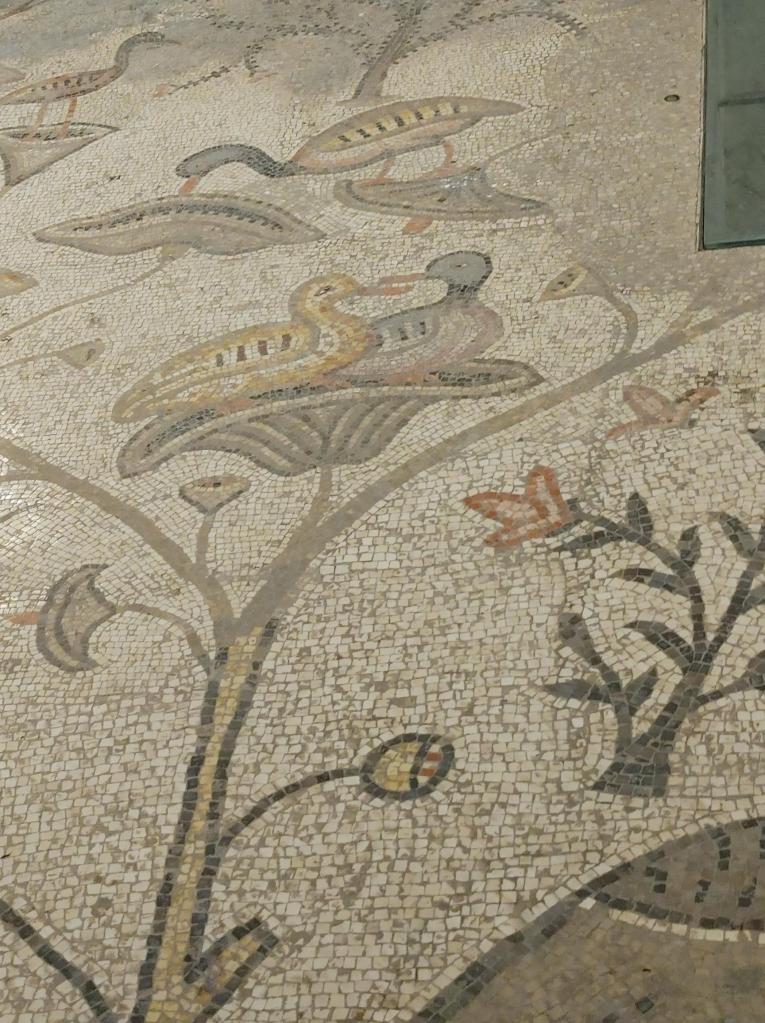
Tabgha, on the shores of the Sea of Galilee, is the traditional site of the feeding of the 5,000. The location was originally known as Heptapegon, meaning “the place of the seven springs.” Its lush gardens are an inviting place for a picnic or a service of worship. From the fourth century, Byzantine Christians were making pilgrimage to the site. Egeria, a Western European Christian woman and author of a detailed account of a pilgrimage to the Holy Land about 381/2–386, described her visit to Tabgha. She wrote, “By the sea is a grassy field with plenty of hay and many palm trees. By them are seven springs, each flowing strongly. And this is the field where the Lord fed the people with the five loaves and the two fishes. In fact, the stone on which the Lord placed the bread has now been made into an altar. People who go there take away small pieces of the stone to bring them prosperity and they are very effective.” Today the Church of the Multiplication of the Loaves and Fishes has replaced the original Byzantine church. It features the remains of the stone table as well as a splendid early figured pavement (mosaic floor), depicting flora and fauna of the lakeside.

The miracle that Jesus worked at Tabgha began with two facts: hungry people and the reluctance of the disciples to do anything about it.  Jesus was clear with his friends: it was their responsibility to meet the hunger of their neighbors.  The disciples gathered their little bits: just a few barley loaves and some small, dried fish, the lunch of peasants.  But those little bits went a long way.  Some say it was a miracle of multiplication.  Some say it was a miracle of the Spirit, a satisfying “spiritual” meal.  Still others suggest that the willingness of the disciples to share inspired a miracle of sharing in others who opened their packs and passed around provisions. The outcome was a blessing for all and a bold precedent that faithful people have been following ever since. 

Questions for reflection: How do you need Jesus to feed you today?

How will you feed others?

Please join me in prayer . . .

Generous and provident God, you make abundance of the most meager beginnings.  Grant us the grace to know that you can feed us and satisfy our deepest hunger, today and every day. Renew us in the way of discipleship that notices and cares, feeds and shares. We pray in the name of Jesus, the Lord of abundance. Amen.


He Himself is the fuel our spirits were designed to burn, or the food our spirits were designed to feed on. There is no other. — C.S. Lewis

“There are people in the world so hungry, that God cannot appear to them except in the form of bread.” — Mahatma Gandhi

“I hunger for filling in a world that is starved.” — Ann Voskamp


Figured pavement, Church of the Multiplication of the Loaves and Fishes, Tabgha on the Sea of Galilee

Crazy Math

Sabbath Day Thoughts — John 6:1-14

We are well acquainted with miracle stories.

A thirty-five-year-old nun, serving as the principal of a girl’s school in Calcutta, heard Jesus’ “call within her calling:” to abandon her teaching and go forth into the city’s slums to tend the poorest and sickest of people. She completed a six-month course in basic medical care, traded her nun’s habit for a sari, and left her convent behind so that she could be the hands and feet of Jesus for those whom she saw were unwanted, unloved, and uncared for. She tended lepers dying in the street, fed maimed children who begged for a living, and cared for women forced into lives of prostitution. All that need of the streets of Calcutta plus one poorly trained nun should have been a formula for failure. Yet by some crazy cosmic math, two years later Sister Mary Teresa was joined by twelve like-minded nuns and together they launched the Missionaries of Charity. Today, there are 5, 167 sisters of the Missionaries of Charity, serving the poorest of the poor in 758 communities in 139 countries.

In 1990, Tom Logan was visiting Dr. John Knowle’s, a missionary doctor at the Ekwendeni Hospital in Malawi. The two men came across the pump and raw materials to build a shallow well, delivered by the Malawi government years before but never installed. Knowing that waterborne disease from foul, open, community water sources was the leading cause of death for Malawi’s young children, the two men were shocked and angered. “Why don’t you install it?” Logan wanted to know. Dr. Knowles responded, “Why don’t you install it, Tom?” And so was launched the shallow well program of the Marion Medical Mission. That first year, Logan installed thirteen wells. Marion Medical Mission now installs more than 3,000 wells each year in partnership with local villages and leaders. Thirty years after Tom’s bold question, “Why don’t you install it?”, four million people in Malawi, Tanzania, and Zambia now have safe, clean drinking water, thanks to the shallow well program.

Millard and Linda Fuller were self-made millionaires before they were thirty. Instead of retiring and living large, the Fullers sold most of their possessions and moved to Koinonia Farm, the Christian community founded by pastor and Bible scholar Clarence Jordan. Aware of the need for adequate housing for the poor of rural Georgia, the Fullers teamed with Jordan to develop the concept of “partnership housing.” Those in need would work side-by-side with volunteers to build decent, affordable homes. The first partnership home built was for Beau and Emma, who lived with their five children in an unpainted, uninsulated shack without any plumbing. Two years later in 1976, the Fullers founded Habitat for Humanity, International, which now works in all fifty states and more than seventy countries. Habitat has helped more than thirty-five million people achieve their dream of “safe, decent, and affordable shelter.”

We are well-acquainted with miracle stories. Today’s reading may be the best-known miracle story of all. The feeding of the 5,000 is told by all four gospel writers. Today we get to hear it from John’s perspective. Jesus had been teaching his disciples on the hillside above the Sea of Galilee when he looked up to see a huge crowd on the move. They were in need of his wise words and healing touch. It was also late in the day, and there were no resources at hand to meet their physical hunger.

To test his friends, Jesus asked how they could feed the multitude. Philip surveyed the throng and knew that their need for bread far exceeded the financial resources they had on hand. Andrew did some reconnaissance and came up with five small loaves of barley bread and two little dried fish—resources that weren’t even his to share. The other ten disciples were silent, clearly thinking that they were powerless in the face of such need—there was nothing that they could do about it. The twelve disciples likely expected that would be the end of the discussion.

Jesus confounded those expectations. He took their meager provisions, blessed them, and shared them as if it were Thanksgiving dinner at Grandma’s house with all the fixings. Then, by some crazy and holy math, five loaves plus two fish equaled enough to feed 5,000 men and their families, with leftovers to spare. That vast, hungry crowd was miraculously fed in body, mind, and spirit. Praise the Lord!

Well-acquainted as we are with miracle stories. We are also familiar with times when we have felt like we needed a personal miracle, like when we lost our job, like when our marriage was on the rocks, like when the doctor gave us that scary diagnosis, or like when we were lost in grief. Given the history and crazy math behind faithful people who accomplished extraordinary things with the Lord’s help, we might think that when life gets overwhelming, or crisis strikes, or the rug is pulled out from beneath our feet, we would have faith and trust that the Lord will make a way and see us through. But we can tend to be a little like the disciples. Like Philip, we can only see all the ways that we are woefully inadequate to meet the moment. Like Andrew, we hope someone else can provide what is needed to fix our problem. Like the other ten disciples, we shake our heads, we throw up our hands, and think it is hopeless. The need overwhelms us. We want to give up. We want to run away. We want to crawl into bed, pull up the covers, and retreat into denial. There may be miracles out there, but we cannot imagine that any amount of multiplication or distribution could meet our need. We say, “Jesus, where is my miracle? Jesus, where are my loaves and fish? Jesus, where are my leftovers to spare?”

Miracles often begin with the smallest of faithful acts. A thirty-five-year-old nun with inadequate training decides to go out and help just one leper, one child, one woman, one person at a time. Tom Logan and his friends install a long-forgotten shallow well. The Fullers help their impoverished neighbors build a concrete block house with indoor plumbing. Jesus says grace—he blesses five barley loaves—the bread of the poor. He prays over two salty, dried fish. It starts small. It starts with just one simple faithful act. We can do that. We can launch our hopeful intent into that impossible void. We can place our little bit into the hands of Jesus. We can trust that some crazy math can begin to unfold. Somehow, with the Lord’s help, we find that we have what is needed to face the impossible. Really and truly, it is a miracle.

We know that’s true because there are miracles who walk among us, people who have defied and confounded every expectation. The widow, who wakes each morning to an empty house and the pall of grief, yet finds the courage to set that aside, smile, care for her family, and help her neighbor, she is a miracle. She and Jesus are doing some crazy math. The youth who rises above the dysfunction and alcoholism of his parents to get an education and forge a professional identity, he is a miracle. He and Jesus are doing some crazy math. The impoverished neighbor who finds ways to share with others and be generous with family and still put a little something in the offering plate each Sunday, they are a miracle. They are doing some crazy math with Jesus. Thank God, everywhere we look, miracles of multiplication and blessing and abundance are unfolding if we will only have eyes to see.

So maybe this week, in that best-known of Jesus’ miracles, and in the stories of Teresa and Tom and Millard and Linda, and in those indomitable spirits who live next door or bump into us in Top’s or sit next to us in church, we can find a little hope. We really are well-acquainted with miracles. We can find the courage to stand on our ground. We can throw back the covers and get out of bed. We can take the first simple step. We can place our little bit in the hands of Jesus and trust in the crazy math to come.

Resources:
Bryant, Robert A. “Exegetical Perspective on Mark 6:30-34, 53-56” in Feasting on the Word, Year B, vol. 3. Louisville: John Knox Press, 2009.
Yust, Karen Marie. “Pastoral Perspective on Mark 6:30-34, 53-56” in Feasting on the Word, Year B, vol. 3. Louisville: John Knox Press, 2009.
Johns, Cheryl Bridges. “Homiletical Perspective on Mark 6:30-34, 53-56” in Feasting on the Word, Year B, vol. 3. Louisville: John Knox Press, 2009.
–. “Mother Teresa” in Biography, Feb. 24, 2020. Accessed online at biography.com.
–. “Habitat’s Story” in Habitat for Humanity, International. Accessed online at habitat.org.
–. “Who We Are: The Beginning” in Marion Medical Mission. Accessed online at mmmater.org.

Photo by Ivan J. Long on Pexels.com