The New Commandment

Sabbath Day Thoughts — “The New Commandment” John 13:1-9, 31-35

Andrew Rice’s best friend when growing up was his brother David. Although the two shared a rebellious spirit as kids, with age they settled down to careers in journalism and finance. On September 11, 2001, Andrew was covering the Toronto Film Festival when their mother called him with unsettling news. His brother David, had telephoned from his office in the World Trade Center to say that a plane hit the tower next door, but he was OK. Andrew rushed to the press room of his hotel, just in time to see a second jet hit the trade center. Filled with panic, Andew ran back to his hotel room. He turned on the TV as the first tower collapsed. In Andrew’s words, “At this point I just let out this terrible shriek, overwhelmed by the certainty that David was dead.”

After the attack, Andrew read a New York Times “Portrait of Grief” about his brother David. In the very same paper, Andrew was discomfited to read another article with words of impending retribution from Vice President Cheney, who threatened, “if you’re against us you’ll feel our wrath.” Andrew felt an inner tension. Part of him was with the Vice President, “We’ll show them,” while another part knew that force wasn’t the answer. In ensuing weeks and months, as news of mounting civilian deaths came from the war in Afghanistan, he felt increasingly concerned that ordinary people like his brother were dying. Andrew didn’t know how to respond to his brother’s death, but he had a growing sense that retribution would get him nowhere.

We may not have lost a brother on September 11th, but we have all struggled to discern how to respond when we are hurt. Whether it is a spouse who walks out the door, an adult child who severs ties, a colleague who badmouths us to the boss, a friend who betrays our dearest trust, a sibling who cheats us out of an inheritance, or a complete stranger whose violence shatters our lives, it is hard to imagine how to move forward. We may, like Andrew Rice, feel the unbearable tension between our desire for payback and our feeling that violence is not the answer.

Throughout Lent, we have been considering Jesus’ final week in Jerusalem. On the night of his arrest, Jesus offered an object lesson in how to respond to those who wrong us. He then invited his disciples to forge a new kind of community, a fellowship that would make revolutionary choices when it came to building a life together.

Foot washing was an essential rite of hospitality in the Ancient Near East. In an arid world with unpaved roads, sandaled feet got dusty, gritty, and grimy during the course of a day. Upon entering a home for a seder, the guests would shed their sandals, and a servant would wash their feet, sluicing them with water over an open basin, drying them off, and perhaps anointing them with a drop of oil. Foot washing was the most menial of household chores, performed by the lowest status slave, typically a woman or a child. With feet refreshed, the guests moved on to the table and an evening of good food and congenial conversation.

At the last supper that Jesus shared with his disciples, he rose during the meal, and undertook that most humble of services. He removed his outer robe, girded himself with a towel, and washed his friends’ feet. It was a wildly countercultural act. A high-status rabbi, acclaimed by his friends and the crowds as the Messiah, chose to do the work of a slave. It was a loving act, the kind of simple service that warms our heart—like when a caring parent kisses a child’s booboo, or a good coach takes the time to praise our efforts on the playing field; or our beloved ones remember our birthday with roses or a special meal or a night on the town.

John’s gospel tells us that Jesus knew exactly what was going on that night. He understood that he would soon leave this world and return to his heavenly Father. Soon, his passion predictions of terrible suffering and a horrible death would be fulfilled. Within the hour, one of his trusted disciples, Judas, would depart to betray him, selling his life for thirty pieces of silver. Later, all his disciples would abandon him, running off under the cover of darkness to save their own skins. Next, Peter, a dear friend and confidante, would deny and curse him three times before the sun rose. Jesus knew everything that was to come, and still he chose to do the work of a humble servant, washing the feet of those who would betray, abandon, and deny him. It was a radical act of loving kindness. Then, Jesus told his friends that they were to do the same for one another.

Humble, loving service isn’t the first thing that comes to mind when we ponder those who have betrayed, abandoned, denied, mistreated, oppressed, badmouthed, robbed, or smeared us. Our hearts skip a beat and our blood pressure rises at the very thought of mercy for those who have been so merciless to us. Our sense of justice bristles. It seems only fair that our oppressor should experience a taste of the hurt and pain that we have known. It seems only right that there should be an, “I’m sorry,” a mea culpa, a comeuppance in the court of public opinion, or at least some acknowledgment of wrongdoing. Jesus, we know you washed the feet of your fickle and failing friends, but you are who you are—and we are not. Do you truly demand this of us?

I imagine that on Holy Saturday, when Jesus lay dead in the tomb, and the women wailed in grief, and the disciples hid away in the Upper Room filled with remorse and self-recrimination, they remembered the foot washing. They recalled the stripped-down Jesus with his sleeves rolled up, kneeling at their feet. They remembered how it felt to be held and appreciated, to be accepted and loved, even though they weren’t perfect. In the darkness of that day, I like to think that the foot washing was the luminous thread that bound them to Jesus and to one another. Yes, Caesar’s Kingdom had unleashed unthinkable horror against their Lord and upon their community. Yes, the desire to either hit back or flee must have been great. Yet there had been that irresistible invitation to make a different choice, as Jesus had made a different choice. There was the call to humility and love. Rome may have appeared victorious on that first Good Friday, but Jesus had shown them another Kingdom. In Jesus’ Kingdom, power is exercised in acts of humble service and love heals the gaping holes that we carry in our hearts.

In November 2002, Andrew Rice, with others who had lost loved ones in the September eleventh attacks, learned that Madame al-Wafi, the mother of alleged twentieth hijacker Zacharias Moussaoui, was in New York City and wished to meet with them. They struggled with the choice to accept her plea for a face-to-face, but they ultimately agreed. It was a profound meeting for all. Andrew remembers that Madame al-Wafi greeted them with tears of grief and remorse for her son’s hatred. She reminded Andrew of his own mother, who had cried so much after David died. Madame al-Wafi spent three hours with them, recounting how the hatred peddled by al-Qaeda had given her mentally-ill son a purpose in life. There was no foot washing in that room, but there was healing. Many tears were cried, hugs exchanged, and a better way forward was found.

Andrew says, “One day I’d like to meet Zacharias Moussaoui. I’d like to say to him, ‘you can hate me and my brother as much as you like, but I want you to know that I loved your mother and I comforted her when she was crying.’” Andrew is still hurt and angry about the events of September eleventh, but the choice for love freed Andrew from the desire for payback and retribution. He writes, “I’m refusing to fall in line with what ‘they’ want, which is visceral hatred between two sides; this [choice for love] gives me permission to reconcile.”

Love gives us permission to reconcile. Jesus saw this so clearly on the night of his arrest. In washing his disciples’ feet and commanding them to love one another as he had loved them, he forged the graced space for them to overcome the everyday hurts, betrayals, rifts, and harms that could tear them apart. In washing his friends’ feet and commanding them to love, he sent them forth to forge a world where we do not resort to hatred and violence, a world where enemies could become friends.

What a world that will be! I can imagine it. Can you? Vladimir Putin will be on his knees, washing the feet of Vlodimir Zelenskyy. The new Ayatollah Khameini will wash the feet of the jailed protesters who called for Iranian reform. Israeli Defense Forces and Hamas Rebels will wash the feet of the widows and orphans of Gaza. Chuck Shumer and Mike Johnson will try to outdo one another in humility, each washing the other’s feet. Pam Bondi will tie back her hair, put on the apron, and wash the feet of those Epstein survivors.

And we will be there, too, daring to dream of that graced space where hurts are healed and new beginnings are found through humble acts of self-giving love. May it be so. Amen.

Resources:

Andrew Rice. “My Story” in Stories Library, The Forgiveness Project, https://www.theforgivenessproject.com/stories-library/andrew-rice/

Matt Skinner. “Walking the Palm Sunday Path: A Lenten Sermon Series for 2026” in Preaching Series, January 21, 2026. Accessed online at https://www.workingpreacher.org/preaching-series/walking-the-palm-sunday-path-in-lent-a-sermon-series-for-2026

Karoline Lewis. “Commentary on John 13:1-9, 31-35” in Preaching Series, Jan. 22, 2026. Accessed online at https://www.workingpreacher.org/preaching-series/sermon-series-john-13-footwashing-and-new-commandment

Kathleen Long Bostrom. “Pastoral Perspective on John 13:1-9” in Feasting on the Gospels, John, vol. 2. Louisville: WJKP, 2014.

Coleman Baker. “Exegetical Perspective on John 13:1-9” in Feasting on the Gospels, John, vol. 2. Louisville: WJKP, 2014. Michael Waters. “Homiletical Perspective on John 13:1-9” in Feasting on the Gospels, John, vol. 2. Louisville: WJKP, 2014.


John 13:1-9, 31-35

13 Now before the festival of the Passover, Jesus knew that his hour had come to depart from this world and go to the Father. Having loved his own who were in the world, he loved them to the end. The devil had already decided[a] that Judas son of Simon Iscariot would betray Jesus. And during supper Jesus, knowing that the Father had given all things into his hands and that he had come from God and was going to God, got up from supper, took off his outer robe, and tied a towel around himself. Then he poured water into a basin and began to wash the disciples’ feet and to wipe them with the towel that was tied around him. He came to Simon Peter, who said to him, “Lord, are you going to wash my feet?” Jesus answered, “You do not know now what I am doing, but later you will understand.” Peter said to him, “You will never wash my feet.” Jesus answered, “Unless I wash you, you have no share with me.” Simon Peter said to him, “Lord, not my feet only but also my hands and my head!”

31 When he had gone out, Jesus said, “Now the Son of Man has been glorified, and God has been glorified in him. 32 If God has been glorified in him, God will also glorify him in himself and will glorify him at once. 33 Little children, I am with you only a little longer. You will look for me, and as I said to the Jews so now I say to you, ‘Where I am going, you cannot come.’ 34 I give you a new commandment, that you love one another. Just as I have loved you, you also should love one another. 35 By this everyone will know that you are my disciples, if you have love for one another.”
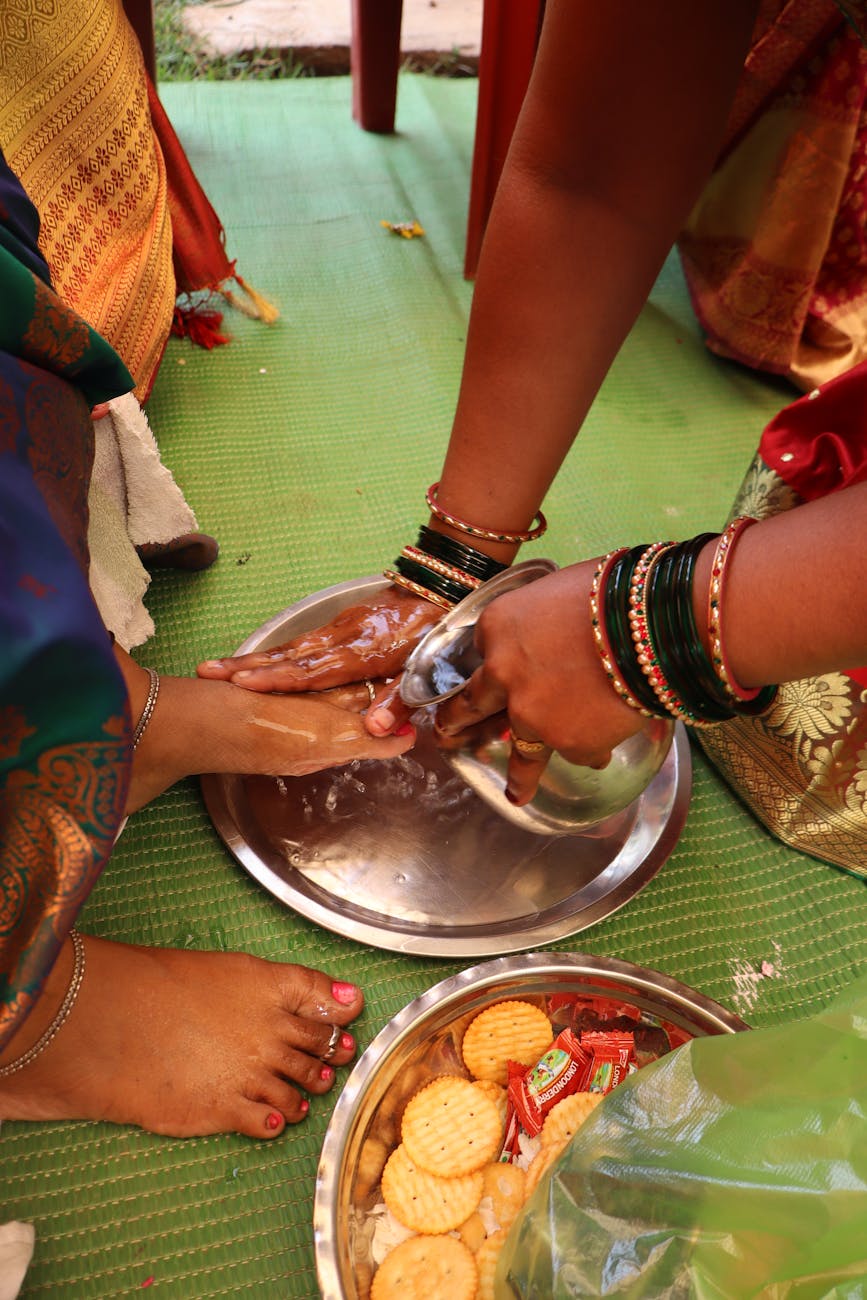

Photo by Ashish Keshkar on Pexels.com

Bad Feet, Good Lord!

Sabbath Day Thoughts — “Bad Feet, Good Lord!” John 13:1-5, 12-15

“Ouch!” Too late, I sidestep the bench and heel hobble to the foot of the bed. I hoist my leg up and look at my toe. A bloody, purple blush balloons around the base of the nailbed. When probed, the nail wobbles ominously, back forth, up down, like an unmoored dinghy bobbing in an eddy. Duane pushes the bench back into place. He does not want to look at my toe, but I make him.

“Check it out,” I say, wobble wobbling the nail.

Overcoming revulsion, he musters what passes for concerned interest, looking at the toe, the nail, the foot. He shakes his head.

I’ve got bad feet. Imagine that said with the mix of frustration and disappointment that a not-very-patient dog owner might use to say, “Bad dog,” to the new puppy who has, yet again, soiled the fake Persian carpet in the Pastor’s Study. Bad feet! Bad feet!

I blame it on Nana. My maternal great grandmother had feet that we christened “Nana’s Beauties.” Shaped by years of hairdressing in Brooklyn, Nana’s Beauties were a hideous amalgam of hammer toes, bunions, and thick calluses that came to an unnatural point, as if still poured into the fashionable kitten-heeled pumps, adorned with black velvet bows, that she wore in the 1920s. As a small child, I watched those feet with uncomfortable fear and fascination, as if the Beauties might, in any moment, become cognizant of my attention and demand to be touched, or even worse, rubbed. Avert thine eyes!

My Beauties might rival Nana’s. Bunions, bunion-ettes, seed corns, tendonitis, occasional plantar fasciitis, and a few curiously thickened nails that my podiatrist assures me are NOT fungal but symptomatic of feet that regularly take a beating on roadways and trails. Beyond the genetics of low arches and skinny heels, I earned my Beauties, not while flashing a sassy flapper smile and shaping the crimped waves and swingy bobs that Nana crafted at the Flatbush Beauty Emporium, but rather while logging miles, miles, and more miles of walks and hikes in the Adirondacks and beyond. And, of course, with the occasional catastrophically stubbed toe. The nail would blacken, work its way loose, and cast me off one morning to escape down the shower drain.  

There’s money to be made in foot beauty. [1]  Indeed, those with lovely feet can capitalize on them. Foot models, born with a perfect size six and ideal squoval nails can earn six figures by donning shoes or smearing on pharmaceuticals while the camera clicks. A pedicure, with toenails trimmed and filed, calluses softened, and polish artfully applied, can set you back $60.  And if you want your feet to be beautifully and fashionably clad, a pair of smoky blue, patent leather Jimmy Choo mules with a crystal strap will cost $1,095.

But we with Beauties learn early that ours is not the world of nail salons and high fashion footwear. It’s never a good feeling when your nail tech calls in a consultant to determine the best way to shave the callosity on your heels. We hide our thorny feet within thick athletic socks in the girl’s locker room.  We look for pool shoes that hide our deformity. In our youth, we don’t boogie barefoot on the frat house lawn. Later in life, we won’t parade our naked dogs in the health club sauna. Our feet have their own costs: a $45 co-pay at the podiatrist; $5,560 for a bunionectomy that may or may not help; $200 for your Hoka CarbonX3 runners. There are other costs, like the shame we feel at the snicker of fellow campers on the beach at Silver Bay.

Even the biblical authors seemed to think that feet were an appropriate metaphor for that which is illicit, embarrassing, or must be hidden away. When I translated the Book of Ruth from Hebrew to English, my professor Brenda Shaver, in her edgy shicksa-turned-rabbi perkiness, told me with a wink that when Ruth slipped into the granary to spend the night with Boaz, the Hebrew text may say that she uncovered his feet, but she was actually intent on uncovering something else, due north and much more likely to get the attention of the sleeping patriarch.  If Ruth had lifted the blanket and seen that Boaz’s feet rivaled Nana’s Beauties—or mine, there might never have been an Obed, Jesse, or David. Maybe no Jesus.

I bet Jesus had Beauties. The man walked a lot. He walked along the Via Maritima from the black basalt jetty at Capernaum up to the rabbit warren of bureaucratic offices at Caesarea Philippi. He walked from the radium-infused Roman baths of Tiberias down the increasingly arid Jordan Valley to the palm-treed oasis of Jericho. He climbed the red eroded hills of the Judean Wilderness and walked the dangerous, narrow path through the Valley of the Shadow of Death. He walked the Via Dolorosa. Jesus didn’t have the benefit of my Keen trail shoes or my real leather, European-made hiking boots. He did it in sandals, the first century kind, not much more than a slab of foot-shaped leather, held on with straps and ties. I bet Jesus had calluses, corns, nicks, scars, and soles made thick by walking. From time to time, he, too, may have been missing a toenail or two. I’m sure the feet of his disciples were no better, especially the fishermen, who spent half their time barefoot, wading in water or sitting in the slime left behind in the bottom of the boat by the dragnet. Jesus, my brother, of the bad, bad feet.

The synoptic gospels (Matthew, Mark, and Luke) tell us that on the night of his arrest, Jesus shared a final Passover meal with his friends and instituted a tradition, a shared meal of bread and wine in remembrance of him. John remembers differently. According to John, in the last meal that Jesus shared with his disciples, he rose from the table, took off his outer robe, wrapped an apron around his waist, and knelt at his friends’ feet to do the work of the most menial servant in the household. Jesus washed the disciples’ feet, all of them, even those of Judas, who was already counting the silver coins that would soon grease his palm. I like to think that Jesus washed the feet of their wives and children, too.

One by one, Jesus cradled the disciples’ feet.  He held their hammer toes and bunionettes, their fallen arches, plantar warts, and ingrown toenails. He poured out water to wash away the grime accrued in a long day of walking on cobbles and unpaved paths in an arid land where dust lifts and swirls with every step. After the washing, he dried their feet, shrouding them in the towel, pressing, rubbing, squeezing, letting go.

John saw this foot washing, and not the Lord’s Supper, as the rite that Jesus used to call us into a community of people committed to his way. Jesus told the twelve, “So if I, your Lord and Teacher, have washed your feet, you also ought to wash one another’s feet.” Faithful people have long heard in Jesus’ words the calling to a life of humble service, of falling to our knees in prayer and rising to bless others with simple acts of self-giving love. We help out at the Food Pantry or roll up our sleeves at the Community Garden. We clean apartments in public housing or fly off to Malawi to teach kids to read.

But what if Jesus wants more?

In holding those feet, in embracing that which society deems unworthy, unlovely, and unclean in us, Jesus sets another sort of example. It’s an example that we with Beauties can perhaps most fully appreciate. Jesus chooses to be lovingly present to that which we—and others—little love about ourselves. He does so patiently, insistently, relentlessly, without judgment, comment, or snark. It’s an act of inclusion and acceptance that humbles and heals.

It’s an act that also inspires, calling us to hold for one another all that we fear is ugly and unlovable: our misshapen feet and scaley psoriatic skin, our receding hairlines and jiggly bellies, our bad grades and lack of athleticism, our misspent youth and crabby age, our failed marriages and poor parenting, our fragile mental health and compulsive addictions. In truly following Jesus, we could find the humility to gently hold and simply care, to cherish and even love, that which others have learned to hate in themselves. We could choose to move past discomfort, judgment, and even revulsion to love. Are you with me?

The last Christmas that Nana came to our house, before she broke her hip and moved to the nursing home, was a snowy one. A big storm dumped two feet of snow, so heavy and wet that my grandparents couldn’t navigate our street with their big Buick. In those days before SUVs and cell phones, they parked at the top of the hill, a mile away, and everyone got out to walk, even Nana, who, true to form, had worn completely unsuitable shoes that were soaked by the time she reached our front door. When the doorbell rang, we welcomed everyone with hugs and great rejoicing, but it was my Grandmommie White, a retired nurse and Presbyterian Deaconess, who did the most fitting thing.

“Here, Betty,” she said to my Nana, taking her by the elbow and easing her into a chair.

Then she removed Nana’s soggy shoes and washed her beautiful feet. Amen.

—-

This message is part of a longer essay that I worked on this past week during my DMin residency for Pittsburgh Theological Seminary’s Creative Writing and Public Theology Program.


[1] The Egyptian foot, with the big toe longer than the others, is considered the most beautiful foot shape, followed by the Roman foot (big toe and next two toes of equal length). The least appealing foot shape is purported to be the Greek, with the second toe longer than the first. The only possible advantage of the Egyptian foot is that it is less likely to suffer from ingrown toenails.


John 13:1-5, 12-15

Now before the festival of the Passover, Jesus knew that his hour had come to depart from this world and go to the Father. Having loved his own who were in the world, he loved them to the end. 2 The devil had already decided that Judas son of Simon Iscariot would betray Jesus. And during supper 3 Jesus, knowing that the Father had given all things into his hands and that he had come from God and was going to God, 4 got up from supper, took off his outer robe, and tied a towel around himself. 5 Then he poured water into a basin and began to wash the disciples’ feet and to wipe them with the towel that was tied around him. 12 After he had washed their feet, had put on his robe, and had reclined again, he said to them, “Do you know what I have done to you? 13 You call me Teacher and Lord, and you are right, for that is what I am. 14 So if I, your Lord and Teacher, have washed your feet, you also ought to wash one another’s feet. 15 For I have set you an example, that you also should do as I have done to you.


Photo by THIS IS ZUN on Pexels.com

The Call to Serve

Throughout Lent, I’ll be sharing weekly devotions based upon my travels to the Middle East. Today’s meditation is the fifth in the series.

“Jesus knew that the Father had given everything into His hands, that He had come from God, and that He was going back to God. So, He got up from supper, laid aside His robe, took a towel, and tied it around Himself. Next, He poured water into a basin and began to wash His disciples’ feet and to dry them with the towel tied around Him.”

—John 13:3-5

The traditional site of the Last Supper is found on Mount Zion in the neighborhood of Jerusalem known as the City of David. In Jesus’ day, it would have been a prosperous neighborhood, home perhaps to an affluent follower of Jesus who made his residence available for the Passover celebration. As early as the year 130 CE, there was a “little church of God” in this location, most likely a house church where Christians gathered discretely in a time when they were strongly persecuted. Many churches have since stood on this spot. Two were destroyed by fire in the years 614 and again in 965. The current building was constructed by the Franciscans in 1335. The “Upper Room,” commemorated as the location of the Last Supper, is simply constructed with vaulted ceiling, Gothic arches, and white-washed-walls. It’s been sacred to Christians, Jews, and Muslims. The Tomb of David is housed in the lower level of the same building, and from 1524 to 1948 the building housed a mosque.

What Jesus chose to do as the Passover meal began was the work of the lowest status member of a household, a labor normally undertaken by a menial servant or slave. Jesus washed the disciples’ feet. Perhaps we can imagine him in the golden glow of oil lamps as he rolled up his sleeves, fell to his knees, and moved from one of his followers to another. He cradled their road-weary heels, poured water to wash away the grime of the day, and then gently toweled them dry. The busy chatter that precedes the Passover seder would have fallen silent, the disciples profoundly uncomfortable to have a high-status rabbi like Jesus serving them.

It was an object lesson in humility, setting the example of self-giving love and humble service. Within twenty-four hours, Jesus would set an even greater example, giving his life for the sins of the world.

How will you follow Jesus in the way of humble service?

Please pray with me . . .

Gentle and humble Lord, may love put us on our knees today. Amen.


“Do you wish to rise? Begin by descending. You plan a tower that will pierce the clouds? Lay first the foundation of humility.”–Augustine

“Miss no single opportunity of making some small sacrifice, here by a smiling look, there by a kindly word; always doing the smallest right and doing it all for love.”
―Therese of Lisieux

“I am persuaded that love and humility are the highest attainments in the school of Christ and the brightest evidences that He is indeed our Master.”–John Newton

“I cannot do all the good that the world needs. But the world needs all the good that I can do.”― Jana Stanfield


https://commons.wikimedia.org/wiki/File:Cenacle_corner_2.jpg