True Abundance

Sabbath Day Thoughts — “True Abundance” John 10: 7-10

Plastic is perhaps the greatest pollution threat to our planet. In the past fifty years, it has become the primary material used in our packaging industry, replacing paper, cardboard, metal, and glass. One million plastic water bottles are purchased every minute worldwide. Five trillion plastic bags are used each year. 460 million tons of plastic are produced annually, and that production is anticipated to increase by one-third in the next five years.

Plastic is an environmental threat. Whether we bury plastic in landfills or dump it untreated into our waters, plastic is slow to biodegrade, taking twenty to five hundred years to decompose. A plastic bag buried in a landfill is estimated to take 1,000 years to breakdown. There is an estimated 75 to 199 million tons of plastic waste currently in our oceans, with a further 33 billion pounds of plastic entering the marine environment every single year. Ocean wildlife mistake plastic waste for prey. Unable to digest the plastic they eat, fish, turtles, and birds suffer internal injuries and starvation. A sperm whale that washed up at the Wakatobi National Park in Indonesia in December 2018 had more than a thousand pieces of plastic in its stomach.

When plastic biodegrades, it lingers in the environment as microplastics—tiny plastic particles less than five millimeters in size that make their way into water, farmland, and the food we eat. Studies have found that our personal annual consumption of microplastics is equivalent to eating 50 plastic bags per year or one credit card each week. The chemicals in these microplastics are linked to a bevy of health concerns, like reproductive problems, obesity, organ disease, developmental delays in children, and chronic inflammation.

Plastics sure are convenient. Just about everything—our breakfast yogurt, laundry detergent, shower gel, and ice cream—is neatly and durable packaged. But our dependence upon plastic is a problem for the planet, perilous to wildlife, and bad for our health. It’s a twenty-first century problem, yet I like to think that on this Care for Creation Sunday Jesus might have some first century wisdom to help us rethink our relationship with plastic.

In our reading from John’s gospel, Jesus characterized himself as the “good shepherd,” drawing upon a key metaphor from the Hebrew Bible. In Ezekiel 34, evil and corrupt kings were characterized as bad shepherds of the people, who ruled with force and harshness, scattering and destroying the flock. God promised to rescue the flock of Israel from their evil rulers. God would be Israel’s good shepherd. God would seek the lost, gather the scattered, and feed the people on rich pasture.

Jesus had seen some bad shepherding for the people of Israel. Herod Antipas, Herod Philip, and Pontius were all Roman appointed rulers. Their mission was to collect taxes to fill the emperor’s treasury and put down any whiff of rebellion. Instead of shepherding the people, they exploited them to line their own pockets and ensure their position and power. Even the chief priest in the temple was a Roman appointee, part of an elite class religious professionals who had controlled the worship life of Israel since the Roman invasion.

Jesus saw the suffering of his people at the hands of bad shepherds and longed to fulfill God’s plan to shepherd them. Jesus promised his friends “abundant” life. The Greek word that Jesus used for abundant is perisson. It means a life that is more, a life that is over and above what we have come to expect. An abundant life provides enough to meet our needs. Think of Jesus feeding the multitudes, welcoming outsiders, and healing the sick. Jesus’ abundance surpassed this, not in ways that would grant political power or bring fabulous wealth. Jesus wanted his followers to find more life, eternal life, in his Father’s Kingdom, a life that could not be bound by time or space or even death. Abundant life is blessed now as we live a balanced life with love for God and neighbor. Abundant life is blessed eternally as we anticipate that far brighter light on that far better shore. Abundant life is found in Christ the good shepherd.

One of the great challenges that we face in our world today is that we have forgotten what true abundance looks like. Jessica Maudlin, who heads the PCUSA’s Earth Care Congregations initiative and resources the ecumenical thinktank Creation Justice Ministries, cautions that we confuse true abundance with excess, with acquiring more stuff than we will ever use and consuming more than our world can sustain. Our excess is an idolatry that lulls us into thinking that we save ourselves when only God can do that. Our excess threatens the planet that has been entrusted to our care. Our excess is a failure to love our neighbors to come—the generations who must live with the legacy of what our excess leaves behind.

On this Care for Creation Sunday, Jesus might invite us to be reoriented, to trade our excess for his true abundance. It may not be easy. We begin by affirming that Jesus is our good shepherd, who has provided for us the blueprint for true abundance. As we rely upon the Lord instead of ourselves, we learn to shift our priorities from acquiring more and stockpiling excess to ensuring that there is enough for ourselves, our neighbors, and the wild world around us. We can follow Jesus by becoming better shepherds of our resources, so that the abundant life promised by the Lord is a promise for the planet and for generations to come.

I want to circle back to all those concerning facts about plastics that I mentioned at the start of this message because I think it’s a place where we need to—and can—make a difference. We can begin by reducing our plastic consumption. If you google the words “plastic footprint calculator,” you’ll find some useful web-based tools that will help you track how much plastic you use each year and guide you in thinking about ways to use less. Check it out. We can also purchase the new generation of bioplastics. Made from corn or bamboo, bioplastics are a little pricey, but they compost and biodegrade easily in landfills.

We can also move away from single-use plastics by reusing. Carry a water bottle or a reuseable coffee cup. Remember to keep a stash of cloth shopping bags in your car. Invest in a durable stainless-steel straw and skip the plastic straws used in convenience stores. Bring your own containers for leftovers when you dine out.

We can get better about recycling. Only 14% of plastics get recycled. You know what happens to the other 86%. Look for a trash service that recycles. Sort it yourself and make sure you get everything in the right receptacles at the transfer station. Did you know that you can now recycle plastic bags and wraps locally? The Women’s Civic Chamber is collecting clean, dry plastic bags. Partnering with Trex, a company that makes composite decking, they’ll turn our bags and wrappers into park benches. You can donate yours at collection bins at Nori’s, Woods and Waters, Kinney Drugs, and Harrietstown Town Hall. They started this in May and have already collected enough plastic—1,000 pounds—to make the first bench. Trex reclaims about a billion pounds of plastic each year.

We can also try removing the plastics that we find. Take a bag along on your neighborhood walk and pick up the trash. This morning as I took Gybi around the block, I picked up: a chip bag, a wrapper for Chips Ahoy, a single-use water bottle, a big bottle for Arnold Palmer (aka iced tea mixed with lemonade), a zip lock bag, a candy dispenser, and a plastic mini-basketball—and there were two plastic bags filled with poop from another dog (at least I hope it was a dog). If you are hitting the trail or paddling the waters, take care to ensure that everything that comes in with you goes back out—and pick up what others leave behind. And don’t forget that our fall highway clean-up will be scheduled in the coming weeks. We’ll be collecting trash along Rte. 186 in Lake Clear. There will be plenty of plastic: soda bottles, carry-out containers, masks, compact disks, diapers, and more. Sign up to help out and see who can collect the most plastic.

Well, my friends, an abundant life doesn’t need to include an abundance of plastic. It just needs the good shepherd. With our careful shepherding of resources, the abundant life promised by the Lord can be a promise for the planet and for generations to come. May it be so.

Resources

Aaron Marbone. “Building benches with plastic” in Adirondack Daily Enterprise, May 11, 2024. Accessed online at Building benches with plastic | News, Sports, Jobs – Adirondack Daily Enterprise

Jessica Maudlin, et al. “Plastic Jesus: Real Faith in a Synthetic World,” in Creation Justice Ministries, Earth Day Sunday 2024. Accessed online at Plastic Jesus – CREATION JUSTICE MINISTRIES

Statista. “Global Plastic Packaging Industry—statistics and facts.” Accessed online at statista.com

United Nations Environmental Program. “Our Planet Is Choking in Plastic,” an interactive  resource for individuals, schools, and teachers in UNEP Interactives, 2024. Accessed online at https://unep.org/interactives/beat-plastic-pollution.

–. Plastic Footprint Calculator. Plastic Bank. Accessed online at Plastic Footprint Calculator – Plastic Bank


John 10:7-10

So again Jesus said to them, “Very truly, I tell you, I am the gate for the sheep. All who came before me are thieves and bandits, but the sheep did not listen to them. I am the gate. Whoever enters by me will be saved and will come in and go out and find pasture. 10 The thief comes only to steal and kill and destroy. I came that they may have life and have it abundantly.

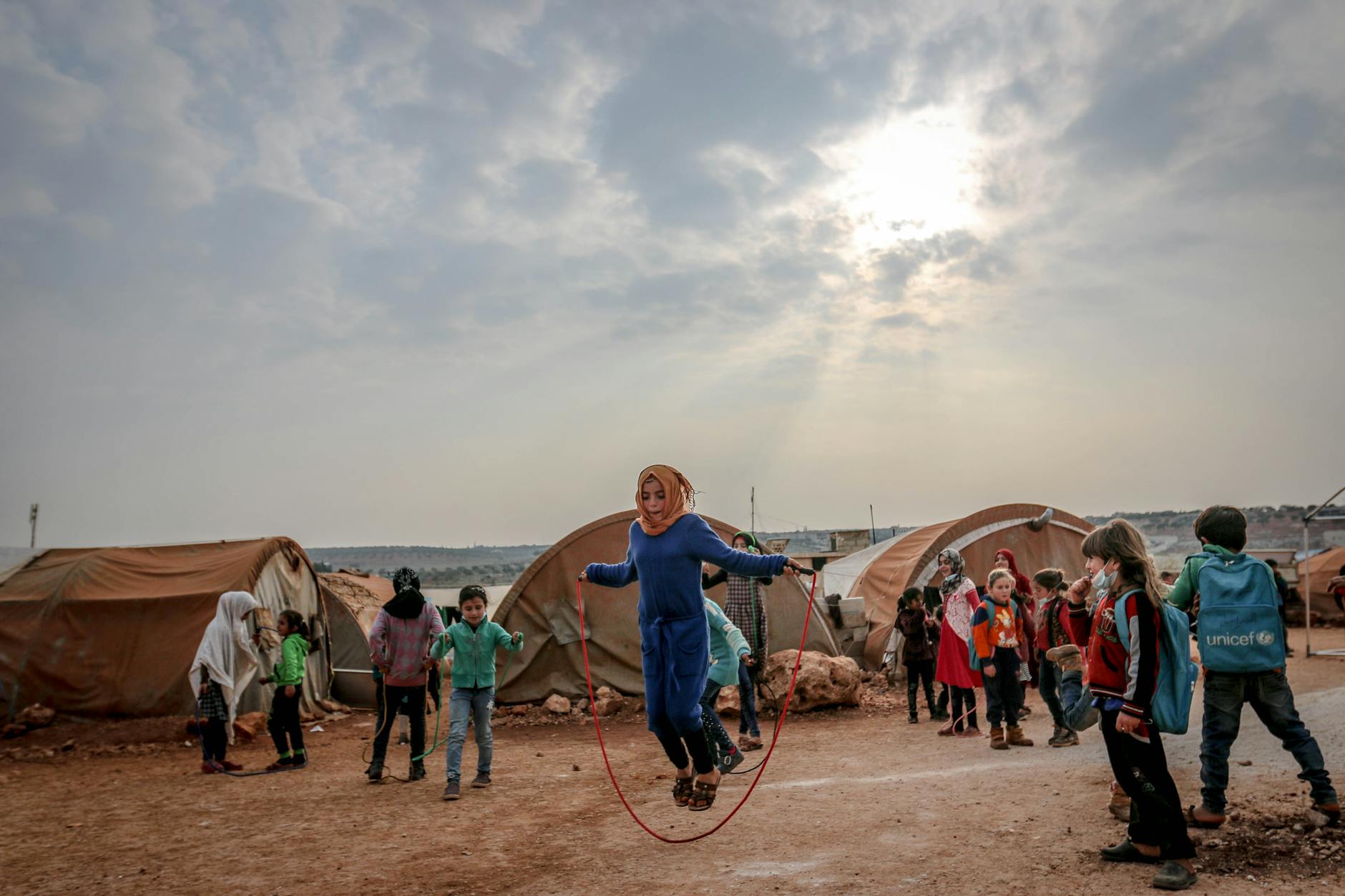
Photo by Catherine Sheila on Pexels.com

Good Shepherds

Sabbath Day Thoughts — “Good Shepherds” John 10 and 1 John 3:16-24

There are 35.3 million refugees in our world, global neighbors who have been forced to flee their homes and cross borders in search of safety and a future. A further 62.5 million people are internally displaced, still residing within their country of origin but homeless. 10 million people are asylum seekers. For them, going home would mean certain death. Last year saw the largest single-year increase in the forced displacement of people in modern history, more even than in the chaos of the Second World War.

4.5 million people of Sudan have been forced to flee amid civil violence. Awad decided to flee to the neighboring village of Mafot when fighting erupted in his hometown. His 80-year-old mother Dawa was too frail to make the two-day journey by foot, so Awad hid her in the bush for three days while he moved his wife and nine children to safety. Awad returned for his mother and carried her to Mafot. After several months, the artillery shells again began to fall. Awad’s family fled further. For 15 days, Awad carried his elderly mother and his daughter Zainab on his back, until they reached the border crossing into South Sudan. Awad’s family now lives with 56,000 other refugees in the Gendrassa camp. Awad knows he will never go home, but he hopes for a day when he will again farm.

The civil conflict in Syria is now in its 14th year. Syrians account for 20% of the world’s refugee population with 6.5 million people hosted in 131 countries. Within Syria, 13.5 million people, more than half of the population, are displaced. Yehia is a Syrian farmer, who raised wheat and barley near the city of Hama. Before the civil war, Yehia says that the family had “the best life.” But in 2017, fighting destroyed their family home. Yehia’s 10-year-old son and one-year-old daughter were killed along with five other family members. Rescuers pulled his four-year-old girl Shahad from the rubble and rushed her to a local clinic, where an overworked medic stitched her badly lacerated face. They then fled for the border. On the way, they were stopped at dozens of checkpoints, where they feared being detained and imprisoned. Seventeen hours later, after midnight, they arrived in Lebanon with nothing but a suitcase. Now at a refugee camp in Lebanon, Yehia is doing what he can to support the surviving members of his family.

In its first year, the Russian invasion drove eight million people out of Ukraine. Almost four million Ukrainians are internally displaced, driven from their homes by violence. Elena Yurchuk worked as a nurse in the northern town of Chernihiv. She tended the injured in a hospital that overflowed with the wounded and dying, even as the Russian bombs fell around them. When the hospital was reduced to rubble, Elena, like many of her neighbors, fled for her life. In a hastily packed car, Elena and her family set out for the Romanian border town of Suceava. Along the way, a car with a young family that followed them was blown up. Elena says, “I don’t know if I have a home or not. Our city is under siege and we barely escaped.”

In a world where 108 million people live the precarious life of refugees and the displaced, the promise of a Good Shepherd sounds especially sweet. When Jesus chose the metaphor of the Good Shepherd to describe himself and his ministry, he drew on a favorite image from the world of the ancient Near East. Kings, emperors, and religious leaders were characterized as shepherds of the people.  Good shepherds protected their people from foreign invaders, provided food in times of famine, took particular care of vulnerable widows and orphans, and maintained justice in the land.  Bad shepherds were more like wolves.  They profited at the people’s expense by conscripting men for endless warfare, taxing villages to pay for imperial luxuries, neglecting the widow and orphan, and selling justice to the highest bidder.  The Hebrew scriptures, whether we are reading the twenty-third psalm or the Prophet Ezekiel (34), affirm that God is the best shepherd, and God longs for a world where people are shepherded with compassion and infinite care – with abundant pastures, flowing streams, protection from enemies, and safety even in the presence of death.

Jesus tells us that he is the Good Shepherd, sent by God to care for God’s people.  Jesus’ life was an object lesson in good shepherding. He worked miracles of healing that brought new life to even the most hopeless of cases.  He fed hungry crowds abundantly, multiplying scanty provisions to satisfy multitudes.  Jesus specially cared for the most vulnerable members of the flock, widows and children, lepers and demoniacs.  Jesus sought and saved the lost. He dined with social refugees, like sinners, tax collectors, and prostitutes. In Jesus, we saw the perfect fulfillment of God’s promise to raise up a messianic Good Shepherd to redeem the lost, lonely, hurting, and oppressed people of Israel. 

Perhaps Jesus’s good shepherding was strengthened by his own experience of vulnerability. As refugees, Jesus’s family fled Bethlehem for the safe haven of Egypt, just one step ahead of Herod’s death squad. A homeless rabbi, Jesus lamented that foxes had holes, birds had nests, yet he had no place to lay his head. A target of powerful religious and political enemies, Jesus endured the criticism of scribes and Pharisees, elders and priests. He suffered the insults, torture, and injustice of Herod and Pilate. Jesus, our Good Shepherd, knew first hand a world where bad shepherds called the shots, and he longed to set it straight.

In a world where refugees and displaced people abound, the Good Shepherd reminds us that we cannot turn a blind eye to the suffering of our global neighbors. We belong to one another, just as we belong to God. Jesus told his friends that he had other sheep, that did not belong to their fold. Those other sheep listened for his voice, and he longed to welcome them. Whether we call Saranac Lake our home, we shelter like Awad in the Gendrassa Camp of South Sudan, we seek safety like Yehia in Lebanon, or like Elena we are on the run from war-torn Ukraine, we are a single global flock, loved by a sovereign God. Professor Gennifer Benjamin Brooks of Garrett Evangelical Seminary says that we cannot love the shepherd without loving the flock, in all the diversity of our world.

Being a member of the Good Shepherd’s flock becomes a call to action, to work for the help and healing of our world. We are summoned to the task of shepherding, of living with and for the best interest of others. Jesus tells us that the Good Shepherd lays down his life for the sheep. Indeed, on a lonely cross, stationed between two common criminals, beaten and bloodied, subjected to the verbal abuse of jeering crowds, the good shepherd laid down his life for the flock and reconciled us to God and one another.

In his first letter, the Apostle John characterized the Christian life as living for others, writing, “We know love by this, that Jesus laid down his life for us—and we ought to lay down our lives for one another. How does God’s love abide in anyone who has the world’s goods and sees a brother or sister in need and yet refuses help? Little children, let us love, not in word or speech, but in truth and action.” That imperative to act has prompted this church to give generously to One Great Hour of Sharing, lace up our sneakers and stride out for CROP Walk, and advocate for humanitarian parole for the Hamidullah Family languishing in Kabul, Afghanistan. All are ministries that serve the most vulnerable members of the world’s flock. The more we listen to and follow the shepherd’s voice, the more we live with his care and compassion, the more our world begins to resemble that holy Kingdom where the Good Shepherd reigns triumphant and eternal. 

We, who follow the Good Shepherd, seek a different kind of future for the exiled and displaced. We long to build a world where the global flock knows its belovedness and belongingness. It will be a world where Awad plants fields of green and his family puts down roots. It’s a world where Yehia and the war-ravaged people of Syria go back to ancestral homes amid the blessing of peace. It’s a world where Elena returns to the mundane duties of nursing in Ukraine, safe from the blast of bombs. May we make it so.

I’d like to close this message with “A Prayer to the Shepherd” written by Andrew King, who blogs at “A Poetic Kind of Place.”

O Lord our Shepherd,

may your flock not want

in the refugee camps

of Yarmouk, of Darfur, of Dadaab.

May life-giving pastures of nourishment be theirs

in Sudan, in Niger, in Chad.

May waters of peacefulness and healing flow

in Somalia, in Syria, in Ukraine.

And may souls be restored in our own cities and towns

where violence and hunger still live.

O Lord our Shepherd,

death shadows the valleys

and the houses and hills of our lands.

May the strength of your grace and

the assurance of your love

ever with us and ever embracing,

bring comfort to the grieving and alone.

May there be a table of reconciliation prepared

where enemies may sit down in peace

and may the cup of joy overflow for those

whose suffering has been their drink.

Let your goodness and mercy attend your flock,

O Shepherd, our Lord,

and may all your flock dwell

in the unity of your love

as long as life endures.


Resources:

Andrew King. “A Prayer to the Shepherd” in A Poetic Kind of Place, April 10, 2016. Accessed online at https://earth2earth.wordpress.com/tag/the-good-shepherd/

USA for UNHCR. “Refugee Statistics” in Refugee Facts 2024. Accessed online at Refugee Statistics | USA for UNHCR (unrefugees.org)

–. “Refugee Stories: Mapping a Crisis.” The Choices Program, Brown University Department of History. Accessed online at www.choices.ed

Stephen McGrath. “Ukraine refugees tell harrowing tales even as numbers ease” in The Associated Press, March 13, 2022. Accessed online at Ukraine refugees tell harrowing tales even as numbers ease | AP News.

Lucy Lind Hogan. “Commentary on John 10:11-18” in Preaching This Week, April 29, 2012. Accessed online at Commentary on John 10:11-18 – Working Preacher from Luther Seminary

Gennifer Benjamin Brooks. “Commentary on John 10:11-18” in Preaching This Week, April 25, 2021. Accessed online at Commentary on John 10:11-18 – Working Preacher from Luther Seminary

Susan Hedahl. “Commentary on John 10:11-18” in Preaching This Week, May 3, 2009. Accessed online at Commentary on John 10:11-18 – Working Preacher from Luther Seminary


John 10:1-26

10“Very truly, I tell you, anyone who does not enter the sheepfold by the gate but climbs in by another way is a thief and a bandit. 2The one who enters by the gate is the shepherd of the sheep. 3The gatekeeper opens the gate for him, and the sheep hear his voice. He calls his own sheep by name and leads them out. 4When he has brought out all his own, he goes ahead of them, and the sheep follow him because they know his voice. 5They will not follow a stranger, but they will run from him because they do not know the voice of strangers.” 6Jesus used this figure of speech with them, but they did not understand what he was saying to them. 7So again Jesus said to them, “Very truly, I tell you, I am the gate for the sheep. 8All who came before me are thieves and bandits; but the sheep did not listen to them. 9I am the gate. Whoever enters by me will be saved, and will come in and go out and find pasture. 10The thief comes only to steal and kill and destroy. I came that they may have life, and have it abundantly. 11“I am the good shepherd. The good shepherd lays down his life for the sheep. 12The hired hand, who is not the shepherd and does not own the sheep, sees the wolf coming and leaves the sheep and runs away—and the wolf snatches them and scatters them. 13The hired hand runs away because a hired hand does not care for the sheep. 14I am the good shepherd. I know my own and my own know me, 15just as the Father knows me and I know the Father. And I lay down my life for the sheep. 16I have other sheep that do not belong to this fold. I must bring them also, and they will listen to my voice. So there will be one flock, one shepherd. 17For this reason the Father loves me, because I lay down my life in order to take it up again. 18No one takes it from me, but I lay it down of my own accord. I have power to lay it down, and I have power to take it up again. I have received this command from my Father.”

19Again the Jews were divided because of these words. 20Many of them were saying, “He has a demon and is out of his mind. Why listen to him?” 21Others were saying, “These are not the words of one who has a demon. Can a demon open the eyes of the blind?”

22At that time the festival of the Dedication took place in Jerusalem. It was winter, 23and Jesus was walking in the temple, in the portico of Solomon. 24So the Jews gathered around him and said to him, “How long will you keep us in suspense? If you are the Messiah, tell us plainly.” 25Jesus answered, “I have told you, and you do not believe. The works that I do in my Father’s name testify to me; 26but you do not believe, because you do not belong to my sheep. 27My sheep hear my voice. I know them, and they follow me. 


Photo by Ahmed akacha on Pexels.com