Blessed in the Struggle

Sabbath Day Thoughts — “Blessed in the Struggle” Gen. 32:22-31

At the age of two, doctors said that Temple had brain damage. She would never talk or be able to function in a home or school setting. “The best option is to institutionalize the child,” they told her parents. Temple’s father agreed, but her mother refused. Instead, she found a neurologist who provided Temple with speech therapy, and she hired a nanny to play games with the little girl. As she grew, school was an agony for Temple. She was ridiculed and taunted for being a nerdy kid with strange behaviors. She earned the nickname “human tape recorder” for perseverating, obsessively repeating word for word whatever was said to her.

Terry was a young athlete with a winning personality and a lot of heart. He played basketball and ran cross country in high school and was awarded the distinction of Athlete of the Year as a senior. He headed to college to study kinesiology with the hope of becoming a physical education teacher. That spring, growing pain in Terry’s right knee sent him to the doctor. Testing found that he had osteosarcoma, a form of cancer that often starts near the knees. Terry was told that his leg had to be amputated, and he would require extended chemotherapy. His odds of survival were only fifty percent.

Maya spent her childhood in and out of poverty, shuttled between the homes of her parents, grandparents, and divorced mother. As a little Black girl in the south, she had limited opportunity for school, but her teachers noticed from a young age that she had a gift for poetry. When Maya was seven, she was sent to live with her mother. There she was sexually abused by her mother’s boyfriend Freeman. She told her brother, who told the rest of the family. Freeman was found guilty but was jailed only one day for his crime. Four days after his release, Freeman was found dead, probably killed by Maya’s uncles. The little girl was so traumatized by her experience that she became mute for almost five years, believing she was to blame for the man’s death.

We all have endured struggle. Like Temple, we may contend with learning disabilities, school bias, and bullying. Like Terry, we grapple with devastating diagnoses and major health crises. Like Maya, we have known poverty and hardship, abuse and trauma. No life is without moments when we feel that we are fighting for our lives, in the struggle with everything we’ve got, hoping against hope for some sort of blessing.

Jacob knew all about struggle, but much of his battle was of his own making. Twenty years before the events of our reading from Genesis 32, Jacob fled his home in Canaan. He had tried to swindle his brother Esau out of his birthright as the firstborn, and then he duped his blind father into granting him the patriarchal blessing. When Jacob had left home, he was running for his life, one step ahead of Esau, who was ready to kill him. Now as Jacob returned to Canaan, he was again worried about brother Esau. Word had come that Esau was on his way to meet Jacob, accompanied by 400 men. Although Jacob had sent his wives and children and ample herds ahead to appease his brother, Jacob feared the worst.

Things shifted for Temple when she spent the summer before her senior year in high school on her aunt’s farm. There, Temple found that she had a special affinity for animals. If her schoolmates ridiculed her, animals were drawn to her. She understood their feelings and behavior in ways that others could not. Temple noticed that typical farming practices, from medical care to slaughter, panicked and traumatized animals. She began to imagine inventions that could make the treatment of animals more humane. When she returned to school for her senior year, she had a science teacher who was a former Nasa scientist Robert Carlock. He began mentoring Temple and encouraged her to build her first invention, the hugbox, which held animals firmly in place while they were tended.

With the help of a prosthetic limb, Terry Fox was walking three weeks after the amputation of his right leg. Terry had a positive outlook that impressed doctors. That summer, Rick Hansen of the Canadian Wheelchair Sports Association, invited Terry to try out for his wheelchair basketball team. Less than two months after learning how to play the sport, Terry became a member of the team. He would go on to win three national titles with the team, and was named an all-star by the North American Wheelchair Basketball Association.

Maya slowly found her voice through her love of poetry. One of her teachers, Mrs. Bertha Flowers, told the teenaged Maya who still struggled with mutism, “You do not love poetry, not until you speak it.” Mrs. Flowers encouraged Maya’s writing, introducing her to the work of William Shakespeare, James Weldon Johnson, and Black female artists like Frances Harper and Anne Spencer. Maya wrote. In her first book, I Know Why the Caged Bird Sings, Maya told the story of her life from the age of three to the age of sixteen. Maya described her transformation from a victim of racism to a self-possessed young woman capable of responding to prejudice. Her work was nominated for the National Book Award and remained on the New York Times bestseller list for two years.

Jacob spent a long night wrestling. In the Jewish tradition, they say that Jacob wrestled with an angel. Some modern interpreters say that Jacob wrestled with himself, with his deceitful past, with his need to seek reconciliation with his brother and make a fresh start as a patriarch and father of a nation. Jacob believed that he wrestled with God. All night long they grappled. As the sun rose, Jacob found he was alone, wounded but blessed, ready to meet his brother and start a new life.

We have all endured struggles. Sometimes, like Temple, Terry, Maya, and Jacob, we may even find that we are blessed in the struggle. We discover that we have unique abilities and a calling to use those gifts. We find the right attitude to meet the challenge and head off in a new direction. We rise above our trauma and see that we have a voice that can help and bless others who struggle. We grow, transforming in ways that we never expected. At some point in the struggle, we may even realize that we aren’t wrestling with God. Instead, God is on our side as we wrestle with the adversity that touches every life. We, too, emerge from our struggles wounded, but blessed.

Dr. Temple Grandin was one of the first adults to publicly disclose that she was autistic. Her work broke down years of shame and stigma. She is a prominent proponent of the humane treatment of livestock for slaughter, and the author of more than 60 scientific papers on animal behavior. Her research and inventions have revolutionized livestock handling, transport, and slaughter. In 2010, Temple was named in the Time Magazine list of the one hundred most influential people in the world.

In 1980, Terry Fox launched an epic attempt to run across Canada to raise funds and awareness for cancer research. He began in April, dipping his prosthetic leg into the Atlantic, and in the first days of his run was met by gale-force winds, heavy rain, and a snowstorm. As he racked up the miles, Terry’s fame spread and so did the donations to the Canadian Cancer Society. He was forced to end his run in Thuder Bay, Ontario, after 143 days and 3,339 miles when chest pain and coughing led to testing that determined that Terry’s cancer had returned. Terry’s run raised about $23 million for cancer research. He died in 1981, but an annual run in his honor is the world’s largest one-day fundraiser for cancer research, and over $900 million has been raised in his name.

May Angelou was a poet, playwright, director, actor, Civil Rights activist, and public speaker. In 1993, Angelou recited her poem “On the Pulse of Morning” at the first inauguration of President Bill Clinton. Maya was respected as a spokesperson for Black people and women, and her works have been considered a defense of Black culture. Her books are used in schools and universities worldwide, although attempts have been made to ban her books from some U.S. libraries. Maya received three Grammys for her spoken-word albums. She was awarded the Spingarn Medal, the National Medal of Arts, and the Presidential Medal of Freedom.

After his long night of wrestling, Jacob was finally reunited with his brother Esau. The two men embraced, Esau weeping to see Jacob after so many years of alienation and separation. They made peace and went their separate ways. Each man became the father of a nation.

We all have endured struggle. We all bear wounds. May we remember that God is with us, not against us, in the grappling. May we all be blessed.

Resources

Amy Merrill Willis. “Commentary on Genesis 32:22-31” in Preaching This Week, August 2, 2020. Accessed online at https://www.workingpreacher.org/commentaries/revised-common-lectionary/ordinary-18/commentary-on-genesis-3222-31

Mark S. Smith. “Commentary on Genesis 32:22-31” in Preaching This Week, August 6, 2023. Accessed online at https://www.workingpreacher.org/commentaries/revised-common-lectionary/ordinary-18/commentary-on-genesis-3222-31-13

Wil Gafney. “Commentary on Genesis 32:22-31” in Preaching This Week, July 31, 2011. Accessed online at https://www.workingpreacher.org/commentaries/revised-common-lectionary/ordinary-18/commentary-on-genesis-3222-31-2

Terry Fox Foundation. “A Dream as Big as Our Country.” https://terryfox.org/terrys-story/

“Terry Fox.” Encyclopedia Britannica, 17 Oct. 2025, https://www.britannica.com/facts/Terry-Fox. Accessed 17 October 2025.

Temple Grandin. “About Temple Grandin.”  Accessed online at https://www.templegrandin.com/

The Information Architects of Encyclopedia Britannica. “Temple Grandin”. Encyclopedia Britannica, 17 Oct. 2025, https://www.britannica.com/facts/Temple-Grandin. Accessed 17 October 2025.

Maya Angelou. “And Still I Rise,” documentary first aired winter 2017. BBC One Imagine. https://www.bing.com/videos/search?q=and+still+i+rise+documentary&view=detail&mid=653D576936E13F10B2B8653D576936E13F10B2B8&FORM=VIRE


Genesis 32:22-31

22 The same night he got up and took his two wives, his two maids, and his eleven children and crossed the ford of the Jabbok. 23 He took them and sent them across the stream, and likewise everything that he had. 24 Jacob was left alone, and a man wrestled with him until daybreak. 25 When the man saw that he did not prevail against Jacob, he struck him on the hip socket, and Jacob’s hip was put out of joint as he wrestled with him. 26 Then he said, “Let me go, for the day is breaking.” But Jacob said, “I will not let you go, unless you bless me.” 27 So he said to him, “What is your name?” And he said, “Jacob.” 28 Then the man said, “You shall no longer be called Jacob, but Israel, for you have striven with God and with humans and have prevailed.” 29 Then Jacob asked him, “Please tell me your name.” But he said, “Why is it that you ask my name?” And there he blessed him. 30 So Jacob called the place Peniel, saying, “For I have seen God face to face, yet my life is preserved.” 31 The sun rose upon him as he passed Penuel, limping because of his hip.


Photo by cottonbro studio on Pexels.com

Healing Help

Sabbath Day Thoughts — “Healing Help” 2 Kings 5:1-15

October is National Breast Cancer Awareness Month. It all got started in 1985 as a week-long awareness campaign by the American Cancer Society. Breast cancer is the most commonly diagnosed cancer for women, accounting for about 30% of cancer cases. One in eight women will be diagnosed with breast cancer in their lifetimes. This year, 316,950 American women and 2,800 men will be diagnosed with breast cancer. This year, two million women will be diagnosed around the world. There are about 4 million breast cancer survivors in the U.S., including women now receiving breast cancer treatment.

My experience with breast cancer began in May of 2023 when my annual screening turned up unusual findings that needed a biopsy. Although my sister was a breast cancer survivor, it never really occurred to me that I could have breast cancer. Our clean Adirondack living, active lifestyle, and healthy diet seemed the perfect antidote for health troubles, but my biopsy results said otherwise. Soon, I was undergoing more tests, choosing a surgeon and oncologist, and undergoing multiple operations. It was a dizzying, overwhelming experience. I would need help.

Naaman needed help. As commander of the Aramean army, Naaman was one of the most powerful men in the Ancient Near East. He was wealthy and well-connected. He owned slaves and property. He hobnobbed with kings. Naaman spoke and his soldiers listened, racing into battle to win victory against their Hebrew opponents. Yet despite his power and privilege, Naaman was unable to find healing for his leprosy, a progressively debilitating skin disease that carried social stigma. Naaman’s leprosy troubled him enough that he was willing to go to great lengths to seek a cure. Naaman’s disease troubled others, too. His household buzzed with concern and compassion for their powerful master who could vanquish Israel but couldn’t find the relief that he needed from his illness.

We have all had times when we, or our beloved ones, have needed help. The doctor calls with a scary diagnosis. A bad fall causes chronic pain or lasting disability. A case of COVID leads to life-limiting chronic fatigue. That breathlessness we experience when climbing the stairs turns out to be COPD or heart trouble. Our forgetfulness points to an underlying neurological issue. Our child’s school struggles get labeled with letters that we don’t understand or want to hear: ADHD, OCD, DCD, EFD or ODD, and it all feels like TMI. Whether we or our beloved ones suffer, sometimes we all need help.

Naaman’s help began with the least powerful and most vulnerable member of his household, a Hebrew slave girl. She remembered her life in Israel, before she became a war captive, and the story of a Hebrew prophet whose healing gifts came from God Almighty. Surely, this prophet could heal her master’s affliction. When Naaman’s wife took up the cause, urging her husband to seek the help of Aram’s enemy, the slave girl’s compassion launched an international healing expedition. The King of Aram got involved, writing a persuasive letter of introduction and sending Naaman to Israel with a king’s ransom: 750 pounds of silver, 6,000 pieces of gold, and ten costly, bespoke Armani suits. Naaman would need the help of the King of Israel, too, to find Elisha, the prophet whose reputation had started the healing quest.

Naaman’s healing journey almost came to a screeching halt when he arrived at the home of the prophet. It must have been an impressive entourage that rolled up to Elisha’s house: horses, chariots, a cartful of treasure, a retinue of servants. But the prophet wouldn’t come out. A servant informed the mighty Naaman that healing could be found in the muddy waters of the Jordan. All he had to do was get naked and immerse himself seven times. To the Aramean general, that sounded more like a recipe for public humiliation than healing.

When we or our beloved ones face those big health challenges, it can be hard to ask for or accept the help that is offered. As a seminarian, more than twenty-five years ago, I was taught that pastors had to have big boundaries with their people in the pews. Sharing a personal crisis or news of health worries was frowned upon. Clearly those academics had never lived in a small town, where we tend to know one another’s business, whether we want to or not. Clearly those experts had never served a church for more than a decade in which lives are closely interwoven through weddings, births, and deaths; health crises, major milestones, and joyous celebrations. All the same, Duane and I debated what to share. In the end, we decided to break the news of my breast cancer to the session and then share it with the whole congregation. It felt uncomfortable and vulnerable, but I trusted that it was best for me and best for the church, that I was modeling a healthy openness that I hoped others would practice, too.

It would take a final act of help to convince the general to peel off his clothes and enter the water. Using tender language that suggests real affection, the servants interceded, saying to Naaman, “Father, if the prophet had commanded you to do something difficult, you would have done it.  Why not try something simple?” Their master had come so far. He had endured so much. “Take the risk,” they urged, “Enter the water.” What did Naaman really have to lose, other than his leprosy?

Encouraged by their words and touched by their care, the mighty man of valor entered the Jordan. His feet sank into the mud and silt. The swirling, murky water rose to his ankles and knees. It surged above his waist and chest. Holding his breath, Naaman ducked beneath the watery darkness, seven times down and seven times up, hoping for a miracle. All the while, his retinue watched with hopeful hearts and fervent prayers.

When I shared the news of my cancer diagnosis, I didn’t realize that it would open the door to help that blessed my journey to healing. I heard from other women who I didn’t even know were breast cancer survivors. They reassured and encouraged me. Our church cooks hit the kitchen and dropped off tasty hot dishes that kept us well-fed. The Estlings took care of our corgi Gybi, who made a best friend forever in Mason’s dog York. Folks sent beautiful bouquets of flowers, and my food pantry friends surprised me with two enormous mums. The prayer chain bathed me in healing prayers, and my mailbox overflowed with cards and notes. A special offering even helped with the overwhelming costs of healthcare. I was wading in the waters of cancer treatment, and the church was right there, with hopeful hearts and good help for my healing journey. How blessed I was!

God healed Naaman’s leprosy, but the miracle would never have happened if the mighty man of valor hadn’t had a lot of help along the way. After his seventh time down into the murky waters, Naaman waded back to the river bank. Perhaps it felt like a holy tingle or a soothing tide of sudden warmth. Or, maybe it felt like an end to years of constant pain or a return of feeling to long dead flesh. The naked general stood on the banks of the Jordan and looked down at his body. He flexed his fingers and kicked up his heals. His disease was gone! Naaman rejoiced, and the community celebrated right along with him with shouts of “Alleluia!” and “Praise the Lord!” and “There is a God in Israel!”

Naaman’s story reminds us that healing is a communal journey. Our quest for wholeness finds unexpected blessing when we dare to share our news and accept the help of those we trust. As we accompany others through tough times, we find that we have gifts to share that make a healing difference. We may not be super-star surgeons, seasoned oncologists, or skilled physical therapists, but when we show up with simple kindness, encouragement takes root and hope abounds for those who may feel they walk alone. In reaching out with compassion, we follow in the footsteps of Jesus and the disciples he sent out before him to help and heal.

As Breast Cancer Awareness Month continues, there will be fundraising walks across the nation that unite communities in supporting the breast cancer cause. Survivors will lead the way in Survivor Celebration Walks. Memorial Miles will be dedicated to those who lost their breast cancer battle. Family Fun Walks will include shorter routes to inspire all ages. Workplaces will get in on the action, too. Offices will express solidarity with Pink Out Fridays or department fundraising competitions creating friendly rivalry between teams. Women will schedule their annual mammograms and encourage friends and family to do the same. Our thoughts will turn to someone we know who lives with breast cancer or has been affected by the disease. We’ll check in with them, ask how they are doing, and offer our healing help. Amen.

Resources

Julianna Claasens. “Commentary on 2 Kings 5:1-3, 7-15c” in Preaching This Week, Oct. 12, 2025. Accessed online at https://www.workingpreacher.org/commentaries/revised-common-lectionary/ordinary-28-3/commentary-on-2-kings-51-3-7-15c-6

Kathryn Schifferdecker. “Commentary on 2 Kings 5:1-3, 7-15c” in Preaching This Week, Oct. 9, 2016. Accessed online at https://www.workingpreacher.org/commentaries/revised-common-lectionary/ordinary-28-3/commentary-on-2-kings-51-3-7-15c-2

Rachel Wrenn. “Commentary on 2 Kings 5:1-3, 7-15c” in Preaching This Week, Oct. 9, 2022. Accessed online at https://www.workingpreacher.org/commentaries/revised-common-lectionary/ordinary-28-3/commentary-on-2-kings-51-3-7-15c-5

Roger Nam. “Commentary on 2 Kings 5:1-3, 7-15c” in Preaching This Week, Oct. 13, 2013. Accessed online at https://www.workingpreacher.org/commentaries/revised-common-lectionary/ordinary-28-3/commentary-on-2-kings-51-3-7-15c-3

American Cancer Society. Breast Cancer Facts & Figures 2024-2025. ACS: Atlanta, 2024.


2 Kings 5:1-15

Naaman, commander of the army of the king of Aram, was a great man and in high favor with his master because by him the Lord had given victory to Aram. The man, though a mighty warrior, suffered from a skin disease. Now the Arameans on one of their raids had taken a young girl captive from the land of Israel, and she served Naaman’s wife. She said to her mistress, “If only my lord were with the prophet who is in Samaria! He would cure him of his skin disease.” So Naaman went in and told his lord just what the girl from the land of Israel had said. And the king of Aram said, “Go, then, and I will send along a letter to the king of Israel.”

He went, taking with him ten talents of silver, six thousand shekels of gold, and ten sets of garments. He brought the letter to the king of Israel, which read, “When this letter reaches you, know that I have sent to you my servant Naaman, that you may cure him of his skin disease.” When the king of Israel read the letter, he tore his clothes and said, “Am I God, to give death or life, that this man sends word to me to cure a man of his skin disease? Just look and see how he is trying to pick a quarrel with me.”

But when Elisha the man of God heard that the king of Israel had torn his clothes, he sent a message to the king, “Why have you torn your clothes? Let him come to me, that he may learn that there is a prophet in Israel.” So Naaman came with his horses and chariots and halted at the entrance of Elisha’s house. 10 Elisha sent a messenger to him, saying, “Go, wash in the Jordan seven times, and your flesh shall be restored, and you shall be clean.” 11 But Naaman became angry and went away, saying, “I thought that for me he would surely come out and stand and call on the name of the Lord his God and would wave his hand over the spot and cure the skin disease! 12 Are not Abana and Pharpar, the rivers of Damascus, better than all the waters of Israel? Could I not wash in them and be clean?” He turned and went away in a rage. 13 But his servants approached and said to him, “Father, if the prophet had commanded you to do something difficult, would you not have done it? How much more, when all he said to you was, ‘Wash, and be clean’?” 14 So he went down and immersed himself seven times in the Jordan, according to the word of the man of God; his flesh was restored like the flesh of a young boy, and he was clean.

15 Then he returned to the man of God, he and all his company; he came and stood before him and said, “Now I know that there is no God in all the earth except in Israel; please accept a present from your servant.”


Be Opened

Sabbath Day Thoughts — “Be Opened” Mark 7:24-37

When I came to Saranac Lake in January 2005, we needed a new sign for the church. The old sign was made many years ago by Skip’s Dad. The wooden boards were lovingly hand-routed and painted. But too many Adirondack winters had taken their toll. Session debated the size, shape, and color of the replacement sign. But what inspired most discussion was the message we included, which felt a little radical at the time, “All are welcome.”

When session decided to broadcast that message, we were remembering the years of conflict that we were leaving behind. We wanted to send a hopeful, healing message to the community, a message to inspire those who felt a little like outsiders to come on in. I know that it worked on at least one occasion. One Sunday, a couple of out-of-town visitors in full motorcycle gear joined us for worship. They wore black jackets, chaps, and big motorcycle boots. The back pew had never seen so much leather.  In visiting with them after the service, they said that they had wanted to go to church somewhere in Saranac Lake but felt a little uncomfortable about their appearance. They finally decided that any church that put “All are welcome” on the sign was their best bet for warm hospitality. I hope that we lived up to their expectations.

In Jesus’ day, religious traditionalists had strong opinions about who was and was not welcome, not only in church but also in God’s Kingdom. Mark’s seventh chapter explores this question of God’s acceptance and welcome. In the verses leading up to today’s reading, Jesus was under attack by the Pharisees and scribes. Those religious traditionalists looked at Jesus’ disciples, saw their failure to observe rituals of purity, like handwashing before eating, and decided that neither the disciples nor Jesus was holy enough. In their opinion, failure to keep the traditions of the elders rendered the disciples unclean and unwelcome in the eyes of God.

In some of the boldest teaching of his ministry, Jesus denounced this narrow-minded belief. Jesus argued that it is what comes out of a person that separates them from God and neighbor. God was less concerned about handwashing or a kosher diet and more concerned about idolatry, adultery, theft, hypocrisy, slander, and malice.

The two encounters in today’s gospel reading probably stretched even Jesus’ understanding of God’s welcome. After his clash with his opponents, Jesus withdrew to the seaside city of Tyre beyond the Galilee, seeking a quiet place to pray and find refreshment. But the word soon got out. It wasn’t long before there was a knock on the door. Jesus was beseeched for healing, and he wasn’t very happy about it.

The woman who implored Jesus to heal her child had three strikes against her.  She was a Gentile, outside the covenant between God and Israel. Not only was she a Gentile, she was the worst sort of Gentile—a Syro-Phoenician. The evilest woman in the Hebrew scriptures, Jezebel, was a Syro-Phoenician princess who brought idolatry and immorality to the reign of her Israelite husband King Ahab. What’s even worse, this woman was flouting the bounds of good behavior. In a time and place when women didn’t speak to men outside their family, she was on her knees, imploring a strange man to do her a favor. Utterly scandalous!  Jesus had every reason to say, “No.” Indeed, the Pharisees and scribes, with whom Jesus had recently argued, would have congratulated him on his good judgment. When Jesus called the woman a “dog,” he sounded a lot more like them than he did like the Jesus we know and love. Didn’t he?

The gospel might have stayed good news only for Jews if the Syro-Phoenician woman hadn’t challenged Jesus. She demanded just a few crumbs of God’s welcome for Gentile dogs, like her sick child. In response, we glimpse a shift in Jesus’ understanding. He sees that, in his Father’s Kingdom, this woman didn’t belong under the table, begging for table scraps. In his Father’s Kingdom, she had a place at the table, alongside the children of Israel. The proof of Jesus’ insight came immediately. Jesus blessed her for her bold speech, in Greek—her logos, her word, her wisdom—and he sent her home. There she found her child waiting, right as rain.

Perhaps Jesus struggled with the boldness of God’s welcome because he soon encountered another healing request that would have been out-of-bounds for scribes and Pharisees. As Jesus returned to Galilee, he traveled through the Decapolis, the ten city-states to the east of the sea.  These communities, planted three hundred years earlier when Alexander the Great claimed Israel for his empire, were largely Gentile and culturally Greek. When those Greek neighbors brought to Jesus a man who was hearing- and speech-impaired, Jesus didn’t rebuke them or call them dogs. Instead, the suffering man got a private audience. There was touching and spitting, speaking and sighing. Jesus’ word, “Ephphatha”—be opened—may have been part of the man’s healing experience, but perhaps it was also part of Jesus’ own healing experience—and a calling to all who would be his followers. “Ephphatha”—be opened. Don’t build fences or set limits on God’s love.

Mark’s seventh chapter is a great comfort to us. We, who have lived enough or have the depth of faith to acknowledge our personal sinfulness and brokenness, can rejoice in the promise that God loves and welcomes us, despite our painful pasts and our present mistakes. We are welcome, and there isn’t anything that we can do that will render us unlovable or irredeemable. Jesus has done the hard work on the cross so that even though our sins abound, his righteousness prevails. There is a place for us at the table. Thank you, Lord.

Yet Mark’s seventh chapter is a challenge to us. Part of our human sinfulness is that we always want to draw lines, create in-groups and out-groups. We see it in high school cliques. We see it in partisan politics. We even see it in our penchant to form factions within churches or denominations. There lurks within each of us the scribe or Pharisee, who keeps watch, rushes to judgment, and wants to limit God’s love. Today’s reading suggests that God invites us to get over ourselves and get out of God’s way so that healing may abound. God’s great longing is for a church and a world where no one feels like they have to beg for table scraps when it comes to God’s love and mercy.

I’m not sure that when session approved the words, “All are welcome,” for the sign out front that we thought we were making a bold theological statement, right out of the seventh chapter of Mark’s gospel. We just wanted folks to worship with us. We may have even wanted to send a friendly message to those who had left us, with whom we had quarreled so bitterly in the dark, divided days of our past. But perhaps when we chose that message, God was working on us. God was summoning us to open up, to see the immensity of God’s love and welcome.

I suspect that if Jesus were sitting in the back pew today, wearing his motorcycle leathers, he would remind us that God isn’t finished with us. There are other people out there whom God calls us to welcome, folks who will test our limits and make us feel uncomfortable. I bet they will have tattoos and body piercings. They’ll probably love people whom we don’t think they should love. I imagine that some of them will be developmentally disabled or mentally ill or physically impaired. They’ll probably have big, obnoxious placards in their front yards for candidates from that other political party. They’ll drive gas-guzzling Cadillac Escalades or energy-efficient Teslas. They’ll stand in line in front of us at Stewart’s and make us wait while they buy cigarettes and a billion lottery tickets. The’ll stumble up Broadway after a long night at the Rusty Nail.

Be opened, my friends. God’s love is bigger than we can imagine.

Resources

Alyce McKenzie. “Commentary on Mark 7:24-37” in Preaching This Week, Sept. 6, 2009. Accessed online at Commentary on Mark 7:24-37 – Working Preacher from Luther Seminary

Matt Skinner. “Commentary on Mark 7:24-37” in Preaching This Week, Sept. 9, 2012. Accessed online at Commentary on Mark 7:24-37 – Working Preacher from Luther Seminary

C. Clifton Black. “Commentary on Mark 7:24-37” in Preaching This Week, Sept. 5, 2012. Accessed online at Commentary on Mark 7:24-37 – Working Preacher from Luther Seminary

Courtney V. Buggs. “Commentary on Mark 7:24-37” in Preaching This Week, Sept. 8, 2024. Accessed online at Commentary on Mark 7:24-37 – Working Preacher from Luther Seminary

Joann White. “Everyone Gets Healed,” Sept. 9, 2012.


Mark 7:24-37

24 From there he set out and went away to the region of Tyre. He entered a house and did not want anyone to know he was there. Yet he could not escape notice, 25 but a woman whose little daughter had an unclean spirit immediately heard about him, and she came and bowed down at his feet. 26 Now the woman was a gentile, of Syrophoenician origin. She begged him to cast the demon out of her daughter. 27 He said to her, “Let the children be fed first, for it is not fair to take the children’s food and throw it to the dogs.” 28 But she answered him, “Sir, even the dogs under the table eat the children’s crumbs.” 29 Then he said to her, “For saying that, you may go—the demon has left your daughter.” 30 And when she went home, she found the child lying on the bed and the demon gone.

31 Then he returned from the region of Tyre and went by way of Sidon toward the Sea of Galilee, in the region of the Decapolis. 32 They brought to him a deaf man who had an impediment in his speech, and they begged him to lay his hand on him. 33 He took him aside in private, away from the crowd, and put his fingers into his ears, and he spat and touched his tongue. 34 Then looking up to heaven, he sighed and said to him, “Ephphatha,” that is, “Be opened.” 35 And his ears were opened, his tongue was released, and he spoke plainly. 36 Then Jesus ordered them to tell no one, but the more he ordered them, the more zealously they proclaimed it. 37 They were astounded beyond measure, saying, “He has done everything well; he even makes the deaf to hear and the mute to speak.”


Photo by Kevin Bidwell on Pexels.com

A House Divided

Sabbath Day Thoughts — “A House Divided” 2 Sam. 18:5-9, 15, 31-33

Jill hasn’t seen her Mom in a decade. Both of Jill’s parents have struggled with alcoholism. Addiction cast a long, painful shadow over her childhood. When Jill started her own family, she hoped that things might change. She scheduled times for her mother to visit with the kids, but there were so many no-shows or last-minute cancellations. The last straw came when Jill’s Mom offered to watch the kids for the evening so that Jill and her husband could see a concert. When they arrived home near midnight, they found Mom passed out on the couch. The kids had never gotten dinner, and the baby was crying in a dirty diaper.

Carl is estranged from his father. Dad left the family when Carl was only eight years old. There were years of shared custody with Carl bouncing back and forth between his parents. But Carl’s father has a new family with a younger wife and small children. Carl’s dad was always too busy to come to Carl’s baseball games and didn’t show up for graduation. When Carl sees his father doting on those younger children, it hurts Carl’s heart. He doesn’t understand why his Dad doesn’t love him or make time for him.

Jenny and her brother Sam stopped speaking after their parents died. Sam always felt that Jenny was their favorite. They always sang Jenny’s praises, she was included in special vacations, and she received generous gifts, including a down payment for her home. When it was time to settle their parent’s estate, Sam learned that there was nothing left. Jenny had power of attorney and had spent his inheritance on a pricey renovation of her own home.

If we come from a family with painful, broken relationships, we are not alone. Seventy to eighty percent of Americans consider their families to be dysfunctional. Issues of violence, abuse, neglect, and addiction create a toxic, traumatic environment for children. Unhealthy boundaries, the inability to give love, and poor communication also lead to breakdowns in families and leave a lasting legacy of guilt and shame. One in four people experience estrangement from a family member. One in ten people say that they have a cut off, a total disconnection, in a relationship with a parent or a child. Our homes have been divided in painful ways, and we can feel powerless to change.

Our reading from Second Samuel is a final sad chapter in a lengthy tale of dysfunction in the family of King David. Last week, we learned that David’s misconduct was to have lasting consequences for his house. This week, it proves to be true. It started with David’s treatment of the women in his life. In his bid to forge alliances and secure his dynasty, David acquired eight wives and at least eleven concubines. In a patriarchal world, where women had no standing apart from their menfolk, we can imagine the bitter rivalry and hurt feelings in David’s house as younger, more nubile women were constantly added to David’s harem. Those bitter feelings passed to children, who longed for the love of an absent and unavailable father.

The trouble with David’s second son Absalom was nine years in the making. When older half-brother and heir-apparent Amnon raped Absalom’s sister Tamar, Absalom hoped that his father David would remedy the injustice. But David didn’t. Amnon was his favorite son, so the king was unwilling to enforce any discipline. After two years of waiting for his father to act, Absalom took justice into his own hands. He struck down Amnon and fled to the neighboring Kingdom of Geshur. David ignored him. After three years, David’s general Joab engineered a reconciliation between father and son. Absalom moved home, but his father continued to ignore him. After four more years of this, Absalom left Jerusalem for Hebron. There he launched a conspiracy to usurp his father.

It almost worked. David with his loyalists fled Jerusalem just ahead of Absalom’s advancing forces. The rebellious son moved into the royal palace and raped his father’s concubines. The victory was short-lived. Absalom’s upstart army was no match for David’s seasoned warriors. In the bloodbath that unfolded in the forest of Ephraim, Absalom’s escape was foiled when his abundant tresses caught in the downward reaching branches of an oak tree. It didn’t take long for Joab and his armor bearers to dispatch the rebel, repeatedly running him through with their spears.

The sad, sad tale ends with the sound of a father’s remorse. David cries, “My son, Absalom! My son, my son, Absalom! If only I had died instead of you!” We can well imagine the self-recrimination behind David’s lamentation. If only he had punished Amnon when he violated Tamar. If only he had protected and comforted his daughter. If only he had been truly reconciled with Absalom. If only he had not allowed Absalom to languish in the vacuum left by too little love, too little kindness, too little attention.

Our family dysfunction seems pretty tame when compared to David’s household. In fact, this is such an unpleasant chapter in David’s story that we might like to skip right over it, but that wouldn’t provide us with the real picture of David, who may have had a heart for God but also made a mess of his own family. In tackling this terrible tale head-on, we are granted the opportunity to ponder our own families. I’d like to suggest a few lessons that we can glean from today’s reading—with hope that they might be helpful as we seek wholeness in the midst of dysfunction

A first lesson is that we all need helpful people and caring places where we can find support and healing. Poor Absalom, raised in a household that pitted wife against wife and child against child! Poor Absalom, waiting for justice for his sexually abused sister! Poor Absalom, longing year after year for the love of his father. Absalom needed caring people with whom he could work through his trauma. Absalom needed a safe and caring place where he could find the love that his father would never provide. Sometimes we need mentors or counselors, pastors or churches, that can help us to heal. We who have known our own broken families, we who have done our own healing work, we can offer the caring presence and unconditional love that help to mend hurting hearts.

We may also find healing when we decide to make different choices for our lives and families. Absalom repeated his father’s sins. He had Amnon killed, much as David had Uriah killed. Absalom raped his father’s concubines, just as David raped Bathsheba. The apple didn’t fall far from that tree. Yet we can choose to not repeat the sins of others. We have the power to remember, reflect, and opt to behave in very different ways. Those of us, who never knew a parent’s approval, can make sure our kids know that they are loved unconditionally. Those who grew up in households with poor communication and deep, dark secrets can opt to live in the light and speak the truth. We who are plagued by shame and guilt can grab ahold of God’s mercy and trust that the grace of our Lord Jesus is always sufficient for us.

We can also rethink family. In some cases where there is intractable abuse or unresolved addiction, in some cases where there is untimely death or even suicide, we don’t find a satisfactory resolution for the pain and brokenness of our families. Yet it may still be possible to find some measure of peace and healing through the families that we make. When Jesus’s family thought he was crazy and wanted to end his ministry by taking him back home to Nazareth, Jesus found in his friends and disciples the kinship and love that he needed. Jesus pointed to his companions and said, “Here are my mother, and brothers, and sisters.” May we find and be for one another the families of necessity that help us to heal, grow, and endure.

Finally, we can remember that we are not alone in the struggle. God is with us. God knows how it feels to be despised and rejected. God knows how it feels when addiction or greed or violence becomes the self-destructive idol of our beloved one. God knows what it is like to lose a grown son. God weeps with David over the loss of Absalom. God weeps with Jill over the chronic problem of her Mom’s alcoholism. God weeps with Carl over his absentee Dad. God weeps with Sam over the betrayal of his sister Jenny. God weeps with us in the chaos of trauma and dysfunction. We can trust that we have a holy helper. Thanks be to God.

Seventy to eighty percent of Americans may consider their families to be dysfunctional, but there is hope for us yet. May we find the helping people and places that we need. May we make some different choices for our lives. May we forge from those around us the family of our necessity. May we trust that God holds the hope and healing for a better tomorrow for our families.

Resources

Ted A. Smith. “Commentary on 2 Sam18:5-9, 15, 31-33” in Preaching This Week, August 9, 2009. Accessed online at Commentary on 2 Samuel 18:5-9, 15, 31-33 – Working Preacher from Luther Seminary

Robert Hoch. “Commentary on 2 Sam18:5-9, 15, 31-33” in Preaching This Week, August 12, 2012. Accessed online at Commentary on 2 Samuel 18:5-9, 15, 31-33 – Working Preacher from Luther Seminary

Ralph W. Klein. “Commentary on 2 Sam18:5-9, 15, 31-33” in Preaching This Week, August 9, 2015. Accessed online at Commentary on 2 Samuel 18:5-9, 15, 31-33 – Working Preacher from Luther Seminary

Timothy Adkins-Jones. “Commentary on 2 Sam18:5-9, 15, 31-33” in Preaching This Week, August 8, 2021. Accessed online at Commentary on 2 Samuel 18:5-9, 15, 31-33 – Working Preacher from Luther Seminary

Soulaima Gourani. “What Does Having A ‘Real’ Family Mean?” in Forbes Magazine, Nov. 24, 2019. Accessed online at What Does Having A “Real” Family Mean? (forbes.com)

Kui Mwai. “Why So Many People (Myself Included) Are Experiencing Family Estrangement” in Vogue: Culture, May 2, 2024. Accessed online at Why So Many People (Myself Included) Are Experiencing Family Estrangement | Vogue


Photo by Liza Summer on Pexels.com

Bent Over

Sabbath Day Thoughts — “Bent Over” Luke 13:10-17

It was the best sermon I had ever heard.  Shall I start with the voice?  Rich and melodic, captivating.  Within moments, I felt as if I had known him all my life.  He read the Torah with such love, as if he were feasting on every word.  And when he opened the scriptures to us, they came alive.  I could feel the compassion and mercy of God in ways that I had never felt before, as if even I were a beloved child of God.  The synagogue at Capernaum was quiet. Every ear strained to hear every sound.  When Rivka’s baby began to fuss, we all said, “Shhhh!” not wanting to miss a word.

But then it stopped.  Without warning or “Amen,” there were simply no more words.  Worshippers began to buzz and turn restlessly in their seats.  Slowly things got louder, like a wave of sound rising from the best seats at the front of the sanctuary and rolling back to where I stood, mostly hidden, in the doorway.  My husband Moshe placed a hand upon my back and cursed under his breath.  “Lord, help us! It’s you, Mahalath. He sees you.  I knew we never should have come.”

I should tell you about my back.  It started the year our second child was born, a sweet and ruddy boy to join an older brother.  I was still hale and strong.  With one child bouncing on my hip and another sleeping in a sling at my breast, I worked alongside Moshe. We brought in the barley harvest and shook olive branches to rain down a harvest of ripe fruit. I milked the goats, fed chickens, ground grain at the wheel, and spun wool into yarn.  Young and able with the handsome Moshe at my side and our beautiful boys, I was the envy of many, and that may have been part of the problem.  You know the ways of jealousy and the dangers of the evil eye.

One day, I bent to lift the bread from the oven, and I couldn’t stand up.  My back writhed like it was being squeezed in a vice, and my whole body seized in pain.  I couldn’t breathe.  I couldn’t move.  I dropped to my knees, sending the loaves into the fire.  The world grew dim and then went black.

I’m not sure how long I was in darkness.  I awoke to the sound of my children crying.  Moshe hovered over me, looking worried.  A Greek physician from Sepphoris had been brought to attend me. 

“Ah!  You are awake!” the doctor said matter-of-factly.  He dribbled a vile tasting liquid into the corner of my mouth.  “Drink it all, dear,” he said with kindness. “It will help with the pain.”  I gagged it down, blinking back tears, and slipped into a sleep troubled by dreams of fire, serpents, and burned bread.

When I awoke, Moshe was sitting at my side, holding my hand.  Our boys had climbed into the bed with me.  Their small hands clutched the folds of my tunic. Their cheeks were red with worry and weeping.  “Ugh!” I moaned.

Moshe leaned in, “Mahalath, stay still.  The Greek says that you have been possessed by the spirit of the python.  You must save your strength to fight.”

Now, I had heard that in Delphi, on the far side of the Great Sea, the Greeks worship the sun god.  Poseidon speaks through priestesses possessed by the spirit of the python.  Twisted, bent, and rigid, they prophesy all day long.  For the right price, they might even tell you of a bright future.  But that had nothing to do with me. I loved Yahweh.  I was a beloved daughter of Israel, or so I thought.

I did fight.  I found my feet again.  I learned to live with pain.  I tended my children.  I did my best to keep our home and fields, but I never stood up straight again. Our neighbors said that I was “bent over,” as if I were a broken reed or a tree snapped by a windstorm. With every year, my back bent more noticeably, and as my shoulders rounded and my spine folded in on itself, my perspective grew small, narrow, and limited. 

My affliction made me unwelcome at the synagogue, for only someone cursed by Yahweh could look as I did.  But each week, I would wait at the back, hovering in the doorway, hoping for the smallest crumb of blessing.  Our neighbors stopped including us, uncomfortable with my woe and believing the worst.  One day, the neighborhood children began to call me names. At first, they did so behind my back; eventually, they did so to my face.  In time, most people just called me “Bent Over Woman,” as if I didn’t even have a real name.  I prayed always, hoping that if I could find the right words, I might be set free from this prison that my body had become.

So, while I could tell you that he preached the best sermon I had ever heard, and I could tell you that Rivka’s baby fussed, and I could tell you that the preaching stopped and the sound of whispering and unrest rolled to me like a restless wave, I could not tell you what he looked like, or why Rivka’s baby fussed, or why the rabbi stopped speaking, or why the sound of my restless neighbors rolled toward me.  Because the only thing that I could see was what I always see: my feet.

Moshe reached a protective arm around my back and held my hand.  “Mahalath,” he whispered, “He’s waving to you!  He wants you to come forward.”

I tried to turn and leave, but Moshe held me fast.  “Mahalath,” he urged, “What have we got to lose?” 

What did we have to lose?  It doesn’t get much worse than living in constant pain, shunned by your neighbors, and excluded from your church.  It doesn’t get much worse than being called Bent Over Woman.  My life had become an agony of loneliness and suffering.  With Moshe at my side, I walked to the front.

If it was quiet when the rabbi spoke, it was deathly still as I stood before him.  Every eye in the synagogue was fixed on me.  Every breath was held.  Even Rivka’s baby was silent. 

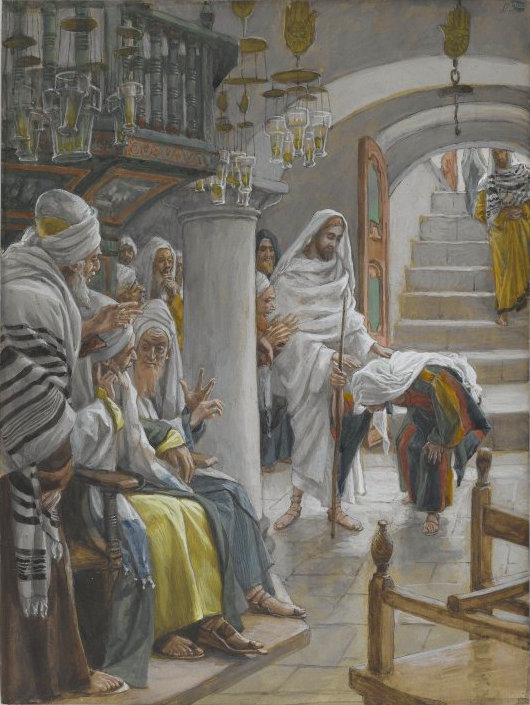
Then, this rabbi did a most unusual thing.  He squatted down on his haunches, down into my limited field of vision, and he looked up into my face.  He was sun-browned, as if he worked in the fields.  Fine lines creased the corners of his eyes, which were a deep, bottomless brown.  He smiled and his kind eyes sparkled with interest and concern. Next, he said the most ridiculous thing that I had ever heard, “Woman, you are set free from your ailment.”  Didn’t he see what everyone else saw: my hideous bent-over back?  Someone snickered. Moshe took a protective step closer.

What happened next is still being talked about in Capernaum.  The rabbi stood up and placed his two broad, strong hands on my poor crippled back.  What I noticed first was warmth, like the sun on a winter day bringing a blessing to your upturned face.  Slowly it flowed out from his hands, spreading down to the tips of my toes and reaching up to the top of my head.  It was then that I realized that my pain was gone.  The spirit of the python that had held me tight in its grip had departed!  I took a deep breath and then another. Then, for the first time in eighteen years, I stood up.  I gasped and shouted bold cries of “Alleluia!” and “Thanks be to the Holy One of Israel!” I hugged Moshe, then I hugged the rabbi as my neighbors watched in shocked silence.

Not everyone was happy.  The synagogue leader was scandalized that I had entered the sanctuary, and the rabbi had healed on the sabbath.  But the rabbi would hear none of it, for surely, even one such as I deserved the mercy that is shown to an ox or mule. 

With a wink, the rabbi turned to me. “Mahalath,” he called me by name. “Mahalath, I think I just finished my sermon for today.”

I practically danced toward the door of the synagogue, followed by the rabbi and Moshe.  Out they went, but before I left, I turned to my neighbors, the ones who for eighteen years had ignored me, gossiped about me, called me names, and failed to show me the courtesy one might extend to a barnyard animal.  I looked them in the eyes and said, “By the way, my name is not Bent-Over-Woman.  My name is Mahallath. You are welcome to come break your fast with us today.”

The synagogue erupted in cheers and praise.  That sabbath evening, Jesus dined with us, and so did all of Capernaum. The pot never emptied, the bread seemed to multiply, and the wine never failed. But that is a miracle to tell on another day.  I rejoiced—and so did the whole village with me—in the wonderful things that Jesus was doing.


Luke 13:10-17

10 Now he was teaching in one of the synagogues on the Sabbath. 11 And just then there appeared a woman with a spirit that had crippled her for eighteen years. She was bent over and was quite unable to stand up straight. 12 When Jesus saw her, he called her over and said, “Woman, you are set free from your ailment.” 13 When he laid his hands on her, immediately she stood up straight and began praising God. 14 But the leader of the synagogue, indignant because Jesus had cured on the Sabbath, kept saying to the crowd, “There are six days on which work ought to be done; come on those days and be cured and not on the Sabbath day.” 15 But the Lord answered him and said, “You hypocrites! Does not each of you on the Sabbath untie his ox or his donkey from the manger and lead it to water? 16 And ought not this woman, a daughter of Abraham whom Satan bound for eighteen long years, be set free from this bondage on the Sabbath day?” 17 When he said this, all his opponents were put to shame, and the entire crowd was rejoicing at all the wonderful things being done by him.


James Tissot, “The Woman with an Infirmity of Eighteen Years” (La femme malade depuis dix-huit ans), Public domain, via Wikimedia Commons, in the collection of the Brooklyn Museum.

Helped and Healed

Sabbath Day Thoughts — “Helped and Healed” 2 Kings 5:1-14

We can find it hard to ask for help. Blame it on our American independence.  We generally think we know best, and we don’t like other people telling us what we should or should not be doing. It’s a deeply held American belief that we can be self-made men or self-made women.  That phrase was coined in 1842 by Senator Henry Clay to describe individuals whose success lay within the individuals themselves, not with outside conditions. Needing help? That can sound downright un-American.

Naaman needed help.  The Syrian General was a mighty man of valor.  He wielded absolute authority over his troops.  He won victory after victory for his country. He commanded the respect of his king.  He amassed untold wealth and acquired a retinue of servants. Naaman even had the favor of the Hebrew God Yahweh, who gave him victory after victory.

But Naaman couldn’t do it all.  Naaman suffered from tzara áth—leprosy.  He had skin lesions and eruptions. In the biblical world, Naaman’s disease rendered him an unclean social outcast, separated from God and neighbors We know that Naaman’s leprosy was bad enough that the household talked about it, and we can surmise that the men whom Naaman commanded did, too. It was bad enough that Naaman and his wife worried about it—and it seems that they had given up hope on finding a cure.  In fact, no one on earth could cure leprosy.  Only God could do that.

We all need help sometimes. The COVID-19 pandemic made us acutely aware of that. We needed help at church.  Thank goodness that our Resource Presbyter David Bennett came by that first week when things shut down and gave Duane and me a crash course in livestreaming.  I can’t begin to say how thankful I am for all the help that Scott and Karen gave me in troubleshooting technical issues and providing music.  How about Gaelle serving week after week as our greeter and COVID screener?  Many hands helped to set up a worship space in the Great Hall and to eventually move us back into the sanctuary.  Help was needed and help abounded.  Thanks be to God.

COVID made us all realize that we needed help at home, too.  Perhaps someone helped you shop for groceries or brought food in when you tested positive.  Our crafty friends got out their sewing machines and stitched up masks for us.  When we couldn’t figure out how to Zoom, thank goodness for those techy people who got us online and in touch.  When there wasn’t any toilet paper, sanitizing wipes, or bleach on the store shelves, neighbors reached into their stashes and shared what was needed. The mass vulnerability of the COVID pandemic turned us to one another in search of help and in willingness to provide it.

Naaman got help.  It started with the most vulnerable member of the household: a young Hebrew slave girl.  She saw the affliction of Naaman and felt compassion. She cared enough to go to her mistress with the hope of a cure.  If only Naaman would go see the Prophet Elisha!  That started a cascade of helping actions.  Naaman’s wife persuaded the general to seek help from his king.  The king wrote a letter of support and loaded up the travel wagons with treasure.  After a momentary meltdown, King Jehoram of Israel sent Naaman to Elisha.  And Elisha stepped up to say that he was the man for the job.

But all those offers of help almost came to no avail.  At Elisha’s house, the mighty man of valor expected an impressive ritual, the prophet in flowing robes, waving his arms, chanting incantations, and touching Naaman’s wounds.  Instead, the front door opened, a servant came out, and Naaman was instructed to bathe seven times in the Jordan, where the murky waters were brown as dirt.  Feeling hurt and disrespected, Naaman prepared to turn around and head home.

Beyond the mutual need of the COVID pandemic, it can be hard for us to ask for help. Nora Bouchard, author of Mayday! Asking for Help in Times of Need, writes that we are hardwired to want to do things our way.  It’s there from the moment that our toddler tells us, “Me do it, Mommy!” to the moment they leave the nest and don’t call home nearly as often as we would like.  We could also be reluctant to ask for help because we do not want to be perceived as needy or vulnerable.  Among the most influential forces in our willingness—or reluctance— to seek help is the attitude that we experienced in our families of origin. Were our bids for help encouraged and answered or were they ignored?  Were we treated like a whiny cry baby? Did someone take advantage of our need for assistance?  If help was hard to come by growing up, then we may have particular trouble asking for help now.  Our wiring, our self-perception, and our formation can all get in the way of asking for the help we need.

We might be more likely to ask for help if we remembered that Jesus asked for help. If you read the gospel lection for today (Luke 10:1-11, 16-20), then you were reminded that Jesus sent seventy disciples on ahead of him in pairs to every place where he himself intended to go. The Lord could have done it all by himself. But Jesus saw the rightness of asking for help and the wisdom of pairing up buddies so that they could help one another.  Jesus also sent them out with minimal resources—no purse, no bag, no sandals. As those vulnerable disciples moved from community to community, sharing the gospel, they depended upon the help of others.  It was in the giving and receiving of help that the beloved community of the first Christians took shape.

It might also inspire us, as independent-minded Americans, to remember on this Independence Day weekend that even our founding fathers and mothers needed help.  It’s questionable whether we would have won the Revolutionary War without the help of our French allies.  Starting in 1775, France became a secret supporter of the revolutionary cause, providing us with engineers to build fortifications, as well as uniforms, arms, and ammunition to equip the Continental Army.  French aid to the colonies came to more that 1.3 billion livres (that’s about $13 billion), crippling their own economy.  At the turning point of the war, at Saratoga in 1777, 90% of American troops carried French rifles and all of our gunpowder came from France.

What might asking for help look like for us?  I like to begin with prayer and inviting others to pray for me.  We could also start small with help for a minor problem, rather than waiting for something to morph into crisis.  We can trust that the Lord has brought people into our lives who will want to help us, just as the Lord did for Naaman.  If those folks can’t help us, they may know someone who can.  We could also consider having a support team, a little like the people who were in our COVID bubbles but permanent.  These are the people with whom we can feel safe asking for help and extending ourselves in help.  There is help out there if we are willing to ask.

Naaman got the help that he needed. Using a tenderness of language that suggests real affection, the servants interceded, saying to Naaman, “Father, if the prophet had commanded you to do something difficult, you would have done it.  Why not try something simple?”  Maybe this healing process really could work. They had come so far.  Wasn’t it worth a try?

Down Naaman went to the shores of Jordan.  He stripped off his uniform and everyone got a look at his scabby skin.  Then he waded down into the chocolaty brown water.  It rose to his ankles and knees.  It surged above his waist and chest.  He grimaced, held his breath, and dunked his head.  Seven times Naaman went down.  Seven times he came up, sputtering.  At some point, Naaman noticed that he was no longer the same.  Help had led to healing.  The mighty man of valor walked out of the river with skin as soft and supple as a young boy. Alleluia!

Help—both holy and human—abounds for the asking.

Resources:

Walter Brueggemann. Knox Preaching Guides: 2 Kings, ed. John H. Hayes, (Atlanta: John Knox Press, 1982).

Lisa Fierenz. “Why Asking for Help Is Hard to Do,” in Psychology Today, April 5, 2017. Accessed online at http://www.psychologytoday.com.

L. Daniel Hawk. “Commentary on 2 Kings 5:1-14” in Preaching This Week, July 3, 2022. Accessed online at www.workingpreacher.org.

Brian C. Jones. “Commentary on 2 Kings 5:1-14” in Preaching This Week, July 7, 2019. Accessed online at www.workingpreacher.org.

Suzanne McGee. “5 Ways the French Helped Win the American Revolution” in History, Sept. 9, 2020. Accessed online at www.history.com.

Cory Stieg. “Everyone Needs Help During the Coronavirus Pandemic” in CNBC: Health and Wellness, April 22, 2020. Accessed online at http://www.cnbc.com

W. Dennis Tucker. “Commentary on 2 Kings 5:1-14” in Preaching This Week, Feb. 15, 2009. Accessed online at http://www.workingpreacher.org.


2 Kings 5:1-14

Naaman, commander of the army of the king of Aram, was a great man and in high favor with his master, because by him the Lord had given victory to Aram. The man, though a mighty warrior, suffered from leprosy. 2Now the Arameans on one of their raids had taken a young girl captive from the land of Israel, and she served Naaman’s wife. 3She said to her mistress, “If only my lord were with the prophet who is in Samaria! He would cure him of his leprosy.” 4So Naaman went in and told his lord just what the girl from the land of Israel had said. 5And the king of Aram said, “Go then, and I will send along a letter to the king of Israel.” He went, taking with him ten talents of silver, six thousand shekels of gold, and ten sets of garments. 6He brought the letter to the king of Israel, which read, “When this letter reaches you, know that I have sent to you my servant Naaman, that you may cure him of his leprosy.” 7When the king of Israel read the letter, he tore his clothes and said, “Am I God, to give death or life, that this man sends word to me to cure a man of his leprosy? Just look and see how he is trying to pick a quarrel with me.” 8But when Elisha the man of God heard that the king of Israel had torn his clothes, he sent a message to the king, “Why have you torn your clothes? Let him come to me, that he may learn that there is a prophet in Israel.” 9So Naaman came with his horses and chariots, and halted at the entrance of Elisha’s house. 10Elisha sent a messenger to him, saying, “Go, wash in the Jordan seven times, and your flesh shall be restored and you shall be clean.” 11But Naaman became angry and went away, saying, “I thought that for me he would surely come out, and stand and call on the name of the Lord his God, and would wave his hand over the spot, and cure the leprosy! 12Are not Abana and Pharpar, the rivers of Damascus, better than all the waters of Israel? Could I not wash in them, and be clean?” He turned and went away in a rage. 13But his servants approached and said to him, “Father, if the prophet had commanded you to do something difficult, would you not have done it? How much more, when all he said to you was, ‘Wash, and be clean’?” 14So he went down and immersed himself seven times in the Jordan, according to the word of the man of God; his flesh was restored like the flesh of a young boy, and he was clean.


Photo by Roman Carey on Pexels.com