Come, Let Us Walk in the Light

Sabbath Day Thoughts — “Come, Let Us Walk in the Light” Isaiah 2:1-5

It was a tough Thanksgiving for Sharon and Tim. Family gathered from far and wide. The food was delicious. Laughter sounded around the table. Everyone cheered and jeered in goodhearted rivalry as the Detroit Lions took on the Green Bay Packers. It was a special day. But Sharon and Tim couldn’t help but think about who was not there. Kyle, their oldest son, doesn’t come to Thanksgiving or Christmas or any of those special family gatherings anymore. It started with a rift over Kyle’s decision to quit school and the division seems to grow wider with the years.

For Henry, the best part about the long Thanksgiving weekend is not going to the office. His workplace has become increasingly polarized along the dividing lines of our national political landscape. His MAGA colleagues rejoice in every tweet that emerges from the oval office while the progressives cheer for their champion from across Lake Champlain Bernie Sanders. Henry tries to stay out of it, but he has found that he has few friends. He’d quit, but he needs the paycheck, and good jobs are hard to find, especially in the Adirondacks.

Jen has been thinking about her former best friend Cynthia. Friends since high school, Jen and Cynthia had a Black Friday tradition. They would rise early, take the Northway south, and do their Christmas shopping at the Colonie Center. After crossing everyone off their gift list, they would enjoy an early dinner at the Cheesecake Factory before heading home, the car filled with presents and the Christmas music blaring on the stereo. But when Cynthia married someone whom Jen didn’t like, the two had a falling out that never healed. Jen misses their friendship and Black Friday tradition.

The Thanksgiving holiday makes us aware of the ways that we have been blessed. God has been so good to us. Yet Thanksgiving and the coming Christmas holiday also draw our attention to the painful holes, protracted conflicts, and disappointing absences in our lives. We long for wholeness, for the peace that only Jesus can bring. We long to walk in his light.

The Prophet Isaiah knew that sense of longing. In his decades-long ministry, Isaiah endured the turbulent rule of four kings: Uzziah, Jotham, Ahaz, and Hezekiah.  Judah’s leaders were a selfish and short-sighted lot, more concerned with preserving their personal power than honoring God or protecting the people. They failed to defend the orphan or hear the pleas of widows. They ground the face of the poor into the dust. God expected justice from Judah’s rulers, but saw only bloodshed. Judah’s kings played dangerous games of shifting alliances between the reigning superpowers of their day. First, King Ahaz conspired with the Assyrians to undermine and overthrow his kin in the Northern Kingdom. Then, Hezekiah formed a secret alliance with Egypt. When Hezekiah’s double dealing came to light, the Assyrian armies rolled over Judah. Forty-six fortified cities were destroyed, and Jerusalem was encircled. Hezekiah and his people were imprisoned within a city under siege.

Into this time of suffering and violence, Isaiah shared God’s radically hopeful vision of Jerusalem. Instead of laying siege to Jerusalem, the nations of the world made a holy pilgrimage to the city. The roads thronged with people: rich and poor, young and old, sinners and saints. They walked in worn sandals. They rode opulently saddled camels. They strode with the vigor of youth. They leaned on canes and limped with the creaky joints of age. They carried babies on their hips. They sang songs of peace, “I ain’t gonna study war no more” and “Imagine all the people living life in peace.” Sounds of excitement, laughter, and hope could be heard along the way. Neighbor called to neighbor, “Come, let us go up to Jerusalem! Let us learn from God.”

When they reached the holy city, the people found that it was not ruled by Uzziah, Jotham, Ahaz, or Hezekiah. On the contrary, God was sovereign there, and God was cleaning house, ending years of injustice and oppression, judging between the nations and arbitrating for the people. There was peace and a new beginning for all God’s children. Jerusalem’s center of industry was no longer the privileged elite who built fortunes on the backs of the poor. Now, the most sought-after tradespeople were the blacksmiths. Their forges glowed red-hot, night and day. Their hammers rang out and sparks rose up in fiery showers as they beat the instruments of death into the tools of life. Swords became plowshares, spears became pruning hooks. Tanks turned to combines. AK-47s, Kalashnikovs, and Uzis transformed to hoes, rakes, and cultivators. What a lovely luminous vision held out to people living in dark times! O house of Jacob!  Come, let us walk in the light of the Lord!

As we hear Isaiah’s prophecy, we feel a terrible tension between what is and what could be, between the corruption and political intrigue of ancient Judah and God’s holy hope for Jerusalem. We know, too, the tension of Isaiah’s vision for our own lives and times, the tension between the brokenness of our families, workplaces, and friendships and the ways that God would have us live. Isaiah’s vision is a powerful and enduring invitation to faithful people to be grounded in and directed by God, to choose once and for all to walk in God’s light, to live into God’s good vision for a healed world where differences are overcome by an irresistible, holy love.

This Sunday, as we remember Isaiah’s vision and begin the season of Advent, anticipating the light of Christ that shines in our world’s darkness, we are invited to be agents of Isaiah’s vision of peace and transformation in our own communities and within our own families. This is the really hard part. Change begins here, within our heart of hearts, as we allow God’s love and grace to heal old hurts and turn us to one another with a spirit of forgiveness and forbearance. To walk in the light, we must first allow it to shine within us and transform us. Then, we must be willing to allow that light to shine through us to our neighbors, knowing that we are one and all God’s beloved children. 

There is the famous story of a wise old Rabbi who taught his students by asking them questions.  “How can a person tell when the darkness ends and the day begins?” he asked. After thinking a moment, one student replied, “It is when there is enough light to see an animal in the distance and be able to tell if it is a sheep or a goat.” Another student ventured, “It is when there is enough light to see a tree and tell if it is a fig or an oak tree.” The old Rabbi smiled and gently said, “No. It is when you can look into a man’s face and recognize him as your brother. For if you cannot recognize in another’s face the face of your brother or sister, the darkness has not yet begun to lift, and the light has not yet come.”  Come, let us walk in the light.

On this first Sunday of Advent, perhaps we could follow in Isaiah’s footsteps and cast our own vision of the world that we can make if only we will choose to walk in the light. It will be a world where we love God and we love one another as we love ourselves. It will be a world where we will even dare to love our enemies and pray for those who have persecuted us. It will be a world where we will turn the other cheek, go the extra mile, and forgive as we have been forgiven. The sharp barbs of our personal criticisms will be transformed to words of encouragement and praise. The battle lines of our political landscape will unravel at the table of peace. The sticks of insults hurled and stones of promises broken will fall powerless at the feet of unstoppable love. We will truly see one another as brothers, sisters all.

It’s a world where family rifts will come to an end, and Sharon and Tim will share Thanksgiving dinner with Kyle. It’s a world where toxic politics are set aside in favor of the common good, and Henry will like his job again. It’s a world where friendships endure despite personal differences, and Jen and Cynthia will celebrate the conclusion of their Black Friday shopping over a piece of Godiva Chocolate Cheesecake. It’s a world where we put God at the center of it all, and we learn to live by the words that Jesus taught. Can we dare to dream it?

O house of Jacob!  Come, let us walk in the light of the Lord!
Resources

Corinne Carvalho. “Commentary on Isaiah 2:1-5” in Preaching This Week, Nov. 30, 2025. Accessed online at https://www.workingpreacher.org/commentaries/revised-common-lectionary/first-sunday-of-advent/commentary-on-isaiah-21-5-7

Joel Kemp. “Commentary on Isaiah 2:1-5” in Preaching This Week, Nov. 27, 2022. Accessed online at https://www.workingpreacher.org/commentaries/revised-common-lectionary/first-sunday-of-advent/commentary-on-isaiah-21-5-6

Anathea Portier-Young. “Commentary on Isaiah 2:1-5” in Preaching This Week, Nov. 28, 2010. Accessed online at https://www.workingpreacher.org/commentaries/revised-common-lectionary/first-sunday-of-advent/commentary-on-isaiah-21-5

Fred Gaiser. “Commentary on Isaiah 2:1-5” in Preaching This Week, Dec. 2, 2007. Accessed online at https://www.workingpreacher.org/commentaries/revised-common-lectionary/first-sunday-of-advent/commentary-on-isaiah-21-5-2

The traditional story of the wise rabbi is from Dennis Bratcher “Hope!” www.cresourcei.org


Isaiah 2:1-5

The word that Isaiah son of Amoz saw concerning Judah and Jerusalem.

In days to come
    the mountain of the Lord’s house
shall be established as the highest of the mountains
    and shall be raised above the hills;
all the nations shall stream to it.
    Many peoples shall come and say,
“Come, let us go up to the mountain of the Lord,
    to the house of the God of Jacob,
that he may teach us his ways
    and that we may walk in his paths.”
For out of Zion shall go forth instruction
    and the word of the Lord from Jerusalem.
He shall judge between the nations
    and shall arbitrate for many peoples;
they shall beat their swords into plowshares
    and their spears into pruning hooks;
nation shall not lift up sword against nation;
    neither shall they learn war any more.
O house of Jacob,
    come, let us walk
in the light of the Lord!


Photo by Thilipen Rave Kumar on Pexels.com

A Peaceable Kingdom

Sabbath Day Thoughts — “A Peaceable Kingdom” Isaiah 65:17-25

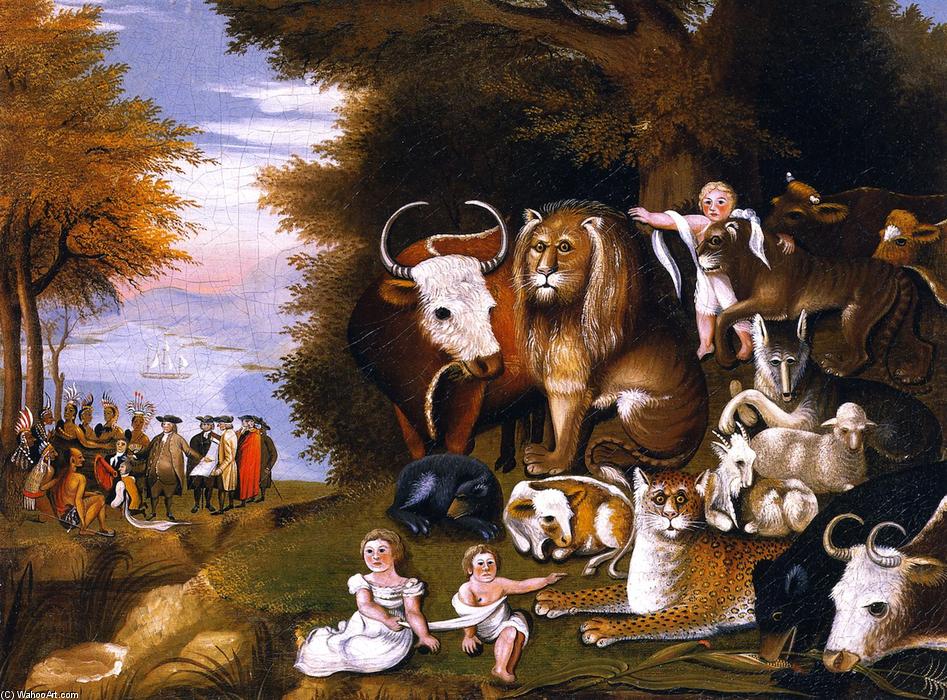
Edward Hicks was a Quaker sign painter born in Pennsylvania in 1780. He is acknowledged as one of America’s greatest folk artists. In 1820, when Edward was forty years old, he painted Isaiah’s vision of “The Peaceable Kingdom.” Against a green landscape and blue skies, a primitive looking infant, swaddled in gauzy cloth, sits between a pointy-horned ox and a lounging lion. The ox and the lion munch on hay. Nearby, a wooly lamb cozies up to a placid wolf. Two goats and a leopard look like best friends. It’s a wistful vision of a new creation, a world where violence has come to an end, where all God’s creatures live in peace, abundance, and safety.

This morning, the world is far from that bucolic vision of the peaceable kingdom. It’s day 1,361 of the war in Ukraine. Fierce fighting is ongoing in Zaporizihia, amid adverse weather conditions. In response to ongoing Russian aggression, Ukraine has targeted drone and missile strikes on key Russian oil facilities to disrupt Russian supply lines and military operations. On Friday night, Russia launched a blistering assault on Ukraine, killing at least six people and injuring 35 as 430 drones and 18 missiles rained down through the night sky. It’s estimated that Russian military casualties in the war have topped 1,000,000 personnel while Ukraine’s deaths and injuries are near 450,000. An estimated 45,000 Ukrainian civilians have been caught in the crossfire, about 3,000 of those children. We long for a peaceable kingdom.

Yemen has been locked in civil war for more than a decade. In September 2014, Houthi forces took control of the capital, Sanaa, following widespread discontent with the Saudi-backed government. A coalition, led by Saudi Arabia, stepped in, using air strikes to try to restore the former Yemeni government. Al Qaeda and ISIS fighters soon saw the conflict as a way to advance their regional ambitions, so they have carried out attacks against both factions. In the shadows, the Iranians pull the strings. Israel has been drawn into the conflict, killing the Yemeni Prime Minister in an August airstrike. In just the first three years of the war, more than 85,000 children died of starvation. A decade of war has left Yemen’s infrastructure in ruins and its people exhausted. Close to 20 million people in Yemen depend on aid simply to survive. Nearly five million are homeless, pushed from one place to another by violence and disaster. We long for a peaceable kingdom.

In our reading from the Prophet Isaiah, we hear God’s promise of a peaceable kingdom. The Israelites had returned to Jerusalem after fifty years of exile in Babylon. They were refugees returning to a homeland that was broken and scarred by war. Ancestral property rights were gone. Vineyards and fields had gone wild. Food was scarce. Disease was rampant. Neighbors, who had not gone into exile, were hostile and suspicious. Roads were unsafe. The Temple was in ruins. In a devastated land that once flowed with milk and honey, the people’s safety and security hung upon the mercy of a foreign king. A foreign-appointed government had replaced the once mighty kingship of David. The lives of the remnant of Israel were so filled with death, grief, hunger, and despair that they began to wonder. Is God with us? Has God forsaken us and sent us home to live as a broken people in a broken land?

Into this time of uncertainty and fear, Isaiah spoke words of prophetic promise, a beautiful vision of a fresh start in a new Jerusalem where weeping will cease and children will thrive. It was a bold vision of long life, good homes, and abundant harvests. It was a faithful promise of abiding love and prayers answered from generation to generation.  It was a holy vision of peace for all creation, of a new Eden where the wolf and the lamb shall feed together, the lion shall eat straw like the ox, and God’s holy mountain will be free of hurt and destruction. God promised the people an everlasting shalom, the peace and wholeness that we find when we are in right relationship with God, neighbor, and even within ourselves.

I imagine that as the people listened, their eyes filled with tears and their hearts with longing. They remembered that God is with them, always with them. They found the courage to persevere and seek the future that God held ready for them. They rolled up their sleeves and worked the fallow fields. They shared what little they had, so that everyone had enough. They gathered at the Temple, worshipped amid the ruins, and dreamed of a new sanctuary. They reached out to their suspicious neighbors with kindness and patience, setting aside their tribalism to work toward a shared future. It wasn’t exactly the peaceable kingdom, but it held the promise of it.

This morning, we may not be caught up in the ground-shaking artillery fire of Zaporizihia, or the mass homelessness and hunger of Yemen, or the despair of Israelite refugees returning to a broken land, but we, too, long for a peaceable kingdom. We mourn the casualties in Ukraine, the devastation of Gaza, and the threat of war with Venezuela. We are grieved by the fracture of longstanding alliances and friendships between nations. We are frightened by the seemingly intractable polarization of our political landscape. We despair over the lack of respect or even common courtesy in our public discourse. In this land of plenty, we are shocked by widespread food insecurity and the millions of neighbors who teeter on the brink of economic crisis. We long for a peaceable kingdom.

As the holidays draw near, we acknowledge that we long for peace closer to home. We want peace for our families; we dream of a holiday table where every place is occupied, every tummy is full, the conversation is merry, and the love abounds. We need God’s peace to find a spirit of tolerance and acceptance, to heal our hardheartedness and unwillingness to accept one another as we are. We long for God’s forgiveness that will be a balm for old wounds and long-held grudges. We pray for God’s courage and grace to name and heal from incidents of abuse. And when we take the time to be quiet, to go deeper, we admit that we need God’s peace in our hearts, so that we may forgive ourselves as we have forgiven others, love without strings attached, and accept what cannot be changed. We long for a peaceable kingdom.

This morning, may we hear anew God’s promise through the Prophet Isaiah of the new heavens and new earth, of the peaceable kingdom where ancient enmities come to an end, where the lion lies down with the lamb. May we remember that God is with us, always with them. We may make a mess of our world, but future is always in God’s hands, and the vision is one of peace.

If we listen with the ears of our hearts, we may even hear God’s vision that peace begins with us. We are not the architects of the peaceable kingdom, but we can be the artists, painting peace with the brushstrokes of lives lived in faith and love. Let’s roll up our sleeves and join God in the work of shalom. We cannot arbitrate ceasefires for Ukraine and Yemen, yet we can pray for their peace. We can demand better and more peaceful ways for those who govern. We can reach out to neighbors with kindness and patience, setting aside tribalism to work toward a shared future. We can share what we have, so that everyone has enough. We can dare to heal our families, reaching out with love, even if our best efforts fall short. Let’s extend to others and to ourselves the grace that has been so freely shared with us in Jesus. It won’t be the peaceable kingdom, but with God’s help our lives may begin to hold the promise of it. Let’s take a moment to commit ourselves to take one action in the coming week that can prosper peace.

The Quaker painter Edward Hicks painted “The Peaceable Kingdom” more than a hundred times in the last twenty years of his life, as if by repeatedly painting the promise of the kingdom he could hasten its coming. Over the years, Hicks’ Bucks County surroundings began to be represented in his paintings. The Delaware River wound through the background. Little girls entered the picture, breaking the gender barrier and joining the Christ child in his peaceful romp with the wild beasts. In the distance, William Penn and his Quaker friends, clad in somber shades of gray and black, passed a peace pipe with Lenni Lenape tribesmen in bright blankets, feathers, and wampum. Hicks painted to cast a prophetic vision of harmony and plenty, an end to violence and bloodshed, a setting aside of oppression for women and people of color. It’s as if Hicks trusted that if he could share Isaiah’s vision in ways that spoke to his world, folks would understand and change would come. It wouldn’t be the peaceable kingdom, but with God’s help there would be the promise of it.

We may not be America’s greatest folk artists, but Isaiah’s vision of the peaceable kingdom still sparks the imagination of God’s people. May we go forth to seek that kingdom with the broad brushstrokes of lives lived in pursuit of peace.

Resources

Carolyn J. Sharp. “Commentary on Isaiah 65:17-25” in Preaching This Week, Nov. 14, 2010. Accessed online at Commentary on Isaiah 65:17-25 – Working Preacher from Luther Seminary

Garrett Galvin. “Commentary on Isaiah 65:17-25” in Preaching This Week, Nov. 14, 2010. Accessed online at Commentary on Isaiah 65:17-25 – Working Preacher from Luther Seminary

John Braostoski. “Hicks’s Peaceable Kingdom,” Friends Journal, February 2000. Hicks’s Peaceable Kingdom – Friends Journal

James C. Reynolds and Steffie Banatvala. “Inside Putin’s campaign of terror in Kyiv: Why Russia keeps bombarding the capital” In The Independent, Nov. 14, 2025. Accessed online at Inside Putin’s campaign of terror in Kyiv: Why Russia keeps bombarding the capital | The Independent

Lyndal Rowlands and News Agencies. “Russia-Ukraine war: List of key events, day 1,357” in Aljazeera, Nove. 12, 2025. Accessed online at Russia-Ukraine war: List of key events, day 1,357 | Russia-Ukraine war News | Al Jazeera

Statista Research Department. “Number of civilian casualties in Ukraine during Russia’s invasion verified by OHCHR from February 24, 2022 to July 31, 2025,” Statista, Sept. 25, 2025. Accessed online at Ukraine civilian war casualties 2025| Statista

Othman Belbeisi. “Yemen: Ten Years of War, a Lifetime of Loss” in UN News, March 26, 2025. Accessed online at Yemen: Ten Years of War, a Lifetime of Loss | UN News


Isaiah 65:17-25

For I am about to create new heavens
    and a new earth;
the former things shall not be remembered
    or come to mind.
18 But be glad and rejoice forever
    in what I am creating,
for I am about to create Jerusalem as a joy
    and its people as a delight.
19 I will rejoice in Jerusalem
    and delight in my people;
no more shall the sound of weeping be heard in it
    or the cry of distress.
20 No more shall there be in it
    an infant who lives but a few days
    or an old person who does not live out a lifetime,
for one who dies at a hundred years will be considered a youth,
    and one who falls short of a hundred will be considered accursed.
21 They shall build houses and inhabit them;
    they shall plant vineyards and eat their fruit.
22 They shall not build and another inhabit;
    they shall not plant and another eat,
for like the days of a tree shall the days of my people be,
    and my chosen shall long enjoy the work of their hands.
23 They shall not labor in vain
    or bear children for calamity,[a]
for they shall be offspring blessed by the Lord—
    and their descendants as well.
24 Before they call I will answer,
    while they are yet speaking I will hear.
25 The wolf and the lamb shall feed together;
    the lion shall eat straw like the ox,
    but the serpent—its food shall be dust!
They shall not hurt or destroy
    on all my holy mountain,
            says the Lord.


“The Peaceable Kingdom” Edward Hicks, 1832. From the collection of the Abby Aldrich Rockefeller Folk Art Center (United States)

The Pearl of Scotland

Sabbath Day Thoughts — “The Pearl of Scotland” Isaiah 6:1-8

Let me tell you two stories.

Margaret never wanted to be a queen. She was the granddaughter of Edmund Ironside, one of the last Saxon kings of England. Amid the struggle for succession that followed Edmund’s death, Margaret’s father Edward was sent to the protection of King Stephen of Hungary. When Margaret was only nine, the family returned to England, where the king, childless and aging, had resolved to adopt Edward as his heir. But within days of their return to English soil, Edward fell mysteriously ill and died. For the next twelve years, Margaret was a dependent of the royal court until her brother Harold could inherit the crown. Margaret had little appetite for court with its pomp, intrigue, and power. Instead, she led a quiet and devout life, finding comfort in prayer, the study of scripture, and meditating upon the life of Christ. She was befriended by a fellow exile, Malcolm of Scotland, whose father had been murdered by the usurper Macbeth.

Isaiah never wanted to be a prophet. Young Isaiah was worshipping in the Temple, surrounded by songs and prayers, sacrifice and incense, when he saw a vision of the heavenly throne room. So limitless was God that the Temple could barely contain the hem of God’s robe.  In a flash of spiritual insight, Isaiah realized that his earthly worship was only a dim echo of heavenly rejoicing. Six-winged seraphs thundered God’s praise, shouting “Holy, holy, holy!” Amid the overwhelming sanctity of the heavenly and earthly throne rooms, Isaiah heard an undeniable voice. The Triune God called, saying to him, “Whom shall I send?”

Margaret’s calling came in the year 1066 when she was twenty-one. William the Conqueror laid claim to the English throne and defeated the British at the Battle of Hastings. Margaret, with her mother and siblings, fled north and boarded a boat, intent on returning to the safety of Hungary. But as the boat got underway, a mighty wind blew them off course, driving them ever further north until they ran aground in the broad estuary where the Forth River empties into the North Sea. There, they learned that providence had brought them to an old friend: Malcolm of Scotland. Now king, Malcolm was widowed with a young son. By all accounts, when Malcolm again saw Margaret, he fell head-over-heels in love. Here was his new queen, sent to him by God. Within days, Malcolm proposed, but the exiled princess turned down the royal invitation.

When God asked, “Whom shall I send?”, Isaiah was reluctant to answer the call. Confronted by the earthshaking holiness of God almighty, Isaiah felt only his frailty and unworthiness. Every false or self-serving statement that Isaiah had ever spoken rang in his ears, forcing him to confess the painful truth of his sinfulness, “I am a man of unclean lips, and I live among a people of unclean lips.” But the reluctant Isaiah soon learned that God could work with that. A coal, plucked from the fire of the heavenly throne room, touched Isaiah’s lips, and his sins were refined by the holy fire. Isaiah’s overweening sense of unworthiness was replaced by a compulsion to speak God’s word to the people.

When the exiled Princess Margaret declined Malcolm’s proposal, the Scottish King persisted. He granted Margaret’s family his protection, and they came to live in his castle at Dunfermline. There Margaret saw a royal court far removed from the pomp and intrigue of England. Malcolm was illiterate. His subjects lived in poverty. Margaret’s love for the king began as she read to him from the New Testament, and she learned of his passion to improve the lives of his people. Margaret and Malcolm heard in the words of Jesus, an imperative to serve the “least of these.” More than three years after that fateful wind blew her north to Scotland, Margaret finally said, “Yes,” to Malcolm. She came to see that her royal marriage would allow her to serve two kingdoms, one earthly, the other heavenly.

Isaiah’s words of prophecy held a similar concern for the vulnerable of the land. He had seen the face of poverty and the indifference of the rich. They had failed to honor the words of God, ignored the plight of the widow and orphan, denied justice to the foreign worker, and ground the face of the poor into the dust. The prophet spoke God’s judgment against the Kingdom of Judah, pleading with them to repent. Time was short, Isaiah warned, but they could still learn to do good: to seek justice, rescue the oppressed, defend the orphan, and plead for the widow (Is. 1:17). If they failed, God would bring judgment against the people of Israel. Babylon would rise. Judah would be conquered and taken into exile.

Margaret and Malcolm had a happy, fruitful marriage. The exiled princess, now a queen, became the mother of eight children and the mother of the Scottish people. She saw herself as a steward, entrusted by God with the care of a nation. Each morning, Margaret left the palace at Dunfermline with her New Testament tucked under her arm. She took a seat on a rock outside the royal residence to receive guests who came to her for counsel, prayer, and help. The queen fed nine orphans every morning with her own silver spoon. Each evening, Margaret and Malcolm opened their table to 24 of their poorest neighbors. They instituted a series of feast days, in keeping with the church calendar, when 300 of their most vulnerable subjects were banqueted with royal splendor. Motivated by the love of Christ, they built schools and churches, opened hospitals and hostels, and rebuilt Iona Abbey, which had fallen into ruin. They instituted sabbath laws, giving workers a weekly day of rest. Margaret had special concern for prisoners and exiles. She bought the freedom of English and Irish slaves, returning them to their homelands.

When Isaiah’s prophecy was fulfilled and Judah fell to Babylonian invaders, Isaiah’s call shifted as the no-longer-powerful people of Judah became as vulnerable as the poor they had once oppressed. Isaiah spoke God’s words of consolation to a hurting people, “Comfort, comfort my people, says your God.  Speak tenderly to Jerusalem” (Isaiah 40:1).  Years later as the exiles returned home, Isaiah went with them, prophesying about God’s plans for a new beginning for the humbled nation, speaking God’s promise, “For I will create a new heaven and a new earth; the past events will not be remembered or come to mind” (Isaiah 65:17). Perhaps Isaiah’s greatest legacy, though, was the lasting impact that he would have upon all who pursue God’s call to serve the last and the least. When Jesus preached to his hometown crowd in Nazareth, he opened the scroll to the words of the prophet Isaiah and read words that were fulfilled in his ministry, “The Spirit of the Lord is upon me, because he has anointed me to bring good news to the poor. He has sent me to proclaim release to the captives and recovery of sight to the blind, to let the oppressed go free, to proclaim the year of the Lord’s favor.”

In 1093, when King Malcolm and their oldest son were killed in a skirmish with Norman invaders, Queen Margaret, hearing the news in Edinburgh, fell sick. She died three days later; some say of a broken heart. But Margaret and Malcolm’s youngest son, David, would become Scotland’s most beloved king, pursuing his father’s royal rule and his mother’s passion for the least of these. One hundred and fifty years after Margaret’s death, those who remembered her life and legacy began to advocate for her canonization as a saint. The trouble was that she didn’t fit the traditional mold of sainthood. She was a devoted wife and the happy mother of a large family. She worked no miracles, other than the everyday miracle of loving her people and advocating ceaselessly for their health, justice, and care. The arbiters of sainthood in Rome came up with four posthumous miracles for Margaret, all related to her tomb and bones. Today Margaret is reverenced as the patron saint of service to the poor, learning, large families, mothers, and all those who are raising children. Margaret’s greater legacy is felt whenever we, who have privilege by virtue of our birth, education, or wealth, choose to generously use our resources for the good of our vulnerable neighbors.

In his biography of Margaret, her friend and confessor Bishop Turgot of St. Andrews, noted that the name Margaret derives from the Greek word Margaron, meaning pearl. Turgot wrote, “She was called Margaret, and in the sight of God she showed herself to be a pearl, precious in faith and works. She was indeed a pearl to you, to me, to all of us, yea, to Christ Himself, and being Christ’s she is all the more ours now that she has left us, having been taken to the Lord. . . and now she shines in her place among the jewels of the Eternal King.” Margaret has been known as the Pearl of Scotland ever since.

Resources:

Turgot, Bishop of St. Andrew’s. “Life of St. Margaret Queen of Scotland.” trans. Theodericus Monk of Durham and William Forbes-Leith. Edinburgh: William Paterson Press, 1884. Accessed online at https://archive.org/details/lifeofstmargaret00turguoft/lifeofstmargaret00turguoft/page/n9/mode/2up

Clerk of Oxford. “St Margaret of Scotland,” June 10, 2012. Accessed online at https://aclerkofoxford.blogspot.com/2012/06/st-margaret-of-scotland.html

Griffiths, Paul James. “Queen Margaret: the Pearl of Scotland” in The Middle Ages, May 7, 2021. Accessed online at https://www.christianheritageedinburgh.org.uk

Floyd, Michael. “Exegetical Perspective on Isaiah 6:1-8” in Feasting on the Word, Year B Vol. 2.  Louisville: Westminster John Knox Press, 2009.

Ramsey Jr., G. Lee. “Homiletical Perspective on Isaiah 6:1-8” in Feasting on the Word, Year B Vol. 2.  Louisville: Westminster John Knox Press, 2009.


Isaiah 6:1-8

6In the year that King Uzziah died, I saw the Lord sitting on a throne, high and lofty; and the hem of his robe filled the temple. 2Seraphs were in attendance above him; each had six wings: with two they covered their faces, and with two they covered their feet, and with two they flew. 3And one called to another and said: “Holy, holy, holy is the Lord of hosts; the whole earth is full of his glory.” 4The pivots on the thresholds shook at the voices of those who called, and the house filled with smoke.

5And I said: “Woe is me! I am lost, for I am a man of unclean lips, and I live among a people of unclean lips; yet my eyes have seen the King, the Lord of hosts!” 6Then one of the seraphs flew to me, holding a live coal that had been taken from the altar with a pair of tongs. 7The seraph touched my mouth with it and said: “Now that this has touched your lips, your guilt has departed and your sin is blotted out.” 8Then I heard the voice of the Lord saying, “Whom shall I send, and who will go for us?” And I said, “Here am I; send me!”


Santa Margarida da Escócia – Basílica de São Patrício, Montreal (Canadá) – Foto: Gustavo Kralj