Sabbath Day Thoughts — “A Peaceable Kingdom” Isaiah 65:17-25
Edward Hicks was a Quaker sign painter born in Pennsylvania in 1780. He is acknowledged as one of America’s greatest folk artists. In 1820, when Edward was forty years old, he painted Isaiah’s vision of “The Peaceable Kingdom.” Against a green landscape and blue skies, a primitive looking infant, swaddled in gauzy cloth, sits between a pointy-horned ox and a lounging lion. The ox and the lion munch on hay. Nearby, a wooly lamb cozies up to a placid wolf. Two goats and a leopard look like best friends. It’s a wistful vision of a new creation, a world where violence has come to an end, where all God’s creatures live in peace, abundance, and safety.
This morning, the world is far from that bucolic vision of the peaceable kingdom. It’s day 1,361 of the war in Ukraine. Fierce fighting is ongoing in Zaporizihia, amid adverse weather conditions. In response to ongoing Russian aggression, Ukraine has targeted drone and missile strikes on key Russian oil facilities to disrupt Russian supply lines and military operations. On Friday night, Russia launched a blistering assault on Ukraine, killing at least six people and injuring 35 as 430 drones and 18 missiles rained down through the night sky. It’s estimated that Russian military casualties in the war have topped 1,000,000 personnel while Ukraine’s deaths and injuries are near 450,000. An estimated 45,000 Ukrainian civilians have been caught in the crossfire, about 3,000 of those children. We long for a peaceable kingdom.
Yemen has been locked in civil war for more than a decade. In September 2014, Houthi forces took control of the capital, Sanaa, following widespread discontent with the Saudi-backed government. A coalition, led by Saudi Arabia, stepped in, using air strikes to try to restore the former Yemeni government. Al Qaeda and ISIS fighters soon saw the conflict as a way to advance their regional ambitions, so they have carried out attacks against both factions. In the shadows, the Iranians pull the strings. Israel has been drawn into the conflict, killing the Yemeni Prime Minister in an August airstrike. In just the first three years of the war, more than 85,000 children died of starvation. A decade of war has left Yemen’s infrastructure in ruins and its people exhausted. Close to 20 million people in Yemen depend on aid simply to survive. Nearly five million are homeless, pushed from one place to another by violence and disaster. We long for a peaceable kingdom.
In our reading from the Prophet Isaiah, we hear God’s promise of a peaceable kingdom. The Israelites had returned to Jerusalem after fifty years of exile in Babylon. They were refugees returning to a homeland that was broken and scarred by war. Ancestral property rights were gone. Vineyards and fields had gone wild. Food was scarce. Disease was rampant. Neighbors, who had not gone into exile, were hostile and suspicious. Roads were unsafe. The Temple was in ruins. In a devastated land that once flowed with milk and honey, the people’s safety and security hung upon the mercy of a foreign king. A foreign-appointed government had replaced the once mighty kingship of David. The lives of the remnant of Israel were so filled with death, grief, hunger, and despair that they began to wonder. Is God with us? Has God forsaken us and sent us home to live as a broken people in a broken land?
Into this time of uncertainty and fear, Isaiah spoke words of prophetic promise, a beautiful vision of a fresh start in a new Jerusalem where weeping will cease and children will thrive. It was a bold vision of long life, good homes, and abundant harvests. It was a faithful promise of abiding love and prayers answered from generation to generation. It was a holy vision of peace for all creation, of a new Eden where the wolf and the lamb shall feed together, the lion shall eat straw like the ox, and God’s holy mountain will be free of hurt and destruction. God promised the people an everlasting shalom, the peace and wholeness that we find when we are in right relationship with God, neighbor, and even within ourselves.
I imagine that as the people listened, their eyes filled with tears and their hearts with longing. They remembered that God is with them, always with them. They found the courage to persevere and seek the future that God held ready for them. They rolled up their sleeves and worked the fallow fields. They shared what little they had, so that everyone had enough. They gathered at the Temple, worshipped amid the ruins, and dreamed of a new sanctuary. They reached out to their suspicious neighbors with kindness and patience, setting aside their tribalism to work toward a shared future. It wasn’t exactly the peaceable kingdom, but it held the promise of it.
This morning, we may not be caught up in the ground-shaking artillery fire of Zaporizihia, or the mass homelessness and hunger of Yemen, or the despair of Israelite refugees returning to a broken land, but we, too, long for a peaceable kingdom. We mourn the casualties in Ukraine, the devastation of Gaza, and the threat of war with Venezuela. We are grieved by the fracture of longstanding alliances and friendships between nations. We are frightened by the seemingly intractable polarization of our political landscape. We despair over the lack of respect or even common courtesy in our public discourse. In this land of plenty, we are shocked by widespread food insecurity and the millions of neighbors who teeter on the brink of economic crisis. We long for a peaceable kingdom.
As the holidays draw near, we acknowledge that we long for peace closer to home. We want peace for our families; we dream of a holiday table where every place is occupied, every tummy is full, the conversation is merry, and the love abounds. We need God’s peace to find a spirit of tolerance and acceptance, to heal our hardheartedness and unwillingness to accept one another as we are. We long for God’s forgiveness that will be a balm for old wounds and long-held grudges. We pray for God’s courage and grace to name and heal from incidents of abuse. And when we take the time to be quiet, to go deeper, we admit that we need God’s peace in our hearts, so that we may forgive ourselves as we have forgiven others, love without strings attached, and accept what cannot be changed. We long for a peaceable kingdom.
This morning, may we hear anew God’s promise through the Prophet Isaiah of the new heavens and new earth, of the peaceable kingdom where ancient enmities come to an end, where the lion lies down with the lamb. May we remember that God is with us, always with them. We may make a mess of our world, but future is always in God’s hands, and the vision is one of peace.
If we listen with the ears of our hearts, we may even hear God’s vision that peace begins with us. We are not the architects of the peaceable kingdom, but we can be the artists, painting peace with the brushstrokes of lives lived in faith and love. Let’s roll up our sleeves and join God in the work of shalom. We cannot arbitrate ceasefires for Ukraine and Yemen, yet we can pray for their peace. We can demand better and more peaceful ways for those who govern. We can reach out to neighbors with kindness and patience, setting aside tribalism to work toward a shared future. We can share what we have, so that everyone has enough. We can dare to heal our families, reaching out with love, even if our best efforts fall short. Let’s extend to others and to ourselves the grace that has been so freely shared with us in Jesus. It won’t be the peaceable kingdom, but with God’s help our lives may begin to hold the promise of it. Let’s take a moment to commit ourselves to take one action in the coming week that can prosper peace.
The Quaker painter Edward Hicks painted “The Peaceable Kingdom” more than a hundred times in the last twenty years of his life, as if by repeatedly painting the promise of the kingdom he could hasten its coming. Over the years, Hicks’ Bucks County surroundings began to be represented in his paintings. The Delaware River wound through the background. Little girls entered the picture, breaking the gender barrier and joining the Christ child in his peaceful romp with the wild beasts. In the distance, William Penn and his Quaker friends, clad in somber shades of gray and black, passed a peace pipe with Lenni Lenape tribesmen in bright blankets, feathers, and wampum. Hicks painted to cast a prophetic vision of harmony and plenty, an end to violence and bloodshed, a setting aside of oppression for women and people of color. It’s as if Hicks trusted that if he could share Isaiah’s vision in ways that spoke to his world, folks would understand and change would come. It wouldn’t be the peaceable kingdom, but with God’s help there would be the promise of it.
We may not be America’s greatest folk artists, but Isaiah’s vision of the peaceable kingdom still sparks the imagination of God’s people. May we go forth to seek that kingdom with the broad brushstrokes of lives lived in pursuit of peace.
Resources
Carolyn J. Sharp. “Commentary on Isaiah 65:17-25” in Preaching This Week, Nov. 14, 2010. Accessed online at Commentary on Isaiah 65:17-25 – Working Preacher from Luther Seminary
Garrett Galvin. “Commentary on Isaiah 65:17-25” in Preaching This Week, Nov. 14, 2010. Accessed online at Commentary on Isaiah 65:17-25 – Working Preacher from Luther Seminary
John Braostoski. “Hicks’s Peaceable Kingdom,” Friends Journal, February 2000. Hicks’s Peaceable Kingdom – Friends Journal
James C. Reynolds and Steffie Banatvala. “Inside Putin’s campaign of terror in Kyiv: Why Russia keeps bombarding the capital” In The Independent, Nov. 14, 2025. Accessed online at Inside Putin’s campaign of terror in Kyiv: Why Russia keeps bombarding the capital | The Independent
Lyndal Rowlands and News Agencies. “Russia-Ukraine war: List of key events, day 1,357” in Aljazeera, Nove. 12, 2025. Accessed online at Russia-Ukraine war: List of key events, day 1,357 | Russia-Ukraine war News | Al Jazeera
Statista Research Department. “Number of civilian casualties in Ukraine during Russia’s invasion verified by OHCHR from February 24, 2022 to July 31, 2025,” Statista, Sept. 25, 2025. Accessed online at Ukraine civilian war casualties 2025| Statista
Othman Belbeisi. “Yemen: Ten Years of War, a Lifetime of Loss” in UN News, March 26, 2025. Accessed online at Yemen: Ten Years of War, a Lifetime of Loss | UN News
Isaiah 65:17-25
For I am about to create new heavens
and a new earth;
the former things shall not be remembered
or come to mind.
18 But be glad and rejoice forever
in what I am creating,
for I am about to create Jerusalem as a joy
and its people as a delight.
19 I will rejoice in Jerusalem
and delight in my people;
no more shall the sound of weeping be heard in it
or the cry of distress.
20 No more shall there be in it
an infant who lives but a few days
or an old person who does not live out a lifetime,
for one who dies at a hundred years will be considered a youth,
and one who falls short of a hundred will be considered accursed.
21 They shall build houses and inhabit them;
they shall plant vineyards and eat their fruit.
22 They shall not build and another inhabit;
they shall not plant and another eat,
for like the days of a tree shall the days of my people be,
and my chosen shall long enjoy the work of their hands.
23 They shall not labor in vain
or bear children for calamity,[a]
for they shall be offspring blessed by the Lord—
and their descendants as well.
24 Before they call I will answer,
while they are yet speaking I will hear.
25 The wolf and the lamb shall feed together;
the lion shall eat straw like the ox,
but the serpent—its food shall be dust!
They shall not hurt or destroy
on all my holy mountain,
says the Lord.
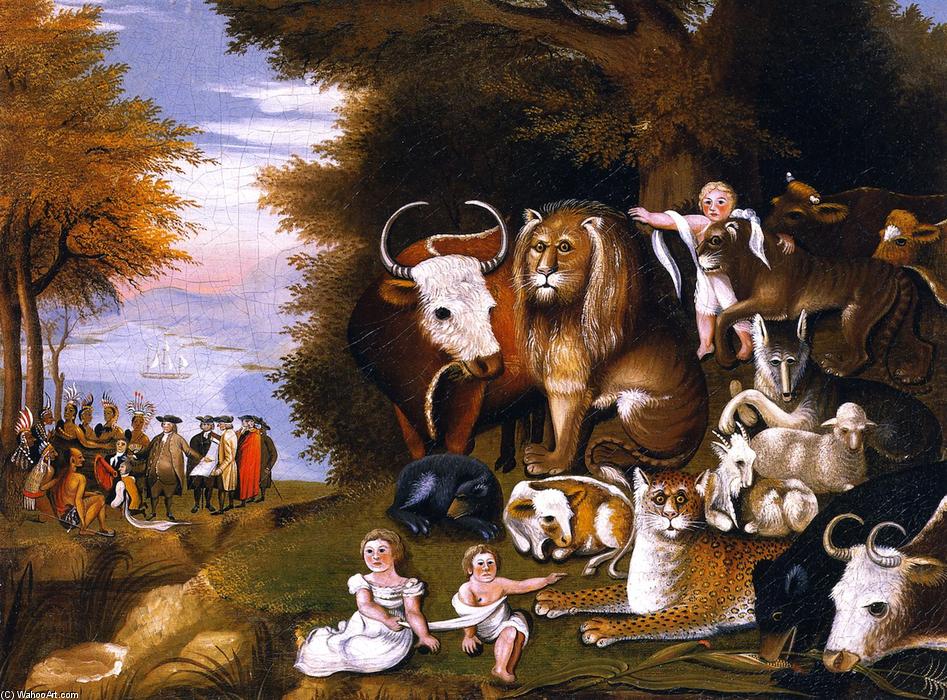
“The Peaceable Kingdom” Edward Hicks, 1832. From the collection of the Abby Aldrich Rockefeller Folk Art Center (United States)

 Joann White