Be Opened

Sabbath Day Thoughts — “Be Opened” Mark 7:24-37

When I came to Saranac Lake in January 2005, we needed a new sign for the church. The old sign was made many years ago by Skip’s Dad. The wooden boards were lovingly hand-routed and painted. But too many Adirondack winters had taken their toll. Session debated the size, shape, and color of the replacement sign. But what inspired most discussion was the message we included, which felt a little radical at the time, “All are welcome.”

When session decided to broadcast that message, we were remembering the years of conflict that we were leaving behind. We wanted to send a hopeful, healing message to the community, a message to inspire those who felt a little like outsiders to come on in. I know that it worked on at least one occasion. One Sunday, a couple of out-of-town visitors in full motorcycle gear joined us for worship. They wore black jackets, chaps, and big motorcycle boots. The back pew had never seen so much leather.  In visiting with them after the service, they said that they had wanted to go to church somewhere in Saranac Lake but felt a little uncomfortable about their appearance. They finally decided that any church that put “All are welcome” on the sign was their best bet for warm hospitality. I hope that we lived up to their expectations.

In Jesus’ day, religious traditionalists had strong opinions about who was and was not welcome, not only in church but also in God’s Kingdom. Mark’s seventh chapter explores this question of God’s acceptance and welcome. In the verses leading up to today’s reading, Jesus was under attack by the Pharisees and scribes. Those religious traditionalists looked at Jesus’ disciples, saw their failure to observe rituals of purity, like handwashing before eating, and decided that neither the disciples nor Jesus was holy enough. In their opinion, failure to keep the traditions of the elders rendered the disciples unclean and unwelcome in the eyes of God.

In some of the boldest teaching of his ministry, Jesus denounced this narrow-minded belief. Jesus argued that it is what comes out of a person that separates them from God and neighbor. God was less concerned about handwashing or a kosher diet and more concerned about idolatry, adultery, theft, hypocrisy, slander, and malice.

The two encounters in today’s gospel reading probably stretched even Jesus’ understanding of God’s welcome. After his clash with his opponents, Jesus withdrew to the seaside city of Tyre beyond the Galilee, seeking a quiet place to pray and find refreshment. But the word soon got out. It wasn’t long before there was a knock on the door. Jesus was beseeched for healing, and he wasn’t very happy about it.

The woman who implored Jesus to heal her child had three strikes against her.  She was a Gentile, outside the covenant between God and Israel. Not only was she a Gentile, she was the worst sort of Gentile—a Syro-Phoenician. The evilest woman in the Hebrew scriptures, Jezebel, was a Syro-Phoenician princess who brought idolatry and immorality to the reign of her Israelite husband King Ahab. What’s even worse, this woman was flouting the bounds of good behavior. In a time and place when women didn’t speak to men outside their family, she was on her knees, imploring a strange man to do her a favor. Utterly scandalous!  Jesus had every reason to say, “No.” Indeed, the Pharisees and scribes, with whom Jesus had recently argued, would have congratulated him on his good judgment. When Jesus called the woman a “dog,” he sounded a lot more like them than he did like the Jesus we know and love. Didn’t he?

The gospel might have stayed good news only for Jews if the Syro-Phoenician woman hadn’t challenged Jesus. She demanded just a few crumbs of God’s welcome for Gentile dogs, like her sick child. In response, we glimpse a shift in Jesus’ understanding. He sees that, in his Father’s Kingdom, this woman didn’t belong under the table, begging for table scraps. In his Father’s Kingdom, she had a place at the table, alongside the children of Israel. The proof of Jesus’ insight came immediately. Jesus blessed her for her bold speech, in Greek—her logos, her word, her wisdom—and he sent her home. There she found her child waiting, right as rain.

Perhaps Jesus struggled with the boldness of God’s welcome because he soon encountered another healing request that would have been out-of-bounds for scribes and Pharisees. As Jesus returned to Galilee, he traveled through the Decapolis, the ten city-states to the east of the sea.  These communities, planted three hundred years earlier when Alexander the Great claimed Israel for his empire, were largely Gentile and culturally Greek. When those Greek neighbors brought to Jesus a man who was hearing- and speech-impaired, Jesus didn’t rebuke them or call them dogs. Instead, the suffering man got a private audience. There was touching and spitting, speaking and sighing. Jesus’ word, “Ephphatha”—be opened—may have been part of the man’s healing experience, but perhaps it was also part of Jesus’ own healing experience—and a calling to all who would be his followers. “Ephphatha”—be opened. Don’t build fences or set limits on God’s love.

Mark’s seventh chapter is a great comfort to us. We, who have lived enough or have the depth of faith to acknowledge our personal sinfulness and brokenness, can rejoice in the promise that God loves and welcomes us, despite our painful pasts and our present mistakes. We are welcome, and there isn’t anything that we can do that will render us unlovable or irredeemable. Jesus has done the hard work on the cross so that even though our sins abound, his righteousness prevails. There is a place for us at the table. Thank you, Lord.

Yet Mark’s seventh chapter is a challenge to us. Part of our human sinfulness is that we always want to draw lines, create in-groups and out-groups. We see it in high school cliques. We see it in partisan politics. We even see it in our penchant to form factions within churches or denominations. There lurks within each of us the scribe or Pharisee, who keeps watch, rushes to judgment, and wants to limit God’s love. Today’s reading suggests that God invites us to get over ourselves and get out of God’s way so that healing may abound. God’s great longing is for a church and a world where no one feels like they have to beg for table scraps when it comes to God’s love and mercy.

I’m not sure that when session approved the words, “All are welcome,” for the sign out front that we thought we were making a bold theological statement, right out of the seventh chapter of Mark’s gospel. We just wanted folks to worship with us. We may have even wanted to send a friendly message to those who had left us, with whom we had quarreled so bitterly in the dark, divided days of our past. But perhaps when we chose that message, God was working on us. God was summoning us to open up, to see the immensity of God’s love and welcome.

I suspect that if Jesus were sitting in the back pew today, wearing his motorcycle leathers, he would remind us that God isn’t finished with us. There are other people out there whom God calls us to welcome, folks who will test our limits and make us feel uncomfortable. I bet they will have tattoos and body piercings. They’ll probably love people whom we don’t think they should love. I imagine that some of them will be developmentally disabled or mentally ill or physically impaired. They’ll probably have big, obnoxious placards in their front yards for candidates from that other political party. They’ll drive gas-guzzling Cadillac Escalades or energy-efficient Teslas. They’ll stand in line in front of us at Stewart’s and make us wait while they buy cigarettes and a billion lottery tickets. The’ll stumble up Broadway after a long night at the Rusty Nail.

Be opened, my friends. God’s love is bigger than we can imagine.

Resources

Alyce McKenzie. “Commentary on Mark 7:24-37” in Preaching This Week, Sept. 6, 2009. Accessed online at Commentary on Mark 7:24-37 – Working Preacher from Luther Seminary

Matt Skinner. “Commentary on Mark 7:24-37” in Preaching This Week, Sept. 9, 2012. Accessed online at Commentary on Mark 7:24-37 – Working Preacher from Luther Seminary

C. Clifton Black. “Commentary on Mark 7:24-37” in Preaching This Week, Sept. 5, 2012. Accessed online at Commentary on Mark 7:24-37 – Working Preacher from Luther Seminary

Courtney V. Buggs. “Commentary on Mark 7:24-37” in Preaching This Week, Sept. 8, 2024. Accessed online at Commentary on Mark 7:24-37 – Working Preacher from Luther Seminary

Joann White. “Everyone Gets Healed,” Sept. 9, 2012.


Mark 7:24-37

24 From there he set out and went away to the region of Tyre. He entered a house and did not want anyone to know he was there. Yet he could not escape notice, 25 but a woman whose little daughter had an unclean spirit immediately heard about him, and she came and bowed down at his feet. 26 Now the woman was a gentile, of Syrophoenician origin. She begged him to cast the demon out of her daughter. 27 He said to her, “Let the children be fed first, for it is not fair to take the children’s food and throw it to the dogs.” 28 But she answered him, “Sir, even the dogs under the table eat the children’s crumbs.” 29 Then he said to her, “For saying that, you may go—the demon has left your daughter.” 30 And when she went home, she found the child lying on the bed and the demon gone.

31 Then he returned from the region of Tyre and went by way of Sidon toward the Sea of Galilee, in the region of the Decapolis. 32 They brought to him a deaf man who had an impediment in his speech, and they begged him to lay his hand on him. 33 He took him aside in private, away from the crowd, and put his fingers into his ears, and he spat and touched his tongue. 34 Then looking up to heaven, he sighed and said to him, “Ephphatha,” that is, “Be opened.” 35 And his ears were opened, his tongue was released, and he spoke plainly. 36 Then Jesus ordered them to tell no one, but the more he ordered them, the more zealously they proclaimed it. 37 They were astounded beyond measure, saying, “He has done everything well; he even makes the deaf to hear and the mute to speak.”


Photo by Kevin Bidwell on Pexels.com

Bent Over

Sabbath Day Thoughts — “Bent Over” Luke 13:10-17

It was the best sermon I had ever heard.  Shall I start with the voice?  Rich and melodic, captivating.  Within moments, I felt as if I had known him all my life.  He read the Torah with such love, as if he were feasting on every word.  And when he opened the scriptures to us, they came alive.  I could feel the compassion and mercy of God in ways that I had never felt before, as if even I were a beloved child of God.  The synagogue at Capernaum was quiet. Every ear strained to hear every sound.  When Rivka’s baby began to fuss, we all said, “Shhhh!” not wanting to miss a word.

But then it stopped.  Without warning or “Amen,” there were simply no more words.  Worshippers began to buzz and turn restlessly in their seats.  Slowly things got louder, like a wave of sound rising from the best seats at the front of the sanctuary and rolling back to where I stood, mostly hidden, in the doorway.  My husband Moshe placed a hand upon my back and cursed under his breath.  “Lord, help us! It’s you, Mahalath. He sees you.  I knew we never should have come.”

I should tell you about my back.  It started the year our second child was born, a sweet and ruddy boy to join an older brother.  I was still hale and strong.  With one child bouncing on my hip and another sleeping in a sling at my breast, I worked alongside Moshe. We brought in the barley harvest and shook olive branches to rain down a harvest of ripe fruit. I milked the goats, fed chickens, ground grain at the wheel, and spun wool into yarn.  Young and able with the handsome Moshe at my side and our beautiful boys, I was the envy of many, and that may have been part of the problem.  You know the ways of jealousy and the dangers of the evil eye.

One day, I bent to lift the bread from the oven, and I couldn’t stand up.  My back writhed like it was being squeezed in a vice, and my whole body seized in pain.  I couldn’t breathe.  I couldn’t move.  I dropped to my knees, sending the loaves into the fire.  The world grew dim and then went black.

I’m not sure how long I was in darkness.  I awoke to the sound of my children crying.  Moshe hovered over me, looking worried.  A Greek physician from Sepphoris had been brought to attend me. 

“Ah!  You are awake!” the doctor said matter-of-factly.  He dribbled a vile tasting liquid into the corner of my mouth.  “Drink it all, dear,” he said with kindness. “It will help with the pain.”  I gagged it down, blinking back tears, and slipped into a sleep troubled by dreams of fire, serpents, and burned bread.

When I awoke, Moshe was sitting at my side, holding my hand.  Our boys had climbed into the bed with me.  Their small hands clutched the folds of my tunic. Their cheeks were red with worry and weeping.  “Ugh!” I moaned.

Moshe leaned in, “Mahalath, stay still.  The Greek says that you have been possessed by the spirit of the python.  You must save your strength to fight.”

Now, I had heard that in Delphi, on the far side of the Great Sea, the Greeks worship the sun god.  Poseidon speaks through priestesses possessed by the spirit of the python.  Twisted, bent, and rigid, they prophesy all day long.  For the right price, they might even tell you of a bright future.  But that had nothing to do with me. I loved Yahweh.  I was a beloved daughter of Israel, or so I thought.

I did fight.  I found my feet again.  I learned to live with pain.  I tended my children.  I did my best to keep our home and fields, but I never stood up straight again. Our neighbors said that I was “bent over,” as if I were a broken reed or a tree snapped by a windstorm. With every year, my back bent more noticeably, and as my shoulders rounded and my spine folded in on itself, my perspective grew small, narrow, and limited. 

My affliction made me unwelcome at the synagogue, for only someone cursed by Yahweh could look as I did.  But each week, I would wait at the back, hovering in the doorway, hoping for the smallest crumb of blessing.  Our neighbors stopped including us, uncomfortable with my woe and believing the worst.  One day, the neighborhood children began to call me names. At first, they did so behind my back; eventually, they did so to my face.  In time, most people just called me “Bent Over Woman,” as if I didn’t even have a real name.  I prayed always, hoping that if I could find the right words, I might be set free from this prison that my body had become.

So, while I could tell you that he preached the best sermon I had ever heard, and I could tell you that Rivka’s baby fussed, and I could tell you that the preaching stopped and the sound of whispering and unrest rolled to me like a restless wave, I could not tell you what he looked like, or why Rivka’s baby fussed, or why the rabbi stopped speaking, or why the sound of my restless neighbors rolled toward me.  Because the only thing that I could see was what I always see: my feet.

Moshe reached a protective arm around my back and held my hand.  “Mahalath,” he whispered, “He’s waving to you!  He wants you to come forward.”

I tried to turn and leave, but Moshe held me fast.  “Mahalath,” he urged, “What have we got to lose?” 

What did we have to lose?  It doesn’t get much worse than living in constant pain, shunned by your neighbors, and excluded from your church.  It doesn’t get much worse than being called Bent Over Woman.  My life had become an agony of loneliness and suffering.  With Moshe at my side, I walked to the front.

If it was quiet when the rabbi spoke, it was deathly still as I stood before him.  Every eye in the synagogue was fixed on me.  Every breath was held.  Even Rivka’s baby was silent. 

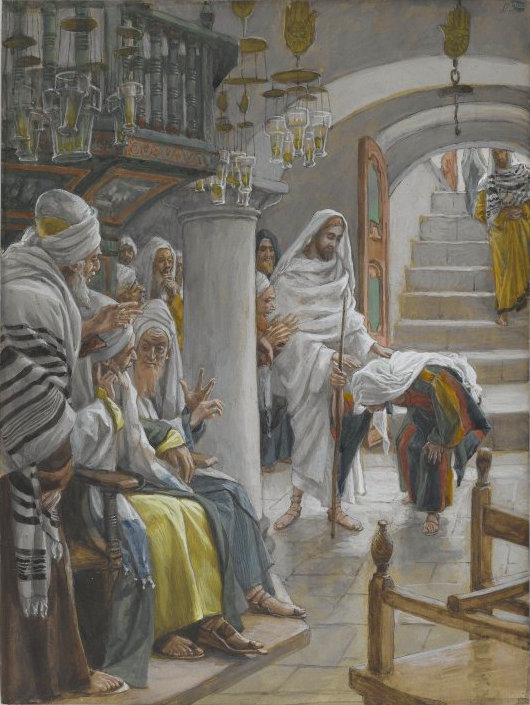
Then, this rabbi did a most unusual thing.  He squatted down on his haunches, down into my limited field of vision, and he looked up into my face.  He was sun-browned, as if he worked in the fields.  Fine lines creased the corners of his eyes, which were a deep, bottomless brown.  He smiled and his kind eyes sparkled with interest and concern. Next, he said the most ridiculous thing that I had ever heard, “Woman, you are set free from your ailment.”  Didn’t he see what everyone else saw: my hideous bent-over back?  Someone snickered. Moshe took a protective step closer.

What happened next is still being talked about in Capernaum.  The rabbi stood up and placed his two broad, strong hands on my poor crippled back.  What I noticed first was warmth, like the sun on a winter day bringing a blessing to your upturned face.  Slowly it flowed out from his hands, spreading down to the tips of my toes and reaching up to the top of my head.  It was then that I realized that my pain was gone.  The spirit of the python that had held me tight in its grip had departed!  I took a deep breath and then another. Then, for the first time in eighteen years, I stood up.  I gasped and shouted bold cries of “Alleluia!” and “Thanks be to the Holy One of Israel!” I hugged Moshe, then I hugged the rabbi as my neighbors watched in shocked silence.

Not everyone was happy.  The synagogue leader was scandalized that I had entered the sanctuary, and the rabbi had healed on the sabbath.  But the rabbi would hear none of it, for surely, even one such as I deserved the mercy that is shown to an ox or mule. 

With a wink, the rabbi turned to me. “Mahalath,” he called me by name. “Mahalath, I think I just finished my sermon for today.”

I practically danced toward the door of the synagogue, followed by the rabbi and Moshe.  Out they went, but before I left, I turned to my neighbors, the ones who for eighteen years had ignored me, gossiped about me, called me names, and failed to show me the courtesy one might extend to a barnyard animal.  I looked them in the eyes and said, “By the way, my name is not Bent-Over-Woman.  My name is Mahallath. You are welcome to come break your fast with us today.”

The synagogue erupted in cheers and praise.  That sabbath evening, Jesus dined with us, and so did all of Capernaum. The pot never emptied, the bread seemed to multiply, and the wine never failed. But that is a miracle to tell on another day.  I rejoiced—and so did the whole village with me—in the wonderful things that Jesus was doing.


Luke 13:10-17

10 Now he was teaching in one of the synagogues on the Sabbath. 11 And just then there appeared a woman with a spirit that had crippled her for eighteen years. She was bent over and was quite unable to stand up straight. 12 When Jesus saw her, he called her over and said, “Woman, you are set free from your ailment.” 13 When he laid his hands on her, immediately she stood up straight and began praising God. 14 But the leader of the synagogue, indignant because Jesus had cured on the Sabbath, kept saying to the crowd, “There are six days on which work ought to be done; come on those days and be cured and not on the Sabbath day.” 15 But the Lord answered him and said, “You hypocrites! Does not each of you on the Sabbath untie his ox or his donkey from the manger and lead it to water? 16 And ought not this woman, a daughter of Abraham whom Satan bound for eighteen long years, be set free from this bondage on the Sabbath day?” 17 When he said this, all his opponents were put to shame, and the entire crowd was rejoicing at all the wonderful things being done by him.


James Tissot, “The Woman with an Infirmity of Eighteen Years” (La femme malade depuis dix-huit ans), Public domain, via Wikimedia Commons, in the collection of the Brooklyn Museum.