Unprepared

Sabbath Day Thoughts — “Unprepared” Matthew 3:1-12

It was finals week. An entire semester’s worth of work depended upon some big tests. I was cramming for my exams, making the most of reading week. I felt good about my impending tests. Then, I suddenly realized that there was one exam that I was completely unprepared for. I don’t know how it escaped my attention, but there on my schedule was a course that I had overlooked for an entire semester. I hadn’t gone to class. I didn’t know the professor. I hadn’t read the books. How could I possibly pass that test? Like all college students, I began to panic. What if I stayed awake all night and skimmed the reading? I didn’t own the books! Could I borrow someone’s notes? I didn’t know who was in the class! It did not look good. I was unprepared.

Perhaps you have had that nightmare or something like it. I’m told that many professions are plagued by their version of the school dream. The contractor dreams of an overlooked job that must be done immediately. The caterer has a nightmare about a huge wedding that never made it onto their calendar. The business manager dreams of a surprise audit. I can testify that the pastor’s nightmare entails going to a new church on Sunday morning and discovering that you are expected to preach, and when you look down, you notice that you are naked.

Psychologists tell us that these dreams are typically provoked by unresolved anxiety or feelings of inadequacy. When we are stressed and overwhelmed, our brains work overtime to cope, even in our sleep. We awaken with our hearts pounding, feeling sweaty and gripped with self-critical worry. The experts say we should pay attention to dreams like this. It could be a wake-up call from our subconscious, telling us to attend to a particular issue, make a big decision, or change our course of action.

I bet John the Baptist had school dreams. He was born to prepare the way of the Lord, but the more John tried to live into his calling, the more he noticed that the folks who came out to the Judean Wilderness to hear him preach were totally unprepared. The messiah was coming with his baptism of fire and his winnowing fork in hand! God’s great redemption of humankind was about to unfold! But the people, they were eating, drinking and being merry, as if they had all the time in the world and could not be bothered to do their homework.

Even the piety experts, the Pharisees and Sadducees, were slackers. They may have been savants on the requirements of the Torah, but as far as John was concerned, they were a brood of vipers. They talked a good game about loving the Lord, but their actions spoke louder than words. The righteous deeds that were typically born of a transformed heart—like caring for vulnerable widows and orphans, feeding the hungry, and loving their neighbors—those deeds were nowhere to be seen. Where was the good fruit?! “Repent!” John cried, trying to infect his listeners with enough of his anxiety and urgency to inspire them to turn their lives around.

We aren’t strangers to anxiety in this Christmas season. No other time of the year is so steeped in preparation and timeworn tradition. There’s a lot to do, and we’ve got to get it done before Christmas Day. Our to-do list is as long as our arm: gifts to buy and the tree to decorate, cookies to bake and old family recipes to duplicate, packages to wrap and charitable giving to do, parties to attend and guests to host. Every year, right about this time, we wonder, “How will we ever get it all done?” As I talk about the Christmas juggernaut that is bearing down upon us, arriving in exactly eighteen days, perhaps you are feeling a little infected with John the Baptist’s anxiety, perhaps you are feeling like you just woke up from a bad school dream.

Our seasonal Study Group is reading Advent in Plain Sight by Jill Duffield. In our reading from Thursday, Dr. Duffield recounted attending a small group meeting at church a number of years ago when she was a young adult.  Their pastor asked them what they thought about Advent. The responses focused on the baby Jesus, the infant so tender and mild. Folks were thankful for the incarnation, the breaking of barriers between heaven and earth, the confidence that God is with us—Emmanuel! I’m sure everyone in the group had that good feeling you get when you know the answer to the question that the professor asks in class.

But right about then, the pastor went a little John-the-Baptist on them. He blurted out, “No one ever thinks of the Second Coming!” It’s true. In this Advent season, we look back, remembering and giving thanks for the baby Jesus. But Advent means coming. We are also called to look ahead, to anticipate the ultimate fulfillment of the great redemption that God has begun in Jesus. We are talking about End Times, Judgment Day, the Kingdom of God, the apocalypse. We’re talking about the inevitable fact that each of us, one day, will meet our maker. The ultimate final exam awaits us all—and we don’t have much say about when that will happen. Are our hearts pounding? Are we feeling a little sweaty and gripped with self-critical anxiety? Then John the Baptist and I have achieved our mission.

We are really good at preparing for the baby Jesus, aren’t we? Just look around the church—the purple paraments, the greens, the Advent Wreath, the Christmas tree in the Great Hall. But on the second Sunday of Advent, John the Baptist shows up, like a bad school dream, and he thinks we are unprepared. John wants us to temper our nostalgic looking back with some prophetic looking ahead. He calls us once again to prepare the way of the Lord, to live today as if Jesus were coming tomorrow, to bear fruit worthy of our repentance.

For John the Baptist’s listeners on the banks of the Jordan, all those years ago, preparing the way of the Lord began with a change of heart. They heard the truth of John’s words and knew they could do better. They returned to God, wading into the waters of the Jordan in an outward sign of their inward repentance. I like to think that their watery rite was followed by some fruitful living. They were kinder to their families. They prayed fervently, worshipped ardently, and feasted on God’s word. They lived with a renewed compassion, service, and love for the world around them that can only come from a life lived with God.

On this second Sunday of Advent, we, too, can have a change of heart. We can draw near to God even as God draws near to us. 18 days and counting. We won’t be wading in the Jordan, but amid all our Christmas preparations, I trust that we’ll find the quiet moment today to commit our purpose to God’s purpose. We’ll resolve to love the Lord our God with all our heart, mind, soul, and strength, and we’ll go forth to love our neighbors as ourselves. We’ll bear fruit worthy of that repentance. The basket at the side entrance will fill with cans of corn for the ecumenical holiday boxes for neighbors in need. Our shallow well gifts will provide clean drinking water for many villages in sub-Saharan Africa. We’ll invite a hurting friend to attend the Longest Night Service with us this Wednesday. We’ll set an extra place at the Christmas dinner table for someone who might otherwise be alone. When that final exam comes, we’ll be ready.

Prepare the way of the Lord, my friends, make his paths straight.

Resources:

Adam England. “What Does It Mean When You Dream about Being Back in School?” in Very Well Mind, Oct. 30, 2025. Accessed online at verywellmind.com.

Catherine Sider Hamilton. “Commentary on Matthew 3:1-12” in Preaching This Week, Dec. 7, 2025. Accessed online at https://www.workingpreacher.org/commentaries/revised-common-lectionary/second-sunday-of-advent/commentary-on-matthew-31-12-7

Arland J. Hultgren. “Commentary on Matthew 3:1-12” in Preaching This Week, Dec. 8, 2013. Accessed online at https://www.workingpreacher.org/commentaries/revised-common-lectionary/second-sunday-of-advent/commentary-on-matthew-31-12-3

Stanley Saunders. “Commentary on Matthew 3:1-12” in Preaching This Week, Dec. 9, 2007. Accessed online at https://www.workingpreacher.org/commentaries/revised-common-lectionary/second-sunday-of-advent/commentary-on-matthew-31-12-6

James Boyce. “Commentary on Matthew 3:1-12” in Preaching This Week, Dec. 4, 2022. Accessed online at https://www.workingpreacher.org/commentaries/revised-common-lectionary/second-sunday-of-advent/commentary-on-matthew-31-12-2


Matthew 3:1-12

1 In those days John the Baptist appeared in the wilderness of Judea, proclaiming, “Repent, for the kingdom of heaven has come near.” This is the one of whom the prophet Isaiah spoke when he said,

“The voice of one crying out in the wilderness:
‘Prepare the way of the Lord;
    make his paths straight.’ ”

Now John wore clothing of camel’s hair with a leather belt around his waist, and his food was locusts and wild honey. Then Jerusalem and all Judea and all the region around the Jordan were going out to him, and they were baptized by him in the River Jordan, confessing their sins.

But when he saw many of the Pharisees and Sadducees coming for his baptism, he said to them, “You brood of vipers! Who warned you to flee from the coming wrath? Therefore, bear fruit worthy of repentance, and do not presume to say to yourselves, ‘We have Abraham as our ancestor,’ for I tell you, God is able from these stones to raise up children to Abraham. 10 Even now the ax is lying at the root of the trees; therefore every tree that does not bear good fruit will be cut down and thrown into the fire.

11 “I baptize you with water for repentance, but the one who is coming after me is more powerful than I, and I am not worthy to carry his sandals. He will baptize you with the Holy Spirit and fire. 12 His winnowing fork is in his hand, and he will clear his threshing floor and will gather his wheat into the granary, but the chaff he will burn with unquenchable fire.”


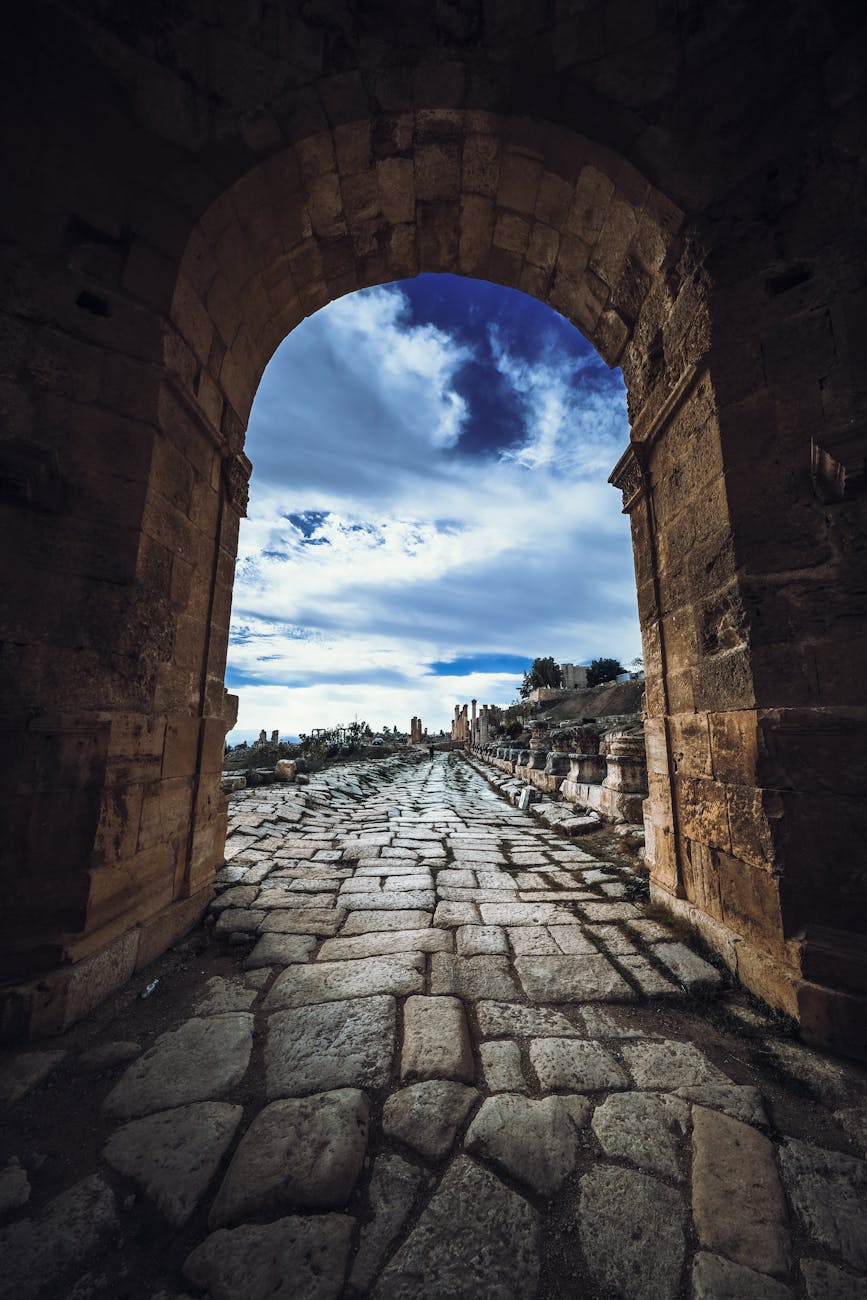
Photo by Tara Winstead on Pexels.com

The Voice from the Margins

Sabbath Day Thoughts — “The Voice from the Margins” Luke 3:1-18

The Christmas preparations have been underway in the village for weeks. First, our lampposts were hung those giant sparkly snowflakes. Then, Berkely Green sprouted a bevy of Christmas trees. Salvation Army bell ringers with their red kettles are stationed at the post office and Kinney’s. Shopkeepers have decked their windows with lights and greens and tempting wares that we just might need to purchase for our beloved ones. Sparkle Village returned to the town hall with those wonderful one-of-a-kind crafts and gifts.

We have been preparing for Christmas at church, too. The Advent wreath has emerged from its basement lair to hang above the chancel and call us to worship weekly. Cherise has done yet another amazing job of greening our sanctuary and doors. Some of us are reading our way to Christmas. Perhaps you took home an Advent devotional, or you are gathering on Thursdays for lunch and book discussion. Scott and the choir have been hard at work on a spectacular anthem for Christmas Eve. The kids, under the direction of Ms. Kim, are preparing to delight us with a special play next week.

I know that there have been plenty of preparations on our home fronts, too. We may be working out final details on travel plans or preparing to welcome guests. Our front doors are sporting wreaths and our eves are dripping with Christmas lights. We are hanging favorite ornaments on our Christmas trees—candy canes, antique glass balls, and golden macaroni wreaths made by little hands long ago. We’ve been shopping, and if we are very organized, we are wrapping. If the baking hasn’t begun yet, it will soon—Christmas cookies, fruitcakes, panettone, stollen, and our favorite family recipes. If you are like me, there is joy in the preparation, a remembering of Christmases past and an anticipation of the holiday to come.

On this second Sunday in Advent, the gospel reading brings us John the Baptist, who gives us an earful about preparing the way of the Lord. When I served the Community Church in Morton Grove, I would tag along with my head of staff Michael Winters to attend a lectionary group. These were seasoned pastors who preached weekly and met to discuss the scripture and work on their sermons. The second Sunday of Advent was near, and we had just read together the reading I shared a minute ago—John the Baptist calling us a brood of vipers and exhorting us to repent. There was a long moment of silence following the reading, then Rev. Debbie spoke up, “Don’t you wish we only had to preach on John once a year for Baptism of the Lord Sunday in January? Who wants to hear about John at Christmas?”

John certainly wasn’t dressed for the holidays and his diet of locusts and wild honey hardly sounds like a tasty Christmas dinner. In 1457, Donatello cast a larger-than-life bronze statue of John the Baptist for the Cathedral in Siena, Italy. In Donatello’s imagination, John has unkempt hair and the burning eyes of a fanatic. He’s impossibly thin, a skeleton with skin, all lean muscle and sinew. He’s clothed in matted furs that part at the side to show bare flesh. His long, bony fingers extend, as if pointing the way to Christ, the stronger one who will follow. The statue is eerie, unsettling, discomforting. There is no bow big enough to dress John up and put him under our Christmas trees. Let’s face it, we would never invite John the Baptist to Christmas dinner because he would be certain to shout, wouldn’t wear a tie, and would probably smell like the wilderness he just rolled out of. No. At Christmas, we prefer the baby Jesus, the holy infant so tender and mild to the disconcertingly wild, wooly, and radical John.

The sermon that John gave doesn’t sound like something you want to read in a Christmas card. Let me channel my inner John . . .

Dear Brood of Vipers,

What is wrong with you?!

Don’t you know that God is coming? That’s right Yahweh, the great I AM. He’s really topped himself this time, dared to wrap himself in flesh and walk among us. He’s on the loose!

And you?! You’re oblivious! You just go on living large. It’s all about you, isn’t it?

And what about this world? God help us! Nation taking up arms against nation. Neighbor trash-talking neighbor. What about the poor, the orphan, the refugee, the folks who struggle to put food on the table or a roof over their heads?

Stop, people! Just stop. Turn it around before it’s too late. You need to remember who is really in charge around here and it’s not you. It’s God Almighty. So straighten up and fly right. Be prepared!

Got it? Good!

Yours truly,

John

On this second Sunday of Advent, the ill-mannered, ill-timed, wild-and-crazy John the Baptist breaks into our lives and throws a big fat monkey wrench into our Christmas customs and timeworn traditions. Truth be told, we need John. We need him to startle us out of our Christmas complacency and call us away from our ordinary lives to a time and place of awareness and anticipation. We need John to urge us to leave, if only for a little bit, our kitchens and Christmas trees, our on-line shopping and office parties, our school books and family festivities. We need John to remind us of the reason for the season and tell us what it really means to prepare the way of the Lord. We need John’s encouragement to repent (metanoia), to thoughtfully and honestly reflect upon our lives, redirect our actions and energies, and re-commit ourselves to God-centered living. We need John to remind us that, no matter what the circumstance of our lives may be, we can be redeemed and renewed. We can come back to God because every year at Christmas, we are reminded that God comes to us with help and healing and love beyond our wildest imaginings.

Our Advent book this year is Season’s Greetings, an imaginative collection of Christmas letters from those who were there at the first Christmas. The author, my friend Ruth Boling, invites us to imagine John as “one of those wacky inflatable air dancers outside a car dealership.” You know those annoying windsocks that rise and fall and gyrate in unexpected ways that captivate our attention? According to my friend Ruth, John says, “I’m here to do that. To get you and everyone else to stop racing around on your Christmas hamster wheels, to get you to take notice and to study what I—wacky inflatable air dancer—am pointing toward. Here, people of God, is the one you want to be chasing . . . Don’t be a hamster, or a lemming, or an idiot. See, here is the one who came to redeem and restore.” It’s Jesus.

In the coming weeks of Advent, the frenzied pace of our Christmas preparations will build to a crescendo. That Kanoodle Ultimate Champion game that we purchased online for our grandchildren will be backordered, and we’ll scramble for a last-minute gift. Grandma’s recipe for authentic German stollen will disappear, and we’ll spend hours trying unsuccessfully to duplicate her kitchen magic through guesswork. Our Christmas trees will dry up and shed boatloads of needles, and we’ll wake up in the middle of the night to worry that our house might burn down. Our children will grow SO excited that they will not sleep a wink on Christmas Eve, and neither will we.

Amid the crazy-hamster-wheel-joy of this Advent season, may we listen for the voice from the margins. The Baptizer still calls out in the wilderness. May the wild one summon us away from the holiday rush to quiet moments with God for reflection, redirection, and renewal. Prepare the way of the Lord, my friends, make his paths straight.

Resources

Troy Troftgruben. “Commentary on Luke 3:1-6” in Preaching This Week, Dec. 8, 2024. Accessed online at Commentary on Luke 3:1-6 – Working Preacher from Luther Seminary

David Lose. “Commentary on Luke 3:1-6” in Preaching This Week, Dec. 6, 2009. Accessed online at Commentary on Luke 3:1-6 – Working Preacher from Luther Seminary

Audrey West. “Commentary on Luke 3:1-6” in Preaching This Week, Dec. 5, 2021. Accessed online at Commentary on Luke 3:1-6 – Working Preacher from Luther Seminary

Ruth Boling. Season’s Greetings: Christmas Letters from Those Who Were There. Nashville: Upper Room books, 2024.


In the fifteenth year of the reign of Tiberius Caesar, when Pontius Pilate was governor of Judea, and Herod was ruler of Galilee, and his brother Philip ruler of the region of Ituraea and Trachonitis, and Lysanias ruler of Abilene, during the high priesthood of Annas and Caiaphas, the word of God came to John son of Zechariah in the wilderness. He went into all the region around the Jordan, proclaiming a baptism of repentance for the forgiveness of sins, as it is written in the book of the words of the prophet Isaiah,

“The voice of one crying out in the wilderness:
‘Prepare the way of the Lord;
    make his paths straight.
Every valley shall be filled,
    and every mountain and hill shall be made low,
and the crooked shall be made straight,
    and the rough ways made smooth,
and all flesh shall see the salvation of God.’ ”

John said to the crowds coming out to be baptized by him, “You brood of vipers! Who warned you to flee from the coming wrath? Therefore, bear fruits worthy of repentance, and do not begin to say to yourselves, ‘We have Abraham as our ancestor,’ for I tell you, God is able from these stones to raise up children to Abraham. Even now the ax is lying at the root of the trees; therefore every tree that does not bear good fruit will be cut down and thrown into the fire.”

10 And the crowds asked him, “What, then, should we do?” 11 In reply he said to them, “Whoever has two coats must share with anyone who has none, and whoever has food must do likewise.” 12 Even tax collectors came to be baptized, and they asked him, “Teacher, what should we do?” 13 He said to them, “Collect no more than the amount prescribed for you.” 14 Soldiers also asked him, “And we, what should we do?” He said to them, “Do not extort money from anyone by threats or false accusation, and be satisfied with your wages.”

15 As the people were filled with expectation and all were questioning in their hearts concerning John, whether he might be the Messiah, 16 John answered all of them by saying, “I baptize you with water, but one who is more powerful than I is coming; I am not worthy to untie the strap of his sandals. He will baptize you with the Holy Spirit and fire. 17 His winnowing fork is in his hand to clear his threshing floor and to gather the wheat into his granary, but the chaff he will burn with unquenchable fire.”

18 So with many other exhortations he proclaimed the good news to the people.


Donatello, John the Baptists, 1457, Duomo di Siena.

Torn Open

Sabbath Day Thoughts — “Torn Open” Mark 1:4-11

Elena Bernal was not looking forward to the holidays. The sixty-six-year-old was widowed three years ago in December. Home feels quiet and lonely now, especially at Christmas. Elena breaks down in tears, just thinking about her loss. “We grew up together,” she says of her late husband, “We met in middle school. I miss him so much.”

The world is in the midst of a loneliness epidemic. A Meta-Gallup poll released in October conducted in 142 countries found that one quarter of the world’s population reports feeling very or fairly lonely. The statistics are even higher in the United States. In May, the Surgeon General Dr. Vivek Murthy released a report indicating that half of Americans report experiencing loneliness.

There are a number of reasons for our national surge in loneliness. In this post-pandemic world, more people are working and learning remotely. We’re communicating more remotely, too, with Facetime and Zoom replacing meetings, visits, and face-to-face gatherings. Larger societal changes further contribute to the problem of loneliness. The social media boom, which presents a distorted, idealized vision of the daily life of others, has us scrolling on our phones rather than picking up our phones to make a call to our friends and family. More of us live alone these days. In 1960, only 13% of Americans lived by themselves. Today that number has more than doubled to 29% of us. We may feel it is tougher to form genuine connections, too. In 1972, 45% of us trusted our neighbors. In the midst of the increasing political and social division of our nation, only about 30% of us now say that our neighbors are trustworthy.

Loneliness is bad for our health. It puts us at increased risk for depression, anxiety, addiction, self-harm, and even suicide. The Surgeon General’s report indicates that loneliness increases the risk of premature death by 26%. It’s worse for us than obesity or inactivity. Dr. Murthy compares loneliness to smoking fifteen cigarettes a day. It increases our risk of heart disease by 29%, our risk of stroke by 32%, and among the elderly, the risk of dementia doubles. Feelings of loneliness have seen the greatest increase among those aged 19 to 29. Half of young adults say that in the last week no one had taken more than a few moments to reach out to them or express any sort of genuine care.

If the Meta-Gallup poll and the US Surgeon General are right, then addressing the epidemic of loneliness and isolation is critical to the world’s well-being.

I suspect that there were feelings of loneliness and isolation at play in the crowds who came to hear the fiery preaching of John the Baptist. John spoke boldly of existential loneliness, the alienation and isolation that come when we feel that we are separated from God and our neighbors. In fact, John proclaimed a bold message of repentance, of returning to right relationship with God and community.

Jesus came to the muddy banks of the River Jordan.  He took a seat among the crowds and listened to what John had to say.  Throngs of pilgrims, the whole Judean countryside, had come to gawk at John and listen to his bold exhortation. If we listen up this morning, we can almost hear the rough voice of the Baptizer, the song of the river, and the murmuring of the entranced crowds. Compelled by the power of John’s message, Jesus kicked off his sandals, set aside his staff, bag, and traveling cloak.  He waded into the gritty Jordan to John’s side, and he was baptized. 

We’re told that when Jesus emerged from the river, something extraordinary happened.  The sky was torn open (sxizomenous).  In the Hebrew understanding of the world, the sky was a solid dome, the firmament, established by God at creation.  The Israelites believed that we lived on this side of the firmament while God was on the other. Separate. Holy. Distant. Apart. The Prophet Isaiah gives us a feeling for this separation between God and humanity. When the Israelites lived in exile in Babylon, Isaiah cried out to God, “O, that you would tear open the heavens and come down!” (Isaiah 64:1).  At Jesus’ baptism, God tore open the heavens. God entered into the world to reshape it through this humble carpenter from Galilee.

Jesus went forth from his baptism to live a torn-open life, a life marked by compassion and a willingness to be vulnerable with and for others. He identified with those who lived as outsiders. He called fishermen, tax collectors, and peasants to be his disciples. He broke bread with sinners. Jesus advocated for the powerless – welcoming women to his ministry and blessing the children. Jesus healed, ending the physical, social, and spiritual isolation of lepers, demoniacs, and the disabled. The torn-open Jesus confronted empire and Temple, those who wielded brutal power over others, with the promise of a coming Kingdom where power would be used to help and to heal.

Jesus’s choice for a torn-open life was most clearly revealed in his death on the cross. Even as he underwent unimaginable suffering, he thought of others. He welcomed a repentant thief to paradise. He prayed for God to forgive his executioners. Let’s face it. On the cross, Jesus was literally torn open. Nails brutally pierced his hands and feet. A spear was thrust through his side and into his vital organs.  It’s messy and brutal and awful. And we learn the lengths that God will go for our sake, the limitless love of a torn-open God.

At the moment of Christ’s death, we are reminded of his baptism. The curtain in the Temple that sequestered the holy of holies was torn open from top to bottom. We do not hear God’s voice speaking from the heavens, “This is my Son the Beloved;” rather, a Roman soldier at the foot of the cross, who witnessed the compassion and dignity with which Jesus died, pronounced, “Surely, this man was God’s son.” In living a torn-open life, Jesus granted us a vision of the world that God would have us make. It’s a world where faithful people choose to make a difference by facing head-on all that has separated us from God and one another. It’s world where we trust that on the far side of the world’s worst, new life will rise, and we have a role to play in that new creation.

Michael Rogness, who taught preaching for many years at Luther Seminary, likes to point out that to be baptized is to follow Jesus. We, who were sprinkled as infants, confirmed as teens, or chose baptism as adults, have embarked on a life of discipleship. That doesn’t mean that we are perfect or exceptionally pious, walk on water or know every chapter and verse of scripture. Rather, discipleship is that choice for a torn-open life of compassion and caring. It prompts us to feed hungry neighbors, welcome strangers, embrace those who feel like outsiders, and bless children. The torn-open life is a calling to help, to heal, and to love. Always love.

Our choice to follow Jesus in this torn-open life may be the antidote for the world’s epidemic of loneliness. According to the Surgeon General, social connection is the most important tool in overcoming social isolation. Human beings who are embedded in a web of concerned and caring individuals thrive. Our interest and caring for others are as essential to our well-being—and theirs—as the air we breathe and the food we eat. Medical science confirms that the world becomes healthier, physically and mentally, when people are respected and valued, looked after and look out for. Our loving care and interest in others, our choice to be torn open, changes us and changes others. Loneliness ends. We find meaning, purpose, motivation, and hope. We begin to see the world that Jesus would have us make, where the barriers that separate us from our neighbors and disconnect us from God are torn open.

Elena Bernal’s Christmas was a lot better than she expected. She accepted an invitation to attend Christmas lunch at the Serving Seniors Wellness Center in Cortez Hills where she lives. Serving Seniors is a nonprofit organization that is dedicated to helping low-income seniors. They provide nutritious food, but they believe the social interaction and hospitality that are shared when they break bread together is even more important. Elena ran into an old friend Gwendolyn King at the lunch. The two women visited and shared news as they enjoyed a traditional holiday meal. Alan Busteed, looking dapper in a three-piece suit, moved from table to table playing carols on his violin and taking requests. As Elena left, she was given a Christmas present and a $10 gift card. It was nice, really nice.

The Serving Seniors Wellness Center has a banner that hangs above the buffet. It reads, “Remember, you are a citizen of the world, and everybody needs you. You’ll find happiness in the giving of yourself.” If you ask me, it sounds a lot like a torn-open life.

Resources

Tammy Murga. “Christmas Day can be lonely, quiet for many. Serving Seniors made it a fun one for these San Diegans,” in The San Diego Union-Tribune, Dec. 25, 2023. Accessed online at https://www.sandiegouniontribune.com/

Dr. Vivek Murthy, Julianne Holt-Lunstad, et al. Our Epidemic of Loneliness and Isolation: The Surgeon General’s Advisory on the Healing Effects of Social Connection and Community. Washington, DC: Office of the Surgeon General, May 2, 2023. Accessed online at https://www.hhs.gov/sites/default/files/surgeon-general-social-connection-advisory.pdf

Paul S. Berge. “Commentary on Mark 1:4-11” in Preaching This Week, January 8, 2012. Accessed online at workingpreacher.org.

Michael Rogness. “Commentary on Mark 1:4-11” in Preaching This Week, January 8, 2012. Accessed online at workingpreacher.org.

Adrianna Rodriguez. “Americans Are Lonely and It’s Killing Them” in USA Today, Dec. 24, 2023. Accessed online at https://www.usatoday.com.

Theresa Coleman. “2023: The Year of the Loneliness Epidemic” in The Week Magazine, December 9, 2023. Accessed online at https://theweek.com.


Mark 1:4-11

4John the baptizer appeared in the wilderness, proclaiming a baptism of repentance for the forgiveness of sins. 5And people from the whole Judean countryside and all the people of Jerusalem were going out to him, and were baptized by him in the river Jordan, confessing their sins. 6Now John was clothed with camel’s hair, with a leather belt around his waist, and he ate locusts and wild honey. 7He proclaimed, “The one who is more powerful than I is coming after me; I am not worthy to stoop down and untie the thong of his sandals. 8I have baptized you with water; but he will baptize you with the Holy Spirit.” 9In those days Jesus came from Nazareth of Galilee and was baptized by John in the Jordan. 10And just as he was coming up out of the water, he saw the heavens torn apart and the Spirit descending like a dove on him. 11And a voice came from heaven, “You are my Son, the Beloved; with you I am well pleased.”


Photo by Pixabay on Pexels.com

Messengers

Sabbath Day Thoughts — “Messengers” Mark 1:1-8

When we want to send a message, we pick up our phones and tap out a text. We may even resort to a phone call. For longer messages, we’ll sit down at the computer to send an email. All those modes of communication get the message out instantaneously. If we are old school, we might pick up a pen and write a letter, carefully seal it in an envelope, apply a stamp, and drop it off at the post office, trusting that our snail mail will reach its destination across the country in a matter of days.

To send a message in the ancient near east, you needed a messenger, someone who would carry your words to their intended destination. Messengers traveled long distances on important purposes, sometimes at great risk.

There were royal messengers. In the fifth century BC, the Persian Emperor Darius developed the Royal Road, a network of mounted couriers called the Angarium. They efficiently transmitted imperial messages from Susa in modern-day Iran to Sardis in modern day Turkey. Like the pony express, the mounted messengers of the Angarium worked in relays. They reportedly could make the 1,677-mile journey in nine days, a journey that would take ninety days on foot. The Greek historian Herodotus was so impressed that he wrote, “There is nothing in the world that travels faster than these Persian couriers.” “Neither snow nor rain nor heat nor gloom of night stays these couriers from the swift completion of their appointed rounds.” If those words sound familiar, it is because they are sometimes quoted as the unofficial slogan of the United States Postal Service. 

The Romans expanded this early postal system with engineering work that forged lasting roadways along ancient trade routes that dated back thousands of years. The Romans employed military messengers who brought news to and from the battlefield. A messenger with good news carried a laurel wreath, heralding victory. A messenger with bad news attached a feather to his spear, indicating the need for haste. In the year four, when Gaius Caesar, the heir to the Roman throne, died in Lycia, a military messenger bore the news home. Bad weather forced the courier to travel the 1,345 miles overland. His journey took thirty-six days, averaging more than thirty-seven miles a day.

Of course, scripture tells us that there were religious messengers in the ancient world. When God’s word came to the prophets, they felt compelled to speak uncomfortable or surprising truths to humanity. God sent the reluctant Jonah to Nineveh to preach repentance. God sent the Prophet Elijah to trouble King Ahab and Queen Jezebel by denouncing their idolatry. Messengers from God never knew what to expect. In Jonah’s case, his tough message was welcomed and the whole city returned to right living. In Elijah’s case, he spent most of his life on the run or battling the prophets of Baal. It’s a whole lot easier to tap out a text, make a call, send an email, or resort to snail mail. Isn’t it?

Mark’s gospel bypasses our beloved stories of Jesus’s birth.  There is no babe in a manger. No shepherds guarding their flocks by night. No wise ones from the east bearing royal gifts. Instead, Mark gives us a messenger: John.

Like a royal messenger, John conveyed a message from the Kingdom of God to the people of occupied Israel. Mark introduces John with the words of the Prophet Isaiah, “The voice of one crying out in the wilderness: Prepare the way of the Lord, make his paths straight.” When Isaiah first spoke those words, they heralded coming liberation for the Hebrew people. God would soon bring Israel’s time of exile in Babylon to an end, and the Israelites would return to their promised land. It may be lost on us, but to the Israelites, John’s introduction sounded like a promise of coming freedom from Roman occupation.

John’s urgency was that of a military messenger. The battle between good and evil had been won in heaven, but the battle was coming to an earthly battlefield. The one coming after John would confront the forces of empire and temple. Those forces would send God’s champion to his death on a cross. But just when it seemed that the forces of darkness had won the battle, a resurrection miracle would win the victory for God and for us.

John was also a religious messenger. With a camel-hide tunic, unappetizing diet of locusts and honey, and tense message, John fit the description of an Old Testament Prophet, like Elijah, who was expected to return to herald the Messiah. John brought good and bad news, a laurel wreath and the feather. The good news was that the messiah was coming. The bad news was that the people weren’t ready. They needed to repent, to turn their lives around and return to God.

John visits us every Advent. He’s the messenger who stirs a little bah humbug into our Christmas cheer. God sends John into the midst of our shopping and baking, our parties and pageants. John reminds us that we are meant to serve another Kingdom. That Kingdom is coming, whether we are ready or not. John is a timely reminder that our holiday preparations are always best when tempered by our spiritual preparation. John invites us to turn things around, to be centered in God with worship, prayer, study and the desire to be good news for the world around us.

The Apostle Paul characterized Christians as messengers. Paul and his friends would make at least four missionary journeys across the Roman Empire, covering thousands of miles by foot or by sea. In the course of those travels, Paul suffered stoning, beatings, imprisonment, shipwreck, and rejection. In the course of those travels, Paul also established more than twenty churches and launched a tide of caring and good news that today spans the globe.  In his second letter to the church in Corinth, Paul wrote, “We are messengers for Christ. God is using us to call people. So, we are standing here for Christ and begging people, ‘Come back to God’” (2 Cor. 5:20-21). It’s a message worthy of John the Baptist. It’s a message worthy of the second Sunday of Advent.

What might it look like for us to be messengers? I’m not suggesting that we put on John’s camel pelt and dine on locusts and honey. I’m not recommending that we saddle up and ride the Royal Road from Susa to Sardis. We don’t need to tie a laurel wreath or a feather to our spear and rush off with news from the battlefield. But I do believe that the world needs messengers. The world needs faithful people who will listen for God’s voice and speak God’s word. I’d like to suggest three messages that the world needs to hear.

The first message is that we are loved. In this hectic holiday season, not everyone is merry. Christmas for some of us raises painful memories of holidays past. Or, it may make us mindful of who will not be at Christmas dinner: the beloved ones lost to death, the family scattered across the miles, the son deployed to the middle east. Some of us may not feel we have much to celebrate this year: we’re sick, we’re broke, we’re depressed, we’re alone. Amid the merry Christmases, there will be blue Christmases. We are called to bear the message that God chose to be born into our suffering with limitless love. We can share that message with cards and calls, dinner invitations and small gifts, or by welcoming a neighbor to our Longest Night Service on Friday.

The second message worth bearing this Christmas is that God longs for peace on earth. Amid the falling bombs in Gaza, as rebel fighting intensifies in Congo, and the war in Ukraine grinds on amid worsening humanitarian conditions, God longs for peace. The angels heralded Jesus’s birth with the words, “Peace on earth. Good will among all people.” The risen Lord greeted his grieving disciples with the word, “Peace.” The biblical understanding of peace, shalom, means wholeness in body, mind, and spirit. We are messengers of peace when reconciliation puts an end to our family feud, when we bridge divides in community conflicts, and when we walk the tough path of bi-partisan work. We share the message of peace by standing against hate, working to stem the tide of gun violence, and seeking equal justice for all.

The third message that God might have us bear this holiday season is that we are not alone. The heavenly kingdom comes in the midst of this troubled world. Jesus proclaimed that the Kingdom is all around us. God is here. Christ is alive and still at work in the life of the world. The Rev. Tracy Daub, author of our Advent Study Holy Disruption, reminds us that Jesus works within the world’s chaos. Daub uses the story of Jesus stilling the storm on the Sea of Galilee to remind us that amid the forces of chaos that disrupt our lives, Jesus is powerfully on our side. We remind those around us of the presence of Christ when we share an Advent devotional, or invite a friend to a worship service, or we serve Christ in our vulnerable neighbors.

On this second Sunday of Advent, John the Baptist strides out of the wilderness and reminds us that the world needs messengers. The world needs faithful people who will listen for God’s voice and speak God’s word. We are loved. God longs for peace. We are not alone. How will we share the message this Advent, my friends?

Resources

Paul S. Berge. “Commentary on Mark 1:1-8” in Preaching This Week, Dec. 7, 2008. Accessed online at workingpreacher.org.

Mark Alan Powell. “Commentary on Mark 1:1-8” in Preaching This Week, Dec. 7, 2014. Accessed online at workingpreacher.org.

Karoline Lewis. “Commentary on Mark 1:1-8” in Preaching This Week, Dec. 4, 2011. Accessed online at workingpreacher.org.

Barry J. Beitzel. “Travel and Communication” in The Anchor Bible Dictionary, ed. David Noel Friedman, vol. 6 (New York: Bantam, Doubleday, Dell, 1992).

Tracy S. Daub. Holy Disruption (Louisville: Westminster John Knox Press, 2022).


Mark 1:1-8

1The beginning of the good news of Jesus Christ, the Son of God.

2As it is written in the prophet Isaiah,

“See, I am sending my messenger ahead of you, who will prepare your way;
3the voice of one crying out in the wilderness:‘ Prepare the way of the Lord, make his paths straight,’”

4John the baptizer appeared in the wilderness, proclaiming a baptism of repentance for the forgiveness of sins. 5And people from the whole Judean countryside and all the people of Jerusalem were going out to him, and were baptized by him in the river Jordan, confessing their sins. 6Now John was clothed with camel’s hair, with a leather belt around his waist, and he ate locusts and wild honey. 7He proclaimed, “The one who is more powerful than I is coming after me; I am not worthy to stoop down and untie the thong of his sandals. 8I have baptized you with water; but he will baptize you with the Holy Spirit.”


Photo by Andrea Piacquadio on Pexels.com

Not What You Expected

Sabbath Day Thoughts — “Not What You Expected” Matthew 11:2-12

On a high bluff rising 3,500 feet above the surrounding desert, sixteen miles southeast of where the Jordan River empties into the Dead Sea, stood the hilltop fortress of Machaerus.  In the year 40BC, Herod the Great saw the strategic importance of the site.  From Machaerus, eastern invaders from Arabia could be easily spotted and signal fires ignited to warn fortifications to the west at Masada, Herodion, and Jerusalem.  Herod built a lavish palace and fortified compound atop the bluff.  A walled garden, elaborate Roman baths, ornate living quarters, two dining rooms, and carefully tiled mosaic floors were surrounded by massive stone walls with watch towers that soared ninety feet above the ramparts. Roman naturalist and philosopher Pliny the Elder described the stronghold as the most strongly fortified place in all of Judea, a statement supported by its name.  Machaerus means “the sword” or “the edge of the knife.”

John the Baptist came to Machaerus as a prisoner. His prophecy of the coming Messiah and his criticism of the bigamy of the king’s wife had made him powerful enemies.  At Machaerus, John was likely held captive in an empty cistern, an enormous underground vault cut from the bedrock and lined with plaster.  Dark and windowless, the cistern would have been a miserable place to live in isolation.  There John brooded on his thoughts and prophesied to the echoing walls.  We know from scripture that the king feared John and the queen hated him.  When Oscar Wilde wrote the libretto for the Opera Salome, he imagined the king peering into the dungeon, both fascinated and horrified by the prophet imprisoned within.

By the time John sent word to Jesus in our reading from Matthew’s gospel, the prophet had been imprisoned for two years.  It was clear to John that, unless the king were overthrown, he would never walk out of Machaerus alive.  Back when Jesus had come to him at the River Jordan, John was convicted that the Messiah had finally come.  So certain was he that he refused at first to baptize Jesus, declining the honor on the basis that he was unworthy of the task (Matt. 3).  But two years in Machaerus can change a man, begin to break him, and rattle his faith.  Where was the fire and brimstone that John had imagined the Messiah would bring?  Where was the conquering army that the Messiah would lead?  Would the Messiah allow John, who had prepared the way of the Lord, to die in prison?

John the Baptist was not alone in his anticipation of a different kind of Messiah.  Some sects of first century Judaism, like the Sadducees, didn’t believe in a Messiah at all.  The Essenes at Qumran, on the other hand, believed there would be two Messiahs: one a military leader and the other a sage and teacher of the law. Most who looked for the Messiah agreed that the “coming one” would be a king like David.  This warrior king would unite the Israelites, put an end to the foreign occupation, and usher in an era of peace, independence, and prosperity.

Jesus failed to meet the messianic expectations of John the Baptist, the Essenes, and pretty much everyone else.  In the response that Jesus shared with John’s messengers, Jesus described the actions that the Prophet Isaiah said would be the sign of the coming Messiah (Isaiah 29, 35, 61).  The ears of the deaf would be opened. The blind would see. Newfound mobility would come to the lame.  The mute would speak.  The brokenhearted would find comfort. And the poor would be blessed with good news.  Instead of insisting on his messianic identity, Jesus urged John to simply take a look at what he was doing.  In Jesus’s ministry, the long-promised work of the Messiah was already underway in compassionate acts of mercy, forgiveness, and love.  “Consider the evidence,” Jesus was saying to John, “And please don’t be offended that I am not what you expected.”

We don’t need to be imprisoned in a mountaintop fortress like John, to feel that we need a Messiah. New Testament scholar Ronald J. Allen teaches that John the Baptist’s query, “Are you the one who is to come?” is the most important question of this Advent season.  We all need a savior, but like our ancestors in the faith, our longings and expectations for “the one who is to come” may or may not be met by Jesus.

We want a Messiah who will ride in on a white horse and free us from the enmity and bitter division of our political landscape.  We want a Messiah who will take away our grief and put a “don’t worry, be happy” smile upon our faces.  We want a Messiah who will smite our enemies, reinforce our world view, and describe a God who is created in our own image. We want a Messiah who will fix our marriage for us, make our children behave, and give us a nice pay raise.  We want a Messiah who will save us in the way we want, when we want it to happen, and that had better be sooner than later. 

If the Messiah doesn’t give us what we want, we just may take offense.  We say, “He’s not the real deal. God wouldn’t work in that way. God wouldn’t love those people.  This so-called Messiah isn’t worth our prayers, our devotion, or our Sunday mornings.” The Messiah comes on his own terms, with compassion, healing, forgiveness, and love, but we would rather sit in the dark prison of our disappointed expectations. 

We don’t know what happened when John’s disciples made the long journey back from Galilee to Machaerus and shared what Jesus had to say. I suspect that they shared with John not only the words that Jesus had spoken, but also the signs and wonders that they saw unfolding in Jesus’s ministry.  They talked about the demon-possessed man in Capernaum who had found his right mind with Jesus’s help.  They described the beautiful healed skin of the leper whom Jesus had touched. They shared the wisdom of the Sermon on the Mount and the exhortation to love God and neighbor. They shook their heads over the mystery of outsiders being welcomed, sinners forgiven, and fresh starts for hurting lives.  There was so much good news, even if it wasn’t the message that John wanted to hear.

I like to think that when John was executed not long afterward, he was at peace.  The gospels and the Jewish historian Flavius Josephus tell us that John was beheaded in the year 32, the year before Jesus would himself run afoul of Herod and Pilate and find himself in prison, facing execution.  God had confounded all John’s expectations, but this Jesus, this unorthodox Messiah, was a sign that God’s Kingdom and power were always at work in the midst of this hurting and broken world.  This unlikely Messiah and the improbable Kingdom would always grow within the kingdoms of the world, finding fresh expression wherever faithful people would follow the way of Jesus and commit to lives of mercy, compassion, and boundless love.  On this Advent Sunday when we light the candle of joy, I like to imagine that Jesus’s assurance brought John quiet joy amid the darkness of Machaerus. I like to imagine that we too can find joy in that assurance, regardless of the trials of our lives and our world.

In the year 66CE, Herod’s kingdom fell when Jewish rebels revolted and seized the fortress of Machaerus.  It took the Romans four years to put down the rebellion. In the year 70CE, they destroyed Jerusalem. Then, the Roman legion of Lucilius Bassus was assigned to exterminate the last rebel holdouts at Herodion, Massada, and Machaerus.  The Romans arrived at the Edge of the Knife in the year 72CE, set up camp, and began to build an immense earthen ramp to accommodate their siege engines and breach the stronghold’s walls.  When they saw the inevitability of their defeat, the rebels surrendered.  They were allowed to leave and disappeared into the trans-Jordan wilderness and the mists of history.  The Romans destroyed Machaerus, tearing down the impressive towers and stone walls, leaving behind only the dim outlines of its once mighty foundations. 

The kingdoms of man rise and fall: Herod, the rebels, the Romans. Yet the Kingdom of God persists whenever we surrender our false expectations and follow the Messiah with mercy, compassion, and boundless love.  Blessed are we when we do not take offense.

Resources:

Stanley Saunders. “Commentary on Matthew 11:2-12” in Preaching This Week, Dec.  11, 2022.  Accessed online at workingpreacher.org.

Ronald J. Allen. “Commentary on Matthew 11:2-12” in Preaching This Week, Dec. 11, 2016.  Accessed online at workingpreacher.org.

Arland Hultgren. “Commentary on Matthew 11:2-12” in Preaching This Week, Dec. 15, 2013.  Accessed online at workingpreacher.org.

James Boyce. “Commentary on Matthew 11:2-12” in Preaching This Week, Dec. 16, 2007.  Accessed online at workingpreacher.org.

Markus Milligan. “Machaerus–The Palace Fortress of King Herod” in Heritage Daily, Dec. 28, 2020. Accessed online at https://www.heritagedaily.com/2020/12/machaerus-the-palace-fortress-of-king-herod/136596

Biblical Archaeology Society Staff. “Machaerus: Beyond the Beheading of John the Baptist” in Bible History Daily, June 28, 2022. Accessed online at https://www.biblicalarchaeology.org/daily/biblical-sites-places/biblical-archaeology-sites/machaerus-beyond-the-beheading-of-john-the-baptist/

Saeb Rawashdeh. “Lost biblical fortress of Machaerus restored after 50 years of excavations” in The Jordan Times, March 14, 2019. Accessed online at http://www.jordantimes.com/news/local/lost-biblical-fortress-machaerus-restored-after-50-years-excavations

Pat McCarthy. “Machaerus” in See the Holy Land: Jordan. Accessed online at https://www.seetheholyland.net/machaerus/


Matthew 11:2-11

2When John heard in prison what the Messiah was doing, he sent word by his disciples 3and said to him, “Are you the one who is to come, or are we to wait for another?” 4Jesus answered them, “Go and tell John what you hear and see: 5the blind receive their sight, the lame walk, the lepers are cleansed, the deaf hear, the dead are raised, and the poor have good news brought to them. 6And blessed is anyone who takes no offense at me.”

7As they went away, Jesus began to speak to the crowds about John: “What did you go out into the wilderness to look at? A reed shaken by the wind? 8What then did you go out to see? Someone dressed in soft robes? Look, those who wear soft robes are in royal palaces. 9What then did you go out to see? A prophet? Yes, I tell you, and more than a prophet. 10This is the one about whom it is written, ‘See, I am sending my messenger ahead of you, who will prepare your way before you.’ 11Truly I tell you, among those born of women no one has arisen greater than John the Baptist; yet the least in the kingdom of heaven is greater than he.


Photo by Eva Lacroix on Pexels.com

Changing Minds

Sabbath Day Thoughts — “Changing Minds” Luke 3:1-6

Christmas is a beautiful and magical time of year in Saranac Lake.  On Friday evening, I was working in my home study when the windows began to vibrate with the thump and boom of over-amplified bass guitar.  The night sky pulsed with the bright flash of holiday lights.  Big wheels rolled up Park Avenue.  It was Santa, paying neighborhood children a visit pandemic-style, riding through the village streets in a convoy of fire engines.

After a forced hiatus, Sparkle Village returned to the Town Hall this year.  Our favorite crafters, like Martha, shared their one-of-a-kind hand-made wares with neighbors in search of that perfect holiday gift.  There were birch baskets and handknit sweaters, wooden toys and sweet jams, fragrant soaps and hand-poured candles.  This year, to mitigate the risk of sharing COVID along with our holiday cheer, immunization records were checked, masks were worn, and entrance was staggered.

Fortunately, some of our Christmas traditions seem naturally suited to pandemic life.  We can still admire the village Christmas tree on Berkeley Green while sipping a peppermint latte and grooving to Santa’s jukebox.  We can go for an evening stroll and check out our neighborhood Christmas lights.  We can take the kids to drop a donation in the red kettle while a masked bellringer wishes us, “Merry Christmas!”  Despite COVID-19, we are finding ways to enter the spirit of this special season.

For the majority of our neighbors, this is what preparing for Christmas is all about.  It’s Santa and shopping.  It’s seasonal music and decorations.  It’s gift making and gift giving.  I, for one, will freely admit that those are some of my favorite pursuits of the season.  After all, it is Saranac Lake, there’s a fresh snowfall, and it’s just so beautiful.  But John the Baptist always pays us a disruptive visit on the second Sunday of Advent to see if he can change our minds about what this time leading up to Christmas is all about.

Advent is a prophetic, preparatory season, so after Jesus’ apocalyptic message last week, it is only fitting that this week John the Baptist strides across the wild country surrounding the Jordan River, looking and sounding a lot like a Hebrew prophet.  John had heard a message from God Almighty, a word so significant and relevant that he felt compelled to preach it.  Drawn by his powerful preaching, crowds came from the cities and villages.  They flocked to the banks of the Jordan to hear John speak.

Luke calls our attention to the political and religious landscape of the day by naming seven of the most powerful and affluent men in John’s world.  Tiberius rose to the rank of emperor after military conquests in Pannonia, Dalmatia, and Germania and the mysterious deaths of those who were closer to the throne.  Annas and Caiphas were part of a priestly dynasty that would control the Temple until its destruction in the year 70.  Herod and Philip had followed in the footsteps of their father Herod the Great, living lavishly amid the poverty of the people they ruled.  Pilate, a military man like Tiberias, would govern Judea for ten years with a brute force that would eventually lead to his recall to Rome.  These men called the shots in the life of the Hebrew people with an earthly dominion that was brutal, costly, and oppressive.  That’s one heck-of-a context in which John shared the prophetic word of God.

We no longer contend with emperors and high priests or client kings and procurators, but we have our own less than desirable political, religious, and social realities that we contend with this Advent.  Don’t get us started on the gridlock, corruption, acrimony, and big money of partisan politics.  Don’t remind us about multi-million-dollar mega churches, high-flying televangelists, and miracle working faith-healers.  Don’t remind us about the rise of the “nones,” those neighbors, friends, and sometimes family members who say there is no God and scoff at our Christmas joy while putting up a Christmas tree, hanging stockings for Santa, exchanging gifts, and perhaps even coming to church on Christmas Eve.  How weary are we of twenty months of pandemic with shots and boosters, masks and hand sanitizer, social distance and unending variants?  Our world is not the same as John’s world, but we need God’s word to come to us, every bit as much as John’s listeners did.

And what a word it was.  John called his listeners to trust that God was still at work in a world dominated by petty despots.  God’s plan for the salvation of all people was unfolding in their midst.  A Messiah had come to usher in a holy and eternal Kingdom that would have no end.  Tiberias, Caiaphas, Herod, Philip, Pilate, all would one day be footnotes in the greatest story ever told, the story of a holy child, born in lowly circumstance, God Almighty, who would enter all those hard political, religious, and social realities to reveal to us an eternal love strong enough to break the powers of sin and death.  John called his listeners to be a part of that story, to join their purpose to God’s purpose with repentance that would prepare the way for that coming King.

Repentance—metanoia—means to change your mind, to turn around, to be reoriented.  John called his listeners to change their minds about what power and authority looked like.  John summoned the crowds to turn away from the powers, principalities, and preoccupations of their world and to turn instead to God.  John longed for his neighbors to be reoriented, to prepare for the coming Messiah, who alone would be worthy of their ultimate allegiance and devotion.

Alan Culpepper, who served as dean of the McAfee School of Theology for more than twenty years, teaches that John the Baptist continues to remind us that God is at work to bring salvation to all people.  We can trust that John’s prophetic word is true, regardless of our challenging political climate, our daunting religious landscape, the economics of inequality, and the limited social circumstances forced upon us by COVID-19.  Each Christmas, we remember that God continues to enter our world and work in ways that bring healing, redemption, new beginnings, and a love that is stronger than death. 

That promise of God’s salvation calls for our repentance.  Amid the beauty and magic of these weeks, the music and decorations, Santa and shopping, gift-making and gift-giving, we return to God.  We change our minds about what is really important in this busy and overscheduled season.  We turn our lives around.  We make straight the behaviors that have gone crooked.  We smooth out the rough places where we have been captivated by political powers or we have been preoccupied with consumption, or we have lost sight of religious truth.  As John the Baptist preachers, we reevaluate our priorities and grant God the authority and reverence that God so richly deserves.

As the crowds sat on the banks of the Jordan and listened to John preach, their perspective shifted.  They worried less about the trifling despots of their world.  They remembered God’s long history of raising up heroes, toppling empires, and delivering faithful people.  They began to trust that God was still at work for their salvation and the redemption of all people.  Repentance came in the changing of minds, hearts, and priorities.  They returned to God.  Then, as an outward sign of that inward shift, they were baptized.  Afterward, as the people returned to their villages, their political and religious realities hadn’t changed one bit.  Tiberias remained the emperor, Caiaphas still held sway in the Temple, and Herod would continue to collect their taxes.  But John’s listeners felt freer, lighter, more hopeful.  God was at work.  The Messiah was coming.

As John’s prophetic word finds us this morning amid the beauty and magic of a Saranac Lake Christmas, may we, too, find that our perspective has shifted.  In the first year of the Biden presidency and the second year of the pandemic.  When Kathy Hochul was the first woman governor of New York, Clyde was marking his final year as mayor, and the Atlanta Braves shut out the Astros to win the World Series, the word of God comes to us.  God is still at work, my friends.  The Messiah comes with the promise of salvation for all people.  It’s a promise powerful enough to change our minds, turn us around, and reorient us in God.  May it be so.  Amen.

Resources:

R. Alan Culpepper.  “The Gospel of Luke: Introduction, Commentary, and Reflections” in The New Interpreter’s Bible, Vol. IX. Nashville: Abingdon Press, 1995.

David Lose. “Commentary on Luke 3:1-6” in Preaching This Week, Dec. 6, 2009.  Accessed online at workingpreaher.org.

Audrey West. “Commentary on Luke 3:1-6” in Preaching This Week, Dec. 5, 2021.  Accessed online at workingpreaher.org.

Kathy Beach-Verhey. “Homiletical Perspective on Luke 3:1-6” in Feasting on the Word, Year C, Vol. 1. Louisville: Westminster John Knox Press, 2009.

Veli-Matti Karkkainen. “Theological Perspective on Luke 3:1-6” in Feasting on the Word, Year C, Vol. 1. Louisville: Westminster John Knox Press, 2009.


Luke 3:1-6

In the fifteenth year of the reign of Emperor Tiberius, when Pontius Pilate was governor of Judea, and Herod was ruler of Galilee, and his brother Philip ruler of the region of Ituraea and Trachonitis, and Lysanias ruler of Abilene, during the high priesthood of Annas and Caiaphas, the word of God came to John son of Zechariah in the wilderness. He went into all the region around the Jordan, proclaiming a baptism of repentance for the forgiveness of sins, as it is written in the book of the words of the prophet Isaiah, “The voice of one crying out in the wilderness: ‘Prepare the way of the Lord, make his paths straight. Every valley shall be filled, and every mountain and hill shall be made low, and the crooked shall be made straight, and the rough ways made smooth; and all flesh shall see the salvation of God.’”


Photo by Vladislav Murashko on Pexels.com

The Message We Do Not Want to Hear

Sabbath Day Thoughts–Mark 6:14-29

Our nation has a long tradition of people who have spoken hard truths to those in power. In 1777, Midshipman Samuel Shaw and Third Lieutenant Richard Marven blew the whistle on the torture of British prisoners of war by Commodore Esek Hopkins, the commander-in-chief of the Continental Navy. Commodore Hopkins was well-connected. His brother was the Governor of Rhode Island and a signer of the Declaration of Independence. In response to their truth-telling, Shaw and Marven were dismissed from the Navy, jailed, and slapped with a criminal libel suit in the Rhode Island courts. When the Continental Congress learned of the injustice afoot in Rhode Island, they unanimously enacted America’s first whistleblower protection law on June 30, 1778. Shaw and Marven were exonerated and Commodore Hopkins was censured for misconduct.

Perhaps the most notorious whistleblower of the twentieth century was Daniel Ellsberg, a military analyst with RAND Corporation. In 1971, Ellsberg and colleague Anthony Russo leaked a top-secret study—the Pentagon Papers. The study revealed a web of deception and misinformation about the war in Vietnam. The Kennedy, Johnson, and Nixon administrations had lied to Congress and the American people about the viability and success of the war effort. Ellsberg was charged with espionage. He would likely have been convicted if Nixon conspirators G. Gordon Liddy and Howard Hunt—The Whitehouse Plumbers—hadn’t burgled Ellsberg’s workplace, illegally tapped his phones, and plotted to have him dosed with LSD. When their efforts to quash Ellsberg’s truth telling were uncovered, the case against Ellsberg was dismissed.

Employees who speak hard truths in the workplace also face harassment and persecution. In 2010, Everett Stern was working as an anti-money laundering compliance officer with HSBC when he blew the whistle. Stern uncovered a massive, multi-national, money-laundering network at HSBC tied to terrorist groups in the Middle East. Stern sent numerous alerts to his supervisor about the problem, but his boss quashed every effort to stop the illegal wire transfers. Out of options, Stern made contact with the FBI and CIA. As the government noose tightened, Stern lost his job in October 2011. Blacklisted by the financial industry, Stern couldn’t find work. He resorted to waiting tables at PF Chang’s before eventually launching his own business in fraud detection. HSBC paid the federal government $1.92 billion in fines but never faced criminal prosecution for their actions.

John the Baptist knew all about the danger of speaking truth to power. As our reading from Mark’s gospel began, John was imprisoned at Machaerus, Herod Antipas’s mountaintop fortress and retreat. John was the only man in Israel with the chutzpah to call out Herod on his illicit marriage to Herodias. Herodias was Herod’s niece, the daughter of his brother Aristobulous, who had been murdered by their father Herod the Great. Herodias was also already married to his brother, Herod Philip I, who was very much alive and living as an ex-patriate in Rome. The incestuous and illicit union of Herod and Herodias was proscribed by the Torah. Leviticus eighteen and twenty expressly condemned their marriage. But not one priest, not one scribe, not one rabbi in Israel would confront the king about his sin. Everyone at Herod’s Feast knew that the king’s conduct was scandalous, an affront to the Torah, a sin against God, and an embarrassment to the nation.

They left it to John the Baptist, who was known for his blunt and fiery speech, to deliver the message that neither Herod nor Herodias wanted to hear. The Baptizer blew the whistle. He exposed the whole sordid scandal. His condemnation set tongues a-wagging and invited questions and scrutiny. As a result, John found himself a permanent guest of the king, confined to the dungeon at Machaerus, where he continued to denounce Herod and call for the king’s repentance. The king listened to the Baptizer with mixed fascination and fear.

Every message John preached from his prison cell was an opportunity for change. Herod could return to righteousness. He could make the choice for a holier life. Herod knew his guilt, and so did Herodias. As a woman in a deeply patriarchal world, John’s truth telling could lead to her banishment or execution. Rather than renounce her illegal marriage and return to her rightful husband, Herodias waited for the opportune moment when the whistleblower could be silenced, once and for all.

Being a whistleblower is risky business. We may not ever expose military misconduct or the abuse of Presidential power or corporate fraud and profiteering, but we all face moments when our moral sensibility tells us that something doesn’t smell right. Something is wrong. We know that if we remain silent, we will be complicit. Refusing to speak up, to say, “Stop. No.” is really a “Yes” because we have allowed wrong to go unchallenged. We know that if we speak out, there will be painful consequences for our lives: job loss, broken relationships, angry arguments, malicious gossip, outright rejection. Speaking the truth can be the hardest thing we ever do.

Although we may know the ethical challenge of being the whistleblower, we also know the shock and shame of having the whistle blown on us. We have heard hard truths that have confronted us with our bad behavior and sin. Our John the Baptist may have been the father who told us to swallow our pride, straighten up, and go home to the wife and kids. Our John the Baptist may have been the friends who confronted us about our addiction and insisted that we seek professional help. Our John the Baptist may have been the boss who noticed that we were cutting ethical corners and gave us the “Come to Jesus” speech. Our John the Baptist may have been the professor who caught us plagiarizing a paper and made us face the academic consequences for stealing someone else’s work.

We all know John. We have all had people in our lives who have cared enough to invite us to change, to be our better selves, to repent and begin again. Sometimes, we use the power at our disposal to silence them. We disconnect from the relationship. We tell them they are crazy. We deny we have a problem. We resort to threats and insults. Occasionally, we listen to them. Our lives take a new trajectory that isn’t easy, but it is right.

Herodias’s opportune moment came as her husband hosted a banquet to curry favor with his nobles, military commanders, and leading men of Galilee. The table was decked with delicacies. The wine flowed in abundance. The disturbing passion of the evening reached its crescendo as the daughter danced for her father’s pleasure. As Herod promised half his kingdom in reward for his daughter’s performance, Herodias knew she would get exactly what she wanted: John the Baptist’s head on a platter. When the tragic request is made to kill John, there is a graced moment, the king could have challenged his wife and risen to his better nature. He could have acknowledged his wrong and saved John’s life. But the moment passed and John’s fate was sealed in gory fashion.

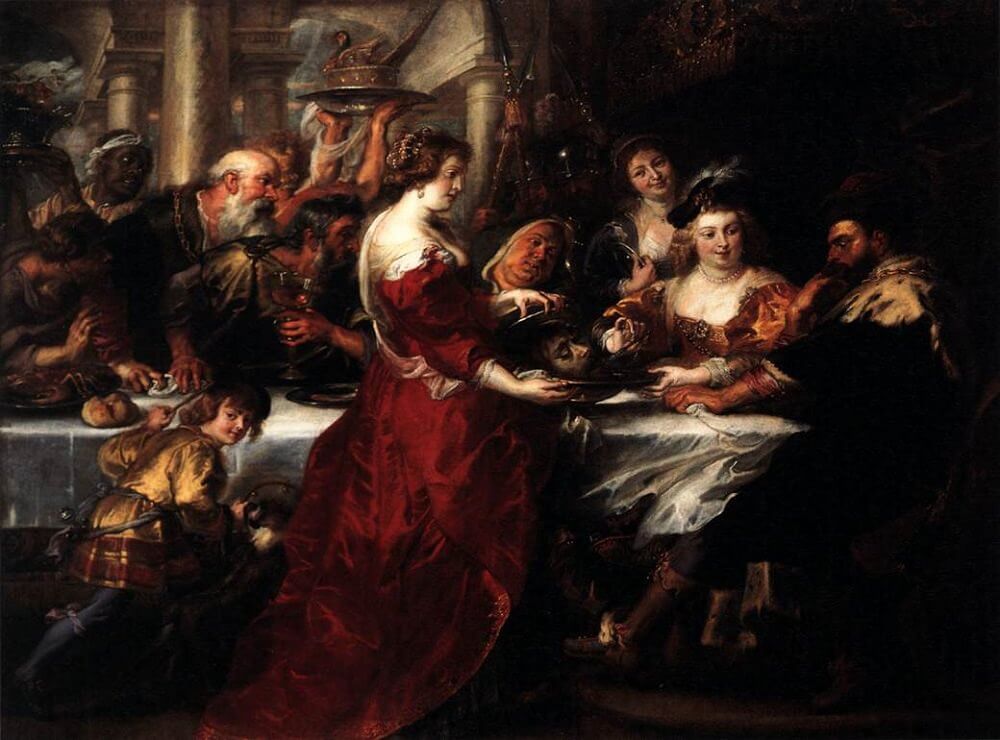
When the Flemish artist Peter Paul Reubens painted “Herod’s Feast” in the 1600s, he did so with bold color and sensuous detail. Reubens portrayed Herod’s daughter in a scarlet silken dress, bosom bulging, coquettishly lifting the cover on a silver platter bearing the bloodied head of John. A smirking Heodias, at the king’s side, plies a fork with her pinky finger lifted in elegant fashion, ready to poke John’s lifeless head or perhaps serve him up to her husband. Herod looks on, eyes bulging in horror, hands clenching the table cloth in guilt and remorse, barely holding it together. All around them, the party continues, guests feasting and drinking and gossiping, as if the death of the whistleblower were a foregone conclusion.

It’s a terrible story. It’s hard to hear that Herod would sooner take an innocent man’s life than admit his sin and make a change. We are appalled to think that a mother would manipulate her husband and her daughter to bring about a murder. John’s death anticipates the cross and the death of the innocent Jesus at the hands of a weak Pontius Pilate and an angry mob. When this passage pops up in the lectionary cycle, preachers are tempted to give it a pass. But it is a story worth attending to. John’s end questions our moral character. Will we stand up for truth, or will we fail to blow the whistle and live in guilty silence? John’s demise also ultimately confronts us with our own whistleblowers. We have all walked in Herod’s sandals. We have not always risen to our better natures when forced to listen to the message that we do not want to hear. We read of Herod’s Feast and John’s death, and we know our aversion to the hard truths and our reluctance to change, even when it is the right and holy thing to do.

Our John the Baptist blows the whistle. There is a graced moment – the potential for change and growth. Will we become our better selves, or will the prophet lose their head?


Questions to ponder (leave a comment) . . .

When have you been a whistleblower?

Who has been your personal John the Baptist?

How have hard truths prompted you to change?


Peter Paul Reubens, “The Feast of Herod,” accessed online at https://www.peterpaulrubens.net/the-feast-of-herod.jsp

Resources:
Black, Matthew. “The US passed the first whistleblower law in 1777” in History 101, Feb. 14, 2020. Accessed online at https://www.history101.com/the-us-passed-the-first-whistle-blower-law-in-history-in-1777/.
Mullins, Lisa. “50 Years Ago, Daniel Ellsberg — Who Leaked The Pentagon Papers — Surrendered At Boston Federal Court” in WBUR News, June 28, 2021. Accessed online at https://www.wbur.org/news/2021/06/28/on-this-day-daniel-ellsberg-pentagon-papers-surrender-boston-federal-court
Mollenkamp, Carrick and Brett Wolf. “Special Report: HSBC’s money-laundering crackdown riddled with lapses” in Reuters, July 30, 2012. Accessed online at https://www.reuters.com/article/us-hsbc-compliance-delaware-idUSBRE86C18H20120714
Hall, Douglas John. “Theological Perspective on Mark 6:14-29” in Feasting on the Word, Year B, Vol. 3. Louisville: Westminster John Knox Press, 2009.
Yust, Karen Marie. “Pastoral Perspective on Mark 6:14-29” in Feasting on the Word, Year B, Vol. 3. Louisville: Westminster John Knox Press, 2009.
Bryant, Robert A. “Exegetical Perspective on Mark 6:14-29” in Feasting on the Word, Year B, Vol. 3. Louisville: Westminster John Knox Press, 2009.