Gluttony

Sabbath Day Thoughts — Luke 16:19-31 “Gluttony”

This is the fifth in a series on the Seven Deadly Sins.

For many people, an unexpected consequence of the pandemic has been unwanted weight gain.  42% of US adults have reported gaining an average of 29 pounds.  What did we expect?  We were homebound and stressed out. The gyms were closed, yoga and dance classes cancelled, and we stopped jogging with our buddy.  We were ordering take-out and having groceries delivered.  If only we hadn’t started baking sourdough bread and discovered the recipe for the Cheesecake Factory’s original cheesecake.

Obesity has been on the rise in the US for decades.  In the year 2000, 30.5% of us were obese.  By 2021, that statistic had swelled to 42.4% of us.  All that weight puts us at increased risk for diabetes, stroke, heart attack, and cancer.  The annual cost of obesity to our health care system is $147 billion.  Weight loss is a growth industry, raking in $253 billion in 2021.  According to a report in the New England Journal of Medicine, our weight problems won’t be improving any time soon. Unless we change, half of all Americans will be obese by 2029.  One in four Americans will be severely obese, that’s more than 100 pounds overweight.

A parallel consequence of the pandemic has been an increase in world hunger.  In 2021, 957 million people across 93 countries did not have enough to eat, a jump of 161 million people from before the advent of COVID-19.  239 million people are in need of life-saving humanitarian action.  21.3% of the world’s children suffer from stunted growth, due to chronic malnutrition.  Hunger is a problem that cannot be solved by emergency food aid alone.  We need a concerted global effort to develop sustainable food systems.  There is more than enough food produced to feed everyone on the planet, but we have lacked the global will to ensure that everyone has enough.

Our Lenten consideration of the Seven Deadly Sins continues this morning with gluttony, from the Latin gluttire, to gulp down or swallow. Aristotle, in his Nicomachean Ethics, taught that gluttony is the unrestrained desire for food that harms the individual and prevents human flourishing.  The Roman philosopher Cicero saw gluttony as a matter of wrong priorities, saying, “It is necessary to eat in order to live, not to live in order to eat.”  The influential medieval theologian Thomas Aquinas saw gluttony as a moral wrong, an inordinate desire for food that adversely affects our spiritual life. Aquinas cast gluttony as a form of idolatry in which our god is the belly.  Within the Christian tradition, we have seen over-indulgence in food as particularly egregious when it exists side-by-side with the hunger of our neighbors.  Dante envisioned a special Hell for gluttons, lying in filthy, cold slush amid a never-ending icy rain while watched over by a giant stomach with three worm-like heads.  Eeeew!

Contemporary thinking on gluttony invites us to consider the social, psychological, and spiritual context of the sin.  In her book Glittering Vices, Prof. Rebecca DeYoung of Calvin College casts gluttony as a sin of self-gratification, an ultimate expression of “Me” culture in which it is all about us.  The social sciences invite us to see how our human relationship with food has shifted over the course of centuries.  Once upon a time, only the elite could over-indulge in food, but with the rise of the middle class, a well-stocked table was seen as a sign of vitality, prosperity, and success. Somewhere along the way, that sign of prosperity and success went off the rails.  We eat for any number of reasons other than necessity.  We eat out of boredom, stress, tiredness, and anger. Overeating can just be a habit.  Or, we may have never learned proper portion sizes.  Who belonged to the “Clean Plate Club” as a child or was told that there were starving children in India or China or Africa who would love to have our dinner?  Professor Graham Tomlin of Oxford University suggests that beneath those social and psychological forces that promote gluttony, there is a deep spiritual need.  We mistakenly use food to try to satisfy the deeper craving within us.  The craving for God.  What a poor, dissatisfying substitute.

Our biblical paradigm of gluttony is Jesus’ story of the Rich Man and Lazarus. The rich man feasts sumptuously every day, seemingly oblivious to the suffering of the neighbor who begs at his gate.  Lazarus is poignantly described: starving, sick, too weak to keep the dogs from licking his festering sores.  Death brings a great reversal.  While the rich man suffers eternal torment, Lazarus is welcomed and comforted like a beloved child. We learn that the rich man was not unaware of his neighbor’s suffering—he recognizes Lazarus and knows his name.  In life, the rich man simply chose to not see or assist his starving neighbor.  Instead, he indulged his own lavish appetite.  Jesus suggests that our unbridled consumption and our choice to be blind to the need of our neighbors creates a willful gap that allows suffering to flourish in this world, a gap that has eternal consequences for the life to come.

The remedy for gluttony is found in the virtue of temperance. Temperance is an antiquated word with negative connotations that spring from America’s failed experiment with Prohibition.  Perhaps better words for temperance these days are moderation or self-discipline.  Aristotle characterized temperance as finding the “Golden Mean”—doing the right thing in the right amount in the right way.  Aquinas believed that we don’t need to abstain from the pleasure of good food, but we do need to make discerning choices about what and how we eat, shunning those pleasures that are “immoderate and contrary to reason.”  In Paradise Lost, 17th century poet John Milton had the archangel Michael extoll the virtue of temperance which leads to a long and happy life.

“There is, said Michael, if thou will observe

The rule of not too much, by temperance taught

In what thou eat’st and drink’st, seeking from thence

Due nourishment, not gluttonous delight,

Till many years over thy head return:

So mai’st thou live, till like ripe Fruit thou drop

Into thy Mother’s lap, or be with ease

Gather’d, not harshly pluck’t, for death mature.”

Nowadays, advocates of Positive Psychology, which focuses on individual and societal well-being, teach that temperance is one of six core virtues that increase happiness when we build upon them.  Temperate people develop the capacity to handle the complexity of life. They choose to face things calmly and insightfully. Temperance allows us to control our impulses and delay our gratification in pursuit of future goals.  For Christians, temperance equips us to weather difficult times with grace, because we see the long view and trust that God is with us and change can come. Temperance finds its expression in us when we find a healthy moderation and balance in life, creating the right environment for us—and our neighbors—to thrive. 

Our biblical model for temperance is Jesus.  His critics may have alleged that he was a glutton and a drunkard, but Jesus made choices about food to serve the Kingdom of God. Jesus chose fasting in the wilderness as an act of spiritual preparation.  Yet, the first miracle of his ministry was one of feasting.  In Cana, the Lord turned water into wine to save the day at a wedding banquet.  Jesus used meals to build community. He welcomed to the table outsiders, like sinners and tax collectors, and insiders, like Pharisees and disciples.  Jesus was concerned about hungry people.  He fed multitudes with meager resources and miracles of multiplication.  Jesus gave us a holy meal, the Lord’s Supper, to remind us of his great love for us and the ultimate sacrifice that he would make for our sake on the cross.  Jesus liked to eat, just like the rest of us, but he made intentional choices about where, when, and how he ate in order to achieve his mission and give glory to God.  Now that’s temperance.

How might we follow Jesus in practicing temperance?  We can be informed by scripture.  The psalmist affirms that food is God’s good and generous providence: all creation looks to God “to give them their food in due season.” By God’s generous hand we “are filled with good things” (Psalm 104:27-28).  We have a role to play as stewards of that generous providence of God, not only for ourselves, but also for the world around us.  We remember that when the disciples wanted to send away hungry people, Jesus stopped them with the words, “You feed them” (Mark 6:37).  Our personal concern with food needs to be a global concern for feeding a hungry world, for ensuring that Lazarus does not languish at our gate while we feast sumptuously.  Changing our thinking about food can draw us closer to God and closer to our most vulnerable neighbors.

Changing our thinking about food can also change how we understand ourselves.  Learning and implementing temperance in our personal relationship with food may feel harder, but the behavioral science surrounding weight loss tells us there is hope.  We can set dietary goals and be accountable, even if that means keeping a food journal or finding a trusted friend to encourage us.  We can be aware of what tempts us most and take time to notice when the craving kicks in.  We can practice some selective abstinence from foods that are most likely to sabotage us, whether we stop buying the potato chips or we take a break from sugar during Lent.  We can make better choices, cultivating an appetite for healthier foods.  We can also look to things other than food for our personal satisfaction, like a good book, music, fellowship, scripture, nature, creativity, learning, prayer, or exercise.  Healthy change is possible with the help of temperance, the Holy Spirt, and some hard work.

So, let’s give temperance a try.  What do we have to lose other than the 29 pounds we gained during the pandemic and the hunger of 957 million of our world neighbors? 


Resources

Valeria Sabater. “Temperance is Key to Your Psychological Well-Being” in Exploring Your Mind, Nov. 15, 2021.  Accessed online at https://exploringyourmind.com/temperance-is-key-to-your-psychological-well-being/

Lesley Lyle. “Developing Temperance” in Positive Psychology, March 2013. Accessed online at thepositivepsychologypeople.com.

Gernot Laganda. “2021 Is Going to Be a Bad Year for World Hunger” in Food Systems Summit. Accessed online at un.org

Kaia Hubbard. “The Pandemic Has Worsened the US Obesity Epidemic” in US News and World Report, Sept. 15, 2021. Accessed online at usnews.com

Aristotle. Nicomachean Ethics. Accessed online at virtuescience.com.

Thomas Aquinas. Summa Theologica. Accessed online at newadvent.org.

Francine Prose. “Seven Deadly Sins: Gluttony” from Gluttony (Oxford: Oxford U. Press, 2006). Accessed online at blog.oup.com.

CNN Staff. “Obesity in the US Fast Facts,” May 27, 2021. Accessed online at cnn.com.

Graham Tomlin. “Gluttony” in The Seven Deadly Sins (Oxford: Lion Hudson, 2014).

Kimberly Winston, “Gluttony and the Seven Deadly Sins” in Religion News Service, Nov. 22, 2016.  Accessed online at religion news.com.


Luk 16:19-31

19 “There was a rich man who was dressed in purple and fine linen and who feasted sumptuously every day. 20 And at his gate lay a poor man named Lazarus, covered with sores, 21 who longed to satisfy his hunger with what fell from the rich man’s table; even the dogs would come and lick his sores. 22 The poor man died and was carried away by the angels to be with Abraham. The rich man also died and was buried. 23 In Hades, where he was being tormented, he looked up and saw Abraham far away with Lazarus by his side. 24 He called out, ‘Father Abraham, have mercy on me, and send Lazarus to dip the tip of his finger in water and cool my tongue; for I am in agony in these flames.’ 25 But Abraham said, ‘Child, remember that during your lifetime you received your good things, and Lazarus in like manner evil things; but now he is comforted here, and you are in agony. 26 Besides all this, between you and us a great chasm has been fixed, so that those who might want to pass from here to you cannot do so, and no one can cross from there to us.’ 27 He said, ‘Then, father, I beg you to send him to my father’s house— 28 for I have five brothers—that he may warn them, so that they will not also come into this place of torment.’ 29 Abraham replied, ‘They have Moses and the prophets; they should listen to them.’ 30 He said, ‘No, father Abraham; but if someone goes to them from the dead, they will repent.’ 31 He said to him, ‘If they do not listen to Moses and the prophets, neither will they be convinced even if someone rises from the dead.’”


Photo by Jonathan Borba on Pexels.com

Lust

Sabbath Day Thoughts — “Lust” 2 Samuel 11

This is the fourth message in a Lenten Sermon Series on the Seven Deadly Sins.

We don’t often talk about lust in church.  Passion and sexuality are God-given gifts, part of our essential being, and key to God’s best hope for the creation.  They can be the crown and ultimate fulfillment of our most committed and caring relationships.  Yet, when misused and expressed as lust, passion and sexuality can have destructive consequences.

Consider adultery. Until a few decades ago, adultery was still a criminal offense in many countries where Christianity is the dominant religion. Adultery is technically illegal in 21 states in the US. New York is one of the few states that considers cheating on your spouse to be a sin. Idaho, Massachusetts, Michigan, Oklahoma, and Wisconsin, among others, have felony charges against it. Most couples marry with the expectation of fidelity, and yet extramarital affairs persist.  22% of married men and 14% of married women have committed adultery.  Adultery, as a breach of marital trust, is emotionally traumatic for both spouses.  17% of marriages that go through an incident of cheating end in divorce.

Lust among Millennials is expressed in hookup culture, which has replaced traditional dating on college campuses.  In hookup culture, relationships are purely physical and very brief—a few minutes, a couple of hours, or overnight.  Sexual intimacy is followed by no further communication or connection that could lead to attachment.  Often, drinking is involved.  One in three students characterize hookups as “traumatic” or “very difficult to handle.”  One in ten students say that they have been sexually coerced or assaulted.  Professor Lisa Wade of Tulane University says that hookup culture is “a punishing emotional landscape where caring for others or even simple courtesy seem inappropriate.”

The most prevalent expression of lust in our culture is pornography. More than 90% of young men report that they watch porn with some regularity. The world’s largest pornography website Pornhub reports that 90 billion videos are watched on their site every day by 64 million visitors. $3,000 is spent every minute. Research suggests that porn is bad for our committed relationships.  A 2016 study by the University of Oklahoma found that divorce rates double when pornography enters the marriage.  56% of divorce cases cite obsessive interest in porn as a contributing factor.

According to Aristotle, lust is an irrational, insatiable desire for pleasure that increases the more it is exercised. Thomas Aquinas taught that lust is a “voluptuous emotion” that “unloosens the human spirit and sets aside all reason.” In his Inferno, Dante Alighieri portrayed unrepentant lustful souls in Hell, eternally buffeted and driven by the force of a whirlwind. From antiquity through the 19th century, artistic depictions of lust are typically female.  Maybe we can blame it on Prudentius, who in the fifth century described the deadly sin of lust as “lavish of her ruined fame, loose-haired, wild-eyed, her voice a dying fall, lost in delight.”

In our modern understanding, we acknowledge the harmful unrestrained, sometimes escalating, sexual impulse of lust.  Yet, we also recognize the interpersonal abuse of lust. Our Friday night hookup isn’t regarded as a person with social and emotional needs to be respected or reverenced.  They are just a means to get our “rocks off” (as the Rolling Stones once said).  Jesus understood this.  That’s why he taught that when we look at others with lust, we have committed adultery in our hearts (Matthew 5:27-28).  In lust, we dehumanize and objectify others, looking only for our self-satisfaction.  Lust can also lead to the abuse of power.  The #METOO Movement shined a spotlight on successful men, like Harvey Weinstein, who used their personal, professional power to coerce women into sex.  In Old Hollywood, they called it the casting couch.  Now, we know it’s rape.

Our biblical paradigm of lust is King David.  While the younger men went off to war, the aging king let his eyes roam and his lust call the shots.  He abused his power to use Bathsheba to gratify his needs.  Then, when there were consequences, he hatched a series of plots to escape responsibility. Uriah was summoned home to sleep with his wife, but when the younger man proved too honorable, things got darker yet as the king engineered his death.  David may not have shot the arrow that took Uriah’s life, but he was the murderer, nonetheless.  History and Hollywood have suggested that Bathsheba was somehow to blame for the King’s lust.  But we know better.  I like to point out that the only sound we hear from Bathsheba in this terrible tale is her wailing of lamentation for the husband she loved.

We find the remedy for our lust in chastity.  Chastity has gotten a bad rap, conjuring up images of prudish men and women with their shirts buttoned up and a withering gaze for anything flirty.  So, perhaps I should begin with what chastity is NOT.  Chastity is not abstinence, although in practicing chastity, we may make choices for abstinence at different times in our lives.  Chastity is not sexual repression, pushing down within ourselves or punishing ourselves for our natural sexual impulses.  Chastity is not refusing to think about or talk about sex, as if sex isn’t a normal, natural part of being human.  Unfortunately, we tend to project all those unnatural, unhealthy qualities onto the virtue of chastity.

Aristotle taught that chastity uses rational principles to govern and bring into order our sexual desire.  He saw it as a natural discipline to be learned and practiced, saying, “as the child should live according to the direction of his tutor, so the appetitive element (lust) should live according to rational principle.”  In Christian thinking, chastity is more than just thinking our way past our sexual impulses.  Robert Kruschwitz, a Senior Scholar at Baylor University, says, “Chastity is a habit of reverence for oneself and others that enables us to use our sexual powers intelligently in the pursuit of human flourishing and happiness.”  I’ll break that down.  In chastity, we are at peace with our bodies and our sexuality—we see their God-given nature.  Then, we bring a loving reverence for ourselves and others to our intimacy.  We honor ourselves as creatures made in the image of God (Gen. 1:26), and we revere the image of God in others.  We bring love and respect to our intimate encounters for the sake of the other person’s good and ultimate happiness.  In chastity, those sexual impulses that we all experience are governed by Christ’s great commandment that we love God—and we love others as we love ourselves.  When we get right down to it, chastity is a choice to live in love. To bring agape to our sexuality.

Our biblical model of chastity is Joseph, the youngest son of Israel’s Patriarch Jacob (Genesis 39).  After Joseph was sold into slavery by his jealous older brothers, he was bought by Potiphar, the Captain of the Egyptian Guard.  Joseph served as Potiphar’s personal attendant, and the bond between the two men grew so close that Potiphar entrusted Joseph with his entire household. All was well that ended well until Potiphar’s wife cast her lusty gaze upon the well-built, handsome young Hebrew.  She commanded Joseph, “Sleep with me!”  Joseph refused the temptation, seeing that if he said “Yes,” he would betray the kindness and generosity of Potiphar and the love and goodness of God, who had blessed Joseph amid his misfortune. 

We can push back against the harmful consequences of lust in our society by practicing the virtue of chastity.  G.K. Chesterton taught that “chastity, like any value or virtue, is a positive thing that you gain, not something that you give up.”  Indeed, this notion of chastity as a gift or quality earned after moral struggle dates back to the 13th century.  Thomas Aquinas was said to have fought long against the temptation of lust.  According to tradition, when Aquinas prevailed, the angels gave him a rope belt as a sign of his victory.  Soon after his death, his followers began to wear chastity cords in hopes of a similar victory over lust.  Aquinas’s chastity belt is preserved today at the Cathedral in Cheiri, Italy.

In the absence of Thomas Aquinas, chastity belts, and the intercession of angels, there are some steps that we can take to nurture our formation in chastity.  We can acknowledge that lust and sexual urges are part of who we are.  We can learn to recognize what our triggers are, whether it is loneliness, a work trip, porn, or a fraternity party with too much alcohol.  We can be attentive to and mindful of our thoughts and physical state, and then we can choose not to act on those impulses.  It helps to have a small circle of trusted, honest, confidential friends who can hold us accountable, with whom we can share our temptation and find encouragement.  We can find role models who inspire us in the way of chastity at its best, whether it is Jesus or Thomas Aquinas or Captain America, who waited so long for his best-gal Peggy.  We can also accept that chastity, like any other virtue, is one that we can fall from.  Even Jimmy Carter admitted that he had felt lust and committed adultery in his heart.  And yet we trust that even as we fall, the grace of our Lord Jesus is sufficient for us.  We can begin again.  Perhaps most important of all, we need to talk about lust and chastity with our children and grandchildren, who will one day find themselves in the midst of that emotionally punishing landscape of hookup culture.

Well, my friends, we’ve done it.  We have talked about lust in church.  The roof has not fallen in.  Instead, we’ve taken an honest look at the world out there, where the God-given gifts of passion and sexuality have gotten misdirected into adultery, pornography, and hookups.  Lust may abound, but so can chastity.  Let’s choose chastity.  Let’s make that reasoned, respectful, loving choice for ourselves.  Let’s make it for the sake of others.  Let’s teach it to our children.  Amen.

Resources:

Lisa Wade. “The Rise of Hookup Culture on American College Campuses” in Scholars Strategy Network, August 25, 2017. Accessed online at scholars.org.

Alexandra Solomon. “What Hookup Culture Means for the Future of Millennial Love” in Psychotherapy Network, Oct. 5, 2020.  Accessed online at psychotherapynetworker.org.

Content Team. “Adultery” in Legal Dictionary.  Accessed online at legaldictionary,com.

David Schultz. “Divorce rates Double When People Start Watching Porn” in Science, August 26, 2016.  Accessed online at science.org.

Content Team. “Porn Addiction” in Psychology Today.  Accessed online at psychologytoday.com.

Robert B. Kruschwitz. “Chastity as a Virtue” in Christian Reflection, 2016.  Accessed online at baylor.edu.

Adam Jeske. “The Seven Deadly Sins: Lust” in InterVarsity, March 15, 2014.  Accessed online at intervarsity.org.

Aristotle. Nichomachean Ethics, Book 3, Ch. 12. Accessed online at virtuescience.com.

Thomas Aquinas. Summa Theologiae. Accessed online at newadvent.org.


2 Samuel 11:1-18, 22-27

11 In the spring of the year, the time when kings go out to battle, David sent Joab with his officers and all Israel with him; they ravaged the Ammonites, and besieged Rabbah. But David remained at Jerusalem.

2 It happened, late one afternoon, when David rose from his couch and was walking about on the roof of the king’s house, that he saw from the roof a woman bathing; the woman was very beautiful. 3 David sent someone to inquire about the woman. It was reported, “This is Bathsheba daughter of Eliam, the wife of Uriah the Hittite.” 4 So David sent messengers to get her, and she came to him, and he lay with her. (Now she was purifying herself after her period.) Then she returned to her house. 5 The woman conceived; and she sent and told David, “I am pregnant.”

6 So David sent word to Joab, “Send me Uriah the Hittite.” And Joab sent Uriah to David. 7 When Uriah came to him, David asked how Joab and the people fared, and how the war was going. 8 Then David said to Uriah, “Go down to your house, and wash your feet.” Uriah went out of the king’s house, and there followed him a present from the king. 9 But Uriah slept at the entrance of the king’s house with all the servants of his lord and did not go down to his house. 10 When they told David, “Uriah did not go down to his house,” David said to Uriah, “You have just come from a journey. Why did you not go down to your house?” 11 Uriah said to David, “The ark and Israel and Judah remain in booths; and my lord Joab and the servants of my lord are camping in the open field; shall I then go to my house, to eat and to drink, and to lie with my wife? As you live, and as your soul lives, I will not do such a thing.” 12 Then David said to Uriah, “Remain here today also, and tomorrow I will send you back.” So Uriah remained in Jerusalem that day. On the next day, 13 David invited him to eat and drink in his presence and made him drunk; and in the evening he went out to lie on his couch with the servants of his lord, but he did not go down to his house.

14 In the morning David wrote a letter to Joab, and sent it by the hand of Uriah. 15 In the letter he wrote, “Set Uriah in the forefront of the hardest fighting, and then draw back from him, so that he may be struck down and die.” 16 As Joab was besieging the city, he assigned Uriah to the place where he knew there were valiant warriors. 17 The men of the city came out and fought with Joab; and some of the servants of David among the people fell. Uriah the Hittite was killed as well. 18 Then Joab sent and told David all the news about the fighting; 22 So the messenger went and came and told David all that Joab had sent him to tell. 23 The messenger said to David, “The men gained an advantage over us, and came out against us in the field; but we drove them back to the entrance of the gate. 24 Then the archers shot at your servants from the wall; some of the king’s servants are dead; and your servant Uriah the Hittite is dead also.” 25 David said to the messenger, “Thus you shall say to Joab, ‘Do not let this matter trouble you, for the sword devours now one and now another; press your attack on the city and overthrow it.’ And encourage him.”

26 When the wife of Uriah heard that her husband was dead, she made lamentation for him. 27 When the mourning was over, David sent and brought her to his house, and she became his wife, and bore him a son. But the thing that David had done displeased the Lord.


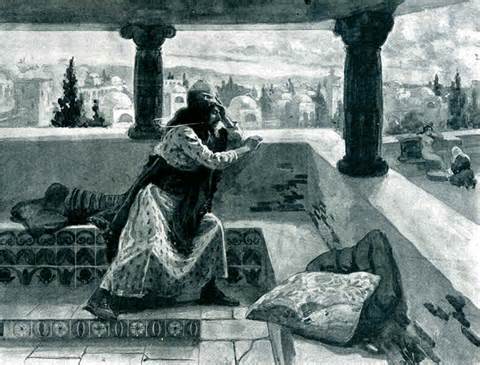
James Tissot, “David Sees Bathsheba Bathing,” https://www.newworldencyclopedia.org/d/images/3/3a/King_David_Bathsheba_Bathing.jpg

Wrath

Sabbath Day Thoughts — “Wrath” Acts 7:54-8:3; 9:1-5

New York Police are investigating what looks like a case of road rage in Harlem on Tuesday.  After a dispute between a motorcyclist and a driver, surveillance video shows motorcyclists surrounding the car and an argument ensuing.  The 63-year-old driver and his 35-year-old son were pulled from the vehicle, thrown to the ground, kicked, and robbed.

Last week, Atlanta Braves outfielder Marcell Ozuna told his teammates he was sorry for an arrest last year on charges of aggravated assault by strangulation and battery after police officers said they witnessed him attacking his wife. Ozuna, who attended court-mandated counseling, says, “I learned how you treat a person, how you be a better person, how you be the best daddy, how you be a human being. You learn everything from that.”  He hopes the public can forgive him.

In Fresno, a long-running feud between next-door-neighbors came to a head last month when a yard sale ended in violence.  According to witnesses, the two men were having a heated argument outside their homes when one picked up a pellet gun and shot the other.  When the police arrived, the shooter had walked away to cool down and the victim had broken his collar bone in a fall.

We all get angry.  It’s part of how we are hardwired.  Presented with threat, a part of our brain called the amygdala kicks into gear, telling us to fight or flee.  Anger can get us out of dangerous situations or motivate us to change.  Indeed, anger can be constructive, like Jesus turning over the tables in the Temple as a righteous protest against the exploitation of the poor.  Yet, anger, especially when it is long-held, disproportionate, or explosive is destructive, for ourselves and others.

Theologians have long called our uncontrolled feelings of anger wrath.  The Medieval philosopher Thomas Aquinas wrote that anger is a good and useful passion, but becomes evil when the order of reason is set aside.  Aquinas described the daughters of wrath as “quarreling, swelling of the mind, contempt, derision, clamor, indignation, and blasphemy.”  Poet and philosopher Dante Alighieri said that wrath is “the love of justice that has been perverted to revenge and spite.”  In his Inferno, Dante imagined the eternal punishment for the wrathful: dismemberment while still alive.  16th century painter Hieronymus Bosch in his painting “The Seven Deadly Sins” depicted wrath as two drunken neighbors violently quarreling.  One has clearly been hit over the head with a chair.  The table is overturned, hats and cloaks are cast off, blades are drawn, and a long-suffering wife tries to intercede.  

Our Biblical example of wrath is Saul, that’s the Apostle Paul before his come-to-Jesus moment.  Saul saw himself as the ultimate defender of the Hebrew faith.  He once described himself to the church in Philippi as “circumcised on the eighth day, a member of the people of Israel, of the tribe of Benjamin, a Hebrew born of Hebrews; as to the law, a Pharisee; as to zeal, a persecutor of the church; as to righteousness under the law, blameless” (Phil. 3:4-6).  When the followers of Jesus demonstrated a new interpretation of the Torah, Paul got angry, and then his anger grew into hatred and violence. First, Saul sponsored the execution of the deacon Stephen.  Then, he rounded up and imprisoned followers of Jesus in Jerusalem and Samaria.  Next, unwilling to stop with the elimination of Christians in Israel, Saul traveled to the Roman province of Syria to launch a new program of persecution there.  It would take an encounter with Jesus himself to turn things around for Saul.

In our own lives, wrath has physical and relational effects.  When we are in the throes of wrath, our hearts race, our blood pressure spikes, and our blood courses with adrenaline and noradrenaline.  We lose our capacity to monitor our emotions and actions.  We lack objectivity.  We are incapable of empathy, prudence, and thoughtfulness.  Wrath behind the wheel of a car can escalate to road rage, yet it is also seen in speeding, tailgating, and flipping off another driver.  Wrath can explode in marriages with acts of domestic violence, yet it is also revealed in that same fight that we have over and over again for years. We’re a little like the late comedian Phyllis Diller who quipped, “Don’t go to bed angry; stay up and fight!”   Wrath between neighbors can devolve into a feud, but it can also look like someone with their anger button stuck on, who takes exception to anything and everything that someone else does.  We feel so self-righteous about it, too.  But it’s like author Ambrose Bierce once wrote, “Speak when you are angry and you will make the best speech you will ever regret.”

Although we all struggle with wrath, we have a powerful weapon for that spiritual battle: the virtue of patience. The Latin root of patience pati means to suffer or endure.  According to Aquinas, a person is patient because she or he is able “to act in a praiseworthy manner by enduring things that hurt” without being unduly saddened or troubled by them.  When we are patient, we keep control over the impulse that suddenly and naturally arises when something disagreeable happens to us.  Patient people aren’t doormats or victims who allow themselves to be steamrolled in conflict. Rather, those who are patient choose to control themselves amid difficult circumstances for the sake of what is right – they trust that a way forward can be found with time and effort.  You might even say that in patience we freely bear the small cross of facing someone’s anger and bad behavior for the common good that makes healing possible.

Our biblical model of patience is, of course, Jesus.  Just look at his relationships with the two apostles who would become the lions of the early church.  Remember Peter?  Peter tried to talk Jesus out of the way of the cross.  Peter would sleep through Jesus’ anguish in Gethsemane.  Peter would resort to violence when the Temple guard arrived.  And Peter would deny Jesus three times.  Yet the long-suffering Jesus saw in Peter the gifts of leadership that the early church would need.  With great patience, Jesus restored Peter to right relationship with the three-fold invitation to feed the flock that Jesus was entrusting to his care.  Likewise, Saul, that Hebrew born of Hebrews, that greatest of persecutors, got turned around by Jesus on the Damascus Road.  Thanks to the patience of Jesus, Saul was redeemed.  Saul became Paul, the great evangelist to the Gentiles.

The bad news about patience is that these days there is less of it to go around.  In 2012, UMass researchers Krishnan and Sitaraman determined in a study of 6.7 million internet users that we can lose patience in as little as two seconds.  Buffering leads half of viewers to abandon videos in ten seconds.  The faster our internet connection is, the more impatient we become.  Scientists theorize that the rapid pace of technology is rewiring human brains to be less and less patient.  Is it any wonder that road rage incidents in Texas have doubled in the last year?  Jesus, take the wheel!

The good news about patience is that we can cultivate it.  We can grow our capacity to stay patient amid all the experiences that can make us angry.  A good place to begin is simply thinking before we speak.  Whether we count to ten or we take a minute to gather our thoughts and make a reasoned response, a little time can keep us from responding in ways that hurt and escalate anger.  We can also think about how we express ourselves.  It’s okay to let people know we are angry, but we can do it in a non-confrontational way.  Be clear and direct with statements that take personal responsibility for feelings.  “I feel angry. . . I feel irritated . . . I feel frustrated . . .”  Identify some possible solutions to the conflict and try to work toward a mutual agreement.  Humor, not sarcasm, can deflate heightened tensions.  “George, I’m angry that you chopped down the cherry tree.  I may not ever win the Great British Baking Show, but you’ve set me back about fifteen years in my quest to bake the perfect cherry pie. What would you like to do to make this right?”

In addition to those strategies in the moment, we can use some simple skills that help us to manage the side-effects of our angry encounters.  Take a walk.  Give yourself a time-out.  Listen to music.  Write in your journal. Imagine yourself in a relaxing place.  Not only do these practices relieve the physical effects of anger, they equip us to observe and reflect upon our own behavior.  We begin to see that we can make different choices.

Finally, even when we are not able to successfully resolve our angry encounters, we can choose to not hold a grudge.  The practice of forgiveness releases us from bitterness and creates the graced space where a relationship can find redemption.  When we are clean out of forgiveness, we can always borrow some from Jesus, who had plenty of mercy for Peter, Paul, and for us.

Well, my friends, we all get angry.  This week will bring a fresh batch of headlines about road rage, domestic violence, and community feuds.  We’ll feel our hearts racing, blood pressure rising, and our tempers flaring when the car we are following stops dead at the intersection of Route 86 and Brandy Brook Avenue, or when someone forgets to put the trash out again, or when the neighbor hangs yet another banner airing their political opinions.  But we can take a deep breath and have patience.


Resources:

CBS News Team. NYPD: Driver pulled from car, kicked and robbed by motorcyclists in possible road rage incident, CBS News, March 17, 2022. Accessed online at cbsnews.com.

Jake Seiner. “Ozuna addresses Braves after domestic violence ban ends” in AP News, March 14, 2022.  Accessed online at apnews.com.

Nic Garcia. “Fresno man in hospital after being shot by neighbor, police say” in ABC30 Action News, Feb. 20, 2022. Accessed online at https://abc30.com

Thomas Aquinas. Summa Theologiae. Accessed online at newadvent.org.

Krishnan and Sitaraman. “Video Stream Quality Impacts Viewer Behavior,” Amherst: UMass, 2012.  Accessed online at people.cs.umass.edu.

Adam R. Shannon. “The Sin of Anger” in The Seven Deadly Sins.  Accessed online at deadlysins.com

Charles Pope. “The Seven Deadly Sins: Anger” in Catholic Standard, April 4, 2019. Accessed online at cathstan.org.

Christopher Muther. “Instant Gratification Is Making Us Perpetually Impatient” in The Boston Globe, Nov. 2, 2016.

Mayo Clinic Staff. “10 Tips to Tame Your Temper.” Accessed online at mayoclinic.org.

–. “Control Anger Before It Controls You” in Journal of the American Psychological Association, January 2005. Accessed online at APA.org.


Acts 7:54-8:3; 9:1-5

54 When the elders heard these things, they became enraged and ground their teeth at Stephen. 55 But filled with the Holy Spirit, he gazed into heaven and saw the glory of God and Jesus standing at the right hand of God. 56 “Look,” he said, “I see the heavens opened and the Son of Man standing at the right hand of God!” 57 But they covered their ears, and with a loud shout all rushed together against him. 58 Then they dragged him out of the city and began to stone him; and the witnesses laid their coats at the feet of a young man named Saul. 59 While they were stoning Stephen, he prayed, “Lord Jesus, receive my spirit.” 60 Then he knelt down and cried out in a loud voice, “Lord, do not hold this sin against them.” When he had said this, he died. 8 1 And Saul approved of their killing him. That day a severe persecution began against the church in Jerusalem, and all except the apostles were scattered throughout the countryside of Judea and Samaria. 2 Devout men buried Stephen and made loud lamentation over him. 3 But Saul was ravaging the church by entering house after house; dragging off both men and women, he committed them to prison. Then, Saul, still breathing threats and murder against the disciples of the Lord, went to the high priest 2 and asked him for letters to the synagogues at Damascus, so that if he found any who belonged to the Way, men or women, he might bring them bound to Jerusalem. 3 Now as he was going along and approaching Damascus, suddenly a light from heaven flashed around him. 4 He fell to the ground and heard a voice saying to him, “Saul, Saul, why do you persecute me?” 5 He asked, “Who are you, Lord?” The reply came, “I am Jesus, whom you are persecuting.”


Photo by Alex Green on Pexels.com

Pride

Sabbath Day Thoughts — “Pride” Luke 4:1-13, Luke 18:9-14

This is the first in a Lenten sermon series on the Seven Deadly Sins and the Seven Heavenly Virtues.

Our Lenten season begins with Jesus in the wilderness.  As the Lord fasts and prays, the Devil confronts Jesus with a series of temptations.  “Use your holy power to turn stones into bread.  Bow down and worship me in exchange for world domination.  Put God to the test, reveal your glory, and be worshipped.”  Jesus turns away from the tempter’s wiles with scripture quotations.  He remains sinless.  Unfortunately, we do not.

The Seven Deadly Sins and the Seven Heavenly virtues are grounded in scripture.  There are thirteen virtue lists in the New Testament, from 2 Corinthians to First Peter, and there are twenty-three vice lists, from Matthew all the way through Revelation.  In the first centuries of our faith with the rise of asceticism, church leaders began to think systematically about those lists of sins and virtues.  As Christian mystics and monks withdrew to the Egyptian desert to focus on God, they noticed that they had some big distractions.  In the fourth century, Evagrius of Ponta identified a list of eight thoughts that could interfere with spiritual practice—these would become the Seven Deadly Sins.  A century later, Aurelius Prudentius Clemens wrote a 1,000-line poem, “Psychomachia,” in which he identified seven heavenly virtues that corresponded to the deadly sins.  Clemens argued that Christ our Lord helps us with “the jewels of virtue,” which he places within us to battle sin and delight wisdom.  Augustine argued that the seven virtues characterize the new life in Christ and grow within us out of love—agape.

The Seven Deadly Sins and corresponding Seven Heavenly Virtues found renewed interest in the Middle Ages.  In his 13th century opus Summa Theologica, Thomas Aquinas wrote that the virtues are habitual dispositions, “patterns of mind and heart,” that bring about good actions and curb our sinful impulses.  In meditating on scripture, imitating Christ, and practicing the virtues, God’s grace deepens and matures in us.  So popular was this thinking on the deadly sins and heavenly virtues that they became a favorite theme of Medieval art.  Church walls were painted with murals depicting them.  Countless medieval illustrated manuscripts of Clemens’ poem “Psychomachia” still survive, depicting the sins and virtues—in female form—doing battle.

These days, the Seven Deadly Sins and Seven Heavenly Virtues are a helpful framework in our spiritual formation.  We acknowledge that we are saved by grace through faith in Christ alone, yet we realize that God’s grace deserves our response.  In meditating upon scripture, in following the way of Jesus, we can look within.  We can identify the sins with which we struggle.  We can cultivate the virtues, those spiritual weapons given to us by Jesus.  We can seek to curb sin and grow into virtue as we grow into the beloved people whom God created us to be.

We begin with the sin of pride.  In his 2006 book Pride, Michael Eric Dyson of Vanderbilt University notes that pride has a favorable value in our society.  We have school pride.  We feel pride in our achievements wrought through long, hard work.  We have cultural pride that ties us to our ancestors and celebrates what made them and us the people we are.  This reasonable, appropriate regard for others and for ourselves is not what I am talking about. 

We can chalk that up to the limits of the English language, in which we have a single word to describe the full spectrum of pride.  Latin, on the other hand, uses the word superbia to talk about the sin of overweening pride, arrogance, contempt for others, self-righteousness, and the belief that we are not subject to God.  C.S. Lewis taught that superbia pride “is the complete anti-God state of mind.  It is ‘The Great Sin’ that leads to all other sins, because pride is the exaltation of Self above all authority, even God’s authority.”

The prime scriptural example of superbia is found in the Parable of the Pharisee and the Tax Collector (Luke 18).  Two men go up to the Temple to pray.  The Pharisee prays, “God, I thank you that I am not like other people: thieves, rogues, adulterers, or even like this tax collector.  I fast twice a week; I give a tenth of all my income.”  The Pharisee clearly thinks he is better than his neighbors—those “other people.”  He also imagines that he doesn’t really need God.  His exceptional piety and righteousness are enough to justify him. 

The tax collector presents a stark contrast.  He knows his sin and feels completely unworthy.  He stands far off, unable to lift his eyes to heaven.  He beats his breast in mourning and prays, “‘God, be merciful to me, a sinner!’” The tax collector knows that he doesn’t have a leg to stand on before God.  In the punchline of the parable, Jesus cautions his listeners that it won’t be the Pharisee who is justified before God.  It will be that scoundrel, the tax collector.

We know this sort of superbia pride when we see it.  It prompted Hitler to annex the Sudetenland.  It has driven Putin to roll his tanks into Ukraine.  We see superbia in the racial pride of white supremacy that drives a speeding car into a crowd of peaceful protesters.  Superbia is in the arrogance and utter disdain with which we belittle and trash-talk our rivals and enemies.  Superbia pride seeks constant adulation and praise from an army of “yes-men.”  Superbia kills our marriages and friendships because we believe that we alone are right—and everyone else is wrong.  We see superbia in the context of our faith communities when we believe that we don’t need to practice confession, we don’t have to hear what the preacher says because we’ve heard it all before and we know it all, and we don’t really need church because we don’t need saving—we are just fine on our own.  Woe to us when pride drives the bus.

Jesus saw the remedy to superbia in the virtue of humility.  He followed that teaching about the Pharisee and tax collector with the words, “All who exalt themselves will be humbled, but all who humble themselves will be exalted.”  Humility is the recognition of who we are in relationship to God.  In other words, God is God, and we are not.  Humility submits to the authority of God and the guidance of scripture.  Humility acknowledges that our personal abilities and resources are gifts from God that are to be used and shared to the glory of God and for the building up of our neighbors.

To comprehend humility, it helps to think about the origin of the word.  The Latin form humilitas shares the same root as humus, the organic component of soil, formed by the decomposition of leaves and other plant matter by microorganisms in the soil.  When we practice humility, we are down to earth, grounded, and aware of our limits and mortality.  Yet, Martin Luther warned that even humility can lead to sin.  As a monk, Luther sought humility.  He wore hairshirts to mortify his flesh.  He fasted, prayed, and slept on the floor.  “I finally achieved humility,” Luther quipped, “and I was proud of it!”

Humility finds its scriptural revelation in Christ’s death on the cross.  Although sinless, Jesus took on the burden of our collective sin and died a brutal, scandalous, shameful death to reveal God’s great love for us.  Thank you, Jesus.

So, what does humility look like for us?  Humility is knowing that we need God at the very center of our lives and our families.  Humility is good sportsmanship—acknowledging our losses and our opponent’s better abilities on any given day.  Humility is accepting responsibility for our mistakes and seeking to make things right.  We say, “I did it.  It’s my fault.  Let me make amends.  I am truly sorry.”  Even if we are convinced that we are right, humility demands that we stay in relationship, listen, find common ground, and work through differences.  Humility is identifying with the poor, the sick, and the despised people of our world.  It’s seeking to make a caring difference because we know that they are worthy, deserving of our love and tender care.  A world shaped by humility is blessed because it looks a lot like Jesus and anticipates the Kingdom.

So, my friends, as we begin our Lenten journey, let’s spend some time building that Kingdom by tempering our sins of pride with the virtue of humility.  We can begin by noticing the ways that pride has separated us from God and one another.  Then, we can find healing as we ground ourselves in humility, turning to the world with deep truth and abounding love.  May it be so. Amen.

Resources:

Neal Conan. “Interview with Michael Eric Dyson” in Talk of the Nation, Feb. 13, 2006.  Accessed online at npr.org.

Jerry D. Kistler. “The Deadly Sin of Pride” in The Montrose Press, March 8, 2019.  Accessed online at https://www.montrosepress.com/.

Ryan Griffith. “The Seven Heavenly Virtues: An Ancient Framework for Spiritual Formation” in desiring God, November 1, 2021. Accessed online at desiringgod.org.

Becky Little.  “How the 7 Deadly Sins Began as the ‘8 Evil Thoughts’” in History, March 29, 2021. Accessed online at history.com.


Luke 8:9-14

9 Jesus also told this parable to some who trusted in themselves that they were righteous and regarded others with contempt: 10 “Two men went up to the temple to pray, one a Pharisee and the other a tax collector. 11 The Pharisee, standing by himself, was praying thus, ‘God, I thank you that I am not like other people: thieves, rogues, adulterers, or even like this tax collector. 12 I fast twice a week; I give a tenth of all my income.’ 13 But the tax collector, standing far off, would not even look up to heaven, but was beating his breast and saying, ‘God, be merciful to me, a sinner!’ 14 I tell you, this man went down to his home justified rather than the other; for all who exalt themselves will be humbled, but all who humble themselves will be exalted.”


Photo by Krisp Cut on Pexels.com