Threading the Needle

Sabbath Day Thoughts — “Threading the Needle” Mark 10:17-31

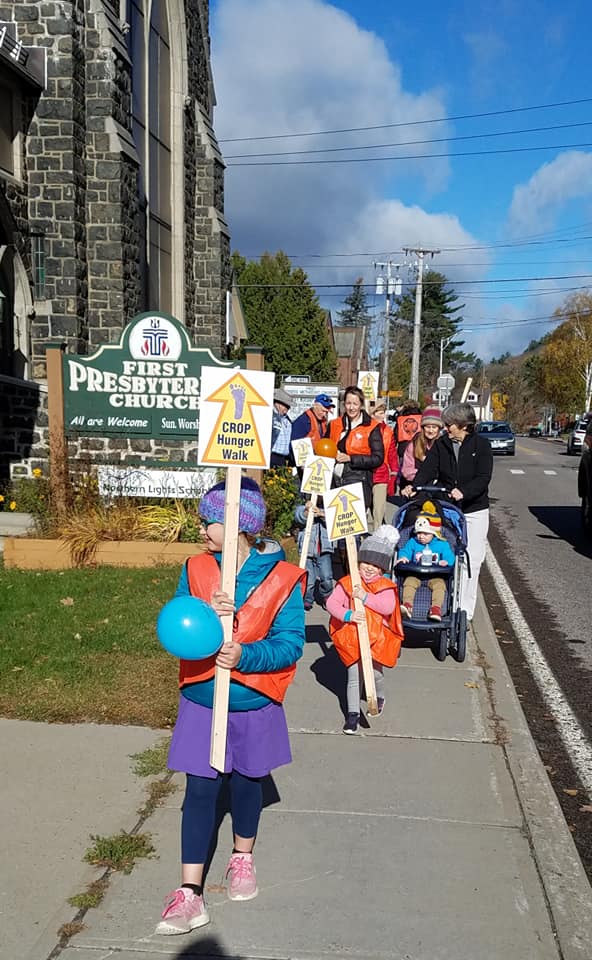
Next Saturday, walkers from this church will join our ecumenical neighbors in the annual Saranac Lake CROP Walk. We’ll be raising funds for the international hunger programs of Church World Service and the Interfaith Food Pantry here at home. CROP walkers say, “We walk because they walk.” It’s an acknowledgment of our solidarity with global neighbors who daily walk for food, water, work, school, and firewood.  The average distance that women in the developing world walk every day for water for their families is 3.4 miles. Elma Kassa of Ethiopia walks for water. Although Elma would like to go to school, she cannot because she helps her mother wash clothes to support the family.  Four times every day, Elma collects water, using a five-gallon clay jar.  Perhaps next Saturday as walkers stride down LaPan Highway from the Alliance Church to our church, they can think of Elma, with her heavy clay jar atop her head.

CROP Walks seek to eradicate hunger.  That’s a formidable task.  The Global Hunger Index tracks the state of hunger worldwide, country by country. Their 2024 report shows that little progress has been made in reducing hunger since 2016. Forty-two countries still experiencing alarming or serious hunger. Globally, 733 million people lack access to sufficient calories, and 2.8 billion people cannot afford a healthy diet. Acute food insecurity and the risk of famine are on the rise, and starvation is proliferating as a weapon of war. Worldwide, 148 million children are stunted, 45 million children are wasted, and almost 5 million children die before age five from hunger-related causes. The situation is most severe in Burundi, Yemen, and Niger—and it is on the rise in Afghanistan, Argentina, and Mongolia. Hunger kills more than nine million people each year, more than AIDs, malaria, and tuberculosis combined. 3.1 million of those deaths are children. 

People are hungry in the United States. The USDA estimates that 44.2 million Americans nationwide live in food insecure households. These are homes where meals are skipped or kids are sent to school without breakfast because there aren’t sufficient resources to put food on the table. 28% of households with children indicate that kids were not eating enough because families could not afford food, thanks to inflated prices and the end of federal pandemic relief support. Feeding America reports that more than 53 million people turn to food banks, food pantries, and meal programs for help. That’s one-third more than prior to the pandemic. Our food pantry volunteers will tell you that the Saranac Lake pantry downstairs is a busy place on Saturday mornings, serving all kinds of neighbors—seniors, single moms, traditional families, and people living with homelessness, mental illness, developmental disabilities, or physical handicaps.

Jesus’ encounter with the rich man invites us to consider the responsibilities of our relative affluence in a world plagued by persistent hunger.  Breathless after his run, kneeling in the dust of the road at Jesus’ feet, the rich man wanted to know what he must do to inherit eternal life. This righteous man was relieved to hear Jesus reciting the instructions of the Torah—no murder, adultery, stealing, lying, or defrauding. Be sure to honor your parents. The man had kept all these commandments from his youth, and he must have done so with great earnestness and integrity, because Jesus loved him for it and invited him to become a disciple.

There was only one thing lacking. Although the man was expert in keeping the Torah, he seemed to have fallen short in tzedakah or almsgiving, one of the most essential principles of Jewish piety.  Our Jewish ancestors believed that, ultimately, everything belongs to God.  While God could have created a world where everyone had exactly the same distribution of God’s bounty, God chose not to do so. Instead, some, like the rich man, were given much, while others had little. This uneven distribution of resources was how God invited faithful people to join their purpose to God’s purpose, to live lovingly and generously so that God’s goodness could abound for all. Faced with Jesus’ invitation to sell what he owned for the blessing of his impoverished neighbors, the rich man turned his back on a life with Jesus and went away grieving.

When it comes to wealth, we don’t consider ourselves rich, certainly not rich enough to be labeled “the rich man” or “the rich woman.” But when we see ourselves through the eyes of the world, we are more than blessed. The average daily wage in the United States is about $162. Developing countries with unstable political and economic conditions do not fare nearly so well. In Nepal, the average daily wage is $3.75; in Sudan, it’s $2.71; and in Afghanistan, people try to survive on less than a dollar a day. I have said it before, and I suspect that I will say it again, my friends. We are blessed—we are rich.

I’m not saying that we don’t work hard to earn what we have. We may spend long years striving in tough jobs to give our families the sort of home life and advantages that we wish them to have. I see a lot of hard workers when I look out at our pews on Sunday mornings. But I wonder if we see our relative wealth in the same way that Jesus invited the rich man to think of his money. Our relative affluence is a generous gift from God to bless our lives and to bless the lives of our impoverished neighbors. I wonder what our household expenditures might look like if Jesus were writing the checks. Today Jesus gives the rich man—and us—an uncomfortable reminder that we are meant to share God’s blessing with others.  When we do so, we get a foretaste of God’s Kingdom, where all are welcomed to the bountiful feast that Jesus has prepared.

I want to share how our participation in the CROP Walk can allow us to be a blessing to our neighbors, near and far. Our CROP dollars will help world neighbors like Moize Munenwa Joseph, one of over 800 people in Tanzania who participated in a CWS-sponsored vegetable farming program. Moize learned valuable farming skills like seed selection, pest control, and farm cleanliness. This helped him to improve his harvest and increase his income. Now Moize is sharing what he learned with others in his community. Moize says, “I can take care of my family and ensure we consume healthy food.”

Our CROP dollars can help world neighbors like Hak Nhy in Cambodia. For generations, her family has lived off crops from their vegetable farm. Challenges from climate change and the pandemic affected their harvest, leaving Hak and her family with barely enough to eat or sell. Hak enrolled in a Church World Service gardening program that taught her how to plant a more productive and nutritious garden. Hak says, “I have [gained] skills and knowledge on vegetable gardening, adapting to the changing weather conditions, and compost making.” Her family now has a better diet and her garden’s increased harvest allows her to sell surplus vegetables.

Our CROP dollars also help world neighbors like Alodia González, who lives in rural Paraguay. Alodia’s family struggled to have a stable income until she participated in a CWS training that focused on planting seeds and food production. Alodia learned about beekeeping and making honey. She also learned to organize and launch a community garden. Alodia says, “With a good production of honey, we are generating significant income to support our families. With the garden, we are able to eat lettuce and other vegetables produced by us.”

Our CROP dollars can be the kind of blessing that Jesus had hoped the rich man might share with his impoverished neighbors. I’m not talking about selling everything we have and giving it all away this morning. The good news for us is that even a modest gift that is well within our budgets can make a big difference in the lives of our needy neighbors.  A $20 pledge can provide chickens for a family—chickens are a lasting resource for eggs and meat. $60 is enough to help three families with seeds and training for home gardening. They’ll have better nutrition and the extra income that comes with plenty of veggies. A $161 pledge would be enough to enable a farmer to plant an acre of sweet potatoes, to provide both food and income. Are we feeling especially generous? $1,499 buys the whole farm—seeds, meat animals, and training to provide a family with reliable sources of food and income to meet their needs for years to come.

The rich man may have turned away from Jesus, saddened by the invitation to discipleship that Jesus shared with him. But I suspect that this morning, as we consider the call to discipleship and the impact of CROP Walk, we are getting inspired, eager even, to make a difference in the lives of hungry neighbors.  We are blessed, my friends, so that we might be a blessing to others. May we go forth to follow Jesus, sharing generously of our abundance to make a difference in the lives of our hungry neighbors.

Resources

Concern Worldwide. “Global Hunger Index 2024.” Accessed online at 2017 Global Hunger Index: The Inequalities of Hunger (concern.net)

Mehdi Punjwani. “Average salary in the U.S. in 2024” in USA Today, Sept. 26, 2024. Accessed online at Average Salary in the U.S. in 2024 (usatoday.com)

World Data. “Average income around the world” October 2024. Accessed online at https://www.worlddata.info/average-income.php

Church World Service. CWS (cwsglobal.org)

Mark G. Vitalis-Hoffman. “Commentary on Mark 10:17-31” in Preaching This Week, Oct. 11, 2015. Accessed online at Commentary on Mark 10:17-31  – Working Preacher from Luther Seminary

David Lose. “Commentary on Mark 10:17-31” in Preaching This Week, Oct. 14, 2012. Accessed online at Commentary on Mark 10:17-31  – Working Preacher from Luther Seminary

Matt Skinner. “Commentary on Mark 10:17-31” in Preaching This Week, Oct. 11, 2009. Accessed online at Commentary on Mark 10:17-31  – Working Preacher from Luther Seminary

To make a donation: https://events.crophungerwalk.org/cropwalks/event/saranaclakeny


Mark 10:17-31

17 As he was setting out on a journey, a man ran up and knelt before him and asked him, “Good Teacher, what must I do to inherit eternal life?” 18 Jesus said to him, “Why do you call me good? No one is good but God alone. 19 You know the commandments: ‘You shall not murder. You shall not commit adultery. You shall not steal. You shall not bear false witness. You shall not defraud. Honor your father and mother.’ ” 20 He said to him, “Teacher, I have kept all these since my youth.” 21 Jesus, looking at him, loved him and said, “You lack one thing; go, sell what you own, and give the money to the poor, and you will have treasure in heaven; then come, follow me.” 22 When he heard this, he was shocked and went away grieving, for he had many possessions.

23 Then Jesus looked around and said to his disciples, “How hard it will be for those who have wealth to enter the kingdom of God!” 24 And the disciples were perplexed at these words. But Jesus said to them again, “Children, how hard it is to enter the kingdom of God! 25 It is easier for a camel to go through the eye of a needle than for someone who is rich to enter the kingdom of God.” 26 They were greatly astounded and said to one another, “Then who can be saved?” 27 Jesus looked at them and said, “For mortals it is impossible, but not for God; for God all things are possible.”

28 Peter began to say to him, “Look, we have left everything and followed you.” 29 Jesus said, “Truly I tell you, there is no one who has left house or brothers or sisters or mother or father or children or fields for my sake and for the sake of the good news 30 who will not receive a hundredfold now in this age—houses, brothers and sisters, mothers and children, and fields, with persecutions—and in the age to come eternal life. 31 But many who are first will be last, and the last will be first.”

Give It Your All

Sabbath Day Thoughts — “Give It Your All” Mark 10:17-31

Our mission focus during the season of Lent turns to One Great Hour of Sharing. This ecumenical offering was first observed in 1946. In the wake of World War II, the world was hungry and displaced. War had devastated farmland and disrupted supply chains. Hunger had been used as a weapon of war with German occupied lands from Holland to Russia experiencing mass starvation. There were fifty-five million refugees in Europe alone. In response to the global humanitarian crisis, the first One Great Hour of Sharing offering was received in 1946 with a goal of raising $1 million in the one hour, from 11AM until noon, when most American churches gathered for worship.

In 1949, a national radio broadcast on the Saturday evening before Easter promoted One Great Hour of Sharing.  A host of famous people appeared on the program, including President Harry Truman and actors Gregory Peck and Ida Lupino. In his radio address, Truman tugged at the nation’s heartstrings saying, “There are thousands of children in foreign lands today who have no memory of their parents, no knowledge of the meaning of the words ‘home and family,’ and who have forgotten what it feels like to have enough to eat. There are hopeless thousands who wander among the shattered towns seeking a place to rest, seeking security and a chance to begin their lives anew. There are many who pray to God only in secret, fearing persecution if they profess their beliefs openly. It is hard for us to comprehend grief and distress such as this, because we in America are so much more fortunate.” This church participated in that 1949 offering. Members were invited to listen to their radios from 8-9PM on Holy Saturday and come to church to celebrate Easter and make a contribution the following morning.

Seventy-five years later, One Great Hour of Sharing is still going strong. The offering that we collect on Easter will benefit three programs of the denomination—Presbyterian Disaster Assistance, the Presbyterian Hunger Program, and Self-Development of People, initiatives that make a difference in the lives of vulnerable neighbors in the United States and around the world. Nowadays, we don’t have the President, or the likes of Gregory Peck, encouraging us to give. Instead, we have fish banks that the children, and those of us who feel a little childlike, will fill in the coming weeks to remember our at-risk global neighbors throughout the Lenten season.

In our lesson from Mark’s gospel, Jesus encouraged a “rich man” to consider parting with his affluence to help his hurting neighbors.  We can imagine it. Breathless after his run, kneeling in the dust of the road at Jesus’ feet, the rich man wanted to know what he must do to inherit eternal life.  I bet he was relieved to hear Jesus recite the instructions of the Torah – no murder, adultery, stealing, lying, or defrauding.  Be sure to honor your parents.  This man had been observing all those commandments from his youth, and he must have done so with great earnestness and integrity, because Jesus loved him for it.

There was only one thing lacking.  Although the man was expert in keeping the Torah, he seemed to have fallen short in tzedakah or almsgiving, one of the most essential principles of Jewish piety.  Our Jewish ancestors believed that, ultimately, everything belongs to God.  While God could have created a world where everyone had exactly the same distribution of God’s bounty, God chose not to do so.  Instead, some, like the rich man, were given much, while others had little.  This uneven distribution of resources was how God invited faithful people to join their purpose to God’s purpose. They could live lovingly and generously so that God’s goodness could abound for all.  Faced with Jesus’ invitation to sell what he owned for the blessing of his impoverished neighbors, the rich man balked.  He turned his back on a life with Jesus and went away grieving.

I don’t know if many of us would consider ourselves rich, certainly not rich enough to be labeled by our neighbors “the rich man” or “the rich woman.”  But when we see ourselves through the eyes of the world, we are truly blessed.  The average daily wage for New York state is about $202.  Compare that to the average global daily wage of $7.56.  We earn twenty-seven times what our global neighbors earn. Those who live in the five poorest nations—Burundi, Afghanistan, Somalia, South Sudan, and Mozambique—survive on less than $1 a day. We earn two-hundred times what the world’s poorest neighbors are able to earn. We are rich!

 Each day we make choices about how we are going to spend our relative affluence.  I’ll share some examples from the Department of Labor’s latest report on consumer expenditures.  The average gross household income in our country for 2022 was $72,961.  We dedicated about 33% of that household income to shelter—paying the mortgage or rent, utilities, home improvements, and furnishings.  We spent about 17% of our household income on transportation—car payments, maintenance, fuel, and insurance. Those seem like pretty essential expenditures to me. We are blessed to have homes and cars.  Aren’t we?

We also choose to spend our household income on some less essential things. Our average household expense for eating meals out was $3,639. That was followed closely by our average annual household expense for entertainment—$3,429 for things like music, movies, apps, games, vacations, and sporting events. We like to look sharp while we are being entertained and eating out because the average household spent $1,970 on clothes, which far outpaced what we spent on reading $117.  How fortunate we are to not only cover our basic expenses but to enrich our lives with vacations, special meals, new clothes, and good books.

We work hard to earn what we have. We may spend long years striving in tough jobs to give our families the sort of home life that we wish them to have.  But I wonder if our spending patterns, especially for discretionary income, might shift if we thought of our relative wealth in the same way that Jesus invited the rich man to think of his money.  Our relative affluence is a generous gift from God to bless our lives and to bless the lives of our impoverished neighbors. I wonder if our spending patterns might alter if we thought it was just as important to care for the well-being of our needy neighbor as it is to honor our fathers and mothers and to keep all those other commandments.  I wonder what our household expenditures might look like if Jesus were writing the checks. 

I think that Jesus would approve of the way our One Great Hour of Sharing Offering was used last year to help those who aren’t quite as blessed as we are. Presbyterian Disaster Assistance provided $3.1 million in grants to twenty-seven communities in the US and thirty-five countries around the world. We helped people like Bernadette, whose home began to crumble beneath her very feet when a 7.8 magnitude earthquake hit Aleppo, Syria a year ago. With help from PDA, her home was stabilized and rehabilitated. Bernadette says, “We offer our thanks to all who have given so generously. Our prayers likewise go out to all who stand by us and receive the Offering to ease our economic burdens and encourage us to stay in our country and continue witnessing to our Christian faith.”

That isn’t the only way our gifts made a difference. Through the Presbyterian Hunger Program, 525,000 pounds of seeds and seedlings were distributed to farmers around the globe. 875 chickens went to households in Guatemala and Colombia to provide an ongoing resource for eggs and meat. 105 women became self-employed in Malawi as they developed a bakery to serve rural communities. One Great Hour of Sharing doesn’t ask us to sell all we have and give the money to the poor, but it does invite us to consider how our thoughtful gifts can make a world-changing difference for our local and global neighbors.

In the last image that Mark’s gospel grants us of the “rich man,” he was shocked. Reeling from what Jesus had asked of him, he turned his back and walked away. We don’t know what happened after that. But I like to imagine that the rich man spent some time thinking about what he possessed, and he began to wonder if what he owned really owned him. He began to notice his neighbors more, especially the ones who suffered, who didn’t have enough food, who couldn’t afford to pay a daughter’s dowry, whose disability forced them to beg, whose hearts trembled every time the tax collector knocked at their door. As the rich man opened his heart to those in need, he saw that Jesus was right. He could help. He opened his hands, he loosened his purse strings, and everyone got blessed.

Resources:

Bureau of Labor and Statistics. “Consumer Expenditures—2022,” USDL-23-1943, September 8, 2023. Accessed online at https://www.bls.gov/cex

Claudio Carvalhaes, “Commentary on Mark 10:17-31” in Preaching This Week, Feb. 18, 2024. Accessed online at Commentary on Mark 10:17-31 – Working Preacher from Luther Seminary

Pat Cole. “Presbyterians celebrate 70 years of One Great Hour of Sharing” in Presbyterian News Service, March 6, 2019. Accessed online at https://www.presbyterianmission.org/story/presbyterians-celebrate-70-years-of-one-great-hour-of-sharing/

Jack Flynn. “Average Global Income [2023]: What Is the Median Income Worldwide?” in Zippia, April 13, 2023. Accessed online at https://ww.zippia.com.

Gloria Guzman and Melissa Kolar. “Income in the U.S.: 2022.” US Census Bureau, Sept. 12, 2023.

Raquel Lettsome. “Commentary on Mark 10:17-31” in Preaching This Week, Feb. 14, 2016. Accessed online at Commentary on Mark 10:17-31  – Working Preacher from Luther Seminary

–. “Living on the Brink of Disaster” in Presbyterian News Service, February 13, 2024. Accessed online at https://www.presbyterianmission.org/weekly-offerings/2024/02/13/oghs-presbyterian-disaster-assistance/

Harry Truman. “Radio Address as Part of Interdenominational Program, ‘One Great Hour’” in the National Archives: Harry S. Truman Library Museum, March 26, 1949. Accessed online at https://www.trumanlibrary.gov/library/public-papers/62/radio-address-part-interdenominational-program-one-great-hour


Mark 10:17-31

17As he was setting out on a journey, a man ran up and knelt before him, and asked him, “Good Teacher, what must I do to inherit eternal life?” 18Jesus said to him, “Why do you call me good? No one is good but God alone. 19You know the commandments: ‘You shall not murder; You shall not commit adultery; You shall not steal; You shall not bear false witness; You shall not defraud; Honor your father and mother.’” 20He said to him, “Teacher, I have kept all these since my youth.” 21Jesus, looking at him, loved him and said, “You lack one thing; go, sell what you own, and give the money to the poor, and you will have treasure in heaven; then come, follow me.” 22When he heard this, he was shocked and went away grieving, for he had many possessions.

23Then Jesus looked around and said to his disciples, “How hard it will be for those who have wealth to enter the kingdom of God!” 24And the disciples were perplexed at these words. But Jesus said to them again, “Children, how hard it is to enter the kingdom of God! 25It is easier for a camel to go through the eye of a needle than for someone who is rich to enter the kingdom of God.” 26They were greatly astounded and said to one another, “Then who can be saved?” 27Jesus looked at them and said, “For mortals it is impossible, but not for God; for God all things are possible.”

28Peter began to say to him, “Look, we have left everything and followed you.” 29Jesus said, “Truly I tell you, there is no one who has left house or brothers or sisters or mother or father or children or fields, for my sake and for the sake of the good news, 30who will not receive a hundredfold now in this age—houses, brothers and sisters, mothers and children, and fields with persecutions—and in the age to come eternal life. 31But many who are first will be last, and the last will be first.”


By Heinrich Hofmann – Purchased by John D Rockefeller Jr, now residing at Riverside Church, New York, Public Domain, https://commons.wikimedia.org/w/index.php?curid=14265296

Possessed

Sabbath Day Thoughts: “Possessed” Mark 10:17-31

Americans don’t like to talk about money.  In May, Business Insider Magazine conducted a poll of 2,130 people to determine the topics they were most likely to discuss with friends.  Last on the list was money, outranked by current events, family, health, sex, relationships, and politics.

Rachel Sherman, a sociologist with the New School, reports that how we feel about discussing money may be determined by how much we have.  Affluent Americans say they are circumspect about money because they don’t want their lower-wage-earning friends to feel bad.  Middle income Americans tend to shy away from the topic of money because they may be economically fragile—the cost of their kid’s college education, a surge in healthcare expenses, or an unexpected big-ticket home repair can leave them reeling with more month than money.  Working class Americans are much more transparent about money.  They freely discuss the challenges or even impossibilities of supporting a family on minimum wage work.  They swap ideas about how they stretch their dollars and cut corners.

Kimberly Chong, an anthropology lecturer at University College, London, teaches that at the heart of the taboo on money talk is a cultural belief that money is associated with personal worth.  Social status, power, and respect are tied to our paychecks and our bank accounts.  It’s like that bumper sticker, “The boy, who dies with the most toys, wins.”  That sort of thinking is uncomfortable in a democracy where we affirm the equality of all citizens, even as we acknowledge the reality of income inequality and the concentration of wealth.

We don’t like to talk about money, if we can help it.  We really don’t like talking about it in church.  Perhaps my calling our attention to the topic has got you feeling uncomfortable—or wishing that I would change the subject.

Jesus didn’t have any trouble talking about money.  He talked about it a lot.  Indeed, the only topic that Jesus talked about more than money was the Kingdom of God.  If you counted, you would see that eleven of Jesus’ thirty-nine parables are about money.  Today’s reading from Mark’s gospel speaks frankly about the tension that can exist between our understanding of earthly riches and Jesus’ teaching about the Kingdom of God.

As Jesus and his friends were departing on a missionary journey, a rich man stopped them and asked the Lord an urgent question, “What must I do to inherit eternal life?”  In Jesus’ day, eternal life was just another way of saying the Kingdom of God.  Jesus sounded impatient as he counted off the requirements of the Torah: no murder, no adultery, no stealing, no lying, no fraud, be sure to honor your parents.  Perhaps feeling relieved, the man was quick to share that he was all about that sort of righteous living.

Mark gives us a window into Jesus’ feelings.  The Lord, seeing the rich man and hearing of his obedience, loved the man.  Jesus saw that it was this man’s heartfelt desire to love God and love his neighbor as himself.  This man had disciple written all over him.  And so, Jesus extended to him the same invitation he had made to Levi the tax collector and Peter, Andrew, James, and John, the fishermen: “Follow me.”

When the rich man heard the cost of discipleship, he balked.  The thought of selling his property, and parting with the proceeds made his heart skip a beat, tied his stomach in knots, and sent his mind scampering down rabbit trails of worry and fear.  The rich man went away grieving.  The Greek word that describes how the man felt is stugnasas.  It means shocked, surprised, and in sorrow.  The man had a crisis of character.  He turned away from Jesus, unable to accept what the Lord asked of him.

It’s a story that is hard to hear and perhaps harder to understand.  Even the disciples struggled with what Jesus had to say about the rich man and camels passing through needles’ eyes.  In the ancient near east, wealth was seen as a blessing from God.  From the point of view of the disciples, this rich man was one of God’s beloved ones.  How else could he have amassed that land, those homes, those belongings, those slaves?  It didn’t make sense to the twelve.  If the rich man wasn’t first in line at the pearly gates, then who could be saved?

Over the centuries, Bible scholars and preachers have grappled with how best to interpret this tough story, a story that questions our relationship with God and money.  The monastic tradition has long looked to this passage as a proof text for vows of voluntary poverty.  Postulants of the Franciscan, Claretians, and other religious orders take vows of poverty upon entrance, renouncing their worldly possessions.  What they own becomes the community’s and is used or disposed of for the benefit of all.

In the Reformation of the sixteenth century, our spiritual ancestor John Calvin taught that the rich man’s problem was more than money.  The rich man wanted to know what he must “do” to inherit eternal life.  For Calvin, that smacked of works’ righteousness, as if we earn our way into God’s Kingdom by accruing God’s particular favor with good deeds.  Eternal life, Calvin taught, is God’s freely given gift for all who place their trust in Jesus.  We cannot earn our way into heaven, but God’s grace makes the impossible possible for us.

During stewardship season, generations of preachers have used this story to invite us to be generous givers.  The rich man makes us question what we truly value.  Is it Jesus and a life spent in his company, or is it our money and the things that we possess?  In our love for Jesus, we are inspired, maybe not to sell all that we have, but to hold our possessions loosely.  We prayerfully consider how our abundance may be used in Jesus’ purpose.  We live generously as a blessing to church and community.

I think those are all valid and responsible ways of preaching about the rich man.  Some are called to a life of voluntary poverty and radical sharing.  Heaven is ours only by the grace of our Lord Jesus Christ.  We are, indeed, blessed to be a blessing to our church and others.  Ultimately, all we have and all we are belongs to God, whether we are rich men and women, or middle-class families, or the working poor who live so creatively on so little.

But the story of the rich man goes deeper than all that.  Jesus calls us to question the core assumptions and the cultural beliefs about money that possess our society.  Jesus contradicts the premise that our personal worth is tied to our net worth.  That assumption prompts us to value some people over others.  It’s a short leap from there to what the disciples presumed: that the rich man’s wealth was a sign of God’s special favor.

But that wasn’t how Jesus saw the world.  Jesus loved the rich man.  Yet, Jesus also loved those low-status, vulnerable children whom he hugged and blessed.  Jesus loved those disciples, who struggled to understand his teaching.  That abundant and overflowing love of Jesus was a reflection of God’s love.  After all, God so loved the world that God sent the beloved son to die for us.

At the close of today’s reading, Jesus told his friends that those core cultural beliefs that we hold about personal worth and net worth don’t apply in the Kingdom of God.  There, many who are first will be last and the last will be first.  Jesus invited his friends—Jesus invites us—to let go of our false assumptions.  We are called to envision a world where the penniless Haitian migrant at the southern border is as loved by God as the billionaire businessman.  It’s a world where the illiterate day laborer is of equal value to the university professor.  It’s a world where the residents of Edgewood House, and others who are reliant upon the social safety net, are every bit as valued and beloved as those who are enjoying a leaf-peeping getaway at The Point this weekend.  That’s some radical stuff, Jesus.

If we accept what Jesus has to say, it will change how we see not only our neighbors but also our possessions.  If our personal worth isn’t incumbent upon the size of our paychecks or our 401Ks or our brokerage accounts, then it gets easier to live generously and share freely.  Our abundance becomes a way to shape a world where all may know that they are the beloved by our limitlessly loving God.  That’s an invitation to discipleship that can make us feel stugnasas—shocked, surprised, or in sorrow.  Or, Jesus’s invitation just might grant us a foretaste of the Kingdom to come and the life eternal.  Jesus says, “Follow me.” How will we respond?


Resources

Black, C. Clifton.  “Exegetical Perspective on Mark 10:17-31” in Feasting on the Word, Year B, vol. 4. Louisville: Westminster John Knox Press, 2010.

Loudenback, Tanza. “A Survey of 2,000 Americans Found . . .” in Insider: Business Magazine.  Accessed online at businessinsider.com.

Menendez-Atun͂a,Luis. “Commentary on Mark 10:17-31” in Preaching This Week, Oct. 10, 2021.  Accessed online at workingpreacher.org.

Pinsker, Joe. “Why So Many Americans Don’t Talk about Money” in The Atlantic, March 2, 2020.  Accessed online at theatlantic.com.

Thompson, James J. “Theological Perspective on Mark 10:17-31” in Feasting on the Word, Year B, vol. 4. Louisville: Westminster John Knox Press, 2010.


Photo by Alexander Mils on Pexels.com