Rise Up!

Sabbath Day Thoughts — “Rise Up!” Mark 16:1-8

In three weeks, when we traditionally celebrate Good Shepherd Sunday, our cousins in the Orthodox tradition will commemorate the Sunday of Myrrh-bearing Women. They have been doing so since the fifth century when John Chrysostom, the Bishop of Constantinople, first honored those women who went to the tomb, armed with burial spices and anointing oil. In Orthodox churches on the Sunday of Myrrh-bearing Women, censers will be filled with smoking incense, and the priest will swing them with a practiced arm, venerating all four sides of the altar, the congregation, the bread and wine of communion, and the church itself. Prayers will remember the faithful witness of the women. The sermon may even make the connection between the myrrh-bearers and the long history of women who have served the church. The hymn of the day will be introduced with the words, “The women disciples bring myrrh unto Christ. And I bring a hymn as [if] it were myrrh unto them.”

Our Orthodox cousins also remember the myrrh-bearing women with a long tradition of iconography, sacred art that is used as an invitation to prayer and reflection. Perhaps you have seen the icons. Mary Magdalene, Mary the mother of James, and Salome are depicted at the tomb. The holy messenger in dazzling white points to the empty graveclothes, proclaiming that Jesus has risen. The women, with heads covered and flowing robes, carry ceramic flasks of oil. Their faces are wide-eyed with fear and lined with tears. One of the women is often painted with her back to the angel, as if poised to run. She looks back over her shoulder, torn between learning what has happened to Jesus and succumbing to holy terror.

After the sabbath, when the myrrh-bearers rose early, purchased spices, and walked to the tomb, they were well-acquainted with death. In first-century Israel, tending the dead was women’s work. It fell to women to prepare bodies for the grave: washing, anointing with oil, and wrapping in a simple linen shroud. For three days, women accompanied the body, walking to the tomb each morning, singing psalms, and sharing tears and cries of mourning. The myrrh-bearers had buried many people and tended many bodies: elderly parents, aged husbands, dear friends, solitary neighbors, and in a world where only one in five children lived to adulthood, they had buried children, many children.

Jesus warned the disciples that death waited in the Holy City. But the week before the women had rejoiced and danced into Jerusalem. Filled with hope, they sang and played their drums, waved palm branches and rejoiced to be in the company of the Messiah. That week the city turned hostile, even murderous.  On the night of the Passover, the women saw Jesus betrayed, abandoned, and led off like a lamb to the slaughter. On Friday, the women followed their bloody, broken Lord as he stumbled beneath the terrible burden of the cross. From a distance, they watched while soldiers gambled and the mob taunted and mocked. As the sun failed and darkness covered the land, they saw Jesus surrender his spirit. As the day grew late and the sabbath neared, two of the women followed Joseph of Arimathea.  They watched him claim the body, wrap it in linen, and hastily stow it in a rock-hewn tomb. All through the Sabbath, the women sat with their grief and loss. They weren’t sure who they were anymore, what their purpose was, or how they could go on. But as the rosy promise of a new week crept above the eastern horizon, they found the courage to do what women always did when a beloved one died. They purchased their burial spices and anointing oil and walked to the tomb.

/

We are not myrrh-bearers in the traditional sense of the word. We leave it to the mortuary or the crematorium to tend to the bodies of our dead. Yet we are not strangers to death. We know what it is like to walk to the tomb, to face squarely our loss and pain, our disbelief and defeat. We know the untimely death of our beloved ones. We know the death of our endeavors: the marriage that flounders and fails; the business that goes under; the degree we never finish. We know the death of friendships and kinships: the forgiveness we never extend, the trust that is betrayed, the selfish interest that drives home the killing wedge. We know death writ large upon the world stage: our planet groaning beneath the burden of our abuse, the blood of Palestinians and Israelis crying from the ground of a broken land, the lament of refugees longing for welcome and home. In the dark hours before dawn, we know how the myrrh-bearers felt. We know the unbearable grief. We may even wonder who we are, what our purpose is, or how we can go on.

/

When the women arrived at the tomb, the stone was rolled back. They hesitated in fear outside, each too frightened to go in alone, and so they decide to venture in together, a fearful little band bound by their love for Jesus and their common duty as myrrh-bearers. Mary Magdalene, Mary the Mother of James, and Salome entered the tomb, anticipating death. But there in the cold stone crypt, still smelling of blood and suffering, the women were shocked to find life. A holy messenger shared the good news that God could take all the evil of their world and work from it a miracle of life.

In the hours before dawn, as the earth rolled on to meet the morning and the last stars faded from the western sky, Jesus rose. He stretched and stood, testing his bruised body.  He stepped out of the tomb and into the garden, breathing deep the cool of the dying night. God’s amazing love had broken the power of sin and death. 

Mary Magdalene whispered, “Jesus is alive,”

Mary the mother of James gasped, “Jesus has been raised, just as he promised.”

Salome dared to hope, “Jesus has gone ahead to Galilee. We’ll see him there.”

/

On Easter morning, we dare to imagine that if God can raise Jesus from dead, then surely there is hope for us and all the ways that we are well-acquainted with death. We can trust that, just as God was at work to overcome the world’s sin and hate to raise Jesus, God is at work even now to help and to heal, to raise up the promise of new life.

Yes, we know the grief that comes with the death of our beloved ones, but we also trust that we are raised with Christ. The promise of the life everlasting and the heavenly shore awaits. Rise up!

Yes, we are well-acquainted with failure, but God is faithful and a new day dawns. One day we may love again, or find fresh purpose, or hear the knock of opportunity. Rise up!

Yes, we know the death of friendship and kinship, but if God can win the victory over sin, then maybe with the Lord’s assistance we can pick up the phone or write that letter or ask for help. Rise up!

Yes, we know global death and destruction, but if Jesus is raised, then maybe there is hope for our world yet. We can learn to tread lightly on God’s good earth. Peace can break out in the midst of war. The homeless poor can find home at last. Rise up!

We are well-acquainted with death, but on Easter morning, we join the myrrh-bearers, with great hope and holy fear, for with God the last word is always life.

/

Mary Magdalene, Mary the mother of James, and Salome came to the tomb in the traditional women’s role of myrrh-bearer; yet, they soon had a new vocation. Commissioned by God to be the first gospel-bearers, they rose up. They dropped their flasks of oil, lifted their skirts, and fled back into Jerusalem. Somewhere along the way, they overcame their fear and found their voices. They shared their good news with Peter and the disciples, saying, “Death does not have the last word. God has won the victory! Jesus is risen!”

/

I suspect that our cousins in the Orthodox tradition are right. Those myrrh-bearers are worthy of our gratitude and remembrance on at least one Sunday a year. They may even have something to teach us. If three women can overcome their fear to rise up and launch a tidal wave of hope and love that laps the shores of today, then think what we can do. We may be well-acquainted with death, but oh the life, sweet life! Let’s trade our myrrh for the gospel, my friends. There is good news to share. Rise up!

Resources

C. Clifton Black. “Commentary on Mark 16:1-8,” in Preaching This Week (Narrative Lectionary), March 27, 2016. Accessed online at Commentary on Mark 16:1-8 – Working Preacher from Luther Seminary

Greek Orthodox Diocese of America. “Learn: Sunday of The Myrrhbearers.” Accessed online at https://www.goarch.org/myrrhbearers-learn

Kaufman Kohler. “Burial” in Jewish Encyclopedia. Accessed online at https://www.jewishencyclopedia.com/articles/3842-burial#anchor6.

Nelson Rivera. “Theological Perspective on Mark 16:1-8” in Feasting on the Gospels: Mark. Louisville: Westminster John Knox Press, 2014.

John Sanidopolous. “Sunday of the Myrrhbearers Resource Page,” Orthodox Christianity: Then and Now, April 30, 2017. Accessed online at https://www.johnsanidopoulos.com/2017/04/sunday-of-myrrhbearing-women-resource.html

Oliver Yarbrough. “Homiletical Perspective on Mark 16:1-8” in Feasting on the Gospels: Mark. Louisville: Westminster John Knox Press, 2014.


Mark 16:1-8

16When the sabbath was over, Mary Magdalene, and Mary the mother of James, and Salome bought spices, so that they might go and anoint him. 2And very early on the first day of the week, when the sun had risen, they went to the tomb. 3They had been saying to one another, “Who will roll away the stone for us from the entrance to the tomb?” 4When they looked up, they saw that the stone, which was very large, had already been rolled back. 5As they entered the tomb, they saw a young man, dressed in a white robe, sitting on the right side; and they were alarmed. 6But he said to them, “Do not be alarmed; you are looking for Jesus of Nazareth, who was crucified. He has been raised; he is not here. Look, there is the place they laid him. 7But go, tell his disciples and Peter that he is going ahead of you to Galilee; there you will see him, just as he told you.” 8So they went out and fled from the tomb, for terror and amazement had seized them; and they said nothing to anyone, for they were afraid.
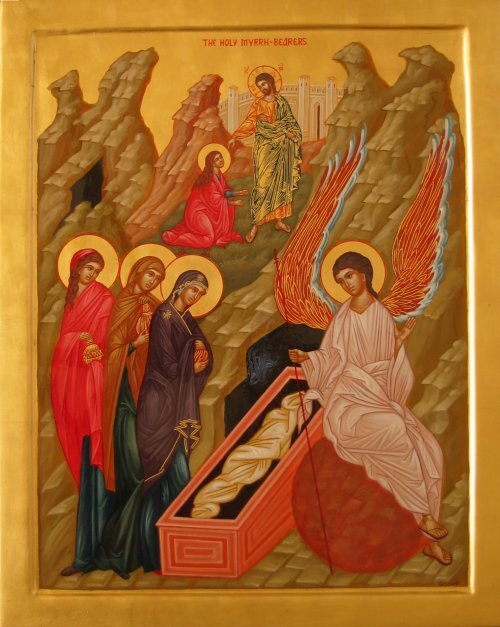

“The Holy Myrrh-bearers.” Accessed online at https://www.allsaintstoronto.ca/services-events/soo-gdthh-2ptfc-lng35-c8gjx-xaf3p

The End Is the Beginning

Sabbath Day Thoughts — “The End Is the Beginning” Mark 13:1-8, 24-37

Sometimes the end is the beginning.

Glenn was a young boy when he was terribly injured by a fire at school. Doctors warned his parents that Glenn would likely die, and even if he did survive, the burns to his lower body were so significant that he would be severely handicapped. When he was eventually discharged from the hospital, Glenn had no motor function in his lower body. He was confined to a wheelchair, his thin legs unable to walk.

Kris was a successful thirty-one-year-old actress and photographer, with a growing portfolio of film, advertising, and stage acting credits. She was living her dream when she woke up feeling like she had been hit by a truck. The doctor thought she was having gallbladder trouble—too much rich food and good wine, but tests said otherwise. On Valentine’s Day 2003, Kris was diagnosed with a rare, incurable sarcoma, stage four cancer that was attacking her liver and lungs.

Edward grew up loving the outdoors. His earliest memories were of hiking, rock climbing, and sailing with his father, who was an avid adventurer. By the time he was a teenager, Edward had learned to sky dive and earned a blackbelt in Shotokan karate. After college, he climbed big mountains in Nepal, before enlisting in the military as a paratrooper. In 1996, while on a training mission in Kenya, Edward’s parachute failed to fully open. He survived the fall by landing on the pack on his back, but three vertebrae were crushed by the impact, ending his career as a paratrooper.

Jesus knew his ministry was coming to an end. It was his final week in Jerusalem. The critics attacked him daily, seeking to discredit his teaching. The Romans, always concerned by the threat of insurrection at Passover, were looking for an excuse to set a public example of what happens to dissidents. The chief priests and scribes were plotting Jesus’ arrest and execution. Before the week was out, Jesus would be dead. His followers would scatter, mourning their dashed dreams and failed hopes.

The words that Jesus spoke in today’s lesson from Mark have long been called the little apocalypse. Those frightening images of war, earthquake, famine, the sun going dark, the stars falling from the sky, sound like the end of the world. They sound like the inner chaos and the outer tumult that would soon engulf Jesus’ friends. Their hopes and dreams and messianic expectations were coming to an end. But according to Jesus, God wasn’t finished with them yet. Amid the chaos, uncertainty, and fear, the Kingdom would come. The Son of Man drew near. Indeed, the fearful events of the coming days would be but the birth pangs of a new creation.

We’ve all had times when we felt we were at the end. A marriage begun with the greatest of love grows cold, distant, and dissolves in divorce. The workplace that brought us professional fulfillment and put food on the table hands us a pink slip. Our kid makes some bad choices and winds up alienated from us and in a world of trouble. The doctor gives us that difficult diagnosis, the one that makes our heart skip a beat. No one escapes those unexpected and unwanted “ends” that leave us mourning our dashed dreams and failed expectations. When we are at the end, it is hard to have hope for tomorrow. It’s hard to know what to do. With our plans for the future on permanent hold, we cannot return to the way things used to be, and we cannot imagine how we might move ahead.

Jesus knew that his followers would need words of encouragement to guide them through the days to come when his arrest and crucifixion would feel like the worst end imaginable to their beautiful dream of discipleship. So, he told them the parable of a man going on a journey, who left his slaves in charge of the household. Not knowing the date or time of their master’s homecoming, the servants were called to live with vigilance, as if their master were returning tomorrow. In the years to come, the disciples would need to keep hope alive by working together, encouraging and supporting one another, trusting that although the beautiful dream of Jesus’ earthly ministry had come to an end, God was up to something new and they could be a part of it, showing up each day and doing what was expected of them.

Fred Rogers was notorious for saving quips and quotes that he found inspiring. His wife Joanne said that he clipped them out of newspapers or magazines or copied them from books and kept them in his wallet, next to his neatly folded bills, or in the pages of his planner. After Fred’s death, Joanne and his friends at their production company Family Communications Incorporated were asked to compile a volume of their favorite quotes from Fred, the words that had made them sit up and pay attention or that had struck a chord with Fred’s viewers on “Mr. Roger’s Neighborhood.” The resulting book, The World According to Mr. Rogers, was an instant bestseller, filled with the sort of practical wisdom and kindness that Fred so embodied. One of my favorite quotes from Fred is “Often when you think you’re at the end of something, you’re at the beginning of something else. I’ve felt that many times. My hope for all of us is that the ‘miles we go before we sleep’ will be filled with all the feelings that come from deep caring—delight, sadness, joy, wisdom—and that in all the endings of our life, we will be able to see the new beginnings.” It reminds me of Jesus with his disciples on the Mount of Olives, knowing that his friends’ world was about to end, hoping that they would understand that God would make a new beginning.

The disciples did, indeed, learn that the end can be the beginning. On the far side of Good Friday, there was an Easter Sunday miracle. Jesus rose. He sent his friends forth into the world with the good news of a love that is stronger than death. Yes, life brings endings, but sometimes the end can be the beginning.

I want to circle back to the people I mentioned at the beginning of this message, people who experienced lifechanging, unwanted endings. Glenn, who was terribly injured by a fire at school, decided that he didn’t want to live his life in a wheelchair. One day, left alone in the yard, he overturned his chair, dragged himself over to the fence, pulled himself up, and tried to walk. He did this every day, slowly regaining the ability to stand and walk haltingly. He began to walk to school and eventually to run. He went to college and made the track team. In February 1934, in Madison Square Garden, Glenn Cunningham ran the world’s fastest mile.

Kris Carr, who received that frightening cancer diagnosis, decided that even if her disease was incurable, she would learn to live with it to the best of her ability. She read up on the power of healthy nutrition, exercise, a good support network, clean living, meditation and prayer to help in treating cancer. In fact, she became an expert in the lifestyle that physicians now understand is essential in fighting cancer. Kris decided to share that learning with others. She has written nine NY Times bestselling books and been the subject of the documentary “Crazy Sexy Cancer.” Kris says that her most treasured accomplishment is being able to help people take back their health and feel more empowered. Two decades after her diagnosis, Kris is still going strong.

Edward, who crushed three vertebrae in a parachuting accident, spent eighteen months in intensive rehabilitation.  He recovered and went on to become one of the youngest climbers ever to reach the summit of Mount Everest. Better known by his family knick-name “Bear,” he went on to star in seven seasons of the Discovery Channel’s series “Man vs. Wild,” which became one of the most-watched shows on the planet, reaching an estimated 1.2 billion viewers. Bear Grylls describes his Christian faith as the “backbone” of his life, saying, “You can’t keep God out. He’s all around us, if we’re just still enough to listen.”

Just as the disciples—and Glenn, Kris, and Bear—learned, I trust that we, too, will see that our ends just may be beginnings. On the far side of our loss and chaos, on the far side of our dashed dreams and withered hopes, new life stirs. It may not be easy. It may feel slow in coming. But even now God is at work. God is always up to something new, and we can be a part of it. May it be so.

Resources

–. “He suffered severe leg burns as a kid but that didn’t stop Cunningham from winning an Olympic medal” in Scroll, June 15, 2020. Accessed online at https://scroll.in/field/964606/he-suffered-severe-leg-burns-as-a-kid-but-that-didnt-stop-cunningham-from-winning-an-olympic-medal

Glenn Cunningham, the child who was told would never walk again (youtube.com)

Kris Carr. “Celebrating a Decade Thriving with Cancer” in HuffPost, Feb. 21, 2013. https://www.huffpost.com/entry/living-with-cancer_b_2663548

https://kriscarr.com/about#

John Cole. “Pastoral Perspective on Mark 13:1-8” in Feasting on the Gospels: Mark. Louisville: Westminster John Knox Press, 2014.

Ira Brent Driggers. “Commentary on Mark 13:1-8, 24-37” in Preaching This Week (Narrative Lectionary), March 17, 2024. Accessed online at https://www.workingpreacher.org/commentaries/narrative-lectionary/end-of-the-age-2/commentary-on-mark-131-8-24-37-3

Bear Grylls. Mud Sweat and Tears. London and New York: William Morrow, 2013.

Fred Rogers. The World According to Mr. Rogers. New York: Hyperion, 2004.

Lisa Stein. “Living with Cancer: Kris Carr’s Story” in Scientific American, July 16, 2008. https://www.scientificamerican.com/article/living-with-cancer-kris-carr/


Mark 13:1-8, 24-37

13As he came out of the temple, one of his disciples said to him, “Look, Teacher, what large stones and what large buildings!” 2Then Jesus asked him, “Do you see these great buildings? Not one stone will be left here upon another; all will be thrown down.”

3When he was sitting on the Mount of Olives opposite the temple, Peter, James, John, and Andrew asked him privately, 4“Tell us, when will this be, and what will be the sign that all these things are about to be accomplished?” 5Then Jesus began to say to them, “Beware that no one leads you astray. 6Many will come in my name and say, ‘I am he!’ and they will lead many astray. 7When you hear of wars and rumors of wars, do not be alarmed; this must take place, but the end is still to come. 8For nation will rise against nation, and kingdom against kingdom; there will be earthquakes in various places; there will be famines. This is but the beginning of the birthpangs.

24“But in those days, after that suffering,

the sun will be darkened,and the moon will not give its light,
25and the stars will be falling from heaven,and the powers in the heavens will be shaken.

26Then they will see ‘the Son of Man coming in clouds’ with great power and glory. 27Then he will send out the angels, and gather his elect from the four winds, from the ends of the earth to the ends of heaven.

28“From the fig tree learn its lesson: as soon as its branch becomes tender and puts forth its leaves, you know that summer is near. 29So also, when you see these things taking place, you know that he is near, at the very gates. 30Truly I tell you, this generation will not pass away until all these things have taken place. 31Heaven and earth will pass away, but my words will not pass away.

32“But about that day or hour no one knows, neither the angels in heaven, nor the Son, but only the Father. 33Beware, keep alert; for you do not know when the time will come. 34It is like a man going on a journey, when he leaves home and puts his slaves in charge, each with his work, and commands the doorkeeper to be on the watch. 35Therefore, keep awake—for you do not know when the master of the house will come, in the evening, or at midnight, or at cockcrow, or at dawn, 36or else he may find you asleep when he comes suddenly. 37And what I say to you I say to all: Keep awake.”


Photo by Ana Arantes on Pexels.com