Sabbath Day Thoughts — “God’s Wide Welcome” Acts 8:4-8, 12, 14-17
On Thursday, the nation said goodbye to our 39th President, Jimmy Carter. The Carter Family was joined at the National Cathedral in Washington by the five living Presidents and dignitaries from around the world. The former peanut farmer and Navy nuclear engineer had started small, serving on the local school board and in the state legislature before rising to national prominence as the Georgia governor. When the shadow of Watergate left Americans disillusioned with Washington insiders, we turned to Carter, the deeply ethical outsider, to reorient our political landscape.
The diplomatic highlight of Jimmy Carter’s presidency was his effort to achieve peace between Israel and Egypt. In twelve days of secret negotiations at Camp David in September 1978, Carter met with Israeli Prime Minister Menachim Begin and Egyptian President Anwar Sedat. The terms reached between the two nations, called the Camp David Accords, laid the groundwork for the Egypt-Israel Peace Treaty, which Carter witnessed in Washington the following March. The treaty notably made Egypt the first Arab country to officially recognize Israel. More than forty-five years later, the peace agreement between Egypt and Israel is still in effect.
Carter’s initiative in seeking peace was prompted, in part, by his faith. A staunch Christian, Carter saw in Begin and Sadat his brothers, all sons of a common ancestor, the biblical patriarch Abraham. If only their divides could be bridged, the world would be blessed by their kinship, and there would be hope for Middle East peace. Newspapers captured that beautiful promise of peace in a remarkable photo after the signing of the treaty. Begin, Carter, and Sadat stand facing one another, their hands extended to clasp across the circle, kind of like a Little League Team prepping for the big game with a hand sandwich and the cry, “Go team!” The joy on the three men’s faces is still palpable across the years.
When the evangelist Philip went down to Samaria, he may have felt a little like Jimmy Carter trying to bring Arabs and Israelis to the table of peace. When persecution against the early church surged in Jerusalem, Philip and his friends were forced to flee the city and seek another place to share their gospel. By any stretch of the imagination, though, Samaria was an unlikely location to start. Samaritans and Jews had been at odds for centuries. It had started more than a thousand years before when the Hebrew people split into the northern Kingdom of Israel and the southern kingdom of Judah. Samaritans traced their ancestry to the north while Jews looked to south. Both nations worshiped Yahweh and observed the teachings of the Torah, but the Samaritans worshiped God on their holy mountain Gerizim while the Jews believed that God could only be worshiped in the Temple in Jerusalem.
Relations between the neighbors hit a low point during the rule of the Maccabees. In the year 110BCE, the troops of the Jewish King and High Priest John Hyrcanus invaded Samaria, ascended Mt. Gerizim, and destroyed the Samaritan Temple. Later, around the time Jesus was born, Samaritans sneaked into the Jerusalem Temple and scattered human bones, desecrating the space. By the time of Jesus’ ministry, if you wanted to really insult someone, you would call them a Samaritan. That’s what Jesus’ opponents did in John 8:48, saying to the Lord, “You are a Samaritan and have a demon!” That’s some serious biblical trash talk.
Philip the evangelist must have been surprisingly openminded and wildly hopeful to want to test the Samaritan waters. Yet as he shared the good news of God’s love for all people, a love that was revealed in Jesus, something remarkable happened. The Book of Acts tells us that there was healing and joy. The dividing line between Jew and Samaritan vanished. Enemies became friends. Jewish and Samaritan sons and daughters of Abraham, who had long been estranged, found common ground. In the waters of baptism, they became a new sort of family, brothers and sisters, whose eyes had been opened to see that God’s love is big enough to welcome Jews and Samaritans. When the apostles in Jerusalem heard about it, they couldn’t believe it. They had to send Peter and John on a snoop mission to check it out. As the apostles laid hands upon the Samaritans and prayed, the Holy Spirit confirmed that the impossible was true. In Jesus Christ, all divisions had come to an end. Alleluia!
Our world continues to struggle with the sort of deep-seated division that plagued the Jews and Samaritans. We see it on the international stage, where Israeli bombs fall on Gaza and Lebanon, and Hezbollah and Houthi rockets seek to break through Israel’s Iron Dome. We see it in Ukraine, where this week Russian missiles killed at least 13 civilians in the southern city of Zaporizhzhia, and an increasingly beleaguered Ukrainian military lobs longer range rockets into Russia.
We see those deep-seated divisions on our national stage as we characterize one another as red states and blue states, and we have a hard time listening to our differing perspectives. We see it as those who are generational Americans look with suspicion on immigrants, questioning their work ethic, their values, and even their diets.
We have known deep-seated divisions in our personal lives. We like to put a lot of emotional and physical distance between ourselves and those who hurt us. We don’t like to hang out with folks when we find that their core beliefs are different from our own. We tend to avoid those who look different, whether they are covered with a landscape of tattoos or punctuated by multiple piercings, sporting the shaved head and jackboots of the neo-Nazi or wearing the bling-bling of the HipHop gangsta’.
The dividing lines are everywhere. Maintaining them is easy. We don’t have to destroy any sacred sites or scatter any bones to keep the walls up. All we have to do is accept the divisive narrative that is handed to us. All we have to do is harden our hearts and perpetuate the status quo. All we have to do is wash our hands of personal responsibility and forge a world of us and them.
I suspect that the reason that Philip could bridge the divide with the Samaritans was because Jesus did it first. When a Samaritan village refused to welcome Jesus, the disciples implored the Lord to call down fire from heaven to obliterate the community, but Jesus wouldn’t do it. Instead, as we read the gospels, we find Jesus healing a thankful Samaritan leper (Luke 17), offering the water of life to a marginal Samaritan woman (John 4), and shocking everybody by casting the hero of his most beloved parable as a Good Samaritan (Luke 10). Jesus, in his longing to restore the lost sheep of Israel, held out hope for the Samaritans. Perhaps he knew that through a shared trust in him the thousand-year divide between Jew and Samaritan could come to an end. Philip saw that, too. His willingness to step out in the footsteps of Jesus made a world-altering difference.
Jesus is always out ahead of us, my friends, bridging the divides. The question for those of us who call Jesus Lord is, “Do we have the courage to follow him?”
Our scripture reading today suggests that we can. If Philip could go to the Samaritans, if Jimmy Carter could prevail with Israel and Egypt, there is hope for us yet. God’s love is big enough for Jews and Samaritans. God’s love is big enough for Israel and Hezbollah, Russia and Ukraine, red states and blue states, native born and immigrant. God’s love is wide enough to overcome all those deep-seated divisions that mar our own lives. The enemy can become an ally. The differences can be overcome. The hurt can be healed. The stranger may even become a friend. But it won’t happen unless we take the risk: to step out in faith, trusting that Jesus is already there. Are you with Jesus? Are you with me?
At the Carter funeral on Thursday, Steve Ford, the son of former President Gerald Ford, was an unexpected eulogist. Jimmy Carter defeated Gerald Ford in the 1976 presidential election. Their political differences and the outcome of the election should have put an end to the relationship between the two men. It didn’t. In 1981, after Carter’s term in office had ended, Jimmy and Gerald traveled together to attend the funeral of assassinated Egyptian President Anwar Sadat. The two men bonded during the long plane trips, and their professional relationship grew into an enduring friendship. They were both Navy men, had three sons, and a strong faith that Ford was quieter about than Carter was. After that, Jimmy and Gerald spoke regularly, teamed up as co-leaders on dozens of projects, and decided together which events they’d attend and skip in tandem.
The two men made a pact: whoever lived the longest would speak at the other’s funeral. Carter kept his end of the bargain at Ford’s funeral in 2007. On Thursday, from beyond the grave, as Steve Ford read his father’s eulogy for his friend Jimmy, Gerald Ford kept his. Ford spoke about their ability to bridge the divide that once had separated them, saying, “According to a map, it’s a long way between Grand Rapids, Michigan and Plains, Georgia. But distances have a way of vanishing when measured in values rather than miles, and it was because of our shared values that Jimmy and I respected each other as adversaries even before we cherished one another as dear friends.”
May we, too, go forth to follow Jesus, Philip, Jimmy, and Gerald. Let us go forth to bridge those divides.
Resources
Jimmy Carter. The Blood of Abraham. University of Arkansas Press, 1985 (3rd ed. 2007).
Kayla Epstein. “In pictures: Handshakes, smiles and stares as five presidents meet at Carter’s funeral” in BBC News, January 9, 2025. Accessed online at https://www.bbc.com/news/articles/czjdjz3pdd0o.
Calvin Woodward. “Jimmy Carter had little use for the presidents club but formed a friendship for the ages with Ford” in The Associated Press, January 6, 2025. Accessed online at https://www.ap.org/news-highlights/spotlights/2025/jimmy-carter-had-little-use-for-the-presidents-club-but-formed-a-friendship-for-the-ages-with-ford/
Robert W. Wall. “Acts” in The New Interpreter’s Bible, vol. X. Nashville: Abingdon Press, 2002.
Pat McCloskey. “The Rift between Jews and Samaritans” in Ask a Franciscan, May 16, 2020. Accessed online at www.franciscanmedia.org
William Willimon. Acts, Interpretation Bible Commentary. Atlanta: John Knox Press, 1988.
Acts 8:4-8, 12, 14-17
4 Now those who were scattered went from place to place proclaiming the word. 5 Philip went down to the city of Samaria and proclaimed the Messiah to them. 6 The crowds with one accord listened eagerly to what was said by Philip, hearing and seeing the signs that he did, 7 for unclean spirits, crying with loud shrieks, came out of many who were possessed, and many others who were paralyzed or lame were cured. 8 So there was great joy in that city.
12 But when they believed Philip, who was proclaiming the good news about the kingdom of God and the name of Jesus Christ, they were baptized, both men and women.
14 Now when the apostles at Jerusalem heard that Samaria had accepted the word of God, they sent Peter and John to them. 15 The two went down and prayed for them that they might receive the Holy Spirit 16 (for as yet the Spirit had not come[c] upon any of them; they had only been baptized in the name of the Lord Jesus). 17 Then Peter and John[d] laid their hands on them, and they received the Holy Spirit.
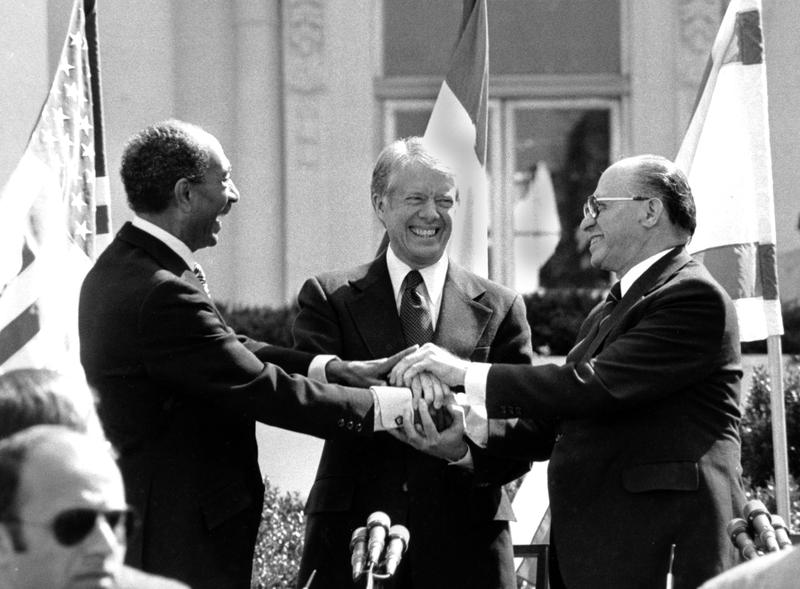
Photo credit: https://www.britannica.com/event/Camp-David-Accords#/media/1/91061/9162
 Joann White