I Yield Thee Praise

Poem for a Tuesday — “I Yield Thee Praise” by Philip Jerome Cleveland

For thoughts that curve like winging birds

Out of the summer dusk each time

I drink the splendor of the sky

And touch the wood-winds swinging by —

I yield Thee praise.

For waves that lift from autumn seas

To spill strange music on the land,

The broken nocturne of a lark

Flung out upon the lonely dark —

I give Thee praise.

For rain that piles gray torrents down

Black mountain-gullies to the plain,

For singing fields and crimson flare

At daybreak, and the sea-sweet air —

I yield Thee praise.

For gentle mists that wander in

To hide the tired world outside

That in our hearts old lips may smile

Their blessing through life’s afterwhile —

I give Thee praise.

For hopes that fight like stubborn grass

Up through the clinging snow of fear

To find the rich earth richer still

With kindliness and honest will —

I yield Thee praise.

from A Sacrifice of Praise, ed. James H. Trott. Nashville: Cumberland House, 1999.


Philip Jerome Cleveland (1903-1995) was a Congregational minister. His diverse ministry included service as a prison chaplain, a newspaper editor, a radio pianist, and a Sears and Roebuck Santa Claus. He pastored churches in Nova Scotia, Connecticut, Pennsylvania, and Massachusetts. He had several bestselling novels about church life, including It’s Bright in My Valley, Three Churches and a Model-T, and End of Dreams. After his death, a portion of his manuscripts, articles, and papers were acquired by The University of Southern Mississippi — de Grummond Children’s Literature Collection


Photo by Pixabay on Pexels.com

Requiem

Poem for a Tuesday — “Requiem” by Kwame Dawes

“I sing requiem
for the dead, caught in that
mercantilistic madness.

We have not built lasting
monuments of severe stone
facing the sea, the watery tomb,

so I call these songs
shrines of remembrance
where faithful descendants

may stand and watch the smoke
curl into the sky
in memory of those

devoured by the cold Atlantic.
In every blues I hear
riding the dank swamp

I see the bones
picked clean in the belly
of the implacable sea.

Do not tell me
it is not right to lament,
do not tell me it is tired.

If we don’t, who will
recall in requiem
the scattering of my tribe?

In every reggae chant
stepping proud against Babylon
I hear a blue note

of lament, sweet requiem
for the countless dead,
skanking feet among shell,

coral, rainbow adze,
webbed feet, making as if

to lift, soar, fly into new days.”

from Requiem by Kwame Dawes, Leeds: Peepal Tree Press, 1996.


Poet, professor, and Pulitzer Prize winner Kwame Dawes was born in Ghana and raised in Jamaica. Dawes’s work in reporting on the HIV AIDS crisis in Haiti after the earthquake for the Pulitzer Center on Crisis Reporting won the National Press Club Joan Friedenberg Award for Online Journalism. He says that his spiritual, intellectual, and emotional engagement with reggae music is a central influence in his poetry. He is a foremost scholar of the work of Bob Marley. Dawes is the Chancellor’s Professor of English at the University of Nebraska.


Photo by Blaque X on Pexels.com

Passage

Poem for a Tuesday — “Passage” by Elizabeth Alexander

“Henry Porter wore good clothes for his journey,

the best his wife could make from leftover

cambric, shoes stolen from the master. They

bit his feet, but if he took them off he feared

he’d never get them on again. He needed

to look like a free man when he got there.

Still in a box in the jostling heat,

nostrils to a board pried to a vent,

(a peephole, too, he’d hoped, but there was only

black to see) there was nothing to do

but sleep and dream and weep. Sometime the dreams

were frantic, frantic loneliness an acid

in his heart. Freedom was near but un-

imaginable. Anxiety roiled inside

of him, a brew which corroded his stomach,

whose fumes clamped his lungs and his throat.

When the salt-pork and corn bread were finished

he dreamed of ice cream and eggs but the dreams

made him sick.  He soiled himself and each time

was ashamed.  He invented games tried to

remember everything his mother

ever told, every word he hadn’t

understood, every vegetable he’d ever

eaten (which was easy: kale, okra, corn,

carrots, beans, chard, yams, dandelion greens),

remember everyone’s name who had ever

been taken away.  The journey went that way.

When he got there, his suit was chalky

with his salt, and soiled, the shoes waxy with blood.

The air smelled of a surfeit of mackerel.

Too tired to weep, too tired to look through

the peephole and see what freedom looked like,

he waited for the man to whom he’d shipped

himself: Mister William Still, Undertaker,

Philadelphia.  He repeated the last

words he’d spoken to anyone: goodbye

wife Clothilde, daughter Eliza,

 best friend Luke.  Goodbye, everyone, goodbye.

When I can, I’ll come for you. I swear,

I’ll come for you.”

in Furious Flower, ed. Joanne V. Gabbin. Charlottesville: University of Virginia Press, 2004.


Elizabeth Alexander is a Black writer, poet, and educator. Born in Harlem and raised in Washington, DC, Alexander studied at Yale, Boston University, and the University of Pennsylvania. She is a gifted educator, who has taught at Haverford College, the University of Chicago, the University of Pennsylvania, and Smith College. Her father served as the United States Secretary of the Army. Her mother was a distinguished professor of African American Women’s History. She was just a toddler when her parents took to the March on Washington in August 1963. In 2009, she recited her poem “Praise Song for the Day” at President Barack Obama’s first Presidential Inauguration.


Facing It

Poem for a Tuesday — “Facing It” by Yusef Komunyakaa

“My black face fades,   

hiding inside the black granite.   

I said I wouldn’t  

dammit: No tears.   

I’m stone. I’m flesh.   

My clouded reflection eyes me   

like a bird of prey, the profile of night   

slanted against morning. I turn   

this way—the stone lets me go.   

I turn that way—I’m inside   

the Vietnam Veterans Memorial

again, depending on the light   

to make a difference.   

I go down the 58,022 names,   

half-expecting to find   

my own in letters like smoke.   

I touch the name Andrew Johnson;   

I see the booby trap’s white flash.   

Names shimmer on a woman’s blouse   

but when she walks away   

the names stay on the wall.   

Brushstrokes flash, a red bird’s   

wings cutting across my stare.   

The sky. A plane in the sky.   

A white vet’s image floats   

closer to me, then his pale eyes   

look through mine. I’m a window.   

He’s lost his right arm   

inside the stone. In the black mirror   

a woman’s trying to erase names:   

No, she’s brushing a boy’s hair.”

in Pleasure Dome: New and Collected Poems (Wesleyan University Press, 2001)


Yusef Komunyakaa was born in Bogalusa, Louisiana. He served as a war correspondent and managing editor of the Southern Cross during the Vietnam war, earning him a Bronze Star. His poetry reflects the cadences and influence of jazz and his grandparents, who were church people: “the sound of the Old Testament informed the cadences of their speech.” He takes on complex moral issues: the Vietnam War, his experience as a black man, and the underside of life in America. He lives in New York City where he is Distinguished Senior Poet in NYU’s graduate creative writing program.


Vietnam War Memorial — Washington, DC

The Enactment

Poem for a Tuesday — “The Enactment” by Rita Dove

“I’m just a girl who people were mean to on a bus. . . . I could have been anybody.” — Mary Ware, nee Smith

“Can’t use no teenager, especially

no poor black trash,
no matter what her parents do

to keep up a living. Can’t use

anyone without sense enough

to bite their tongue.

It’s gotta be a woman,

someone of standing:

peferably shy, preferably married.

And she’s got to know

when the moment’s right.

Stay polite, though her shoulder’s

aching, bus driver

the same one threw her off

twelve years before.

Then all she’s got to do is

sit there, quiet, till

the next moment finds her—and only then

can she open her mouth to ask

Why do you push us around?

and his answer: I don’t know but

the law is the law and you

are under arrest.

She must sit there, and not smile

as they enter to cary her off;she must know who to call

who will know whom else to call

to bail her out . . . and only then

can she stand up and exhale

can she walk out the cell

and down the jail steps

into flashbulbs and

her employer’s white

arms—and go home,

and sit down in the seat

we have prepared for her.”

in Furious Flower, ed. Joanne V. Gabbin. Charlottesville: University of Virginia Press, 2004.


Poet and Professor Rita Dove grew up in Akron, Ohio. She was a Fulbright Scholar in Tubingen, Germany, before joining the renowned University of Iowa Writers’ Workshop. Her third book, Thomas and Beulah, based on her grandparents’ lives, won the Pulitzer Prize. She became the American Poet Laureate in 1993, making her both the youngest recipient of this honor and the first African American. Her poetry has a unique musicality, grounded in her own musicianship and personal belief that “language sings.” She is an avid ballroom dancer and lives in Charlottesville, Virginia, where she has taught since 1989.


By Unknown author – USIA / National Archives and Records Administration Records of the U.S. Information Agency Record Group 306, Public Domain, https://commons.wikimedia.org/w/index.php?curid=4344206

The Task

Poem for a Thursday — “The Task” by Denise Levertov

As if God were an old man
always upstairs, sitting about
in sleeveless undershirt, asleep,
arms folded, stomach rumbling,
his breath from open mouth
strident, presaging death . . .

No, God’s in the wilderness next door
— that huge tundra room, no walls and a sky roof —
busy at the loom. Among the berry bushes,
rain or shine, that loud clacking and whirring.
irregular but continuous;
God is absorbed in work, and hears
the spacious hum of bees, not the din,
and hears far-off
our screams. Perhaps
listens for prayers in that wild solitude.
And hurries on with the weaving:
till it’s done, the great garment woven,
our voices, clear under the familiar
blocked-out clamor of the task,
can’t stop their
terrible beseeching. God
imagines it sifting through, at last, to music
in the astounded quietness, the loom idle,
the weaver at rest.

in Oblique Prayers. New Castle upon Tyne: Bloodaxe Books, 1984.

Denise Levertov was born in England in 1923. Her father Paul Levertov was a Russian Hassidic Safardic Jew who became an Anglican priest. When she was twelve, Levertov sent some of her poems to T. S. Eliot, who replied with a two-page letter of encouragement. She published her first book of poems in 1940 at age seventeen. She served as a nurse during the Blitz in London. Politics, war, and religion all became major themes in her life’s work. Levertov published more than twenty books before her death in 1994. She received the Shelley Memorial Award, the Robert Frost Medal the Lenore Marshall Prize, the Lannan Award, a Catherine Luck Memorial Grant, a grant from the National Institute of Arts and Letters, and a Guggenheim Fellowship.

Photo by Rodolfo Clix on Pexels.com

As the Ruin Falls

Poem for a Tuesday — “As the Ruin Falls” by C. S. Lewis

“All this is flashy rhetoric about loving you.
I never had a selfless thought since I was born.
I am mercenary and self-seeking through and through:
I want God, you, all friends, merely to serve my turn.

Peace, re-assurance, pleasure, are the goals I seek,
I cannot crawl one inch outside my proper skin:
I talk of love —a scholar’s parrot may talk Greek—
But, self-imprisoned, always end where I begin.

Only that now you have taught me (but how late) my lack.
I see the chasm. And everything you are was making
My heart into a bridge by which I might get back
From exile, and grow man. And now the bridge is breaking.

For this I bless you as the ruin falls. The pains
You give me are more precious than all other gains.”

C.S. Lewis was perhaps the most influential Christian writer of the twentieth century. A noted scholar of Medieval and Renaissance Literature, he taught at Oxford and Cambridge Universities. Lewis wrote more than thirty books. His most distinguished and popular accomplishments include Mere ChristianityOut of the Silent PlanetThe Great DivorceThe Screwtape Letters, and The Chronicles of Narnia. To date, the Narnia books have sold over 100 million copies and been transformed into three major motion pictures.

Photo by Gije Cho on Pexels.com

“Ode to My Socks”

It was eighteen below zero in Saranac Lake when I took the dog out on Tuesday morning. I hear that we are headed back into the deepfreeze for the weekend. What better time could there be to savor the beauty and goodness of wool socks?

Poem for a Thursday — “Ode to My Socks” by Pablo Neruda

“Maru Mori brought me
a pair
of socks
which she knitted herself
with her sheepherder’s hands,
two socks as soft
as rabbits.
I slipped my feet
into them
as though into
two
cases
knitted
with threads of
twilight
and goatskin.
Violent socks,
my feet were
two fish made
of wool,
two long sharks
sea-blue, shot
through
by one golden thread,
two immense blackbirds,
two cannons:
my feet
were honored
in this way
by
these
heavenly
socks.
They were
so handsome
for the first time
my feet seemed to me
unacceptable
like two decrepit
firemen, firemen
unworthy
of that woven
fire,
of those glowing
socks.

Nevertheless
I resisted
the sharp temptation
to save them somewhere
as schoolboys
keep
fireflies,
as learned men
collect
sacred texts,
I resisted
the mad impulse
to put them
into a golden
cage
and each day give them
birdseed
and pieces of pink melon.
Like explorers
in the jungle who hand
over the very rare
green deer
to the spit
and eat it
with remorse,
I stretched out
my feet
and pulled on
the magnificent
socks
and then my shoes.

The moral
of my ode is this:
beauty is twice
beauty
and what is good is doubly
good
when it is a matter of two socks
made of wool
in winter.”

in Neruda and Vallejo: Selected Poems. Boston: Beacon Press, 1993.

Chilean poet Pablo Neruda (1904-1973) had a long career in foreign service with posts as Consul in Burma, Argentina, Spain, and Mexico. He was elected to the senate in 1943 but was later forced out of office and into hiding for his communist views. When Chile’s government swung back to the center seven years later, Neruda again found favor. Neruda was awarded the International Peace Prize in 1950 and the Nobel Prize for Literature in 1971.

Photo by Taryn Elliott on Pexels.com

“Boy at the Window”

Poem for a Tuesday — “Boy at the Window” by Richard Wilbur

Seeing the snowman standing all alone
In dusk and cold is more than he can bear.
The small boy weeps to hear the wind prepare
A night of gnashings and enormous moan.
His tearful sight can hardly reach to where
The pale-faced figure with bitumen eyes
Returns him such a God-forsaken stare
As outcast Adam gave to paradise.

The man of snow is, nonetheless, content,
Having no wish to go inside and die.
Still, he is moved to see the youngster cry.
Though frozen water is his element,
He melts enough to drop from one soft eye
A trickle of the purest rain, a tear
For the child at the bright pane surrounded by
Such warmth, such light, such love, and so much fear.

in Good Poems, New York: Penguin Books, 2000. p. 319


Richard Purdy Wilbur published his first poem at age 8. He went on to win the Pulitzer Prize in poetry in 1957 and 1989. He served as the Poet Laureate of the United States in 1987. Wilbur was profoundly shaped by his experience in the Army during World War II. He once described how the war changed his writing, saying, “One does not use poetry for its major purposes, as a means to organize oneself and the world, until one’s world somehow gets out of hand.” He taught for decades at Amherst College and Wesleyan University. He died in 2017 in Belmont, Massachusetts.


Photo by Arina Krasnikova on Pexels.com

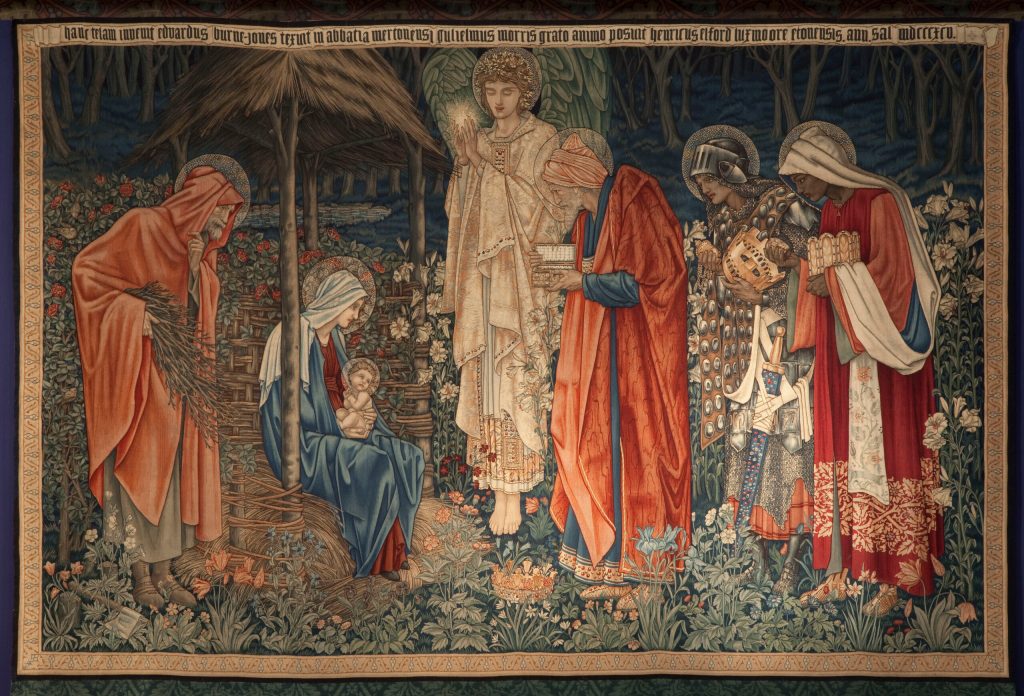
Journey of the Magi

Poem for a Tuesday — “Journey of the Magi” by T.S. Eliot

A cold coming we had of it,
Just the worst time of the year
For a journey, and such a long journey:
The ways deep and the weather sharp,
The very dead of winter.’
And the camels galled, sorefooted, refractory,
Lying down in the melting snow.
There were times we regretted
The summer palaces on slopes, the terraces,
And the silken girls bringing sherbet.
Then the camel men cursing and grumbling
and running away, and wanting their liquor and women,
And the night-fires going out, and the lack of shelters,
And the cities hostile and the towns unfriendly
And the villages dirty and charging high prices:
A hard time we had of it.
At the end we preferred to travel all night,
Sleeping in snatches,
With the voices singing in our ears, saying
That this was all folly.

Then at dawn we came down to a temperate valley,
Wet, below the snow line, smelling of vegetation;
With a running stream and a water-mill beating the darkness,
And three trees on the low sky,
And an old white horse galloped away in the meadow.
Then we came to a tavern with vine-leaves over the lintel,
Six hands at an open door dicing for pieces of silver,
And feet kicking the empty wine-skins.
But there was no information, and so we continued
And arriving at evening, not a moment too soon
Finding the place; it was (you might say) satisfactory.

All this was a long time ago, I remember,
And I would do it again, but set down
This set down
This: were we led all that way for
Birth or Death? There was a Birth, certainly
We had evidence and no doubt. I had seen birth and death,
But had thought they were different; this Birth was
Hard and bitter agony for us, like Death, our death.
We returned to our places, these Kingdoms,
But no longer at ease here, in the old dispensation,
With an alien people clutching their gods.
I should be glad of another death.

in T.S. Eliot Selected Poems, New York: Harcourt Brace Jovanovich, 1936.


After Jesus was born in Bethlehem in Judea, during the time of King Herod, Magi from the east came to Jerusalem and asked, “Where is the one who has been born king of the Jews? We saw his star when it rose and have come to worship him.”–Matthew 2:1-2


“Adoration of the Magi” Edward Burne-Jones, Musee d’Orsay Paris