Now I See!

Sabbath Day Thoughts — “Now I See” John 9:1-38

It’s been twenty years since the death of Fred Rogers. Fred was a college student, home on break, when he saw his first television set and immediately recognized it as a powerful tool for communication and education. Fred later worked as a program manager for Pittsburgh’s first public television station, but he attended seminary classes on his lunch hour. He was ordained by the Presbytery of Pittsburgh in 1963 with the unusual charge to do ministry through mass media. In describing his sense of vocation, Fred felt he was called to use every talent that had ever been given to him—writing, music, puppetry, faith, kindness—in the service of children and their families.

From 1968 to 2001, Rogers ministered to pre-school children through 896 episodes of “Mr. Rogers’ Neighborhood.” Fred tapped into his past experience as a chubby, chronically sick, lonely kid to help children face their own childhood fears and insecurities. He tackled tough topics, like divorce and the assassination of Robert Kennedy. He explored how good people could sometimes do things that weren’t so good. Through his puppet Daniel Tiger, Rogers even voiced the grief and alienation that children feel when they sense they are unwanted or unloved. Those 896 visits to “Mr. Rogers’ Neighborhood” were an extended tutorial in the core Christian values of caring, inclusion, and kindness.

In our reading from John’s gospel, we meet a visually-impaired man, who had known little of caring, inclusion, or kindness before he met Jesus. Born blind in a world where disability was attributed to sin, people took one look at this man and presumed that either he, as an unborn child, or his parents had violated the Torah and invited the wrath of God. His disability rendered him unclean, unable to enter the Temple to worship or to work and associate with his Torah-observant neighbors. He was forced to beg for a living from a mat stationed outside a gateway to the Temple. There, he hoped that some would do a good deed—a mitzvah— on their way to prayer by placing a coin in his bowl.

Then one day, Jesus and his friends were leaving the Temple. Spotting the disabled man, the disciples asked Jesus a rabbinic question, looking for Jesus to interpret the scriptures, “Who sinned, Rabbi, this man or his parents?” But Jesus refused to engage their assumption that disability was the result of sin. Instead, Jesus stopped, spit into his hand, added some dirt to make a muddy paste and applied it to the man’s sightless eyes. Next, he instructed the man to wash in the Pool of Siloam, more than half a mile away. Jesus didn’t even stick around to see the outcome of his kindness.

What happened next was an extended public debate involving the neighbors, the man’s parents, and some powerful religious leaders.  Reading this story again this week through the lens of Mr. Rogers’ neighborliness and caring got me thinking about the visually-impaired man—and how the characters in this story are blind to who he really is. To the disciples, the man is an opportunity for a teaching moment. To the neighbors, unable to recognize him even though the man has been in their midst for years, the man is his disability. To the parents, who should be in the man’s corner, he is a source of shame and danger. To the Pharisees and Temple leaders, the man is a sinner, so they ban him from the Temple. A teaching moment, a disability, an embarrassment, a sinner? No one truly sees this man.

It’s tempting to judge the neighbors, the parents, the Pharisees, and Judeans, until we look in the mirror and see our own inability to see. We constantly make assessments and assumptions about one another. Even the best of us makes assumptions that spring from our understanding of gender, ability, race, age, and political convictions, beliefs that we often acquire very early—in our homes, our schools, our communities, and even our churches. We all carry pictures in our heads, whether we want to or not. The big rainbow flag that Duane and I have on our porch may lead you to make some judgments about us, just as the enormous Trump banner that our neighbor has been flying since 2015 may lead you to make some judgments about him. 

In 1922, psychologist and researcher Walter Lippman coined the term “stereotype” to name our inherent bias and prejudice.  We all have a cognitive framework that we fit people into. Indeed, it feels natural, normal, dependable, and comfortable to slip people into that cognitive framework. The trouble is that it isn’t true because we don’t take the time to really consider or understand who people truly are. Lippman rightly described our stereotypes and prejudice as a casual cruelty. We do not see people. We don’t take the time to go deeper, to understand, to know. We can be blind.

The only person in today’s story who truly sees the visually impaired man is Jesus. It’s right there in the first verse, “As Jesus walked along, he saw a man blind from birth.” The Greek word here for “saw” is ʽorao, meaning to perceive, to know, to have spiritual perception or insight. Behold, Jesus saw the blind man and knew that this man was someone to hold onto, hold close, hold up. Jesus saw the blind man and knew his vulnerability and loneliness, his shame and grief, his isolation and hurt. Jesus saw the blind man and recognized not a disability, not a scandal, not a sinner, but instead someone intended to glorify God.

If Jesus and Fred Rogers were here with us this morning, they might invite us to wonder together. Can we imagine a world where we do not fit people into those convenient mental frameworks of gender, ability, age, race, or politics? It would be a world where we “see” that all people deserve our compassionate care and all have the inherent capacity to give God the glory. It is a world where, in our true and authentic interactions with others, we come to know one another better, and we learn to serve God more truly. That’s what they call the Kingdom.

I think that Fred Rogers did his best to give us a foretaste of that world. He did that by calling us his neighbors. Not his friends, not his little learners, not his flock. His neighbors. He wanted us to honor that great commandment to love God and neighbor. He, like Jesus, wanted us to see one another, in all our frailty and difference, and to know that we are loveable, that we owe one another the debt of noticing, caring, welcoming, and sharing kindness.

 In subtly subversive ways, Fred showed us who our neighbors are. When pools were still segregated in some parts of our country, Mr. Rogers invited the Black policeman Officer Clemmons to dip his feet into a kiddie pool with him. The two even dried off using the same towel.

In Mr. Rogers’ Neighborhood, Lady Elaine Fairchild taught us that girls could move past the gender limits placed upon them. They could become managers, doctors, mayors, or even astronauts.

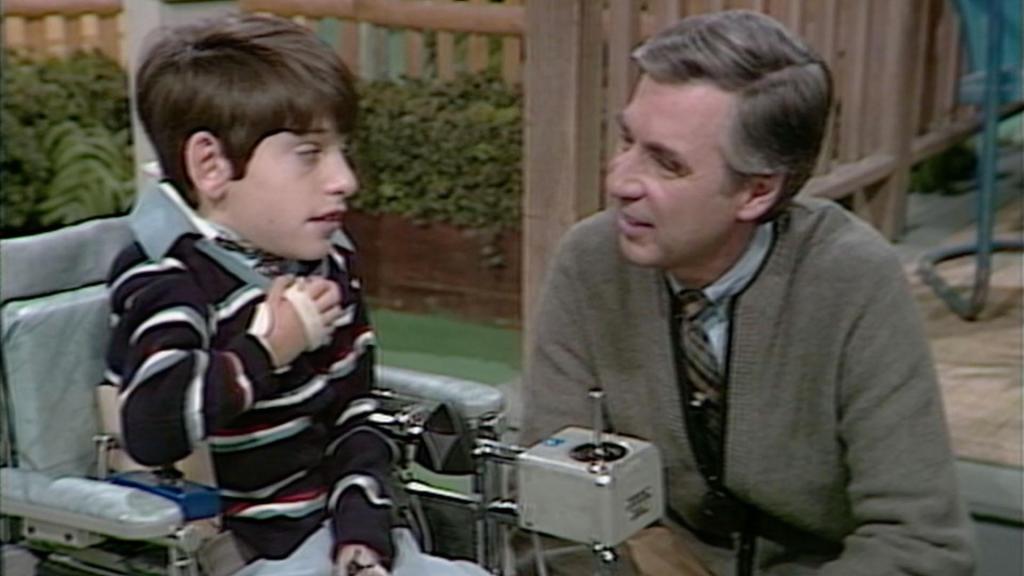
In a time when families of children with disabilities were fighting for access to schools and facilities for their children, Mr. Rogers featured children with disabilities on his show.  One was a seven-year-old quadriplegic boy, Jeff Erlanger. They had met two years earlier when young Jeff was scheduled to undergo major surgery and asked his parents if they could first arrange for him to meet Mr. Rogers. They wrote to Fred and he made time during a promotional visit to Milwaukee to meet with the family. Afterward, they continued to keep in touch.  When Jeff made his appearance on Fred’s show, he explained how his electric wheelchair worked and why he needed it. Then Jeff and Fred sang a duet of that corny-but-deeply-true Mr. Rogers’ song, “It’s You I Like.”

When later asked by a reporter why their five-year-old child would want to meet Fred Rogers before undergoing major surgery, Howard and Pam Erlanger explained that Jeff “always said that Mister Rogers told him that he was special and that he was just fine the way he was, and it gave him confidence and it made him feel good, and Mister Rogers just seemed to love him.” It was as if Mr. Rogers could really “see” Jeff, kind of like the way that Jesus could “see” the blind man. Fred Rogers beheld Jeff, knew that this child was someone to hold onto, hold close, hold up.

Nearly twenty years later, when Fred was inducted into the Television Hall of Fame, Jeff surprised him, rolling onto stage to present the award. In true Mr. Rogers’ form, Fred got so excited that he ran up onto the stage and hugged Jeff as if they were the only two people in the auditorium. “On behalf of millions of children and grown-ups,” Jeff said in presenting the award to Fred, “It’s You I like.”

It’s a beautiful day in the neighborhood, my friends. It’s a day, like every day, made for us to notice and care, love and share. May we go forth to truly see and serve our neighbors.

Resources:

Jason Fraley. “Remembering Mr. Rogers Twenty Years after the Death of Our Favorite Neighbor” in WTOP News, Feb. 27, 2023. Accessed online at wtop.com.

Robert Hoch. “Commentary on John 9:1-41” in Preaching This Week, March 30, 2014. Accessed online at workingpreacher.org.

Osvaldo Vena. “Commentary on John 9:1-41” in Preaching This Week, March 26, 2017. Accessed online at workingpreacher.org.

Shea Tuttle. “Seven Lessons from Mr. Rogers that Can Help Americans Be Neighbors Again” in Greater Good Magazine, July 13, 2018. Accessed online at greatergood.berkeley.edu.

Maxwell King. “How ‘Mister Rogers’ Neighborhood’ Championed Children with Disabilities” in Guideposts. Accessed online at http://www.guideposts.org

–. “About Fred Rogers” in Mister Rogers’ Neighborhood. Accessed online at misterrogers.org.


John 9:1-38

As he walked along, he saw a man blind from birth. 2His disciples asked him, “Rabbi, who sinned, this man or his parents, that he was born blind?” 3Jesus answered, “Neither this man nor his parents sinned; he was born blind so that God’s works might be revealed in him. 4We must work the works of him who sent me while it is day; night is coming when no one can work. 5As long as I am in the world, I am the light of the world.” 6When he had said this, he spat on the ground and made mud with the saliva and spread the mud on the man’s eyes, 7saying to him, “Go, wash in the pool of Siloam” (which means Sent). Then he went and washed and came back able to see.

8The neighbors and those who had seen him before as a beggar began to ask, “Is this not the man who used to sit and beg?” 9Some were saying, “It is he.” Others were saying, “No, but it is someone like him.” He kept saying, “I am the man.” 10But they kept asking him, “Then how were your eyes opened?” 11He answered, “The man called Jesus made mud, spread it on my eyes, and said to me, ‘Go to Siloam and wash.’ Then I went and washed and received my sight.” 12They said to him, “Where is he?” He said, “I do not know.”

13They brought to the Pharisees the man who had formerly been blind. 14Now it was a sabbath day when Jesus made the mud and opened his eyes. 15Then the Pharisees also began to ask him how he had received his sight. He said to them, “He put mud on my eyes. Then I washed, and now I see.” 16Some of the Pharisees said, “This man is not from God, for he does not observe the sabbath.” But others said, “How can a man who is a sinner perform such signs?” And they were divided. 17So they said again to the blind man, “What do you say about him? It was your eyes he opened.” He said, “He is a prophet.” 18The Jews did not believe that he had been blind and had received his sight until they called the parents of the man who had received his sight 19and asked them, “Is this your son, who you say was born blind? How then does he now see?” 20His parents answered, “We know that this is our son, and that he was born blind; 21but we do not know how it is that now he sees, nor do we know who opened his eyes. Ask him; he is of age. He will speak for himself.” 22His parents said this because they were afraid of the Jews; for the Jews had already agreed that anyone who confessed Jesus to be the Messiah would be put out of the synagogue. 23Therefore his parents said, “He is of age; ask him.” 24So for the second time they called the man who had been blind, and they said to him, “Give glory to God! We know that this man is a sinner.” 25He answered, “I do not know whether he is a sinner. One thing I do know, that though I was blind, now I see.” 26They said to him, “What did he do to you? How did he open your eyes?” 27He answered them, “I have told you already, and you would not listen. Why do you want to hear it again? Do you also want to become his disciples?” 28Then they reviled him, saying, “You are his disciple, but we are disciples of Moses. 29We know that God has spoken to Moses, but as for this man, we do not know where he comes from.” 30The man answered, “Here is an astonishing thing! You do not know where he comes from, and yet he opened my eyes. 31We know that God does not listen to sinners, but he does listen to one who worships him and obeys his will. 32Never since the world began has it been heard that anyone opened the eyes of a person born blind. 33If this man were not from God, he could do nothing.” 34They answered him, “You were born entirely in sins, and are you trying to teach us?” And they drove him out.

35Jesus heard that they had driven him out, and when he found him, he said, “Do you believe in the Son of Man?” 36He answered, “And who is he, sir? Tell me, so that I may believe in him.” 37Jesus said to him, “You have seen him, and the one speaking with you is he.” 38He said, “Lord, I believe.” And he worshiped him.

https://www.pbs.org/video/mister-rogers-neighborhood-its-you-i-like/

Click the link above to hear Jeff and Fred singing “It’s You I Like.”

Thirsty

Sabbath Day Thoughts — “Thirsty” Exodus 17:1-7

We all fall into catastrophic thinking from time to time. Something doesn’t seem right and worst-case scenarios play out in our minds, over and over again, provoking anxiety and sending us into a panic. When I lived in Washington, DC, snow in the forecast sent the entire metro area into a frenzy of catastrophic thought.  Neighbors rushed out to the grocery stores to buy up every loaf of bread, every gallon of water, and every roll of toilet paper.  Then, as snow began to fall and streets turned slick, drivers would give up and abandon their vehicles, leaving cars haphazardly parked along the shoulder while they hoofed it home.

Our catastrophic thinking may not be nearly so apocalyptic.  When our teen is late in getting home from a date, we imagine them lying in a ditch or pulled over by the police. When the doctor’s office calls to schedule an appointment to follow up on our test results, we think the worst – we must have a serious illness or they want to put us on a diet. When our employer announces that it’s time to reorganize at work, we’re ready to head for the unemployment line.

Catastrophic thinking preoccupies us, saps our emotional and rational energy.  It’s tough on our bodies, boosting our blood pressure and respiration, and flooding our system with stress hormones. Catastrophic thinking doesn’t feel good. Our tummies churn, our thoughts race, and we can’t sleep.  Catastrophic thinking is especially hard on those we live with. We may take our anxiety out on our beloved ones with a short temper and sharp tongue.  We may even infect them with our catastrophic thinking; soon they are imagining the worst, right along with us.

Our reading from the Book of Exodus tells us that the Israelites were doing some catastrophic thinking. In fairness to them, their circumstances were truly stress-inducing.  They were in the Sinai Wilderness, a desert landscape where temperatures could soar over 100 degrees and rainfall was infrequent. For the month of December, the rainiest month of the year, the average rainfall in the Sinai is a whopping two-tenths of an inch.  The Israelites in that desert were dependent upon springs and oases to sustain them and their livestock, but at the end of a long day of travel, they arrived at Rephidim, where they expected to find a spring and instead found no water. No water for drinking. No water for their flocks. No water for their children. No water for cooking. No water for bathing. No water at all.

The human body can last about 100 hours without water in normal circumstances, but in a hot and sunny spot like the Sinai, they might be fortunate to last about half that time. Their tongues felt swollen and dry, clinging to the roofs of their mouths.  The children began to cry. The sheep began to bleat. Even the camels were looking ornery. The catastrophic thinking kicked in.

“Our water reserves won’t last the night. The sun is going to roast us. We’ll never find water in this wasteland.  We’ll have to set the flocks free to fend for themselves.  We’ll have to resort to drinking our urine. We’ll cradle our dying children. Someday they’ll find our bleached bones and tell the terrible tale of what happens to foolish people who turn their back on the Nile.”

They took all their angry anxiety, aggression, and stress to Moses, and soon he was doing some of his own catastrophic thinking.  “How am I supposed to find water in the desert? I’ve got a mutiny on my hands. They’re sharpening their knives.  They’re gathering stones. I won’t last the night. They’re coming for me.”

Our catastrophic thinking can be problematic. It can undermine our workplaces. One manager complained to the Harvard Business Review that every time she tried to delegate to her employees, things went sideways. She was sure they would fail to deliver, or they might miss deadlines, or they could do things the wrong way. Rather than mentoring her workers as they learned new skills and allowing them to make mistakes, her catastrophic thinking would kick in.  Imagining the poor sales that would ensue and the criticism she would face from her boss and the possibility of taking a hit to her reputation, she would take back all the work she had shared in an endless cycle of overwork and anxiety.

Catastrophic thinking can impact our relationships.  We put off returning the phone call to our friend who is always imagining the worst and foretelling gloom and doom. We start editing what we share with the parent who spirals into a frenzy of anxiety at the sort of everyday setback that happens to everyone.  If a spouse goes catastrophic every time that we try to share our feelings, we learn to keep them to ourselves.

Catastrophic thinking can even affect churches. I’ve known churches that refuse to host healing groups like NA and AA because something at church might get dirty or broken or stolen. I’ve known churches that refuse to try new programs for fear that it could demand too much work, take too much time, or bring too much change. And then, there is the catastrophic thinking that surrounds the introduction of new music—often rejected with the insistence that it’s too hard to sing, makes us uncomfortable, and will surely cause a mass stampede for the exit with worshippers vowing never to return.

It probably shouldn’t surprise us that when the Israelites got so anxious about water, it wasn’t the first time they went catastrophic.  When Pharaoh’s army had pursued them to the shores of the Reed Sea, they all thought they were goners.  Then, when the water at Mara was bitter and undrinkable, they thought that was it. When provisions got scarce and their bellies growled, they were certain they would starve to death. But those things didn’t happen.

Instead, each of those scary and overwhelming circumstances had turned into an opportunity for them to know the presence and the goodness of God. On the shores of the Reed Sea, God had interceded, standing between Pharoah’s forces and the people while Moses raised his staff above the waters—which parted, allowing the Israelites to escape.  Then, when the water was so bitter, God had told Moses how to make it sweet. And when the people were hungry, God had brought quails into the camp in the evening and rained down manna every morning.  All that adversity wasn’t easy or fun or pleasant or wanted, but again and again, the people had learned that they were not alone in the wilderness.  They had a holy traveling companion, who cared and provided and would not abandon them, even when catastrophe struck.

One of my favorite memes that I have posted more than once on my Facebook page goes like this: “On particularly rough days, I like to remind myself that my track record for getting through bad days so far is 100%, and that’s pretty good.” I believe that, like the Israelites, we have a holy traveling companion, who is with us in the midst of those moments that make us want to call our friend and start complaining.  We have a holy friend, who walks us through those experiences that make us infect our spouse with our anxiety. We are not alone on those days that make us want to stay in bed with the covers over our heads. Life does bring adversity, there’s no questioning that, but our track record for getting through it so far is pretty good, because we are not alone. We may not have manna showering us from the heavens, or water springing from a rock, or quails flying into the soup pot, but we can trust that God is with us because in Jesus, God chose to walk this lonesome valley and face head-on the catastrophe of the cross.

God’s goodness and grace find us in the middle of our catastrophic thinking. Sometimes it is a feeling of peace that surpasses all understanding. Sometimes it is in the comfort of scripture.  Sometimes it is in the caring person who simply sits with us and holds our hand. Sometimes it is in the deacon who shows up with a hot dish. Sometimes it is in the people who pray for us, sending out a holy hotline to the Almighty. Sometimes it is in the leader who casts the hopeful vision for life on the far side of our woe.  Sometimes it is in the family member who talks us off the ledge.  We all get thirsty.  We all go catastrophic from time to time, but God is with us and there is water.

When God sent Moses to Horeb to find water to ease the people’s thirst, God instructed him to take along some of the elders of Israel. On the mountain, in the presence of those witnesses, water gushed forth from the rock, and the crisis was averted. The people drank, the children drank, the flocks drank. There was water for cooking. There was water for bathing. There was water enough for all. 

I like to think that those elders, who watched the water spring forth, never forgot that moment. When times were tough and disaster loomed, they took a deep breath and nipped their catastrophic thinking in the bud. They remembered the goodness of God.  Then, they turned to their anxious people, and pointed to the presence of God, who brings water in the desert.  May we, who have witnessed the goodness of God, do the same. 

Resources:

Julianna Claasens. “Commentary on Exodus 17:1-7” in Preaching This Week, March 23, 2014. Accessed online at workingpreacher.org.

Anathea Portier-Young. “Commentary on Exodus 17:1-7” in Preaching This Week, October 1, 2017. Accessed online at workingpreacher.org.

Callie Plunkett-Brewton. “Commentary on Exodus 17:1-7” in Preaching This Week, September 28, 2014. Accessed online at workingpreacher.org.

Ron Carucci. “Stress Leads to Bad Decisions” in The Harvard Business Review, August 29, 2017.

Ron Breazeale. “Catastrophic Thinking” in Psychology Today, March 25, 2011. Accessed online at http://www.psychologytoday.com.


Exodus 17:1-7

17 From the wilderness of Sin the whole congregation of the Israelites journeyed by stages, as the Lord commanded. They camped at Rephidim, but there was no water for the people to drink. 2 The people quarreled with Moses and said, “Give us water to drink.” Moses said to them, “Why do you quarrel with me? Why do you test the Lord?” 3 But the people thirsted there for water, and the people complained against Moses and said, “Why did you bring us out of Egypt, to kill us and our children and livestock with thirst?” 4 So Moses cried out to the Lord, “What shall I do for this people? They are almost ready to stone me.” 5 The Lord said to Moses, “Go on ahead of the people and take some of the elders of Israel with you; take in your hand the staff with which you struck the Nile and go. 6 I will be standing there in front of you on the rock at Horeb. Strike the rock, and water will come out of it, so that the people may drink.” Moses did so, in the sight of the elders of Israel. 7 He called the place Massah and Meribah, because the Israelites quarreled and tested the Lord, saying, “Is the Lord among us or not?”


Photo by Antonio_22 on Pexels.com

Late Night Questions

Sabbath Day Thoughts — “Late Night Questions” John 3:1-17

We all have late-night questions.  They keep us from falling asleep and leave us tossing and turning for hours. They wake us from a sound sleep, with hearts drumming and thoughts racing. Late-night questions lead to bleary-eyed mornings when we feel sleep-deprived and irritable.

Our late-night questions may be about work. How do we handle our boss? How do we manage our workers? Is what we are doing meaningful, worthwhile, the best use of our abilities?

Our late-night questions may be about our loved ones. How do we heal the breach with our spouse or sibling or child? What can we do about that diagnosis? How do we respond to a loved one’s crisis? 

Our late-night questions may be about the world community. What about homelessness and hunger? Climate change? World peace? What happens if that Republican or Democrat or Libertarian or Progressive gets elected?

Our late-night questions can be existential. Does God love us? What happens when we die? How do we find forgiveness?

Does any of this sound familiar?

We aren’t the only ones with late-night questions. Our gospel reading relates the story of Nicodemus, who came to Jesus at night filled with big questions. Nicodemus was a Pharisee. He practiced an ultra-observant form of Judaism, which demanded of him the same requirements for holiness that were applied to priests during their active service in the Temple.  For a Pharisee like Nicodemus, careful observance of all 613 commandments of the Torah rendered him holy, as God is holy.  In fact, Nicodemus was an expert in the Torah, both a rabbi and an active elder serving on the Sanhedrin, which was a lot like Israel’s supreme court.  The seventy-one elders of the Sanhedrin came from families of priests, legal scholars, and the most politically powerful families in the land.  They met every day, except on the sabbath and the holy days, gathering in the Hall of Hewn Stones, a courtroom built into the outer wall of the Temple.  There they listened to cases referred to them from lower courts, determining righteous judgments based upon their understanding of the Torah. Nicodemus was respected, scholarly, influential, powerful, and wealthy.

But Nicodemus wasn’t feeling so comfortable in his role as elder, judge, and Torah-expert. He was troubled by Jesus.  This Jesus was neither priest nor scribe nor member of an elite family, but Jesus had worked miracles and taught with an authority that could only come from God. Jesus had blessed a poor family and saved their wedding feast from shame by changing the water into the finest wine.  Jesus had denounced the profiteering and exploitation of the poor that was going on in the Temple, turning over the tables of the money changers and driving out the animals and their vendors.  Jesus had been teaching and healing in the Temple, bringing life-changing understanding and wholeness to people. Nicodemus was no fool.  His gut told him that this Jesus was the real deal, sent by God to bless the people. But if Jesus had it right, then was it possible that he (Nicodemus) had it wrong? What if honoring God wasn’t about rote obedience to 613 commands?  What if God wasn’t an angry judge waiting to condemn Israel for the slightest infraction? What if God wanted something different from Israel? Nicodemus needed answers.

John’s gospel allows us to listen in on a snippet of what must have been a free-wheeling, intense, late-night conversation between Nicodemus and Jesus. Nicodemus had his rabbi’s hat on. He was parrying Jesus’s assertions with questions, in fine rabbinic form. “Can anyone truly be born anew, Jesus?  Are we talking about the physical or the spiritual realm? Give me the details, Jesus, how can this be?” It was a late-night disputation that ended with the best-known of Jesus’s words, “For God loved the world in this way: God gave God’s One and Only Son, so that everyone who believes in Him will not perish but have eternal life. For God did not send the Son into the world to condemn the world, but that the world might be saved through Him” (Holman translation).

Can you imagine it? Jesus and Nicodemus, sit with heads close in intense conversation in the warm glow of the oil lamp. The supreme court justice learns with a shock of deep knowing that God isn’t about judgment and condemnation.  God is all about love, mercy, life.  Jesus tells the Pharisee, “God wants to save you, not condemn you, Nicodemus. You are loved.”

As Jesus challenged Nicodemus to change, to be spiritually reborn into the Kingdom of God—the Kingdom of Love, Nicodemus struggled to imagine what that might mean. It would mean that God didn’t want his blind obedience; rather, God was looking for a relationship with him.  It meant the Torah should be read through the lens of love—love for God and love for neighbor. It would require him to love the petitioners who came through his high court, both vulnerable plaintiffs and ruthless scoundrels. If Nicodemus started to preach and teach like that, it could make him seventy powerful enemies on the Sanhedrin. It could threaten his standing, compromise his power, and even have a negative impact on his bottom line—his pocketbook.  We don’t get to hear Nicodemus’s response to Jesus. Nicodemus seems to slip back into the darkness, perhaps filled with more questions than when he knocked on Jesus’s door in search of easy answers.

We are a lot more like Nicodemus than we care to admit. We want easy answers to our late-night questions.  We want answers that will not challenge our assumptions or demand a change in our thinking or conduct. We want answers that won’t cost us anything—not a big commitment of our time, not a dent in our bottom line, not a hit to our reputation, not a rethinking of our self-understanding, not a revision of our world view.  We want Jesus to pitch us easy answers that make us feel good and assure us of a healthy seven to eight hours of sleep every night.  But what if the answer isn’t easy? What if Jesus’s answer will change us in ways that feel scary, new, and a little out-of-control. What if what we are always and ultimately called to do is love more, to love like God does—like Jesus does—wholeheartedly, without strings attached, for the good of this flawed and fallen world?

If the answer to our late-night questions is a spiritual rebirth to the Way of Love, then we will be changed and so will the way that we relate to our families. We’ll mend the breach of our broken relationships with the resolve to love, a love that listens and stays in relationship even when we want to walk away, a love that forgives and seeks to be forgiven. We’ll choose to face those difficult diagnoses with love that supports, encourages, and accompanies others in times of fear and uncertainty. We’ll stop trying to fix other people’s crises and simply commit to loving them through the mess.

If the answer to our late-night questions is a spiritual rebirth to the Way of Love, then we will be changed, and so will the ways that we relate to our workplace. We could resolve to love our boss, our colleagues, our workers, not with the mushy, entangled love that we feel for our families, but the sort of love that calls forth the best in one another.  It’s a love that trusts in the power of shared vision and teamwork, a love that believes that when we work well together, what we achieve is always better than what we do on our own. We could ask loving questions of our employers, like, “How can what we do better serve the common good?”

If the answer to our late-night questions is a spiritual rebirth to the Way of Love, then we will be changed, and so will the ways that we relate to the world around us. We’ll love our vulnerable neighbors with vital ministries like the Food Pantry, Samaritan House, and One Great Hour of Sharing.  We’ll love God’s good creation in ways that leave no trace and protect precious resources and creatures. We’ll advocate for peace, everywhere.  All that love might even send us to the ballot box, where we’ll cast our votes for those whom we perceive can best translate love into political action. Wouldn’t that shake things up?

In the end, because the answer to our late-night questions is a spiritual rebirth to the Way of Love, we will be changed, and so will the way that we relate to God. We will trust that God is love.  We’ll build our relationship with God on that rock.  We will know that we are loved in life and in death, even when we wrestle in the late, late hours with the big, big questions.

Our last glimpse of Nicodemus in John’s gospel is on Golgotha, the place of the crucifixion. There, Nicodemus with Joseph of Arimathea demanded the body of Jesus from his Roman executioners. Then, those powerful and influential elders of the Sanhedrin did women’s work. They anointed Jesus’s body with a king’s ransom in costly oils and aloes, wrapped him in linen, and laid him in the tomb. It was a bold and risky task.  It was quiet and humble evidence of that spiritual rebirth to the Way of Love.

Resources:

Robert Hoch. “Commentary on John 3:1-17” in Preaching This Week, March 16, 2014. Accessed online at workingpreacher.org.

Osvaldo Vena. “Commentary on John 3:1-17” in Preaching This Week, March 12, 2017. Accessed online at workingpreacher.org.

Ronald J. Allen. “Commentary on John 3:1-17” in Preaching This Week, March 5, 2023. Accessed online at workingpreacher.org.

Judith Jones. “Commentary on John 3:1-17” in Preaching This Week, May 27, 2018. Accessed online at workingpreacher.org.


John 3:1-17

1 Now there was a Pharisee named Nicodemus, a leader of the Jews. 2 He came to Jesus by night and said to him, “Rabbi, we know that you are a teacher who has come from God, for no one can do these signs that you do unless God is with that person.” 3 Jesus answered him, “Very truly, I tell you, no one can see the kingdom of God without being born from above.” 4 Nicodemus said to him, “How can anyone be born after having grown old? Can one enter a second time into the mother’s womb and be born?” 5 Jesus answered, “Very truly, I tell you, no one can enter the kingdom of God without being born of water and Spirit. 6 What is born of the flesh is flesh, and what is born of the Spirit is spirit. 7 Do not be astonished that I said to you, ‘You must be born from above.’ 8 The wind blows where it chooses, and you hear the sound of it, but you do not know where it comes from or where it goes. So it is with everyone who is born of the Spirit.” 9 Nicodemus said to him, “How can these things be?” 10 Jesus answered him, “Are you the teacher of Israel, and yet you do not understand these things?

11 “Very truly, I tell you, we speak of what we know and testify to what we have seen, yet you do not receive our testimony. 12 If I have told you about earthly things and you do not believe, how can you believe if I tell you about heavenly things? 13 No one has ascended into heaven except the one who descended from heaven, the Son of Man. 14 And just as Moses lifted up the serpent in the wilderness, so must the Son of Man be lifted up, 15 that whoever believes in him may have eternal life.

16 “For God so loved the world that he gave his only Son, so that everyone who believes in him may not perish but may have eternal life.

17 “Indeed, God did not send the Son into the world to condemn the world but in order that the world might be saved through him.


Photo by cottonbro studio on Pexels.com

Put to the Test

Sabbath Day Thoughts — “Put to the Test” Matthew 4:1-11

It had seemed like the natural thing to do.  After all, Moses had spent forty days and nights fasting on the mountain of God before he had returned with the stone tablets of the ten commandments.  Elijah had humbled himself for forty days in the wilderness after battling the prophets of Baal. He had come away with a new vision for his prophetic work. If it had been right for Moses and Elijah, why not him?  No sooner had God’s voice stopped ringing from the heavens above the waters of his baptism, than he felt it—the tug of the Spirit, leading him away from the Jordan’s banks and guiding him high into the hills of the Judean desert.

It hadn’t been easy. The sun was brutal, and even though the grotto was sheltered, the days were far hotter there than in the Galilee, and the nights were surprisingly cold. Some days, the wind blew in from the Transjordan with the harsh whirl of stinging sand.  There were snakes and scorpions. One night, jackals howled nearby, dreaming of an easy meal. He saw a sand cat, warily trotting with belly low and enormous ears swiveling for sounds of threat. She paused and blinked at him with amber eyes, a dead lizard dangling from her mouth. “Have you brought me a gift?” he asked before she scuttled away to a hidden den.

He wasn’t sure when he first realized that he was not truly alone. The first temptation seemed so innocuous. “Jesus, I’m famished.  When was the last time we ate, anyway?  Don’t you need a little something to renew your strength and reinvigorate your prayers? Even the Israelites found a little manna in the desert.  Why not turn this stone to bread and relieve our hunger?” 

His stomach growled at the suggestion.  It would be easy.  Anyone who would one day turn five loaves and two fish into a feast for thousands could certainly whip up a tasty treat for two from a stone.  Who would know anyway? 

But then he thought about his ancestors: the Israelites in Sinai nourished with bread from heaven; Elijah under the broom tree, fed by an angel; Moses on the mountaintop, sustained by God only knows what.  He sighed. If there were to be an end to his fast there in the wilderness, it would be up to God and not the rumbling of his belly or the wiles of the Adversary. 

The answer to the question, when he found it, came from the Torah, “One does not live by bread alone, but by every word that comes from the mouth of the Lord.”  He suspected that it would not be the last time that he would be hungry, but he trusted that God would provide. He returned to his prayers.

/

It didn’t stop. In a dizzy disorienting whirl of color and light, he found that, although he was still way up high, the wilderness was far behind.  He looked out over a busy city.  A crowded labyrinth of streets marched down a hill, crammed with shops and vendors and pedestrians.  A haze of dust and the smoke of cooking fires hung upon the air. On one side, a steep valley fell away to a deep wadi, water-filled and gleaming.  Below him were giant flagstones, marble columns, and people, many, many people: pilgrims in travel-worn cloaks, proud scribes in fine robes, threadbare beggars crying out for alms, lordly priests with bejeweled breastplates.

He sat down with a thump, his legs dangling over the edge of the parapet, knowing exactly where he was.  He had been dedicated here at 8 days old, the priest wielding a small, sharp, curved knife to mark him as a child of Abraham.  He had camped out here when he was only twelve, sitting among the teachers for days, filled with questions and an eagerness to learn and teach.  Year after year, he had made pilgrimage here, to remember the Passover, to pay the tax, to offer an acceptable sacrifice.  Jesus was in his Father’s House, the Temple in Jerusalem.  He had just never seen it from this vantage before, from the very pinnacle. 

“Magnificent, isn’t it?” his companion asked with sincere admiration.  “You are the Messiah, God’s beloved one.  All this is yours by right.  Let’s get the party started. Reveal yourself right now in power and glory.  Let’s humble those scribes and priests.  Let’s liberate those people.  Let’s heal those beggars.  Let’s clean house.  Step out and claim your rightful place.  You know what the Psalmist said, ‘God will lift you up.’” 

Jesus thought.  Below him in the court of the Gentiles, he heard the shouts of moneylenders and the cries of animals to be sacrificed.  A display of holy power and protection here and now would do more to affirm his identity as the Messiah than years of preaching and teaching and healing in the hinterlands.  Why not put these arrogant priests and self-centered scribes in their places?  Why not claim what was rightfully his and restore righteousness to the Father’s House?  He could see it.

But as Jesus looked out over Jerusalem’s narrow streets, he remembered the story of his forefather David. The King of Israel, sweat-soaked, half-naked, and exhausted, had sung and danced before the Lord with all his might, bringing the Ark of the Covenant up to the holy city, limping and leaping before God and all the people.  Surely, the way of the Messiah was like that, one of complete devotion and absolute humility, not power and pride.  The way of God’s Son would be to do God’s bidding and not the other way around.  “No,” Jesus answered with a rueful shake of his head, “I’ll not put God to the test.”  He bowed his head and closed his eyes.

/

It wasn’t over.  “Come with me,” his Adversary invited. They were back in the wilderness where his companion was leaning in the shade at the mouth of the grotto. With a quick upward jerk of his chin, he pointed to the trail that threaded up the hillside to the very top of the mountain.  Jesus rose on wobbly legs, stepped out, and stood blinking in the harsh sun. The air was clear and super-heated, rippling out at the brim of the world. The stones were hot beneath his sandals. ‘Let’s climb,” his friend smiled. Together they threaded their way to the summit, where a broad flat boulder waited like a throne.  With a bow and a sweep of his arm, his companion invited him to climb on high. He did.

Jesus caught his breath and took in the world around him.  In the distance, the Jordan was a muddy snake winding across the landscape, cutting a narrow green swath through the valley.  Clouds on the far western horizon hinted at the presence of the great sea, where the merchants sailed and Leviathan swam.  To the north, he caught sight of the silver-blue Sea of Galilee, harp-shaped, nestled beneath the Golan Heights.  Far beyond that, the mountains of Lebanon rose with their snow-covered caps glinting in the midday sun.  To the south, the salt wastes stepped down to the Dead Sea.  Beyond that, yawned the Sinai desert, its saw-toothed peaks and barren sands stretching all the way to Africa.  Jesus drank deep the desert air and looked with awe at his Father’s world. 

“Amazing, isn’t it?” It was his companion, at his elbow now.  “But there is so much grief and poverty, hunger and heartlessness out there.  And the Romans, ugh. Why not make it yours?  Why not change the way things are?  Free the captives, feed the hungry, welcome the stranger, heal the sick.  It is all yours for the taking.  All that is required is just one small thing: a little bending of the knees, the slightest bowing of the head, a few prayers, a little incense burned. Worship me. What are we waiting for?”

Jesus looked out over the beautiful broken world at his feet.  He thought about the hurting people he had seen everywhere—hungry, fearful, dirt poor, ground down.  What was he waiting for?  Why not rise to his friend’s charge and set things straight?  Couldn’t the end justify the means?

But as Jesus looked over the Promised Land, gleaming like a green and tan jewel, he remembered that God alone had the power to create this world. God alone had the authority to give this land as a blessing to the people. God alone would be the architect of its salvation, and God alone would determine that path.  Whatever it might be. 

Unbidden, the words of Moses were on his tongue, “Worship the Lord your God, and serve only him.”  With an uneasy sense of hard things yet to come, Jesus waved off his tempter. “Enough. Away with you. Get behind me.”

/

Jesus stood strong in the noonday sun on the summit, his shadow so small that it flitted out only as the wind surged through his linen robe. The sand cat crouched in the shade of a boulder, dozing in the heat with whiskers twitching. Jesus felt clear as the five springs at Jericho, bubbling up from the depths below the sand.  He felt empty and open as new amphorae, awaiting the first pressing of the finest grapes from the new harvest. He felt like Moses astride Sinai with two stone tablets. He felt like Elijah stalking off to trouble the Northern Kingdom. He felt ready for what would come.

Resources:

Audrey West. “Commentary on Matthew 4:1-11” in Preaching This Week, Feb. 10, 2008. Accessed online at workingpreacher.org.

David Lose. “Commentary on Matthew 4:1-11” in Preaching This Week, March 13, 2011. Accessed online at workingpreacher.org.

Judith James. “Commentary on Matthew 4:1-11” in Preaching This Week, March 9, 2014. Accessed online at workingpreacher.org.


Matthew 4:1-11

Then Jesus was led up by the Spirit into the wilderness to be tempted by the devil. 2He fasted forty days and forty nights, and afterwards he was famished. 3The tempter came and said to him, “If you are the Son of God, command these stones to become loaves of bread.” 4But he answered, “It is written, ‘One does not live by bread alone, but by every word that comes from the mouth of God.’” 5Then the devil took him to the holy city and placed him on the pinnacle of the temple, 6saying to him, “If you are the Son of God, throw yourself down; for it is written, ‘He will command his angels concerning you,’ and ‘On their hands they will bear you up, so that you will not dash your foot against a stone.’” 7Jesus said to him, “Again it is written, ‘Do not put the Lord your God to the test.’” 8Again, the devil took him to a very high mountain and showed him all the kingdoms of the world and their splendor; 9and he said to him, “All these I will give you, if you will fall down and worship me.” 10Jesus said to him, “Away with you, Satan! for it is written, ‘Worship the Lord your God, and serve only him.’” 11Then the devil left him, and suddenly angels came and waited on him.


Photo Credit: Dennis Jarvis, accessed online at https://www.flickr.com/photos/archer10/34955863901/

Be the Light

Sabbath Day Thoughts — “Be the Light” Matthew 17:1-9

Followers of Jesus have been debating the meaning of his Transfiguration for almost 2,000 years.

Within our Protestant Reformed tradition, the Transfiguration is celebrated on this last Sunday before the season of Lent. Transfiguration closes out the season that begins with those post-Christmas Sundays: Epiphany and Baptism of the Lord.  The Magi followed that brilliant star to find the newborn king. God proclaimed from the heavens at Jesus’s baptism that he is God’s beloved Son.  It’s entirely fitting, as we enter the Lenten valley, that there should be a mountaintop moment, the Transfiguration, to remind us that the heavenly light shines in Jesus, the Beloved Son whom we should be listening to.

Our brothers and sisters in the Orthodox and Roman Catholic traditions won’t be celebrating Christ’s Transfiguration until August sixth.  That’s when they observe the feast day, deep in the heart of those long weeks of Ordinary Time that stretch from Pentecost to Christ the King Sunday.  Once upon a time, no one agreed when the Transfiguration should be observed.  In the tenth century, it was celebrated in France and England on July 27th, in Saxony on March 17th, and at Halberstadt on September 3rd. Finally, in 1456 Pope Callixtus III established the date of the Transfiguration for the universal church on August 6th, in memory of the victory won over the invading Turks at Belgrade.

Even modern-day Bible scholars disagree about the Transfiguration.  An influential block of twentieth century experts, including Rudolf Bultmann, argued that when Matthew, Mark, and Luke were writing their gospels, they got the date wrong.  These scholars say that the Transfiguration is actually a resurrection experience.  It belongs at the end of the synoptic gospels when they imagined it more likely that the risen Lord would appear to his inner circle of disciples and grant them a vision of his glorified resurrection body that would soon be permanently communing with Moses and Elijah in that far brighter light on that far better shore.

Just reading the Transfiguration story confronts us with the fact that, at the time, even the disciples didn’t know what to make of their experience. That most trusted of disciples Peter was definitely clueless. Confounded by all that holiness, Peter wanted to pitch some tents.  We’re still not sure whether the dwellings were meant to be an act of hospitality, a plan to preserve the moment, or just an uncomfortable effort to do and say something to relieve the mystery and stress of an experience that he really couldn’t wrap his head around.

If the disciples and the Bible scholars and the major branches of world Christianity can’t agree on the date, significance, and timing of the Transfiguration, then what hope is there for us? Help us, Jesus!

David Lose is a Lutheran pastor and former president of The Lutheran Theological Seminary at Philadelphia.  When David teaches about the Transfiguration, he likes to call attention to what followed the dazzling, numinous, incomprehensible moment of enlightenment on the mountaintop when God spoke from the heavens, telling Peter to pipe down and listen up to the Beloved Son. Suddenly, the light was gone, the disciples had fallen on their faces in fear, and Jesus was still there, looking like he usually does. The Lord went to the disciples.  He touched them.  He comforted them. Then, he set their feet on the path that would take them back down the mountain and into the valley where the world waited, in desperate need of love and light.

In Jesus, God chose to enter the world with love and light. Instead of dwelling on the mountain in glorious mystery with holy conversation partners like Moses and Elijah, Jesus chose the disciples. Jesus chose to be in the midst of trouble with followers who often felt confused, who didn’t always know the right thing to say or do. Jesus would be with them to help and to heal, whether he looked glorified or not.  The Transfiguration offers a promise of accompaniment and presence. That promise would later be confirmed at the close of Matthew’s gospel when the risen Lord stood with his disciples atop another Galilean mountain. As Jesus prepared to ascend to his Father—and his friends Moses and Elijah—Jesus again reminded his frightened followers that he would always be with them, even to the end of the age.

Years later, as Peter neared the end of his life, he wrote to the early church and described his memory of the Transfiguration as “a lamp shining in a dismal place.” Through years of witness and ministry that would take Peter from the Galilee to the heart of the empire in Rome, his experience of the Lord’s Transfiguration would stand as a holy reminder of the presence and power of Jesus.  Peter would trust that amid the fear and darkness of his world, Jesus would always reach out to frightened disciples with light and life, sustaining the church until the Kingdom would come, until the day dawns and the morning star rises in our hearts (2 Peter 1:17).

John, too, when he wrote his gospel, would hold fast to that memory of light. In the glorious opening verses of his gospel, John would remember the Transfiguration, writing, “The Word became flesh and took up residence among us.  We observed his glory, the glory as of the ‘one and only Son’ of the Father.” John trusted in the promise of the Transfiguration: that the light continues to shine in the world’s darkness, and the darkness does not overcome it (John 1).

Perhaps the question that we should be asking on Transfiguration Sunday isn’t, “What does all that numinous holiness mean?”  Perhaps the better question that we should be asking ourselves is, “How am I called to live in response to the transfigured Lord who has chosen to be with me in all my fear and limitation in the midst of this dark world?”

The late Archbishop Joseph Raya of the ancient Greek Melkite Church taught that the Transfiguration is a call for disciples to be the light amid the world’s darkness.  Raya said, “Transfiguration is not simply an event out of the two-thousand-year-old past, or a future yet to come. It is rather a reality of the present, a way of life available to those who seek and accept Christ’s nearness.  We can live lives transfigured by the nearness of Jesus, and we can go forth to transfigure our world.”

Joseph Raya would spend a lifetime being the light of Christ and getting into “good trouble.” Born to a Christian family in Lebanon in 1916, he was ordained in 1941 in the midst of the chaos of the second World War.  He taught in Cairo until 1948 when he was expelled from Egypt for advocating for the rights of women. Raya believed women should have the right to receive an education and generally defended the dignity of women. Raya advised an Arab woman to slap the face of any man who made inappropriate sexual advances toward her, no matter the man’s rank. When the deserved slap was delivered to King Farouk, Father Raya was given twenty-four hours to leave the country.

The following year, Raya emigrated to the United States.  In 1952, he was appointed pastor of the Melkite Church in Birmingham, Alabama, where he befriended Martin Luther King, Jr. The two marched together across Alabama, including the March on Selma. This made him a target for the KKK. On one occasion, Raya was dragged from his home in the church’s rectory and badly beaten by three clansmen, who taunted him with the name “Nigger Lover.” Raya responded, “Yes, I am, and I love you too.” His witness of love toward all people caused one of the men who beat him to call and beg his forgiveness 35 years later.

In 1968, Raya returned to the Middle East when he was appointed the Melkite Archbishop of Akko, Haifa, Nazareth, and all Galilee. There he continued to be light, working for reconciliation between Christians, Jews, Muslims, and Druze. He brought along his gifts for non-violent direct action, organizing marches and sit-ins, and engaging in a highly publicized hunger strike to advocate for the return of Palestinian refugees to their Galilee homes. 

President Carter awarded Joseph Raya the Presidential Medal of Freedom in 1980.  Raya was later nominated for the Nobel Peace Prize. When the Archbishop died in 2005 at the age of 89, Coretta Scott King wrote of him, “At a time when the nation’s most prominent clergy were silent, Archbishop [Raya] courageously supported our Freedom Movement and marched with my husband.  Throughout his life, he continued to support the nonviolent movement against poverty, racism, and violence.”

On this Transfiguration Sunday, as we are again dazzled by that holy vision of the glorified Jesus on the mountaintop, may we remember that the Lord is with us still. He reaches out to us in our fear and confusion and reminds us that there is work to be done.  May we go forth to be the light, transfiguring our world, one simple act of kindness and justice at a time.

Resources

Robert H. Stein. “Is the Transfiguration a Misplaced Resurrection-Account?” Journal of Biblical Literature, 1976, pp. 79-96. Accessed online at https://biblicalstudies.org.uk/pdf/jbl/1976_stein.pdf

Robert Klesko. “A Profile in True Social Justice — Birmingham’s Archbishop Joseph Raya,” National Catholic Register, Sept. 27, 2021. Accessed online at https://www.ncregister.com/blog/archbishop-raya-true-social-justice

Lesya Sabada. “Archbishop Joseph Raya – Apostle of Peace and Love” in Arab America, Nov. 13, 2014. Accessed online at https://www.arabamerica.com/archbishop-joseph-raya-apostle-of-peace-and-love/

–. “The Greek Archbishop That Marched with Martin Luther King, Jr.” in Greek Gateway, June 2, 2020. Accessed online at https://www.greekgateway.com/news/the-greek-archbishop-that-marched-with-martin-luther-king-jr/

David Lose. “Commentary on Matthew 17:1-9” in Preaching This Week, March 6, 2011. Accessed online at workingpreacher.org.

Ronald J. Allen. “Commentary on Matthew 17:1-9” in Preaching This Week, Feb. 19, 2023. Accessed online at workingpreacher.org.

Eric Barreto. “Commentary on Matthew 17:1-9” in Preaching This Week, Feb. 23, 2020. Accessed online at workingpreacher.org.


Matthew 17:1-9

Six days later, Jesus took with him Peter and James and his brother John and led them up a high mountain, by themselves. And he was transfigured before them, and his face shone like the sun, and his clothes became bright as light. Suddenly there appeared to them Moses and Elijah, talking with him. Then Peter said to Jesus, “Lord, it is good for us to be here; if you wish, I[a] will set up three tents here, one for you, one for Moses, and one for Elijah.” While he was still speaking, suddenly a bright cloud overshadowed them, and a voice from the cloud said, “This is my Son, the Beloved;[b] with him I am well pleased; listen to him!” When the disciples heard this, they fell to the ground and were overcome by fear. But Jesus came and touched them, saying, “Get up and do not be afraid.” And when they raised their eyes, they saw no one except Jesus himself alone. As they were coming down the mountain, Jesus ordered them, “Tell no one about the vision until after the Son of Man has been raised from the dead.”


image: “Transfiguration” by Kelly Latimore (Vanderbilt Divinity Library- Shared through Creative Commons Attribution Noncommercial ShareAlike 3.0 License). Accessed online at https://www.pulpitfiction.com/narrative-notes/3-29.

Beyond the Letter of the Law

Sabbath Day Thoughts — “Beyond the Letter of the Law” Matt. 5:21-26

It can prompt the silent treatment or explode into domestic violence. It can extinguish passion, put an end to love, stifle dreams, break our hearts, and end a marriage.

It can divide our families, pit brother against brother, disconnect parent from child, unfold into long years of puzzling, hurtful, and bleak estrangement.

It can turn us against our neighbor, inspire us to trade insults and trash talk, ignite a feud, make us feel unsafe in our homes, and create animosity on the block.

It can make us hate our jobs, kindle disrespect for the boss or colleague, cause us to procrastinate or miss deadlines, lash out in water cooler gossip, and even get us fired.

It can divide our churches into factions, convince us that we are holier or more righteous than others. It can splinter us into schisms that vote with their feet and head for the door.

It can ruin your health, pump cortisol and adrenaline into your system, spike your blood pressure, flood your stomach with acid, attack your heart, consume your mind with obsessive thoughts, or turn inward to self-harm and abuse—cutting, disordered eating, even suicide.

I’m talking about anger.

In our reading from Matthew’s gospel, Jesus continues his Sermon on the Mount with a series of antitheses, teachings which radicalize the commandments of the Torah and reveal God’s intent for our lives in community.  Jesus begins with anger.  He takes the commandment, “You shall not kill,” which prohibits the taking of human life (Exodus 20:13; Deut. 5:17), and he goes deeper, exploring the power of our anger, not only to take life but to divide families, undermine relationships, and mar our communities. From everyday insults to slander to frivolous lawsuits that pursue a selfish agenda, Jesus saw anger at work in destructive ways that wounded spirits and brought death to relationships.

Jesus used the exaggerated rhetoric of hyperbole to impress upon his friends that they could not be in right relationship with God if they were not in right relationship with one another. Jesus described a worshiper bringing an offering to God.  In the first century, offerings were presented in the Temple.  The offering was the culmination of a multi-day pilgrimage from Galilee to Jerusalem.  Then, a ritual of purification was undertaken, the Temple was entered, and a sacrifice was purchased from the vendors. But just as the priest prepared to kill the animal or burn the grain, Jesus’s worshipper remembered his angry estrangement from a brother or sister, jumped up, rushed out of the Temple, and made the three-day return trip to Galilee to make things right.  Then, the worshiper returned to Jerusalem and dedicated his offering to God.  It’s a powerful statement of the fact that we cannot love God without loving our neighbor.

To further emphasize his point, Jesus next described neighbors embroiled in a lawsuit. Their refusal to settle on the way to court and make things right, even when given ample opportunity, set them on a self-destructive path.  Harbored anger and antipathy become a prison.  Trapped within the walls of our rage, judgment, and alienation, we can idle away the years until we get over ourselves and make things right. Woe to us when we choose our wounded pride and angry outrage above reconciling with others—and reconciling with God.

Don’t get me—or Jesus—wrong.  Anger is part of how God has made us.  Anger has its time and place. Anger can motivate us to get out of a difficult or dangerous situation.  Anger can inspire us to change and grow.  Anger can prompt us to find a prophetic voice that speaks out against the sins of society, from gender oppression to racial hate to economic injustice.  Jesus got plenty mad. He denounced religious leaders who prized holiness over love and mercy. He decried the corruption of the Temple by turning over the moneychangers’ tables. But we also must acknowledge that anger can be an unholy and destructive force. Indeed, the frightened and vengeful anger of powerful opponents sent Jesus to the cross.

We all struggle with anger.  Some of us grew up in families where anger wasn’t expressed in healthy or constructive ways.  Anger meant that someone got hit or verbally abused or humiliated.  Anger meant the silent treatment and being made to feel like an outsider in our own home.  For others among us, we weren’t allowed to express anger.  It wasn’t ladylike or it might hurt someone’s feelings, or it wasn’t nice.  We don’t know what to do with anger—so it explodes in hurtful ways or gets swallowed in fear and shame.  Learning to manage our anger may put us face to face with old feelings of hurt, vulnerability, and powerlessness. We may find it easier to disconnect and walk away than to work things through. Unresolved anger can have painful consequences; our lives can be littered with broken relationships and hurting hearts.

But Jesus holds out hope that his disciples can do better.  We can make different choices with our anger.  We can find healing.  We find the wherewithal to manage our anger when we consider the reconciling work of Jesus.  If the cross teaches us anything, it is that God would sooner face death than be alienated and separated from us.  The resurrection overcomes the world’s violence and anger.  Think about it. On Easter evening, the risen Lord sought out the disciples who had betrayed, denied, and abandoned him. Jesus came to them not with anger or harsh recrimination, but with love.  His first word to them was “Peace.”  And he sent them forth not to punish or enact retributive violence on those who had condemned him to death and prosecuted his execution, but to forgive and to love. Our efforts to move past anger find inspiration and possibility when we remember the Lord’s example and we trust that he is with us, calling us always to the work of reconciliation.

We can begin to change our relationship with anger and heal the angry hurts that trouble us by simply paying attention.  Sometimes we walk around with an angry chip on our shoulder, taking our feelings out on the world around us.  Take time to notice what you are feeling and what has prompted those feelings to stir within you.  Keeping a daily journal can help you grow in your ability to notice and reflect, and so can having a close conversation partner with whom you can share, whether it is a friend or a spouse.  As we become more aware of what we are feeling and how it shapes our actions, we find the emotional space to make different choices instead of allowing our anger to drive the bus.

Despite our best intentions, there will be times when we find ourselves in the middle of an encounter that gets our blood boiling.  Our spouse will forget our birthday.  A teacher may hurt our child’s feelings.  Our best effort in the workplace will get scrubbed by the boss.  Take a deep breath and remember the simple wisdom of counting to ten.  That moment of reflective awareness grants us control over our breath and our body— and can help to deescalate the tension.  If we find we are still itching for a fight or inclined to say things we will surely regret, we can take a step back.  It can be as simple as saying, “I’m really angry right now.  Let’s take a beat and come back together when we can have a productive conversation.”  Then, follow through on that—sooner rather than later.  The Apostle Paul advised that we shouldn’t let the sun go down on our anger.  Work it through and move on.

What about those old angers and hurts that we all harbor, the broken relationships, the estranged siblings, the lost friends?  Is it too late to make a fresh start?  Jesus was the master of second chances.  He might remind us that we have nothing to lose, other than our anger, sadness, and grief.  Pray about it and see how the Lord may be leading you to make amends or build a bridge.  Pick up the phone and make contact.  Have a heart to heart over a cup of coffee. Send an email or reach out through social media. It can be as simple as saying, “I miss you. I regret the hard words and the hurt feelings. Let’s try again.” If we feel truly trapped and overwhelmed by our anger, we may need the support of a trusted counselor or pastor. We don’t have to face it alone.

I suspect that as we learn to manage our anger, we’ll feel better.  We’ll be a lot less likely to kill someone.  Our relationships will be healthier and find a new sense of strength and intimacy that forges a lasting bond.  We’ll be closer to others, even as we are closer to God. May it be so.

Resources

Amy Oden. “Commentary on Matthew 5:21-36” in Preaching This Week, Feb. 13, 2011. Accessed online at workingpreacher.org.

Karoline Lewis. “Commentary on Matthew 5:21-36” in Preaching This Week, Feb. 12, 2017. Accessed online at workingpreacher.org.

Carla Works. “Commentary on Matthew 5:21-36” in Preaching This Week, Feb. 16, 2014. Accessed online at workingpreacher.org.

Eric Barreto. “Commentary on Matthew 5:21-36” in Preaching This Week, Feb. 16, 2020. Accessed online at workingpreacher.org.

Melanie Howard. “Commentary on Matthew 5:21-36” in Preaching This Week, Feb. 12, 2023. Accessed online at workingpreacher.org.


Matthew 5:21-26

21 “You have heard that it was said to those of ancient times, ‘You shall not murder,’ and ‘whoever murders shall be liable to judgment.’ 22 But I say to you that if you are angry with a brother or sister, you will be liable to judgment, and if you insult a brother or sister, you will be liable to the council, and if you say, ‘You fool,’ you will be liable to the hell of fire. 23 So when you are offering your gift at the altar, if you remember that your brother or sister has something against you, 24 leave your gift there before the altar and go; first be reconciled to your brother or sister, and then come and offer your gift. 25 Come to terms quickly with your accuser while you are on the way to court with him, or your accuser may hand you over to the judge and the judge to the guard, and you will be thrown into prison. 26 Truly I tell you, you will never get out until you have paid the last penny.


Let Your Light Shine

Sabbath Day Thoughts — “Let Your Light Shine” Matt. 5:13-16

Ever since Thomas Edison invented the lightbulb in 1879, our nights have gotten a lot brighter, so much so that if you live on the eastern seaboard or are near a big city, you may never catch a glimpse of the Milky Way or witness a meteor shower. On our last trip to Acadia, Duane and I attended a presentation on Dark Sky Parks.  These are places that have been specially certified for their exceptional starry nights and nocturnal environment.  Park lighting must be shielded and feature energy-efficient amber bulbs. Trails are unlit, so bring your headlamp. Even roadways and signs are minimally lighted, relying on reflective paint and your car’s headlights to show you the way.  Dark Sky areas have a light curfew – no outside lights from 10PM until an hour before dawn.  That goes for your home and your camper.

They may not be official, but we are blessed with some dark sky areas here in the Adirondacks, like the Adirondack Sky Center on Big Wolf Road in Tupper Lake, where you can explore the night sky on second and fourth Friday nights for much of the year.  When I moved to Saranac Lake from the Chicago area 18 years ago, I was shocked by the darkness of the night, so deep that I couldn’t see my hand in front of my face inside the tiny cottage that I shared with my sheltie on Lake Flower.  I bought nightlights, which helped until I became accustomed to the darkness.

Unless they live in a place like the Adirondacks or a Dark Sky Park, most folks hearing today’s reading from the Sermon on the Mount will have little appreciation for the point that Jesus was trying to make when he told his disciples that they are the light of the world.  In Jesus’s day, life was governed by the rising and the setting of the sun.  Every night was a dark sky night, an opportunity for exceptional stargazing.

Light was a precious commodity in the Ancient Near East, pushing back against the darkness and extending the day. Travelers caught on the road after dark would rejoice in the tiny pinpoints of light that marked their destination ahead.  Every household had an oil lamp, a simple clay pinch pot filled with olive oil and lit to impart a small, warm, golden glow to the simple one- or two-room home that was typical of the day.  So, Jesus was making a bold statement when he told his disciples, “You are the light of the world.” Just as God had created the heavenly lights of sun and moon, planets and stars, Jesus’s followers had likewise been made with a special purpose: to shine light amid the darkness of the world around them.

That darkness of Jesus’s world had nothing to do with Dark Sky Parks.  Darkness for Jesus’s listeners meant the Roman occupation of their land, with soldiers garrisoned from Dan to Beer Sheba, from the Great Sea to the western cities of the Decapolis. Darkness for the disciples included a religious milieu that prized holiness and purity above compassion and mercy. Lepers, demoniacs, and those living with disability were seen as sinners afflicted by God.  Tax collectors, scoundrels, and foreigners were labeled unclean and unfit for pious company. Vulnerable widows, orphans, and slaves rarely saw vindication in courts where justice tilted to the highest bidder.  In this world where the darkness of occupation, exclusion, and injustice abounded, Jesus told his friends that God had made them to be light.

In this post-modern world where artificial light is so abundant that we have to create sanctuaries to observe the night sky, we are not strangers to darkness.   Darkness for us looks like hate, whether it is the systemic racial hatred that puts people of color at terrible risk for brutality or it is the partisan spirit that pits neighbor against neighbor.  Darkness for us looks like generational poverty and income inequality in an area where multi-million-dollar camps are nestled among rusted out trailers and poorly heated sub-standard housing, and a quarter of our children qualify for free or reduced-price school lunches.  Darkness for us looks like addiction, from the family member who can’t make it through the day without a drink to the opioid epidemic that sweeps our nation.  For 2020, the most recent year in which data is available nationally, overdose deaths were the highest in history. New York State is part of this national trend.  We experienced a 37% increase in overdose deaths, the highest annual amount ever recorded, thanks to the increased presence of the prescription drug fentanyl in the illicit drug market.

Jesus’s followers knew what it felt like to be daunted by growing darkness.  As the Lord’s ministry continued, a growing number of powerful opponents would commit themselves to the cause of extinguishing the light of Christ that God was shining in the dark of the first century world. The disciples were tempted to hide their light: they slept in the Garden of Gethsemane while Jesus prayed; they ran when the Temple guards arrived to make an arrest; they hid in a dark, locked room until the risen Lord broke in with a message of peace.

Whether disciples live in the first century or the twenty-first century, darkness abounds, and it can feel overwhelming.  We feel powerless in the face of the violent deaths of George Floyd and Tyre Nichols.  We feel puzzled by the neighbor who rejects us when they learn that we don’t share their political beliefs.  We are saddened by the unending issues of North Country homelessness and hunger. We are frightened by the addiction that touches our families and community.  The darkness makes us want to give up and go home, to hide our light under a big bushel basket, plunging our world into shadows where we don’t want to look and we can’t really see. “You are the light of the world,” Jesus says, and we say, “Who me?”

One of my favorite memes that you can see floating around the internet, from Facebook to Instagram to Pinterest, is by the cartoonist Sandra Boynton, known for her humorous renderings of cats and cows. This meme shows a very worried looking grey cat, standing human-like on two legs against a dark backdrop.  In the cat’s paw is clutched a lit candle. The caption reads, “So much darkness. Offer whatever light you can.” It’s a reminder that, like that little oil lamp in a first-century home, even a single light can make a dent in the world’s darkness if we will only cast off the bushel basket and let it shine.

Letting our light shine before others gets easier when we do not do it alone.  Something gets lost in the translation of today’s reading from biblical Greek to English.  The “you” that Jesus uses—you are the light of the world—is second person plural.  It’s collective, speaking to all the disciples, not just one disciple.  You—all together—are the light of the world.  The darkness of this world is much less daunting when we work together, each shining our little bit to push back against the night.

Churches like this one are a remarkable witness to the power of light shared in the Lord’s purpose.  We may not feel effective when we act alone, but our collective gifts, abilities, and actions make a powerful difference.  Nine African villages will be blessed with lifesaving clean drinking water this year, thanks to our Christmas gift of shallow wells.  Those big pots will fill up on Super Bowl Sunday with dollar bills and cans of soup and our hungry neighbors will get hot meals.  A crew of caring deacons comes alongside the pastor and casts a caring net of cards and phone calls, hot dishes and funeral hospitality to ease loneliness and grief of hurting friends.  A growing crew of children comes to church, and a corps of steadfast adults joins forces to teach Sunday School, revealing the love of Christ for all God’s children. 

Our light shines in more ways than I could possibly name on a Sunday morning.  Those collective actions shine a vision of the world that Jesus would have his disciples make.  It’s a world where strangers are neighbors, everyone has enough, people feel valued and loved, and our little ones know that they belong to God.  We may not singlehandedly end hate, or resolve income inequality, or stem the opioid crisis, but when we work together, the world begins to feel like a brighter place.  I think Jesus, who exhorted his disciples to shine their light before others, would like that.  May it be so.

Resources

Eric Baretto. “Commentary on Matthew 5:13-20” in Preaching This Week, Feb. 9, 2020. Accessed online at workingpreaher.org.

Karoline Lewis. “Commentary on Matthew 5:13-20” in Preaching This Week, Feb. 5, 2017. Accessed online at workingpreaher.org.

Amy G. Oden. “Commentary on Matthew 5:13-20” in Preaching This Week, Feb. 9, 2014. Accessed online at workingpreaher.org.

New York State Department of Health. The New York State Department of Health Announces Quarterly Opioid Report and Increased Actions to Prevent Opioid Overdose Statewide (ny.gov) April 4, 2022, Albany.

International Dark Association. “Our Work.” Accessed online at https://www.darksky.org/our-work/


Matthew 5:13-16

13 “You are the salt of the earth. But if the salt loses its saltiness, how can it be made salty again? It is no longer good for anything, except to be thrown out and trampled underfoot. 14 “You are the light of the world. A town built on a hill cannot be hidden. 15 Neither do people light a lamp and put it under a bowl. Instead they put it on its stand, and it gives light to everyone in the house. 16 In the same way, let your light shine before others, that they may see your good deeds and glorify your Father in heaven.


Photo by Debabrath Goswami on Pexels.com

Blessed Are the Peacemakers

Sabbath Day Thoughts — “Blessed are the Peacemakers” Matthew 5:9

It’s one of Jesus’s most essential teachings. Many of us know it by heart.  “Blessed are the peacemakers, for they will be called children of God.” But if we were to ask the man or woman on the street what a “peacemaker” is, we might be surprised at the variety of answers we get and the diverging opinions about the things that make for peace.

Young people today, especially DC comic fans, will tell you that “Peacemaker” is a super hero, well maybe a little more like an anti-hero.  This “Peacemaker” grew up in a dysfunctional family with a violent, unloving father. Peacemaker made an oath to keep the peace, regardless of the means or how many people he must kill to achieve that peace. He acts as a vigilante, leaving a destructive trail of death and mayhem in his wake.  He’s popular enough to merit his own tv series, where he is played with tongue-in-cheek humor by former pro wrestler John Cena. This is not what Jesus was talking about.

Looming larger in the imagination of older Americans is the Colt single action revolver, dubbed the Peacemaker, standard Army issue between 1873 and 1892.  This Peacemaker has been popular with ranchers, lawmen, and outlaws alike, an iconic symbol of the Wild West.  It was carried by Doc Holiday, Wyatt Earp, Billy the Kid, Jesse James, and Buffalo Bill Cody. General George S. Patton wore a leather gun belt that carried his Peacemaker throughout the second World War; Patton’s Peacemaker had ivory grips and was engraved with his initials and an eagle.  This is not what Jesus was talking about.

If super heroes and handguns don’t make you think peacemaker, beer might.  The Peacemaker Brewing Company in Canandaigua is known for their tasty and innovative craft beers. You can drop by the Peacemaker Brewery on Monday nights and sample the 1000-Yard-Stare Scottish Ale while you play Euchre.  Or, try Thursday night trivia with a Peacemaker Moon Perfume India Pale Ale.  January is stout month, so we have a few more days to sample the Peacemaker Ginger and Molasses Stout. This is not what Jesus was talking about.

It’s not surprising that people in Jesus’s day also had conflicting notions about peacemakers.  In the first century, the denizens of the Roman Empire saw themselves as makers of peace.  They boasted that the Pax Romana – the Peace of Rome – had brought stability and prosperity to their world. The Roman peace was achieved through violence. Caesar’s legions sailed and marched across the Mediterranean world to defeat local powers, depose their kings, and install their own hand-picked leaders, like King Herod and Pontius Pilate.  The Peace of Rome was costly. Troops were garrisoned in the countries they occupied, and an imperial tax was levied to cover the costs of that occupation. Challengers to the Pax Romana were met with brutality, including crucifixion.  This is not what Jesus was talking about.

Jesus’s understanding of peace was grounded in the Hebrew word for peace: shalom. Shalom has great depth of meaning, including wholeness, completeness, soundness or safety of body, health, prosperity, quiet, tranquility, contentment, friendship in relationship, non-violence, and the absence of war.  Shalom is peace that comes from God and is found when we are in right relationship with God and neighbor.  You might even say that shalom abounds when we generously and selflessly love (agape) God and neighbor.

In Jesus’s understanding, the work of shalom/peacemaking is active and ongoing.  Jesus could have said “Blessed are those who are peaceful” or “Blessed are those who have peace.” Instead, Jesus’s blessing is more nearly but less eloquently translated: “Blessed are the peace-doers.”  We are blessed when we are actively seeking and working for the wholeness, health, well-being, and non-violence of our world.

God is a peacemaker. In Paul’s letter to the Colossians, Paul described what God achieved through the cross, saying, “God was pleased to have all his fullness dwell in Jesus, and through Jesus to reconcile everything to himself by making peace through the blood of his cross” (Col. 1:19-20). To heal the alienation that existed between humanity and God, God chose in self-giving love to become flesh and face head on the sin of our world.  The peace of God met the Pax Romana on the cross.  Instead of sin and death prevailing, God worked a miracle of life. Jesus rose and lives, always reaching out to us with love and forgiveness, so that we can in turn reach out to one another with love and forgiveness. As children of God, we are called to be busy with our Father’s work.  We are called to pursue God’s peacemaking.

When we choose to be makers of peace and live as children of God, we begin to move and think and act in ways that bring wholeness, safety, good will, and non-violence to our lives and the lives of those around us.  In a world where partisan politics have us drawing dividing lines, the work of peace demands that we stay in relationship with others, even when we disagree with them.  In a world that can often be bigoted and intolerant of diversity, we honor and respect others, regardless of skin color, gender identity, religion, nation, or physical ability. In a world where gossip, trash talk, and insults abound, peacemakers guard their tongues.  Those who follow Jesus in paths of peace refuse to return evil for evil; we turn the other cheek to those who do us harm and even violence.  These are the things that make for peace. This is what Jesus is talking about.

Those who would make peace learn to live into the prayer of Francis of Assisi,

“Lord, make me an instrument of your peace:

where there is hatred, let me sow love;

where there is injury, pardon;

where there is doubt, faith;

where there is despair, hope;

where there is darkness, light;

where there is sadness, joy.

O divine Master, grant that I may not so much seek

to be consoled as to console,

to be understood as to understand,

to be loved as to love.

For it is in giving that we receive,

it is in pardoning that we are pardoned,

and it is in dying that we are born to eternal life.”

In a world where the name “Peacemaker” is more often associated with super heroes, hand guns, and beer than it is with God’s work of wholeness, healing, and non-violence, it is up to us as children of God to follow Jesus in ways of peace.  It starts with those everyday choices we make in relating to our beloved ones, co-workers, and neighbors.  

Those paths of peace continue in our efforts as a national church through Presbyterian Peacemaking. The program works in communities across the United States and around the world to promote the things that make for peace.  Today we are partnering with the IndyTenPoint Coalition in the city of Indianapolis to address record-breaking violence and homicide. One young man made a tearful confession about growing up in places like Indy, “I was living in a community that was so violent, it was forcing me to do things I didn’t want to do but felt like I had to do.”  The IndyTenPoint program serves as a support system, providing presence in the community, mentoring, job training, avenues to employment, and school help for kids on the street who may be more likely to get involved in drug trafficking and gangs, which put them on a pathway to prison.  In the neighborhoods where IndyTenPoint has boots on the ground, the reduction in the level of shootings, stabbings, and homicides has been a shocking 100%. This is what Jesus was talking.

Presbyterian Peacemaking is also at work globally to promote non-violence, healing, and wholeness.  In Greece, we have partnered with Lesvos Solidarity, which assists Syrians, Afghanis, and Iraqis interned at the Pikpa Camp refugee camp. Luciano Kovacs, the PCUSA area coordinator, says, “Lesvos Solidarity is a living example of how we can show love to the stranger and promote dignity among those who flee war and poverty. Helping those who leave war-infested areas is a peacemaking act.”  Lesvos Solidarity helps with practical things: finding asylum, permanent housing, and employment.  Even more, at their Mosaik Support Center, they focus on the sort of things that make for wholeness and meaning for life in a new land, like language classes, educational activities for children, computer classes, guitar lessons, yoga classes, literature workshops, human rights workshops, poetry nights, cinema screenings, and two choirs. These are the things that make for peace. This is what Jesus was talking about.

When we go forth as peace-doers, we get blessed, even as we are a blessing.  Our relationships with family and friends are strengthened, our communities are safer, vulnerable people find encouragement and support.  When we go forth as peace-doers, this world begins to look and feel a lot less like the Pax Romana and a lot more like the Peace of Christ.  Peacemakers working together forge a Beloved Community, that earthly Kingdom that God would have us build.  Let us go forth to make peace.

Resources:

Jillian Engelhardt. “Commentary on Matthew 5:1-12” in Preaching This Week, Jan. 29, 2023. Accessed online at workingpreacher.org.

Amy G. Oden. “Commentary on Matthew 5:1-12” in Preaching This Week, Feb. 2, 2014. Accessed online at workingpreacher.org.

Eric Barretto. “Commentary on Matthew 5:1-12” in Preaching This Week, Feb. 2, 2020. Accessed online at workingpreacher.org.

This sermon drew on my research from the 2013 study series that I led on The Beatitudes.

Presbyterian Peacemaking Program. https://www.presbyterianmission.org/ministries/peacemaking/


Matthew 5:9

“Blessed are the peacemakers, for they will be called children of God.”


Photo by Ahmed akacha on Pexels.com

My Beloved

Sabbath Day Thoughts — “My Beloved” Matthew 3:13-17

Researchers have found that the most important thing we can do to have healthy, happy, caring children is to love them.  Brain scans conducted over time at Washington University in St. Louis indicate that children with loving and supportive parents experience greater growth in the hippocampus.  That’s the region deep within the brain that is essential for memory, learning, and handling stress, all crucial factors in creating adaptive, resourceful human beings. 

Parental love is also critical for the development of self-esteem. Richard Filson and Mary Zielinski conducted landmark research in the 1980s at the University of Albany.  They learned that the most significant factor in a child’s development of healthy self-esteem is parental love and support.  Regardless of the child’s ability or aptitude, encouragement, attention, and constancy of love equipped children with a sense of competence and resilience.

Love is good for the health of our children.  Researchers at UCLA have found that children who experience low levels of love and affection, especially those who are abused, are at significant health risk, not only throughout childhood but also later in life.  Children who feel at-risk and little loved are exposed to toxic levels of stress that can affect every system in the body. Adults who emerge from an unloving nest are at increased risk for heart disease, stroke, diabetes, and mental illness.

Dr. Barbara Frederickson of UNC Chapel Hill has determined that the experience of a loving childhood makes us better people.  Love enhances the social awareness of our children and their feelings of connection to others.  Well-loved children are more likely to have healthy relationships and feelings of oneness with others.  Children who have early loving relationships with their parents grow up to be more compassionate adults, better able to share love, empathy, and caring with those around them.

The social and scientific evidence is clear, children thrive on love.  They need our attention and praise.  They need our encouragement and kindness.  They need our willingness to engage, teach, and support. Our capacity to love our children makes a huge difference in every aspect of their lives.  When you consider the implications, our nurture and care have a powerful impact not only upon the child, but also upon our world.

In our gospel lesson today, we hear the voice of God, calling from the heavens as Jesus emerges from the waters of his baptism.  God sounds a lot like a good parent, doing all those things that it has taken researchers 2,000 years, countless hours of observation, and plenty of brain scans to figure out.  God says, “This is my Son, the Beloved. I take delight in him.” 

That theophany is a holy affirmation that Jesus belongs to God—God’s child, specially loved, a source of joy, deserving of praise.  As Jesus was baptized in the muddy Jordan, he hadn’t even begun his ministry.  Not one sermon had been preached.  Not one miracle had been worked—no lepers or paralytics healed, no demons cast out or blind eyes opened.  Jesus had not changed the water into wine, walked on water, stilled the storm, or multiplied the loaves and fish.  All that ministry and mission would lie ahead of him. 

Truly, in the eyes of the first century world, Jesus hadn’t done a darned thing to deserve God’s love.  On the banks of the Jordan stood a poor pious carpenter from a backwater town in Galilee.  But apparently Jesus didn’t have to do anything to earn God’s love.  God’s limitless and overflowing love was simply there in abundance, sailing down from the heavens, calling over the waters.  I like to think that as Jesus basked in that holy love, he found that he was filled with love, and he longed for his neighbors to also know their belovedness.

If, as all four gospels suggest, Jesus’ baptism is the point of departure from which his ministry would spring, then the most important faith lesson that we can ever learn is that we are loved.  Yet we live in a world where many of us are estranged from the belovedness that all the researchers say we need to thrive, grow, and be whole.

We may come from families where our parents were too stressed out, worn out, or down and out to share the sort of open and abundant love that researchers believe we need as children.  In our experience, love may be conditional, dependent upon the neatness of our room, the grades on our report card, or how well we perform on the athletic field.  Our love and trust may have been ill-used by a hyper-critical parent, or a significant other who has broken our heart, or a best friend who betrayed our confidence.  We may feel little love from our peers in a society where the measure of our worth isn’t determined by how God sees us, but by the size of our paycheck, the car we drive, or the title we bear.  Sometimes, we feel unloved because we haven’t been very loving ourselves, and we can’t imagine that others would still love us.  We’ve hurt others, sinned, or rejected God’s love for us. 

Life and personal experience wear us down, leaving us alienated and estranged, forgetful that we are beloved.  We fail to understand that God’s love is always there for us.  In our baptisms, God whispers to each of us, “You are my beloved child.  I take delight in you.”

The love of God that surrounded Jesus at his baptism was the great and driving force of his ministry. Jesus was all about love. He taught his friends to, “Love the Lord your God with all your heart, mind, soul, and strength; and love your neighbor as yourself.”  On the night of his arrest, Jesus instructed his disciples that they must love one another as he had loved them.  Jesus reached out to the world, his every act a miracle of love.  He dared to love those who were little loved: the sinner, the outcast, the Samaritan, the Roman slave, the uppity women.  You might even say that Jesus poured himself out in love, God’s holy love shining through him to heal and redeem our broken world.  Truly, the beloved son gave his life, so that we might know that God loves us enough to die for us. God’s love is always there for us in abundance, sailing down from the heavens, calling over the waters of our own baptisms, living and breathing in Jesus Christ. Thanks be to God.

If we page ahead to the end of Matthew’s gospel, we hear the risen Lord giving a final great commandment to his friends, “Go therefore and make disciples of all nations, baptizing them in the name of the Father, and of the Son, and of the Holy Spirit.”  The theologians and masters of church doctrine like to debate what Jesus really meant with his imperative for Christians to go out there and baptize.  They teach that in baptism we are cleansed of our sins, grafted into the body of Christ, and sealed with the Holy Spirit. Those are good things to know.

But as your local theologian on this Baptism of the Lord Sunday, I believe it could be a whole lot simpler. 

I like to think that the Lord’s great commandment to go forth and baptize was all about love. In this world where too many people know too little love, Jesus wanted folks to know the immeasurable love of God that he experienced as he stood in the waters of the River Jordan and heard that holy voice, claiming, affirming, and loving him.  Jesus longed for the world to know God’s love, for the world to know his love. If they followed his great commission, then the disciples could be a little like spiritual parents, going forth to make that much-needed holy love known to a world hungry for it. The Lord envisioned baptism, like an unstoppable tide of love, sweeping over our world, from 1st century Palestine, across the Roman Empire, and down through the centuries to this day. 

On this baptism of the Lord Sunday, allow me to act in loco parentis.  May we hear the holy words that we all need to have healthy brains and bodies, sound self-esteem, and caring relationships.  This is God’s promise for you, “You are my beloved child. I take delight in you.”

Resources:

Karyn Wiseman. “Commentary on Matthew 3:13-17” in Preaching This Week, Jan. 12, 2014. Accessed online at workingpreacher.org.

Warren Carter. “Commentary on Matthew 3:13-17” in Preaching This Week, Jan. 8, 2017. Accessed online at workingpreacher.org.

Stephanie Crowder. “Commentary on Matthew 3:13-17” in Preaching This Week, Jan. 12, 2020. Accessed online at workingpreacher.org.

Jim Dryden. “Mom’s Love Good for Child’s Brain” in The Source, Washington University in St. Louis. Jan. 30, 2012. Accessed online at https://source.wustl.edu.

Ronald B. Filson and Mary Zielinski. “Children’s Self-Esteem and Parental Support” in the Journal of Marriage and Family, vol. 51, no. 3. August 1989, pp. 727-735. Accessed online at www.jstor.org.

Enrique Rivero. “Lack of Parental Warmth, Abuse in Childhood Linked to Multiple Health Risks in Adulthood” in UCLA Newsroom, Sept. 30, 2013. Accessed online at https://newsroomucla.edu.

Maryam Abdullah. “With Kids, Love Is in the Little Things” in Greater Good Magazine: Science-based Insights for a Meaningful Life. June 18, 2019. Accessed online at greatergood.berkeley.edu.


Matthew 3:13-17

13Then Jesus came from Galilee to John at the Jordan, to be baptized by him. 14John would have prevented him, saying, “I need to be baptized by you, and do you come to me?” 15But Jesus answered him, “Let it be so now; for it is proper for us in this way to fulfill all righteousness.” Then he consented. 16And when Jesus had been baptized, just as he came up from the water, suddenly the heavens were opened to him and he saw the Spirit of God descending like a dove and alighting on him. 17And a voice from heaven said, “This is my Son, the Beloved, with whom I am well pleased.”


Photo by Photography Maghradze PH on Pexels.com

New Year, New Verse, New You?

Sabbath Day Thoughts

On this New Year’s Day, I invite us to celebrate the birth of Christ and ponder his calling for our lives with some of my favorite poems of this season.

Susan Elizabeth Howe is a poet, playwright, and editor. Her poems have a keen attention to ordinary details that hint toward sacred truths.  Her favorite themes explore women’s lives and the natural world through the lens of faith.  Susan says, “Imagination . . . can be part of and lead to spiritual growth, and imagination is the natural province of the poet.” This poem was inspired by the promise found in a fortune cookie, “Your luck is about to change.”

“Your Luck Is About to Change”                                                       Susan Elizabeth Howe

(A fortune cookie)

Ominous inscrutable Chinese news

to get just before Christmas,

considering my reasonable health,

marriage spicy as moo-goo-gai-pan,

career running like a not-too-old Chevrolet.

Not bad, considering what can go wrong:

the bony finger of Uncle Sam

might point out my husband,

my own national guard,

and set him in Afghanistan;

my boss could take a personal interest;

the pain in my left knee could spread to my right.

Still, as the old year tips into the new,

I insist on the infant hope, gooing and kicking

his legs in the air. I won’t give in

to the dark, the sub-zero weather, the fog,

or even the neighbors’ Nativity.

Their four-year-old has arranged

his whole legion of dinosaurs

so they, too, worship the child,

joining the cow and sheep. Or else,

ultimate mortals, they’ve come to eat

ox and camel, Mary and Joseph,

then savor the newborn babe.

In Poetry, December 2002, p. 153.


Langston Hughes was an innovator of jazz poetry and one of the foremost poets of the Harlem Renaissance. He was a descendant of the elite, politically active Langston family, free people of color who worked for the abolitionist cause and helped lead the Ohio Anti-Slavery Society in 1858. Hughes wrote from an early age, moving to New York City as a teen to attend Columbia University. In addition to poetry, Hughes wrote plays, short stories, essays, and non-fiction. From 1942 to 1962, he wrote an in-depth weekly column in a leading black newspaper, The Chicago Defender. In 1960, the NAACP presented Hughes with the Spingarn Medal for distinguished achievements by an African American. As you read, “Christmas Eve: Nearing Midnight in New York,” attend to his use of the word “almost” and consider what Hughes might be saying.

“Christmas Eve: Nearing Midnight in New York”                            Langston Hughes

The Christmas trees are almost all sold
And the ones that are left go cheap
The children almost all over town
Have almost gone to sleep.

The skyscraper lights on Christmas Eve
Have almost all gone out
There’s very little traffic
Almost no one about.

Our town’s almost as quiet
As Bethlehem must have been
Before a sudden angel chorus
Sang PEACE ON EARTH
GOOD WILL TO MEN!

Our old Statue of Liberty
Looks down almost with a smile
As the Island of Manhattan
Awaits the morning of the Child.

In Collected Poems of Langston Hughes. New York: Vintage Press, 1994.


Ann Weems was a gifted and prolific Presbyterian poet with seven books and collections of poems written for use in worship. Ann was the daughter of a Presbyterian minister and was married to a Presbyterian minister.  She served as an elder with her local church.  Ann believed that writing was “a spiritual exercise, a form of prayer in which one can imagine what might be and in the writing help it become true.” She was sometimes referred to as the Presbyterian Poet Laureate.

“Boxed”                                                                                              Ann Weems

I must admit to a certain guilt

about stuffing the Holy Family into a box

in the aftermath of Christmas.

It’s frankly a time of personal triumph when,

each Advent’s eve, I free them (and the others)

from a year’s imprisonment

boxed in the dark of our basement.

Out they come, one by one,

struggling through the straw,

last year’s tinsel still clinging to their robes.

Nevertheless, they appear, ready to take their place again

in the light of another Christmas.

The Child is first

because he’s the one I’m most reluctant to box.

Attached forever to his cradle, he emerges,

apparently unscathed from the time spent upside down

to avoid the crush of the lid.

His mother, dressed eternally in blue,

still gazes adoringly,

in spite of the fact that

her features are somewhat smudged.

Joseph has stood for eleven months,

holding valiantly what’s left of his staff,

broken twenty Christmases ago

by a child who hugged a little too tightly.

The Wise Ones still travel,

though not quite so elegantly,

the standing camel having lost its back leg

and the sitting camel having lost one ear.

However, gifts intact they are ready to move.

The shepherds, walking or kneeling,

sometimes confused with Joseph

(who wears the same dull brown),

tumble forth, followed by three sheep

in very bad repair.

There they are again,

not a grand set surely,

but one the children (and now the grandchildren)

can touch and move about to reenact that silent night.

When the others return,

we will wind the music box on the back of the stable

and light the Advent candles

and go once more to Bethlehem.

And this year, when it’s time to pack the figures away,

we’ll be more careful that the Peace and Goodwill 

are not also boxed for another year!

In Kneeling in Bethlehem. Louisville: Westminster John Knox Press, 1980, p. 87.


The Rev. Dr. J. Barrie Shepherd is a retired Presbyterian minister, who pastored the First Presbyterian Church of New York City.  Shepherd has fifteen books of poetry and has published over 600 poems and articles in publications both sacred and secular. He has preached and lectured at Harvard, Yale, Princeton, Cornell, Dartmouth, Duke, and other universities, colleges and seminaries. In 2000, while I was serving Westminster Presbyterian Church in Wilmington, Delaware, Rev. Shepherd joined us for a special 3-hour-long Good Friday service that featured his poetry. As you read “Forest Snowfall” listen for his description of the Kingdom of God, which dwells within the world, there for us to see and serve, if only we have the courage.

“Forest Snowfall”                                                                               J. Barrie Shepherd

(Before sunrise)

It is as if the light that is to come
had taken on a flake-like form and substance
laid itself, in silhouette, along, against,
the windward part
of every naked trunk and branch.
The ground below lies cloaked,
each blade of grass or bracken
with its glistening garment,
so that, even at the darkest hour last night,
a luminescence shone as if reflected
from whatever burns within.

Might the bright, promised realm
lie here and now revealed,
its last impediment
my faltering fear to enter in?

In The Christian Century, Dec. 19, 2019. Accessed online at christiancentury.org.


Joyce Rupp is well-known for her work as a writer, international retreat leader, and conference speaker. She is the author of twenty-eight bestselling books on spirituality. A member of the religious order known as the Servites or Servants of Mary since the age of nineteen, Joyce received the U.S. Catholic Award for Furthering the Cause of Women in the Church in 2004.  She has played a significant role as a “midwife” for women’s spirituality. In 2007, I attended “Writing from the Soul,” a writer’s workshop with Joyce in Chicago.

“A Christmas Blessing” (responsive)                                                 Joyce Rupp

May there be harmony in all your relationships. May sharp words, envious thoughts, and hostile feelings be dissolved.

May you give and receive love generously. May this love echo in your heart like the joy of church bells on a clear December day.

May each person who comes into your life be greeted as another Christ. May the honor given the Babe of Bethlehem be that which you extend to every guest who enters your presence.

May the hope of this sacred season settle in your soul. May it be a foundation of courage for you when times of distress occupy your inner land.

May the wonder and awe that fills the eyes of children be awakened within you. May it lead you to renewed awareness and appreciation of whatever you too easily take for granted.

May the bonds of love for one another be strengthened as you gather around the table of festivity and nourishment.

May you daily open the gift of your life and be grateful for the hidden treasures it contains.

May the coming year be one of good health for you. May you have energy and vitality. May you care well for your body, mind, and spirit.

May you keep your eye on the Star within you and trust this Luminescent Presence to guide and direct you each day.

May you go often to the Bethlehem of your heart and visit the One who offers you peace. May you bring this peace into our world.

In Out of the Ordinary, Notre Dame: Ave Maria Press, 2000, p. 36.


Alfred, Lord Tennyson, was regarded as the chief representative of the Victorian age in poetry. He was the fourth of twelve children. His brilliant but mercurial father, George Clayton Tennyson, was a country clergyman, who struggled with addiction to alcohol and opium; his mother was the daughter of a vicar.  Plagued by poverty, Alfred never graduated from Cambridge University. Despite hardship, he persisted in his efforts as a poet. In 1850, Queen Victoria appointed Alfred Poet Laureate, a distinction that he held until his death in 1892. He is buried in Westminster Abbey. “Ring Out Wild Bells” expresses the fervent hope for a better year-to-come and our ability to shape the year with the choice for truth, right, and love.

“Ring Out, Wild Bells”                                                                       Alfred, Lord Tennyson

Ring out, wild bells, to the wild sky,

The flying cloud, the frosty light;

The year is dying in the night;

Ring out, wild bells, and let him die.

Ring out the old, ring in the new,

Ring, happy bells, across the snow:

The year is going, let him go;

Ring out the false, ring in the true.

Ring out the grief that saps the mind,

For those that here we see no more,

Ring out the feud of rich and poor,

Ring in redress to all mankind.

Ring out a slowly dying cause,

And ancient forms of party strife;

Ring in the nobler modes of life,

With sweeter manners, purer laws.

Ring out the want, the care, the sin,

The faithless coldness of the times;

Ring out, ring out my mournful rhymes,

But ring the fuller minstrel in.

Ring out false pride in place and blood,

The civic slander and the spite;

Ring in the love of truth and right,

Ring in the common love of good.

In In Memoriam. London: Edward Moxson, 1850.

May we go forth into the New Year to “Ring in the love of truth and right, ring in the common love of good.”


Psalm 148

1 Praise the Lord.

Praise the Lord from the heavens;
    praise him in the heights above.
Praise him, all his angels;
    praise him, all his heavenly hosts.
Praise him, sun and moon;
    praise him, all you shining stars.
Praise him, you highest heavens
    and you waters above the skies.

Let them praise the name of the Lord,
    for at his command they were created,
and he established them for ever and ever—
    he issued a decree that will never pass away.

Praise the Lord from the earth,
    you great sea creatures and all ocean depths,
lightning and hail, snow and clouds,
    stormy winds that do his bidding,
you mountains and all hills,
    fruit trees and all cedars,
10 wild animals and all cattle,
    small creatures and flying birds,
11 kings of the earth and all nations,
    you princes and all rulers on earth,
12 young men and women,
    old men and children.

13 Let them praise the name of the Lord,
    for his name alone is exalted;
    his splendor is above the earth and the heavens.
14 And he has raised up for his people a horn,
    the praise of all his faithful servants,
    of Israel, the people close to his heart.

Praise the Lord.


Photo by Jill Wellington on Pexels.com