The Unexpected Neighbor

Sabbath Day Thoughts — “The Unexpected Neighbor” Luke 10:25-37

Louella Fletcher could really tell a story, and she had been spinning them all afternoon.  Bob said a prayer and bid her goodbye.  Louella walked with him out to the porch.  As the sun had dropped, afternoon flurries had intensified into huge, fast-falling flakes.  A smooth blanket of snow surrounded the house, and Bob’s Subaru was shrouded in white. 

“Say, Bob,” Louella said, holding onto his arm, “Maybe you should have dinner with us and spend the night.  We’re awful remote, and I don’t like the look of this.” 

Bob thought about Marge and Paul back home, waiting dinner for him.  He remembered his meeting, first thing in the morning.  “Thanks, Louella, but I’ll be ok.  I’ve got all-wheel drive.” 

Louella looked as if she was on the edge of another story or a word of warning, but she shrugged and gave Bob a hug, “You take care now, pastor.  Be safe.”

Bob inched along, wipers thumping, defroster rushing, headlights barely making a dent in the snowy darkness.  He hesitated at the pointy corner where the main road swept to the right and the seasonal road climbed to the left.  The main road was likely to be better driving, but the seasonal road shaved a good ten miles off what was proving to be a long, slow trip. “O, what the hay,” Bob said, “I imagine the Subaru and I can handle a seasonal road.”  The car slowly toiled up, up, up, to the top of Hotchkiss Hill. 

At the summit, Bob felt a surge of relief that soon shifted to concern.  He had never noticed how sharp the descent was, no switchbacks, no guardrails, and certainly no lights way out here. Feeling like a kid on a carnival ride, all fear, butterflies, and acid reflux, he steered the car onward.  About half-way down the slope, building speed, deepening snow, and an unfortunate tap on the breaks got the rear end of the Subaru slaloming back and forth.  “Sweet Jesus!” Bob prayed as the car spun out of control, down into the dark, headlights flashing past huge trees.  With a grinding thump, the Subaru scooted off the road and into a ditch.  The rear end settled against a big white pine with a bone-jarring crack.  The wipers stopped, the defroster fell silent, and the headlights went dark. 

Bob thanked the Lord he was still alive and fished out his cellphone.  His joy at the digital glow gave way to disappointment—no signal.  Bob fished a headlamp, two handwarmers, and a granola bar out of the glovebox.  He opened the warmers, gave them a shake, and slipped them into his gloves.  He strapped on the headlamp over his hat.  Then, he turned up the collar on his coat and stepped out into more than a foot of snow. The temperature was dropping and the wind was picking up. He debated turning back to Louella’s, but if the Subaru couldn’t handle the snowy track, then his boots surely wouldn’t.  It was miles and miles to town, but if he was lucky, someone might come along and help.

Petey Freudenberg was on his way home from a day of meetings at the DEC.  The ranger was more at home in the woods than in an office.  He resented days like this, hours spent listening to policy wonks who wouldn’t know a mink from a fisher. As Petey’s headlights swept the darkness ahead, he glumly thought that this would be the last day he could get away with taking the shortcut on the seasonal road.  It would be impassable in a matter of hours. 

Not too far from the bottom of Hotchkiss Hill, Petey saw the willow-the-wisp of a headlamp, dancing along the shoulder. “Durned yuppies,” he muttered under his breath, “Come up here from the city and think they’ll have a little fun snowshoeing through a blizzard.”  This imbecile took the prize, even gave him a big wave and a yell before Petey dropped the truck into low and surged off up the hill and into the night.

By the time Rhonda LaMott came along in her rig, Bob’s headlamp had failed, first growing slowly dimmer and then blinking out entirely.  His trail boots really weren’t meant for this sort of weather and his feet were wet and numb.  He brushed the snow from his coat and hat and ducked his head against the weather.

Rhonda had just finished plowing at the QuikMart.  Folks had been resistant to a woman clearing snow—said it wasn’t ladylike.  But Rhonda was good and incredibly dependable. She was headed home for the evening, but she would be back in town first thing to clear away the drifts.  Rhonda was thinking about hot chocolate when she caught a glimpse of something moving on the shoulder.  It was big and lumbering through the snow.  A moose?  A man?

About fifty yards past it, Rhonda slowed to a standstill and eyed her rearview mirror.  A woman on her own in the middle of the Hotchkiss bog wasn’t safe.  She checked her door locks and peered into the dark.  Whatever it was, it was bellowing now and running in her direction.  “Jeezum Crow!” Rhonda cursed.  With her heart rising into her throat, Rhoda slid the rig into gear and sent up a shower of snow as she floored it, not daring to look back.

Now Bob was really worried. His boots squelched with melted snow.  At this rate, he might have to walk all night to make it to civilization.  He quickened his pace, fished the granola bar from his pocket, and took an incredibly stale bite.  At the top of a rise, Bob paused and patted his breast pocket for his phone.  He never did find out if he was back in range.  Bob turned out every pocket with the sickening realization that his cell must have fallen out when he ran after the plow.  He squinted back down the road and cursed his stupidity. In Bob’s overactive imagination, he saw headlines, “Local pastor freezes to death in November blizzard” or “Winter storm claims victim” or “Local church mourns pastor.”

About a half mile down the road, Bob stopped, pushed his hat up, and cupped his hands behind his ears to listen.  There it was—jingling, like Santa’s sleigh or something else, something that told him that he was out in the middle of a full-fledged snow emergency: tire chains.  He strained his eyes in the dark and glimpsed two dim beams, slowly growing brighter behind him.  He heard the chugga, chugga, chugga of a big diesel engine.  It was now or never.  Bob took a deep breath and stepped out in the middle of the road with his hands up.

Bob had never met Chester Perkins, but he had heard stories.  No one was certain exactly where Chester lived, but he was definitely off the grid.  Some said he was an anti-social hermit.  Others thought he was related to Big Foot.  Everyone agreed that he smelled bad.  Chester had seen the reflective gleam of a tail light in an empty car in the ditch at the bottom of Hotchkiss Hill, and he’d been prowling up the seasonal road in his rusted-out F-350 ever since. Maybe someone hadn’t had the good sense to stay put and wait out the storm.  Chester thought about the three toes he had lost to frostbite in the big storm of ‘93. Some poor fool might need help. 

The F-350 creaked to a stop about a foot away from Bob, who wasn’t certain which would be worse, getting run over or dying from exposure.  Chester opened the truck door and shouted through the gap, “What are you waiting for?  Get in!”  While Bob’s numb hands fumbled for a grip on the passenger door, Chester kicked it wide open.  He reached out a strong arm and hauled Bob up onto the bench seat.

Bob didn’t know what the source of the odor was, but it smelled bad in the truck, like dead things, body odor, and bean burritos.  As Bob gagged and struggled into the seat belt, Chester passed a jar. “Drink that up, son.” Something fiery and potent, maybe moonshine, blazed down Bob’s throat and kindled warmth in his chest. 

Chester pointed to Bob’s sodden boots.  “Get those off,” he ordered and then passed Bob a furry pelt that looked suspiciously like it had come from a large dog.  “Wrap your feet in this.” Bob did, his feet looking white and waxy in the dashboard light. 

“Alright then, eat this.”  Chester handed Bob a tough, salty chunk of jerky.  Bob briefly wondered what sort of meat it could be but figured it was safe when Chester broke off a big hunk and began gnawing on some himself. 

Chester dropped the truck into first and they crept toward town.  “Where to?” he wanted to know.

“If you could take me to the manse at the Presbyterian Church, I’d be so grateful,” Bob answered, still finding it hard to believe that he just might make it out of this alive.  They rode on for a few miles in silence. 

Chester gave Bob a sidelong glance, “Man of God, huh? I never been to church.”  Bob wasn’t sure how to respond to that.  Certainly, if Chester had ever come to church, it would have been an unforgettable occasion. 

With a sweep of his arm that took in the wind, snow, night, forest, darkness, Chester said, “This is my god.”

Bob nodded, thinking that Chester’s god had almost gotten the better of him that evening. 

Maybe it was the moonshine, or the warmth of the animal skin on his feet, or the chugging of the truck that did it.  Bob’s head fell to his chest, and the next thing he knew, they were in town, parked in front of the manse. Every light in the house was on, and Bob could see into the kitchen, where Marge looked like she was shouting into the telephone. 

Bob pulled on his boots and turned to Chester, “I think you saved my life.  How can I ever repay you?”

“No trouble,” Chester answered, “but it wouldn’t hurt if you promised to never do that again.”

“I promise, I really do,” Bob answered, shaking Chester’s grimy hand and knowing the grace of miraculous second chances and improbable saviors.

Chester chugged off into the night while Bob waved from the top step.  Marge opened the front door, “Thank God! You’re home, Bob! We’ve been worried sick. Who was that?”

Bob reached an arm around Marge and watched as taillights disappeared at the end of the block.  “Marge, that was a neighbor, a true-blue neighbor. Thank God, indeed.”


Photo by Nathan Moore on Pexels.com

Helped and Healed

Sabbath Day Thoughts — “Helped and Healed” 2 Kings 5:1-14

We can find it hard to ask for help. Blame it on our American independence.  We generally think we know best, and we don’t like other people telling us what we should or should not be doing. It’s a deeply held American belief that we can be self-made men or self-made women.  That phrase was coined in 1842 by Senator Henry Clay to describe individuals whose success lay within the individuals themselves, not with outside conditions. Needing help? That can sound downright un-American.

Naaman needed help.  The Syrian General was a mighty man of valor.  He wielded absolute authority over his troops.  He won victory after victory for his country. He commanded the respect of his king.  He amassed untold wealth and acquired a retinue of servants. Naaman even had the favor of the Hebrew God Yahweh, who gave him victory after victory.

But Naaman couldn’t do it all.  Naaman suffered from tzara áth—leprosy.  He had skin lesions and eruptions. In the biblical world, Naaman’s disease rendered him an unclean social outcast, separated from God and neighbors We know that Naaman’s leprosy was bad enough that the household talked about it, and we can surmise that the men whom Naaman commanded did, too. It was bad enough that Naaman and his wife worried about it—and it seems that they had given up hope on finding a cure.  In fact, no one on earth could cure leprosy.  Only God could do that.

We all need help sometimes. The COVID-19 pandemic made us acutely aware of that. We needed help at church.  Thank goodness that our Resource Presbyter David Bennett came by that first week when things shut down and gave Duane and me a crash course in livestreaming.  I can’t begin to say how thankful I am for all the help that Scott and Karen gave me in troubleshooting technical issues and providing music.  How about Gaelle serving week after week as our greeter and COVID screener?  Many hands helped to set up a worship space in the Great Hall and to eventually move us back into the sanctuary.  Help was needed and help abounded.  Thanks be to God.

COVID made us all realize that we needed help at home, too.  Perhaps someone helped you shop for groceries or brought food in when you tested positive.  Our crafty friends got out their sewing machines and stitched up masks for us.  When we couldn’t figure out how to Zoom, thank goodness for those techy people who got us online and in touch.  When there wasn’t any toilet paper, sanitizing wipes, or bleach on the store shelves, neighbors reached into their stashes and shared what was needed. The mass vulnerability of the COVID pandemic turned us to one another in search of help and in willingness to provide it.

Naaman got help.  It started with the most vulnerable member of the household: a young Hebrew slave girl.  She saw the affliction of Naaman and felt compassion. She cared enough to go to her mistress with the hope of a cure.  If only Naaman would go see the Prophet Elisha!  That started a cascade of helping actions.  Naaman’s wife persuaded the general to seek help from his king.  The king wrote a letter of support and loaded up the travel wagons with treasure.  After a momentary meltdown, King Jehoram of Israel sent Naaman to Elisha.  And Elisha stepped up to say that he was the man for the job.

But all those offers of help almost came to no avail.  At Elisha’s house, the mighty man of valor expected an impressive ritual, the prophet in flowing robes, waving his arms, chanting incantations, and touching Naaman’s wounds.  Instead, the front door opened, a servant came out, and Naaman was instructed to bathe seven times in the Jordan, where the murky waters were brown as dirt.  Feeling hurt and disrespected, Naaman prepared to turn around and head home.

Beyond the mutual need of the COVID pandemic, it can be hard for us to ask for help. Nora Bouchard, author of Mayday! Asking for Help in Times of Need, writes that we are hardwired to want to do things our way.  It’s there from the moment that our toddler tells us, “Me do it, Mommy!” to the moment they leave the nest and don’t call home nearly as often as we would like.  We could also be reluctant to ask for help because we do not want to be perceived as needy or vulnerable.  Among the most influential forces in our willingness—or reluctance— to seek help is the attitude that we experienced in our families of origin. Were our bids for help encouraged and answered or were they ignored?  Were we treated like a whiny cry baby? Did someone take advantage of our need for assistance?  If help was hard to come by growing up, then we may have particular trouble asking for help now.  Our wiring, our self-perception, and our formation can all get in the way of asking for the help we need.

We might be more likely to ask for help if we remembered that Jesus asked for help. If you read the gospel lection for today (Luke 10:1-11, 16-20), then you were reminded that Jesus sent seventy disciples on ahead of him in pairs to every place where he himself intended to go. The Lord could have done it all by himself. But Jesus saw the rightness of asking for help and the wisdom of pairing up buddies so that they could help one another.  Jesus also sent them out with minimal resources—no purse, no bag, no sandals. As those vulnerable disciples moved from community to community, sharing the gospel, they depended upon the help of others.  It was in the giving and receiving of help that the beloved community of the first Christians took shape.

It might also inspire us, as independent-minded Americans, to remember on this Independence Day weekend that even our founding fathers and mothers needed help.  It’s questionable whether we would have won the Revolutionary War without the help of our French allies.  Starting in 1775, France became a secret supporter of the revolutionary cause, providing us with engineers to build fortifications, as well as uniforms, arms, and ammunition to equip the Continental Army.  French aid to the colonies came to more that 1.3 billion livres (that’s about $13 billion), crippling their own economy.  At the turning point of the war, at Saratoga in 1777, 90% of American troops carried French rifles and all of our gunpowder came from France.

What might asking for help look like for us?  I like to begin with prayer and inviting others to pray for me.  We could also start small with help for a minor problem, rather than waiting for something to morph into crisis.  We can trust that the Lord has brought people into our lives who will want to help us, just as the Lord did for Naaman.  If those folks can’t help us, they may know someone who can.  We could also consider having a support team, a little like the people who were in our COVID bubbles but permanent.  These are the people with whom we can feel safe asking for help and extending ourselves in help.  There is help out there if we are willing to ask.

Naaman got the help that he needed. Using a tenderness of language that suggests real affection, the servants interceded, saying to Naaman, “Father, if the prophet had commanded you to do something difficult, you would have done it.  Why not try something simple?”  Maybe this healing process really could work. They had come so far.  Wasn’t it worth a try?

Down Naaman went to the shores of Jordan.  He stripped off his uniform and everyone got a look at his scabby skin.  Then he waded down into the chocolaty brown water.  It rose to his ankles and knees.  It surged above his waist and chest.  He grimaced, held his breath, and dunked his head.  Seven times Naaman went down.  Seven times he came up, sputtering.  At some point, Naaman noticed that he was no longer the same.  Help had led to healing.  The mighty man of valor walked out of the river with skin as soft and supple as a young boy. Alleluia!

Help—both holy and human—abounds for the asking.

Resources:

Walter Brueggemann. Knox Preaching Guides: 2 Kings, ed. John H. Hayes, (Atlanta: John Knox Press, 1982).

Lisa Fierenz. “Why Asking for Help Is Hard to Do,” in Psychology Today, April 5, 2017. Accessed online at http://www.psychologytoday.com.

L. Daniel Hawk. “Commentary on 2 Kings 5:1-14” in Preaching This Week, July 3, 2022. Accessed online at www.workingpreacher.org.

Brian C. Jones. “Commentary on 2 Kings 5:1-14” in Preaching This Week, July 7, 2019. Accessed online at www.workingpreacher.org.

Suzanne McGee. “5 Ways the French Helped Win the American Revolution” in History, Sept. 9, 2020. Accessed online at www.history.com.

Cory Stieg. “Everyone Needs Help During the Coronavirus Pandemic” in CNBC: Health and Wellness, April 22, 2020. Accessed online at http://www.cnbc.com

W. Dennis Tucker. “Commentary on 2 Kings 5:1-14” in Preaching This Week, Feb. 15, 2009. Accessed online at http://www.workingpreacher.org.


2 Kings 5:1-14

Naaman, commander of the army of the king of Aram, was a great man and in high favor with his master, because by him the Lord had given victory to Aram. The man, though a mighty warrior, suffered from leprosy. 2Now the Arameans on one of their raids had taken a young girl captive from the land of Israel, and she served Naaman’s wife. 3She said to her mistress, “If only my lord were with the prophet who is in Samaria! He would cure him of his leprosy.” 4So Naaman went in and told his lord just what the girl from the land of Israel had said. 5And the king of Aram said, “Go then, and I will send along a letter to the king of Israel.” He went, taking with him ten talents of silver, six thousand shekels of gold, and ten sets of garments. 6He brought the letter to the king of Israel, which read, “When this letter reaches you, know that I have sent to you my servant Naaman, that you may cure him of his leprosy.” 7When the king of Israel read the letter, he tore his clothes and said, “Am I God, to give death or life, that this man sends word to me to cure a man of his leprosy? Just look and see how he is trying to pick a quarrel with me.” 8But when Elisha the man of God heard that the king of Israel had torn his clothes, he sent a message to the king, “Why have you torn your clothes? Let him come to me, that he may learn that there is a prophet in Israel.” 9So Naaman came with his horses and chariots, and halted at the entrance of Elisha’s house. 10Elisha sent a messenger to him, saying, “Go, wash in the Jordan seven times, and your flesh shall be restored and you shall be clean.” 11But Naaman became angry and went away, saying, “I thought that for me he would surely come out, and stand and call on the name of the Lord his God, and would wave his hand over the spot, and cure the leprosy! 12Are not Abana and Pharpar, the rivers of Damascus, better than all the waters of Israel? Could I not wash in them, and be clean?” He turned and went away in a rage. 13But his servants approached and said to him, “Father, if the prophet had commanded you to do something difficult, would you not have done it? How much more, when all he said to you was, ‘Wash, and be clean’?” 14So he went down and immersed himself seven times in the Jordan, according to the word of the man of God; his flesh was restored like the flesh of a young boy, and he was clean.


Photo by Roman Carey on Pexels.com

No Turning Back

Sabbath Day Thoughts — “No Turning Back” Luke 9:51-62

When it comes to understanding our higher purpose as human beings, author, psychologist, and wilderness guide Bill Plotkin teaches that each of us is born to occupy a specific ecological niche—that’s econiche for short.  Each of us is blessed with gifts, abilities, and aptitudes that are intended to fulfil a particular function in our families, communities, and beyond.  You might even say that we are each created with a God-given purpose.  By living faithfully and courageously, we grow fully into the people whom God created us to be.

Take my econiche, for example.  I like to say that I am doing what God put me on earth to do: serving as a pastor and spiritual leader.  I also feel that I am fulfilling that function where God calls me to be—right here in Saranac Lake.  I believe that God called me to marriage with Duane, who has been a wonderful encourager and conversation partner for my life and ministry.  A few years ago, I began to hear God calling me to use my writing to reach beyond the walls of the church and the limits of Saranac Lake.  When I chose to live into that expanded econiche, doors opened: a book, a doctoral program, and an article in a literary journal this month.

Bill Plotkin writes that we are “each born to take a specific place within the earth community, to fill an individual ecological niche in the greater web of life.”  We each have a holy purpose that serves the planet.  Our personal growth and discovery of our econiche is part of God’s plan.  It’s a fulfillment of our purpose and a blessing to the world around us.  What is your econiche?

In today’s lesson from Luke’s gospel, Jesus resolved to travel to Jerusalem.  Along the way, Jesus would share some of his most profound teachings and work some of his most compelling acts of healing. He would do all this while knowing what awaited him in Jerusalem: betrayal, arrest, conviction, torture, and death.  Jesus knew his econiche.  He knew the redemptive purpose that God put him on earth to serve and he “set his face” to fulfill it.

As Jesus embarked on that fateful journey, he was not alone.  He was accompanied by “the women,” his inner circle of disciples, and other unnamed followers.  Drawn by Jesus’ wise instruction or in search of a healing miracle, people came to see what Jesus was all about.  According to Luke, some who came felt that God’s will for their life—their econiche—was to be a disciple.  Indeed, in today’s lesson, Jesus was approached by three would-be disciples.  All expressed interest in following Jesus, but there seemed to be impediments to answering that calling.

The first would-be disciple sounded eager.  He promised to follow Jesus wherever he might go.  Yet Jesus cautioned that following him would not be easy. Foxes have dens, birds of the air go home to roost, but, at times, Jesus and his friends would have no place to lay their heads. Being a disciple would bring opposition from Samaritan villages, scandalized Pharisees, and plotting priests and scribes.  Jesus and his friends would make enemies.  Discipleship would sometimes feel unsafe and inhospitable, lonely and under-supported.  If this would-be disciple was going to answer the call, then he would need to be ready to face adversity.

If we are to grow into our God-given purpose—our econiche, then we need to be prepared to work through difficulty and adversity along the way.  Benjamin Franklin was 10-years-old when his parents could no longer afford to send him to school.  The resourceful Franklin resolved to teach himself.  He read voraciously, studying late into the night with poor lighting after working all day as a printer’s apprentice. Franklin’s self-directed study equipped him for life as a patriot, scientist, and diplomat.  He was an editor and signer of the Declaration of Independence, the inventor of the lightning rod and bifocals, and the American ambassador to France from 1776 to 1785.  

A second would-be disciple approached Jesus.  This man wished to join the Lord on the journey to Jerusalem, but he first wanted to bury his father. First century Jewish tradition taught that at the death of a patriarch a mourning period of seven days followed the burial.  If the dead man were of high status in the community, that mourning period could extend to thirty days.  This would-be disciple wished to follow Jesus, but it would be a while before he was available.  Jesus’ response, “Let the dead bury the dead, but you go share the good news of the Kingdom,” sounds harsh. Some Bible scholars say this is hyperbole, an exaggerated rhetoric that makes a point.  Clearly, Jesus is saying that discipleship takes unwavering commitment that is willing to set aside time-worn traditions.

Fulfilling God’s purpose for our lives may likewise demand that we make tough choices that depart from traditions and expectations.  Those of you who are older among us remember the days when the only career options available to women were mothering, teaching, nursing, or being a clerical worker.  Judith von Seldeneck’s parents thought she would make a great secretary – and she was, serving as the personal secretary to Sen. Walter Mondale in the 1960s.  But Judith had different ideas about her purpose. She attended law school—one of only two women in her class.  Then, as more and more women began to enter the workforce, Judith found her niche: helping women find jobs.  The business that she launched, Diversified Search Group, is now a global leader in executive recruitment, with offices in fourteen cities across the US and global affiliates around the world. 

A third would-be disciple approached Jesus. He hoped to follow the Lord, but first he wished to go back home and take his leave.  Jesus sensed that this man’s past would have a powerful hold upon him. Like a distracted farmer who plows a crooked and shallow furrow, this man would always look back.  He would not have the focus and commitment for discipleship.  His preoccupation with the past would be a roadblock to moving ahead.

To grow into the people whom God calls us to be, we may sometimes need to leave something behind.  This may include false beliefs about ourselves and patterns of behavior that are a stumbling block to our growth.  In his book How Not to Be Afraid, author, storyteller, and peacemaker Gareth Higgins writes that many of us subject ourselves to “harsher judgment than that which we direct to people we might even consider enemies.  We have likely judged ourselves worthy of public flogging more times than we can remember.” To move forward and grow into God’s purpose for our lives, we may need to leave behind our critical inner voice, or our failures, or even traumatic experiences that have kept us stuck.  Sometimes, it’s the shame of our past mistakes or our feelings of sinfulness that hold us back because we fail to extend to ourselves the grace that Jesus so generously extended to others. 

The research of author and professor Brene Brown has found that eighty-five percent of men and women interviewed could recall a school incident from their childhood that was so shaming that it changed how they thought of themselves as people and learners. What made those findings even more haunting was that approximately half of those recollections were what Brown calls “creativity scars.” The research participants could point to a specific incident where they were told or shown that they weren’t good writers, artists, musicians, dancers, or creators.  Our potential is stifled when we accept the criticism of others as part of our self-understanding.

Making peace with the past so that we can move into the future takes prayer, reflection, and healing work.  We may need a wise mentor, a caring friend, a listening pastor, or a good counselor to help us see that our past does not have to determine our future. Indeed, it is in our healing and growing that we discern and cultivate strengths and gifts that will serve us and the world around us. Like Rumpelstiltskin spinning straw into gold, those personal pains that once held us back can be transformed, equipping us richly to serve in the struggles of others.  If we refuse to let go of the past, if we won’t take the risk of stepping out to follow Jesus and pursue our higher purpose, then we fail ourselves and the role we are meant to serve in God’s Kingdom goes unfulfilled.

What I find most fascinating about today’s reading is that we don’t get to see the choices that those would-be disciples made. Did they rise to move into that beautiful, if daunting, path of discipleship?  Or, did they despair at the possibility of discomfort, cling too closely to outdated traditions, and let their pasts get the better of them? Call me an optimist, but I like to think they found their econiche.  Those would-be disciples chose Jesus, chose growth, chose to become the people whom God was calling them to become.  I like to think that they were blessed in that—and that they went on to become a blessing for others.

May we do the same.


Resources:

Brené Brown. “The Most Dangerous Stories We Make Up” excerpted from Rising Strong, July 27, 2015. Accessed online at brenebrown.com.

Chris Crisman. “Women’s work: 12 stories of female success and struggle in male-dominated fields | Perspective” in The Philadelphia Inquirer, March 7, 2020. Accessed online at inquirer.com.

Mikeal Parsons. “Commentary on Luke 9:51-62” in Preaching This Week, June 26, 2016. Accessed online at workingpreacher.org.

Marilynn Salmon. “Commentary on Luke 9:51-62” in Preaching This Week, June 27, 2010. Accessed online at workingpreacher.org.

Michael Rogness. “Commentary on Luke 9:51-62” in Preaching This Week, June 30, 2013. Accessed online at workingpreacher.org.

David Lose. “Out of Control” in Dear Working Preacher, June 24, 2013. Accessed online at workingpreacher.org.


Luke 9:51-62

51When the days drew near for him to be taken up, he set his face to go to Jerusalem. 52And he sent messengers ahead of him. On their way they entered a village of the Samaritans to make ready for him; 53but they did not receive him, because his face was set toward Jerusalem. 54When his disciples James and John saw it, they said, “Lord, do you want us to command fire to come down from heaven and consume them?” 55But he turned and rebuked them. 56Then they went on to another village. 57As they were going along the road, someone said to him, “I will follow you wherever you go.” 58And Jesus said to him, “Foxes have holes, and birds of the air have nests; but the Son of Man has nowhere to lay his head.” 59To another he said, “Follow me.” But he said, “Lord, first let me go and bury my father.” 60But Jesus said to him, “Let the dead bury their own dead; but as for you, go and proclaim the kingdom of God.” 61Another said, “I will follow you, Lord; but let me first say farewell to those at my home.” 62Jesus said to him, “No one who puts a hand to the plow and looks back is fit for the kingdom of God.”


Photo by Kindel Media on Pexels.com

The Community of Overflowing Love

Sabbath Day Thoughts — Matthew 28:16-20 “The Community of Overflowing Love”

Ireland has long been known as the Land of a Thousand Welcomes, with a well-deserved reputation as the most hospitable nation on earth.  In Ireland, lost tourists looking for directions find themselves escorted to their destination with many a story along the way.  Visitors to a pub are welcomed like old friends with raised glasses and calls of “Slainte!” An afternoon visit leads to tea with many a cuppa’ and soda bread dotted with raisins and slathered with butter.

This unofficial code of Irish welcome dates back more than 1,000 years to when the Irish clans were regulated by the Brehon Laws.  Under Brehon Law, all households were obliged to provide some measure of hospitality to strangers—food, drink, entertainment, and a bed.  No prying questions could be asked of the guest, and once hospitality was accepted, the guest refrained from any quarrel or harsh words.  The only price of hospitality was the exchange of stories, poetry, and song.  In a rural land with few roads and long distances between settlements, these ancient Irish traditions ensured a much-needed welcome for weary travelers. 

Today, the warm welcome of the Irish continues to summon visitors from around the world.  In 2019, before the pandemic, 11.3 million travelers visited the Land of a Thousand Welcomes, more than double the Irish population.  That’s almost three times the number of annual visitors to the Holy Land.

At the conclusion of Matthew’s gospel, Jesus cast a vision for the life and ministry of his disciples. We call it the Great Commission.  Jesus sent his friends forth to all nations to share the gospel.  They were commissioned to bear witness to God’s great love for all people, a love that was revealed in the life, death and rising of their Lord.  For their mission, the disciples would rely on the hospitality of others. They had to trust that there would be a welcome waiting for them at the end of a long day of travel—safety, the sharing of food, drink, entertainment, and a bed.

It was in acts of hospitality, in the welcoming of strangers and the telling of stories, that the good news of Jesus Christ was shared.  At the table or while seated at the fire, tales were told.  Strangers became friends.  Disciple begat disciple.  Hosts were welcomed into the community of Christ, which had its own far-reaching hospitality, a hospitality that found its ultimate expression in the rite of baptism.  In the name of the Father, Son, and Holy Spirit, guest became host, host became guest, and all became One in the family of love and faith that Jesus commanded his disciples to make.

Jesus’ vision of an expanding community of love is grounded in the Trinity—the belief that God is Three-in-One.  Father, Son, and Holy Spirit exist in eternal community, three simultaneous, co-equal expressions of the One Holy and Almighty God.  The theologians say that Father, Son, and Holy Spirit indwell each other (perichoresis).  They make room for one another and are hospitable to one another.  Reformed author and pastor Leonard Vander Zee describes the Trinity eloquently and understandably when he writes, “At the center of all reality, at the heart of the universe, there exists an eternal divine community of perfect love.”

Everything that we know flows forth from that perfect love.  Creation is the expansion and delight of that overflowing divine love.  All creatures arise from that overflowing divine love.  We are an expression of that overflowing divine love.  It is no wonder that when Jesus cast the vision for the church, it was a vision of overflowing divine love, of disciples going forth in love to welcome friends, neighbors, strangers, and all nations into that eternal community of perfect love.  Now that’s what we call holy hospitality.

Standing at the intersection of the ancient Brehon Laws of hospitality and the overflowing love of the Triune God is Brigid of Ireland.  With Patrick and Columba, Brigid is one of the three patron saints of the Land of a Thousand Welcomes. While Patrick evangelized the Irish, and Columba sailed off to share the gospel with the Scots, Brigid was consecrated as a bishop and established Irish communities where the overflowing love of Christ was revealed.

In the 6th century, Brigid was born a slave to a pagan chieftain and his Christian dairymaid.  From an early age, Brigid resolved to live a life of dedication to Christ with great kindness and generosity.  She so infuriated her father by giving away his possessions to anyone in need that he sold her with her mother to the household of a druid priest.  There, Brigid’s generosity got her into trouble again.  Her druid master confronted her for giving away the entire supply of butter, but when Brigid prayed, the butter supply was divinely restored—and more.  Her master’s household prospered and grew rich with abundance.  Convicted of Brigid’s holiness, the druid and his family were baptized in the name of the Father, Son, and Holy Spirit. The druid’s first action as a newborn member of that community of overflowing divine love was to give Brigid her freedom.

Brigid’s kindness and generosity often extended to the most vulnerable of her neighbors.  When she fell while riding and struck her head, she asked that the blood from her wound be mixed with water and used to anoint two sisters who were deaf and mute.  Both were healed.  When a cow had been sorely troubled and milked dry by hungry neighbors, Brigid blessed the poor beast, which then provided ten times the milk expected of it and never went dry again.  Brigid gave a mug of water to a leper, instructing him to wash with it, and he was made clean.  Brigid’s self-proclaimed purpose was “to satisfy the poor, to banish every hardship, and to save every sorrowful man.”  That sounds like what Jesus had in mind when he sent out his disciples to share the overflowing love of the Triune God.

Brigid believed in the power of community to extend the outreaching, overflowing love of Christ.  With seven other Christian women, Brigid went to the King of Kildare to request land to build a Christian community.  When the king refused, Brigid persuaded him to give her a parcel of land no larger than her cloak could cover.  The king agreed.  Four women were given the corners of her cloak, and as Brigid prayed, they began to walk.  The Lord brought the increase, expanding the cloak until it covered a generous parcel of land, the Curragh of Kildare. 

There Brigid and her friends built a large double monastery for women and men.  Kildare Abbey was a center for learning, worship, farming, the arts, and, of course, hospitality. In the Spirit of Christ and the tradition of Brehon Law, strangers were welcomed with food, drink, entertainment, and rest.  In the sharing of stories, many a visitor came to know the overflowing love of God and was baptized in the name of the Father, Son, and Holy Spirit.

On Trinity Sunday, we celebrate that eternal, divine community of perfect love that lives at the heart of the universe. We remember Jesus’s vision of a ministry of overflowing divine love for all nations. Brigid believed that when we go forth in that overflowing love of the Trinity, we become Christ to others and they become Christ to us.  Brigid said, “It is in the name of Christ that I feed the poor, for Christ is the body of every poor man.” As we are a blessing to others, they become a blessing to us.  This morning, Jesus and Brigid bid us to ponder: How will we go forth to share the overflowing perfect love of the Triune God?

I’ll close with the Irish Rune of Hospitality, attributed to Brigid.

“I saw a stranger yestere’en;

I put food in the eating place,

Drink in the drinking place,

Music in the listening place,

And in the name of the Triune

He blessed myself and my house,

My cattle and my dear ones,

And the lark said in her song

Often, often, often,

Goes the Christ in the stranger’s guise,

Often, often, often,

Goes the Christ in the stranger’s guise.”

Resources:

Daniel Migliore. Faith Seeking Understanding. Grand Rapids: Wm. B. Eerdmans Publishing, 1991.

Leonard Vander Zee. “The Holy Trinity: The Community of Love at the Heart of Reality” in The Banner, Feb. 26, 2016.

Wendy Hopler. “Biography of Brigid of Kildare” in Learn Religions, June 10, 2019.  Accessed online at learnreligions.com.

John D. Gee. “5 Lessons from St. Brigid of Kildare” in Patheos: Hosting the Conversation on Faith, Feb. 1, 2021.  Accessed online at patheos.com.

Mary Dugan Doss. “A Gift of Hospitality: Saint Brigid, Abbess of Kildare” in Orthodox Christianity, Feb. 1, 2014. Accessed online at orthochristian.com.


Matthew 28:16-20

16 Now the eleven disciples went to Galilee, to the mountain to which Jesus had directed them. 17 When they saw him, they worshiped him, but they doubted. 18 And Jesus came and said to them, “All authority in heaven and on earth has been given to me. 19 Go therefore and make disciples of all nations, baptizing them in the name of the Father and of the Son and of the Holy Spirit 20 and teaching them to obey everything that I have commanded you. And remember, I am with you always, to the end of the age.”


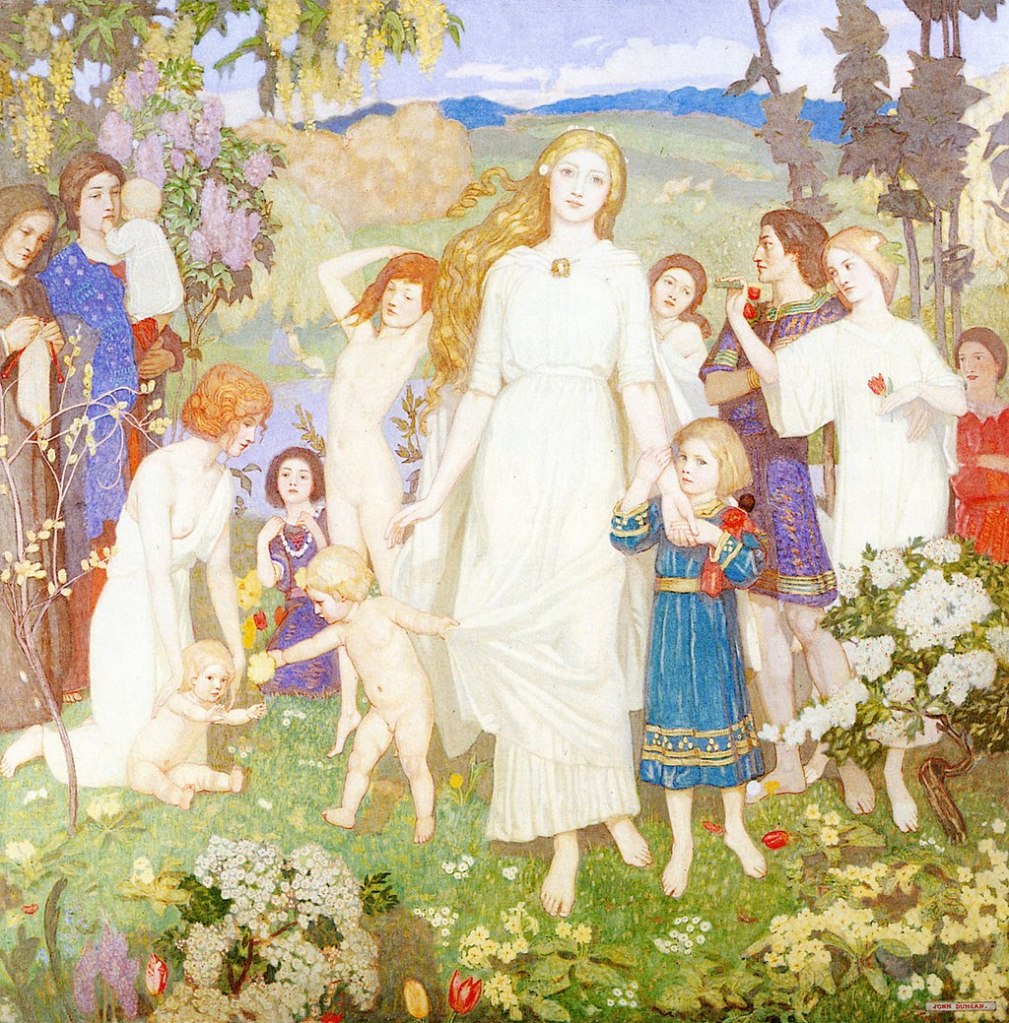
By John Duncan (1866-1945) – http://www.the-athenaeum.org/art/full.php?ID=27474, Public Domain, https://commons.wikimedia.org/w/index.php?curid=46026001

On Each of Us

Sabbath Day Thoughts — “On Each of Us” Acts 2:1-13

Anyone who has lived in a foreign country for an extended period of time can affirm how hungry we become for the sound of our own language.  My classmates and I had been living in Switzerland for about three months when culture shock set in. We were exhausted by trying to decipher the nearly incomprehensible accents of Swiss-German.  We were sick of the mockery of Swiss students, who thought we were all cowboys, Madonna, or surfer dudes.  We had had more than our fill of sausages, Smurfs, mopeds, bidets, smelly cheese, and toilets with observation platforms.

Then one day, my friends and I were wandering through a labyrinth of displays at a cultural expo when we heard something that made our hearts beat a little faster: the familiar twang of country music.  With ears tuned to that beacon, we zeroed in on the source: a booth where women were speaking English, not the clipped rhythm of British English, not the thick brogue of the Scots, not the lilt of the Irish, but real American English.  It felt like home: warm, welcoming, and safe.

On that first Pentecost, there were devout Jews living in Jerusalem from every nation under heaven, from North Africa to Mesopotamia to Rome.  I suspect that those who had been sojourning for a long time were hungry for the sound of their mother tongue.  They were strangers in a strange land, and no one let them forget it.  They were weary of the overweening pride of the priests in the Temple and shocked by the exorbitant price of lodging.  They were missing the tastes of home and thoroughly sick of falafel. 

Then, as they were walking to morning prayer, came the rush of a violent wind, followed by a sound that was music to their ears. For each one heard in his or her own language the story of God’s great deeds of power and the truth of God’s immeasurable love for them, the love revealed in Jesus.  In that foreign city, surrounded by a sea of strange people and foreign languages, each heard the language they most needed to hear.  It must have felt like home: warm, welcoming, and safe.

When we think about Pentecost, we tend to focus on the disciples.  We remember Peter’s powerful proclamation that inspired 3,000 people to make the choice for Jesus. We imagine Philip finding the courage and vision to take the good news and go to the Samaritans and that Ethiopian eunuch.  We consider James, who stayed put in Jerusalem and thanklessly worked, year after year, to teach the Jewish people the gospel of Jesus until his enemies put him to the sword.  When the Spirit came with rushing wind and tongues of flame, it empowered those disciples to do extraordinary, heroic, and miraculous deeds in service to the Kingdom of God.

Yet a closer reading of the Pentecost story reminds us that 120 followers of Jesus were gathered together in that place when that wind from God blew and the flames danced above their heads.  There were twelve disciples.  Another seven men were present who would become the first deacons.  There were the largely unnamed women who provided for Jesus, including Mary Magdalene, Susannah, and Joanna.  There were Jesus’ brothers and mother.  Even if we are generous with the math, that leaves about ninety other people who were there in that Upper Room at Pentecost—ninety people, whom we’ve never heard of, were filled with the Spirit at Pentecost.  We don’t know their stories.

Back at that cultural expo in the Basel, Switzerland of my college days, we discovered that those speakers of our mother tongue were American ex-patriot women.  Their lives had landed them abroad for decades. They taught at the university or were chemists with CIBA-GEIGY.  Their husbands were titans of industry or wizards of global finance.  Some had raised families in that foreign land, children who spoke the strange sounds of Swiss-German with just as much fluency as they did English.  Each week, those women gathered in one another’s homes to drink coffee, speak English, and navigate together the difficulty of being strangers in a strange land.

They could have been our mothers or grandmothers as they turned to us with the listening ears and compassionate care that we all need when we fear that we are alone in the dark, a long way from home. They didn’t have to be so nice, but they were. Each of them, in her own way, was extraordinary in her ordinary kindness.  There were smiles and hugs and cups of coffee.  In days to come, there were bowls of chili and slices of apple pie that tasted just like home.  And in some way when we were with them, we were home, even if it was only for an hour or so at a time in the midst of that sea of indifferent faces and other languages.

I trust that on that first Pentecost the nameless ninety went out into the streets of Jerusalem to be extraordinary in their ordinary ways.  They were kind and welcoming.  They listened and cared.  They were a lot like those American ex-patriot women I met in Basel.  In their willingness to love, they revealed that other love, the Great Love that spins the whirling planets, puffs into our lungs the breath of life, and waits to welcome us at the last.  They showed forth the holy love that walked this world in Jesus.  Filled with the Spirit, the unknown ninety went forth in their quiet, quaint, and ordinary ways to speak other languages that made the world feel like home to people who feared they were alone in the dark.

As we celebrate that first Pentecost and the falling of the Spirit upon all those named and nameless followers of Jesus, may we remember that the Holy Spirit rests upon each of us.  Empowered by the Spirit, some of us may go forth to serve the Kingdom in ways that are truly remarkable and well-worthy of the disciples.  Yet most of us will be like the ninety.  We’ll go forth to speak the languages that others long to hear in a world that feels lonely, unsafe, and far from home.  It may surprise us to learn that we are already fluent in the loving language that Jesus spoke so eloquently, the language that our neighbors long to hear.

We can speak the language of prayer.  We’ll lay a hand on the shoulder of a hurting friend and seek some holy help.  We’ll pray with the headlines, lifting up the victims of school shootings, natural disasters, and the tragedy of war.  We’ll pray for those whom we love, gently naming the worries and fears that plague every family and trusting the Lord to be at work.  We are fluent in prayer.

We can speak the language of caring.  We’ll feed hungry people with monthly food offerings. We’ll share the gospel of fresh, church-grown vegetables.  We’ll testify with toilet paper and paper towels for Grace Pantry. We’ll wrap hurting neighbors in prayer shawls made with love.  We’ll cheer friends with the gift of a prayer bear.  We’ll bless folks through times of crisis with help from the deacons’ fund. We are fluent in care.

We can speak the language of welcome.  We’ll take the time to truly see our vulnerable neighbors, to notice, greet, and listen.  We’ll reach out with concern for those who feel invisible, due to advancing age or growing disability.  We’ll greet and honor children, whose voices are often dismissed.  We’ll embrace diversity as God’s wondrous and stunning plan for humanity.  We’ll welcome students who feel like strangers in a strange land as they contend with sub-zero temperatures, long dark winters, and cafeteria food. We are fluent in the language of welcome.

By the power of the Spirit, each of us can be extraordinary in our ordinary, everyday ways.  Through our prayer, caring, and welcome, this world may even begin to feel like home for those who fear they are alone in the dark.  Let us go forth to speak the languages that others need to hear.  Amen.

Resources:

Karl Kuhn. “Commentary on Acts 2:1-21” in Preaching This Week, June 5, 2022. Accessed online at workingpreacher.org.

Debra J. Mumford. Amy Oden. “Commentary on Acts 2:1-21” in Preaching This Week, May 31, 2020. Accessed online at workingpreacher.org.

Amy Oden. “Commentary on Acts 2:1-21” in Preaching This Week, June 9, 2019. Accessed online at workingpreacher.org.

Greg Carey. Amy Oden. “Commentary on Acts 2:1-21” in Preaching This Week, May 20, 2018. Accessed online at workingpreacher.org.

Mikeal C. Parsons. “Commentary on Acts 2:1-21” in Preaching This Week, June 8, 2014. Accessed online at workingpreacher.org.


Acts 2:1-13

2 When the day of Pentecost had come, they were all together in one place. 2 And suddenly from heaven there came a sound like the rush of a violent wind, and it filled the entire house where they were sitting. 3 Divided tongues, as of fire, appeared among them, and a tongue rested on each of them. 4 All of them were filled with the Holy Spirit and began to speak in other languages, as the Spirit gave them ability. 5 Now there were devout Jews from every people under heaven living in Jerusalem. 6 And at this sound the crowd gathered and was bewildered, because each one heard them speaking in the native language of each. 7 Amazed and astonished, they asked, “Are not all these who are speaking Galileans? 8 And how is it that we hear, each of us, in our own native language? 9 Parthians, Medes, Elamites, and residents of Mesopotamia, Judea and Cappadocia, Pontus and Asia, 10 Phrygia and Pamphylia, Egypt and the parts of Libya belonging to Cyrene, and visitors from Rome, both Jews and proselytes, 11 Cretans and Arabs—in our own languages we hear them speaking about God’s deeds of power.” 12 All were amazed and perplexed, saying to one another, “What does this mean?” 13 But others sneered and said, “They are filled with new wine.”


Photo by Ron Lach on Pexels.com

Prisoners Freed

Sabbath Day Thoughts — “Prisoners Freed” Acts 16:16-34

On May fourteenth, Payton Gendron, an eighteen-year-old white male with an assault rifle and body armor, entered the Tops Market in the predominantly African American East Side neighborhood of Buffalo.  He opened fire, killing ten black shoppers and workers. Gendron drove 200 miles to commit his crime, and we know from a manifesto that he wrote and the video footage that he livestreamed of his attack that he was motivated by racial hate. Among the victims was eighty-six-year-old Ruth Whitfield.  Ruth was on her way home from visiting her husband in nursing care.  Also killed was sixty-seven-year-old Heyward Patterson, a deacon at his church, who was giving rides to shoppers that needed them.

On May fifteenth, members of the Laguna Woods Taiwanese Presbyterian Church came under attack as they shared lunch in the church hall following worship.  David Chou was a visitor that day.  He came armed with two nine-millimeter guns, a bag of Molotov cocktails, and anti-Taiwanese beliefs. Chou visited with church members and shared lunch before launching his attack. Dr. John Cheng, an orthopedist, was killed when he charged the gunman, but his brave actions allowed others to overpower and hogtie their attacker. Five people, ranging in age from sixty-six to ninety-two were wounded, four of them critically.

On Tuesday, an armed gunman, eighteen-year-old Salvador Ramos, entered Robb Elementary School in Uvalde, Texas through a back door that had been propped open. Just the week before, Ramos purchased two AR-15 assault-style rifles and a lot of ammunition for his birthday. At the school, Ramos entered a fourth grade classroom and killed nineteen children and two teachers before being shot by federal officers.  Among the dead was ten-year-old Jose Flores, Jr, who loved baseball, videogames, and being an amazing big brother.  Also killed was veteran teacher Irma Garcia, described as sweet, kind, and loving. She tried to shield the children from the gunman.

In the wake of so much senseless violence, we are heartbroken, grieved, and weary.  We struggle to imagine the enormity of the loss. We consider how we would feel if the lives lost were our grandpas, our children, our teachers.  It feels like we are trapped in an endless cycle of violent attacks, followed by thoughts and prayers, followed by calls for change, followed by the failure to take action, followed by yet another incident of mass violence.  It is as if we are prisoners of an epic cycle of senseless, horrific death that repeats, over and over again.

The Apostle Paul was imprisoned many times as he took the gospel out into the Greco-Roman world.  Indeed, four of Paul’s epistles were written from prison and he repeatedly described himself as being in chains for the sake of the gospel.  Today’s reading from the Acts of the Apostles describes Paul’s stay as a “guest of the emperor” in the Roman colony of Philippi.

It all started when Paul exorcised a pneuma puthona, spirit of the python, the ancient serpent who guarded the oracle at Delphi.  We don’t know how, but this demon had taken up residence in the belly of a slave girl and spoke prophecy to the highest bidder.  This poor girl was doubly enslaved.  She was held in the python’s coiled grasp and held captive by men who exploited her suffering to make “a great deal” of money.  These slave owners were irate when their income stream dried up, so they had Paul and Silas arrested on trumped-up charges of disturbing the peace and promoting anti-Roman sentiment.  It didn’t take much to gather an angry mob to call for immediate, harsh, and violent punishment. Paul and Silas were stripped, flogged, chained, and thrown into the inmost part of the jail, the tullianum, a dungeon without light or fresh air where those who had committed the most serious crimes or were of the very lowest level of society were kept. 

That’s when this story gets really interesting.  Severely punished and unjustly imprisoned, we expect Paul and Silas to tend their wounds and silently languish. But around midnight, the two men were praying and singing psalms.  Philippi’s deepest dungeon became an impromptu church.  Paul and Silas found hope in the Lord.  Other prisoners listened in, longing for good news in the dark.  Next, the presence of the Most-High God was revealed: the earth shook violently, the prison’s foundations rocked, doors sprung open, chains were loosed and prisoners freed; yet, instead of making a break for it, Paul and Silas stuck around.  They saved the life of their jailer, shared the good news of salvation, and baptized the entire household.  The next day when the apostles were exonerated, they went forth renewed in God’s power and purpose. How is that for a Hollywood ending?

It’s a wild and hopeful story of prisoners freed, one that we need to hear as we languish in dark times of senseless violence, hate, and mass shootings.  It’s a story that can speak to hearts hurting with unending grief and overwhelming fear. It’s a story that contradicts our belief that we are powerless to make a difference and put an end to the cycle of meaningless death.  Would you like to know how?

It begins with what we do in the dark.  Bruised by the world’s brutality, it is easy to throw up our hands and feel powerless.  And yet, we are not alone in the dark.  God faced the worst of human violence for love’s sake when Jesus suffered a cruel and savage death on the cross.  In Jesus, God infused the world’s suffering with God’s presence.  And so, we trust that God was there as Payton Gendron prowled the aisles of that East Side Tops Market.  God was there in the church hall when Taiwanese Presbyterians came under attack.  God was there in Robb Elementary School as children wept and teachers pleaded.  God is with us in our darkness, from the inner dungeon of a Philippian jail to the hushed silence of our sanctuary.  We are not alone in the dark, and that is something to trust in, to pray and sing about.  In a world where we feel we are prisoners of an endless cycle of violence, we can offer a bright and lyrical hope to all who feel alone and afraid in the dark.  Sing and pray, my friends.

We can trust that God, who is with us in the dark, is powerful.  In teaching about this story, Professor Brian Peterson of the Lutheran Theological Southern Seminary in Columbia, SC points to the earthquake.  Peterson writes that “this earthquake is the visible manifestation of God shaking this world’s powers to their foundations.” God was more powerful than a Roman jail.  God is more powerful than the violence of this world.  God is more powerful than the economic interests that make big money off the sale of guns and ammunition.  God is more powerful than the powers that seek to make political hay from gun violence without effecting any change.  Our all-powerful God longs to shake things up, to rock the foundations of a world that has grown numb to senseless attacks.  God longs to set prisoners of violence free.  Trust in the power of God, my friends.

That all-powerful God calls faithful people everywhere to shake things up.  We are grateful citizens of this nation, and yet we belong to the Kingdom where Christ is King and love is the byword.  We have been saved and freed for God’s purpose.  In response to that amazing grace, we dare each day to nudge this broken world a little closer to that holy Kingdom that is all around us and still to come. 

It doesn’t matter what your social or political beliefs may be.  There is plenty of Kingdom work for those who would dare to break that horrific cycle of violence.  If we believe that mental illness is to blame, then we need to be out there making a healthcare system where those who suffer from mental illness get the best possible care, provided with great compassion and medical excellence at reasonable cost. If we believe that hate is to blame, then we have a lot of loving to do, we have many vulnerable people to shelter, and we have the work of non-violent resistance ahead of us.  If we believe that political agendas and gridlock impede change, then we need to find candidates who listen and use our votes to bring change to the halls of power.  If we believe that greed is the problem, from DC lobbyists to arms manufacturers, from videogame designers to an entertainment industry that glorifies violent heroes, then we need to think seriously about how we spend our money, time, and attention.  Never underestimate the power of collective action shared in pursuit of a Kingdom-purpose.  With God’s help, we can be world-changing.  Let’s shake things up, my friends.

If we squander our freedom with endless hand-wringing, indifference, or political in-fighting, we know what the consequences will be.  That cycle of violence will continue.  Senseless violent attacks will provoke our thoughts and prayers.  We’ll fail to take meaningful action.  We’ll lapse into apathy and indifference.  Then, yet another mass shooting at a place like Robb Elementary School or the Taiwanese Presbyterian Church or Tops Market will again launch the same brutal and intolerable cycle.  We don’t want that for our world.  We don’t want that for our children. 

Sing and pray.  Trust in God.  Shake things up.


Resources:

Jake Bleiberg, Jim Venturo, and Elliot Spagat. “Gunman’s Final 90 Minutes Fuel Questions about Police Delays” in Associated Press News, May 26, 2022.  Accessed online at apnews.com.

Eric Levinson, et al. “Uvalde School Shooting Suspect Was a Loner Who Bought Two Assault Rifles for His 18th Birthday” in CNN News, May 27, 2022. Accessed online at cnn.com.

AP News Staff. “Buffalo Supermarket Shooting: What Do We Know So Far?” in Associated Press News, May 24, 2022. Accessed online at apnews.com.

Damian Dovarganes and Christopher Weber. CA Churchgoers Detained Gunman in Deadly Attack” in Associated Press News, May 16, 2022.  Accessed online at apnews.com.

Jerusha Matsiu Neal. “Commentary on Acts 16:16-34” in Preaching This Week, May 29, 2022. Accessed online at http://www.workingpreacher.org.

Jennifer Kaalund. “Commentary on Acts 16:16-34” in Preaching This Week, June 2, 2019. Accessed online at http://www.workingpreacher.org.

Brian Peterson. “Commentary on Acts 16:16-34” in Preaching This Week, May 12, 2013. Accessed online at http://www.workingpreacher.org.


Acts 16:16-34

16One day, as we were going to the place of prayer, we met a slave girl who had a spirit of divination and brought her owners a great deal of money by fortune-telling. 17While she followed Paul and us, she would cry out, “These men are slaves of the Most High God, who proclaim to you a way of salvation.” 18She kept doing this for many days. But Paul, very much annoyed, turned and said to the spirit, “I order you in the name of Jesus Christ to come out of her.” And it came out that very hour. 19But when her owners saw that their hope of making money was gone, they seized Paul and Silas and dragged them into the marketplace before the authorities. 20When they had brought them before the magistrates, they said, “These men are disturbing our city; they are Jews 21and are advocating customs that are not lawful for us as Romans to adopt or observe.” 22The crowd joined in attacking them, and the magistrates had them stripped of their clothing and ordered them to be beaten with rods. 23After they had given them a severe flogging, they threw them into prison and ordered the jailer to keep them securely. 24Following these instructions, he put them in the innermost cell and fastened their feet in the stocks. 25About midnight Paul and Silas were praying and singing hymns to God, and the prisoners were listening to them. 26Suddenly there was an earthquake, so violent that the foundations of the prison were shaken; and immediately all the doors were opened and everyone’s chains were unfastened. 27When the jailer woke up and saw the prison doors wide open, he drew his sword and was about to kill himself, since he supposed that the prisoners had escaped. 28But Paul shouted in a loud voice, “Do not harm yourself, for we are all here.” 29The jailer called for lights, and rushing in, he fell down trembling before Paul and Silas. 30Then he brought them outside and said, “Sirs, what must I do to be saved?” 31They answered, “Believe on the Lord Jesus, and you will be saved, you and your household.” 32They spoke the word of the Lord to him and to all who were in his house. 33At the same hour of the night he took them and washed their wounds; then he and his entire family were baptized without delay. 34He brought them up into the house and set food before them; and he and his entire household rejoiced that he had become a believer in God.


Image credit: https://thedailycable.co/05/29/general-news/495197/these-are-our-children-80-minutes-of-horror-at-robb-elementary-school/

“Beyond the Dead End”

Sabbath Day Thoughts — “Beyond the Dead End” Acts 16:6-15

We can imagine the Apostle Paul’s disappointment. The Jerusalem Council blessed his mission to the Gentiles. He left Antioch with big plans: to revisit the churches he had planted on his last missionary journey and then push on into new territory. But 750 miles into Paul’s second journey, it appeared that he was at a dead end.  First, the Holy Spirit had turned him around in Asia, and then, the Spirit of Jesus had blocked his way in Bithynia.  750 miles on foot, that’s a long way to go on a dead-end road.

As Paul retreated to the busy seaport of Troas on the Aegean, he must have felt frustrated and grieved.  He had gotten all the proper permissions.  He had the best intentions. And still, it was a no-go.  Even worse, he had dragged friends along on his folly: Silas, Timothy, and Luke.  As the team bedded down for the night, Paul was certainly puzzled—maybe even a little angered—by God, who had called him to this great missionary purpose, yet thwarted his efforts at every new turn.  It seemed that he had come to the end of the road.

We know how it feels to hit a dead end.  We have been there in our personal lives.  We’ve spent years in relationships with significant others who would never commit. We have had broken friendships that will never be mended. We have had family problems that just never get resolved.

We have hit dead ends in the workplace. Armed with a degree in our field of study, we step into a first job and find it is not at all what we had hoped or wanted.  We’ve worked long years for businesses that fail. We’ve done our very best for our boss and still the promotion never comes.

Sometimes we hit a dead end with our bodies, our physical health. There’s the natural progression of age—we no longer have the legs for mountain climbing or the eyesight for fine needlework. Or a difficult diagnosis can have life-changing consequences, like medications with debilitating side-effects or doctor’s appointments rob us of our days off.  Sometimes, our dead end leaves us hoping for a medical miracle.

We don’t like dead ends.  At the dead end, we feel like failures and are filled with “if onlys.” If only I had apologized. If only I had accepted that other job. If only I had taken better care of myself when I was younger. At the dead end, we may wonder if we have wasted our best efforts.  At the dead end, we may question God’s purpose and even God’s presence.

Paul must have felt a lot like that when he and his friends turned in for the night in Troas, lacking direction and wondering where to go. That night, Paul found new vision.  A Greek man, a Macedonian from the heart of the old Greek Empire of Alexander the Great, spoke to Paul.  He pleaded for Paul’s help, calling the apostle to come over, to cross the Aegean Sea.  The apostle awoke with the conviction that the message was from God almighty, who was calling him in an entirely new direction. 

After sharing his vision with Silas, Timothy, and Luke, they all agreed, “Macedonia, here we come!” At first light, the men went down to the waterfront.  They booked passage for Neapolis, the port city of Macedonia.  As they set sail, a promising tailwind pushed them on to their destination in record time.  As Paul and his friends stood on the deck with the wind at their backs and the ocean spray in their faces, it must have felt like a holy affirmation of their new direction.

On some days, it can feel hard to imagine that a fresh start awaits on the far side of our dead ends. It’s difficult to see past grief and heartache, pain and loss, doubts and fears. Dead ends really do feel lousy. Yet, dead ends can be turning points or unexpected twists in a journey that continues.  Sometimes, when we take stock at the dead end, we find that we have grown through our experience. There is wisdom that comes with failure, insight gleaned from our dashed dreams, fresh understanding that grants patience when circumstances are beyond our control.  We may not have a spectacular midnight vision from the Lord, but newness and possibility can emerge from the ash heap of our dead ends.

There is life for us beyond the dead ends in our personal lives. On the far-side of the dead end, we may find a new relationship or discover joy in the freedom of being unattached. We make new friends, tend those kinships better, and keep healthier boundaries. We find the possibility for peace, even when our family stays stuck.  We may choose to make a family of our own with those who accept us as we are and support us in our growth.

There is possibility for us beyond the dead ends we find in the workplace. Beyond the dead end, we take the time to discern our gifts and learn how God would have us use those abilities in meaningful and productive ways.  Or, we find a new job with different, more meaningful responsibilities, colleagues, and learning experiences. Or, we realize that life isn’t about a paycheck. We find fulfillment beyond the unfulfilling workplace in our families, pass times, and service to the community.

There are fresh starts for us beyond the dead ends of growing age and failing health.  Indeed, the dead end of diminishing ability can lead to new interests.  We trade the tennis racquet for the pickleball paddle.  We trade mountain climbing for trail walking.  On the far side of the dead end, we learn to live with that diagnosis. We replace the burgers and fries with grilled salmon and a fresh, leafy salad – and we may even learn to like it.  We find the support we need to accept our limits in small groups and the prayers of faithful friends.  Even when we must acknowledge the finitude of our days—the dead end that we will all one day meet, we savor the time we have, drink each day to the last drop, and trust that with God, there is always an eternal more that awaits us in that far brighter light on that far better shore

The Apostle Paul had one more twist on his missionary journey.  He spent some days in Philippi without any success to speak of.  On the Sabbath morning when he left the city and headed down to the river in search of an informal synagogue, he was probably wondering about the wisdom of this “new direction.”  There had been no Macedonian man waiting to greet him. On the contrary, it was the Gentile woman Lydia, an affluent merchant of imperial cloth, whom he found, gathered with her household at the riverside to pray and meditate upon the Word.

Paul let go of his expectations and followed the Spirit’s lead.  He shared the good news of Jesus and God’s love that is stronger than death.  And Lydia followed the Spirit’s lead, too, with open ears, open heart, and an open home.  Imagine the rejoicing on that riverbank, the shouts of “Alleluia!” “Amen!” and “Thanks be to God!” as Lydia was baptized, and Paul’s first church beyond the dead end was planted. Now, that’s what I call a new beginning.

Paul’s story speaks to us, we who have languished in the cul-de-sac of dead ends and second-guessed our new beginnings.  Paul reminds us that our path and our purpose ultimately belong to God and we are never alone on the journey.  We can trust that the Spirit is at work in us, just as it is at work in others.  God’s Spirit opens ears, opens hearts, and opens the way to the future that God holds ready.  Beyond our dead ends, the Spirit beckons to us, “Come over.”

Resources:

Eric Barreto. “Commentary on Acts 16:9-15” in Preaching This Week, May 9, 2010.  Accessed online at workingpreacher.org.

Brian Peterson. “Commentary on Acts 16:9-15” in Preaching This Week, May 5, 2013.  Accessed online at workingpreacher.org.

Jennifer Kaalund. “Commentary on Acts 16:9-15” in Preaching This Week, May 26, 2019.  Accessed online at workingpreacher.org.

Megan McDonough. “Dead Ends Are New Beginnings.” Accessed online at wholebeinginstitute.com.

Dixie Somers. “7 Dead Ends in Life and How to Avoid Them.” Accessed online at lifehack.org.


Acts 16:6-15

6 They went through the region of Phrygia and Galatia, having been forbidden by the Holy Spirit to speak the word in Asia. 7 When they had come opposite Mysia, they attempted to go into Bithynia, but the Spirit of Jesus did not allow them; 8 so, passing by Mysia, they went down to Troas. 9 During the night Paul had a vision: there stood a man of Macedonia pleading with him and saying, “Come over to Macedonia and help us.” 10 When he had seen the vision, we immediately tried to cross over to Macedonia, being convinced that God had called us to proclaim the good news to them.
11 We therefore set sail from Troas and took a straight course to Samothrace, the following day to Neapolis, 12 and from there to Philippi, which is a leading city of the district of Macedonia and a Roman colony. We remained in this city for some days. 13 On the Sabbath day we went outside the gate by the river, where we supposed[b] there was a place of prayer, and we sat down and spoke to the women who had gathered there. 14 A certain woman named Lydia, a worshiper of God, was listening to us; she was from the city of Thyatira and a dealer in purple cloth. The Lord opened her heart to listen eagerly to what was said by Paul. 15 When she and her household were baptized, she urged us, saying, “If you have judged me to be faithful to the Lord, come and stay at my home.” And she prevailed upon us.


Photo by Ana Arantes on Pexels.com

Out of Bounds

Sabbath Day Thoughts — “Out of Bounds” Acts 11:1-18

Canadians were shocked last May by the news of unmarked graves at residential schools. 215 graves of indigenous children were found at the Kamloops Indian School in British Colombia.  A few weeks later, 751 graves were discovered at a residential school in Saskatchewan.   Those schools were part of a national policy of assimilation for First Nations’ children which was in place from 1869 until the 1990s. Indigenous children were removed from their families and sent to state-sponsored Christian schools.  There they received a basic education and the gospel.  Seventy percent of the residential schools were run by the Catholic Church.  Duncan Campbell Scott, who served as the Deputy Minister of Indian Affairs and ran the boarding school program from 1912-1932, once said, “Our objective is to continue until there is not a single Indian in Canada that has not been absorbed into the body politic.”

Those residential schools were often run by people with little training, empathy, or cultural sensitivity.  65-year-old John Jones recalls his experience as a 7-year-old, taken from his family on the Nahoose Nation and sent to the Alberni Residential School.  There he was punished for speaking his native language or talking about his cultural heritage. At the residential school, John was subjected to daily physical punishment—paddled, slapped, and hit with belts.  He remembers being regularly berated as a dirty, stupid, good-for-nothing Indian.  He was sexually abused by a teacher who traded chocolate bars for illicit late-night visits.

The impact of the residential school system cannot be overstated.  Canada’s Truth and Reconciliation Commission determined that many of the 150,000 children who were sent to the schools were subjected to the same sort of abuse as John Jones.  Thousands died of malnutrition, tuberculosis, and other diseases caused by poor living conditions.  Alcoholism, drug addiction, mental illness, suicide, and domestic violence have been rife among survivors.  The Commission estimates that the 966 graves discovered last year are only the tip of the iceberg in a growing national tragedy.  As Christians, it’s painful for us to hear of the church’s complicity in state-mandated assimilation. It hurts to imagine the gospel of Jesus Christ being shared in a shroud of cultural expectations and demands that have had such far-reaching, destructive consequences.

In our reading from Acts 11, Peter was in hot water for his cross-cultural sharing of the gospel.  Peter’s mission had scandalized the Jewish believers because he had taken the good news of Jesus Christ to Gentiles of the very worst sort.  Cornelius was a centurion of the Italian Regiment, a leader of the foreign occupation of Israel.  Not only had Peter preached to Cornelius and his substantial household, but he had also baptized them, stayed with them, instructed them, and eaten with them.

It’s this last transgression, sharing the table with Gentiles, that was most troubling to Peter’s Jerusalem colleagues.  Keeping a kosher diet was an essential dimension of observing the Torah.  Leviticus 11 made it clear that some foods were pleasing to God (clean) and some were not (unclean).  Eating “clean” foods made the people of Israel holy as God is holy.  Eating unclean Gentile foods, like shellfish or pork, was a sin against God which separated you from God and your Jewish neighbor.  There was more to it.  As an occupied nation, that Jewish diet was a symbol of resistance.  Keeping a clean table reminded the people of Israel that they belonged to God, despite their social and political realities.

In his defense, Peter shared a systematic accounting of his actions.  According to Peter, his every move had been a response to the initiative of God and the work of the Holy Spirit.  God had sent that crazy vision of the sheet descending from heaven, filled with unclean beasts.  God had commanded him to eat.  God had sent a vision to the God-fearing Gentile Cornelius, telling him to summon Peter.  The Holy Spirit had fallen on Cornelius’s household, even before Peter had finished preaching.  The whole mission had clearly been God’s initiative.  Who was Peter to get in God’s way?  There truly had been nothing left to do, other than to baptize, welcome, and affirm what God had already done.

As the apostles followed the Holy Spirit’s leading out of bounds and across the Roman Empire, one of the greatest struggles of the early church was determining what should be demanded of Gentile believers.  Did they need to keep a kosher diet?  Should they be circumcised? Should they be treated as second-class, lower tier Christians?  Must they become Jews? After hearing Peter’s testimony, those earliest of Jewish believers in Jerusalem simply rejoiced and decided to follow the Spirit’s lead without any strings attached.  That wide and inclusive welcome became official in Acts 15 when the Jerusalem Council gave its stamp of approval to Paul’s Gentile mission.

Over the centuries, as Christianity expanded and became enmeshed with the political power of empire and nation, we have struggled and sometimes failed to live into those accepting, welcoming, inclusive expectations of the Holy Spirit and the earliest church.  We’ve often wrapped the gospel in a cloak of culture that demands assimilation.  It played out on the geo-political stage from the moment that Constantine had a vision of the cross and sent his legions into battle with that symbol painted on their shields and the motto, “In this sign conquer.”  We saw it as Galileo was forced to recant his scientific findings because they contradicted church teachings.  We saw it as Spanish conquistadors forced indigenous captives to be baptized at the point of the sword.  As a seminary student more than twenty years ago, I saw the devastating impact of forced assimilation first-hand, on Rose Bud and Pine Ridge Reservations in South Dakota where the Catholic Church and the Presbyterian Church operated government-sponsored boarding schools.

The Apostle Peter might remind us that the Holy Spirit is always way out there ahead of us.  We may want to draw lines and make demands, but salvation always rests in the initiative and power of God alone.  As faithful people, our task is not to insist on a kosher diet or circumcision; our job is not to judge others and insist that they conform to our way of seeing and doing things; our role isn’t to separate children from their families and rob them of their culture. When the Holy Spirit takes us out of bounds, the best thing to do may be to get out of the way, to watch, to listen, to be uncomfortable, to learn, to support, to sit down at the table with folks and break bread.  As Peter so eloquently said, if God gives others the same gift that God gave to us when we believed on the Lord Jesus Christ, how can we possibly hinder God?

Healing on the Rosebud and Pine Ridge Reservations has come slowly.  Indigenous scholars like Albert Whitehat, Sr. learned again their Lakota language and developed curriculum so that it can be taught in schools.  Addiction, which at its worst troubled 90% of reservation families, is slowly declining.  Indigenous priests, pastors, and directors of religious education are sharing the gospel in new ways.  In the suffering of Jesus on the cross, they see their own suffering.  They know that their experience as an occupied nation, subjected to terrible abuse, is closer to the life of Christ than most of us could ever imagine.  They know that Jesus walks with them.

Shortly after the residential school scandal broke in Canada last year, Interior Secretary Deb Haaland, a member of the Laguna Tribe, announced that the U.S. would be conducting its own investigation into our extensive history of Native American Boarding Schools, about half of which were federally funded but operated by churches.  In 1926, 83% of our Native American children were in residential schools, some voluntarily, some forcibly removed from their homes. Just as in Canada, residential schools have had devastating consequences for Native American communities.

Dzbahe remembers the day in 1953 when her parents made the difficult decision to send her to a residential school and she left her Navajo home.  At the school, her Navajo clothes and moccasins were taken and she was issued a uniform.  Her hair was cut. She was forbidden to speak her language.  Not knowing English or American customs, she was repeatedly punished for not doing what was expected of her.  Even her Navajo name, Dzbahe, was taken away, and she was forced to respond to the new name Bessie Smith. 

This week, the Department of the Interior released an initial report with findings from just 19 of the more than 400 US residential schools.  That report included news of more than 500 unmarked graves of children at those 19 schools.  The commission warns that as their work continues, the hidden deaths of indigenous children will rise into the thousands, perhaps even the tens of thousands. Lord, have mercy. 

Resources:

James Boyce. “Commentary on Acts 11:1-19” in Preaching This Week, May 2, 2010. Accessed online at workingpreacher.org.

Karl Kuhn. “Commentary on Acts 11:1-19” in Preaching This Week, May 15, 2022. Accessed online at workingpreacher.org.

Brian Peterson. Commentary on Acts 11:1-19” in Preaching This Week, May 19, 2019. Accessed online at workingpreacher.org.

Jonathan Chang and Meghna Chakrabarti. “Stories from Canada’s Indigenous Residential School Survivors” on On Point, July 28, 2021. WBUR Boston.  Accessed online at wbur.org.

Claire Cleveland. “Indigenous Schools Leave a Legacy of Generational Scars” in The Associated Press, August 8, 2021. Accessed online at apnews.com.

Kalle Benallie. “US boarding school investigative report released” in Indian Country Today, May 11, 2022. Accessed online at https://indiancountrytoday.com/news.


Acts 11:1-18

1 Now the apostles and the brothers and sisters who were in Judea heard that the gentiles had also accepted the word of God. 2 So when Peter went up to Jerusalem, the circumcised believers criticized him, 3 saying, “Why did you go to uncircumcised men and eat with them?” 4 Then Peter began to explain it to them, step by step, saying, 5 “I was in the city of Joppa praying, and in a trance I saw a vision. There was something like a large sheet coming down from heaven, being lowered by its four corners, and it came close to me. 6 As I looked at it closely I saw four-footed animals, beasts of prey, reptiles, and birds of the air. 7 I also heard a voice saying to me, ‘Get up, Peter; kill and eat.’ 8 But I replied, ‘By no means, Lord, for nothing profane or unclean has ever entered my mouth.’ 9 But a second time the voice answered from heaven, ‘What God has made clean, you must not call profane.’ 10 This happened three times; then everything was pulled up again to heaven. 11 At that very moment three men, sent to me from Caesarea, arrived at the house where we were. 12 The Spirit told me to go with them and not to make a distinction between them and us. These six brothers also accompanied me, and we entered the man’s house. 13 He told us how he had seen the angel standing in his house and saying, ‘Send to Joppa and bring Simon, who is called Peter; 14 he will give you a message by which you and your entire household will be saved.’ 15 And as I began to speak, the Holy Spirit fell upon them just as it had upon us at the beginning. 16 And I remembered the word of the Lord, how he had said, ‘John baptized with water, but you will be baptized with the Holy Spirit.’ 17 If then God gave them the same gift that he gave us when we believed in the Lord Jesus Christ, who was I that I could hinder God?” 18 When they heard this, they were silenced. And they praised God, saying, “Then God has given even to the gentiles the repentance that leads to life.”


Native American students at the Carlisle Indian School. By Unknown author – Unknown source, Public Domain, https://commons.wikimedia.org/w/index.php?curid=4797733

From Sheep to Shepherd

Sabbath Day Thoughts — “From Sheep to Shepherd” Acts 9:36-43

The noise was deafening.  Widows of every age surrounded me.  Some cast back their heads in ululation.  Others sobbed in lament.  Some pressed upon me the work of her hands, pointing to a finely woven flax tunic, a weighty woolen shawl, or the fine tracery of crimson embroidery threaded along the cuff of a sleeve.  “Help us, help us! Who will help us?” they pleaded.  I looked over to the husband, who sat on a bench in the courtyard, nearly catatonic with grief.

I was still fairly new to this apostle thing.  In fact, I had considered giving up after the resurrection.  In all honesty, I had proven to be a fairly worthless disciple.  I thought I knew it all.  I slept when I should have been praying.  I ran when I was needed to stand my ground.  In the Chief Priest’s courtyard, I had cursed in fear and panic, insisting that I didn’t know the Lord, had never met him, had nothing to do with him.  If the resurrection had convinced me of anything, it was of the greatness of God, the holiness of my Lord Jesus, and my utter worthlessness as a disciple.

In fact, I had returned to my home in Galilee and the familiar work of fishing.  The waves on the water, the heft of the net in my hands, the rise and fall of the boat under sail.  But I had proven to be a failure even at what was my birthright.  Then, in the early morning on the rocky shore with the smoke of the charcoal fire in my eyes and the taste of grilled fish and fresh bread on my tongue, the risen Lord had restored me to my purpose.  “Do you love me?” he asked.  “Tend my flock,” he commanded.  For the love of Jesus, I was trying.

Now if ever there were sheep without a shepherd, these women were it.  Across the Great Sea, the Greeks and Romans do things differently, but here we live by the Old Ways. Our women do not have inheritance rights.  The death of a husband or a grown son leaves a woman at the mercy of a new patriarch, and some are by no means merciful.  That was obvious.  A toothless crone with two canes wailed at my elbow.  A cross-eyed woman with an addled brain babbled for my attention.  An emaciated young mother, with two small children clinging to her skirt, sobbed hopelessly.  A bald woman with a goiter the size of a pomegranate held up an intricately woven kerchief.

From their stories, it was clear that Tabitha – or I should say Dorcas – had been their shepherd.  She had clothed them, fed them, and provided for them from her own purse. Her death was a tragedy for all.  It started with a cough, followed by the spike of a fever.  Her breathing had grown labored, her breath fetid.  Within a few days, she was gone. Now these lost sheep surrounded me with their tears and the ridiculous expectation that I should raise the dead.  They pushed me up the stairs, shoved me into the upper room, closed the door, and continued their non-stop racket.

The room was dark.  I crossed to the window, parted the curtains, and opened the shutters, flooding the room with light and a sea breeze.  Near the window, where the light was the best, stood a loom, threaded with a work in progress. Across the room, the body lay on a bed, shrouded by a woolen pall.  I peeled back the cloth.  Dark curls, like soft clouds, surrounded a kind face with creases left behind by years of smiles.  She wore a simple linen tunic.  Her hands were folded on her chest above her heart and she held an olive-wood cross.  So natural and peaceful.  I placed my hand on hers and shrank back from the cold flesh, inert and lifeless.

I began to pace, as is often the case when I am worried, anxious, or angry.  What was I doing?  Who was I to raise the dead? What would happen when I failed, as I undoubtedly would? I had agreed to tend the flock, but I didn’t sign up for this.  All those expectations of the keening widows pressed in on me. I felt like I was the one wrapped in a pall, a shroud of their lament. I began to hyperventilate. “Feed my sheep?” I wheezed. “Thanks a lot, Jesus.”

“What seems to be the problem, Peter?” I knew that voice better than my own. He stood with his back to the window, his face in shadows. The sunshine, flooding into the room, seemed to shimmer and surge around his silhouette. I stopped hyperventilating.

“Jesus!” I shouted, half-angry, half-relieved. “C’mon. you don’t expect me to raise this woman.  Do you? I can’t do it!  I can’t!”  It may have been my imagination, but the wailing in the hallway outside the room seemed to escalate.

Jesus nodded, as he often did when I stated the obvious. “No, you can’t do it, Peter.”

This wasn’t helping my confidence at all.  I paced some more while he watched. I stopped and pointed at him accusingly, “You could do it!  You raised Jairus’s daughter.  I was there.  I saw her smile.  I saw her stretch her arms up to be held.  How about the widow of Nain’s son, hopping off his funeral byre as if her were embarrassed to be caught napping? Remember, Lazarus?  Three-days-dead and stinking, you called him out of the tomb.  You can do it!  You can do it!  But I’m not you.”

Jesus agreed, “No, you’re not.”

I paced some more.  I couldn’t do it, but Jesus could.  I shot a look at him where he was now leaning with an elbow on the window sill, and I swear, he raised his eyebrows like he does when he is waiting for me to draw an obvious conclusion.  I stopped.

“Are you really here, Lord?”

Now, he was smiling. “Didn’t I promise to be with you always, Peter, even to the end of the age?” 

He had made that promise.  He had even sent his Holy Spirit as a perpetual reminder.  As Jesus pushed away from the window and took a step closer to me, I felt the Spirit ripple within me. It was obvious. I turned away from Jesus and looked over at the peaceful and thoroughly dead Tabitha—or should I say Dorcas?  “I can’t do it,” I said again, “but you can.”

I moved toward the bed.  The sun warmed my back and moved along my limbs. I stepped closer still to the body and my shadow fell across her face.  I raised my arms with power and words of authority that were mine, but not mine, sounded loud.  “Tabitha!  Get up!”

The first thing I noticed was the slow throb of a vein, pulsing at her temple. Next, her chest began to gently rise and fall with the soft swell of her breath. Her mouth opened in an enormous yawn and a hand fluttered up to cover it.  Here eyelids blinked open, once, twice.  “O, Jesus!  You came!” she smiled.

I whirled around to see if the Lord was still behind me at the window. The room was empty.  The curtains fluttered in the sea breeze, the threads dangling from the loom danced in the shifting air.  Beyond the door, the keening of the women was undiminished and someone had broken out a shofar, blowing long, slow, mournful notes. 

I bent down and took the hand of the no-longer-dead woman. She was still clutching the olive wood cross but had kicked off the woolen shroud and was wiggling her toes.  I helped her up. “Sister,” I said to the puzzled Tabitha, “I know some people who will be happy to see you.” 

As I opened the door and guided her through, there was a moment of stunned silence.  Then, mourning shifted to joy.  There were glad shouts of recognition and fervent alleluias.  Tears of joy streamed down jubilant faces. The crone brandished her canes in celebration.  The fool sang a psalm of rejoicing.  The two children danced, hand-in-hand with their mother.  The woman with the goiter could only repeat, again and again, “Glory be to the great God of Israel, holy be His name!”  Arms reached out to Tabitha, touching, hugging, holding.  Tabitha was swept downstairs and out into the streets in a parade of rejoicing that they are still talking about in Joppa to this day.

I lingered in the upper room, leaning against the sill where the Lord’s elbow had rested, watching the celebration on the street below.  I still felt that I was not very good at this apostle thing. Thank goodness that no one had been in the room with me to witness my panic. But I learned that it is not so much about me as it is about Jesus.  Nine times out of ten, I can’t do what is asked of me.  I can’t rise to the expectations that they have for me.  But Jesus can, and even when I walk through the darkest valley, he is with me.


Acts of the Apostles 9:36-43

36 Now in Joppa there was a disciple whose name was Tabitha, which in Greek is Dorcas. She was devoted to good works and acts of charity. 37 At that time she became ill and died. When they had washed her, they laid her in a room upstairs. 38 Since Lydda was near Joppa, the disciples, who heard that Peter was there, sent two men to him with the request, “Please come to us without delay.” 39 So Peter got up and went with them, and when he arrived, they took him to the room upstairs. All the widows stood beside him, weeping and showing tunics and other clothing that Dorcas had made while she was with them. 40 Peter put all of them outside, and then he knelt down and prayed. He turned to the body and said, “Tabitha, get up.” Then she opened her eyes, and seeing Peter, she sat up. 41 He gave her his hand and helped her up. Then calling the saints and widows, he showed her to be alive. 42 This became known throughout Joppa, and many believed in the Lord. 43 Meanwhile, he stayed in Joppa for some time with a certain Simon, a tanner.


Photo by Karolina Grabowska on Pexels.com

Fed, Forgiven, Sent

Sabbath Day Thoughts — “Fed, Forgiven, Sent” John 21:1-19

“Feed My Sheep”

—Mary Baker Eddy

Shepherd, show me how to go

“O’er the hillside steep,

How to gather, how to sow—

How to feed Thy sheep;

I will listen for Thy voice,

Lest my footsteps stray;

I will follow and rejoice

All the rugged way.

Thou wilt bind the stubborn will,

Wound the callous breast,

Make self-righteousness be still,

Break earth’s stupid rest.

Strangers on a barren shore,

Lab’ring long and lone,

We would enter by the door,

And Thou know’st Thine own;

So, when day grows dark and cold,

Tear or triumph harms,

Lead Thy lambkins to the fold,

Take them in Thine arms;

Feed the hungry, heal the heart,

Till the morning’s beam;

White as wool, ere they depart,

Shepherd, wash them clean.”

What’s next? It’s the question of the Easter season.  The sanctuary is still decked in Easter white, but the lilies are beginning to fade. The Easter crowd has ebbed and may not be seen again until Christmas Eve. Yet, we have rejoiced together and affirmed that Jesus has risen and God has won the victory over sin and death.  So, what are we to do and how are we to live in this post-resurrection world? Our reading from John’s gospel suggests that Eastertide is all about being fed, finding grace, and going forth in Christ’s purpose.

What’s next? That question must have been on Peter’s mind. After the disciples encountered the risen Lord on Easter evening, they had made their way back to the Galilee.  After the chaos and trauma of Good Friday, Peter must have felt the comforting pull of the familiar, and so he returned to the well-known rhythms of fishing.  With six of his friends, he climbed into a boat, pushed out into deep water, and spent a fruitless night casting his nets.

As the sun rose above the Golan Heights, Jesus stood on the beach and guided his friends to a surprisingly bountiful catch.  When the disciples returned to shore, Jesus knew that folks who have been out all night long, rowing and towing a drag net, need to be fed, so he invited them to a breakfast of bread and fish, grilled on a charcoal fire.  Have you ever noticed how good food tastes when it is fresh, simply prepared, and eaten outdoors?  As the disciples filled their bellies in Jesus’s good company, I suspect they felt “fed” in more ways than one.

We all need to be fed.  If life is a spiritual journey, then we need good food to sustain us along the Way.  In our Lenten Study this year, a dozen of us considered what sustains us along life’s spiritual journey.  We all need nourishment.  We all need ways in which we connect with God — because it is there that we find the refreshment and energy that are needed to live faithfully.  In fact, the class brainstormed a list of things that are bread for our journey.  On the list were worship, scripture, the Lord’s Supper, meditation and prayer, fellowship, nature, the arts, and more.  How are you fed for the spiritual journey?  This Easter season invites us to know the risen Lord and to deepen our relationship with him.  As we spend time with Jesus — in church, with others, or in nature — we are filled and energized.

I am certain that, as Peter enjoyed that fish breakfast on the beach with Jesus, the apostle was struggling with guilt and shame.  After all, he had promised to follow Jesus, even if the way led to suffering and death.  But on the night of Jesus’s arrest, fear had gotten the better of Peter.  The last time that Peter had warmed his hands at a charcoal fire, he had been in the courtyard of the high priest.  There he had repeatedly and vehemently denied even knowing Jesus.  Jesus, seeing his friend’s inner turmoil, gave Peter a second, third, and fourth chance—a Mulligan, a “do-over.”  Peter found much-needed grace and forgiveness as he affirmed his love for Jesus three times.  It was the perfect, poignant remedy to those three haunting denials.

We all need mercy and grace.  We may not have denied Jesus three times to save our own skin, but we all stumble and fall short in right living.  We have treated our relationship with Jesus as an after-thought to be sprinkled around the edges of our lives at our personal convenience.  We have made mistakes in our personal lives.  We have been impatient with our spouse, insensitive to our children, or unavailable for our friends.  We have remained silent at injustice, indifferent to suffering, and unwilling to share with those who need our help, compassion, and generosity.  Where do you need grace this morning?  In this Easter season, we remember the enormity of God’s love for us.  If Christ can forgive a repentant thief, his executioners, and the Apostle Peter, then we can trust that Jesus forgives us.  In this Easter season, we can trust that grace and forgiveness abound for us.

As Peter was fed and forgiven, he learned that Jesus had a purpose for him.  The Lord asked Peter to feed and tend the flock that was being entrusted to his care.  Through Peter, Jesus would continue to reach out, heal, and bless a world that was desperately hungry for good news.  When we read the Book of Acts, we note that Peter answered that calling.  Peter would heal a lame beggar on the doorstep of the Temple.  He would raise from the dead the beloved Dorcas, who had so generously cared for the widows of Joppa. Peter would venture into enemy territory, taking the gospel to the household of Cornelius the Centurion in Caesarea.  Through Peter, and those other disciples who answered Jesus’s call, Christ’s love would be made known and shared from one side of the Roman Empire to the other.

Jesus continues to entrust his ministry to flawed people like Peter, to flawed people like us.  Jesus’s flock needs faithful people who will love and feed them, and the Lord trusts that we, too, will reach out with healing, help, and blessing for neighbors who hunger for good news.  When we plant the church garden and we bring food offerings to the pack basket at the side entrance, the flock gets fed.  And when we pray for others in the Prayers of the People or share concerns with the Prayer Chain, the flock is tended.  When the deacons reach out with calls and cards, or we invite a hurting friend to church, the flock is blessed.  In this Easter season, we find our purpose and fulfill our calling when we answer Christ’s call to love and serve the neighbors that he entrusts to us.

What’s next?  It’s the question of the Easter season. What are we to do and how are we to live in this post-resurrection world? According to Jesus, Eastertide is all about being fed, finding grace, and going forth in his purpose.  May it be so. 

“Shepherd, show me how to go

O’er the hillside steep,

How to gather, how to sow—

How to feed Thy sheep;

I will listen for Thy voice,

Lest my footsteps stray;

I will follow and rejoice

All the rugged way.”

Resources:

Thomas Troeger. “Homiletical Perspective on John 21:1-19” in Feasting on the Word, Year C, vol. 2. Louisville: Westminster John Knox Press, 2009.

Gary D. Jones. “Exegetical Perspective on John 21:1-19” in Feasting on the Word, Year C, vol. 2. Louisville: Westminster John Knox Press, 2009.

Robert Hoch. “Commentary on John 21:1-19” in Preaching This Week, April 10, 2016.  Accessed online at workingpreacher.org.

Joy Moore. “Commentary on John 21:1-19” in Preaching This Week, May 5, 2019.  Accessed online at workingpreacher.org.

David Lose. “Two Things Everyone Needs” in Dear Partner in Preaching, April 5, 2016.  Accessed online at davidlose.net.

Longyear Museum. When The Heart Speaks: Feed My Sheep. Poems by Mary Baker Eddy set to music in the Christian Science Hymnal. October 1, 2021. Accessed online at https://www.youtube.com/watch?v=8xI1J5sGbEM


John 21:1-19

21 After these things Jesus showed himself again to the disciples by the Sea of Tiberias; and he showed himself in this way. 2 Gathered there together were Simon Peter, Thomas called the Twin, Nathanael of Cana in Galilee, the sons of Zebedee, and two others of his disciples. 3 Simon Peter said to them, “I am going fishing.” They said to him, “We will go with you.” They went out and got into the boat, but that night they caught nothing.

4 Just after daybreak, Jesus stood on the beach; but the disciples did not know that it was Jesus. 5 Jesus said to them, “Children, you have no fish, have you?” They answered him, “No.” 6 He said to them, “Cast the net to the right side of the boat, and you will find some.” So they cast it, and now they were not able to haul it in because there were so many fish. 7 That disciple whom Jesus loved said to Peter, “It is the Lord!” When Simon Peter heard that it was the Lord, he put on some clothes, for he was naked, and jumped into the sea. 8 But the other disciples came in the boat, dragging the net full of fish, for they were not far from the land, only about a hundred yards off.

9 When they had gone ashore, they saw a charcoal fire there, with fish on it, and bread. 10 Jesus said to them, “Bring some of the fish that you have just caught.” 11 So Simon Peter went aboard and hauled the net ashore, full of large fish, a hundred fifty-three of them; and though there were so many, the net was not torn. 12 Jesus said to them, “Come and have breakfast.” Now none of the disciples dared to ask him, “Who are you?” because they knew it was the Lord. 13 Jesus came and took the bread and gave it to them, and did the same with the fish. 14 This was now the third time that Jesus appeared to the disciples after he was raised from the dead.

15 When they had finished breakfast, Jesus said to Simon Peter, “Simon son of John, do you love me more than these?” He said to him, “Yes, Lord; you know that I love you.” Jesus said to him, “Feed my lambs.” 16 A second time he said to him, “Simon son of John, do you love me?” He said to him, “Yes, Lord; you know that I love you.” Jesus said to him, “Tend my sheep.” 17 He said to him the third time, “Simon son of John, do you love me?” Peter felt hurt because he said to him the third time, “Do you love me?” And he said to him, “Lord, you know everything; you know that I love you.” Jesus said to him, “Feed my sheep. 18 Very truly, I tell you, when you were younger, you used to fasten your own belt and to go wherever you wished. But when you grow old, you will stretch out your hands, and someone else will fasten a belt around you and take you where you do not wish to go.” 19 (He said this to indicate the kind of death by which he would glorify God.) After this he said to him, “Follow me.”


Photo by Oziel Gu00f3mez on Pexels.com