Start Where You Are At

Sabbath Day Thoughts — “Start Where You Are At” Luke 24:36b-48

Krista comes to church on Sunday mornings feeling worn out. She works full-time. She and her husband are raising three very busy school-age children. Last year, Krista’s Mom died unexpectedly. Krista has been helping her father prepare to sell their family home. Krista is constantly on the move. Working, grocery shopping, cooking, and taxying children to extra-curricular activities. Cleaning out the attic at her Dad’s place, running a yard sale, and making many runs to the dump. She misses her Mom.

Charlie comes to church on Sunday mornings feeling stressed out. It’s his only day off from a job that gets bigger every year. So many people depend upon him. His boss expects him to work miracles of productivity and profit, even when he is desperately short-staffed. His colleagues count on him to cast the vision and manage the team. With a big mortgage and kids soon headed to college, his family needs the substantial paycheck. At some point, a job that once felt interesting and fulfilling began to feel like a recipe for burnout, and there doesn’t seem to be much that he can do about it.

Rita and Nate come to church on Sunday morning feeling worried and afraid. Retired now, they are committed to a legion of community concerns: volunteering at the soup kitchen, caring for pets at the animal shelter, helping out for Winter Carnival, and more. Being retired, they spend a LOT of time together, more than ever before in the course of their long marriage. Between annoying habits and differing opinions, it isn’t always easy. Now, one of them has a health crisis. They are on a long journey through the scary, inhospitable realm of healthcare. It feels overwhelming.

Luke tells us how the disciples felt on Easter evening: filled with fear and doubt. They had made a Passover journey to Jerusalem with their friend and rabbi Jesus, whom they believed to be the Messiah. They entered the city feeling hopeful, triumphant even. Yet, their week had taken a foreboding and sinister turn. Tension mounted, day by day.  Powerful opponents waited in the Temple courts to challenge Jesus’ authority, seeking to entrap and discredit him. When they could not best Jesus with deceitful words, they put a price on his head. For thirty pieces of silver, one of them had betrayed him. A kiss sent Jesus to the cross while everyone ran for their lives, all love and loyalty forgotten. Beyond fear and doubt, Jesus’ friends were filled with despair, grief, and the bitter self-recrimination that comes when we know that we have failed those whom we love most.

They were ready to give up and go home, slipping out of the city in anonymous pairs as soon as the time was right. But Easter morning brought confusion and anxiety. Some of the women returned from the gravesite, telling a curious tale of an empty tomb and heavenly messengers. “He is risen!” cried Mary Magdalene, trying to shake them from the stupor of grief, but they could not listen and did not believe. Later, Cleopas and his companion returned with an equally implausible story of Jesus on the road, opening the scriptures to them and sharing an evening meal. In our reading from Luke’s gospel, the disciples had their own terrifying encounter with the risen Lord. Despite the locked door and the secrecy of their location, Jesus found them and stood among them with the greeting of peace.

When Lucy Lind Hogan, who taught at Wesley Seminary in Washington for many years, teaches about today’s scripture reading, she likes to use five “e” words: encounter, explanation, eating, enlightenment, and exit. It begins with encounter, that sudden appearance and shocking greeting of peace in the upper room. Then there is an explanation: visible wounds are shown and touched to assuage fear and doubt. Next comes the eating; after all, Jesus loved to break bread with all kinds of people, even fearful, failed disciples. As Jesus patiently used the Hebrew scripture to reveal that his suffering, death, and resurrection were all part of God’s plan for the Messiah and the salvation of the world, the disciples found enlightenment. Their minds were opened and they understood. Lastly, Jesus vanished, making an exit, but not before giving his friends a mission that would bring meaning and purpose to their lives.

When we come to church on Sunday mornings, our experience is a lot like the disciples on that first Easter evening. We come filled with a weight of experience and feeling. Like Krista, we may be worn-out, stretched thin, and grieved. Like Charlie, we may be stressed-out, over-worked, and under-supported. Like Rita and Nate, we may feel worried and afraid, ill-equipped to face the crises that come, especially as we age. Take a look around. There’s a lot going on inside us on Sunday mornings. We come to church hoping for whatever it may be that we need to send us back out there into a new week.

Somehow on Sunday mornings at church, we find those five “e’s” of Easter evening. We encounter Jesus. He’s here in the smiles, handshakes, and hugs of those who worship alongside us. We feel his mercy and grace as we confess our sins and know that we are forgiven. Through scripture read, the word proclaimed, and the sharing or prayers, we find our explanation and grow in understanding. At least once a month, we eat with Jesus, breaking the bread and lifting the cup that are his body and blood for us. As worship ends, we go forth enlightened. Even though we arrive feeling worn-out, burned-out, or down and out, we trust that we are loved and we are not alone. As we make our exit, the risen Christ walks with us into a new week, and we find what is needed to begin again. Thanks be to God.

Jesus hoped that his friends would go forth from Easter evening with the willingness to do for others what he had done for them. There was a world of people out there who needed his mission, and the Lord trusted that the men and women who followed him would go forth in his purpose. There were outsiders who needed to be welcomed and children who could use a blessing. There were sick people longing for healing. There were sinners who dreamed of forgiveness, and everywhere so many people needed to know that God loved and accepted them in all their frailty. The disciples could handle that mission. They could simply start where they were at, right there in Jerusalem, extending to one another the mercy that Jesus had extended to them and trusting that Jesus would be known through their witness.

Perhaps we can follow in the footsteps of the disciples this morning. Redeemed and renewed by the risen Lord, we can start where we are at, simply carrying the love, grace, and peace that we find on Sunday mornings out there, to a world that is worn-out, stressed-out, and down and out. For us, taking the love of Christ and the good news of repentance and forgiveness to all nations might look like sharing the faith with Bible stories for our children and grandchildren or inviting a neighbor to come to church.  We can tell the story with more than words. We can share it with helping hands and caring thoughts, inviting someone who struggles to join us for a home-cooked meal or meet us for a cup of coffee.  We can sow the seeds of Christ’s love by choosing to love our hard to love neighbors with patience and compassion. We can bear witness that healing and forgiveness are always possible with God, when we dare to let go of old hurts and allow the past to be the past. We share the hope of new life and the life eternal as we help others begin again – whether that new beginning comes after divorce, or as a new career path is undertaken, or as the slow tide of grief that comes with loss ebbs and flows.  How will we start where we are at? How will we pursue Christ’s mission this week?

I trust that as we go forth in Jesus’s purpose, the world will begin to feel a little less burned-out, stressed-out, down and out — and so will we. People like Krista, who are stretched thin and weighed down by grief, will find helping hands and solace for sadness. People like Charlie, caught in big workplace commitments, will find conversation partners who listen, encourage, and help them to set healthier boundaries. Friends who are struggling, like Rita and Nate, will find caring presence, good advice, and timely help with healthcare and counseling resources. As we pray alongside others and remind them that God is powerful when we are not, we can trust that Christ’s mission continues. The world will know those five “e’s” of Easter evening and experience the blessing we find on Sunday mornings. May it be so.

Resources

Michael Joseph Brown. “Commentary on Luke 24:36b-48” in Preaching This Week, April 14, 2024. Accessed online at Commentary on Luke 24:36b-48 – Working Preacher from Luther Seminary

Lucy Lind Hogan. “Commentary on Luke 24:36b-48” in Preaching This Week, April 22, 2012. Accessed online at Commentary on Luke 24:36b-48 – Working Preacher from Luther Seminary

Jacob Myers. “Commentary on Luke 24:36b-48” in Preaching This Week, April 19, 2015. Accessed online at Commentary on Luke 24:36b-48 – Working Preacher from Luther Seminary


Luke 24:36b-48

36While they were talking about this, Jesus himself stood among them and said to them, “Peace be with you.” 37They were startled and terrified, and thought that they were seeing a ghost. 38He said to them, “Why are you frightened, and why do doubts arise in your hearts? 39Look at my hands and my feet; see that it is I myself. Touch me and see; for a ghost does not have flesh and bones as you see that I have.” 40And when he had said this, he showed them his hands and his feet. 41While in their joy they were disbelieving and still wondering, he said to them, “Have you anything here to eat?” 42They gave him a piece of broiled fish, 43and he took it and ate in their presence. 44Then he said to them, “These are my words that I spoke to you while I was still with you—that everything written about me in the law of Moses, the prophets, and the psalms must be fulfilled.” 45Then he opened their minds to understand the scriptures, 46and he said to them, “Thus it is written, that the Messiah is to suffer and to rise from the dead on the third day, 47and that repentance and forgiveness of sins is to be proclaimed in his name to all nations, beginning from Jerusalem. 48You are witnesses of these things.


Photo by Brett Sayles on Pexels.com

Rise Up!

Sabbath Day Thoughts — “Rise Up!” Mark 16:1-8

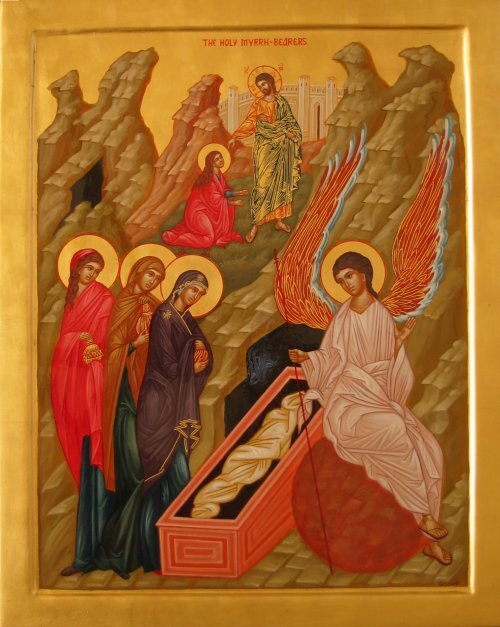
In three weeks, when we traditionally celebrate Good Shepherd Sunday, our cousins in the Orthodox tradition will commemorate the Sunday of Myrrh-bearing Women. They have been doing so since the fifth century when John Chrysostom, the Bishop of Constantinople, first honored those women who went to the tomb, armed with burial spices and anointing oil. In Orthodox churches on the Sunday of Myrrh-bearing Women, censers will be filled with smoking incense, and the priest will swing them with a practiced arm, venerating all four sides of the altar, the congregation, the bread and wine of communion, and the church itself. Prayers will remember the faithful witness of the women. The sermon may even make the connection between the myrrh-bearers and the long history of women who have served the church. The hymn of the day will be introduced with the words, “The women disciples bring myrrh unto Christ. And I bring a hymn as [if] it were myrrh unto them.”

Our Orthodox cousins also remember the myrrh-bearing women with a long tradition of iconography, sacred art that is used as an invitation to prayer and reflection. Perhaps you have seen the icons. Mary Magdalene, Mary the mother of James, and Salome are depicted at the tomb. The holy messenger in dazzling white points to the empty graveclothes, proclaiming that Jesus has risen. The women, with heads covered and flowing robes, carry ceramic flasks of oil. Their faces are wide-eyed with fear and lined with tears. One of the women is often painted with her back to the angel, as if poised to run. She looks back over her shoulder, torn between learning what has happened to Jesus and succumbing to holy terror.

After the sabbath, when the myrrh-bearers rose early, purchased spices, and walked to the tomb, they were well-acquainted with death. In first-century Israel, tending the dead was women’s work. It fell to women to prepare bodies for the grave: washing, anointing with oil, and wrapping in a simple linen shroud. For three days, women accompanied the body, walking to the tomb each morning, singing psalms, and sharing tears and cries of mourning. The myrrh-bearers had buried many people and tended many bodies: elderly parents, aged husbands, dear friends, solitary neighbors, and in a world where only one in five children lived to adulthood, they had buried children, many children.

Jesus warned the disciples that death waited in the Holy City. But the week before the women had rejoiced and danced into Jerusalem. Filled with hope, they sang and played their drums, waved palm branches and rejoiced to be in the company of the Messiah. That week the city turned hostile, even murderous.  On the night of the Passover, the women saw Jesus betrayed, abandoned, and led off like a lamb to the slaughter. On Friday, the women followed their bloody, broken Lord as he stumbled beneath the terrible burden of the cross. From a distance, they watched while soldiers gambled and the mob taunted and mocked. As the sun failed and darkness covered the land, they saw Jesus surrender his spirit. As the day grew late and the sabbath neared, two of the women followed Joseph of Arimathea.  They watched him claim the body, wrap it in linen, and hastily stow it in a rock-hewn tomb. All through the Sabbath, the women sat with their grief and loss. They weren’t sure who they were anymore, what their purpose was, or how they could go on. But as the rosy promise of a new week crept above the eastern horizon, they found the courage to do what women always did when a beloved one died. They purchased their burial spices and anointing oil and walked to the tomb.

/

We are not myrrh-bearers in the traditional sense of the word. We leave it to the mortuary or the crematorium to tend to the bodies of our dead. Yet we are not strangers to death. We know what it is like to walk to the tomb, to face squarely our loss and pain, our disbelief and defeat. We know the untimely death of our beloved ones. We know the death of our endeavors: the marriage that flounders and fails; the business that goes under; the degree we never finish. We know the death of friendships and kinships: the forgiveness we never extend, the trust that is betrayed, the selfish interest that drives home the killing wedge. We know death writ large upon the world stage: our planet groaning beneath the burden of our abuse, the blood of Palestinians and Israelis crying from the ground of a broken land, the lament of refugees longing for welcome and home. In the dark hours before dawn, we know how the myrrh-bearers felt. We know the unbearable grief. We may even wonder who we are, what our purpose is, or how we can go on.

/

When the women arrived at the tomb, the stone was rolled back. They hesitated in fear outside, each too frightened to go in alone, and so they decide to venture in together, a fearful little band bound by their love for Jesus and their common duty as myrrh-bearers. Mary Magdalene, Mary the Mother of James, and Salome entered the tomb, anticipating death. But there in the cold stone crypt, still smelling of blood and suffering, the women were shocked to find life. A holy messenger shared the good news that God could take all the evil of their world and work from it a miracle of life.

In the hours before dawn, as the earth rolled on to meet the morning and the last stars faded from the western sky, Jesus rose. He stretched and stood, testing his bruised body.  He stepped out of the tomb and into the garden, breathing deep the cool of the dying night. God’s amazing love had broken the power of sin and death. 

Mary Magdalene whispered, “Jesus is alive,”

Mary the mother of James gasped, “Jesus has been raised, just as he promised.”

Salome dared to hope, “Jesus has gone ahead to Galilee. We’ll see him there.”

/

On Easter morning, we dare to imagine that if God can raise Jesus from dead, then surely there is hope for us and all the ways that we are well-acquainted with death. We can trust that, just as God was at work to overcome the world’s sin and hate to raise Jesus, God is at work even now to help and to heal, to raise up the promise of new life.

Yes, we know the grief that comes with the death of our beloved ones, but we also trust that we are raised with Christ. The promise of the life everlasting and the heavenly shore awaits. Rise up!

Yes, we are well-acquainted with failure, but God is faithful and a new day dawns. One day we may love again, or find fresh purpose, or hear the knock of opportunity. Rise up!

Yes, we know the death of friendship and kinship, but if God can win the victory over sin, then maybe with the Lord’s assistance we can pick up the phone or write that letter or ask for help. Rise up!

Yes, we know global death and destruction, but if Jesus is raised, then maybe there is hope for our world yet. We can learn to tread lightly on God’s good earth. Peace can break out in the midst of war. The homeless poor can find home at last. Rise up!

We are well-acquainted with death, but on Easter morning, we join the myrrh-bearers, with great hope and holy fear, for with God the last word is always life.

/

Mary Magdalene, Mary the mother of James, and Salome came to the tomb in the traditional women’s role of myrrh-bearer; yet, they soon had a new vocation. Commissioned by God to be the first gospel-bearers, they rose up. They dropped their flasks of oil, lifted their skirts, and fled back into Jerusalem. Somewhere along the way, they overcame their fear and found their voices. They shared their good news with Peter and the disciples, saying, “Death does not have the last word. God has won the victory! Jesus is risen!”

/

I suspect that our cousins in the Orthodox tradition are right. Those myrrh-bearers are worthy of our gratitude and remembrance on at least one Sunday a year. They may even have something to teach us. If three women can overcome their fear to rise up and launch a tidal wave of hope and love that laps the shores of today, then think what we can do. We may be well-acquainted with death, but oh the life, sweet life! Let’s trade our myrrh for the gospel, my friends. There is good news to share. Rise up!

Resources

C. Clifton Black. “Commentary on Mark 16:1-8,” in Preaching This Week (Narrative Lectionary), March 27, 2016. Accessed online at Commentary on Mark 16:1-8 – Working Preacher from Luther Seminary

Greek Orthodox Diocese of America. “Learn: Sunday of The Myrrhbearers.” Accessed online at https://www.goarch.org/myrrhbearers-learn

Kaufman Kohler. “Burial” in Jewish Encyclopedia. Accessed online at https://www.jewishencyclopedia.com/articles/3842-burial#anchor6.

Nelson Rivera. “Theological Perspective on Mark 16:1-8” in Feasting on the Gospels: Mark. Louisville: Westminster John Knox Press, 2014.

John Sanidopolous. “Sunday of the Myrrhbearers Resource Page,” Orthodox Christianity: Then and Now, April 30, 2017. Accessed online at https://www.johnsanidopoulos.com/2017/04/sunday-of-myrrhbearing-women-resource.html

Oliver Yarbrough. “Homiletical Perspective on Mark 16:1-8” in Feasting on the Gospels: Mark. Louisville: Westminster John Knox Press, 2014.


Mark 16:1-8

16When the sabbath was over, Mary Magdalene, and Mary the mother of James, and Salome bought spices, so that they might go and anoint him. 2And very early on the first day of the week, when the sun had risen, they went to the tomb. 3They had been saying to one another, “Who will roll away the stone for us from the entrance to the tomb?” 4When they looked up, they saw that the stone, which was very large, had already been rolled back. 5As they entered the tomb, they saw a young man, dressed in a white robe, sitting on the right side; and they were alarmed. 6But he said to them, “Do not be alarmed; you are looking for Jesus of Nazareth, who was crucified. He has been raised; he is not here. Look, there is the place they laid him. 7But go, tell his disciples and Peter that he is going ahead of you to Galilee; there you will see him, just as he told you.” 8So they went out and fled from the tomb, for terror and amazement had seized them; and they said nothing to anyone, for they were afraid.


“The Holy Myrrh-bearers.” Accessed online at https://www.allsaintstoronto.ca/services-events/soo-gdthh-2ptfc-lng35-c8gjx-xaf3p

Are You Listening?

Sabbath Day Thoughts — “Are You Listening?” Mark 9:2-9

No one teaches us how to listen. As children, we are told to listen to our parents, and we are sent off to school with the expectation that we will listen to our teachers. But rarely will anyone sit down with a child and offer some practical wisdom on how to listen. Our expectation for kids is that listening will come naturally, but true listening is a skilled discipline. It takes practice, openness, and commitment.

One of the core class series that I have taught with our deacons over the years is “Listening Skills.” Good listening involves creating the space within ourselves to hear what the other has to say. We follow the person whom we are listening to, giving them our attention and setting aside our desire to talk back and interrupt. Listening also demands that we attend to non-verbal communication: hand gestures, eye contact, tone of voice, even the pace at which something is shared. When we listen, we respond with verbal check-ins, paraphrasing what someone has said to make sure that we got it right. We might also ask some clarifying questions if we feel confused or need more information. A good listener will withhold judgment and refrain from giving advice. They’ll also be willing to sit in silence. Until we master the basics, good listening can feel hard work, but it equips us to be exceptional caregivers, just ask anyone who has been truly listened to by one of our deacons.

There are great relational benefits to listening. We better understand the other person’s point of view and can respond with empathy. We recognize that the conversation is more about the other person than about us. We gain a better understanding of problems and may be able to collaborate to develop solutions. Not only are our relationships strengthened and deepened, those we listen to feel emotionally supported and valued.

On this Transfiguration Sunday, Mark’s gospel tells us that Peter was having a hard time listening. There on the mountaintop, Jesus was revealed in dazzling glory and joined by Elijah and Moses, the greatest prophet and the wisest teacher in scripture. It was an awesome and holy moment. I love reading the story of the Transfiguration in the King James Version of the Bible, which says that the disciples were “sore afraid.”

But Peter’s silence didn’t last long. If the appearance of Moses and Elijah signaled the end of the age, if Jesus was filled with God’s glory, then there was work to do on the mountaintop. There were shelters to build and an advertising campaign to launch. Peter could see it all: those heroes of the faith ensconced in their booths, the mountain thronged with pilgrims, the word of God flowing down the slopes and out into the world. It would be glorious. But all those plans ground to a halt as a cloud swept over them and the voice of God spoke. “This is my beloved Son. Listen to him!”  C. Clifton Black, who teaches Biblical Theology at Princeton Seminary, likes to point out that this is the only place in the Gospel of Mark where God speaks directly to the disciples. It’s important, both a declaration of love and an imperative to listen.

Perhaps the reason that Peter was having trouble listening was that he didn’t like what he had been hearing. Just six days earlier, while they were on the road to Caesarea Philippi, Jesus disclosed that he would suffer and die a terrible death before being raised. Horrified that the man whom he had rightly identified as the Messiah would make such a prediction, Peter tried to talk Jesus out of it. That didn’t go so well. Jesus silenced him with the words, “Get behind me, Satan.” On the mountaintop, Peter imagined a way out of the coming suffering: building of booths, create of a safe sanctuary where the ways of the Kingdom could be made known and carried down into the world. But according to Jesus, and now God Almighty, there would be no escaping the cross.

Listening! Not only does no one teach us how to listen, it’s also especially hard to listen when we don’t want to hear the message. Let’s be honest, there are teachings of Jesus that we could listen to all day. Love God. Love your neighbor. Do unto others as you would have them do unto you. But there are plenty of Jesus’s words that we would rather not hear. Follow. Forgive those who have wronged you. Feed the hungry masses. It’s best to be last, not first. Turn the other cheek. Do not be afraid. Only believe. All those teachings are easier said than done, Jesus. This listening business is hard. Jesus sets before us the way of life and the goals of the kingdom, and we don’t want to hear about it.

Our struggle to listen is deeply ingrained in a cultural world that emphasizes doing over being. When we are in “doing” mode, we are goal oriented and achievement motivated. Our credo is “Git Er Done,” the catchphrase of the comedian Larry the Cable Guy. Git Er Done! Take action and get things accomplished. Be proactive and don’t slow down, even when faced with emotional turmoil. Just keep moving forward until you have achieved success!

When we are in “doing mode,” we find ourselves saying, “I have to . . . I must . . . I should . . . I ought . . . I need to. Dr. Zinder Segal, Distinguished Professor of Psychology at the University of Toronto, says that the problem with “doing” is that we aren’t all there in the present moment. We’re mentally off to what is next. In fact, we may even switch into “doing mode” to escape tough emotions, like grief, sadness, fear, hurt, disappointment, and anger. Does any of this sound familiar? But when we are focused on what to do next, we miss the “full multidimensional splendor” of the moment. We are like Peter on the mountaintop, who couldn’t be present to the awe-inspiring revelation of Jesus in his glory because he was already planning his big building project.

The antidote to our compulsive doing is “being.” The catch phrase here is from Psalm 62, “For God alone my soul waits in silence.” In “being mode,” our attention shifts from what comes next to the present moment. We accept and allow what is, without the pressure to change it. The moment is experienced in its full depth, width, and richness. We truly see, we really hear, we listen. We stop the driven doing. We don’t miss out on the people and places that surround us. We don’t wish away our lives thinking about the next big event. We find the space to listen to God and one another. Pastor and evangelist John Warden teaches that, “Our identity is not in what we do but in who we are as sons and daughters in Christ. To pursue God’s way is to be people of ‘being’ over people of ‘doing.’”

Dominican leader and author Richard Rohr is the founder of the Center for Action and Contemplation in New Mexico. It’s an educational nonprofit that teaches the contemplative Christian path of transformation. Rohr believes that the way of God’s Kingdom is found when we find the right balance of “doing” and “being.” We begin with being, with contemplation the practice of holy listening. We rely on the heart instead of the head. In contemplation, we prayerfully let go of our sense of control and choose instead to cooperate with God and God’s work in the world. From contemplation, God calls us to action. Being leads to doing, leads to our service to God’s Kingdom. In fact, the more we grow in our capacity for listening with the ear of our heart, the greater our capacity for world-changing social action.

If Richard Rohr is right, then Jesus took Peter, James, and John to the mountaintop to listen with their hearts. Jesus took his friends to the mountain to find in that prayerful being the courage to follow Jesus back down into the valley that would lead to the cross. If Richard Rohr is right, then our practice of being can also lead to doing. We can make the time to listen to Jesus and find the holy purpose that God holds for our lives.

No one teaches us to listen, but today’s reading from Mark’s gospel suggests that it’s never too late. If we aren’t sure how to listen to Jesus, we can use the same steps that we practice when we want to truly listen to one another. We’ll stop what we are doing and create the space within ourselves to hear what Jesus has to say. We’ll follow Jesus, attending to his words in scripture, listening in times of quiet prayer, and expressing our devotion in worship, giving him our full attention. We might want to ask clarifying questions, by digging into Bible Study, reading what scholars have to say, talking with spiritual friends, or checking in with a pastor. As good listeners, we’ll withhold judgment and refrain from thinking we know better than Jesus. We’ll be willing to sit in silence and unknowing. We’ll trust that when the time is right, our listening will flow forth in holy action, to the glory of God and for the good of our neighbors. Are we listening? May it be so.

Resources:

C. Clifton Black. “Commentary on Mark 9:2-9 in Preaching This Week, Feb. 11, 2018. Accessed online at https://www.workingpreacher.org/commentaries/revised-common-lectionary/transfiguration-of-our-lord-2/commentary-on-mark-92-9-4

Arlin Cuncic. “7 Active Listening Techniques for Better Communication” in Verywell Mind, Nov. 9, 2022. Accessed online at https://www.verywellmind.com/what-is-active-listening-3024343

Sarah Henrich. “Commentary on Mark 9:2-9 in Preaching This Week, Feb. 19, 2012. Accessed online at Commentary on Mark 9:2-9 – Working Preacher from Luther Seminary

Zindel Segal. “Being vs Doing: The Difference Between ‘Being’ and ‘Doing,’” in Mindful: Healthy Mind, Healthy Life, Dec. 18, 2022. Accessed online at https://www.mindful.org/difference-between-being-and-doing/


Mark 9:2-9

2Six days later, Jesus took with him Peter and James and John, and led them up a high mountain apart, by themselves. And he was transfigured before them, 3and his clothes became dazzling white, such as no one on earth could bleach them. 4And there appeared to them Elijah with Moses, who were talking with Jesus. 5Then Peter said to Jesus, “Rabbi, it is good for us to be here; let us make three dwellings, one for you, one for Moses, and one for Elijah.” 6He did not know what to say, for they were terrified. 7Then a cloud overshadowed them, and from the cloud there came a voice, “This is my Son, the Beloved; listen to him!” 8Suddenly when they looked around, they saw no one with them any more, but only Jesus. 9As they were coming down the mountain, he ordered them to tell no one about what they had seen, until after the Son of Man had risen from the dead.


Photo by TONI FABREGAT UBACH on Pexels.com