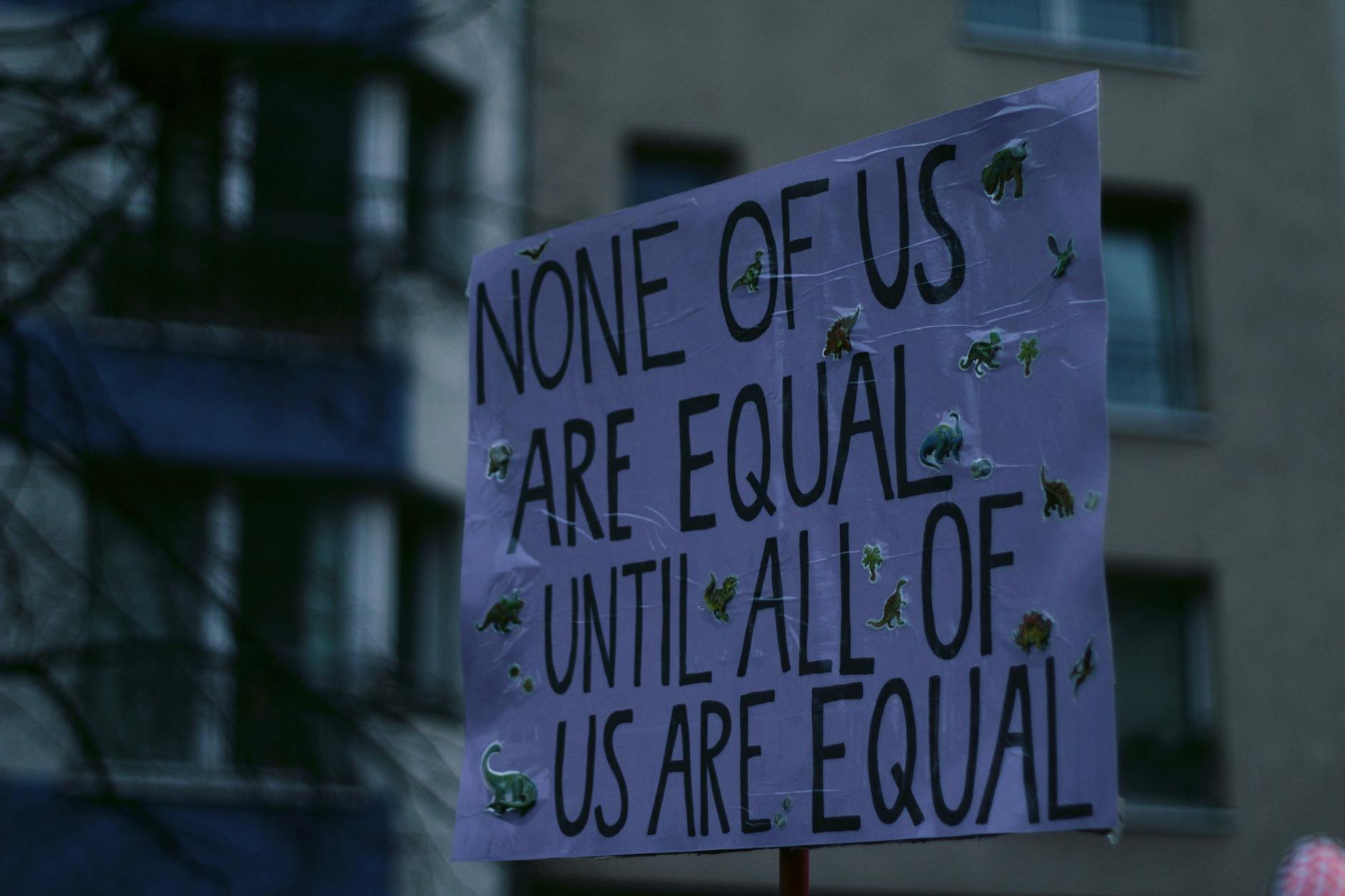
Give Us Justice

Sabbath Day Thoughts — “Give Us Justice” Luke 18:1-8

Americans are fascinated with the world of “Law and Order.” We’ve been watching it on television since 1990. The series follows crime as it moves from law enforcement, where tough-minded detectives make their case, to the courtroom, where idealistic district attorneys present the evidence to judge and jury. With stories that are often ripped from the headlines, the show has been television gold, spawning a number of spin-offs over the years: “Law and Order: Criminal Intent,” “Law and Order: Trial by Jury,” “Law and Order: LA,” “Law and Order: Special Victims Unit,” and “Law and Order: Organized Crime.” Even when the original series was canceled after 20 years in 2010, we wanted more. It returned from beyond the television grave in 2022 and can still be watched on Thursday nights at 9pm. We like it when justice is served.

The Bible tells us that God is our ultimate judge, and one day, we will all face judgment. The Prophet Isaiah instructed, “the Lord is our judge, the Lord is our lawgiver, the Lord is our king; He will save us” (Is. 33:22). As Judge, God has particular interest in justice for the most vulnerable of God’s people. In fact, in reading the Hebrew Bible, you’ll find that God mentions the need to ensure justice for the widow, orphan, and resident alien about ninety times. Without a male head of household to protect them in those deeply patriarchal times, widows, orphans, and guest workers had to find justice in the courts.

Scripture also tells us that God appointed judges as earthly agents of God’s justice. Indeed, long before there were kings in Israel, there were judges, who played a special role in ensuring the peace and wholeness of the community. Judges were chosen from among the people and were known for their wisdom, compassion, and deep understanding of God’s law. The first judges included both women and men.

Justice in the ancient Near East was dispensed at the city gate, before the eyes of the community. In Jesus’ day, you couldn’t enter a city without walking by both the Seat of Judgment and the judge. If you felt a merchant had cheated you with false weights and measure or if a family member had deprived you of a rightful inheritance, then you took it to the Seat of Judgment and trusted that the judge would bring justice and restore peace to the community.

This traditional system of judgment is the setting for Jesus’ story of the persistent widow and the unjust judge. Jesus didn’t give his listeners the back story to his widow, but we can trust that she was mourning the death of her husband and that she had suffered an injustice. Without inheritance rights to protect her, we presume that her late husband’s nearest male relative had helped himself to all that his kinsman left behind and failed to honor his obligation to care well for the widow. So, she turned to the legal system to right the wrong that had been perpetrated against her.

There’s only one problem in Jesus’ story. The judge is corrupt. In a tradition which teaches that the fear of the Lord is the beginning of wisdom, this man doesn’t fear God. In a community where your good reputation is more valuable than gold, this man doesn’t care what his neighbors think. Most likely, he was what was popularly called a “Robber Judge” in first-century Israel; someone who had bought his office by greasing the palm of Herod or a Roman overlord, who dispensed favorable judgments to the highest bidder and would reportedly “pervert justice for a dish of meat.” Every morning, the poor widow in Jesus’ story would go to the city gate and wait at the seat of judgment, but she couldn’t even get on the docket.

The least explored aspect of this parable is the role of the community. I’ve never heard a sermon preached on it or read a scholarly article about it. The action of Jesus’ parable unfolds in the eyes of the community. Remember, justice was dispensed at the city gate. Everyone in Jesus’ fictional community would have known the widow, heard her case, and seen her persistence—day after day crying out for justice. Everyone in Jesus’ community would have known the teachings of the Torah, especially God’s expectation that the widow, orphan, and stranger be guaranteed justice and mercy. But the community in Jesus’ story is silent. No one stands with the widow. No one pleads her case. No patriarch takes her into his household and demands justice on her behalf. Jesus described a woman alone in the struggle, who eventually was granted the just ruling she deserved, not because she changed the mind of a corrupt judge, but because she simply wore him down.

Perhaps when Jesus told his story, he was thinking about his own, fast-approaching day in court. Soon Jesus and his friends would be on their way to Jerusalem for the Passover. Soon Jesus would stand before the judgment seat of Pilate. Soon, Pilate would ask the crowd to cry out in support of Jesus, to call for his release. No one did. Instead, they shouted, “Away with this man! Send out Barabbas for us, but this man, crucify him!”

In Jesus’ parable, no one advocated for the widow’s justice, and when Jesus stood before the seat of judgment, the crowd cried out for an injustice. When the parable and Jesus’ experience are held in tension, we see the power of community to ensure or deny justice. God may be the ultimate judge. Our courts may serve as earthly advocates to arbitrate and rule upon the law. But we all have an indispensable role to play in ensuring that justice prevails.

On March 9, the United States was added to the Global Human Rights Watchlist over declining civil liberties. The watchlist is maintained by CIVICUS—a global alliance and network of civil society groups, including Amnesty International, that advocates for greater citizen action in areas where civil liberties are limited. The watchdog group notes whether nations are open, narrowed, obstructed, repressed, or closed, with regard to civil rights. “Open” is the highest ranking, meaning all people are able to practice liberties such as free speech, while the lowest ranking is, of course, “closed.” We have long cherished our status as an open nation, but last month, we were downgraded to narrowed. In justifying that change, CIVICUS cites the cut of more than 90% of our foreign aid contracts; the elimination of diversity, equity, and inclusion programs; and the denial of due process for immigrants whose legal status is questionable. Since that March ninth report, we’ve seen further challenges to justice, like detention and deportation of those who are in the United States legally, threats to our freedom of assembly, threats to the freedom of the press, the rollback of legal protections for our LGBTQ+ neighbors, efforts to buy votes, and more. The widow is crying out against the unjust judges of our world, and she still can’t get her day in court.

If we page ahead in scripture to the Book of Revelation (Rev. 20:11-12), John of Patmos gives us an unsettling vision of the last days. Seated upon a great white throne is our ultimate judge—and it is Jesus. All humanity stands before the throne and the Book of Life is opened. One by one, we all face judgment according to our deeds.

When Jesus wrapped up his parable of the persistent widow, he alluded to this coming Day of Judgment. He said, “And yet, when the Son of Man comes, will he find faith upon the earth?” It’s a question about our belief and trust in him. But it is also a question about our faithfulness to his ways and our commitment to his justice. We all have an indispensable role to play in ensuring that justice prevails. We know what the Lord requires of us, but will we keep the faith? Will we advocate for the vulnerable? Or, will we stand by as justice is perverted and our vulnerable neighbors struggle alone?

The jury is out, my friends. We can stand up for justice, or we can turn our heads, sit back, and watch a fictionalized “Law and Order” version of it on television every Thursday night at nine. It’s up to us. Amen.

Resources

Solcyré Burga. “U.S. Added to Global Human Rights Watchlist Over Declining Civil Liberties” in Time Magazine, March 13, 2025. Accessed online at https://time.com/7266334/us-human-rights-watchlist-civil-liberties/

Miguel A. De la Torre. “Theological Perspective on Luke 18:1-8” in Feasting on the Gospels: Luke, vol. 2. Westminster John Knox Press, 2014.

Gregory Alan Robbins. “Exegetical Perspective on Luke 18:1-8” in Feasting on the Gospels: Luke, vol. 2. Westminster John Knox Press, 2014.

J.S. Randolph Harris. “Homiletical Perspective on Luke 18:1-8” in Feasting on the Gospels: Luke, vol. 2. Westminster John Knox Press, 2014.

Tembah J. Mafico. “Judge, Judging” in The Anchor Bible Dictionary, vol. 3, H-J. Doubleday, 1992.


Luke 18:1-8

Then Jesus told them a parable about their need to pray always and not to lose heart. 2 He said, “In a certain city there was a judge who neither feared God nor had respect for people. 3 In that city there was a widow who kept coming to him and saying, ‘Grant me justice against my accuser.’ 4 For a while he refused, but later he said to himself, ‘Though I have no fear of God and no respect for anyone, 5 yet because this widow keeps bothering me, I will grant her justice, so that she may not wear me out by continually coming.’” 6 And the Lord said, “Listen to what the unjust judge says. 7 And will not God grant justice to his chosen ones who cry to him day and night? Will he delay long in helping them? 8 I tell you, he will quickly grant justice to them. And yet, when the Son of Man comes, will he find faith on earth?”


Photo by Life Matters on Pexels.com

To Carry the Gospel of Freedom

Sabbath Day Thoughts — “To Carry the Gospel of Freedom” Luke 4:16-21

On Easter Sunday 1963, Martin Luther King sat in a jail cell in Birmingham, Alabama. Dr. King had come to Birmingham at the request of the local Black community to call attention to their experience of injustice. Birmingham was known as the most segregated city in the nation. Local businesses blatantly displayed “whites only” signs, despite negotiations the prior summer to bring change. African Americans routinely experienced police brutality and injustice. The Commissioner of Public Safety was Theophilus Eugene “Bull” Connor, a white supremacist and ardent segregationist. Birmingham had even earned the nickname “Bombingham” because it had more unsolved bombings of Black churches and Black homes than any other community in the nation.

Dr. King didn’t preach a sermon that Easter Sunday. Instead, he wrote a public letter addressed to eight Alabama clergymen, who had published an appeal to the “Negroes” of their state, urging them to wait for change. With time on his hands and only God for a companion in his prison cell, Dr. King began to scribble his letter in the margins of the newspaper, he continued on scraps of paper smuggled to him by another Black inmate, and when he was finally able to see his attorney, he requisitioned his lawyer’s legal pad. The Letter from Birmingham Jail was a blueprint for non-violent direct action and a forceful defense of King’s protest campaign. It is now regarded as one of the greatest texts of the American civil rights movement, and it continues to inspire those who practice peaceful resistance in pursuit of justice.

Accused by white clergy of being an outside agitator come to Alabama to sow discontent, Dr. King argued in his letter that he had come to Birmingham because he was “compelled to carry the gospel of freedom,” just as Jesus carried the gospel from Nazareth to Jerusalem and the apostles carried the gospel to every corner of the Roman Empire. King was keenly aware of the interrelatedness of all communities, saying, “Injustice anywhere is a threat to justice everywhere,” whatever affects one directly touches us all indirectly. He could not turn his back on the people of Birmingham any more than Jesus could fail to confront the oppressive powers of his day.

Our reading from Luke’s gospel grants us a glimpse of Jesus in the early days of his ministry, sharing his gospel of freedom with his hometown crowd in Nazareth. Unrolling the scroll of Isaiah, Jesus found the spot where the prophet had written,

“The Spirit of the Lord is upon me,

because he has anointed me

to bring good news to the poor.

He has sent me to proclaim release to the captives

and recovery of sight to the blind,

to set free those who are oppressed.”

Next, Jesus sat down, as any first century rabbi would, to interpret the words of the Prophet Isaiah for the people of Nazareth.

When I’m teaching confirmation students about mission, we read this passage. I ask the learners, “Why this reading from Isaiah 61?” There are, after all, sixty-six chapters in Isaiah’s work, but Jesus deliberately chose to read this one. I suggest to the kids that this is Jesus’ mission statement. There in his hometown as he launched his public ministry, Jesus wanted people to know who he truly was and what God called him to do. In fact, as we continue to read Luke’s gospel, its one long revelation of how Jesus would pursue his mission by identifying with the poor and lowly, feeding the hungry, healing every sort of infirmity, setting folks free from the burdens of sin and death, confronting the oppressive powers of Temple and empire, and proving God’s great love for all people on the cross. Jesus saw his mission as a holy purpose for all people. In his parting words to his friends, he exhorted them to take his good news to all nations, so that God’s love and freedom might flourish among all people.

The great 16th century Protestant Reformer Martin Luther taught that the good news is often bad news (kakevangelium) before it is good news. In other words, Jesus’ mission to bring good news to the poor, presumes the reality of poverty. And the desire to bring release to captives points to people who are unfairly treated in the court of justice. Recovery of sight to the blind reveals the failures and shortcomings of traditional healing and the costliness that puts good medical care beyond the grasp of some. Setting the oppressed free presumes the reality of oppressors, the few who exploit power to dominate and control the vulnerable. The good news is bad news. It unmasks the sin of our world as we know it. And yet, even as we face the bad news head on, we trust that God is with us in the pursuit of love and justice, and with God, victory is certain. The good news is bad news before it is good news.

In his Letter from Birmingham Jail, Dr. King expressed his disappointment not only with the clergy who urged Black Americans to wait for their oppressors to grant them liberation, but also with the “white church.” Rev. King had anticipated that his fellow Christians would be on the frontlines with their Black neighbors in pursuit of good news to the poor, release for captives, and freedom from oppression. He lamented white churches that were more devoted to order than justice, who felt entitled to paternalistically set a time table for someone else’s freedom. King cautioned that, one day, society would need to repent of the appalling silence of “good people” as much as it did of the hateful words and actions of “bad” people. King’s peaceful demonstration in Birmingham had not created the hurtful, harmful division of Black and white. He had merely brought to the surface tensions that had long existed in Birmingham and the nation. King’s gospel of freedom had to be bad news for the status quo before it could be good news for all God’s people.

Jesus’ sermon in Nazareth and Dr. King’s Letter from Birmingham Jail continue to invite faithful people to join our purpose to God’s purpose and carry the gospel of freedom into the world. It’s a particular challenge for the white mainline church because it confronts us with the sins of our society and may even point to how we have unwittingly been complicit. One of the ways that we carry that challenging gospel of freedom is through the Presbyterian Peacemaking Program, which seeks wholeness for the global community by addressing poverty, violence, racism, climate change, and the crisis in immigration. Let me tell you about two innovative ministries that our donations have supported.

The first initiative is Loads of Love, which seeks to fulfill Jesus’ purpose of good news to the poor. It began with a woman named Linda, who was living with stage-4 cancer when she confessed to her pastor that she could no longer handle the laundry—the sheer volume of blankets and bedding caused by her illness. Financially strapped and already living on the edge, the expense of using coin-operated washers and driers was driving Linda’s family deeper into poverty. Linda’s predicament prompted her Presbytery to launch Loads of Love, which teams struggling families with local volunteers who can help. Rev. Carol Vickery says that her church’s laundry outreach has put them in touch with a world whose hardships they were unaware of. It comes as a shock (bad news) for people to realize how costly doing laundry can be and to know that people can’t use their SNAP benefits to buy detergent, cleaning supplies, or personal hygiene items. Loads of Love brings the good news of caring and dignity to struggling neighbors.

A second initiative is the vision of Joseph Russ, a Presbyterian Mission Worker in El Salvador, who has been instrumental in establishing a network of more than 50 churches, governmental agencies, and non-profits in the US and Central America that are seeking to alleviate the concerns of the immigration crisis. In 2014 when Russ went to El Salvador as a young adult, nearly 70,000 unaccompanied minors were turned away at the US-Mexico border. Many of those kids ended up in El Salvador, which was unable to handle the humanitarian crisis (bad news). Joseph and his partners in the International Red Cross now run a shelter program for internally displaced people and returnees with no place to go. The shelter reduces people’s exposure to violence and poverty and helps them find stability amid difficult and dangerous situations. The organization also seeks to address the root causes of poverty and violence in Central America that precipitate mass migration.

Our gifts to Presbyterian Peacemaking are one of the ways that we join our mission to Jesus’ and further the vision he set forth in that first sermon in Nazareth.

Four months after Dr. King wrote his Letter from Birmingham Jail, he was joined by 250,000 supporters in the March on Washington for Jobs and Freedom. Dr. King spoke last at the rally, his voice faltering and his way unclear until Ralph Abernethy shouted out, “Martin tell them about the dream.” The eloquent words that followed have long inspired us to pursue the beautiful kingdom where people of all races may come to the table of peace, freedom, and opportunity. After the march, the speakers travelled to the White House for a brief discussion with President Kennedy, who felt the day was a victory for him as well—bolstering the chances for the passage of his civil rights bill. The following February, The Civil Rights Act of 1964 was made the law of the land, despite the President’s assassination in November and a 72-day Senate filibuster. The act prohibited discrimination based on race, color, religion, sex, or national origin. It ended segregation in public schools, public accommodations, and federally funded programs. It ended unequal application of voter registration requirements and put an end to Jim Crow laws. The act also established the Equal Employment Opportunity Commission (EEOC).

I suspect that if Jesus and Dr. King were with us this morning, they would tell us that the gospel of freedom remains but a dream for some, especially in all the hurting and broken places of our nation and our world where faithful people prefer order to justice and the bad news prevails. May we dare to go forth with the gospel of freedom.

Resources

Scott O’Neill. “New PC(USA) mission network launches this week” in Presbyterian News Service, March 18, 2024. Accessed online at https://www.pcusa.org/news-storytelling/news/new-pcusa-mission-network-launches-week

Presbyterian Peacemaking. PEACE & GLOBAL WITNESS Leaders Guide, 2024. Accessed online at https://pcusa.org/sites/default/files/2024-11/PGW24%20Leaders%20Guide.pdf

David S. Jacobsen. “Commentary on John 4:16-21” in Preaching This Week, Jan. 27, 2019. Accessed online at https://www.workingpreacher.org/commentaries/revised-common-lectionary/third-sunday-after-epiphany-3/commentary-on-luke-414-21-4

Karoline Lewis. “Commentary on John 4:16-21” in Preaching This Week, Jan. 27, 2013. Accessed online at https://www.workingpreacher.org/commentaries/revised-common-lectionary/third-sunday-after-epiphany-3/commentary-on-luke-414-21

Martin Luther King, Jr. Why We Can’t Wait. New York: Penguin Putnam, 1963, 1964.


Luke 4:14-21

14 Then Jesus, in the power of the Spirit, returned to Galilee, and a report about him spread through all the surrounding region. 15 He began to teach in their synagogues and was praised by everyone. 16 When he came to Nazareth, where he had been brought up, he went to the synagogue on the Sabbath day, as was his custom. He stood up to read, 17 and the scroll of the prophet Isaiah was given to him. He unrolled the scroll and found the place where it was written:

18 “The Spirit of the Lord is upon me,
because he has anointed me
to bring good news to the poor.
He has sent me to proclaim release to the captives
and recovery of sight to the blind,
to set free those who are oppressed,
19 to proclaim the year of the Lord’s favor.”

20 And he rolled up the scroll, gave it back to the attendant, and sat down. The eyes of all in the synagogue were fixed on him. 21 Then he began to say to them, “Today this scripture has been fulfilled in your hearing.”


Image source: https://www.cnn.com/2013/04/16/us/king-birmingham-jail-letter-anniversary/index.html

Resist!

Sabbath Day Thoughts — “Resist!” Exodus 1:8-2:10

The world needs advocates, people who will dare to resist the powers and work for change.

In 1978, Lois Gibbs was a Niagara Falls housewife. She had two young children with unusual health problems. As Lois talked to neighbors, she learned that many of them were similarly plagued with chronic health issues, including reproductive problems, birth defects, chromosome abnormalities, and leukemia. The land on which their community had been built was the site of an old canal, Love Canal, which the Hooker Chemical Company had used as a dumping ground for chemicals. After the site was filled in, Hooker Chemical gave it to the growing city of Niagara Falls, which allowed housing to be built there. When state officials detected the leakage of toxic underground chemicals into the basements of local homes, Lois Gibbs wondered, Could the illness plaguing her daughters be linked to the leaking chemicals? In need of answers, Lois soon found that no one wanted to admit the truth and there were no watchdog agencies or consumer resources that she could turn to for help.

On May 3, 1980, 13-year-old Cari Lightner was walking to church along a quiet road. She was meeting friends for a carnival but never made it. A car swerved out of control and struck and killed the girl. Police later arrested Clarence Busch in connection with the death. Busch had a long record of arrests for intoxication. In fact, he had been arrested on another hit-and-run drunk-driving charge less than a week earlier. Cari’s grieving mother, Candy Lightner, learned from police that drunk driving was rarely prosecuted harshly, and that the man who killed her daughter was unlikely to spend significant time behind bars. The infuriated Mom decided to take action against what she later called “the only socially accepted form of homicide.”

In 2008, when Malala Yousufzai was eleven years old, the Taliban took control of her town in Pakistan’s Swat Valley. The Islamic extremists banned many things: television, music, and education for girls. Malala kept a diary which recorded the events and spoke out against the terrorist regime. When her diary was published by the BBC, the Taliban soon responded with death threats. In 2009, a Taliban gunman boarded the bus that Malala was riding and shot her in the head. She survived and was evacuated to Birmingham England for months of surgeries and rehabilitation. Malala and her family had a new home and a new life in the UK with unlimited educational opportunity. But Malala kept thinking about those other girls, her friends back in the Swat Valley—and in countless places around the world—where education for girls and women was outlawed.

The world needs advocates who will resist the powers and work for change.

Our reading from Exodus grants us a glimpse of two humble women who would outsmart their king and head off genocide. They faced a formidable opponent: Pharaoh, the most powerful man in the Ancient Near East. He ruled over a Mediterranean empire that stretched from Libya to Sudan to Syria at a time when Egypt was at the pinnacle of its economic, military, and cultural power. Pharoah made laws, waged wars, collected taxes, oversaw the land, and dispensed justice. As the Empire’s religious leader, Pharaoh was the divine intermediary between the pantheon of Egyptian gods and the people, a living god on earth who, upon his death, would become fully divine.

When Shiphrah and Puah were summoned to an audience with Pharoah, they knelt before a man who never heard “no.” Even though their calling as midwives made them guardians of life, Pharaoh demanded that they become agents of death. When attending the birth of Hebrew women, the midwives were ordered to murder every boy baby.

Can we imagine the fear, powerlessness, and terror that the midwives must have felt? They had no Midwives’ Union, no ACLU, no powerful political allies who could help them speak back to power. If change was going to happen, they would have to do it themselves.

Shiphrah and Puah were afraid of Pharaoh, but they feared God. Their reverence and devotion to Yahweh gave them the courage to resist.  The two midwives engaged in what Dennis Olson of Princeton Seminary has called “the Bible’s first act of civil disobedience and non-violent resistance.” They went about their work. They coached those laboring mothers through painful contractions, tiresome transitions, and big pushes. They caught those newborn infants, cleared their airways, wiped them clean, and pressed them into their mother’s arms. They welcomed life. And when Pharaoh called them out on the ongoing baby boom among the Hebrew slaves, Shiphrah and Puah covered their tracks by appealing to Pharaoh’s prejudice. “Those Hebrew women aren’t like you refined Egyptians. They’re like animals. They push out their babies long before we arrive to do your bidding.” Those midwives resisted, creating the space for Moses to be born, Moses, who would one day oppose Pharaoh and lead the Israelites out of Egypt to freedom.

The world needs advocates who will dare to resist the powers and work for change.

Back in 1978, Lois Gibbs organized her neighbors to form the Love Canal Homeowners Association. She led her community in a lengthy battle against the local, state, and federal governments. After years of struggle, more than 800 families were eventually evacuated, and cleanup of Love Canal began. Her efforts led to the creation of the US Environmental Protection Agency’s “Superfund,” used to locate and clean up toxic sites throughout the US. In response to her success at Love Canal, Gibbs received over 3,000 letters from Americans everywhere, requesting information on how they could solve toxic waste problems in their area. Lois founded the Center for Health, Environment and Justice, a grassroots environmental crisis center that has trained thousands of community groups around the nation to protect neighborhoods from exposure to hazardous wastes. Lois Gibbs was awarded the Goldman Environmental Prize in 1990 which honors grassroots environmental heroes who take significant action for our planet. 45 years after Love Canal, Lois is still resisting.

Candy Lightner, the bereaved mother of that 13-year-old child killed by a drunk driver, stood up to the injustice of a world that turned a blind eye to drunk driving. She founded MADD, Mothers Against Drunk Driving. She began lobbying California’s governor, Jerry Brown, to set up a state investigative task force. In 1981, California passed a law imposing minimum fines of $375 for drunk drivers and mandatory imprisonment of up to four years for repeat offenders. President Ronald Reagan later asked Candy to serve on the National Commission on Drunk Driving. In July 1984, she stood next to Reagan as he signed a law reducing federal highway grants to any state that failed to raise its drinking age to 21. By the following year, all 50 states had tightened their drunk-driving laws. By 2000, the 20th anniversary of MADD’s founding, alcohol-related fatalities had dropped nationally by some 40 percent, and states with the toughest drunk-driving laws were beginning to treat alcohol-related fatalities as murder.

On Malala Yousufzai’s 16th birthday in 2013, she spoke in support of education for girls at the United Nations. Later that year, she published her first book, an autobiography entitled I Am Malala: The Girl Who Stood Up for Education and Was Shot by the Taliban. In 2014, through her non-profit Malala Fund, she began traveling the world and advocating for girls in Jordan, Syria, Kenya, Nigeria and beyond. At age 17, she became the youngest person to receive the Nobel Peace Prize. In her acceptance speech, Malala said, “This award is not just for me. It is for those forgotten children who want education. It is for those frightened children who want peace. It is for those voiceless children who want change.” Time Magazine has named her one of the 100 most influential voices in the world. She remains a staunch advocate for the power of education and for girls to become agents of change in their communities.

The world needs advocates who will resist the powers, get into good trouble, and work for change, holy change, change that will nudge this hurting world a little closer to God’s Kingdom. Could it be you?

Resources:

Kimberly D. Russaw. “Commentary on Exodus 1:8-2:10” in Preaching This Week, August 27, 2023. Accessed online at workingpreacher.org.

Karla Suomala. “Commentary on Exodus 1:8-2:10” in Preaching This Week, August 27, 2017. Accessed online at workingpreacher.org.

Dennis Olson. “Commentary on Exodus 1:8-2:10” in Preaching This Week, August 24, 2008. Accessed online at workingpreacher.org.

Christopher Eames. “Who Was the Pharaoh of the Exodus?” in Let the Stones Speak, March-April 2023. Accessed online at https://armstronginstitute.org/882-who-was-the-pharaoh-of-the-exodus

History editors. “MADD founder’s daughter killed by drunk driver,” in History, April 30, 2021. Accessed online at https://www.history.com/this-day-in-history/madd-founders-daughter-killed-by-drunk-driver

The Goldman Environmental Prize. “Lois Gibbs, 1990.” Accessed online at  https://www.goldmanprize.org/recipient/lois-gibbs/#recipient-bio

–. Malala Yousafzai – Biographical. NobelPrize.org. Nobel Prize Outreach AB 2023. Sat. 26 Aug 2023. <https://www.nobelprize.org/prizes/peace/2014/yousafzai/biographical/&gt;


Exodus 1:8-2:10

8Now a new king arose over Egypt, who did not know Joseph. 9He said to his people, “Look, the Israelite people are more numerous and more powerful than we. 10Come, let us deal shrewdly with them, or they will increase and, in the event of war, join our enemies and fight against us and escape from the land.” 11Therefore they set taskmasters over them to oppress them with forced labor. They built supply cities, Pithom and Rameses, for Pharaoh. 12But the more they were oppressed, the more they multiplied and spread, so that the Egyptians came to dread the Israelites. 13The Egyptians became ruthless in imposing tasks on the Israelites, 14and made their lives bitter with hard service in mortar and brick and in every kind of field labor. They were ruthless in all the tasks that they imposed on them.

15The king of Egypt said to the Hebrew midwives, one of whom was named Shiphrah and the other Puah, 16“When you act as midwives to the Hebrew women, and see them on the birthstool, if it is a boy, kill him; but if it is a girl, she shall live.” 17But the midwives feared God; they did not do as the king of Egypt commanded them, but they let the boys live. 18So the king of Egypt summoned the midwives and said to them, “Why have you done this, and allowed the boys to live?” 19The midwives said to Pharaoh, “Because the Hebrew women are not like the Egyptian women; for they are vigorous and give birth before the midwife comes to them.” 20So God dealt well with the midwives; and the people multiplied and became very strong. 21And because the midwives feared God, he gave them families. 22Then Pharaoh commanded all his people, “Every boy that is born to the Hebrews you shall throw into the Nile, but you shall let every girl live.”

2Now a man from the house of Levi went and married a Levite woman. 2The woman conceived and bore a son; and when she saw that he was a fine baby, she hid him three months. 3When she could hide him no longer she got a papyrus basket for him, and plastered it with bitumen and pitch; she put the child in it and placed it among the reeds on the bank of the river. 4His sister stood at a distance, to see what would happen to him.

5The daughter of Pharaoh came down to bathe at the river, while her attendants walked beside the river. She saw the basket among the reeds and sent her maid to bring it. 6When she opened it, she saw the child. He was crying, and she took pity on him, “This must be one of the Hebrews’ children,” she said. 7Then his sister said to Pharaoh’s daughter, “Shall I go and get you a nurse from the Hebrew women to nurse the child for you?” 8Pharaoh’s daughter said to her, “Yes.” So the girl went and called the child’s mother. 9Pharaoh’s daughter said to her, “Take this child and nurse it for me, and I will give you your wages.” So the woman took the child and nursed it. 10When the child grew up, she brought him to Pharaoh’s daughter, and she took him as her son. She named him Moses, “because,” she said, “I drew him out of the water.”


Photo by Sides Imagery on Pexels.com