Famished

Sabbath Day Thoughts — “Famished” Luke 4:1-13

On February 28, our Muslim neighbors around the world began Ramadan, a month of fasting, prayer, and reflection. Fasting is one of the five essential practices (pillars) of Islam. During Ramadan, adults of sound health fast daily from sun up until sunset—no food or drink—and their early morning and after dark meals are simple. Ramadan reminds them of the needs of hungry neighbors and our personal dependence upon God.

In my last church, my senior pastor Michael Winters and I were a part of an interfaith ministry group with the local reformed rabbi and the Muslim Imam. Each year at the end of Ramadan, our faith communities would gather for Eid, a celebratory feast, kind of like the ultimate, most delicious potluck that you can imagine. Each year, my colleague Michael, the Imam, and the rabbi would give a little talk at the feast, briefly teaching about a spiritual practice. I’ll never forget the meeting when they decided to talk about fasting in their respective churches. Michael looked mildly alarmed.

Later, in the car on the way back to the church, I turned to Michael.

“Fasting?”

“Not high on the list for Presbyterians,” he glumly replied.

I thought about my time as a Presbyterian, from young adult to seminarian to clergy person. Never once had a congregation that I served ever discussed, let alone practiced, fasting. I commiserated with Michael, “Ugh. I’m guessing that you got nothing. Am I right?”

Shaking his head, he said, “Tell me about it.”

As the season of Lent begins, our gospel reading takes us to the wilderness with Jesus. According to Luke, no sooner had Jesus been baptized than the Holy Spirit swept him into the Judean desert in preparation for his ministry. There, Jesus spent forty days fasting and praying to seek insight, wisdom, and guidance from his heavenly Father. It was a spiritual journey that left him famished.

Thinking that Jesus’ long fast would leave him vulnerable to temptation, the evil one showed up to put the Lord to the test. Jesus was invited to use his power in self-serving ways: first, to relieve his overwhelming hunger by transforming stones to loaves of bread, next to gain worldly authority by changing his allegiance, and finally to put God to the test with a death-defying leap. Each temptation was deftly defeated by Jesus with a short but sweet quote from scripture. Clearly, Jesus’ time of prayer and fasting had equipped him to meet the challenges that were to come.

When Jesus fasted for those forty days, he was part of a long tradition of fasting observed by his ancestors. Leviticus 28 required the Hebrew people to fast each year on the Day of Atonement to seek God’s forgiveness for sin. Also, in times of national crisis, Israel’s kings called for a day of fasting and prayer. For example, when a large army from Edom threatened to invade Judah, King Jehosophat and his people fasted and prayed to avert the catastrophe. The Israelites also refrained from food and drink to deepen their prayer and draw near to God, like Moses—while on the mountaintop with God, he fasted for forty days.

Jesus expected his followers to fast and gave them instructions that suggested some people made a big, self-aggrandizing show of their pious restraint when it came to food. Jesus said, “Whenever you fast, do not look somber, like the hypocrites, for they mark their faces to show others that they are fasting. Truly I tell you, they have received their reward. But when you fast, put oil on your head and wash your face, so that your fasting may be seen—not by others—but by your heavenly Father….” First century Jews fasted twice weekly on Mondays and Thursdays. That means they refrained from food on those days until the ninth hour—three o-clock in the afternoon. As Jesus’ followers took the gospel out into the world, fasting went with them. When the Apostle Paul and his home church in Antioch prepared for the Gentile mission, they did so with fasting and prayer.

Jesus knew that our deepest, most existential, hunger is for God. We look for poor substitutes, trying to fill our lives with food, social media, an over-commitment to work, a passion for politics, shopping until we drop, addictions. You name it. The practice of fasting makes room within us for God. You might even say that fasting is a soul feast, an intentional time to rest in God and meet that deep hunger we have for the sacred. Augustine taught that our hearts are always restless until they find their rest in God alone.

Between the sixth and eighth centuries the role of fasting expanded in Christianity. In addition to fasting until the ninth hour twice weekly, Christians were expected to similarly fast for the forty days of Lent, for three days before the Festival of Ascension, one day every month (except in July and August), on Good Friday, and the day before Christmas, Epiphany, Easter, and Pentecost. If you add all that up, Christians engaged in some form of fasting about 140 days each year.

So how did we as Protestants get from fasting for 140 days to me and Michael Winters feeling like we had nothing to say as we joined our Muslim and Jewish neighbors for Eid? We can blame it on the Reformation. By the 16th century, fasting had lost its spiritual significance. Instead of fasting to draw near to God in prayer, or say “no” to the flesh, or seek divine help in times of crisis, our ancestors were fasting because they considered it a requirement for getting into heaven. John Calvin and other Reformers said that smacked of works righteousness, as if we could manipulate God into opening the pearly gates. This would never do.

In his effort to rethink fasting, Calvin taught that we should think about time, quantity, and quality. Christians should fast at self-chosen times for a prescribed period, like a day or a week; and fasting should always be accompanied by prayer and confession. Fasting did not mean total abstinence from food but to eat sparingly and content ourselves with humble fare. No “dainties” as Calvin called them. In Calvin’s church in Geneva, a simple fast was expected before partaking of the Lord’s Supper, before baptism, and before being ordained to a ministry of the church.

Calvin’s ideas seem reasonable, but when we are left to our own devices to determine our time, quantity, and quality of restraint from food, we opt out. Most of us do not consider fasting to be a core practice of the life of faith. So, how on this first Sunday in Lent, are we to reclaim the ancient practice of fasting in ways that are meaningful and beneficial? And do we really want to?

The late author and editor Harvey Smit suggested that fasting can be a powerful reminder that we do not live by bread alone. In this world where ego is king, fasting reminds us of our utter dependence upon God. Fasting also places us in solidarity with the world’s hungry people—malnourished children in Afghanistan, the starving women and children of Yemen, and working-class families right here in the United States who feel the pinch of inflation and skip meals so that their children can eat. Smit also argued that fasting is useful because it teaches us to postpone gratification. In a world where we want it and we want it now, fasting teaches us to say no to the flesh, no to the selfish impulse, no to the desire for more, more, more. And we shouldn’t forget that fasting functions much as it has for eons: to focus our attention and our prayers upon God, trusting that Jesus, who fasted in the wilderness, is with us.

What might Presbyterian fasting look like? We could try substituting prayer time for a meal, or we could consider simplifying our diets, only having one substantial meal a day and two small snacks that are accompanied by prayer or scripture reading. We could follow the example of the early church and pick a day to fast until the ninth hour (three o’clock). Instead of working through the breakfast and lunch that we miss, we could read a devotional book, sing hymns, play spiritual music, or listen to a sermon. Although fasting is not prescribed for us for Lent, a day of fasting during Lent could serve to focus our attention on Jesus and his journey to the cross. As we ponder the Lord’s words, humility, and self-sacrifice, we draw near to God with gratitude for all that God has done for us.

If the thought of refraining from food makes your blood sugar drop and your knees feel weak, you’ll be relieved that Martin Lloyd-Jones, one of the most influential Calvinist preachers of the twentieth century, taught that, “fasting should really be made to include abstinence from anything. . .for the sake of some special spiritual purpose.” That opens us to a world of possibilities. Could we fast from social media? Instead of doom scrolling, we could try a time of prayer. Could we turn off the television and spend the evening in meditation and divine reading? Could we step back from sweets? Alcohol? Indulgent purchases? Could we then donate the money we save to One Great Hour of Sharing or a favorite charitable concern? The possibilities are truly limitless and up to us.

Back in Morton Grove all those year’s ago, my friend Michael cobbled together a talk on Presbyterian fasting. He spoke last after the Imam told us all about Ramadan and the rabbi impressed us with Yom Kippur and weekly fasts. Later, I took a seat next to Michael after helping myself to a second (or was it third?) plate of tasty treats from the potluck buffet.

“How are you?” I asked my friend. I looked down at his plate, which was just as full as mine.

Michael looked around the room at Jewish, Christian, and Muslim neighbors chatting, eating, and comparing recipes. He smiled, “I may not be an expert in fasting, but this,” he gestured to the beautiful interfaith fellowship and overflowing plates, “this looks like the beautiful feast in the Kingdom of God.”

He couldn’t be more right.

Resources:

William H. Shea. “Fast, Fasting” in The Anchor Bible Dictionary, vol. 2, D-G. Doubleday, 1992, pp. 773-776.

David S. Jacobsen. “Commentary on Luke 4:1-13” in Preaching This Week, March 10, 2019. Accessed online at https://www.workingpreacher.org/commentaries/revised-common-lectionary/first-sunday-in-lent-3/commentary-on-luke-41-13-4

Richard W. Swanson. “Commentary on Luke 4:1-13” in Preaching This Week, March 9, 2025. Accessed online at https://www.workingpreacher.org/commentaries/revised-common-lectionary/first-sunday-in-lent-3/commentary-on-luke-41-13-6

Thomas A. Tarrantson. “The Place of Fasting in the Christian Life” in Knowing and Doing, Knowing and Doing, Summer 2018.

James A. Strong and John McClintock. “Fasting in the Christian Church” in The Encyclopedia of Biblical, Theological, and Ecclesial Literature. New York: Harper Bros, 1880.

David Mathis. “Fasting for Beginners” in Desiring God, August 26, 2015. Accessed online at https://www.desiringgod.org/articles/fasting-for-beginners

Harvey Albert Smit. “Fasting Guidelines for Reformed Christians” in Reformed Worship, December 1987. Accessed online at https://www.reformedworship.org/article/december-1987/fasting-guidelines-reformed-christians


Luke 4:1-13

Jesus, full of the Holy Spirit, returned from the Jordan and was led by the Spirit in the wilderness, where for forty days he was tested by the devil. He ate nothing at all during those days, and when they were over he was famished. The devil said to him, “If you are the Son of God, command this stone to become a loaf of bread.” Jesus answered him, “It is written, ‘One does not live by bread alone.’ ”

Then the devil led him up and showed him in an instant all the kingdoms of the world. And the devil said to him, “To you I will give all this authority and their glory, for it has been given over to me, and I give it to anyone I please. If you, then, will worship me, it will all be yours.” Jesus answered him, “It is written,

‘Worship the Lord your God,
    and serve only him.’ ”

Then the devil led him to Jerusalem and placed him on the pinnacle of the temple and said to him, “If you are the Son of God, throw yourself down from here, 10 for it is written,

‘He will command his angels concerning you,
    to protect you,’

11 and

‘On their hands they will bear you up,
    so that you will not dash your foot against a stone.’ ”

12 Jesus answered him, “It is said, ‘Do not put the Lord your God to the test.’” 13 When the devil had finished every test, he departed from him until an opportune time.


Photo by u0412u043eu043bu043eu0434u0438u043cu0438u0440 u041eu043bu0435u0439u043du0456u043au043eu0432 on Pexels.com

Put to the Test

Sabbath Day Thoughts — “Put to the Test” Matthew 4:1-11

It had seemed like the natural thing to do.  After all, Moses had spent forty days and nights fasting on the mountain of God before he had returned with the stone tablets of the ten commandments.  Elijah had humbled himself for forty days in the wilderness after battling the prophets of Baal. He had come away with a new vision for his prophetic work. If it had been right for Moses and Elijah, why not him?  No sooner had God’s voice stopped ringing from the heavens above the waters of his baptism, than he felt it—the tug of the Spirit, leading him away from the Jordan’s banks and guiding him high into the hills of the Judean desert.

It hadn’t been easy. The sun was brutal, and even though the grotto was sheltered, the days were far hotter there than in the Galilee, and the nights were surprisingly cold. Some days, the wind blew in from the Transjordan with the harsh whirl of stinging sand.  There were snakes and scorpions. One night, jackals howled nearby, dreaming of an easy meal. He saw a sand cat, warily trotting with belly low and enormous ears swiveling for sounds of threat. She paused and blinked at him with amber eyes, a dead lizard dangling from her mouth. “Have you brought me a gift?” he asked before she scuttled away to a hidden den.

He wasn’t sure when he first realized that he was not truly alone. The first temptation seemed so innocuous. “Jesus, I’m famished.  When was the last time we ate, anyway?  Don’t you need a little something to renew your strength and reinvigorate your prayers? Even the Israelites found a little manna in the desert.  Why not turn this stone to bread and relieve our hunger?” 

His stomach growled at the suggestion.  It would be easy.  Anyone who would one day turn five loaves and two fish into a feast for thousands could certainly whip up a tasty treat for two from a stone.  Who would know anyway? 

But then he thought about his ancestors: the Israelites in Sinai nourished with bread from heaven; Elijah under the broom tree, fed by an angel; Moses on the mountaintop, sustained by God only knows what.  He sighed. If there were to be an end to his fast there in the wilderness, it would be up to God and not the rumbling of his belly or the wiles of the Adversary. 

The answer to the question, when he found it, came from the Torah, “One does not live by bread alone, but by every word that comes from the mouth of the Lord.”  He suspected that it would not be the last time that he would be hungry, but he trusted that God would provide. He returned to his prayers.

/

It didn’t stop. In a dizzy disorienting whirl of color and light, he found that, although he was still way up high, the wilderness was far behind.  He looked out over a busy city.  A crowded labyrinth of streets marched down a hill, crammed with shops and vendors and pedestrians.  A haze of dust and the smoke of cooking fires hung upon the air. On one side, a steep valley fell away to a deep wadi, water-filled and gleaming.  Below him were giant flagstones, marble columns, and people, many, many people: pilgrims in travel-worn cloaks, proud scribes in fine robes, threadbare beggars crying out for alms, lordly priests with bejeweled breastplates.

He sat down with a thump, his legs dangling over the edge of the parapet, knowing exactly where he was.  He had been dedicated here at 8 days old, the priest wielding a small, sharp, curved knife to mark him as a child of Abraham.  He had camped out here when he was only twelve, sitting among the teachers for days, filled with questions and an eagerness to learn and teach.  Year after year, he had made pilgrimage here, to remember the Passover, to pay the tax, to offer an acceptable sacrifice.  Jesus was in his Father’s House, the Temple in Jerusalem.  He had just never seen it from this vantage before, from the very pinnacle. 

“Magnificent, isn’t it?” his companion asked with sincere admiration.  “You are the Messiah, God’s beloved one.  All this is yours by right.  Let’s get the party started. Reveal yourself right now in power and glory.  Let’s humble those scribes and priests.  Let’s liberate those people.  Let’s heal those beggars.  Let’s clean house.  Step out and claim your rightful place.  You know what the Psalmist said, ‘God will lift you up.’” 

Jesus thought.  Below him in the court of the Gentiles, he heard the shouts of moneylenders and the cries of animals to be sacrificed.  A display of holy power and protection here and now would do more to affirm his identity as the Messiah than years of preaching and teaching and healing in the hinterlands.  Why not put these arrogant priests and self-centered scribes in their places?  Why not claim what was rightfully his and restore righteousness to the Father’s House?  He could see it.

But as Jesus looked out over Jerusalem’s narrow streets, he remembered the story of his forefather David. The King of Israel, sweat-soaked, half-naked, and exhausted, had sung and danced before the Lord with all his might, bringing the Ark of the Covenant up to the holy city, limping and leaping before God and all the people.  Surely, the way of the Messiah was like that, one of complete devotion and absolute humility, not power and pride.  The way of God’s Son would be to do God’s bidding and not the other way around.  “No,” Jesus answered with a rueful shake of his head, “I’ll not put God to the test.”  He bowed his head and closed his eyes.

/

It wasn’t over.  “Come with me,” his Adversary invited. They were back in the wilderness where his companion was leaning in the shade at the mouth of the grotto. With a quick upward jerk of his chin, he pointed to the trail that threaded up the hillside to the very top of the mountain.  Jesus rose on wobbly legs, stepped out, and stood blinking in the harsh sun. The air was clear and super-heated, rippling out at the brim of the world. The stones were hot beneath his sandals. ‘Let’s climb,” his friend smiled. Together they threaded their way to the summit, where a broad flat boulder waited like a throne.  With a bow and a sweep of his arm, his companion invited him to climb on high. He did.

Jesus caught his breath and took in the world around him.  In the distance, the Jordan was a muddy snake winding across the landscape, cutting a narrow green swath through the valley.  Clouds on the far western horizon hinted at the presence of the great sea, where the merchants sailed and Leviathan swam.  To the north, he caught sight of the silver-blue Sea of Galilee, harp-shaped, nestled beneath the Golan Heights.  Far beyond that, the mountains of Lebanon rose with their snow-covered caps glinting in the midday sun.  To the south, the salt wastes stepped down to the Dead Sea.  Beyond that, yawned the Sinai desert, its saw-toothed peaks and barren sands stretching all the way to Africa.  Jesus drank deep the desert air and looked with awe at his Father’s world. 

“Amazing, isn’t it?” It was his companion, at his elbow now.  “But there is so much grief and poverty, hunger and heartlessness out there.  And the Romans, ugh. Why not make it yours?  Why not change the way things are?  Free the captives, feed the hungry, welcome the stranger, heal the sick.  It is all yours for the taking.  All that is required is just one small thing: a little bending of the knees, the slightest bowing of the head, a few prayers, a little incense burned. Worship me. What are we waiting for?”

Jesus looked out over the beautiful broken world at his feet.  He thought about the hurting people he had seen everywhere—hungry, fearful, dirt poor, ground down.  What was he waiting for?  Why not rise to his friend’s charge and set things straight?  Couldn’t the end justify the means?

But as Jesus looked over the Promised Land, gleaming like a green and tan jewel, he remembered that God alone had the power to create this world. God alone had the authority to give this land as a blessing to the people. God alone would be the architect of its salvation, and God alone would determine that path.  Whatever it might be. 

Unbidden, the words of Moses were on his tongue, “Worship the Lord your God, and serve only him.”  With an uneasy sense of hard things yet to come, Jesus waved off his tempter. “Enough. Away with you. Get behind me.”

/

Jesus stood strong in the noonday sun on the summit, his shadow so small that it flitted out only as the wind surged through his linen robe. The sand cat crouched in the shade of a boulder, dozing in the heat with whiskers twitching. Jesus felt clear as the five springs at Jericho, bubbling up from the depths below the sand.  He felt empty and open as new amphorae, awaiting the first pressing of the finest grapes from the new harvest. He felt like Moses astride Sinai with two stone tablets. He felt like Elijah stalking off to trouble the Northern Kingdom. He felt ready for what would come.

Resources:

Audrey West. “Commentary on Matthew 4:1-11” in Preaching This Week, Feb. 10, 2008. Accessed online at workingpreacher.org.

David Lose. “Commentary on Matthew 4:1-11” in Preaching This Week, March 13, 2011. Accessed online at workingpreacher.org.

Judith James. “Commentary on Matthew 4:1-11” in Preaching This Week, March 9, 2014. Accessed online at workingpreacher.org.


Matthew 4:1-11

Then Jesus was led up by the Spirit into the wilderness to be tempted by the devil. 2He fasted forty days and forty nights, and afterwards he was famished. 3The tempter came and said to him, “If you are the Son of God, command these stones to become loaves of bread.” 4But he answered, “It is written, ‘One does not live by bread alone, but by every word that comes from the mouth of God.’” 5Then the devil took him to the holy city and placed him on the pinnacle of the temple, 6saying to him, “If you are the Son of God, throw yourself down; for it is written, ‘He will command his angels concerning you,’ and ‘On their hands they will bear you up, so that you will not dash your foot against a stone.’” 7Jesus said to him, “Again it is written, ‘Do not put the Lord your God to the test.’” 8Again, the devil took him to a very high mountain and showed him all the kingdoms of the world and their splendor; 9and he said to him, “All these I will give you, if you will fall down and worship me.” 10Jesus said to him, “Away with you, Satan! for it is written, ‘Worship the Lord your God, and serve only him.’” 11Then the devil left him, and suddenly angels came and waited on him.


Photo Credit: Dennis Jarvis, accessed online at https://www.flickr.com/photos/archer10/34955863901/

Into the Wilderness

Throughout Lent, I’ll be sharing a weekly devotion that draws on my travels to the middle east. Here is the first.

“Then Jesus was led up by the Spirit into the wilderness to be tempted by the Devil. After He had fasted 40 days and 40 nights, He was hungry. Then the tempter approached Him.”—Matthew 4:1-3a

From the edge of the ancient oasis of Jericho in the West Bank, you can see the Mount of Temptation in the distance. A Greek Orthodox monastery at the top marks the spot where Jesus fasted and prayed following his baptism. If you have the time, you can ride a cable car to the top, swaying in the hot sun above the Judean Desert. Within the monastery’s walls, you can visit the grotto where tradition maintains that Jesus was tempted to turn stones into bread.  At the south summit of the monastery, now inside a chapel, is a stone where Jesus sat as Satan offered him all the kingdoms of the world, if only Jesus would turn away from God and worship him.  

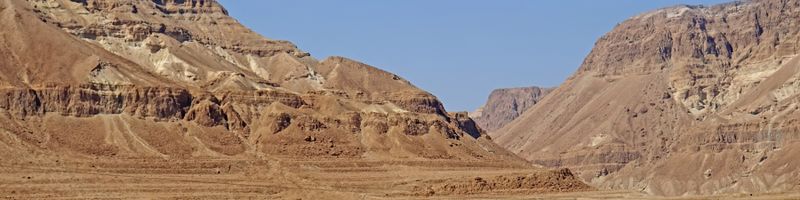
From the summit, the spectacular view takes in the Jordan Valley, the Dead Sea, and the mountains of Moab and Gilead in Jordan. It’s a harsh and hostile landscape. Beyond the oasis of Jericho, it’s all red rocks, sand, dust, scrubby vegetation, and nary a spring in sight. For an Adirondacker from this land of abundant waters, it’s tough to imagine an overnight camp-out there, let alone forty days and nights of prayer and deprivation.

It’s when we are in “the wilderness,” far from what is familiar and comfortable—when we are feeling stretched thin, inadequately supported, and vulnerable—that the diabolical voice of temptation speaks up. Temptation may sound like the critical voice that sabotages our best efforts—telling us we are not good enough, smart enough, or skilled enough to meet the challenge. Temptation may invite us to walk the easy path, doing what is expedient and convenient rather than taking the time to discern and do what is right. Temptation can be insidious, like the desire to put work, civic commitment, friends, or family before our love for God.

Jesus met temptation head-on with the sword of scripture. He rebuked the Devil’s three temptations with three deftly chosen readings.  If only we had been paying better attention in Sunday School when the teachers were handing out those memory verses!  While we may not be the Bible scholar that Jesus was, that diabolical voice is silenced in our understanding that we are not alone in the wilderness, for God so loved the world that he sent us Jesus, who promises to be with us, “even unto the end of the age” (Matt. 28:20b).

Take heart, my friends. The season of Lent may confront us with the reality of temptation and our struggle to resist, but it also reminds us that we are not alone. Our success record with temptation may not be the best, but the Lord has got it covered. May we observe a holy Lent.

Question for reflection: How do you need Jesus’s help today?

Please join me in prayer . . .

Merciful God, we give thanks for your Son Jesus, sent into this world as a sign of your great love for us. Silence within us any voice but your own, that we may move past temptation and doubt to serve you with the fullness of who we are, to the glory of your coming Kingdom. We pray through Christ our Lord. Amen.


“Temptation is the devil looking through the keyhole. Yielding is opening the door and inviting him in.”—Billy Sunday

“We usually know what we can do, but temptation shows us who we are.”—Thomas a Kempis

“The essence of temptation is the invitation to live independently of God.”—Neil T. Anderson


By יעקב – Own work, CC BY-SA 4.0, https://commons.wikimedia.org/w/index.php?curid=75794194