Come, Let Us Walk in the Light

Sabbath Day Thoughts — “Come, Let Us Walk in the Light” Isaiah 2:1-5

It was a tough Thanksgiving for Sharon and Tim. Family gathered from far and wide. The food was delicious. Laughter sounded around the table. Everyone cheered and jeered in goodhearted rivalry as the Detroit Lions took on the Green Bay Packers. It was a special day. But Sharon and Tim couldn’t help but think about who was not there. Kyle, their oldest son, doesn’t come to Thanksgiving or Christmas or any of those special family gatherings anymore. It started with a rift over Kyle’s decision to quit school and the division seems to grow wider with the years.

For Henry, the best part about the long Thanksgiving weekend is not going to the office. His workplace has become increasingly polarized along the dividing lines of our national political landscape. His MAGA colleagues rejoice in every tweet that emerges from the oval office while the progressives cheer for their champion from across Lake Champlain Bernie Sanders. Henry tries to stay out of it, but he has found that he has few friends. He’d quit, but he needs the paycheck, and good jobs are hard to find, especially in the Adirondacks.

Jen has been thinking about her former best friend Cynthia. Friends since high school, Jen and Cynthia had a Black Friday tradition. They would rise early, take the Northway south, and do their Christmas shopping at the Colonie Center. After crossing everyone off their gift list, they would enjoy an early dinner at the Cheesecake Factory before heading home, the car filled with presents and the Christmas music blaring on the stereo. But when Cynthia married someone whom Jen didn’t like, the two had a falling out that never healed. Jen misses their friendship and Black Friday tradition.

The Thanksgiving holiday makes us aware of the ways that we have been blessed. God has been so good to us. Yet Thanksgiving and the coming Christmas holiday also draw our attention to the painful holes, protracted conflicts, and disappointing absences in our lives. We long for wholeness, for the peace that only Jesus can bring. We long to walk in his light.

The Prophet Isaiah knew that sense of longing. In his decades-long ministry, Isaiah endured the turbulent rule of four kings: Uzziah, Jotham, Ahaz, and Hezekiah.  Judah’s leaders were a selfish and short-sighted lot, more concerned with preserving their personal power than honoring God or protecting the people. They failed to defend the orphan or hear the pleas of widows. They ground the face of the poor into the dust. God expected justice from Judah’s rulers, but saw only bloodshed. Judah’s kings played dangerous games of shifting alliances between the reigning superpowers of their day. First, King Ahaz conspired with the Assyrians to undermine and overthrow his kin in the Northern Kingdom. Then, Hezekiah formed a secret alliance with Egypt. When Hezekiah’s double dealing came to light, the Assyrian armies rolled over Judah. Forty-six fortified cities were destroyed, and Jerusalem was encircled. Hezekiah and his people were imprisoned within a city under siege.

Into this time of suffering and violence, Isaiah shared God’s radically hopeful vision of Jerusalem. Instead of laying siege to Jerusalem, the nations of the world made a holy pilgrimage to the city. The roads thronged with people: rich and poor, young and old, sinners and saints. They walked in worn sandals. They rode opulently saddled camels. They strode with the vigor of youth. They leaned on canes and limped with the creaky joints of age. They carried babies on their hips. They sang songs of peace, “I ain’t gonna study war no more” and “Imagine all the people living life in peace.” Sounds of excitement, laughter, and hope could be heard along the way. Neighbor called to neighbor, “Come, let us go up to Jerusalem! Let us learn from God.”

When they reached the holy city, the people found that it was not ruled by Uzziah, Jotham, Ahaz, or Hezekiah. On the contrary, God was sovereign there, and God was cleaning house, ending years of injustice and oppression, judging between the nations and arbitrating for the people. There was peace and a new beginning for all God’s children. Jerusalem’s center of industry was no longer the privileged elite who built fortunes on the backs of the poor. Now, the most sought-after tradespeople were the blacksmiths. Their forges glowed red-hot, night and day. Their hammers rang out and sparks rose up in fiery showers as they beat the instruments of death into the tools of life. Swords became plowshares, spears became pruning hooks. Tanks turned to combines. AK-47s, Kalashnikovs, and Uzis transformed to hoes, rakes, and cultivators. What a lovely luminous vision held out to people living in dark times! O house of Jacob!  Come, let us walk in the light of the Lord!

As we hear Isaiah’s prophecy, we feel a terrible tension between what is and what could be, between the corruption and political intrigue of ancient Judah and God’s holy hope for Jerusalem. We know, too, the tension of Isaiah’s vision for our own lives and times, the tension between the brokenness of our families, workplaces, and friendships and the ways that God would have us live. Isaiah’s vision is a powerful and enduring invitation to faithful people to be grounded in and directed by God, to choose once and for all to walk in God’s light, to live into God’s good vision for a healed world where differences are overcome by an irresistible, holy love.

This Sunday, as we remember Isaiah’s vision and begin the season of Advent, anticipating the light of Christ that shines in our world’s darkness, we are invited to be agents of Isaiah’s vision of peace and transformation in our own communities and within our own families. This is the really hard part. Change begins here, within our heart of hearts, as we allow God’s love and grace to heal old hurts and turn us to one another with a spirit of forgiveness and forbearance. To walk in the light, we must first allow it to shine within us and transform us. Then, we must be willing to allow that light to shine through us to our neighbors, knowing that we are one and all God’s beloved children. 

There is the famous story of a wise old Rabbi who taught his students by asking them questions.  “How can a person tell when the darkness ends and the day begins?” he asked. After thinking a moment, one student replied, “It is when there is enough light to see an animal in the distance and be able to tell if it is a sheep or a goat.” Another student ventured, “It is when there is enough light to see a tree and tell if it is a fig or an oak tree.” The old Rabbi smiled and gently said, “No. It is when you can look into a man’s face and recognize him as your brother. For if you cannot recognize in another’s face the face of your brother or sister, the darkness has not yet begun to lift, and the light has not yet come.”  Come, let us walk in the light.

On this first Sunday of Advent, perhaps we could follow in Isaiah’s footsteps and cast our own vision of the world that we can make if only we will choose to walk in the light. It will be a world where we love God and we love one another as we love ourselves. It will be a world where we will even dare to love our enemies and pray for those who have persecuted us. It will be a world where we will turn the other cheek, go the extra mile, and forgive as we have been forgiven. The sharp barbs of our personal criticisms will be transformed to words of encouragement and praise. The battle lines of our political landscape will unravel at the table of peace. The sticks of insults hurled and stones of promises broken will fall powerless at the feet of unstoppable love. We will truly see one another as brothers, sisters all.

It’s a world where family rifts will come to an end, and Sharon and Tim will share Thanksgiving dinner with Kyle. It’s a world where toxic politics are set aside in favor of the common good, and Henry will like his job again. It’s a world where friendships endure despite personal differences, and Jen and Cynthia will celebrate the conclusion of their Black Friday shopping over a piece of Godiva Chocolate Cheesecake. It’s a world where we put God at the center of it all, and we learn to live by the words that Jesus taught. Can we dare to dream it?

O house of Jacob!  Come, let us walk in the light of the Lord!

Resources

Corinne Carvalho. “Commentary on Isaiah 2:1-5” in Preaching This Week, Nov. 30, 2025. Accessed online at https://www.workingpreacher.org/commentaries/revised-common-lectionary/first-sunday-of-advent/commentary-on-isaiah-21-5-7

Joel Kemp. “Commentary on Isaiah 2:1-5” in Preaching This Week, Nov. 27, 2022. Accessed online at https://www.workingpreacher.org/commentaries/revised-common-lectionary/first-sunday-of-advent/commentary-on-isaiah-21-5-6

Anathea Portier-Young. “Commentary on Isaiah 2:1-5” in Preaching This Week, Nov. 28, 2010. Accessed online at https://www.workingpreacher.org/commentaries/revised-common-lectionary/first-sunday-of-advent/commentary-on-isaiah-21-5

Fred Gaiser. “Commentary on Isaiah 2:1-5” in Preaching This Week, Dec. 2, 2007. Accessed online at https://www.workingpreacher.org/commentaries/revised-common-lectionary/first-sunday-of-advent/commentary-on-isaiah-21-5-2

The traditional story of the wise rabbi is from Dennis Bratcher “Hope!” www.cresourcei.org


Isaiah 2:1-5

The word that Isaiah son of Amoz saw concerning Judah and Jerusalem.

In days to come
    the mountain of the Lord’s house
shall be established as the highest of the mountains
    and shall be raised above the hills;
all the nations shall stream to it.
    Many peoples shall come and say,
“Come, let us go up to the mountain of the Lord,
    to the house of the God of Jacob,
that he may teach us his ways
    and that we may walk in his paths.”
For out of Zion shall go forth instruction
    and the word of the Lord from Jerusalem.
He shall judge between the nations
    and shall arbitrate for many peoples;
they shall beat their swords into plowshares
    and their spears into pruning hooks;
nation shall not lift up sword against nation;
    neither shall they learn war any more.
O house of Jacob,
    come, let us walk
in the light of the Lord!


Photo by Thilipen Rave Kumar on Pexels.com

A Peaceable Kingdom

Sabbath Day Thoughts — “A Peaceable Kingdom” Isaiah 65:17-25

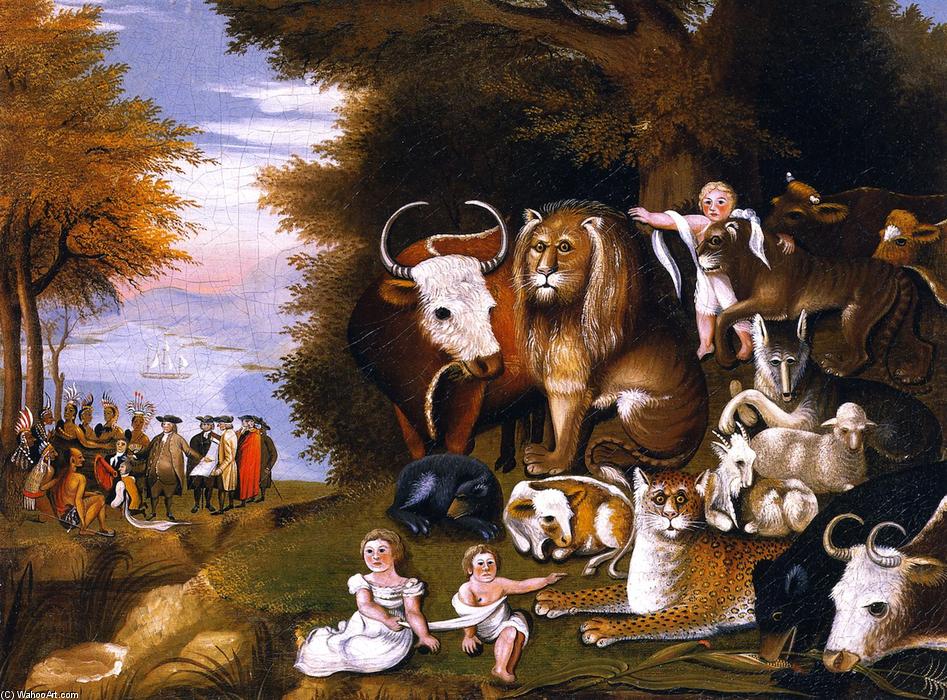
Edward Hicks was a Quaker sign painter born in Pennsylvania in 1780. He is acknowledged as one of America’s greatest folk artists. In 1820, when Edward was forty years old, he painted Isaiah’s vision of “The Peaceable Kingdom.” Against a green landscape and blue skies, a primitive looking infant, swaddled in gauzy cloth, sits between a pointy-horned ox and a lounging lion. The ox and the lion munch on hay. Nearby, a wooly lamb cozies up to a placid wolf. Two goats and a leopard look like best friends. It’s a wistful vision of a new creation, a world where violence has come to an end, where all God’s creatures live in peace, abundance, and safety.

This morning, the world is far from that bucolic vision of the peaceable kingdom. It’s day 1,361 of the war in Ukraine. Fierce fighting is ongoing in Zaporizihia, amid adverse weather conditions. In response to ongoing Russian aggression, Ukraine has targeted drone and missile strikes on key Russian oil facilities to disrupt Russian supply lines and military operations. On Friday night, Russia launched a blistering assault on Ukraine, killing at least six people and injuring 35 as 430 drones and 18 missiles rained down through the night sky. It’s estimated that Russian military casualties in the war have topped 1,000,000 personnel while Ukraine’s deaths and injuries are near 450,000. An estimated 45,000 Ukrainian civilians have been caught in the crossfire, about 3,000 of those children. We long for a peaceable kingdom.

Yemen has been locked in civil war for more than a decade. In September 2014, Houthi forces took control of the capital, Sanaa, following widespread discontent with the Saudi-backed government. A coalition, led by Saudi Arabia, stepped in, using air strikes to try to restore the former Yemeni government. Al Qaeda and ISIS fighters soon saw the conflict as a way to advance their regional ambitions, so they have carried out attacks against both factions. In the shadows, the Iranians pull the strings. Israel has been drawn into the conflict, killing the Yemeni Prime Minister in an August airstrike. In just the first three years of the war, more than 85,000 children died of starvation. A decade of war has left Yemen’s infrastructure in ruins and its people exhausted. Close to 20 million people in Yemen depend on aid simply to survive. Nearly five million are homeless, pushed from one place to another by violence and disaster. We long for a peaceable kingdom.

In our reading from the Prophet Isaiah, we hear God’s promise of a peaceable kingdom. The Israelites had returned to Jerusalem after fifty years of exile in Babylon. They were refugees returning to a homeland that was broken and scarred by war. Ancestral property rights were gone. Vineyards and fields had gone wild. Food was scarce. Disease was rampant. Neighbors, who had not gone into exile, were hostile and suspicious. Roads were unsafe. The Temple was in ruins. In a devastated land that once flowed with milk and honey, the people’s safety and security hung upon the mercy of a foreign king. A foreign-appointed government had replaced the once mighty kingship of David. The lives of the remnant of Israel were so filled with death, grief, hunger, and despair that they began to wonder. Is God with us? Has God forsaken us and sent us home to live as a broken people in a broken land?

Into this time of uncertainty and fear, Isaiah spoke words of prophetic promise, a beautiful vision of a fresh start in a new Jerusalem where weeping will cease and children will thrive. It was a bold vision of long life, good homes, and abundant harvests. It was a faithful promise of abiding love and prayers answered from generation to generation.  It was a holy vision of peace for all creation, of a new Eden where the wolf and the lamb shall feed together, the lion shall eat straw like the ox, and God’s holy mountain will be free of hurt and destruction. God promised the people an everlasting shalom, the peace and wholeness that we find when we are in right relationship with God, neighbor, and even within ourselves.

I imagine that as the people listened, their eyes filled with tears and their hearts with longing. They remembered that God is with them, always with them. They found the courage to persevere and seek the future that God held ready for them. They rolled up their sleeves and worked the fallow fields. They shared what little they had, so that everyone had enough. They gathered at the Temple, worshipped amid the ruins, and dreamed of a new sanctuary. They reached out to their suspicious neighbors with kindness and patience, setting aside their tribalism to work toward a shared future. It wasn’t exactly the peaceable kingdom, but it held the promise of it.

This morning, we may not be caught up in the ground-shaking artillery fire of Zaporizihia, or the mass homelessness and hunger of Yemen, or the despair of Israelite refugees returning to a broken land, but we, too, long for a peaceable kingdom. We mourn the casualties in Ukraine, the devastation of Gaza, and the threat of war with Venezuela. We are grieved by the fracture of longstanding alliances and friendships between nations. We are frightened by the seemingly intractable polarization of our political landscape. We despair over the lack of respect or even common courtesy in our public discourse. In this land of plenty, we are shocked by widespread food insecurity and the millions of neighbors who teeter on the brink of economic crisis. We long for a peaceable kingdom.

As the holidays draw near, we acknowledge that we long for peace closer to home. We want peace for our families; we dream of a holiday table where every place is occupied, every tummy is full, the conversation is merry, and the love abounds. We need God’s peace to find a spirit of tolerance and acceptance, to heal our hardheartedness and unwillingness to accept one another as we are. We long for God’s forgiveness that will be a balm for old wounds and long-held grudges. We pray for God’s courage and grace to name and heal from incidents of abuse. And when we take the time to be quiet, to go deeper, we admit that we need God’s peace in our hearts, so that we may forgive ourselves as we have forgiven others, love without strings attached, and accept what cannot be changed. We long for a peaceable kingdom.

This morning, may we hear anew God’s promise through the Prophet Isaiah of the new heavens and new earth, of the peaceable kingdom where ancient enmities come to an end, where the lion lies down with the lamb. May we remember that God is with us, always with them. We may make a mess of our world, but future is always in God’s hands, and the vision is one of peace.

If we listen with the ears of our hearts, we may even hear God’s vision that peace begins with us. We are not the architects of the peaceable kingdom, but we can be the artists, painting peace with the brushstrokes of lives lived in faith and love. Let’s roll up our sleeves and join God in the work of shalom. We cannot arbitrate ceasefires for Ukraine and Yemen, yet we can pray for their peace. We can demand better and more peaceful ways for those who govern. We can reach out to neighbors with kindness and patience, setting aside tribalism to work toward a shared future. We can share what we have, so that everyone has enough. We can dare to heal our families, reaching out with love, even if our best efforts fall short. Let’s extend to others and to ourselves the grace that has been so freely shared with us in Jesus. It won’t be the peaceable kingdom, but with God’s help our lives may begin to hold the promise of it. Let’s take a moment to commit ourselves to take one action in the coming week that can prosper peace.

The Quaker painter Edward Hicks painted “The Peaceable Kingdom” more than a hundred times in the last twenty years of his life, as if by repeatedly painting the promise of the kingdom he could hasten its coming. Over the years, Hicks’ Bucks County surroundings began to be represented in his paintings. The Delaware River wound through the background. Little girls entered the picture, breaking the gender barrier and joining the Christ child in his peaceful romp with the wild beasts. In the distance, William Penn and his Quaker friends, clad in somber shades of gray and black, passed a peace pipe with Lenni Lenape tribesmen in bright blankets, feathers, and wampum. Hicks painted to cast a prophetic vision of harmony and plenty, an end to violence and bloodshed, a setting aside of oppression for women and people of color. It’s as if Hicks trusted that if he could share Isaiah’s vision in ways that spoke to his world, folks would understand and change would come. It wouldn’t be the peaceable kingdom, but with God’s help there would be the promise of it.

We may not be America’s greatest folk artists, but Isaiah’s vision of the peaceable kingdom still sparks the imagination of God’s people. May we go forth to seek that kingdom with the broad brushstrokes of lives lived in pursuit of peace.

Resources

Carolyn J. Sharp. “Commentary on Isaiah 65:17-25” in Preaching This Week, Nov. 14, 2010. Accessed online at Commentary on Isaiah 65:17-25 – Working Preacher from Luther Seminary

Garrett Galvin. “Commentary on Isaiah 65:17-25” in Preaching This Week, Nov. 14, 2010. Accessed online at Commentary on Isaiah 65:17-25 – Working Preacher from Luther Seminary

John Braostoski. “Hicks’s Peaceable Kingdom,” Friends Journal, February 2000. Hicks’s Peaceable Kingdom – Friends Journal

James C. Reynolds and Steffie Banatvala. “Inside Putin’s campaign of terror in Kyiv: Why Russia keeps bombarding the capital” In The Independent, Nov. 14, 2025. Accessed online at Inside Putin’s campaign of terror in Kyiv: Why Russia keeps bombarding the capital | The Independent

Lyndal Rowlands and News Agencies. “Russia-Ukraine war: List of key events, day 1,357” in Aljazeera, Nove. 12, 2025. Accessed online at Russia-Ukraine war: List of key events, day 1,357 | Russia-Ukraine war News | Al Jazeera

Statista Research Department. “Number of civilian casualties in Ukraine during Russia’s invasion verified by OHCHR from February 24, 2022 to July 31, 2025,” Statista, Sept. 25, 2025. Accessed online at Ukraine civilian war casualties 2025| Statista

Othman Belbeisi. “Yemen: Ten Years of War, a Lifetime of Loss” in UN News, March 26, 2025. Accessed online at Yemen: Ten Years of War, a Lifetime of Loss | UN News


Isaiah 65:17-25

For I am about to create new heavens
    and a new earth;
the former things shall not be remembered
    or come to mind.
18 But be glad and rejoice forever
    in what I am creating,
for I am about to create Jerusalem as a joy
    and its people as a delight.
19 I will rejoice in Jerusalem
    and delight in my people;
no more shall the sound of weeping be heard in it
    or the cry of distress.
20 No more shall there be in it
    an infant who lives but a few days
    or an old person who does not live out a lifetime,
for one who dies at a hundred years will be considered a youth,
    and one who falls short of a hundred will be considered accursed.
21 They shall build houses and inhabit them;
    they shall plant vineyards and eat their fruit.
22 They shall not build and another inhabit;
    they shall not plant and another eat,
for like the days of a tree shall the days of my people be,
    and my chosen shall long enjoy the work of their hands.
23 They shall not labor in vain
    or bear children for calamity,[a]
for they shall be offspring blessed by the Lord—
    and their descendants as well.
24 Before they call I will answer,
    while they are yet speaking I will hear.
25 The wolf and the lamb shall feed together;
    the lion shall eat straw like the ox,
    but the serpent—its food shall be dust!
They shall not hurt or destroy
    on all my holy mountain,
            says the Lord.


“The Peaceable Kingdom” Edward Hicks, 1832. From the collection of the Abby Aldrich Rockefeller Folk Art Center (United States)

Because He Lives

Sabbath Day Thoughts — “Because He Lives” Luke 20:27-38

A very zealous, soul-winning, young preacher came upon a farmer working in his field. Being concerned about the farmer’s soul, the preacher asked, “Are you laboring in the vineyard of the Lord, my good man?”

Continuing his work, not even looking at the preacher, the farmer replied, “Naw, these are soybeans.”

“No, no, no. You don’t understand,” said the young man. “I’m asking are you a Christian?”

With the same amount of interest as his previous answer the farmer said, “Nope my name is Jones. You must be lookin’ for Jim Christian. He lives a mile south of here.”

The determined young preacher tried again, asking the farmer, “Are you lost?”

“Naw! I’ve lived here all my life,” answered the farmer.

Finally, the frustrated preacher threw up his hands, “Are you prepared for the resurrection?”

Now this caught the farmer’s attention, and he asked, “When’s it gonna’ be?”

Thinking he was finally making some headway, the young preacher replied, “It could be today, tomorrow, or the next day.”

The farmer stopped. He took a handkerchief from his back pocket and wiped his brow. “Well, don’t mention it to my wife. She don’t get out much, and she’ll wanna’ go all three days.”

The resurrection is a strange subject for a joke, but that’s exactly what the Sadducees were up to. As they challenged Jesus, he was teaching in the courts of the Temple. Earlier that week, Jesus made a triumphal entry to the city, surrounded by jubilant crowds who were captivated by his dynamic teaching. Jesus cleansed the Temple, turning the tables on money changers and driving out the animal vendors. Then, Jesus settled into a residency on the teaching steps, where his opponents tried their best to discredit him.

The Sadducees were the ruling elite of the temple, having controlled the religious practice of Israel for hundreds of years. The first century Jewish historian Josephus wrote that the Sadducees were filthy rich. They were little-loved by the people, but they preserved their power through wealth and collaboration with the Roman Empire. The Sadducees didn’t like Jesus. They questioned his lowly origins, they feared his appeal to the crowds, and they really didn’t like his disruption of the money changing and animal sales that enriched the Temple’s coffers. They needed to discredit Jesus quickly and embarrass him in front of his adoring crowds.

The question that the Sadducees posed for Rabbi Jesus sounds puzzling and archaic. Unlike Jesus, the Sadducees didn’t believe in the resurrection. They said it wasn’t mentioned in the Torah, thus it couldn’t be part of God’s plan for humanity.  So, the Sadducees turned to the traditional practice of levirate marriage to make a mockery of the very notion of the resurrection. In levirate marriage, a childless widow would be married to her late husband’s brother. The children, who were born of the levirate marriage, were considered the offspring of the late husband. This preserved the husband’s name and the right of inheritance for a future generation. Levirate marriage was also a protection for widows. It stopped the practice of discarding a childless widow, returning her to her father’s house or turning her out into the streets to fend for herself. According to the levirate tradition, the husband’s family must provide for childless widows, ensuring their safety and well-being. The Sadducees’ question imagines a woman who is widowed, time and time again, passed from brother to brother to brother to brother to brother to brother to brother. If there is, indeed a life eternal, the Sadducees ask, whose wife will she be? It’s a bawdy, lewd joke that imagines an infinitely grieving woman passed from brother to brother for all eternity.

Rabbi Jesus dismantled their rude joke in two simple moves. First, he pointed to the practice of levirate marriage. According to Jesus, in the resurrection (in the Kingdom to come), the entire patriarchal structure, which makes the possessing of women as property possible, would be set aside. Girl children won’t be the property of fathers to be traded away in an economic transaction. Women won’t be the sexual property of husbands. Childless widows won’t be at risk for homelessness and exploitation. In God’s Kingdom, our kinship, worth, and life is found in God. We are all God’s children, children of the resurrection, children of a Kingdom where there will no longer be the power of patriarchy. Then, to close his argument, Jesus referenced one of the most foundational stories of the Torah, Moses’ encounter with God at the burning bush. Quoting Exodus 3:6, Jesus noted that God Almighty “is” the God of Abraham, Isaac, and Jacob. God’s relationship with those patriarchs is living and eternal. Indeed, although we are mortal, we find eternal life in our infinite God. It was a microphone-drop-moment. The Sadducees left, bested on their home field. The questions stopped, but the plot to end Jesus’ life found new urgency.

The clash with the Sadducees might have gone undocumented if God hadn’t added a big exclamation point to Jesus’ argument. On Friday of that week, Jesus was arrested by the Temple guards—those minions of the Sadducees. The Chief Priests Annas and Caiaphas, both Sadducees, argued before the Sanhedrin that Jesus was a heretic, and it would be better for one man to die—putting an end to the Messianic rising that followed him—than for the nation to endure the wrath of Rome that was surely coming. We all know what happened next: torture, humiliation, the agony of the cross, and death. On Friday, it felt like the Sadducees had won the argument, after all. But on Sunday, there was a second microphone-drop-moment. God had the last word. God’s resurrection overcame the sin and death of this world. Jesus rose. Because he lives, we trust that we, too, shall live. Thanks be to God.

In light of that Easter morning resurrection miracle, today’s arcane reading from scripture finds deep meaning and powerful relevance for today’s world. It begins with the hope that we find in the resurrection. We choose to love and live in God. And there is nothing in this world that can separate us from the love of God that was made known to us in Jesus. Because God chose to send a son into the world to live and die and rise, we can trust that we are children of the resurrection. Because Jesus lives, we also shall live in that resurrection realm, the Kingdom to come.

Jesus also helps us to see that the Kingdom to come is good news for anyone who has ever been left out, made to feel “less than,” or suffered because of who they are. The sinful practices and oppressive traditions of this world will come to an end and have no place in God’s plans for our future. In the resurrection, there is no place for patriarchy. In the resurrection, there is no place for gender oppression. In the resurrection, there is no place for racial hate. In the resurrection, there is no fear of the foreigner. In the resurrection, there is no poverty or injustice. In the resurrection world to come, we will all be precious, beloved, children of the resurrection. And we will rejoice!

If we accept the promise of the resurrection and the vision that Jesus cast for the Kingdom to come, then today’s reading becomes a call to action. It’s a call to stand against the forces of this world that control, mock, and delight in the suffering of others. It’s a call to live in ways that begin to shape communities that feel like an anticipation of that coming Kingdom. We have hope. We love without limits. We seek justice. We serve our at-risk neighbors.  We follow in the footsteps of the risen Lord.

In 1971, Gloria and Bill Gaither wrote one of the most treasured gospel hymns, “Because He Lives.” The Gaithers were going through tough times. They had left their jobs as public school teachers to become music ministers. But Bill had been sick and depressed. Gloria was expecting their third child. The Vietnam War was underway. Assassination had taken the lives of Martin Luther King and Robert F. Kennedy. Drug abuse was on the rise. Racial injustice persisted. Riots had devastated vulnerable inner-city communities. The world felt chaotic. Gloria Gaither says that she struggled with bringing a third child into a world that felt far from God’s Kingdom. On New Years Eve in the darkness and quiet of their living room, Gloria suddenly felt released from it all as she sensed the reassuring presence of the risen Lord. Fear left. Joy returned. Gloria knew she could have that baby and face the future with trust because Jesus lives, and God can conquer the chaos that touches our days. In response, Gloria wrote the words of what would become the Gospel Song of the Year for 1974.

“Because He lives, I can face tomorrow,

Because He lives, all fear is gone;

Because I know, He holds the future.

And life is worth the living just

Because He lives.”

Gloria’s words and the promise of the resurrection still minister to people everywhere. Live in hope, my friends. Because he lives, we too shall live.


Resources:

David Lose. “Commentary on Luke 20:27-38” in Preaching This Week, Nov. 7, 2010. Accessed online at Commentary on Luke 20:27-38 – Working Preacher from Luther Seminary

Kendra A. Mohn. “Commentary on Luke 20:27-38” in Preaching This Week, Nov. 9, 2025. Accessed online at Commentary on Luke 20:27-38 – Working Preacher from Luther Seminary

Richard Swanson. “Commentary on Luke 20:27-38” in Preaching This Week, Nov. 10, 2013. Accessed online at Commentary on Luke 20:27-38 – Working Preacher from Luther Seminary

Nancy Lynne Westfield. “Pastoral Perspective on Luke 20:27-38” in Feasting on the Word, Year C, vol. 4. Louisville: Westminster John Knox Press, 2020.

Patrick J. Wilson. “Homiletical Perspective on Luke 20:27-38” in Feasting on the Word, Year C, vol. 4. Louisville: Westminster John Knox Press, 2020.

C. Michael Hawn. “History of Hymns: ‘Because He Lives.’” Discipleship Ministries, The United Methodist Church, June 20, 2013. Accessed online at Discipleship Ministries | History of Hymns: “Because He Lives”

Bill and Gloria Gaither. “Because He Lives.” Bing Videos

The opening joke about the resurrection is from Upjoke: Jokes for Every Topic. ↑UPJOKE↑ – Jokes For Every Topic


Luke 20:27-38

27 Some Sadducees, those who say there is no resurrection, came to him 28 and asked him a question: “Teacher, Moses wrote for us that if a man’s brother dies leaving a wife but no children, the man shall marry the widow and raise up children for his brother. 29 Now there were seven brothers; the first married a woman and died childless; 30 then the second 31 and the third married her, and so in the same way all seven died childless. 32 Finally the woman also died. 33 In the resurrection, therefore, whose wife will the woman be? For the seven had married her.”

34 Jesus said to them, “Those who belong to this age marry and are given in marriage, 35 but those who are considered worthy of a place in that age and in the resurrection from the dead neither marry nor are given in marriage. 36 Indeed, they cannot die anymore, because they are like angels and are children of God, being children of the resurrection. 37 And the fact that the dead are raised Moses himself showed, in the story about the bush, where he speaks of the Lord as the God of Abraham, the God of Isaac, and the God of Jacob. 38 Now he is God not of the dead but of the living, for to him all of them are alive.”


Image source: https://medium.com/@kipakcho/jesus-examined-29691938b718

Building Projects

Sabbath Day Thoughts — “Building Projects” Luke 14:25-32

The National Monument of Scotland was never completed. Plans for the memorial atop Carleton Hill in Edinburgh were drawn up more than 200 years ago with the intention of honoring Scotland’s fallen heroes of the Napoleonic War. A massive pillared court, like the Parthenon in Athens, would contain a church, as well as catacombs for the burial of the country’s most significant leaders. By 1822 a foundation was laid, but by 1829, construction ground to a halt, due to insufficient funds. An effort to revive the project in the 1850s likewise failed. The city council eventually became the owners of the partially-finished monument, known as “Edinburgh’s Disgrace.” All that survives of the original grand plans are an immense foundation and twelve colossal Doric columns.

The Cathedral of St. John the Divine in New York City was never completed. One of the largest churches in the world, St. John’s is perched at the top of a flight of wide steps atop one of the highest hills in Manhattan. Standing in front of the massive building, you’ll notice a squat, square, unfinished tower on the south side, but no matching tower on the north. Initial work on the cathedral proceeded from 1892 but competing architectural visions slowed construction. Building efforts stalled entirely at the beginning of World War II and the congregation’s priorities shifted. They saw growing social needs in their community, like poverty, homelessness, and hunger, and they questioned whether they should continue to pour funds into construction. Work resumed in 1979 but stalled in 1997. Today, building efforts focus on preservation and basic improvements at a cost of about $11 million dollars a year. The cathedral is known by the nickname “St. John the Unfinished.”

Closer to home, Boldt Castle, located on Heart Island in the St. Lawrence, was never completed. In 1900, George Boldt, the proprietor of the Waldorf Astoria Hotel, hired 300 laborers to construct a 120-room Rhineland-style castle for his beloved wife Louise. Four years after construction began, Louise suddenly died. The heartbroken husband abandoned the project and never set foot on the island again. For seventy-five years, the site sat abandoned and unfinished until in 1977 the Thousand Islands Bridge Authority acquired the property and opened it for visitors.

In our reading from Luke’s gospel, Jesus used hyperbole— a form of argument that embraces exaggeration—to make a point. Jesus cautioned his disciples about the cost of discipleship with dire-sounding words about family alienation, incomplete building projects, and unwinnable wars. The Lord was on his way to Jerusalem for that fateful final Passover. He was accompanied by large crowds of would-be disciples. The expectations of the crowd about what would go down in Jerusalem were radically different from what Jesus knew would unfold. The crowds thought they would have a ringside seat for healing miracles and earthshaking preaching. Many must have hoped that Jesus would bring change to the religious establishment ensconced in the Temple. Some were hoping for regime change, thinking that Jesus would be a militaristic Messiah, like the Maccabees, who could cast out their Roman overlords. No one wanted to hear that a cross awaited Jesus in Jerusalem. No one wanted to hear that crosses could await many who dared to follow the Lord.

All of Jesus’ apostles would know persecution and eleven of the twelve would face execution. James the Son of Zebedee would be the first, beheaded by the Romans in the year 44. Andrew was crucified on an x-shaped cross in the Greek city of Patras in the year 60. Peter was crucified upside down four years later during the persecution of Christians by the Emperor Nero. Jude was crucified in Persia. Thomas was run through with spears in India. Matthew was impaled and beheaded in Ethiopia. You see my point. The only apostle to die a natural death was John the Beloved, but he and his church were persecuted so harshly that they were forced to flee Israel for the far side of the Mediterranean in what is now western Turkey. Discipleship was costly, indeed, for Jesus’ followers.

It’s hard to know what to do with scripture readings like the one we have today. As first world Christians, not one of us is likely to be executed for our beliefs. Not one of us will be so persecuted for our love of Jesus that we will be forced to flee our homeland. Trey Clark, who teaches preaching at Fuller Seminary says that when we hear Jesus’ words about family alienation and impending oppression or victimization, we are more likely to say “Ouch” than “Amen.” So how do we make sense of it for people here and now?

The circumstances of our lives are very different from Jesus’ first century followers. Taking up our cross and losing our life for the sake of Jesus Christ may look more like death by a thousand paper cuts than a state sponsored execution. Losing our life for Christ involves recognizing that our true purpose and fulfillment are not found in worldly desires but in serving God and others. Authentic discipleship requires a willingness to deny ourselves and take up our cross daily. By embracing the Way of Jesus, we die to self, but we find true life and purpose. The Apostle Paul, who would lose his head for the sake of the gospel, put it this way, “I have been crucified with Christ and I no longer live, but Christ lives in me. The life I now live in the body, I live by faith in the Son of God, who loved me and gave himself for me.” There are millions of everyday folks out there, like you and me, who may not have literally died for Jesus’s sake, but they show singular commitment and deep allegiance by following the Lord in costly ways. Jesus lives in them.  

I would like to celebrate those thousand paper cuts, the everyday ways that I see people denying themselves and taking up their cross for the sake of the gospel. I’ll name just a few and you can respond with an “Amen!” or an “Ouch!”

We could spend our Sunday mornings paddling our canoe or hitting the trail, doing a home improvement project or having a second cup of coffee, but we choose to come to church and worship our awesome God, and we carry the cross.

We could spend our Wednesday evenings watching Jeopardy and Wheel of Fortune, but we make a joyful noise to the Lord with choir or meet with the deacons or come out for Committee Night, and we carry the cross.

In a world where income inequality is accepted, even as it grows and grows, we could ignore the need of our neighbors, but we share our food offerings and donate two cents a meal for hunger programs, we grow veggies in our Jubilee Garden to share at the Food Pantry and cook lunch for the Community Lunch Box, and we carry the cross.

Living in the remote beauty of the Adirondacks, we could close our eyes to the suffering and injustice of our world, but we advocate for the war weary people of Ukraine, and write letters for the starving children of Gaza, we accompany vulnerable refugees and support the widows and children of Mzuzu Malawi, and we carry the cross.

I could say more, but you see my point. We carry the cross. We die to self and live for Jesus, and when we follow the Lord, yielding our will to God’s will, Jesus lives in us.

Our deaths by a thousand paper cuts begin to build something. It isn’t the National Monument of Scotland, better known as Edinburgh’s disgrace. It isn’t the Cathedral of St. John the Divine, aka St. John the Unfinished. It isn’t even Boldt Castle, although New York State has poured millions of our tax dollars into making the castle an accessible tourist destination. Our deaths by a thousand papercuts build a world that looks like Christ’s Kingdom, where the stranger is welcomed, the hungry are fed, the sick and lonely are visited, and God is glorified. That’s a building project that I want to see through to completion. How about you?

Let’s pick up our crosses, my friends. There is building work to be done.

Resources

E. Trey Clark. “Commentary on Luke 14:25-33” in Preaching This Week, Sept. 7, 2025. Accessed online at https://www.workingpreacher.org/commentaries/revised-common-lectionary/ordinary-23-3/commentary-on-luke-1425-33-6

Radhika Jhamaria. “15 Famous Unfinished Projects in Architectural History” in Rethinking the Future. Accessed online at https://www.re-thinkingthefuture.com/architects-lounge/a1289-15-famous-unfinished-projects-in-architectural-history-2/

Ellen Newman. “New York City’s St. John the Unfinished” in Hidden in Plain Sight, July 11, 2019. Accessed online at https://hidden-insite.com/2019/07/08/new-york-citys-st-john-the-unfinished/

Jenna Intersemone. “Massive Building Projects That Were Never Finished” in House Digest, Dec. 7, 2021. Accessed online at https://www.housedigest.com/663379/massive-building-projects-that-were-never-finished/ Edinburgh

Jack Wellman. “How Did the 12 Apostles Die?” in What Christians Want to Know. https://www.whatchristianswanttoknow.com/how-did-the-12-apostles-die-a-bible-study/


Luke 14:25-32

25 Now large crowds were traveling with him, and he turned and said to them, 26 “Whoever comes to me and does not hate father and mother, wife and children, brothers and sisters, yes, and even life itself, cannot be my disciple. 27 Whoever does not carry the cross and follow me cannot be my disciple. 28 For which of you, intending to build a tower, does not first sit down and estimate the cost, to see whether he has enough to complete it? 29 Otherwise, when he has laid a foundation and is not able to finish, all who see it will begin to ridicule him, 30 saying, ‘This fellow began to build and was not able to finish.’ 31 Or what king, going out to wage war against another king, will not sit down first and consider whether he is able with ten thousand to oppose the one who comes against him with twenty thousand? 32 If he cannot, then while the other is still far away, he sends a delegation and asks for the terms of peace. 


Photo by Ron Lach on Pexels.com

The Kingdom Comes

Sabbath Day Thoughts — “The Kingdom Comes” Luke 21:25-36

Italian Renaissance painter Sandro Botticelli believed that the end of the world was coming in the year 1504. You can spy his apocalyptic vision in his painting of Jesus’ birth, The Mystical Nativity. The painting has all the usual things we expect in a manger scene—joyful angels, an adoring Mary and Joseph, reverent shepherds, and curious barnyard beasts, but it also bears the disturbing depiction of small winged devils escaping under rocks or shot through with arrows. Botticelli explained his strange vision in an epigraph at the top of his work, “I, Sandro, painted this picture at the end of the year 1500 in the troubles of Italy in the. . . second woe of the Apocalypse in the loosing of the devil for three and a half years. . . we shall see him trodden down as in this picture.”

New England residents thought the end was near on May 19, 1780 when the skies turned strangely dark. According to one witness, “People [came] out wringing their hands and howling, the Day of Judgment is come.” The Connecticut legislature, which was in session when the sky blackened, feared the apocalypse was imminent and moved for adjournment, but one legislator, Abraham Davenport, responded: “The day of judgment is either approaching, or it is not. If it is not, there is no cause of an adjournment; if it is, I choose to be found doing my duty. I wish therefore that candles may be brought.” The “Dark Day,” as it came to be known, ended at midnight, when the stars once again became visible in the night sky. Historians suspect that the darkness was caused by an ill-timed confluence of smoke from forest fires and heavy fog.

When Halley’s Comet reappeared in 1910, it induced an end-of-the-world panic. Chicago’s Yerkes Observatory announced that it had detected a poisonous gas called cyanogen in the comet’s tail. The New York Times reported that the noted French astronomer, Camille Flammarion believed the gas “would impregnate that atmosphere and possibly snuff out all life on the planet.” Panic ensued. People rushed to purchase gas masks and “comet pills.” The Atlanta Constitution reported that people in Georgia were preparing safe rooms and covering keyholes with paper. One man armed himself with a gallon of whiskey and requested that friends lower him to the bottom of a dry well, 40 feet deep. After the comet passed, the headline of the Chicago Tribune lamely announced, “We’re Still Here.”

Our gospel reading on this first Sunday of Advent is downright apocalyptic. Sounding a lot like an Old Testament prophet, Jesus warned his listeners of a coming Day of Judgment. There would be signs in the heavens, chaos among the nations, and tumult upon the waters. Amid the discord and disruption, Jesus called his followers to vigilance, saying: stand up, raise your head, be on guard, pray. 

When Jesus stood in the Temple court sounding so prophetic, he was in the midst of a different holiday season—the Passover. From across the Roman Empire, people had come to Jerusalem to remember that God had once delivered them from the bondage of Egypt. With plagues of frogs and gnats, darkness, disease, and death, God had bested Pharaoh, and Moses had led the people forth to freedom. That Passover week, Jesus and his friends remembered God’s deliverance with the sacrifice of a lamb, the singing of psalms, and the sharing of a final Passover seder.

The courts of the Temple were filled with politically-charged tension as Passover memories faced the everyday reality of Jesus’ listeners. Israel was again in bondage, a vassal state of the Roman Empire. A legion of Roman soldiers had ridden out of Caesarea and up to Jerusalem amid the Passover pilgrims. Any dreams of Jewish freedom would be promptly and brutally quashed. It may have been Passover, but the local leaders served the emperor’s purpose, not God’s purpose. As that week continued, this would become increasingly clear as the Temple authorities conspired to arrest and condemn the Lord.

Given the context in which Jesus spoke, his promise of the coming of the Son of Man with power and great glory took on a hopeful tone for his listeners. Jesus was assuring the people that it was God, not Rome, who had ultimate authority. God, who delivered their ancestors from slavery in Egypt was still at work and would one day bring all things to completion in the Kingdom of God. The people needed to live today as if that Kingdom were coming tomorrow, alert and on guard, standing tall with heads up.

On this first Sunday in Advent, we puzzle over Jesus’ apocalyptic promise. We smile, perhaps a bit condescendingly, at the long history of apocalypticism—Sandro Botticelli’s Mystical Nativity with winged devils pinned to the earth by heavenly bolts, New Englanders terrified on the Dark Day, Americans plying gas masks and “comet pills” to ward off the end that was surely coming with Halley’s Comet. But if we are honest, we’ll admit that we are not strangers to apocalyptic worry.

We fear the end is near. Vladimir Putin will push the nuclear button in his prolonged war against Ukraine, unleashing a tide of atomic death to threaten the planet. Israel, Hamas, and Iran have set the stage for Armageddon, years of unstoppable, unwinnable war in the Middle East. Our addiction to fossil fuels will bring worldwide ecological catastrophe. The bitter divisions and bizarre turns of American politics herald an end to democracy and our nation as we know it. We faint with fear and foreboding of what is coming upon the world.

Our apocalyptic worries may be deeply personal. The death of a beloved one feels like the end of our world. A terrifying diagnosis convinces us that Judgment Day is near. Money troubles fill us with cataclysmic worry and woe. Estrangement in our families puts an end to future plans. It feels a lot like the apocalypse out there. We are confused and shaken, uncertain and frightened.

And so, on the first Sunday in Advent, we need Jesus to remind us that God has the last word. When Jesus made that promise, his friends would soon feel that their world was coming to an end. Temple guards would take Jesus into custody. He would be tried on trumped up charges, handed over to the Romans, and condemned to death on a cross. For three days, it would feel like the end of the world, that Rome and death and sin had the last word. Yet on Easter morning, they learned, once and for all, that God’s love is always stronger than death, always stronger than all the apocalyptic fears that our world may wield.

In Jesus’ life, death, and rising, God launched a revolution of self-giving love that continues to ripple through the corridors of time. The Kingdom comes even when the Romans rule the land. The Kingdom comes when Renaissance Italy feels like the devil has been loosed for 3 ½ years. The Kingdom comes on Dark Days. The Kingdom comes when the sky is falling. The Kingdom comes despite the machinations of scheming despots. The Kingdom comes as the bombs fall. The Kingdom comes amid global warming. The Kingdom comes in political chaos. The Kingdom comes even when our lives are wracked by personal pain, grief, and loss. The Son of Man comes with power and glory.

On this first Sunday in Advent, we remember that the Kingdom comes, and we can be a part of it—if we will only stand up, raise our heads, and go forth to love today as if the world were ending tomorrow. Lutheran theologian Philip Hefner, who taught for many years at the Lutheran Seminary in Chicago, taught that humankind is created to be co-creators. God grants us the agency, freedom, and creative capacity to join our purpose to God’s purpose. If Hefner is right, then we have a part to play in the coming of God’s Kingdom. Our choice to stand up, raise our heads, roll up our sleeves, and go forth with love is a choice for the Kingdom. And as we dare to love our God and our neighbors and even our enemies when it feels like the world is coming to an end, the Kingdom comes a little bit in each of us and in those whose lives we touch.

So maybe Abraham Davenport got it right on that Dark Day in 1780, and he said, “The day of judgment is either approaching, or it is not. If it is not, there is no cause of an adjournment; if it is, I choose to be found doing my duty. I wish therefore that candles may be brought.” The world may or may not be coming to an end, but there is work still for us to do. May we stand up and raise our heads. May we love today as if the Kingdom were coming tomorrow.

Resources

Mark Strauss. “Ten Notable Apocalypses That (Obviously) Didn’t Happen” in Smithsonian Magazine, Nov. 12, 2009.

Drew Rick-Miller. “Created Co-Creators” in Science for the Church, July 9, 2019. Accessed online at Created Co-Creators – Science for the Church – Ministry Resources 

David Lose. “Commentary on Luke 21:25-36” in Preaching This Week, Nov. 29, 2009. Accessed online at Commentary on Luke 21:25-36 – Working Preacher from Luther Seminary

Mary Beth Dinkler. “Commentary on Luke 21:25-36” in Preaching This Week, Dec. 2, 2018. Accessed online at Commentary on Luke 21:25-36 – Working Preacher from Luther Seminary

Troy Troftgruben. “Commentary on Luke 21:25-36” in Preaching This Week, Dec. 1, 2024. Accessed online at Commentary on Luke 21:25-36 – Working Preacher from Luther Seminary


Luke 21:25-36

25 “There will be signs in the sun, the moon, and the stars and on the earth distress among nations confused by the roaring of the sea and the waves. 26 People will faint from fear and foreboding of what is coming upon the world, for the powers of the heavens will be shaken. 27 Then they will see ‘the Son of Man coming in a cloud’ with power and great glory. 28 Now when these things begin to take place, stand up and raise your heads, because your redemption is drawing near.” 29 Then he told them a parable: “Look at the fig tree and all the trees; 30 as soon as they sprout leaves you can see for yourselves and know that summer is already near. 31 So also, when you see these things taking place, you know that the kingdom of God is near. 32 Truly I tell you, this generation will not pass away until all things have taken place. 33 Heaven and earth will pass away, but my words will not pass away. 34 “Be on guard so that your hearts are not weighed down with dissipation and drunkenness and the worries of this life and that day does not catch you unexpectedly, 35 like a trap. For it will come upon all who live on the face of the whole earth. 36 Be alert at all times, praying that you may have the strength to escape all these things that will take place and to stand before the Son of Man.”


By Sandro Botticelli – National Gallery, London, Public Domain, https://commons.wikimedia.org/w/index.php?curid=39054778

The Beautiful Feast

Sabbath Day Thoughts — “The Beautiful Feast” Isaiah 25:6-9

In October, we revived the pre-pandemic tradition of Committee Night, a monthly evening when the committees of the church gather. The evening begins at 5:30pm with a potluck supper. You never know what will turn up on the dinner table, but it is always good and plentiful. Last week, we had homemade soup, bread, charcuterie, fresh and dried fruit, salad, and a host of desserts, including not one but two birthday cakes for me. What a feast!

We typically transition from the dinner table to our small workgroups around 6:00pm. But as we laughed, swapped stories, and enjoyed the meal, time, as it often does when there is good food and good company, slipped away. About 6:20, I reluctantly shifted us from feast mode to work mode. Committees met, plans were made, and tasks assigned, all in time for choir practice to start at 7pm. That potluck meal felt like a victory as we shrugged off the vestiges of the COVID-19 pandemic and returned to right rhythms of eating, caring, and serving together.

In our reading from Isaiah, God granted the prophet a vision of the beautiful feast in the Kingdom of God. The table overflowed with sumptuous food and the finest of wine. The people of Israel and all the nations of the world rejoiced, feeding on the bounty that God had prepared. Every belly was full, every face flushed with satisfaction. The sound of laughter and song and heartfelt conversation rose in a blessed crescendo. Almighty God, that most generous and loving of hosts, met every hunger, dried every tear, and comforted every sorrow. Then, God had God’s own feast, to the amazement of all. God swallowed up death, ending forever the mortal shroud that parted the holy from the ordinary. What a feast! Isaiah’s vision has prompted hope and delight ever since.

This church is no stranger to the hope and delight that our beautiful feasts can engender. Back in 1927, we called the Rev. Hiram Lyon to serve as our pastor. The recent seminary graduate was a young bachelor with a flair for cooking. On several occasions, he put on summer dinners at Split Rock Farm for the church’s Men’s Club. We don’t know the menu, but since it was a bunch of guys, I think we can trust that there was grilling involved. There is a record, though, of what happened after dinner. The men sat around the campfire until late in the evening, watching the moon rise and the night fall. They pondered the billion stars of the Milky Way and the great mystery of the divine.

Perhaps the church’s fanciest feast took place in 1985. We had building on our minds—the extension of the church to create the Great Hall and the Christian Education classrooms. To share plans and kick-off the church’s fundraising efforts, we hosted a dinner at the Hotel Saranac. Invitations were mailed. Neighbors from the community were invited. I hear the food was excellent and the hall filled with hopeful expectation as we dreamed together about the blessing that would flow for us and for the community when our building effort reached completion.

I may be a little biased, but I think Duane’s and my wedding reception in the Great Hall, almost nineteen years ago now, was another echo of the beautiful feast. It wasn’t fancy. The deacons cooked up seven crockpots of soup. Duane and I provided an abundance of sandwich wraps, cheese and crackers, punch, and a fabulous wedding cake made by Dawne’s sister. Duane’s friends came all the way from Virginia to provide bluegrass music. Little girls twirled around the dancefloor in their princess dresses. And, the golden girls of the United Presbyterian Women sampled and provided commentary on every single soup. What a feast!

It might surprise us to learn that when Isaiah shared God’s hopeful vision of the holy banquet, the Hebrew people didn’t have a lot to celebrate. Gone were the days of unity for the twelve tribes. The northern clans had long ago split to form the Kingdom of Israel. The southern tribes confederated under the banner of Judah. Waves of foreign invasion had wracked the two kingdoms. Indeed, when Isaiah spoke, the northern kingdom had fallen to the Assyrians. Many of their northern kin had been deported, sent to the far corners of the Assyrian Empire. The invaders had almost vanquished Judah, too. They encamped around the walls of Jerusalem and sought to starve the kingdom into submission. Only the forethought of King Hezekiah, whose men had tunneled beneath the city walls to allow access to fresh water and supplies, allowed the hungry city to outlast the siege. As Isaiah spoke the vision of God’s beautiful feast, foreign invaders were again on the horizon. The Babylonian army was rising in the east in what would prove to be an unstoppable tide.

Our beautiful feasts don’t happen in a perfect world. When Hiram Lyon hosted those starry suppers for the Men’s Club, Saranac Lake was at the height of the tuberculosis pandemic. Sanatoriums and cure cottages overflowed with desperately sick neighbors who had come to our village in the hope of a cold air cure. Hiram Lyon knew all about that. He came to the village as a tuberculosis patient, having contracted the disease while a student at Union Seminary in Morningside Heights, NYC. He stayed in the village to pastor our church for ten years and minister to the sick whose experience he had shared.

When we banqueted at the Hotel Saranac and dreamed of a bigger, better building, we weren’t too certain about the future. The church’s Christian Education building—Gurley Hall—had originally been built as a stable and had not withstood the test of time. Under-insulated and poorly heated, it was no longer fit for classes or community use, and our efforts to excavate below the sanctuary to create the Lower Room hadn’t provided nearly enough space for our programs. We were renting space from St. Luke’s and the Methodists. In fact, we debated closing our doors and merging with our neighbors. And then there was the matter of funding. Someone—probably Sally’s husband Bill—had the vision to build, but we definitely didn’t have the money.

When Duane and I danced a bluegrass waltz and the children blew bubbles to bless us in the Great Hall on our wedding day, the church had been through bleak times. There was a full-blown schism with the departure of Pastor Chuck, and we had weathered a lengthy interim with the tough but wise Pastor Carol. People had left the church. We were plagued by poor communication and rival factions. I had inherited a $45,000 budget deficit. We would either make it or we wouldn’t, but we needed to turn the corner fast.

Isaiah’s vision affirms that our beautiful feasts do not happen in a perfect world where everything is blue skies, sunshine, and lollipops. It also affirms that God is present in the midst of our chaos. God longs to feed us, nurture us, dry our tears, and comfort us. The world is filled with war and the threat of war, pandemics, declining mainline churches, and bitter divisions. Yet Isaiah reminds us that God is more than a match for our chaos. God is in the middle of it, fighting to deliver us from all that makes our hearts tremble. Indeed, the God who swallows death whole has raised Jesus from the dead and broken down every barrier that can ever separate us from God’s eternal, unstoppable love. One day, we will all be seated at God’s table, bellies full, laughter ringing, conversation flowing, joy complete. What a feast!

Today, we will celebrate our own feast, here at the Lord’s Table, where generations of Presbyterians have been fed. Our beautiful feast does not happen in a perfect world. Bombs are falling in the Middle East. Children are starving in Gaza and Yemen, Afghanistan and Congo, Somalia and Sudan. We are days away from a hotly contested election that will leave at least half of our neighbors bitterly disappointed, no matter what the outcome. Yet we dare to come to this table, to remember that God is with us even when the world is at its most chaotic. God longs to comfort the grieving, feed the hungry, and dry the tears that flow. The Lord holds out to us the hope that one day all people, all nations, will gather at God’s banquet table—peaceful, beloved, and satisfied. Lord, speed the day!

This morning, like Isaiah, we engage in a prophetic act. As we share the Lord’s Supper, and we pledge our gifts to support the church in the coming year, we acknowledge that we do not live in a perfect world. But with God’s help, we can nudge this world a little closer to the Kingdom. With God’s help, we can live with hope and delight. With God’s help, we can feed the hungry, give drink to the thirsty, and bless the children. With God’s help, we can build a world where all are welcomed to the table. What a feast it will be! Amen.

Resources

Evelyn Outcalt and Judy Kratts. A History of the First Presbyterian Church of Saranac Lake, written in celebration of the church’s centenary, July 25, 1990.

Anathea Portier-Young. “Commentary on Isaiah 25:6-9” in Preaching This Week, Nov. 1, 2015. Accessed online at Commentary on Isaiah 25:6-9 – Working Preacher from Luther Seminary

Amy Erickson. “Commentary on Isaiah 25:6-9” in Preaching This Week, Nov. 4, 2012. Accessed online at Commentary on Isaiah 25:6-9 – Working Preacher from Luther Seminary

Julianna Claasens. “Commentary on Isaiah 25:6-9” in Preaching This Week, Nov. 1, 2009. Accessed online at Commentary on Isaiah 25:6-9 – Working Preacher from Luther Seminary

Corinne Carvalho. “Commentary on Isaiah 25:6-9” in Preaching This Week, Nov. 7, 2021. Accessed online at Commentary on Isaiah 25:6-9 – Working Preacher from Luther Seminary


Isaiah 25:6-9

6 On this mountain the Lord of hosts will make for all peoples
    a feast of rich food, a feast of well-aged wines,
    of rich food filled with marrow, of well-aged wines strained clear.
And he will destroy on this mountain
    the shroud that is cast over all peoples,
    the covering that is spread over all nations;
    he will swallow up death forever.
Then the Lord God will wipe away the tears from all faces,
    and the disgrace of his people he will take away from all the earth,
    for the Lord has spoken.
It will be said on that day,
    “See, this is our God; we have waited for him, so that he might save us.
    This is the Lord for whom we have waited;
    let us be glad and rejoice in his salvation.”


Photo by Bave Pictures on Pexels.com