Not What You Expected

Sabbath Day Thoughts — “Not What You Expected” Matthew 11:2-12

On a high bluff rising 3,500 feet above the surrounding desert, sixteen miles southeast of where the Jordan River empties into the Dead Sea, stood the hilltop fortress of Machaerus.  In the year 40BC, Herod the Great saw the strategic importance of the site.  From Machaerus, eastern invaders from Arabia could be easily spotted and signal fires ignited to warn fortifications to the west at Masada, Herodion, and Jerusalem.  Herod built a lavish palace and fortified compound atop the bluff.  A walled garden, elaborate Roman baths, ornate living quarters, two dining rooms, and carefully tiled mosaic floors were surrounded by massive stone walls with watch towers that soared ninety feet above the ramparts. Roman naturalist and philosopher Pliny the Elder described the stronghold as the most strongly fortified place in all of Judea, a statement supported by its name.  Machaerus means “the sword” or “the edge of the knife.”

John the Baptist came to Machaerus as a prisoner. His prophecy of the coming Messiah and his criticism of the bigamy of the king’s wife had made him powerful enemies.  At Machaerus, John was likely held captive in an empty cistern, an enormous underground vault cut from the bedrock and lined with plaster.  Dark and windowless, the cistern would have been a miserable place to live in isolation.  There John brooded on his thoughts and prophesied to the echoing walls.  We know from scripture that the king feared John and the queen hated him.  When Oscar Wilde wrote the libretto for the Opera Salome, he imagined the king peering into the dungeon, both fascinated and horrified by the prophet imprisoned within.

By the time John sent word to Jesus in our reading from Matthew’s gospel, the prophet had been imprisoned for two years.  It was clear to John that, unless the king were overthrown, he would never walk out of Machaerus alive.  Back when Jesus had come to him at the River Jordan, John was convicted that the Messiah had finally come.  So certain was he that he refused at first to baptize Jesus, declining the honor on the basis that he was unworthy of the task (Matt. 3).  But two years in Machaerus can change a man, begin to break him, and rattle his faith.  Where was the fire and brimstone that John had imagined the Messiah would bring?  Where was the conquering army that the Messiah would lead?  Would the Messiah allow John, who had prepared the way of the Lord, to die in prison?

John the Baptist was not alone in his anticipation of a different kind of Messiah.  Some sects of first century Judaism, like the Sadducees, didn’t believe in a Messiah at all.  The Essenes at Qumran, on the other hand, believed there would be two Messiahs: one a military leader and the other a sage and teacher of the law. Most who looked for the Messiah agreed that the “coming one” would be a king like David.  This warrior king would unite the Israelites, put an end to the foreign occupation, and usher in an era of peace, independence, and prosperity.

Jesus failed to meet the messianic expectations of John the Baptist, the Essenes, and pretty much everyone else.  In the response that Jesus shared with John’s messengers, Jesus described the actions that the Prophet Isaiah said would be the sign of the coming Messiah (Isaiah 29, 35, 61).  The ears of the deaf would be opened. The blind would see. Newfound mobility would come to the lame.  The mute would speak.  The brokenhearted would find comfort. And the poor would be blessed with good news.  Instead of insisting on his messianic identity, Jesus urged John to simply take a look at what he was doing.  In Jesus’s ministry, the long-promised work of the Messiah was already underway in compassionate acts of mercy, forgiveness, and love.  “Consider the evidence,” Jesus was saying to John, “And please don’t be offended that I am not what you expected.”

We don’t need to be imprisoned in a mountaintop fortress like John, to feel that we need a Messiah. New Testament scholar Ronald J. Allen teaches that John the Baptist’s query, “Are you the one who is to come?” is the most important question of this Advent season.  We all need a savior, but like our ancestors in the faith, our longings and expectations for “the one who is to come” may or may not be met by Jesus.

We want a Messiah who will ride in on a white horse and free us from the enmity and bitter division of our political landscape.  We want a Messiah who will take away our grief and put a “don’t worry, be happy” smile upon our faces.  We want a Messiah who will smite our enemies, reinforce our world view, and describe a God who is created in our own image. We want a Messiah who will fix our marriage for us, make our children behave, and give us a nice pay raise.  We want a Messiah who will save us in the way we want, when we want it to happen, and that had better be sooner than later. 

If the Messiah doesn’t give us what we want, we just may take offense.  We say, “He’s not the real deal. God wouldn’t work in that way. God wouldn’t love those people.  This so-called Messiah isn’t worth our prayers, our devotion, or our Sunday mornings.” The Messiah comes on his own terms, with compassion, healing, forgiveness, and love, but we would rather sit in the dark prison of our disappointed expectations. 

We don’t know what happened when John’s disciples made the long journey back from Galilee to Machaerus and shared what Jesus had to say. I suspect that they shared with John not only the words that Jesus had spoken, but also the signs and wonders that they saw unfolding in Jesus’s ministry.  They talked about the demon-possessed man in Capernaum who had found his right mind with Jesus’s help.  They described the beautiful healed skin of the leper whom Jesus had touched. They shared the wisdom of the Sermon on the Mount and the exhortation to love God and neighbor. They shook their heads over the mystery of outsiders being welcomed, sinners forgiven, and fresh starts for hurting lives.  There was so much good news, even if it wasn’t the message that John wanted to hear.

I like to think that when John was executed not long afterward, he was at peace.  The gospels and the Jewish historian Flavius Josephus tell us that John was beheaded in the year 32, the year before Jesus would himself run afoul of Herod and Pilate and find himself in prison, facing execution.  God had confounded all John’s expectations, but this Jesus, this unorthodox Messiah, was a sign that God’s Kingdom and power were always at work in the midst of this hurting and broken world.  This unlikely Messiah and the improbable Kingdom would always grow within the kingdoms of the world, finding fresh expression wherever faithful people would follow the way of Jesus and commit to lives of mercy, compassion, and boundless love.  On this Advent Sunday when we light the candle of joy, I like to imagine that Jesus’s assurance brought John quiet joy amid the darkness of Machaerus. I like to imagine that we too can find joy in that assurance, regardless of the trials of our lives and our world.

In the year 66CE, Herod’s kingdom fell when Jewish rebels revolted and seized the fortress of Machaerus.  It took the Romans four years to put down the rebellion. In the year 70CE, they destroyed Jerusalem. Then, the Roman legion of Lucilius Bassus was assigned to exterminate the last rebel holdouts at Herodion, Massada, and Machaerus.  The Romans arrived at the Edge of the Knife in the year 72CE, set up camp, and began to build an immense earthen ramp to accommodate their siege engines and breach the stronghold’s walls.  When they saw the inevitability of their defeat, the rebels surrendered.  They were allowed to leave and disappeared into the trans-Jordan wilderness and the mists of history.  The Romans destroyed Machaerus, tearing down the impressive towers and stone walls, leaving behind only the dim outlines of its once mighty foundations. 

The kingdoms of man rise and fall: Herod, the rebels, the Romans. Yet the Kingdom of God persists whenever we surrender our false expectations and follow the Messiah with mercy, compassion, and boundless love.  Blessed are we when we do not take offense.

Resources:

Stanley Saunders. “Commentary on Matthew 11:2-12” in Preaching This Week, Dec.  11, 2022.  Accessed online at workingpreacher.org.

Ronald J. Allen. “Commentary on Matthew 11:2-12” in Preaching This Week, Dec. 11, 2016.  Accessed online at workingpreacher.org.

Arland Hultgren. “Commentary on Matthew 11:2-12” in Preaching This Week, Dec. 15, 2013.  Accessed online at workingpreacher.org.

James Boyce. “Commentary on Matthew 11:2-12” in Preaching This Week, Dec. 16, 2007.  Accessed online at workingpreacher.org.

Markus Milligan. “Machaerus–The Palace Fortress of King Herod” in Heritage Daily, Dec. 28, 2020. Accessed online at https://www.heritagedaily.com/2020/12/machaerus-the-palace-fortress-of-king-herod/136596

Biblical Archaeology Society Staff. “Machaerus: Beyond the Beheading of John the Baptist” in Bible History Daily, June 28, 2022. Accessed online at https://www.biblicalarchaeology.org/daily/biblical-sites-places/biblical-archaeology-sites/machaerus-beyond-the-beheading-of-john-the-baptist/

Saeb Rawashdeh. “Lost biblical fortress of Machaerus restored after 50 years of excavations” in The Jordan Times, March 14, 2019. Accessed online at http://www.jordantimes.com/news/local/lost-biblical-fortress-machaerus-restored-after-50-years-excavations

Pat McCarthy. “Machaerus” in See the Holy Land: Jordan. Accessed online at https://www.seetheholyland.net/machaerus/


Matthew 11:2-11

2When John heard in prison what the Messiah was doing, he sent word by his disciples 3and said to him, “Are you the one who is to come, or are we to wait for another?” 4Jesus answered them, “Go and tell John what you hear and see: 5the blind receive their sight, the lame walk, the lepers are cleansed, the deaf hear, the dead are raised, and the poor have good news brought to them. 6And blessed is anyone who takes no offense at me.”

7As they went away, Jesus began to speak to the crowds about John: “What did you go out into the wilderness to look at? A reed shaken by the wind? 8What then did you go out to see? Someone dressed in soft robes? Look, those who wear soft robes are in royal palaces. 9What then did you go out to see? A prophet? Yes, I tell you, and more than a prophet. 10This is the one about whom it is written, ‘See, I am sending my messenger ahead of you, who will prepare your way before you.’ 11Truly I tell you, among those born of women no one has arisen greater than John the Baptist; yet the least in the kingdom of heaven is greater than he.


Photo by Eva Lacroix on Pexels.com

The Promise of Peace

Sabbath Day Thoughts — “The Promise of Peace” Isaiah 11:1-9

On this second Sunday in Advent, we light the candle of peace.  Yet peace feels hard to come by this year. Tensions are high on the Korean Peninsula as Kim Jong Un escalates weapons testing and the South responds with further sanctions. In Ukraine, as troops recover territory once occupied by Russian invaders, they discover a trail of human rights abuses left behind.  All the while, the Russian missiles fall, destroying Ukraine’s power and energy infrastructure as winter approaches.

We long for peace within our nation.  We are wearied by the polarization that casts our political rivals as mortal enemies.  We are heartbroken by the continuing tide of gun violence.  611 mass shootings this year have wounded 3,179 people and taken 637 lives. We are frightened by the rise in hate.  Last month’s shooting in Colorado Springs is the most recent attack in growing violence against our LGBTQ neighbors.  Dark memories of the Holocaust stir amid a surge of antisemitic rhetoric by celebrities, athletes, and politicians.

We long for peace in our homes. Christmas reminds us of the wounds that every family bears.  Our thoughts brush up against our estranged kin, once a part of our holiday joy and now a painful memory of alienation.  As we put on a good show for the gathered clan, we may struggle in marriages grown strained and distant.  We’ll face long-held patterns of family dysfunction: our drunken uncle, the harshly critical parent, the debt-burdened shopaholic. 

We light the candle of peace this morning, longing for the peace of our world, our nation, and our homes.

In the 8th century BC, when Isaiah spoke God’s promise of a coming king and a transformed world, the Hebrew people were far from peace.  The Assyrian Empire was ascendant, marching out of the north like a swarm of locusts.  They excelled at war, having mastered the art of forging iron weapons that were far superior to the bronze-age armaments of their enemies. The armies of Assyria had engineering units to set up ladders and ramps, fill in moats, and dig tunnels to breach walled cities. They were among the first to build chariots, which provided greater mobility and protection on the battlefield.  One by one, the cities of the ancient near east fell to the advancing Assyrian tide.

On a national front, the Israelites knew little of peace. David may have united the twelve tribes of Israel, but within a few generations, the alliance had crumbled.  The Hebrew people had divided into two nations, the Kingdom of Israel to the north and the Kingdom of Judah to the south.  They were often at odds, allying with greater powers on the world stage to the detriment of one another. As the Assyrian army drew near, Judah refused the call to arms to help their northern brothers.  City by city, the Kingdom of Israel fell and its people were defeated and deported.

According to the Prophet Isaiah, peace was hard to find on the home front.  In oracle after oracle, the prophet denounced a people who “called evil good and good evil” (5:20). They worshipped false gods.  They loved graft and chased after bribes. They failed to defend the rights of the fatherless and refused to give justice to widows (1:23).

Over and against this backdrop of conflict and division, the Prophet Isaiah described the peace that would prevail when the Messiah came and the priorities of God’s Kingdom prevailed. According to Isaiah, on that glorious day the nation would be ruled with wisdom, understanding, and fear of the Lord. Righteousness would abound and justice would be served. In a wonderful act of rhetorical exaggeration, Isaiah cast the vision of a new Eden unfolding as the peaceable human kingdom overflowed to all creation.  Wolf and lamb, calf and lion, all would live in harmony.

Isaiah reminded the Hebrew people that God’s longing for our world is peace with justice and righteousness for all.  Isaiah held out the hope that when God’s people choose to live in accord with God’s will, they can flourish.  It’s a vision that must have sounded like music to the ears of Isaiah’s listeners.  It’s a bold picture of peaceful possibility that continues to speak to our imaginations, here and now. 

When the early church read the words of the Prophet Isaiah, they recognized Jesus in Isaiah’s description of the Messiah.  Jesus, with his deep wisdom and keen understanding of God’s law, Jesus with his deep piety and reverence, Jesus with his care for the sick and heart for the outsider, Jesus would embody those character traits of Isaiah’s coming king.  Jesus would embrace peace by welcoming strangers, sinners, and enemies. He would walk the path of non-violence, turning the other cheek to his accusers and praying for his executioners.  As those first Christians carried the Way of Jesus out into the Roman Empire, they knew that the peaceable kingdom persisted whenever wisdom and understanding, piety and love of the Lord were shared and embraced.

On the second Sunday of Advent, Isaiah’s promise of the coming king and his peaceable kingdom remind us that the gap between the world that we have made for ourselves and the world that God would have us make can be bridged.  We can choose to live in accord with God’s promise of peace.  Indeed, when we live with faith and integrity as followers of Jesus, we invite God’s future into our present.  The peaceable kingdom awaits those who would serve it even now.

We can strive for the peace of our world.  We may not be able to bring Russia and Ukraine to the bargaining table, but we have worked for world peace all year long.  We have been seeking a path to bring an at-risk Afghan family from Kabul to America. We have provided much-needed care and support for vulnerable infants at the Crisis Care Nursery in Mzuzu. Through CROP Walk, we have sought to address the root causes of hunger around the globe with the programs of Church World Service.  This Christmas, we will bless our African neighbors with the gift of clean water as we receive a special offering for the Shallow Well program of Marion Medical Mission.  These are the things that make for world peace.

We can strive for the peace of our nation.  We may not be able to break the rancor and gridlock of Washington, but we can choose to make a personal difference for good.  We can refuse to call those whose opinions differ from ours “enemies.” Our dialog can be grounded in mutual respect, and we can keep the lines of communication open, even when we disagree.  We can practice non-violence and call on our elected officials to enact responsible gun legislation.  We can stand with vulnerable minorities and speak out against hateful speech that incites violence. These are the things that make for a more peaceful nation.

We can strive for the peace of our families.  This could be the year that we let bygones be bygones and reconcile with our estranged kin.  We can remember that God is at the heart of our marriage covenant and seek together to reclaim that holy center for our shared life.  We can meet those intractable family dysfunctions with love, openness, and a desire for change. Stop filling the glass of your drunken uncle.  Beg to differ with that hyper-critical parent.  Give your family shopaholic a copy of Bill McKibben’s book Hundred Dollar Holiday and encourage them to resist the relentless onslaught of commercials and catalogs that try to say Christmas is only Christmas if it comes from a store. These are the things that make for a more peaceful family.

This morning, we light the candle of peace and choose to live in accord with God’s promise of the peaceable kingdom.  Can you imagine it with me? 

The Spirit of the Lord shall rest upon us, with wisdom and understanding,

counsel and strength, knowledge and a healthy fear of the Lord.

Nation shall not lift up sword against nation.

Ukraine and Russia, Saudi Arabia and Yemen, North and South Korea, all will come to the table of peace. 

The hungry shall be filled, refugees will be welcomed, vulnerable babies will be blessed,

and clean water shall flow down in an unstoppable tide.

Ears will be opened. Truth will be spoken. Democrats will break bread with Republicans,

Libertarians will find common cause with Progressives, and the DC gridlock shall come to an end. 

We’ll beat our guns into ploughshares, trade our hate speech for songs of praise, and all God’s people will know safety and dignity.

There will be a balm in Gilead for the healing of our families. 

We’ll reach out with a willingness to forgive and be forgiven, and the hatchet of enmity will be forever buried. 

We’ll renew our vows and honor our children.  We’ll love more.  We’ll forgive often.  We’ll judge less.

The land will be as full of the knowledge of the Lord as the sea is filled with water,

and all will be well in these holy mountains,

and all God’s people will say,

“Amen.”

Resources

Eli J. Finkel and Cynthia S. Wang. “The Political Divide in America Goes Beyond Polarization and Tribalism” Kellogg Insight, April 20, 2022. Accessed online at https://insight.kellogg.northwestern.edu/

National Geographic Society. “Assyrian Empire.” In National Geographic Resource Library, May 20, 2022. Accessed online at https://education.nationalgeographic.org/

Fred Gaiser. “Commentary on Isaiah 11:1-9” in Preaching This Week, Dec. 9, 2007. Accessed online at https://www.workingpreacher.org/

Barbara Lundblad. “Commentary on Isaiah 11:1-9” in Preaching This Week, Dec. 8, 2013. Accessed online at https://www.workingpreacher.org/

Michael Chan. “Commentary on Isaiah 11:1-9” in Preaching This Week, Dec. 4, 2016. Accessed online at https://www.workingpreacher.org/


Isaiah 11:1-9

11A shoot shall come out from the stump of Jesse, and a branch shall grow out of his roots. 2The spirit of the Lord shall rest on him, the spirit of wisdom and understanding, the spirit of counsel and might, the spirit of knowledge and the fear of the Lord. 3His delight shall be in the fear of the Lord. He shall not judge by what his eyes see or decide by what his ears hear; 4but with righteousness he shall judge the poor, and decide with equity for the meek of the earth; he shall strike the earth with the rod of his mouth, and with the breath of his lips he shall kill the wicked. 5Righteousness shall be the belt around his waist, and faithfulness the belt around his loins. 6The wolf shall live with the lamb, the leopard shall lie down with the kid, the calf and the lion and the fatling together, and a little child shall lead them. 7The cow and the bear shall graze, their young shall lie down together; and the lion shall eat straw like the ox. 8The nursing child shall play over the hole of the asp, and the weaned child shall put its hand on the adder’s den. 9They will not hurt or destroy on all my holy mountain; for the earth will be full of the knowledge of the Lord as the waters cover the sea.


Photo by Jonathan Meyer on Pexels.com

Testimony

Poem for a Tuesday — “Testimony” by Jane Flanders

This is how death

came to the old tree:

in a cold bolt, a single

thrust from a cloud,

in a tearing away of bark

and limbs, a piercing

of much that was necessary.

We had no choice then

but to cut it down–a pine

of great height, that knew much

about weather and small life.

It had been here longer

than any of us. And now

there is a hole in the sky.

In Cries of the Spirit, ed. Marilyn Sewell. Boston: Beacon Press, 1991. P. 126.


Jane Flanders was a poet, musician, and gardener. A three-time recipient of the Pushcart Prize, Flanders was the author of three volumes of poetry at the time of her death from cancer in 2001. Not long afterward, her husband Steve discovered more than 700 of her uncollected, unpublished poems, a number of which were subsequently published in three posthumous volumes. Reviewer Andrew Hudgins wrote that “Flanders constantly probes the commonplace, seeking what message it has to reveal about the infinite or to discover in what way a particular moment contains the eternal” (Hudson Review).


Photo by Tanya Gorelova on Pexels.com

Your Lord Is Coming

Sabbath Day Thoughts “Your Lord Is Coming” Matthew 24:36-44

The Christmas preparations are underway.  No sooner had the Thanksgiving dishes been washed than the Black Friday shopping began. We can’t wait for Sparkle Village crafts next weekend.  We are hanging wreaths purchased to benefit the Youth Center, the holiday decorations are emerging from their attic lair, and our Nutcracker or holiday concert tickets have been purchased.  We are emerging from our COVID cloud and seeking a little holiday normalcy.

Here at the church, the signs of a new liturgical year are evident. The paraments have gone purple, the Advent devotionals are ready for your perusal, and the Advent wreath has a first purple candle glowing. The church calendar is bristling with Advent Study and kid’s pageant, special services and an evening of music and storytelling.  It’s beginning to feel a lot more like Christmas than it has since 2019.

 Not everyone is ready or eager for Christmas this year. In fact, these Advent weeks of preparation and anticipation may feel at odds with inner feelings of loss, fear, or even hopelessness for some. Some of us are mourning the loss of beloved ones.  We are bitterly and painfully aware of who will not be at the holiday table this year.  Some of us are living with big health concerns that leave us feeling lousy and a little cranky and not in the mood for all the falalalalalalalala. Others of us are feeling the pinch of inflation and economic hardship. We wonder if we can afford a merry Christmas without taking on a mountain of debt.  For some of us, this year’s holiday season confronts us with grief, uncertainty, and perhaps even hopelessness.

When Jesus first shared the unsettling words of our gospel reading, his disciples were gathered around him on the Mount of Olives.  They looked out across the Kidron Valley to see the Temple, perched at the apex of Jerusalem.  The Passover was near.  Jesus had been teaching and preaching some powerful sermons on the southern teaching steps of the Temple, and already it was clear that things weren’t going to go so well that week.  Powerful enemies were plotting to kill Jesus.  Just that afternoon, Jesus had given his opponents the perfect reason to sign the warrant for his arrest by foretelling the destruction of the Temple by the Romans. 

Jesus’ friends welcomed the apocalyptic words that he shared in today’s reading from Matthew’s gospel.  They would have felt comforted by the promise of God’s coming kingdom.  The disciples were powerless against Rome, Herod, and the Temple, but the promise of the Son of Man coming in glory to prevail over the powers of this world must have stirred hope in their hearts.  God had a plan and would ultimately prevail.

Nowadays, hope might not be the first thing we feel when we hear Jesus’ promise of an unexpected Second Coming.  It sounds scary, like a zombie apocalypse or a scene out of that Christian fantasy series “Left Behind.”  Some of our discomfort stems from the images that Jesus used to describe the advent of the Son of Man: destructive flood waters, mysterious disappearances, and thieves breaking into our homes.  Any one of those metaphors might set our hearts racing, but sandwich all three together to make a point, and it’s downright frightening.  It’s important to remember that Jesus was using a first century teaching style called hyperbole; he was ratcheting up the rhetoric to stress the importance of his point.

Jesus knew what awaited him at the end of the week – arrest, trial, abuse, and execution.  He also knew what his friends would undergo in the days and years to come. They would be persecuted: driven from Jerusalem, thrown out of the synagogues, and viewed with increasing hostility by the Roman Empire.  Most would lose their lives for the sake of the gospel: stoned, beheaded, beaten, or crucified.  As Jesus’ friends questioned when he’d be coming back in glory, Jesus realized that the greatest danger his friends would face in the difficult times to come was hopelessness.  Overwhelmed by the powerful forces that would oppose them, they could forget the promise that Jesus would return. 

In the years to come, it would be imperative that they remember that God wasn’t finished.  God had a plan and God would be with them in all the chaos, rejection, and persecution to follow.  On some days, the promise that Christ would come again would be the only thing that kept his friends from giving up, going home, and abandoning the gospel.  That apocalyptic promise encouraged the disciples to be vigilant and faithful no matter what.

That biblical-historical context of Jesus’s words to his disciples sounds completely disconnected from the world of our Advent and Christmas preparations.  Today’s reading is at odds with the world out there, where the shopping and partying juggernaut has left the station.  It’s also at odds with our world in here, where we are eagerly counting down the Sundays until Christmas and chomping at the bit to ditch the Advent hymns and sing some Christmas carols.

But Jesus’s apocalyptic promise might be exactly what those among us who are hurting need to hear. We who mourn hear in the assurance of Jesus’s second coming the reminder that God has won the victory over death.  On the far side of the grave, we will rise. We can trust that we will again hear our name on the lips of the beloved one whom we so dearly miss. When the Son of Man comes at that unexpected hour, our mourning will turn to dancing.

Those who struggle with illness and disability find in Jesus’s apocalyptic promise the comfort of God’s unstoppable power and final victory. We may feel completely powerless in a healthcare system that treats us like a disease, rather than a person. Yet God is always and ultimately all-powerful.  In the end, we are in God’s hands, not the hands of hospital, doctor, or hospice worker, and God’s hands are the very best place to be.  When the Son of Man comes at that unexpected hour, our healing will abound.

For those of us who feel the financial pinch of an uncertain economy and rising inflation, Jesus’s promise of his presence may bring the reorienting perspective that we need to step off the Christmas express. Jesus, who was born into poverty and lived with a radical simplicity, won’t mind a bit if we forego the shopping extravaganza and instead celebrate his birth with simple, heartfelt gifts that are given with great love. Perhaps it is only when we celebrate a Christmas of want that we begin to know the enormity of God’s great and loving gift to us in Jesus. When the Son of Man comes at that unexpected hour, the simple values and limitless love of the Kingdom will prevail.

At the end of Jesus’s apocalyptic discourse is the Parable of the Sheep and Goats (Matt. 25:31-46).  The Lord reminds his friends that, in this time between his first coming and his second coming, he would come to us daily.  He comes in our neighbors who hunger and thirst.  He is known in those who live in poverty and struggle as outsiders.  He is seen in those who cope with illness or languish in prison.  Jesus cautions that how we will fare in that promised second coming will be bound up in how we loved the hidden Jesus, who walks among us even now.

For I was hungry

and you gave Me something to eat;

I was thirsty

and you gave Me something to drink;

I was a stranger and you took Me in;

I was naked and you clothed Me;

I was sick and you took care of Me;

I was in prison and you visited Me.’

‘Come, you who are blessed by My Father, inherit the kingdom prepared for you.”

In this Advent season, Jesus would put us to work. His apocalyptic words invite us to turn away, at least for a bit, from the decorating and baking, the buying and partying. It’s an encouragement to turn with understanding and compassion to those among us who yearn for the second coming, who are hurting and grieved, sick and disabled, broke and oppressed. In our love and care, perhaps we can impart a foretaste of that glorious apocalyptic day when every tear shall be dried and the eternal alleluia shall resound across the heavens.  May it be so.

Resources:

Matt Skinner. “Advent Attentiveness” in Dear Working Preacher, Nov. 20, 2022.  Accessed online at workingpreacher.org.

James Boyce. “Commentary on Matthew 24:36-44” in Preaching This Week, Dec. 2, 2007. Accessed online at workingpreacher.org.

Arland Hultgren. “Commentary on Matthew 24:36-44” in Preaching This Week, Dec. 1, 2013. Accessed online at workingpreacher.org.

O. Wesley Allen, Jr. “Commentary on Matthew 24:36-44” in Preaching This Week, Dec. 1, 2019. Accessed online at workingpreacher.org.


Matthew 24:36-44

36“But about that day and hour no one knows, neither the angels of heaven, nor the Son, but only the Father. 37For as the days of Noah were, so will be the coming of the Son of Man. 38For as in those days before the flood they were eating and drinking, marrying and giving in marriage, until the day Noah entered the ark, 39and they knew nothing until the flood came and swept them all away, so too will be the coming of the Son of Man. 40Then two will be in the field; one will be taken and one will be left. 41Two women will be grinding meal together; one will be taken and one will be left. 42Keep awake therefore, for you do not know on what day your Lord is coming. 43But understand this: if the owner of the house had known in what part of the night the thief was coming, he would have stayed awake and would not have let his house be broken into. 44Therefore you also must be ready, for the Son of Man is coming at an unexpected hour.


Photo by George Becker on Pexels.com

The Glorious Inheritance

Sabbath Day Thoughts — “The Glorious Inheritance Eph. 1:11-23

On All Saints Sunday, we remember our ancestors in the faith.

In July 1890 when Jennie Conklin signed her name to the church register as a founding member, she was newly widowed. Earlier that year, Jennie’s husband John had moved the family from Rochester to Saranac Lake in pursuit of a cold air cure for his tuberculosis, but John died soon afterward.  A Scottish immigrant with three children under the age of ten, Jennie was hardworking and resourceful.  She transformed the family home at the corner of Main and Church Streets into one of the village’s earliest and most successful cure cottages.  Jennie accommodated nine tuberculosis patients at a time, charging them $16 to $18 a week for room and board. That may not sound like much money, but in today’s dollars, Jennie collected about $4,700 a week, all while tending to a three-year-old, six-year-old, and a nine-year-old. Jennie brought that same ethic of ingenuity and industry to her forty-five years of church membership. When she died in 1935, she was remembered as an “active worker” for the church, known for her “first-class doughnuts.”

When William and Rosa Roberts signed on as charter members of the church, they were Saranac Lake pioneers. Not long after their marriage in 1874, the two had come to the north shore of Ampersand Bay where William served as the clerk for the Saranac Lake House, one of the most famous Adirondack hotels of the 19th century. By the time the Lake House burned down in 1888, William Roberts had moved on to serve as the village’s first postmaster. Then, as the tuberculosis boom brought more and more people to town, Roberts saw his opportunity and took it, launching a real estate and insurance agency. William Roberts helped to build this sanctuary.  He was one of the church’s first two elders. In fact, he served as our clerk of session for thirty-eight years, until his retirement in 1928, taking minutes in a nearly indecipherable hand.  You can see him in the photo at the back of the church walking ahead of President Coolidge and Rev. Newell as they emerge from worship. He was notoriously intolerant of long-winded preachers.  One Sunday, he felt the service ran too long, so he collected folding chairs from the center aisle when people rose to sing the last hymn. Unaware that their chairs were gone, worshippers tumbled to the ground when they tried to take their seats for the postlude.

When William Roberts died in 1934, the church grieved, and the elders of session served as his pallbearers.  Among those who carried the burden was Dr. Hugh McClennan Kinghorn. Kinghorn was the young medical superintendent of Montreal General Hospital in 1896 when he contracted pulmonary tuberculosis. He came to Saranac Lake for treatment from EL Trudeau and stayed on after receiving a clean bill of health, serving first as an assistant to Dr. Trudeau and then opening his own medical practice, just one block up Church Street. There was great excitement at the session table in 1897 when Rev. Tatlock announced that Dr. Kinghorn was joining the church. He was promptly appointed to the newly minted board of deacons and continued to be a mainstay of the church for sixty years, until his death in 1957. Dr. Kinghorn was particularly interested in the spiritual nurture of young people. In the mid-1920’s he recommended that confirmation students be given Bibles upon joining the church, a practice we continue today. He also suggested that the minister counsel the youth of the church on the importance of abstinence from the consumption of alcohol.

Jennie Conklin, William Roberts, Hugh Kinghorn. What a glorious inheritance they have left for us here at the Presbyterian Church!

In our reading from the letter to the Ephesians, the apostle Paul reminded the church that they were heirs to a glorious inheritance.  Ephesus, on the Aegean coast of what is now Turkey, was the leading city of the Roman Province of Asia.  The prosperous port was home to a prominent Jewish community and a well-established synagogue. There Paul had taught for three months during his third missionary journey, until he wore out the patience of the temple’s traditionalists and was asked to leave.  Ephesus was also a major center for pagan worship. Indeed, one of the seven wonders of the ancient world, the Tempe of Artemis, drew worshippers from across the Roman Empire.  There pilgrims sacrificed to a many-breasted idol that had fallen from the sky.  Paul, Apollos, Prisca, and Aquila had improbably planted a church in Ephesus, a Christian community that had knit Jews and Gentiles into the body of Christ.

Being a Christian wasn’t easy for those first church members in Ephesus.  They faced opposition from the synagogue, which saw them as heretics who had forsaken the Torah to affiliate with unclean Gentiles.  They also faced opposition from their pagan neighbors.  In one of the most sensational stories of the Acts of the Apostles, we learn that Demetrius the silversmith started a riot in Ephesus in protest of Christians, whose winning ways detracted from the worship of Artemis and put a dent in his sale of silver idols. Members of the Ephesian church were verbally abused and beaten during the riot, and Paul was forced to flee for his life.

It sounds like a tough setting for ministry, yet Paul wrote that his Ephesian friends had every reason to celebrate.  Through Jesus Christ, God had claimed them for God’s purpose and adopted them into the people of Israel. They had a share in the glory and honor and power of Jesus, who had been raised from the dead and seated at God’s right hand in the heavenly realm.  Earthly powers of synagogue and temple might make for challenging ministry, but the faithful of Ephesus were heirs to a glorious inheritance among the saints.  Because they dared to hope in Jesus, the Ephesians could live for the praise of his glory. Their mourning turned to dancing, their lament to jubilation. How could they keep from singing?

On All Saints Sunday, we consider our glorious inheritance among the saints – the saints of Ephesus and the saints of Saranac Lake, like Jennie Conklin, William Roberts, and Hugh Kinghorn.  We, too, have been claimed by Christ and sealed with the Spirit for God’s purpose.  We also acknowledge the responsibility that comes with that wondrous heritage. As heirs and bearers of a legacy, we live in ways that are worthy of our calling. We honor the past and look to God’s future, confident that we are beloved children and inheritors of an imperishable legacy. 

This church abounds with people who honor our glorious inheritance with the sharing of their time, talent, and treasure.  Ted Gaylord, Anita Estling, and Skip Outcalt followed in the footsteps of William Roberts as Clerks of Session.  They may not have served in that capacity for thirty-eight years straight, but their handwriting is a whole lot better.  And with the advent of computers and acid-free papers, the minutes they take today will be perfectly legible for the saints of tomorrow. Others among us have served as elders, doing the prophetic work of making budgets, planning programs, discerning where the Spirit may be leading, and sharing the yoke of leadership. Do we have some elders here today? 

Others among us have, like Dr. Kinghorn, been called to the Board of Deacons.  We care for members and friends in times of sickness or struggle.  We are the first to welcome our babies and to bless our dead.  We have been known to prepare a delicious Spaghetti Dinner or offer tasty treats in big bake sales.  We raise money and awareness to support vulnerable neighbors through the Deacons’ Fund. Do we have any deacons here today?

Many, like Jennie Conklin, honor our glorious inheritance as “active workers” behind the scenes.  We prepare the sanctuary for Sunday mornings as Sanctus volunteers.  We mow the lawn and shovel snow.  We roll up our sleeves for the annual spring cleaning.  We ply the paintbrush, hammer nails, hang drywall, run electrical wiring, or implement new technology. We make “first-class donuts,” chicken noodle soup, and Mardi gras king cake.  Do we have any “active workers” out there?

On this All Saints Day, we remember that we are heirs to a glorious inheritance and bearers of a local legacy.  Through Christ we are welcomed into the company of all the saints, and by choice we have followed in the footsteps of local saints.  Let us live in ways that are worthy of our calling, honoring the past and looking to God’s future, saints one and all.

Resources:

Evelyn Outcalt and Judy Kratts. A History of the First Presbyterian Church of Saranac Lake. Church archives.

Historic Saranac Lake. “Hugh M. Kinghorn.” Accessed online at https://localwiki.org/hsl/Hugh_M._Kinghorn

–. “Dr. Hugh Kinghorn Dies; 61 Years in Saranac Lake.” Adirondack Daily Enterprise. Nov. 7, 1957.

–. “Jane Conklin.” Accessed online at https://localwiki.org/hsl/Jane_Conklin

–. “MRS. CONKLIN DIES AFTER LONG ILLNESS.” Adirondack Daily Enterprise, June 15, 1935.

–. “William F. Roberts.” Accessed online at https://localwiki.org/hsl/William_F._Roberts

–. : W.F. ROBERTS, SARANAC LAKE PIONEER, DEAD.” Adirondack Daily Enterprise, Dec. 13, 1934.

Sally Brown. “Commentary on Eph. 1:11-23” in Preaching This Week, Nov. 7, 2010. https://www.workingpreacher.org/commentaries/revised-common-lectionary/all-saints-day-2/commentary-on-ephesians-111-23-5

Emerson Powery. “Commentary on Eph. 1:11-23” in Preaching This Week, Nov. 3, 2019. https://www.workingpreacher.org/commentaries/revised-common-lectionary/all-saints-day-2/commentary-on-ephesians-111-23-4

Mark Tranvik. “Commentary on Eph. 1:11-23” in Preaching This Week, Nov. 3, 2013. https://www.workingpreacher.org/commentaries/revised-common-lectionary/all-saints-day-2/commentary-on-ephesians-111-23-3


Ephesians 1:11-23

11In Christ we have also obtained an inheritance, having been destined according to the purpose of him who accomplishes all things according to his counsel and will, 12so that we, who were the first to set our hope on Christ, might live for the praise of his glory. 13In him you also, when you had heard the word of truth, the gospel of your salvation, and had believed in him, were marked with the seal of the promised Holy Spirit; 14this is the pledge of our inheritance toward redemption as God’s own people, to the praise of his glory. 15I have heard of your faith in the Lord Jesus and your love toward all the saints, and for this reason 16I do not cease to give thanks for you as I remember you in my prayers. 17I pray that the God of our Lord Jesus Christ, the Father of glory, may give you a spirit of wisdom and revelation as you come to know him, 18so that, with the eyes of your heart enlightened, you may know what is the hope to which he has called you, what are the riches of his glorious inheritance among the saints, 19and what is the immeasurable greatness of his power for us who believe, according to the working of his great power. 20God put this power to work in Christ when he raised him from the dead and seated him at his right hand in the heavenly places, 21far above all rule and authority and power and dominion, and above every name that is named, not only in this age but also in the age to come. 22And he has put all things under his feet and has made him the head over all things for the church, 23which is his body, the fullness of him who fills all in all.


First Presbyterian Church of Saranac Lake, 1901

The Sacred

Poem for a Tuesday — “The Sacred” by Stephen Dunn

After the teacher asked if anyone had
a sacred place
and the students fidgeted and shrank

in their chairs, the most serious of them all
said it was his car,
being in it alone, his tape deck playing

things he’d chosen, and others knew the truth
had been spoken
and began speaking about their rooms,

their hiding places, but the car kept coming up,
the car in motion,
music filling it, and sometimes one other person

who understood the bright altar of the dashboard
and how far away
a car could take him from the need

to speak, or to answer, the key
in having a key
and putting it in, and going.

in Songs for the Open Road. Mineola: Dover Publications, 1999, p. 12.


Pulitzer Prize-winner Stephen Dunn once said he was an unlikely poet. The first in his family to earn a college degree, he attended school on a basketball scholarship, worked writing copy for Nabisco, and quit it all to travel to Spain and pen a failed novel. He found his calling as a writer when his purpose shifted from prose to poetry. The author of twenty-one collections of poetry, Dunn was hailed for his ability to explore the complexity of life by attending to the mundane. Rita Dove once wrote that Dunn was “a poet who time and again achieves that most difficult magic of the ordinary. He can take you by the hand and lead you along a street you may have passed through every day without much notice, and suddenly, at this new angle, the ordinary reveals in itself all the splendor and terror of existence.” He served as a distinguished professor of creative writing at Richard Stockton College before his death in 2021.


Photo by Tobi on Pexels.com

The Dogs in Dutch Paintings

Poem for a Tuesday — “The Dogs in Dutch Paintings” by David Graham

How shall I not love them, snoozing

right through the Annunciation?  They inhabit

the outskirts of every importance, sprawl

dead center in each oblivious household.

They’re digging at fleas or snapping at scraps,

dozing with noble abandon while a boy

bells their tails.  Often they present their rumps

in the foreground of some martyrdom.

What Christ could lean so unconcernedly

against a table leg, the feast above continuing?

Could the Virgin in her joy match this grace

as a hound sagely ponders an upturned turtle?

No scholar at his huge book will capture

my eye so well as the skinny haunches,

the frazzled tails and serene optimism

of the least of these mutts, curled

in the corners of the world’s dazzlement.

— in 180 More Extraordinary Poems for Every Day, ed. Billy Collins. New York: Random House, 2005, p. 160.


David Graham is a teacher, writer, and poet. For twenty-eight years, he taught English literature and writing for Ripon College in Wisconsin. He was selected to serve as Resident Poet, as well as faculty member, at The Frost Place, a nonprofit educational center for poetry and the arts based at Robert Frost’s old homestead in Franconia, New Hampshire. Retired now, Graham lives on the southern edge of the Adirondack Park in Glens Falls, New York. He writes a monthly column, “Poetic License,” on poetry and poets for Verse-Virtual, an online community journal of poetry. He has written nine books of poetry. The most recent The Honey of Earth is available now from Terrapin Books.


“The Arnolfini Portrait” by Jan Vam Eyck, 1434.

Compassion or Contempt?

Sabbath Day Thoughts — “Compassion or Contempt?” Luke 18:9-14

If you are like me, you probably cannot wait for November eighth to roll around so that the mid-term elections will be over.  There are thirty-five U.S. Senate seats up for election in 2022—fourteen seats held by Democrats and twenty-one held by Republicans. All 435 seats in the House of Representatives are up for grabs.  Here in New York, voters will be choosing a Governor.  My eagerness for the eighth has little to do with my passion for the candidates.  It’s more that I am feeling worn out and wearied by all the negative campaigning. 

I’ve noticed that if you are a Democratic candidate, the best way to take your opponent down a peg is to call him or her a “Donald Trump January 6th Republican.”  And if you really want to undo your Democratic opponent, just link their name to Nancy Pelosi or Joe Biden.  Have you seen some of the mudslinging going on in the increasingly close New York Governor’s race?  The advertisements have been downright meanspirited.  According to Kathy Hochul, “Lee Zeldin is extreme and dangerous,” an anti-woman Trump sycophant who voted in congress to overturn the 2020 election. For his part, Lee Zeldin portrays Kathy Hochul as an incompetent, corrupt, pro-criminal, pro-inflation, tax-and-spend candidate.  All that negative campaigning, it’s enough to make you give up watching the evening news.

Jesus once told a story of a Pharisee, who does some negative campaigning as he prays in the Temple.  With hands uplifted and eyes looking to God, he begins with a prayer of thanksgiving.  We expect that he will say, “Thank you, God, for all you have done for me, for all your grace and goodness, for all your bounty and blessing.” Instead, the Pharisee gives thanks that he is not like others.  We get the impression that he is looking around the temple court and taking exception to his neighbors, whom he labels thieves, rogues, adulterers, and even tax collectors.  It’s as if by calling God’s attention to the sins of others, the Pharisee hopes to shine a bit more brightly in God’s esteem. 

Once the Pharisee has gotten his genuine but self-serving thanksgiving out of the way, we hear how his love for God is revealed in his zealous observance of God’s law. His piety is impressive and exceptional. The Pharisee tithes on all his income, not just on his harvest.  He fasts twice a week, not just on required holy days, like the Day of Atonement.  The Pharisee is pretty impressive.  If we could work our way into God’s good graces, this man would get elected in a heartbeat.  It sounds like he is entitled to a prime seat at the heavenly banquet.

And his opponent the tax collector?  Not so good.  He is a scoundrel.  He has made a successful career of worshipping money.  He earns a comfortable living by fleecing his people on behalf of their Roman overlords.  Sure, he collects his neighbor’s taxes, but he also collects a generous surcharge for the trouble. Jesus says that as the tax collector prays, he stands far off, and he won’t even look up.  He knows that he doesn’t have a leg to stand on, before God or neighbor.  As the tax collector prays, he is overcome by his sin and shame.  He beats his breast in grief and self-condemnation, crying, “Lord, have mercy!  I am a sinner!”  And he is a sinner.  There’s no doubt about that.  Everyone knows it.  God knows it.

When it comes to negative campaigning, Jesus knew it was nothing new, and a short lesson from our national history reveals that even our founding fathers were masters of it.  In fact, according to the historic record, what we see today is pretty tame stuff in comparison to the early days of our democracy.  The first political race to get really down and dirty was the presidential election of 1800, which pitted Vice President Thomas Jefferson against the incumbent President John Adams.  Although the two had been compatriots in their revolutionary fervor, there was no love lost between the men when it came to shaping the future of the nation. 

Jefferson got it started.  His camp accused Adams of having a “hideous hermaphroditical character, which has neither the force and firmness of a man, nor the gentleness and sensibility of a woman.”  Adams’s supporters responded, calling Jefferson “a mean-spirited, low-lived fellow, son of a half-breed Indian squaw, sired by a Virginia mulatto father.”  If you ask me, that sounds like the very first “Yo’ Mama” joke.  It escalated from there.  Adams was called “a fool, a hypocrite, a criminal, and a tyrant.”  Jefferson was labeled “a weakling, an atheist, a libertine, and a coward.”  Jefferson went so far as to hire a publicist to smear Adams.  They circulated spurious reports that Adams planned to go to war with France after the election.  Frightened voters rejected Adams and elected Jefferson as their new President.  Jefferson’s publicist went to jail for the slander, former President Adams went home to Massachusetts, and Thomas Jefferson moved into the White House.

When Jesus first told his story of negative campaigning, it would have scandalized his listeners.  Folks would have been shocked as they heard Jesus teach that the Pharisee, despite his very real piety and his genuine love for God and the Torah, is the one who got it all wrong.  No one would have liked to hear that a dirty, rotten, low-life like the tax collector could find mercy and the chance to begin again in right relationship with God and his neighbors.  It’s like saying that when Mother Teresa and Vladimir Putin arrive at the Pearly Gates, the doors swing open, and only Putin dances in.  That’s pretty offensive.  Isn’t it?  That’s how uncomfortable this story would have made Jesus’ listeners feel.

When Jesus first told this story, he must have known that it was not only uncomfortable but also a little dangerous.  Listeners could quickly trade their loathing of tax collectors for contempt of Pharisees.  Then, in their rush to judgment, they would be like the Pharisee, feeling self-righteous and justified by despising the sins of someone else.  I’m sure there was a long uncomfortable silence as Jesus proclaimed, “I tell you — this tax collector went down to his home justified rather than the other.”

When election time draws near in this marvelous and messy American experiment in democracy, we face head-on our human penchant for elevating ourselves by taking shots at others.  Instead of standing on our own merit for who we are, what we believe, and what we have done, we vilify our opponent.  We point out their flaws and foibles as a way of distancing and defining ourselves.  He is this, but I am not.  She did this, but I did not.  They don’t deserve your vote, but I do. Polls say that Americans don’t like negative campaigning, but we don’t seem to be able to get away from it. Do we?

Jesus’s story confronts us with the universality of our brokenness.  We can be short on compassion and long on contempt. We exclude and judge. We elevate ourselves by putting down others.  Jesus cautions that we can love God all we want, but if we don’t love our neighbor, we’ve only gotten it half right.  Being in right relationship with God requires that we seek to love our neighbors, even the dirty, rotten scoundrels.  In the end, no one earns a place at that heavenly banquet table, not the Pharisee, not even Mother Teresa.  In the end, God’s love is freely given, whether we are broken or whole, sinner or saint, Republicans or Democrats, Libertarians or Independents.  Indeed, God loved us enough to die for us, long before we had the wherewithal or the courage to pray, “Lord, have mercy!  I am a sinner!” 

Well, my friends, as Nov. eighth draws near, we can anticipate that the negative campaigning will only get worse.  We’ll hear all about the other candidate’s sins.  Before the debates are over and the last ballot is cast, we may really hear a few “Yo’ Mama” jokes.  It’s part of our national character, but even more so, it’s part of our human frailty.  As the days grow short and our patience wears thin, let us remember Jesus’ shocking and dangerous story of the Pharisee and the tax collector.  May we trade contempt for compassion.  May we love God and neighbor, even the less than loveable ones.

Resources:

David Lose. “Commentary on Luke 18:9-14” in Preaching This Week, Oct. 24, 2010. Accessed online at workingpreacher.org.

Matt Skinner. “Commentary on Luke 18:9-14” in Preaching This Week, Oct. 27, 2019. Accessed online at workingpreacher.org.

Kathryn Schifferdecker. “Dear Working Preacher” in Preaching This Week, Oct. 16, 2022. Accessed online at workingpreacher.org.

For further information regarding the negative campaigning of Presidents Adams and Jefferson, see Kerwood Swint, “Founding Fathers’ Dirty Campaign,” August 22, 2008, CNN. com.


Luke 18:9-14

9 Jesus also told this parable to some who trusted in themselves that they were righteous and regarded others with contempt: 10 ‘Two men went up to the temple to pray, one a Pharisee and the other a tax-collector. 11 The Pharisee, standing by himself, was praying thus, “God, I thank you that I am not like other people: thieves, rogues, adulterers, or even like this tax-collector. 12 I fast twice a week; I give a tenth of all my income.” 13 But the tax-collector, standing far off, would not even look up to heaven, but was beating his breast and saying, “God, be merciful to me, a sinner!” 14 I tell you, this man went down to his home justified rather than the other; for all who exalt themselves will be humbled, but all who humble themselves will be exalted.’


Photo by cottonbro on Pexels.com

To Satisfy the World’s Hunger

Sabbath Day Thoughts — Luke 16:19-31

October sixteenth is World Food Day, an international day of awareness celebrated every year to commemorate the founding of the United Nations’ Food and Agriculture Organization in 1945. We remember those who died on the battlefield during the second world war, but we do not always realize that many people lost their lives to famine. In 1943, famine in the Bengal Province of British India killed an estimated 3.8 million Bengalis.  During the winter of 1944-1945 in the Netherlands, a German blockade cut off food and fuel shipments from farm towns, threatening 4.5 million people with starvation. In the far east, great famines occurred in Vietnam and Java in 1944–1945, claiming the lives of some 3.4 million people. To address the crisis of a hungry, war-weary world, the United Nations’ Food and Agriculture Organization was formed to address the root causes of hunger and improve and develop agriculture, forestry, fisheries, and land and water resources around the globe. On World Food Day, we acknowledge that we are a global community of neighbors, called to alleviate the suffering of those who hunger.

Despite the efforts of the UN Food and Agriculture Organization, hunger is again on the rise globally, thanks to the COVID-19 pandemic, war, and soaring inflation.  Although there is more than enough food produced in the world to feed everyone, hunger affects about ten percent of the world’s population. What does that look like? 829 million people go to bed hungry every night. Since 2019, the number of people with acute food insecurity (who are malnourished and wasting) has surged from 135 million people to 345 million. 14 million children under the age of five suffer from acute malnutrition, think of the ashy skin, dull eyes, and bloated bellies of famine’s children in sub-Saharan Africa. Here in the United States, one in five children live in households that struggle to put food on the table.  Here among our North Country neighbors, those numbers are higher.  One quarter of our children in Franklin County live in food insecure households, where families have more month than money.  On World Food Day, we are challenged to consider what we will do in response to hungry neighbors, near and far.

In our lesson from Luke’s gospel, Jesus shares a parable about a rich man with a poor neighbor.  It’s a study in contrasts.  The Greek word for “rich man” is plousios, and it means a wealthy landowner who does not labor for a living.  Lazarus, on the other hand, is ptoxos, the poorest of the poor, a beggar without the stabilizing resources of property, friends, or family.  The rich man lives behind the gate in a lavish home while the poor man Lazarus has fallen down or been left outside the gate. There he relies on the charity of those who pass him by. The rich man is clothed in a splendid robe of purple cloth and a fine inner garment of the purest linen. Lazarus is clothed in filthy rags and festering sores. The rich man rejoices in feasting sumptuously every day, yet Lazarus is hungry, longing to eat his fill from the refuse that falls beneath the table. The rich man would be respected by all. Lazarus is so powerless that he cannot even prevent the dogs from licking his scabby wounds.

As Jesus tells the story, death brings a great reversal. Lazarus finds himself seated at the heavenly banquet in the place of honored, next to his patriarch Abraham, who comforts and encourages him, while the rich man is endlessly tormented by flames in a shadowy underworld.  Even in Hades, the rich man presumes that he can command Abraham and be served by Lazarus.  The parable gets really uncomfortable when we hear that the rich man’s suffering cannot be relieved because it is a consequence of the choices he has made in life. With his indifference to his suffering neighbor, the rich man dug a great chasm that separated him from God and his neighbor.  Lazarus had been at the gate, entrusted by the circumstances of his life to the care of his affluent neighbor, and the rich man never even noticed. Lazarus at the gate had been an opportunity to love generously and provide for the common good from the bounty with which God had blessed him, but the rich man could not be bothered. 

The Bible scholars tell us that Jesus’s story about the rich man and Lazars is an apocalyptic parable, a vivid description of the afterlife that is intended to change our behavior, here and now.  It’s a wake-up call that reveals a truth that Jesus wants us to see.  Our failure to heed the warning can have the direst of outcomes.  Jesus reminds us that Lazarus is at our gate, but we must open our eyes to see him, and we must be ready to love him. Our failure to engage the suffering of others has terrible consequences for our at-risk neighbors—and, according to Jesus, it has terrible consequences for us.

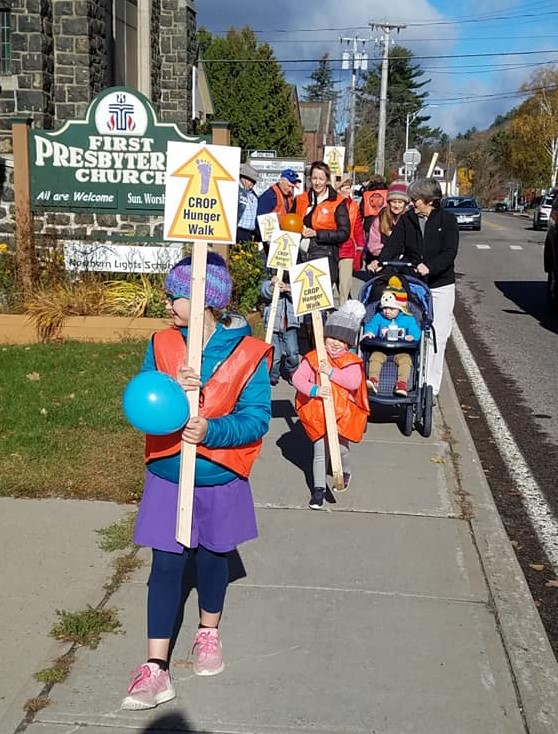
On World Food Day, we acknowledge that in the grand scheme of things, we may not be Jeff Bezos or Bill Gates, but we are the rich man. Lazarus is at our gate. Our hungry neighbors need our care and compassion. For about forty years, we have shown our passion for feeding hungry people with the CROP Walk, taking to the streets to raise awareness and funds to address the reality of hunger around the world and right here in Saranac Lake.  CROP Walk is an initiative of Church World Service, which seeks to address the root causes of hunger by enhancing the capacity of people to feed themselves. I’ll share a couple of examples.

In Honduras, the Miguel family has been subsistence farmers for generations, growing three crops: rice, beans, and coffee.  But then they enrolled in a program through Church World Service and learned how to diversify and grow new crops. The program transformed their small farm as they added vegetables, fruit trees, and grain. Next, they were taught how to raise barnyard animals like chickens and rabbits. Most recently, they have created a pond on their land to farm tilapia. Over the years, the Miguel family has been able to cultivate more land and add corn, squash, bananas, onions, cabbage and tomatoes to their fields. In fact, they have become so successful at growing produce and raising animals that they have been able to sell their surplus at market and put money in the bank. Their daughter Lesly is the first person in the family to attend school. This fall, they sent Lesly to university where she is studying to be a social worker.

In West Timor, Indonesia, Church World Service has launched a Zero Hunger Initiative that seeks to provide seeds, tools, chickens, and clean water access for all. One beneficiary of the program is Yabes.  Her daughter Sifrallili was chronically sick and malnourished, due to contaminated water and lack of fresh fruits and vegetables. CWS helped Yabes with a protected source of clean water and provided seeds and training to help her start a home garden. Things really turned the corner for Yabes and Sifrallili when they were given the gift of a rooster and three hens. Now they are collecting eggs and raising enough chickens to turn a profit. The chicken manure is used, too, to fertilize the garden and boost their veggie crop. Yabes reports that she has saved almost enough money to build a latrine for her family.

When we raise funds through CROP Walk, we are helping global neighbors like the Miguel family and Yabes to feed themselves and escape the cycle of hunger and poverty. Yet when we participate in CROP Walk, we are also taking a bite out of hunger right here in Saranac Lake. One quarter of the money that we raise returns to the community.  This year, we have designated the Wednesday evening Community Supper as the local beneficiary of the walk. The supper offers the opportunity for neighbors who are hungry or hungry-of-heart to gather weekly for a hot, nutritious meal.  Families with children, single folks, seniors from the DeChantal, and more are served, free of charge.  The supper provided meals throughout the COVID pandemic with a team of volunteers delivering take-out to people in their homes.

On World Food Day, we remember that our care for vulnerable neighbors is good for them, but according to Jesus, it’s a moral imperative that is also good for us.  We dream of the day when Lazarus no longer languishes at the gate, a day when all truly have enough.  Let’s lace up our walking shoes and make it happen. Amen.

Resources:

Barbara Rossing. “Commentary on Luke 16:19-31” in Preaching This Week, Sept. 25, 2016.  Accessed online at workingpreacher,org

Lois Malcolm. “Commentary on Luke 16:19-31” in Preaching This Week, Sept. 29, 2013.  Accessed online at workingpreacher,org

Church World Service. CROP Walk 2022 Resources and Activity Guide. Accessed online at CROP Hunger Walk Resources

Food and Agriculture Organization of the United Nations. Home | Food and Agriculture Organization of the United Nations (fao.org)


Luke 16:19-31

19 ‘There was a rich man who was dressed in purple and fine linen and who feasted sumptuously every day. 20 And at his gate lay a poor man named Lazarus, covered with sores, 21 who longed to satisfy his hunger with what fell from the rich man’s table; even the dogs would come and lick his sores. 22 The poor man died and was carried away by the angels to be with Abraham. The rich man also died and was buried. 23 In Hades, where he was being tormented, he looked up and saw Abraham far away with Lazarus by his side. 24 He called out, “Father Abraham, have mercy on me, and send Lazarus to dip the tip of his finger in water and cool my tongue; for I am in agony in these flames.” 25 But Abraham said, “Child, remember that during your lifetime you received your good things, and Lazarus in like manner evil things; but now he is comforted here, and you are in agony. 26 Besides all this, between you and us a great chasm has been fixed, so that those who might want to pass from here to you cannot do so, and no one can cross from there to us.” 27 He said, “Then, father, I beg you to send him to my father’s house— 28 for I have five brothers—that he may warn them, so that they will not also come into this place of torment.” 29 Abraham replied, “They have Moses and the prophets; they should listen to them.” 30 He said, “No, father Abraham; but if someone goes to them from the dead, they will repent.” 31 He said to him, “If they do not listen to Moses and the prophets, neither will they be convinced even if someone rises from the dead.”’


CROP Walkers head out for the Saranac Lake CROP Walk.