After the teacher asked if anyone had a sacred place and the students fidgeted and shrank
in their chairs, the most serious of them all said it was his car, being in it alone, his tape deck playing
things he’d chosen, and others knew the truth had been spoken and began speaking about their rooms,
their hiding places, but the car kept coming up, the car in motion, music filling it, and sometimes one other person
who understood the bright altar of the dashboard and how far away a car could take him from the need
to speak, or to answer, the key in having a key and putting it in, and going.
in Songs for the Open Road. Mineola: Dover Publications, 1999, p. 12.
Pulitzer Prize-winner Stephen Dunn once said he was an unlikely poet. The first in his family to earn a college degree, he attended school on a basketball scholarship, worked writing copy for Nabisco, and quit it all to travel to Spain and pen a failed novel. He found his calling as a writer when his purpose shifted from prose to poetry. The author of twenty-one collections of poetry, Dunn was hailed for his ability to explore the complexity of life by attending to the mundane. Rita Dove once wrote that Dunn was “a poet who time and again achieves that most difficult magic of the ordinary. He can take you by the hand and lead you along a street you may have passed through every day without much notice, and suddenly, at this new angle, the ordinary reveals in itself all the splendor and terror of existence.” He served as a distinguished professor of creative writing at Richard Stockton College before his death in 2021.
Poem for a Tuesday — “The Dogs in Dutch Paintings” by David Graham
How shall I not love them, snoozing
right through the Annunciation? They inhabit
the outskirts of every importance, sprawl
dead center in each oblivious household.
They’re digging at fleas or snapping at scraps,
dozing with noble abandon while a boy
bells their tails. Often they present their rumps
in the foreground of some martyrdom.
What Christ could lean so unconcernedly
against a table leg, the feast above continuing?
Could the Virgin in her joy match this grace
as a hound sagely ponders an upturned turtle?
No scholar at his huge book will capture
my eye so well as the skinny haunches,
the frazzled tails and serene optimism
of the least of these mutts, curled
in the corners of the world’s dazzlement.
— in 180 More Extraordinary Poems for Every Day, ed. Billy Collins. New York: Random House, 2005, p. 160.
David Graham is a teacher, writer, and poet. For twenty-eight years, he taught English literature and writing for Ripon College in Wisconsin. He was selected to serve as Resident Poet, as well as faculty member, at The Frost Place, a nonprofit educational center for poetry and the arts based at Robert Frost’s old homestead in Franconia, New Hampshire. Retired now, Graham lives on the southern edge of the Adirondack Park in Glens Falls, New York. He writes a monthly column, “Poetic License,” on poetry and poets for Verse-Virtual, an online community journal of poetry. He has written nine books of poetry. The most recent The Honey of Earth is available now from Terrapin Books.
Sabbath Day Thoughts — “Compassion or Contempt?” Luke 18:9-14
If you are like me, you probably cannot wait for November eighth to roll around so that the mid-term elections will be over. There are thirty-five U.S. Senate seats up for election in 2022—fourteen seats held by Democrats and twenty-one held by Republicans. All 435 seats in the House of Representatives are up for grabs. Here in New York, voters will be choosing a Governor. My eagerness for the eighth has little to do with my passion for the candidates. It’s more that I am feeling worn out and wearied by all the negative campaigning.
I’ve noticed that if you are a Democratic candidate, the best way to take your opponent down a peg is to call him or her a “Donald Trump January 6th Republican.” And if you really want to undo your Democratic opponent, just link their name to Nancy Pelosi or Joe Biden. Have you seen some of the mudslinging going on in the increasingly close New York Governor’s race? The advertisements have been downright meanspirited. According to Kathy Hochul, “Lee Zeldin is extreme and dangerous,” an anti-woman Trump sycophant who voted in congress to overturn the 2020 election. For his part, Lee Zeldin portrays Kathy Hochul as an incompetent, corrupt, pro-criminal, pro-inflation, tax-and-spend candidate. All that negative campaigning, it’s enough to make you give up watching the evening news.
Jesus once told a story of a Pharisee, who does some negative campaigning as he prays in the Temple. With hands uplifted and eyes looking to God, he begins with a prayer of thanksgiving. We expect that he will say, “Thank you, God, for all you have done for me, for all your grace and goodness, for all your bounty and blessing.” Instead, the Pharisee gives thanks that he is not like others. We get the impression that he is looking around the temple court and taking exception to his neighbors, whom he labels thieves, rogues, adulterers, and even tax collectors. It’s as if by calling God’s attention to the sins of others, the Pharisee hopes to shine a bit more brightly in God’s esteem.
Once the Pharisee has gotten his genuine but self-serving thanksgiving out of the way, we hear how his love for God is revealed in his zealous observance of God’s law. His piety is impressive and exceptional. The Pharisee tithes on all his income, not just on his harvest. He fasts twice a week, not just on required holy days, like the Day of Atonement. The Pharisee is pretty impressive. If we could work our way into God’s good graces, this man would get elected in a heartbeat. It sounds like he is entitled to a prime seat at the heavenly banquet.
And his opponent the tax collector? Not so good. He is a scoundrel. He has made a successful career of worshipping money. He earns a comfortable living by fleecing his people on behalf of their Roman overlords. Sure, he collects his neighbor’s taxes, but he also collects a generous surcharge for the trouble. Jesus says that as the tax collector prays, he stands far off, and he won’t even look up. He knows that he doesn’t have a leg to stand on, before God or neighbor. As the tax collector prays, he is overcome by his sin and shame. He beats his breast in grief and self-condemnation, crying, “Lord, have mercy! I am a sinner!” And he is a sinner. There’s no doubt about that. Everyone knows it. God knows it.
When it comes to negative campaigning, Jesus knew it was nothing new, and a short lesson from our national history reveals that even our founding fathers were masters of it. In fact, according to the historic record, what we see today is pretty tame stuff in comparison to the early days of our democracy. The first political race to get really down and dirty was the presidential election of 1800, which pitted Vice President Thomas Jefferson against the incumbent President John Adams. Although the two had been compatriots in their revolutionary fervor, there was no love lost between the men when it came to shaping the future of the nation.
Jefferson got it started. His camp accused Adams of having a “hideous hermaphroditical character, which has neither the force and firmness of a man, nor the gentleness and sensibility of a woman.” Adams’s supporters responded, calling Jefferson “a mean-spirited, low-lived fellow, son of a half-breed Indian squaw, sired by a Virginia mulatto father.” If you ask me, that sounds like the very first “Yo’ Mama” joke. It escalated from there. Adams was called “a fool, a hypocrite, a criminal, and a tyrant.” Jefferson was labeled “a weakling, an atheist, a libertine, and a coward.” Jefferson went so far as to hire a publicist to smear Adams. They circulated spurious reports that Adams planned to go to war with France after the election. Frightened voters rejected Adams and elected Jefferson as their new President. Jefferson’s publicist went to jail for the slander, former President Adams went home to Massachusetts, and Thomas Jefferson moved into the White House.
When Jesus first told his story of negative campaigning, it would have scandalized his listeners. Folks would have been shocked as they heard Jesus teach that the Pharisee, despite his very real piety and his genuine love for God and the Torah, is the one who got it all wrong. No one would have liked to hear that a dirty, rotten, low-life like the tax collector could find mercy and the chance to begin again in right relationship with God and his neighbors. It’s like saying that when Mother Teresa and Vladimir Putin arrive at the Pearly Gates, the doors swing open, and only Putin dances in. That’s pretty offensive. Isn’t it? That’s how uncomfortable this story would have made Jesus’ listeners feel.
When Jesus first told this story, he must have known that it was not only uncomfortable but also a little dangerous. Listeners could quickly trade their loathing of tax collectors for contempt of Pharisees. Then, in their rush to judgment, they would be like the Pharisee, feeling self-righteous and justified by despising the sins of someone else. I’m sure there was a long uncomfortable silence as Jesus proclaimed, “I tell you — this tax collector went down to his home justified rather than the other.”
When election time draws near in this marvelous and messy American experiment in democracy, we face head-on our human penchant for elevating ourselves by taking shots at others. Instead of standing on our own merit for who we are, what we believe, and what we have done, we vilify our opponent. We point out their flaws and foibles as a way of distancing and defining ourselves. He is this, but I am not. She did this, but I did not. They don’t deserve your vote, but I do. Polls say that Americans don’t like negative campaigning, but we don’t seem to be able to get away from it. Do we?
Jesus’s story confronts us with the universality of our brokenness. We can be short on compassion and long on contempt. We exclude and judge. We elevate ourselves by putting down others. Jesus cautions that we can love God all we want, but if we don’t love our neighbor, we’ve only gotten it half right. Being in right relationship with God requires that we seek to love our neighbors, even the dirty, rotten scoundrels. In the end, no one earns a place at that heavenly banquet table, not the Pharisee, not even Mother Teresa. In the end, God’s love is freely given, whether we are broken or whole, sinner or saint, Republicans or Democrats, Libertarians or Independents. Indeed, God loved us enough to die for us, long before we had the wherewithal or the courage to pray, “Lord, have mercy! I am a sinner!”
Well, my friends, as Nov. eighth draws near, we can anticipate that the negative campaigning will only get worse. We’ll hear all about the other candidate’s sins. Before the debates are over and the last ballot is cast, we may really hear a few “Yo’ Mama” jokes. It’s part of our national character, but even more so, it’s part of our human frailty. As the days grow short and our patience wears thin, let us remember Jesus’ shocking and dangerous story of the Pharisee and the tax collector. May we trade contempt for compassion. May we love God and neighbor, even the less than loveable ones.
Kathryn Schifferdecker. “Dear Working Preacher” in Preaching This Week, Oct. 16, 2022. Accessed online at workingpreacher.org.
For further information regarding the negative campaigning of Presidents Adams and Jefferson, see Kerwood Swint, “Founding Fathers’ Dirty Campaign,” August 22, 2008, CNN. com.
Luke 18:9-14
9 Jesus also told this parable to some who trusted in themselves that they were righteous and regarded others with contempt: 10 ‘Two men went up to the temple to pray, one a Pharisee and the other a tax-collector. 11 The Pharisee, standing by himself, was praying thus, “God, I thank you that I am not like other people: thieves, rogues, adulterers, or even like this tax-collector. 12 I fast twice a week; I give a tenth of all my income.” 13 But the tax-collector, standing far off, would not even look up to heaven, but was beating his breast and saying, “God, be merciful to me, a sinner!” 14 I tell you, this man went down to his home justified rather than the other; for all who exalt themselves will be humbled, but all who humble themselves will be exalted.’
October sixteenth is World Food Day, an international day of awareness celebrated every year to commemorate the founding of the United Nations’ Food and Agriculture Organization in 1945. We remember those who died on the battlefield during the second world war, but we do not always realize that many people lost their lives to famine. In 1943, famine in the Bengal Province of British India killed an estimated 3.8 million Bengalis. During the winter of 1944-1945 in the Netherlands, a German blockade cut off food and fuel shipments from farm towns, threatening 4.5 million people with starvation. In the far east, great famines occurred in Vietnam and Java in 1944–1945, claiming the lives of some 3.4 million people. To address the crisis of a hungry, war-weary world, the United Nations’ Food and Agriculture Organization was formed to address the root causes of hunger and improve and develop agriculture, forestry, fisheries, and land and water resources around the globe. On World Food Day, we acknowledge that we are a global community of neighbors, called to alleviate the suffering of those who hunger.
Despite the efforts of the UN Food and Agriculture Organization, hunger is again on the rise globally, thanks to the COVID-19 pandemic, war, and soaring inflation. Although there is more than enough food produced in the world to feed everyone, hunger affects about ten percent of the world’s population. What does that look like? 829 million people go to bed hungry every night. Since 2019, the number of people with acute food insecurity (who are malnourished and wasting) has surged from 135 million people to 345 million. 14 million children under the age of five suffer from acute malnutrition, think of the ashy skin, dull eyes, and bloated bellies of famine’s children in sub-Saharan Africa. Here in the United States, one in five children live in households that struggle to put food on the table. Here among our North Country neighbors, those numbers are higher. One quarter of our children in Franklin County live in food insecure households, where families have more month than money. On World Food Day, we are challenged to consider what we will do in response to hungry neighbors, near and far.
In our lesson from Luke’s gospel, Jesus shares a parable about a rich man with a poor neighbor. It’s a study in contrasts. The Greek word for “rich man” is plousios, and it means a wealthy landowner who does not labor for a living. Lazarus, on the other hand, is ptoxos, the poorest of the poor, a beggar without the stabilizing resources of property, friends, or family. The rich man lives behind the gate in a lavish home while the poor man Lazarus has fallen down or been left outside the gate. There he relies on the charity of those who pass him by. The rich man is clothed in a splendid robe of purple cloth and a fine inner garment of the purest linen. Lazarus is clothed in filthy rags and festering sores. The rich man rejoices in feasting sumptuously every day, yet Lazarus is hungry, longing to eat his fill from the refuse that falls beneath the table. The rich man would be respected by all. Lazarus is so powerless that he cannot even prevent the dogs from licking his scabby wounds.
As Jesus tells the story, death brings a great reversal. Lazarus finds himself seated at the heavenly banquet in the place of honored, next to his patriarch Abraham, who comforts and encourages him, while the rich man is endlessly tormented by flames in a shadowy underworld. Even in Hades, the rich man presumes that he can command Abraham and be served by Lazarus. The parable gets really uncomfortable when we hear that the rich man’s suffering cannot be relieved because it is a consequence of the choices he has made in life. With his indifference to his suffering neighbor, the rich man dug a great chasm that separated him from God and his neighbor. Lazarus had been at the gate, entrusted by the circumstances of his life to the care of his affluent neighbor, and the rich man never even noticed. Lazarus at the gate had been an opportunity to love generously and provide for the common good from the bounty with which God had blessed him, but the rich man could not be bothered.
The Bible scholars tell us that Jesus’s story about the rich man and Lazars is an apocalyptic parable, a vivid description of the afterlife that is intended to change our behavior, here and now. It’s a wake-up call that reveals a truth that Jesus wants us to see. Our failure to heed the warning can have the direst of outcomes. Jesus reminds us that Lazarus is at our gate, but we must open our eyes to see him, and we must be ready to love him. Our failure to engage the suffering of others has terrible consequences for our at-risk neighbors—and, according to Jesus, it has terrible consequences for us.
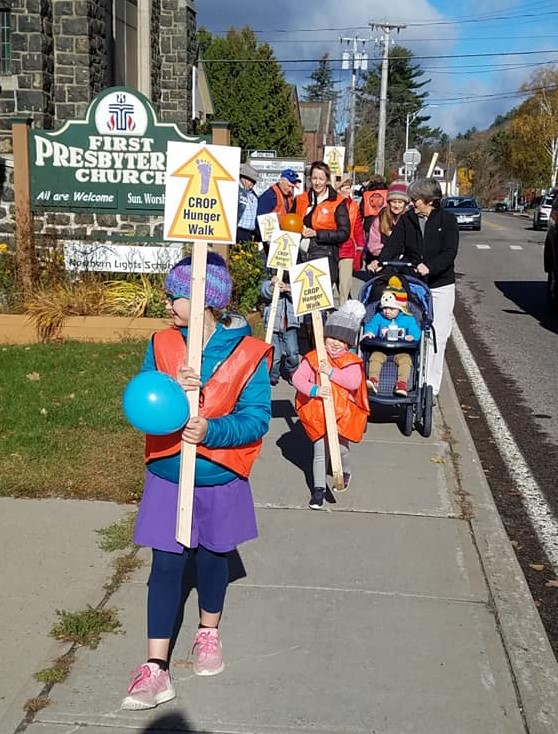
On World Food Day, we acknowledge that in the grand scheme of things, we may not be Jeff Bezos or Bill Gates, but we are the rich man. Lazarus is at our gate. Our hungry neighbors need our care and compassion. For about forty years, we have shown our passion for feeding hungry people with the CROP Walk, taking to the streets to raise awareness and funds to address the reality of hunger around the world and right here in Saranac Lake. CROP Walk is an initiative of Church World Service, which seeks to address the root causes of hunger by enhancing the capacity of people to feed themselves. I’ll share a couple of examples.
In Honduras, the Miguel family has been subsistence farmers for generations, growing three crops: rice, beans, and coffee. But then they enrolled in a program through Church World Service and learned how to diversify and grow new crops. The program transformed their small farm as they added vegetables, fruit trees, and grain. Next, they were taught how to raise barnyard animals like chickens and rabbits. Most recently, they have created a pond on their land to farm tilapia. Over the years, the Miguel family has been able to cultivate more land and add corn, squash, bananas, onions, cabbage and tomatoes to their fields. In fact, they have become so successful at growing produce and raising animals that they have been able to sell their surplus at market and put money in the bank. Their daughter Lesly is the first person in the family to attend school. This fall, they sent Lesly to university where she is studying to be a social worker.
In West Timor, Indonesia, Church World Service has launched a Zero Hunger Initiative that seeks to provide seeds, tools, chickens, and clean water access for all. One beneficiary of the program is Yabes. Her daughter Sifrallili was chronically sick and malnourished, due to contaminated water and lack of fresh fruits and vegetables. CWS helped Yabes with a protected source of clean water and provided seeds and training to help her start a home garden. Things really turned the corner for Yabes and Sifrallili when they were given the gift of a rooster and three hens. Now they are collecting eggs and raising enough chickens to turn a profit. The chicken manure is used, too, to fertilize the garden and boost their veggie crop. Yabes reports that she has saved almost enough money to build a latrine for her family.
When we raise funds through CROP Walk, we are helping global neighbors like the Miguel family and Yabes to feed themselves and escape the cycle of hunger and poverty. Yet when we participate in CROP Walk, we are also taking a bite out of hunger right here in Saranac Lake. One quarter of the money that we raise returns to the community. This year, we have designated the Wednesday evening Community Supper as the local beneficiary of the walk. The supper offers the opportunity for neighbors who are hungry or hungry-of-heart to gather weekly for a hot, nutritious meal. Families with children, single folks, seniors from the DeChantal, and more are served, free of charge. The supper provided meals throughout the COVID pandemic with a team of volunteers delivering take-out to people in their homes.
On World Food Day, we remember that our care for vulnerable neighbors is good for them, but according to Jesus, it’s a moral imperative that is also good for us. We dream of the day when Lazarus no longer languishes at the gate, a day when all truly have enough. Let’s lace up our walking shoes and make it happen. Amen.
19 ‘There was a rich man who was dressed in purple and fine linen and who feasted sumptuously every day. 20 And at his gate lay a poor man named Lazarus, covered with sores, 21 who longed to satisfy his hunger with what fell from the rich man’s table; even the dogs would come and lick his sores. 22 The poor man died and was carried away by the angels to be with Abraham. The rich man also died and was buried. 23 In Hades, where he was being tormented, he looked up and saw Abraham far away with Lazarus by his side. 24 He called out, “Father Abraham, have mercy on me, and send Lazarus to dip the tip of his finger in water and cool my tongue; for I am in agony in these flames.” 25 But Abraham said, “Child, remember that during your lifetime you received your good things, and Lazarus in like manner evil things; but now he is comforted here, and you are in agony. 26 Besides all this, between you and us a great chasm has been fixed, so that those who might want to pass from here to you cannot do so, and no one can cross from there to us.” 27 He said, “Then, father, I beg you to send him to my father’s house— 28 for I have five brothers—that he may warn them, so that they will not also come into this place of torment.” 29 Abraham replied, “They have Moses and the prophets; they should listen to them.” 30 He said, “No, father Abraham; but if someone goes to them from the dead, they will repent.” 31 He said to him, “If they do not listen to Moses and the prophets, neither will they be convinced even if someone rises from the dead.”’
CROP Walkers head out for the Saranac Lake CROP Walk.
Poem for a Tuesday — “Pennsylvania Station” by Langston Hughes
The Pennsylvania Station in New York Is like some vast basilica of old That towers above the terror of the dark As bulwark and protection to the soul. Now people who are hurrying alone And those who come in crowds from far away Pass through this great concourse of steel and stone To trains, or else from trains out into day. And as in great basilicas of old The search was ever for a dream of God, So here the search is still within each soul Some seed to find to root in earthly sod, Some seed to find that sprouts a holy tree To glorify the earth—and you—and me.
In Songs for the Open Road, Mineola: Dover Publications, 1999, p. 38.
Langston Hughes was an innovator of jazz poetry and one of the foremost poets of the Harlem Rennaissance. He was a descendant of the elite, politically active Langston family, free people of color who worked for the abolitionist cause and helped lead the Ohio Anti-Slavery Society in 1858. Hughes wrote from an early age, moving to New York City as a teen to attend Columbia University. In addition to poetry, Hughes wrote plays, short stories, essays, and non-fiction. From 1942 to 1962, he wrote an in-depth weekly column in a leading black newspaper, The Chicago Defender. In 1960, the NAACP presented Hughes with the Spingarn Medal for distinguished achievements by an African American. In 2002, his image was added to The United States Postal Service’s Black Heritage series of postage stamps.
A southward view of the concourse and its famous clock as seen on April 24, 1962. Cervin Robinson photo. Accessed online at https://www.american-rails.com/pnstn.html
Sabbath Day Thoughts — “Life in Exile” Jer. 29:1, 4-7
We all know how it feels to live in exile. Our beloved ones die. We labor in stressful, unfulfilling jobs. Our marriages are fraught. We can’t remember things like we used to. Our kids think we are the enemy. The doctor gives us health news that we do not want to hear. The COVID crisis sweeps across the world, cuts us off from normalcy, and fills us with anxiety. The evening news prompts fear and foreboding. We all know how it feels to sojourn in a time and place that feels far from the promised land.
The Israelites, our spiritual ancestors, were well-versed in exile. The armies of Babylon had overrun their promised land, like locusts swarming out of the north to devour everything in their path. They laid siege to Jerusalem, waiting for hunger to bring the city to its knees. When Jerusalem finally fell, the dead lay in the streets, too many to be counted. The Babylonians pulled down the city walls, sacked the palace, and burned the Temple, making off with the material wealth of the kingdom. Then, they plucked up the human wealth, conscripting everybody who was anybody, the royal court, elders, priests, artisans, and metal smiths and forcing them into exile. 500 miles across the desert, the Israelites marched a trail of tears to the capitol of Babylon. The survivors colonized the ghetto of Tel Abib and wondered what to do next. Babylon was a land they had always despised. They never dreamed that one day it would be home.
Life in exile doesn’t feel good. Our grief threatens to swallow us up. Our frustration and anger can explode with little warning. We take things out on others, or we take it out on ourselves with endless recrimination and critique. We fear that things will never get better—maybe things will get worse. We feel alone, alienated, and abandoned by those we have loved the most. In exile, we are existentially uncomfortable, cut off from better times and our better selves. We wrestle with despair. We ask, “Why me, God? Where are you, God?”
The people of Israel, exiled to Babylon, felt shell-shocked, bereft, and abandoned by God. They struggled with the terrible temptations that all exiles face. Some were tempted to despair, so overwhelmed by their circumstances that the best course of action seemed to be none at all – just give up, decline and disappear. Some were tempted to dissidence. Their hurt and anger were ready to explode in acts of violence against their Babylonian neighbors, even if that brought harsh reprisals and death. Others were tempted to assimilate, to give up their Israelite identities and become just like their captors, until no one was left who remembered the Torah or a faraway land that flowed with milk and honey.
Who can blame them? Because when life as we know it ends, when all our best dreams go up in smoke, when the rug gets pulled right out from under our feet, it’s only natural to give up, or act out, or opt out. It’s only natural to feel hopeless and angry and beaten. When we languish in the land of exile, we need help, holy help. We need hope that there is a better future, not a perfect future, but a tomorrow that feels a little safer and more meaningful than our today.
As the Israelites endured exile, Jeremiah was probably the last person from whom they expected a letter. For forty years, the prophet had warned them about the consequences of failing to love God and honor their neighbor. Back in Israel, they hadn’t liked Jeremiah. They had slapped him silly and bound him in stocks. They had thrown him in prison. They’d almost lynched him after his Temple sermon. Jeremiah was held in such low esteem in Israel that the Babylonians hadn’t even deemed him worthy of deportation. When Jeremiah’s messengers, Elassah and Gemariah, showed up in Tel Abib with a letter from the prophet, the Israelites must have thrown up their hands and said, “Now what, Jeremiah? A big ‘I told you so’?”
No one would have anticipated what Jeremiah really wrote: a message of comfort and reassurance from God Almighty, calling them to go about life as usual, even in exile. “Plant gardens, marry, have children, multiply and thrive, even pray for the peace of the strange city that you now call home. They could make a future, even in Babylon, because despite everything, God was still God. God loved them and would be with them. One day, exile would end and God would bring them home.
On this sabbath morning, perhaps we, who have felt exiled from better times and our better selves, can hear in the words of the Prophet Jeremiah God’s promise to us. We can dare to imagine that our grief may someday be tempered by the memory of love. Our work places can change or new opportunities emerge. Strained marriages can find healing and new ways forward. As memories fade, we can trust that others will remember for us and offer hands to help. One day, our kids will have kids of their own and develop a fresh appreciation for the hard choices and healthy limits that every parent must set. We learn to live with the new normal that the doctor prescribes. We remember that those who came before us lived with grace through pandemic and world war and economic roller coasters— and so will we. Jeremiah reminds us that we are not forgotten or alone. God is with us. We can do it. We can put one foot in front of the other and move ahead. Better days await.
Maybe Jeremiah’s letter got the Israelites thinking about all the other times when their ancestors sojourned in foreign lands without a future. Perhaps they remembered Abraham and Sarah, aging, childless, and “as good as dead” in the distant land of Haran. God had promised to make of them a multitude, as many as the stars in the sky. Maybe they thought of their ancestors groaning beneath Pharaoh’s yoke in Egypt. God had heard their cries and equipped Moses to bring them out of slavery and into that promised land. God had been faithful, and according to Jeremiah, God was faithful still.
So, the Israelites, languishing in the land of Babylon, found courage and took heart. They planted gardens and started businesses. They married and bore children. They found a fresh start in exile, even though it was the last place in the world that they had ever wanted to be.
Let me be your Jeremiah, my friends. Life in exile is crummy. There is no getting around it. But we can endure. Our lives have meaning and purpose. Change comes. The world turns. Dawn follows the dark night, even if it is the far brighter light of that far better shore. I am confident of those essential truths because God so loves us that God would choose to endure exile for our sake. God would take flesh and live among us with healing, compassion, and self-sacrificing love in Jesus of Nazareth. And when the world had done its utmost to exile Jesus, to cut him off from all that was good and merciful and kind, a new day dawned, the stone rolled away, and Jesus rose. And in that rising we trust that we, too, shall rise, and our times of exile will come to an end. For thus says the Lord God of hosts.
Terence E. Fretheim. “Exegetical Perspective on Jer. 29:1, 2-7” in Feasting on the Word, Year C, vol. 4. Louisville: Westminster John Knox Press, 2010.
Jeremiah 29:1, 4-7
29These are the words of the letter that the prophet Jeremiah sent from Jerusalem to the remaining elders among the exiles, and to the priests, the prophets, and all the people, whom Nebuchadnezzar had taken into exile from Jerusalem to Babylon. 4Thus says the Lord of hosts, the God of Israel, to all the exiles whom I have sent into exile from Jerusalem to Babylon: 5Build houses and live in them; plant gardens and eat what they produce. 6Take wives and have sons and daughters; take wives for your sons, and give your daughters in marriage, that they may bear sons and daughters; multiply there, and do not decrease. 7But seek the welfare of the city where I have sent you into exile, and pray to the Lord on its behalf, for in its welfare you will find your welfare.
“Sometimes the mountain is hidden from me in veils of cloud, sometimes I am hidden from the mountain in veils of inattention, apathy, fatigue, when I forget or refuse to go down to the shore or a few yards up the road, on a clear day, to reconfirm that witnessing presence.”
in A Book of Luminous Things, ed. Czeslaw Milosz. New York: Harcourt Brace, 1996, p. 72.
When British-American poet Denise Levertov was five years old, she declared she would be a writer. At the age of 12, she sent some of her poems to T. S. Eliot, who replied with a two-page letter of encouragement. Her father Paul Levertov was a Russian Hasidic Jew who taught at the University of Leipzig. During the First World War, he was held under house arrest as an enemy alien by virtue of his ethnicity. After emigrating to the UK, he converted to Christianity and became an Anglican priest. Denise said, “My father’s Hasidic ancestry, his being steeped in Jewish and Christian scholarship and mysticism, his fervor and eloquence as a preacher, were factors built into my cells.” She was described by the New York Times as, “the most subtly skillful poet of her generation, the most profound, the most modest, the most moving.” She wrote and published twenty-four books of poetry.
Sabbath Day Thoughts — “The Good Treasure” 2 Tim. 1:1-14
For most of us, our faith was formed by the guidance, influence, and instruction of others.
Country music superstar Dolly Parton speaks openly and authentically of her faith. The fourth of twelve children, born in a one-room cabin in Eastern Tennessee, Parton remembers daily times of prayer and Bible reading with her mother Avie Lee, who was the daughter of a pastor. Every Sunday morning, Avie Lee and her brood would head to her father’s little mountain church house, where Parton began singing and playing guitar at the age of six. Although Dolly’s family was what she called “dirt-poor”, she says, “We grew up believing that through God all things are possible.”
Academy Award winning actor Denzell Washington is widely known as a man of faith. His belief was grounded in the witness of his father, a Pentecostal minister and gospel singer. Denzell may be known for making Hollywood hits, but growing up, his father limited the family’s film viewing to movies based on Bible stories, like The Ten Commandments. He also encouraged Denzell to read the Bible daily, a discipline that Washington continues to practice. Denzell’s faith has kept him grateful and humble in an industry where fame can go to your head. Washington says, “[I] understand where the gift comes from. It’s not mine; it’s been given to me by the grace of God.”
Francis Collins is the former head of the National Institutes of Health and director of the Human Genome Project. Not raised in a family of faith, Collins was an atheist until he encountered a cardiac patient during his medical studies. An older woman who lived with chronic pain and serious health challenges, she was consistently sunny and upbeat. She spoke about her faith with Collins on more than one occasion until asking him, “So what about you? What do you believe?” That prompted Collins to do some research. On the recommendation of a Methodist pastor, Francis began some spiritual reading, including Mere Christianity by C.S. Lewis. Taking what he knew of science and looking at it through the lens of Christianity led to belief for Collins who looks at creation and says, “God must be an amazing physicist and mathematician.”
Many of us have similar stories. The faith that sustains us got its start in the witness of a parent or grandparent. The seed of faith was planted in the weekly discipline of going to church, the creative efforts of a Sunday School teacher, the prayers of a friend, the spiritual wisdom of a mentor, or the inspiring witness of a co-worker. How did you discover the good treasure of the gospel?
In his second letter to Timothy, the Apostle Paul reminds his young friend of the faith he found in the spiritual leadership of his grandmother Lois and his mother Eunice. We don’t know much about Lois or Eunice, but the fact that as women their names are remembered in that deeply patriarchal time says a lot. Timothy came from Lystra where Paul planted a church on his first missionary journey. We can imagine that Eunice and Lois were important leaders in that young church, fanning the flames of the gospel in a thoroughly pagan world. We can trust that as a youth Timothy attended church, shared in family prayers, and learned of God’s great love for him. Lois and Eunice must have sensed that Timothy would have a holy purpose for his life. The name Timothy, Timόtheos in Greek, means “honoring God.”
Paul’s letter also reveals that the apostle considered himself to be a spiritual father to Timothy, whom he called his “beloved child.” From Eunice to Lois to Paul, Timothy found belief through the good instruction and faithful witness of those who loved him. As Paul wrote these words, reminding Timothy of the faith that had been imparted to him, Paul was in prison, having stood trial and been condemned to death for his faith. Paul knew that his days were numbered. If the gospel were to continue to go forth across the empire, Paul would need a spiritual heir, someone like Timothy, who would hold to the standard of good teaching, keep the faith, and guard the good treasure that had been entrusted to him.
Scripture and tradition tell us that Timothy found courage and perseverance in his faith. The zealous young disciple acted as Paul’s scribe and co-author of the books of 2 Corinthians, Philippians, Colossians, 1 and 2 Thessalonians, and Philemon. He accompanied Paul on his missionary journeys, and when Paul was in prison, Timothy represented Paul at Corinth and Philippi. For a time, Timothy was also imprisoned for the faith. Church tradition teaches that after Paul’s death, Timothy served as bishop of the church at Ephesus, an important seaport on the west coast of Asia Minor. But in the year 97, Timothy ran afoul of a pagan group celebrating the feast of Catagogion, a festival in which they carried images of their gods about the streets. The pagan revelers beat Timothy with clubs. Two days later, he died.
We may not be Timothy, but we can all testify to the power of our faith. The good treasure of the gospel that has been imparted to us by others has been powerful. It has held our marriages together through dry times. It has prompted us to be better parents. We have prayed our way through workplace woes and health crises. The good treasure of faith has been the lifeline through our dark nights of the soul. We have faced the death of beloved ones, and we contemplate our own mortality, with confidence because we have faith; we trust that Jesus has prepared a place for us in his Father’s House. Thank goodness for those who have cared enough plant those gospel seeds in us, who ensured that we know we are beloved children of God through Jesus Christ.
Sometimes, the seeds of faith that are planted in us by others can prompt us to do remarkable things.
Dolly Parton says that she believes her music is more ministry than job. She has multiple best-selling country gospel recordings, and since 2019, she has collaborated to record hit records with contemporary Christian artists For King & Country, Zach Williams, and the Swedish duo Galantis. Dolly’s faith, however, has found its greatest expression in her efforts to promote children’s literacy. Her literacy program, Dolly Parton’s Imagination Library, mails one book per month to each enrolled child from the time of their birth until they enter kindergarten. Currently, over 1,600 local communities provide Dolly’s Imagination Library to almost 850,000 children each month around the world.
Denzell Washington feels the call to speak of his faith to a younger generation that needs God to negotiate these morally complex times. In his 2015 commencement address at Willard University, Washington advised students that the most important lesson in life is to “put God first” and have the heart to serve others around them. Denzell says that he is here “to serve, help, and provide.” He has been the national spokesperson for the Boys & Girls Clubs of America since 1993. With his family, he has launched the Gifted Scholars Program in Neurosciences. This innovative endeavor provides scholarships and fellowships for studies and research in brain science. A supporter of veterans, Washington also funded new housing for disabled Iraq War vets when he learned that there was no place for them to stay at Fort Sam Huston when they came for treatment.
Francis Collins, the world-renowned geneticist whose journey to faith was prompted by the tough questions of a patient, has been a leader in bridging the so-called divide between science and faith. He sees the laboratory as a place of worship that gives a glimpse of the mind of God. His 2006 bestselling book The Language of God: A Scientist Presents Evidence for Belief describes how his work on the Human Genome Project was like seeing the language that God uses to speak us into creation. In 2007, Collins established the BioLogos Foundation. The foundation addresses the escalating culture war between science and faith, seeking dialog and harmony between the two. In 2020, Collins was awarded the Templeton Prize for harnessing the power of the sciences to explore the deepest questions of the universe and humankind’s place and purpose within it.
Lois, Eunice, Paul, Timothy, Dolly, Denzell, Francis Collins, those are some inspiring witnesses, aren’t they? Their little—and big—efforts to live as people of faith and integrity are inspiring. This morning, may we find in their good examples the invitation to do some faith sharing of our own. Nurture the belief of the children in your life. Challenge the youth you know to put God first. Use your gifts and abilities to share God’s love. Build bridges that expand imaginations and lead to harmony between the secular and spiritual. Lois, Eunice, Paul, Timothy, Dolly, Denzell, Francis Collins—and you—those are some inspiring witnesses. Guard the good treasure entrusted to you. Amen.
1 Paul, an apostle of Christ Jesus by the will of God, for the sake of the promise of life that is in Christ Jesus,
2 To Timothy, my beloved child:
Grace, mercy, and peace from God the Father and Christ Jesus our Lord.
3 I am grateful to God—whom I worship with a clear conscience, as my ancestors did—when I remember you constantly in my prayers night and day. 4 Recalling your tears, I long to see you so that I may be filled with joy. 5 I am reminded of your sincere faith, a faith that lived first in your grandmother Lois and your mother Eunice and now, I am sure, lives in you. 6 For this reason I remind you to rekindle the gift of God that is within you through the laying on of my hands, 7 for God did not give us a spirit of cowardice but rather a spirit of power and of love and of self-discipline.
8 Do not be ashamed, then, of the testimony about our Lord or of me his prisoner, but join with me in suffering for the gospel, in the power of God, 9 who saved us and called us with a holy calling, not according to our works but according to his own purpose and grace, and this grace was given to us in Christ Jesus before the ages began, 10 but it has now been revealed through the appearing of our Savior Jesus Christ, who abolished death and brought life and immortality to light through the gospel. 11 For this gospel I was appointed a herald and an apostle and a teacher, 12 and for this reason I suffer as I do. But I am not ashamed, for I know the one in whom I have put my trust, and I am sure that he is able to guard the deposit I have entrusted to him. 13 Hold to the standard of sound teaching that you have heard from me, in the faith and love that are in Christ Jesus. 14 Guard the good treasure entrusted to you, with the help of the Holy Spirit living in us.
Sabbath Day Thoughts — “Father of the Seas” Job 38:1-18
We live in a watery world. 70% of our planet is covered by ocean. So important are the seas for the existence of life on earth that they are sometimes called the lifeblood or the lungs of the planet.
All life depends upon the water cycle that begins at sea. The ocean is warmed by the sun and water evaporates. Warm water vapor rises and condenses into clouds as it enters the cool air of the atmosphere. When clouds become filled with water, it precipitates, falling as rain or snow to fill our lakes, cap our mountains, bless our forests, and bring forth the harvest.
The ocean is equally essential in sustaining a breathable atmosphere. Scientists estimate that seventy percent of the oxygen in the atmosphere is produced by marine plants, which absorb carbon dioxide from the air and convert it to energy. At the same time, they release oxygen into the atmosphere, giving us fresh and healthy air to breathe.
The ocean is the great temperature regulator of the planet. It absorbs heat in summer and disperses it in winter. Currents within the ocean, like great rivers, sweep the globe, bringing warm tropical waters north and cool arctic waters south. For example, the Gulf Stream sweeps northward through the Atlantic, bringing warmer tropical waters, rain, and milder winters to the United Kingdom and Scandinavia. In fact, without the ocean to moderate the earth’s temperature, this planet would be in perpetual winter.
The ocean is also a haven of stunning biodiversity. Microscopic marine plants (phytoplankton) are the great base of the ocean food chain. Bioluminescent fish dwell in the watery depths of the sea, never seeing the sun but generating their own light. Enormous blue whales, the largest creatures to ever exist on the planet, live ninety years, can reach up to 110 feet, weigh more than 330,000 pounds, and eat six tons of tiny crustaceans called krill every day. How amazing is that?
One of the most essential truths that we embrace as people of faith is that God created the world and all that is in it. In pondering the ocean, we can affirm that God is a master creator with a stunning, interconnected, complex plan for the flourishing of life as we know it.
Our reading from the Book of Job offers one of many descriptions in scripture of God’s work in creation. According to Job, God spoke out of the whirlwind, remembering the birth of the ocean. The primordial waters gushed forth from the cosmic womb and into the hands of God, who shaped them and set their bounds and limits. Next, God clothed the deeps, like a newborn child. God wrapped them in clouds and swaddled them in darkness. Then, God swam through the springs of the sea and walked in the recesses of the deep.
I love this particular creation story. It affirms the truth that God is the great creator, but it does a whole lot more. In the setting of limits and the forging of bounds, we hear that bringing our oceans into being was hard and intentional work. In the holding and clothing of the seas, we hear God’s love for the ocean, like a parent tending a firstborn child. Finally, as God swims through the waves and walks upon the sea floor, we learn that God inhabits and delights in creation. Anyone who has done a little body surfing at the beach or snorkeled along a coral reef knows the joy that God experiences in the ocean. Indeed, this is a creation story that inspires both awe for the Creator and reverence for God’s watery creation.
Unfortunately, our oceans are in trouble and the problem is manmade. We have used our oceans as a dumping ground. Have you heard of the Great Pacific Garbage Patch? It’s a floating dump in the middle of the North Pacific Ocean, two-times the size of Texas. Prevailing currents have collected trash from America and Asia into a 100-million-ton debris field. It’s an ecological catastrophe.
Plastic pollution is one of the biggest challenges to healthy seas. 17.6 billion pounds of plastic enter our oceans every year. That’s equivalent to a garbage truck load of plastic being dumped into the sea every minute. Five trillion plastic pieces weighing 250,000 metric tons are floating in our oceans right now.
Climate change greatly impacts our oceans. In the last fifty years, oceans have absorbed ninety percent of the excess heat caused by global warming. That means that ocean temperatures are rising, especially along coastlines and at the poles, where scientists say the earth is warming twice as fast as at the equator. Cold water habitats are shrinking, including places where phytoplankton grow, that most essential link in the world’s food chain. As our oceans absorb the growing carbon dioxide in our atmosphere, that increases the acidity of waters, killing coral reefs and eroding the shells of clams and crabs.
That stunning biodiversity of our seas is at risk, too. 90 million tons of seafood are fished each year. Sixty percent of the world’s fisheries are overfished and in danger of collapse. In 1992, years of overfishing led to the collapse of the Canada’s Grand Banks. 40,000 fishermen found themselves out of work. Despite a moratorium on cod fishing, the Grand Banks cod population has never recovered.
It isn’t just the fish we eat that is a threat to biodiversity. In the twentieth century, the whaling industry killed an estimated 2.9 million whales. That’s a marine holocaust. Some species, like the blue whales were reduced in population by ninety percent, putting them at risk for extinction.
It isn’t just what we fish. It’s how we fish. Trawling drags massive nets along the sea floor disrupting the ecosystem. Every year, hundreds of thousands of whales, dolphins, and porpoises are killed as they are caught and drowned in commercial nets – a practice that the fishing industry refers to a “bycatch” as if this is an acceptable by-product of the business.
If God were to speak to us from the whirlwind this morning, it would be a tale of lament. The father of the oceans would weep as their beloved child suffers. God would swim through the Great Pacific Garbage Patch in disgust. God would walk the devastated ocean floor in despair. In our misuse of the oceans, we have failed to honor the creator and the creation. The lifeblood of the planet is bleeding out. The lungs of the earth are gasping for air. We have treated the keystone of creation like a sewer and a boundless resource for our personal profit. In doing so, we have threatened death to the planet. It is time to gird up our loins like adults and account for our actions. Lord, have mercy.
So, what we can do? It begins with a shift in how we see the world around us. If God is, indeed, the Creator who has birthed and delights in the creation, then we, as people of faith are called to touch the earth lightly, to carefully consider the impact of our actions upon this great web of being that God has woven. If we can live and act from a place of reverence and humility, then there is hope for our oceans.
We can all make lifestyle choices that reduce our impact upon the oceans, starting with plastics. We can stop using single use plastics like straws, cutlery, coffee cups, water bottles, plastic bags, and take-out containers. If every American just used five fewer straws each year, it would keep 1.5 billion straws out of our landfills and oceans. We can also demand that restaurants and industries use and develop plastic alternatives like compostable containers for leftovers, re-useable cloth bags for produce, and bio-degradable plastics made from corn.
We can reduce our carbon footprint and take our little bite out of global warming. If you live in town, try walking or riding a bike to run errands. If you live out of town, combine errands to make only a trip or two each week. Turn off lights when you leave a room. Better insulate your home to reduce fuel consumption. Consider turning back the thermostat at night or when you are away from home for eight or more hours – you’ll save money and reduce heat loss through your building envelope. Those of us who are carnivores can try eating less meat. Land-based proteins like beef, pork, and lamb generate methane, a greenhouse gas, as part of their digestion. If we really want to cut the world’s carbon footprint, we can make peace. War consumes massive amounts of fossil fuels, devastates the natural world, and warships release extreme amounts of waste into bodies of water, degrading marine habitats and coastlines.
We can also do our part to maintain that stunning biodiversity of the ocean. It can begin by making wise choices at the grocery for seafood that is sustainably fished or farmed. I’ve made some copies for you of Monterey Aquarium’s Seafood Watch National Consumer Guide. The aquarium monitors the fishing industry to determine which seafoods are most sustainably fished or farmed. They adjust their guide every six months so that you can trust that your fish dinner isn’t coming from fishing stocks in danger of collapse. We can also speak out about “by-catch” that murders marine mammals in pursuit of a profit, and we can only purchase tuna that is sustainably caught – look for a label saying so on the can. Finally, tell others about the importance of consumer choices for the world’s fisheries, and let your favorite restaurant know that you only want to see sustainable options on the menu.
We live in a wonderful, watery world. It’s the pride and joy of the Father of the Seas. On this Care for Creation Sunday, let’s resolve to do our part to keep the planet’s lifeblood flowing and lungs breathing.
38 Then the Lord answered Job out of the whirlwind:
2 “Who is this that darkens counsel by words without knowledge? 3 Gird up your loins like a man; I will question you, and you shall declare to me.
4 “Where were you when I laid the foundation of the earth? Tell me, if you have understanding. 5 Who determined its measurements—surely you know! Or who stretched the line upon it? 6 On what were its bases sunk, or who laid its cornerstone 7 when the morning stars sang together and all the heavenly beings shouted for joy?
8 “Or who shut in the sea with doors when it burst out from the womb, 9 when I made the clouds its garment and thick darkness its swaddling band, 10 and prescribed bounds for it, and set bars and doors, 11 and said, ‘Thus far shall you come and no farther, and here shall your proud waves be stopped’?
12 “Have you commanded the morning since your days began and caused the dawn to know its place, 13 so that it might take hold of the skirts of the earth, and the wicked be shaken out of it? 14 It is changed like clay under the seal, and it is dyed like a garment. 15 Light is withheld from the wicked, and their uplifted arm is broken.
16 “Have you entered into the springs of the sea or walked in the recesses of the deep? 17 Have the gates of death been revealed to you, or have you seen the gates of deep darkness? 18 Have you comprehended the expanse of the earth? Declare, if you know all this.
Sabbath Day Thoughts — “Mercy, Me!” 1 Tim. 1:12-17
Oren Kalisman grew up with Muslim neighbors he never met. In fact, as a Jewish child growing up in the Galilee, Oren’s only childhood memory of interacting with a Muslim neighbor was when his mother stopped to give a ride to an old man, hitchhiking on the road to the next village. At eighteen, Oren, like his parents before him, began compulsory military service with the Israeli Defense Forces. He was selected for an elite squad of paratroopers with twenty soldiers under his command.
When the second intifada began in 2000, Oren and his unit were deployed outside a refugee camp. There they used snipers to pick off alarmed Palestinians who emerged to defend their homes with rocks and Molotov cocktails. In 2002, a solo Palestinian attack at an Israeli checkpoint killed six Jewish soldiers. Orders came from Oren’s commanding officers: the Muslim policemen manning Palestinian check points in the West Bank were to be killed in retaliation. Fifteen officers were executed.
Oren justified the violence that he and his men perpetrated. If someone was throwing a Molotov cocktail at you, they should be killed. Likewise, someone had to pay for the murder of six Israeli soldiers, even if those killed had nothing to do with the attack. Oren was just doing his job. He was following orders.
In our reading from 1 Timothy, the Apostle Paul alludes to his track record as a man of violence and a persecutor of Christians. As a devout youth, Paul had studied with the esteemed rabbi Gamaliel in Jerusalem and become an expert in the Torah. Paul practiced Pharisaic teachings, which touted an extreme piety and devotion as the best way to please God. In his zeal as a young Pharisee, Paul had endorsed the stoning of the deacon Stephen, the first martyr among Jesus’ followers. Paul had also harassed the church in Jerusalem, and when many fled to Syria, Paul sought special permission to take his violence on the road, to arrest and return to Jerusalem for punishment all who believed that Jesus was the Messiah. Paul justified his violent behavior, believing that he was rooting out a dangerous sect that defiled Judaism with the news of a false Messiah.
We may not be members of the Israeli Defense Forces or Pharisees censuring blasphemers, but we know how it feels to be troubled by our pasts, even when we believed that what we were doing was true and righteous. In fact, our past may continue to haunt our present and trouble our thoughts about the future.
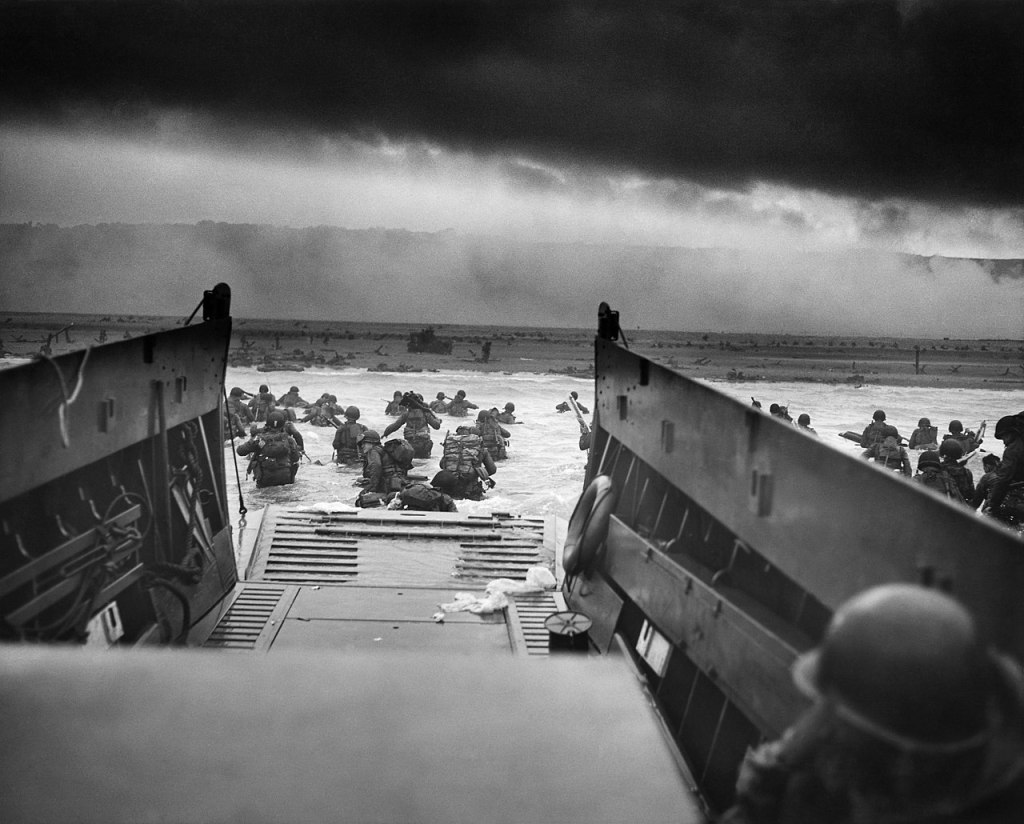
Before coming to Saranac Lake, I enjoyed being a youth pastor in Morton Grove, Illinois. I like to think that I did some good ministry among the young people of the church, but I think some of my best service was in providing caring presence and compassionate listening for some of the church’s oldest members, our World War II veterans. They were troubled by remembrance of the friends they left behind on the beaches of Normandy. They were disturbed by memories of the hate and violence they had directed toward Japanese enemies in the South Pacific. They realized that they had brought the war home with them after it was over. They kept secrets from their wives. They had been emotionally distant with their children. As Morton Grove welcomed an increasing number of Asian immigrants, they struggled to let go of their painful memories and love their new neighbors. There were any number of ways that they could reasonably justify their past actions, but their violent pasts still troubled them.
In my twenty-two years of serving churches, I have learned that we can all be troubled by our pasts, whether we have embraced violence and persecution or we have simply engaged in practices that wound the spirit or brought injury to others. We regret the harm we have caused our families: our impatience and harshness with our children, our failures to care for aging parents, or the too little love that we have shown to our spouse. We regret the harm we have worked against the human family: our gender bias, our racial hate, our prejudice toward those whose ethnicity, social class, or political views are unlike our own. We can be adept at justifying our actions and rationalizing our bad behavior, but when we are truly and deeply honest, we know our need for grace. We know the late-night hours when we pray, “Lord, have mercy upon me, a sinner.”
Paul’s past caught up with him as he hurried down the Damascus Road, intent on arresting those who knew Christ as Lord. According to the Acts of the Apostles, Paul was stopped dead, blinded by a heavenly light, and accused by the aggrieved Jesus, “Saul, Saul, why do you persecute me?” Struck blind and powerless, the incapacitated Paul was taken to Damascus, where he spent three days without sight, neither eating nor drinking, pondering how he had gotten things so wrong.
Oren Kalisman’s turn around came during the Passover in April 2002. In response to a terror attack in Netanya, Oren and his men were sent into the West Bank with orders to occupy Nablus, using whatever means were necessary. From the second floor of a home that they had occupied, Oren heard gunfire from the room next door. There, one of his men, a sniper, was firing at an unarmed old man who was seeking to recover the body of a boy, dead in the street below. When Oren ordered his soldier to stop firing, he learned of orders from their commanding officer to kill with impunity. Shocked at the inhumanity they had resorted to, Oren realized the moral quandary he was in. Remembering that moment, the Israeli says, “We were surrounded by Palestinians who were fighting very bravely and who I realized, like ourselves sixty years ago, were fighting out of desperation for their very homes.” At the end of the operation, Oren voiced his moral concerns and asked to be replaced.
We all have our Damascus Road moments when we are convicted of the harsh truth of sin. Sin confronts us in the dysfunction that we instill in our families. Sin shouts at us from the evening news as the murder of George Floyd, the shooting of Breonna Taylor, or the lead in Jackson, MI drinking water remind us of that racism is part of the fabric of our society. If we are at all self-aware, we will admit the sin of writing off relationships, doing the wrong thing because it is the easy thing, and allowing ourselves to hate others because their political views are unlike our own. When we sin against our neighbors, we sin against God. We sin against Jesus, who asks why we are persecuting him. Lord, have mercy upon us.
Paul tells us good news. Although we act in ignorance and unbelief, the grace of God overflows for us. Jesus came into the world to save sinners—of whom Paul deemed himself to be foremost. We are loved and forgiven. And in the greatness of Christ’s mercy for us, we find a new purpose in service to God and neighbor. Jesus would use Paul’s zeal to serve God’s Kingdom. The former persecutor and newly Christened apostle would make multiple missionary journeys, plant countless churches, and touch many lives with the good news of God’s amazing grace that seeks and saves us when we are lost.
Oren Kalisman has found a new purpose. He has established a chapter of Combatants for Peace in the West Bank community of Nablus where he once was an occupier. Combatants for Peace brings together former members of the Israeli Defense Forces and former Palestinian combatants. They share their stories, build relationships, and learn principles of non-violent conflict resolution. Their goal is nothing less than building a foundation for Israelis and Palestinians that will bring lasting peace to the land.
My wise World War II friends knew that the only way forward from a war to end all wars was through the love and grace of God in Jesus Christ. They trusted that, even though they might always be troubled by their war experiences, the grace of God overflowed for them. They poured out their lives in God’s service in simple heartfelt ways. They attended church every Sunday. They shared their skills and abilities for God’s glory: founding a church, building a manse, tending the church gardens, serving on session. They kept God at the heart of their families with Sunday School and table graces, mission trips and church potlucks. They knew their weakness and trusted that the Lord could do what they could not. In the eighteen years since I served as one of their pastors, those men have all died. I have no doubts that grace led each of them home.
The grace of Jesus Christ overflows for us this morning. We are loved and God is faithful, even if we are, like Paul, the foremost of sinners. Our immortal, invisible, only-wise God redeems us with a love that is stronger than the persecution of Pharisees or the intractable violence between Israelis and Palestinians. God’s mercy for us is bigger than the legacy of war or all the ways that we can get things so wrong in our families and the human family. The mercy of God abounds for us and claims us for God’s purpose. Lord, have mercy!
If you would like to learn more about Combatants for Peace, you can at this link: https://cfpeace.org/
Eric Barreto. “Commentary on 1 Tim. 1:12-17” in Preaching This Week, Sept. 11, 2016. Accessed online at workingpreacher.org
Benjamin Fiore. “Commentary on 1 Tim. 1:12-17” in Preaching This Week, Sept. 15, 2019. Accessed online at workingpreacher.org
Christian Eberhart. “Commentary on 1 Tim. 1:12-17” in Preaching This Week, Sept. 15, 2013. Accessed online at workingpreacher.org
A.K.M. Adam. “Commentary on 1 Tim. 1:12-17” in Preaching This Week, Sept. 12, 2010. Accessed online at workingpreacher.org
1 Timothy 1:12-17
12 I am grateful to Christ Jesus our Lord, who has strengthened me, because he considered me faithful and appointed me to his service, 13 even though I was formerly a blasphemer, a persecutor, and a man of violence. But I received mercy because I had acted ignorantly in unbelief, 14 and the grace of our Lord overflowed for me with the faith and love that are in Christ Jesus. 15 The saying is sure and worthy of full acceptance: that Christ Jesus came into the world to save sinners—of whom I am the foremost. 16 But for that very reason I received mercy, so that in me, as the foremost, Jesus Christ might display the utmost patience as an example to those who would come to believe in him for eternal life. 17 To the King of the ages, immortal, invisible, the only God, be honor and glory forever and ever. Amen.