With You Always

Sabbath Day Thoughts — “With You Always” Matthew 28:16-20

The disciples felt both overwhelmed and a little scared after their mountaintop meeting with Jesus. As the risen Lord said goodbye to his friends, he entrusted them with the continuation of his ministry. “Go and make disciples of all people,” Jesus said, “Baptize and teach!”

The disciples looked at one another, feeling the sudden weight of responsibility. If the good news of God’s love was going to go forth into the world, then they were the ones who must take it. It was a big job, and they weren’t sure they could do it. Andrew shook his head, the way he always did when he had a big question that he couldn’t possibly answer, “Did Jesus say we should make disciples? I thought we were the disciples!  Surely, Jesus doesn’t think we’re ready to do what he did.”

As Jesus’ commission and Andrew’s question sank in, the disciples felt a little panicky. They didn’t have what it would take. There wasn’t a Torah scholar among them. They didn’t have any powerful political connections. Not one drop of priestly blood flowed in their veins, and their name was mud in the Temple. They were a sorry lot, and no one had the deep pockets to bankroll their efforts. And, to be honest, they didn’t have the best track record when it came to following Jesus. One of them betrayed him. All of them deserted him. Peter denied him—three times. Even now, some of them were filled with doubt. This Great Commission, how would they begin? They were ready to give up before they even got started.

Maybe it was then that Peter spoke up, “I remember when Jesus called Andrew and me.  We were fishing, and Jesus came along the lakeshore and said, ‘I will teach you to catch people.’” Then, James and John reminisced, “We were mending nets with our father when Jesus said, ‘Follow me!’” Nathanael told them that Jesus saw him under a fig tree and said “Here is truly an Israelite.” He really hadn’t known what that even meant at the time, but he wanted to find out. Matthew confessed, “I was sitting in my tent counting money, but Jesus told me he had a different kingdom that he wanted me to serve. I left to follow him the same day.”

The disciples remembered how each of them came to follow Jesus. All Jesus did was make the invitation, and each of them had answered, “Yes.” “You know,” Peter said, “we can do that! Let’s just invite people, lots of people. Some of them are bound to say yes.”

The pragmatist Thomas spoke up next, “So, we invite all these people, and they decide to follow us. What are we supposed to do with them next?”

Peter suddenly looked very worried at the prospect of being followed by a crowd of strangers who expected him to know what to do. He put his hands to his head and said, “O Lord, help us!”

But Simon the Zealot, a natural risk taker who was undaunted by challenge, shouted, “Yes, Peter! That’s it! We begin with prayer! We ask the Lord to help us. We pray—and we teach others to pray.”

The disciples remembered all the times that they woke up early in the morning and found Jesus in a quiet place, head bowed in prayer. They recalled how Jesus called them to pray and find rest on the mountaintop or in the wilderness. Then it occurred to them that Jesus had taught them to pray—it was simple and short and to the point—it was so easy that even they could ground their work in that sort of prayer. All at once they prayed together, “Our Father, who art in heaven!”

“What do you think we should teach our disciples?” Bartholomew wondered. 

Peter, whose conscience was bothering him about the three times he denied Jesus, knew the answer. “I think we need to teach them about forgiveness.” Matthew agreed, “Forgiveness! Yes! There I was a tax collector, stealing from my own people, but Jesus called me and forgave me!” The disciples agreed. If they were going to make disciples, they could help people understand that Jesus met people right where they were at. He forgave their mistakes and flaws and short comings. Jesus believed they could lead new, more faithful lives.

Mary the mother of the Lord spoke up then, saying, “Even as my son was dying, he prayed for his executioners, ‘Father, forgive them!’” At that they all bowed their heads and thought about the people whom they needed to forgive as soon as they got down off the mountain.

It was Mary Magdalene who spoke next, “If we want to encourage people to be followers of Jesus, then we must teach them to be compassionate, to specially care for the most vulnerable of our neighbors. I was so sick that people said I was possessed by seven demons, but Jesus made me well. I will share my story to teach others of the compassion of Christ.”

The disciples remembered Jesus’ compassion: 10 lepers made clean, hungry people fed, a blind man whose eyes were opened, a deaf man given ears to hear, and so many little children welcomed and blessed.  They all agreed: telling those stories and setting a compassionate example could encourage others to be compassionate, too. Everyone turned and smiled at Mary Magdalene, “Yes, compassion!  How wise you are sister.”

“Wait a minute!” It was Thomas again. “Have we thought about who these new disciples are going to be? Are we talking friends, neighbors, co-workers, strangers?  I need a little clarity here.”

The disciples thought. One spoke up, “Well, I know someone who struggles with crippling guilt for a past mistake. He needs a lesson in forgiveness. I’m going to ask him.” Another said, “I have a cousin who despairs of life. She doesn’t know she is beloved. I’ll ask her.” James remembered, “I have an old fishing buddy. He has fallen on such hard times. He is in deep need of some compassion. I shall invite him!” Simon the Zealot, who always felt a bit like an outsider said, “We have to remember the outsiders! Don’t forget that Jesus reached out to unlikely people, like that Samaritan woman and the centurion’s slave.” They decided that if they were going to follow in Jesus’ footsteps, they would welcome all people, even the ones who made them feel uncomfortable.

The disciples were feeling pretty good until they realized that they didn’t have many resources for their teaching, no hand-lettered vellum scrolls of the Torah, no rabbinic shul, no posh retreat center on the shores of Galilee. It was a tense moment, until they realized that Jesus hadn’t needed all that. He taught on hillsides and lakeshores, in homes and gardens, and even while sitting in a boat. Jesus simply taught wherever he was. And Jesus used the world around him to make his point. Tiny mustard seeds proved that improbable disciples could do big things. Lilies of the field taught them not to worry. Birds of the air were a reminder of God’s incredible love for them.

The disciples looked at the world around them and saw the everyday tools they would use in teaching. Judas the son of James struck a spark with a flint and said, “We are the light of the world!” Mary Magdalene pretended to knead bread and quoted, “The kingdom of heaven is like yeast that a woman took and mixed in with three measures of flour.” Not to be outdone, Peter scrambled up on top of a big stone, flexed his muscles, and said, “This is the rock upon which Christ will build the church!” Everyone laughed and pulled Peter down from his rocky highpoint.

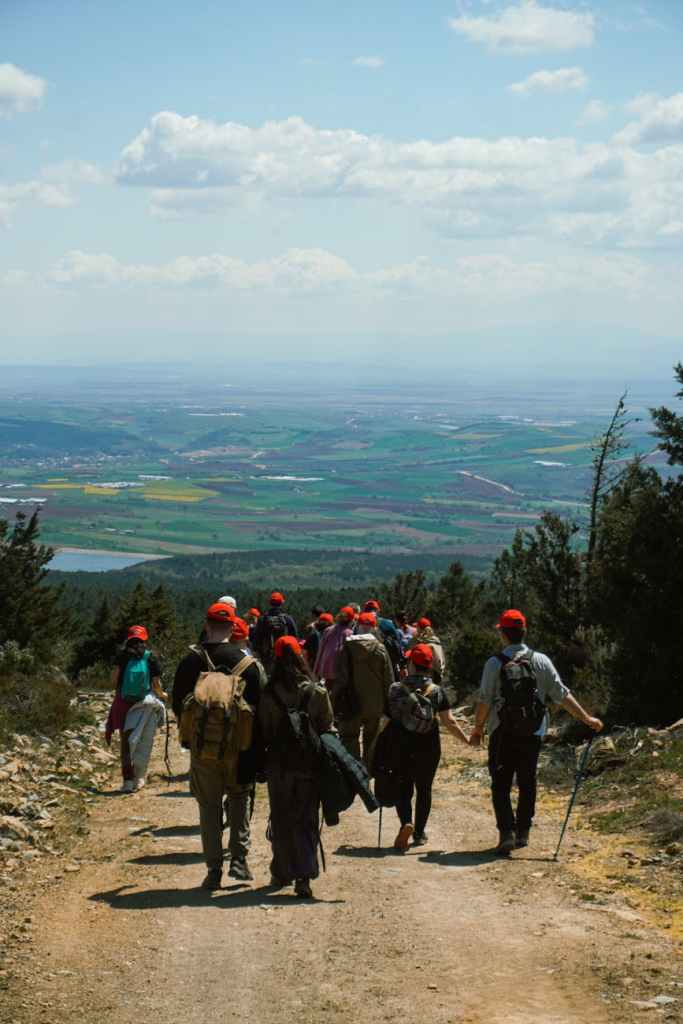
They looked down from the mountaintop, at the world spread out at their feet. Far below them, they saw the checkerboard fields of farms. Off to the east they could make out busy fishing villages along the shores of Galilee. Off to the west, wrapped in haze, seaports dotted the Mediterranean coast and harbors bustled with the trade of empire. Off in the distance to the north rose the mountains of Lebanon, with Mt. Hermon’s snowy peak towering high above them all. Somewhere out there, past the Jordan Valley and the Great Salt Sea, were the sprawling windswept sands of the desert. It was, indeed, a dazzling, diverse, beautiful, terrible world out there. They had a big job to do. It wouldn’t be easy, but together they saw that they could do it.

Thomas shrugged off his doubts and stood tall. He had the last word. “I don’t know if I am up to this job, but Jesus is with us always—to the end of the age. Let’s make disciples!” They packed their gear and headed down to the waiting world below.

Go therefore, my friends. Make disciples of all people. Baptize them in the name of the Father and of the Son and of the Holy Spirit. Teach them to observe everything that Jesus has commanded us. And remember, Jesus is with us always, even to the end of the age.


Matthew 28:16-20

16 Now the eleven disciples went to Galilee, to the mountain to which Jesus had directed them. 17 When they saw him, they worshiped him, but they doubted. 18 And Jesus came and said to them, “All authority in heaven and on earth has been given to me. 19 Go therefore and make disciples of all nations, baptizing them in the name of the Father and of the Son and of the Holy Spirit 20 and teaching them to obey everything that I have commanded you. And remember, I am with you always, to the end of the age.”

Shine

Sabbath Day Thoughts “Shine” Luke 9:28-43

We have all had mountaintop moments, those bright and shining experiences when we feel close to God, one another, and the world around us. I have shared before that one of my mountaintop moments came at age twelve. That’s when I was baptized at the First Baptist Church. I had made my profession of faith and passed the scrutiny of the trustees. In an evening service of worship, in a dimly lit sanctuary, I waded into the bright baptismal tank where my pastor waited to immerse me. Going into the tank, I was most worried about my white robe floating up to expose my underwear. But once I was in the water, I could only think that this was exactly where I belonged, in waters as warm and welcoming as God’s love for me.

Later, as a young adult, I had a mountaintop moment that was instrumental in steering me toward seminary. I was volunteering in a mental health outreach ministry of the New York Avenue Presbyterian Church. Every Wednesday evening, the hall filled with a small faithful core of church volunteers, residents of St. Elizabeth’s Hospital and area halfway houses for folks living with mental illness, and homeless neighbors. On my first Wednesday night, I was a little scared. But one evening, as I served ice tea to my new friends, I felt God’s limitless love, not just for me but for all of us in the church hall. It was like getting hit by a freight train in a good way. God’s limitless love was there, always there, holding us, helping us, blessing us. I knew right then and there that I wanted to spend my life in that love.

Your mountaintop moments may be similar or very different. Perhaps you had that sense of connection to God, creation, and humanity as you held your newborn child, your heart filled to the bursting point by the incalculable miracle of that moment. Perhaps your mountaintop moment came on the athletic field. As you worked with teammates in a shared purpose, you found in that unity that you could be better than you actually were, that in your shared love for the game and one another and your collaborative pursuit of excellence you were blessed; you belonged. Perhaps your mountaintop moment came in nature, whether you were summiting your 46th high peak, or paddling through the St. Regis canoe wilderness, or standing open-mouthed and filled with wonder in the eerie twilight of a total eclipse. Perhaps your mountaintop moment came in worship. It might have felt like an ordinary Sunday to others, but in the singing and the prayers, the message and the fellowship, you knew the nearness of God and your own belovedness.

If we all have mountaintop moments, then we all have valley moments, too. These are the occasions when our hearts tremble before the challenge that we face. I grew up in the valley of family dysfunction, a household troubled by alcohol abuse, domestic violence, and mental illness. The more my family under functioned, the more I tried to over function—to make peace, offer protection, be loving, be perfect. It often felt precarious, powerless, and scary. Your valley moments may have similar roots in a wounded family. Or, the valley may find us when our hearts are broken by the painful and puzzling end of a long, committed relationship. The valley finds us as we confront a bleak diagnosis or support a loved one in a time of health crisis and suffering. The valley finds us when our children struggle, pull away, and even reject us. The valley finds us when we are bowed down by grief and cannot imagine a tomorrow. The valley finds us when we tremble before the chaos unfolding on the national or world stage.

On Transfiguration Sunday, we accompany Jesus and his inner circle of disciples as they move from mountaintop to valley. Atop Mount Tabor, Peter, James, and John saw Jesus revealed in glory, the very light of God shining through him to illuminate the world. Not long before, the disciples had been troubled to hear Jesus anticipate the suffering and death that would await him in Jerusalem. On the mountaintop, flanked by Moses and Elijah, filled with heavenly light, the cross must have seemed like an impossibility for Jesus. In fact, it was such a bright and shining moment that Peter wanted it to last forever, to trade the Via Dolorosa for the moment of revelation. But those impetuous plans were thwarted by God’s proclamation, “This is my Son; listen to him!” Jesus had other plans that would return them to the valley, where a desperate father waited, seeking help for his sick son.

Transfiguration Sunday speaks to an essential tension in every life, where our mountaintop moments are followed by the hurt and hardship of the valley. Our bright and shining moments offer us clarity, affirmation, and love, but we don’t get to stay there. The valley finds us. We return to the hard work of healing.

In his second epistle to the early Christian communities that were scattered across the Roman Empire, the Apostle Peter recalled his mountaintop moment with the transfigured Jesus (2 Peter 1:16-21). He wrote, “[We were] eyewitnesses of his majesty. For he received honor and glory from God the Father when that voice was conveyed to him by the Majestic Glory, saying, ‘This is my Son, my Beloved, with whom I am well pleased.’ We ourselves heard this voice come from heaven, while we were with him on the holy mountain.” Peter came to think of his transfiguration experience as “a lamp shining in a dark place,” a memory with the capacity to illumine life in the valley. Our bright and shining moments kindle an unshakeable hope that shines in our darkness.

Prof. Dan Tomasulo, who teaches at the University of Pennsylvania, says that hope is the most unique of our positive emotions, because hope requires some degree of difficulty, negativity, or uncertainty to be kindled. If there isn’t something going wrong, we don’t call upon hope. When it comes to our emotional world, mountaintop and valley are a beautiful terrible dance. We find inspiration, hope, and purpose on the mountaintop. Then, as life’s valley confronts us with heartache and woe, we must call upon that hope. As hope springs into flame, the memory of our bright and shining moments equips us to face the everyday difficulties that plague us all. In drawing upon the vision and hope of the mountaintop, we find the grace to walk the lonesome valley.

Dr. Tomasulo points out that our level of hope can have a big impact on our lives. When we are high-hope people, we are energized by a passion that stirs our persistence and follow-through. We are optimistic about the future and see challenges as opportunities to grow and learn, rather than as roadblocks or obstacles that keep us stuck. High-hope people not only bounce back from setbacks—”they seem to bounce forward” and keep going despite the challenges.

If the Apostle Peter and Dr. Tomasulo are right, then we have what it takes to endure the valley and move on into the future that God holds ready. There is a holy light that shines in the memory of our times on the mountaintop, and that light never goes away. It shines in the world’s darkness; it shines in our valley. That persistent, powerful, hopeful light, is there, whenever we need it. Thanks be to God.

I’d like to close my message by leading us in a time of reflection, that invites our mountaintop moments to shine in the valley. Are we ready?

We begin by being seated comfortably with a strong back and soft front, rooted in your seat and grounded in the moment. You can adjust your body as needed, attending to how you feel.

If it feels comfortable, you may close your eyes, or simply allow your gaze to be soft and rest upon something still.

Now let’s take a few deep breaths, breathing in through the nose and releasing your breath slowly through the mouth. Imagine you are breathing in this time and place and breathing out any concerns over what has happened in the past. Breathe in this moment and breathe out any worry about what will be. Simply breathe in and out, here and now.

Now I invite you to bring to mind a bright and shining moment. This is a moment when you felt close to God, others, creation. This is a moment that feels hopeful, filled with light, connection, possibility. It’s a moment that feels a little holy, a little more than what is ordinary. Do you have your moment?

Allow that moment to come to life for you, filling you with the images, feelings, and body felt senses of the moment. Allow it to unfold. Be steeped and filled with the goodness of that moment. Take some nice deep breaths into it.

Remember that the blessing of this moment is here for you whenever you need it.

Thank God, and your body, and your breath for that memory and for this moment.

Now, I invite you to begin to come back, perhaps flexing your fingers or wiggling your toes. When you are ready, you can open your eyes.

Thank goodness for those mountaintop moments. May they shine in the valley below. Amen.

Resources:

Susan Henrich. “Commentary on Luke 9:28-36” in Preaching This Week, Feb. 27, 2022. Accessed online at https://www.workingpreacher.org/commentaries/revised-common-lectionary/transfiguration-of-our-lord-3/commentary-on-luke-928-36-37-43-5

Troy Troftgruben. “Commentary on Luke 9:28-36” in Preaching This Week, March 2, 2025. Accessed online at https://www.workingpreacher.org/commentaries/revised-common-lectionary/transfiguration-of-our-lord-3/commentary-on-luke-928-36-37-43a

Kathryn Schifferdecker. “Glimpse of Glory” in Dear Working Preacher, Feb. 27, 2022. Accessed online at https://www.workingpreacher.org/dear-working-preacher/glimpse-of-glory

Dan J. Tomasulo. “How to Cultivate Hope” in Psychology Today, May 2, 2023. Accessed online at https://www.psychologytoday.com/us/articles/202305/the-power-of-hope?msockid=02b77a0d2ad563c12b2668682bd2625c


Luke 9:28-43

The Transfiguration

28 Now about eight days after these sayings Jesus took with him Peter and John and James and went up on the mountain to pray. 29 And while he was praying, the appearance of his face changed, and his clothes became as bright as a flash of lightning. 30 Suddenly they saw two men, Moses and Elijah, talking to him. 31 They appeared in glory and were speaking about his exodus, which he was about to fulfill in Jerusalem. 32 Now Peter and his companions were weighed down with sleep, but as they awoke they saw his glory and the two men who stood with him. 33 Just as they were leaving him, Peter said to Jesus, “Master, it is good for us to be here; let us set up three tents: one for you, one for Moses, and one for Elijah,” not realizing what he was saying. 34 While he was saying this, a cloud came and overshadowed them, and they were terrified as they entered the cloud. 35 Then from the cloud came a voice that said, “This is my Son, my Chosen; listen to him!” 36 When the voice had spoken, Jesus was found alone. And they kept silent and in those days told no one any of the things they had seen.

Jesus Heals a Boy with a Demon

37 On the next day, when they had come down from the mountain, a great crowd met him. 38 Just then a man from the crowd shouted, “Teacher, I beg you to look at my son; he is my only child. 39 Suddenly a spirit seizes him, and all at once he shrieks. It convulses him until he foams at the mouth; it mauls him and will scarcely leave him. 40 I begged your disciples to cast it out, but they could not.” 41 Jesus answered, “You faithless and perverse generation, how much longer must I be with you and put up with you? Bring your son here.” 42 While he was being brought forward, the demon dashed him to the ground in convulsions. But Jesus rebuked the unclean spirit, healed the boy, and gave him back to his father. 43 And all were astounded at the greatness of God.


Photo by Kirill Lazarev on Pexels.com