With You Always

Sabbath Day Thoughts — “With You Always” Matthew 28:16-20

The disciples felt both overwhelmed and a little scared after their mountaintop meeting with Jesus. As the risen Lord said goodbye to his friends, he entrusted them with the continuation of his ministry. “Go and make disciples of all people,” Jesus said, “Baptize and teach!”

The disciples looked at one another, feeling the sudden weight of responsibility. If the good news of God’s love was going to go forth into the world, then they were the ones who must take it. It was a big job, and they weren’t sure they could do it. Andrew shook his head, the way he always did when he had a big question that he couldn’t possibly answer, “Did Jesus say we should make disciples? I thought we were the disciples!  Surely, Jesus doesn’t think we’re ready to do what he did.”

As Jesus’ commission and Andrew’s question sank in, the disciples felt a little panicky. They didn’t have what it would take. There wasn’t a Torah scholar among them. They didn’t have any powerful political connections. Not one drop of priestly blood flowed in their veins, and their name was mud in the Temple. They were a sorry lot, and no one had the deep pockets to bankroll their efforts. And, to be honest, they didn’t have the best track record when it came to following Jesus. One of them betrayed him. All of them deserted him. Peter denied him—three times. Even now, some of them were filled with doubt. This Great Commission, how would they begin? They were ready to give up before they even got started.

Maybe it was then that Peter spoke up, “I remember when Jesus called Andrew and me.  We were fishing, and Jesus came along the lakeshore and said, ‘I will teach you to catch people.’” Then, James and John reminisced, “We were mending nets with our father when Jesus said, ‘Follow me!’” Nathanael told them that Jesus saw him under a fig tree and said “Here is truly an Israelite.” He really hadn’t known what that even meant at the time, but he wanted to find out. Matthew confessed, “I was sitting in my tent counting money, but Jesus told me he had a different kingdom that he wanted me to serve. I left to follow him the same day.”

The disciples remembered how each of them came to follow Jesus. All Jesus did was make the invitation, and each of them had answered, “Yes.” “You know,” Peter said, “we can do that! Let’s just invite people, lots of people. Some of them are bound to say yes.”

The pragmatist Thomas spoke up next, “So, we invite all these people, and they decide to follow us. What are we supposed to do with them next?”

Peter suddenly looked very worried at the prospect of being followed by a crowd of strangers who expected him to know what to do. He put his hands to his head and said, “O Lord, help us!”

But Simon the Zealot, a natural risk taker who was undaunted by challenge, shouted, “Yes, Peter! That’s it! We begin with prayer! We ask the Lord to help us. We pray—and we teach others to pray.”

The disciples remembered all the times that they woke up early in the morning and found Jesus in a quiet place, head bowed in prayer. They recalled how Jesus called them to pray and find rest on the mountaintop or in the wilderness. Then it occurred to them that Jesus had taught them to pray—it was simple and short and to the point—it was so easy that even they could ground their work in that sort of prayer. All at once they prayed together, “Our Father, who art in heaven!”

“What do you think we should teach our disciples?” Bartholomew wondered. 

Peter, whose conscience was bothering him about the three times he denied Jesus, knew the answer. “I think we need to teach them about forgiveness.” Matthew agreed, “Forgiveness! Yes! There I was a tax collector, stealing from my own people, but Jesus called me and forgave me!” The disciples agreed. If they were going to make disciples, they could help people understand that Jesus met people right where they were at. He forgave their mistakes and flaws and short comings. Jesus believed they could lead new, more faithful lives.

Mary the mother of the Lord spoke up then, saying, “Even as my son was dying, he prayed for his executioners, ‘Father, forgive them!’” At that they all bowed their heads and thought about the people whom they needed to forgive as soon as they got down off the mountain.

It was Mary Magdalene who spoke next, “If we want to encourage people to be followers of Jesus, then we must teach them to be compassionate, to specially care for the most vulnerable of our neighbors. I was so sick that people said I was possessed by seven demons, but Jesus made me well. I will share my story to teach others of the compassion of Christ.”

The disciples remembered Jesus’ compassion: 10 lepers made clean, hungry people fed, a blind man whose eyes were opened, a deaf man given ears to hear, and so many little children welcomed and blessed.  They all agreed: telling those stories and setting a compassionate example could encourage others to be compassionate, too. Everyone turned and smiled at Mary Magdalene, “Yes, compassion!  How wise you are sister.”

“Wait a minute!” It was Thomas again. “Have we thought about who these new disciples are going to be? Are we talking friends, neighbors, co-workers, strangers?  I need a little clarity here.”

The disciples thought. One spoke up, “Well, I know someone who struggles with crippling guilt for a past mistake. He needs a lesson in forgiveness. I’m going to ask him.” Another said, “I have a cousin who despairs of life. She doesn’t know she is beloved. I’ll ask her.” James remembered, “I have an old fishing buddy. He has fallen on such hard times. He is in deep need of some compassion. I shall invite him!” Simon the Zealot, who always felt a bit like an outsider said, “We have to remember the outsiders! Don’t forget that Jesus reached out to unlikely people, like that Samaritan woman and the centurion’s slave.” They decided that if they were going to follow in Jesus’ footsteps, they would welcome all people, even the ones who made them feel uncomfortable.

The disciples were feeling pretty good until they realized that they didn’t have many resources for their teaching, no hand-lettered vellum scrolls of the Torah, no rabbinic shul, no posh retreat center on the shores of Galilee. It was a tense moment, until they realized that Jesus hadn’t needed all that. He taught on hillsides and lakeshores, in homes and gardens, and even while sitting in a boat. Jesus simply taught wherever he was. And Jesus used the world around him to make his point. Tiny mustard seeds proved that improbable disciples could do big things. Lilies of the field taught them not to worry. Birds of the air were a reminder of God’s incredible love for them.

The disciples looked at the world around them and saw the everyday tools they would use in teaching. Judas the son of James struck a spark with a flint and said, “We are the light of the world!” Mary Magdalene pretended to knead bread and quoted, “The kingdom of heaven is like yeast that a woman took and mixed in with three measures of flour.” Not to be outdone, Peter scrambled up on top of a big stone, flexed his muscles, and said, “This is the rock upon which Christ will build the church!” Everyone laughed and pulled Peter down from his rocky highpoint.

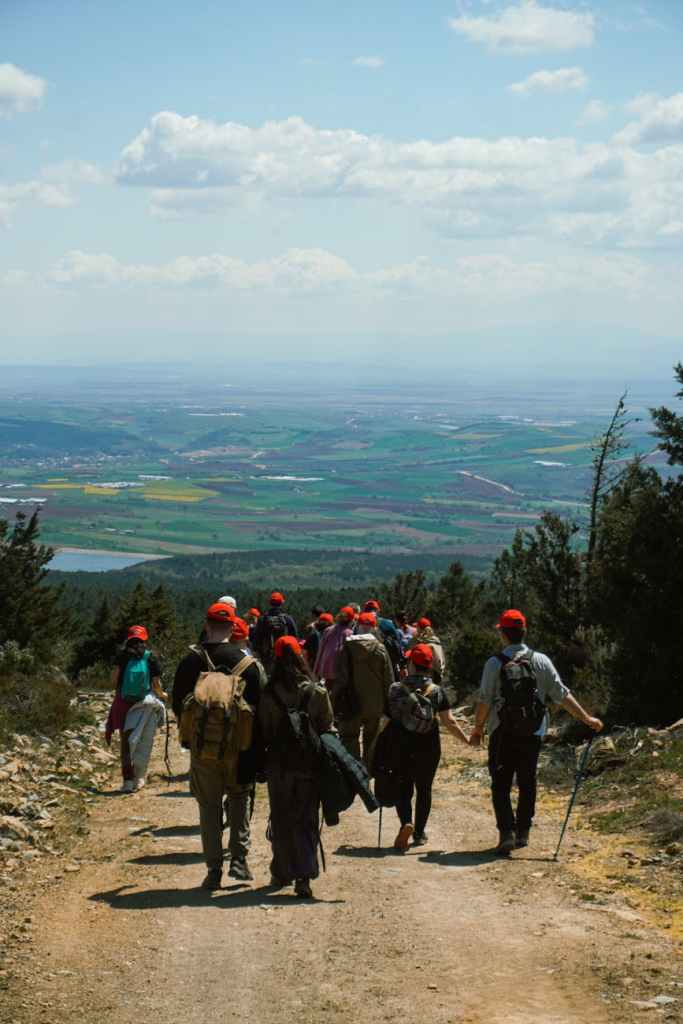
They looked down from the mountaintop, at the world spread out at their feet. Far below them, they saw the checkerboard fields of farms. Off to the east they could make out busy fishing villages along the shores of Galilee. Off to the west, wrapped in haze, seaports dotted the Mediterranean coast and harbors bustled with the trade of empire. Off in the distance to the north rose the mountains of Lebanon, with Mt. Hermon’s snowy peak towering high above them all. Somewhere out there, past the Jordan Valley and the Great Salt Sea, were the sprawling windswept sands of the desert. It was, indeed, a dazzling, diverse, beautiful, terrible world out there. They had a big job to do. It wouldn’t be easy, but together they saw that they could do it.

Thomas shrugged off his doubts and stood tall. He had the last word. “I don’t know if I am up to this job, but Jesus is with us always—to the end of the age. Let’s make disciples!” They packed their gear and headed down to the waiting world below.

Go therefore, my friends. Make disciples of all people. Baptize them in the name of the Father and of the Son and of the Holy Spirit. Teach them to observe everything that Jesus has commanded us. And remember, Jesus is with us always, even to the end of the age.


Matthew 28:16-20

16 Now the eleven disciples went to Galilee, to the mountain to which Jesus had directed them. 17 When they saw him, they worshiped him, but they doubted. 18 And Jesus came and said to them, “All authority in heaven and on earth has been given to me. 19 Go therefore and make disciples of all nations, baptizing them in the name of the Father and of the Son and of the Holy Spirit 20 and teaching them to obey everything that I have commanded you. And remember, I am with you always, to the end of the age.”

A Heart for the Welsh

Sabbath Day Thoughts — “A Heart for the Welsh” Matt. 28:16-20

It wasn’t the welcome that he expected. Gybi and his friends had left behind their native Cornwall and sailed across the Bristol Channel to the southwest of Wales.  They landed near a broad and pleasant meadow, lush with grass and flowers. It looked like a promising place to begin. The monks pitched their tent and began to pray, trusting that God would provide the vision for their mission.

When the local king Edelig heard that Christian monks were camped in his field, he was enraged. “To arms!” he cried, gathering his guard and riding out to slaughter the hapless monks and end their nonsense.  But as the king galloped into the meadow, his horse faltered, falling to the ground and dying. Then, the world went black.  King Edelig and his men were struck blind. Like newborn puppies, they wriggled and groped in the meadow’s long grass.

Realizing that he had picked a fight with the wrong God, King Edelig pleaded for mercy, promising Gybi anything he might ask, if only his sight would be restored. The wily Gybi saw a bargain to be made. If King Edelig would love the Lord Jesus and share just enough land to start a few small churches, Gybi and his friends would pray for healing. The deal was struck, and fervent prayers were offered. First the king and then all his men regained their sight. For good measure, Gybi raised the king’s horse from death to life. The king, who had begun the day with a heart set on murder, ended the day with a heart turned to Jesus.

Faithful people have been going forth in pursuit of the Great Commission ever since Jesus told his disciples to “go therefore into the world to make disciples of all nations.” From the summit of Mt. Tabor, where the disciples stood, 2,000 feet above the Galilean hills, they could see from snow-capped Mt. Hermon to the oases of the Trans-Jordan wilderness, from the blue-green waters of the Mediterranean to the desert sands of the Arabian Peninsula.  With the world stretched out at their feet, the disciples surveyed their mission field—and it was vast. 

These new marching orders from the risen Lord expanded their purpose.  Earlier, when Jesus had commissioned the disciples, he sent them to local villages with good news and healing for the “lost sheep” of Israel (MT 10).  The disciples were sent to those who knew God but feared that they were beyond the reach of God’s love. Sin or sickness, poverty or persecution had made them outsiders, unloved by their pious neighbors and unwelcome in the Temple.  The disciples had risen to the challenge of finding the lost, but now they had a whole world to evangelize.  It’s hard to believe, but by the fourth century, the gospel spread from eleven worried disciples on the summit of Mt. Tabor to the heart of the empire and the halls of power, becoming an official religion of Rome in the year 313. 

As Caesar’s armies marched forth to subdue the world, the gospel went with them. When Gybi was born to the king of Cornwall on the frontier of Britannia in the year 483, he was not the first of his family to be Christian. Destined to one day rule Cornwall, Gybi set out as a young man on pilgrimage to Judea and Jerusalem, where he longed to worship at Christ’s tomb—the holy sepulcher.  When he reached the Holy Land, Gybi was shocked by what he found. Instead of a community of humble disciples sharing the gospel with all nations, the Byzantine church was like an occupying army, great with wealth, hubris, and contempt for the local people. Dismayed by what he witnessed, Gybi sought out the Jewish Christians who persisted in the traditions passed from Jesus to his followers. Gybi met descendants of Jesus’s brothers, James and Jude. In Gybi, they saw humility and a heart for the Lord, and they anointed him with a Great Commission, to take the true gospel wherever the Spirit might send him.

Admonished by an angel of the Lord to return home, Gybi departed for Cornwall, where he renounced the throne and instead planted churches and honed gifts for healing.  One day, the Lord spoke to Gybi a second time, instructing him to sail north with twelve friends to the quarrelsome people of Wales. That’s where this sermon began, with the less than warm welcome of King Edelig.  Gybi and his friends built a small chapel near a deep spring of fresh water. All it took was the rumor of Gybi’s miraculous healing of the King and his men for the people to come. Tradition tells us that Gybi’s miracles rivaled those of the first disciples. He restored sight to the blind, cleansed the leprous, healed the paralytic, loosened the tongues of the dumb, and cast out evil spirits, all by virtue of the HS. To this day, the Welsh seek the water of Gybi’s Well, which is said to heal eye disease, lameness, warts, scrofula, and rheumatism.

With the warlike King Edelig pacified, gifts of healing abounding, and a burgeoning church growing across the southwest of Wales, it seemed that Gybi had fulfilled his great commission, but one day, the angel of the Lord spoke a third time, instructing Gybi to go to the wild and mountainous Kingdom of Gwynedd.  Gybi with his twelve friends sailed north across Cardigan Bay and along St. George’s Channel to the windswept, wave battered shores of Anglesey. There, too, a less than warm welcome waited. No sooner had Gybi pitched his tent than a wild goat bounded in and knelt at his feet in search of sanctuary. In hot pursuit were the hounds of King Maelgwn, soon followed by the King. “Give me that goat!” The king demanded.

The blessed Gybi sensed there was another deal to be made. “I’ll release my goat,” Gybi said, “If you will grant to me all the land that she runs through while your dogs are in pursuit.” The king, eager to be rid of the troublesome goat, agreed.  Off she bounded, with the dogs at her heels, yet no matter how bold their pursuit, the hounds could not gain ground. From one end of the kingdom to the other she scampered until finally returning to Gybi and again taking refuge behind the holy man. 

Seeing that this was no ordinary goat, nor an ordinary man, the king fell to his knees. He pledged to Gybi the old Roman Fort at Holyhead, abandoned 130 years earlier when the Romans turned their back on Britain.  There Gybi established a church and monastic settlement in the old Celtic tradition where families gathered, the hungry were fed, the sick were cared for, and the Lord was worshipped with heart and hand.

“Go therefore and make disciples of all nations, baptizing them in the name of the Father and of the Son and of the Holy Spirit.” The Rev. Dr. David Lose, past President of the Lutheran School of Theology in Philadelphia, says that Jesus’ “Great Commission,” is terrifying for most folks in the pews.  We aren’t evangelists. We can’t preach like Peter. We can’t pray like Paul. When it comes to public speaking, most of us would rather not. But I suspect that the charge that the risen Lord gave to his disciples isn’t always fulfilled in sensational ways. Sometimes, the most powerful purveyors of God’s love are people like Gybi, people like us. They choose humility over pomp and glory. They have a heart for caring and healing. When times get tough, they pray fervently and trust that God has a plan, even when they do not.

The blessed Gybi died in the year 555 at the age of eighty-four, surrounded by the followers and friends who called Holyhead their home.  They say that as he breathed his last, the angels of the Lord came and took Gybi’s spirit to heaven. The church and monastery that Gybi founded remained the center for Christianity in northern Wales for more than 1,000 years until plundered by the forces of Henry VIII in the 16th century. Today St. Gybi’s Church, still nestled within the walls of the old Roman fort at Holyhead, is a vital working church with regular worship services in English and Welsh, as well as weddings, funerals, baptisms, blessings, and outreach to the community.

Resources:

David Nash Ford. “St. Cybi Felyn, Abbot of Caer-Gybi” in Early British Kingdoms. Accessed online.

Celtic Literature Collective. Vita Sancti Kebii (The Life of St. Cybi).

The Friends of St. Gybi. The Story of St. Cybi. Accessed online.

–. “The Age of Saints.” Accessed online at thehistoryofwales.typepad.com.


Matthew 28:16-20

16 Now the eleven disciples went to Galilee, to the mountain to which Jesus had directed them. 17 When they saw him, they worshiped him, but they doubted. 18 And Jesus came and said to them, “All authority in heaven and on earth has been given to me. 19 Go therefore and make disciples of all nations, baptizing them in the name of the Father and of the Son and of the Holy Spirit 20 and teaching them to obey everything that I have commanded you. And remember, I am with you always, to the end of the age.”


Llywelyn2000, CC BY-SA 4.0 https://creativecommons.org/licenses/by-sa/4.0, via Wikimedia Commons

St Cybi window. St Beuno’s Church, Penmorfa, Gwynedd, Wales

The Community of Overflowing Love

Sabbath Day Thoughts — Matthew 28:16-20 “The Community of Overflowing Love”

Ireland has long been known as the Land of a Thousand Welcomes, with a well-deserved reputation as the most hospitable nation on earth.  In Ireland, lost tourists looking for directions find themselves escorted to their destination with many a story along the way.  Visitors to a pub are welcomed like old friends with raised glasses and calls of “Slainte!” An afternoon visit leads to tea with many a cuppa’ and soda bread dotted with raisins and slathered with butter.

This unofficial code of Irish welcome dates back more than 1,000 years to when the Irish clans were regulated by the Brehon Laws.  Under Brehon Law, all households were obliged to provide some measure of hospitality to strangers—food, drink, entertainment, and a bed.  No prying questions could be asked of the guest, and once hospitality was accepted, the guest refrained from any quarrel or harsh words.  The only price of hospitality was the exchange of stories, poetry, and song.  In a rural land with few roads and long distances between settlements, these ancient Irish traditions ensured a much-needed welcome for weary travelers. 

Today, the warm welcome of the Irish continues to summon visitors from around the world.  In 2019, before the pandemic, 11.3 million travelers visited the Land of a Thousand Welcomes, more than double the Irish population.  That’s almost three times the number of annual visitors to the Holy Land.

At the conclusion of Matthew’s gospel, Jesus cast a vision for the life and ministry of his disciples. We call it the Great Commission.  Jesus sent his friends forth to all nations to share the gospel.  They were commissioned to bear witness to God’s great love for all people, a love that was revealed in the life, death and rising of their Lord.  For their mission, the disciples would rely on the hospitality of others. They had to trust that there would be a welcome waiting for them at the end of a long day of travel—safety, the sharing of food, drink, entertainment, and a bed.

It was in acts of hospitality, in the welcoming of strangers and the telling of stories, that the good news of Jesus Christ was shared.  At the table or while seated at the fire, tales were told.  Strangers became friends.  Disciple begat disciple.  Hosts were welcomed into the community of Christ, which had its own far-reaching hospitality, a hospitality that found its ultimate expression in the rite of baptism.  In the name of the Father, Son, and Holy Spirit, guest became host, host became guest, and all became One in the family of love and faith that Jesus commanded his disciples to make.

Jesus’ vision of an expanding community of love is grounded in the Trinity—the belief that God is Three-in-One.  Father, Son, and Holy Spirit exist in eternal community, three simultaneous, co-equal expressions of the One Holy and Almighty God.  The theologians say that Father, Son, and Holy Spirit indwell each other (perichoresis).  They make room for one another and are hospitable to one another.  Reformed author and pastor Leonard Vander Zee describes the Trinity eloquently and understandably when he writes, “At the center of all reality, at the heart of the universe, there exists an eternal divine community of perfect love.”

Everything that we know flows forth from that perfect love.  Creation is the expansion and delight of that overflowing divine love.  All creatures arise from that overflowing divine love.  We are an expression of that overflowing divine love.  It is no wonder that when Jesus cast the vision for the church, it was a vision of overflowing divine love, of disciples going forth in love to welcome friends, neighbors, strangers, and all nations into that eternal community of perfect love.  Now that’s what we call holy hospitality.

Standing at the intersection of the ancient Brehon Laws of hospitality and the overflowing love of the Triune God is Brigid of Ireland.  With Patrick and Columba, Brigid is one of the three patron saints of the Land of a Thousand Welcomes. While Patrick evangelized the Irish, and Columba sailed off to share the gospel with the Scots, Brigid was consecrated as a bishop and established Irish communities where the overflowing love of Christ was revealed.

In the 6th century, Brigid was born a slave to a pagan chieftain and his Christian dairymaid.  From an early age, Brigid resolved to live a life of dedication to Christ with great kindness and generosity.  She so infuriated her father by giving away his possessions to anyone in need that he sold her with her mother to the household of a druid priest.  There, Brigid’s generosity got her into trouble again.  Her druid master confronted her for giving away the entire supply of butter, but when Brigid prayed, the butter supply was divinely restored—and more.  Her master’s household prospered and grew rich with abundance.  Convicted of Brigid’s holiness, the druid and his family were baptized in the name of the Father, Son, and Holy Spirit. The druid’s first action as a newborn member of that community of overflowing divine love was to give Brigid her freedom.

Brigid’s kindness and generosity often extended to the most vulnerable of her neighbors.  When she fell while riding and struck her head, she asked that the blood from her wound be mixed with water and used to anoint two sisters who were deaf and mute.  Both were healed.  When a cow had been sorely troubled and milked dry by hungry neighbors, Brigid blessed the poor beast, which then provided ten times the milk expected of it and never went dry again.  Brigid gave a mug of water to a leper, instructing him to wash with it, and he was made clean.  Brigid’s self-proclaimed purpose was “to satisfy the poor, to banish every hardship, and to save every sorrowful man.”  That sounds like what Jesus had in mind when he sent out his disciples to share the overflowing love of the Triune God.

Brigid believed in the power of community to extend the outreaching, overflowing love of Christ.  With seven other Christian women, Brigid went to the King of Kildare to request land to build a Christian community.  When the king refused, Brigid persuaded him to give her a parcel of land no larger than her cloak could cover.  The king agreed.  Four women were given the corners of her cloak, and as Brigid prayed, they began to walk.  The Lord brought the increase, expanding the cloak until it covered a generous parcel of land, the Curragh of Kildare. 

There Brigid and her friends built a large double monastery for women and men.  Kildare Abbey was a center for learning, worship, farming, the arts, and, of course, hospitality. In the Spirit of Christ and the tradition of Brehon Law, strangers were welcomed with food, drink, entertainment, and rest.  In the sharing of stories, many a visitor came to know the overflowing love of God and was baptized in the name of the Father, Son, and Holy Spirit.

On Trinity Sunday, we celebrate that eternal, divine community of perfect love that lives at the heart of the universe. We remember Jesus’s vision of a ministry of overflowing divine love for all nations. Brigid believed that when we go forth in that overflowing love of the Trinity, we become Christ to others and they become Christ to us.  Brigid said, “It is in the name of Christ that I feed the poor, for Christ is the body of every poor man.” As we are a blessing to others, they become a blessing to us.  This morning, Jesus and Brigid bid us to ponder: How will we go forth to share the overflowing perfect love of the Triune God?

I’ll close with the Irish Rune of Hospitality, attributed to Brigid.

“I saw a stranger yestere’en;

I put food in the eating place,

Drink in the drinking place,

Music in the listening place,

And in the name of the Triune

He blessed myself and my house,

My cattle and my dear ones,

And the lark said in her song

Often, often, often,

Goes the Christ in the stranger’s guise,

Often, often, often,

Goes the Christ in the stranger’s guise.”

Resources:

Daniel Migliore. Faith Seeking Understanding. Grand Rapids: Wm. B. Eerdmans Publishing, 1991.

Leonard Vander Zee. “The Holy Trinity: The Community of Love at the Heart of Reality” in The Banner, Feb. 26, 2016.

Wendy Hopler. “Biography of Brigid of Kildare” in Learn Religions, June 10, 2019.  Accessed online at learnreligions.com.

John D. Gee. “5 Lessons from St. Brigid of Kildare” in Patheos: Hosting the Conversation on Faith, Feb. 1, 2021.  Accessed online at patheos.com.

Mary Dugan Doss. “A Gift of Hospitality: Saint Brigid, Abbess of Kildare” in Orthodox Christianity, Feb. 1, 2014. Accessed online at orthochristian.com.


Matthew 28:16-20

16 Now the eleven disciples went to Galilee, to the mountain to which Jesus had directed them. 17 When they saw him, they worshiped him, but they doubted. 18 And Jesus came and said to them, “All authority in heaven and on earth has been given to me. 19 Go therefore and make disciples of all nations, baptizing them in the name of the Father and of the Son and of the Holy Spirit 20 and teaching them to obey everything that I have commanded you. And remember, I am with you always, to the end of the age.”


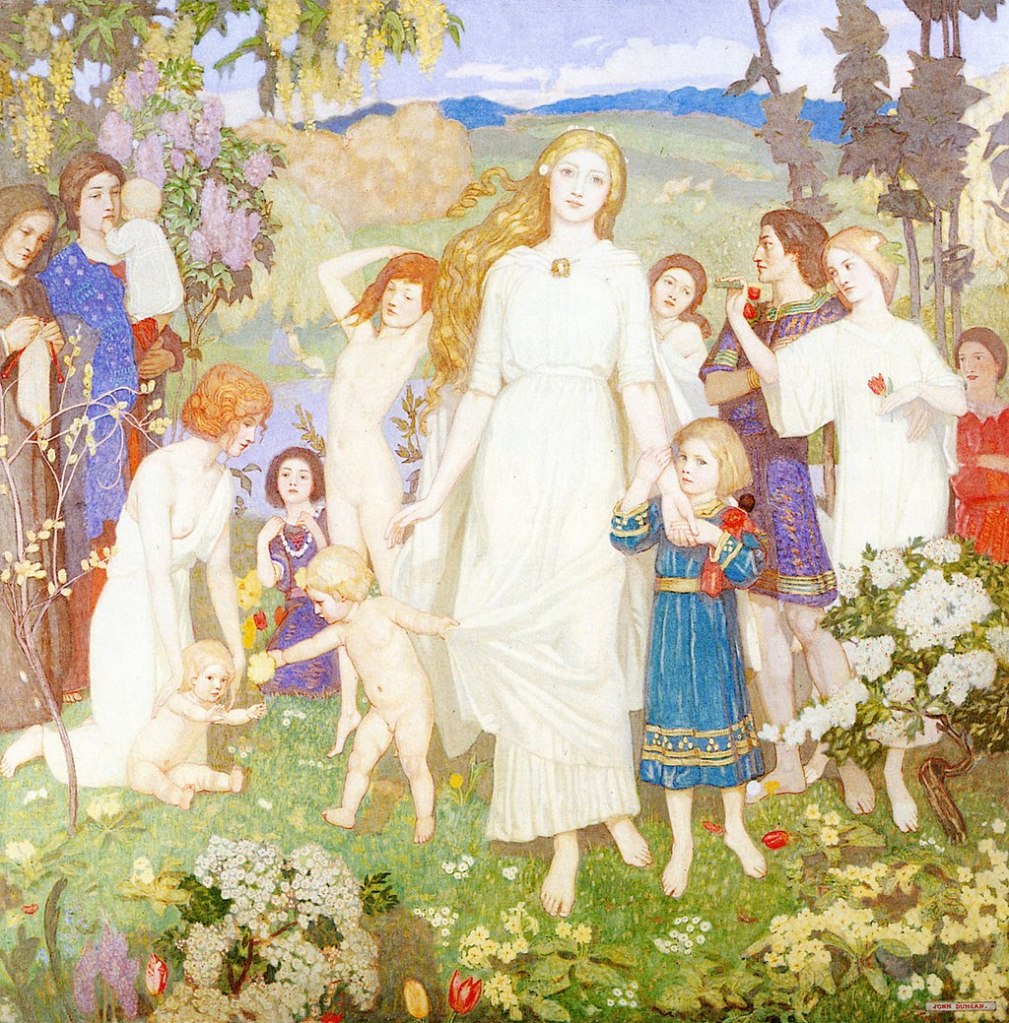
By John Duncan (1866-1945) – http://www.the-athenaeum.org/art/full.php?ID=27474, Public Domain, https://commons.wikimedia.org/w/index.php?curid=46026001