Late Comers

Sabbath Day Thoughts — “Late Comers” Matthew 20:1-16

Many years ago, before I went to seminary, I was a young adult living in a diverse urban neighborhood. My daily path to work took me past the local 7-11 convenience store. What I remember most about the 7-11 was the crowd of Hispanic men who hung out there every morning—rain or shine, weekends, too! I wondered, didn’t they have anything better to do than stand on the corner and hiss at me as I hurried to catch my train? 

One morning, as I was rushing by, I saw a big contractor’s van pull up to the curb, the kind a house painter or roofer might use. The driver leaned out the window and gestured to a few of the waiting men. They quickly scrambled into the back of the van and away they went. Another morning, as I hurried by, I saw a big pick-up truck stop. The back was full of the plants and tools of the landscaping business. The driver held up his hand to show that he was looking for five workers. Immediately five men vied to climb into the bed of the truck and away it rolled. 

I soon realized that the 7-11 wasn’t so much a hang-out spot as it was a job-seeking spot. There was some unwritten law of the city that told day laborers to show up at the 7-11 because tradesmen of all sorts would stop there, looking for help. I’m guessing that many of the men who waited at the 7-11 were undocumented. I’m also fairly certain that the bosses who hired them paid less than a living wage for very hard work. It was probably also true that those bosses couldn’t find anyone else to do that backbreaking, gritty labor.

Occasionally, I’d find myself rushing past the 7-11 later in the day. I would see a few day laborers still lingering, looking up anxiously as vehicles slowed, still hoping that someone might stop, invite them to hop in, and put them to work. These workers were often old and gray or barely past puberty or physically frail. There were always more men eager for work than there were bosses ready to hire them. It was a whole world of hard physical work and meager wages that I never knew existed. All those day laborers were dependent upon the initiative and generosity of folks who were much more fortunate than they were.

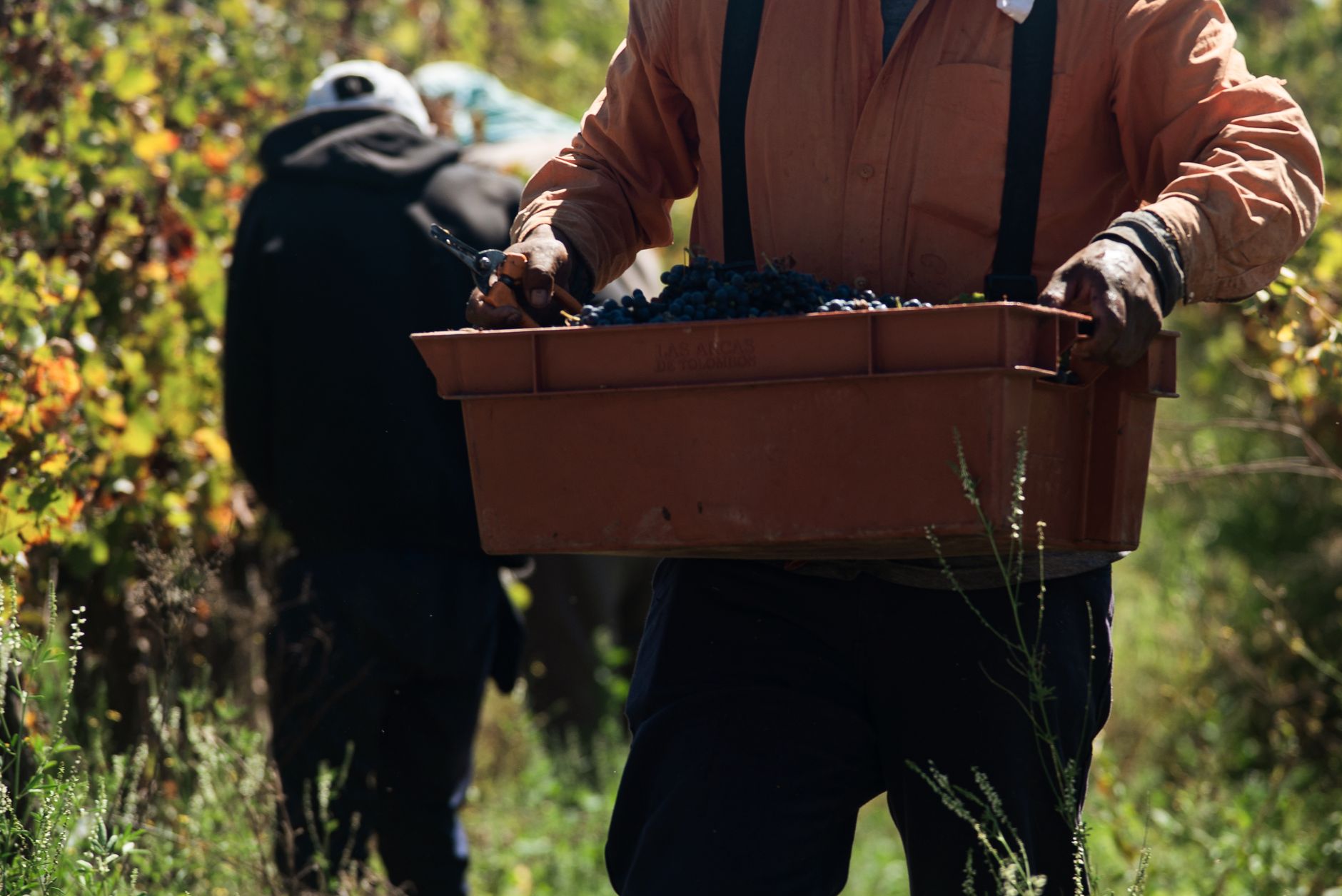
In our gospel lesson today, Jesus described a similar scenario. In Jesus’ time, workers also congregated in the marketplace to seek employment. These were everyday folks who eked out a subsistence living from a garden plot and a goat or two. They depended upon seasonal labor to make ends meet. Jesus says that the kingdom of heaven is like a vineyard owner, seeking workers for his vineyard. At the crack of dawn, the vineyard owner recruited a few early risers and agreed to pay them each a denarius, just enough to meet the daily need of a large, poor family. Then, he sent them into the vineyard to work. Again and again throughout the day, the vineyard owner recruited workers, even at the eleventh hour, at 5:00, when the sun was sinking low and the shadows were lengthening, the vineyard owner hired folks waiting for work and promised to pay them what is right.

When quitting time came, the vineyard owner sent his manager to pay the workers, handing him a generous purse and instructing him to make sure the last were paid first. The workers lined up, last hired to first hired, and as the manager went down the line, he reached into the vineyard owner’s purse and fished out a silver denarius, pressing the same wage into each worker’s palm. The lucky one-hour workers couldn’t believe their good fortune, and those hard working twelve-hour-laborers grumbled that those one-hour-slackers shouldn’t receive the same wage. They’d worked harder and longer. They had the blisters, sore backs, and sunburns to prove it. But the vineyard owner would hear none of it. If he chose to be generous with those who were late in coming, why was that of any concern to them?

Jesus tells us that this is the way the kingdom of heaven works. How we feel about this parable has a lot to do with whether we see ourselves as early risers or latecomers. Among Jesus’ critics were scribes, Pharisees, and devout Jews who had been laboring in God’s vineyard—serving the Kingdom of God—all their lives. They looked at the sinners, tax collectors, lepers, and no-account-losers whom Jesus welcomed into the Kingdom. It wasn’t fair that people like that should receive the same divine love and heavenly reward that they expected. I’m not sure whether the story Jesus told eased the tension with his critics or just ruffled more feathers. The outrageous love and mercy of God can be hard to wrap our heads around. Think of Jesus, telling this shocking and uncomfortable story to people who didn’t want to hear it. Think of Jesus, who knew he would one day be brutally killed to reveal God’s limitless love and mercy for us.

Now, here’s what would really ruffle the feathers of Jesus’ critics. This story sounds like it is all about work. Doesn’t it? But it is really all about grace. God loves us—not because we are the hardest workers, keeping every jot and tittle of the Torah, wearing God out with our prayers, and impressing the neighbors with our exceptional piety. Rather, God simply chooses to love us because God is love. Whether we find this truth and come to God at the eleventh hour or we have known our belovedness from the cradle, we are loved and welcomed. There is a place for us in the Kingdom.

The story of the workers in the vineyard sounds less unfair and unsettling when we realize that we are actually all one-hour workers. We are all latecomers who get the whole denarius, who find salvation late in the day, despite our meager efforts. We are the tax collectors and sinners. We are the uppity women. We are the lepers, and gentile outsiders. We all come to the Kingdom of Heaven late in the day, undeserving of the whole denarius.

We have our reasons for that. We waited all day to go to the vineyard, but no one wanted us because we were too old and infirm, too green and inexperienced, too weak and unclean. We didn’t make it to the vineyard on time because we had overwhelming crises at home that needed our undivided attention. We showed up late because we got lost down that wrong road of addiction or compulsion or sin. We almost didn’t make it to the vineyard at all because we were so depressed that we couldn’t pick our heads off the pillow. We rolled into the vineyard at the eleventh hour because we didn’t even know that the vineyard was hiring.

We are the latecomers. How happy we are to learn that we are accepted and welcomed, loved and rewarded! How happy we are that God generously shares without measuring our worth! That crazy vineyard owner gives and gives and gives without counting the cost. Thank you, Lord.

I doubt that the 7-11 in my old neighborhood is still an open-air labor market. Aggressive immigration enforcement has disrupted local economies, especially those employment opportunities that others don’t want, employment opportunities that are hard and gritty and poorly compensated. I’m sure there are bosses out there still in need of workers. I’m sure there are workers, both early risers and latecomers, wondering how they can support families.

I’m sure the vineyard owner hopes that we will one day realize that grace is freely given for all, whether we are early risers or we are those who come to the vineyard at the eleventh hour. Perhaps we will one day move past our ruffled feathers. Perhaps one day we will know that the love and welcome of Jesus are intended for all.

Resources

Karl Jacobson. “Commentary on Matthew 20:1-16” in Preaching This Week, Sept. 18, 2011. Accessed online at https://www.workingpreacher.org/commentaries/revised-common-lectionary/ordinary-25/commentary-on-matthew-201-16-3

Ira Brent Driggers. “Commentary on Matthew 20:1-16” in Preaching This Week, Sept. 21, 2008. Accessed online at https://www.workingpreacher.org/commentaries/revised-common-lectionary/ordinary-25/commentary-on-matthew-201-16-4

Kimberly Wagner. “Commentary on Matthew 20:1-16” in Preaching This Week, March 5, 2023. Accessed online at https://www.workingpreacher.org/commentaries/narrative-lectionary/laborers-in-the-vineyard-2/commentary-on-matthew-201-16-8


Matthew 20:1-16

20 “For the kingdom of heaven is like a landowner who went out early in the morning to hire laborers for his vineyard. 2 After agreeing with the laborers for a denarius for the day, he sent them into his vineyard. 3 When he went out about nine o’clock, he saw others standing idle in the marketplace, 4 and he said to them, ‘You also go into the vineyard, and I will pay you whatever is right.’ So they went. 5 When he went out again about noon and about three o’clock, he did the same. 6 And about five o’clock he went out and found others standing around, and he said to them, ‘Why are you standing here idle all day?’ 7 They said to him, ‘Because no one has hired us.’ He said to them, ‘You also go into the vineyard.’ 8 When evening came, the owner of the vineyard said to his manager, ‘Call the laborers and give them their pay, beginning with the last and then going to the first.’ 9 When those hired about five o’clock came, each of them received a denarius. 10 Now when the first came, they thought they would receive more; but each of them also received a denarius. 11 And when they received it, they grumbled against the landowner, 12 saying, ‘These last worked only one hour, and you have made them equal to us who have borne the burden of the day and the scorching heat.’ 13 But he replied to one of them, ‘Friend, I am doing you no wrong; did you not agree with me for a denarius? 14 Take what belongs to you and go; I choose to give to this last the same as I give to you. 15 Am I not allowed to do what I choose with what belongs to me? Or are you envious because I am generous?’ 16 So the last will be first, and the first will be last.”


Photo by Gonzalo Acuu00f1a on Pexels.com

The Economy of Grace

Sabbath Day Thoughts — “The Economy of Grace” Matthew 18:21-35

This week marked the twenty-fifth anniversary of 9/11. In lower Manhattan on Friday, family members read aloud the names of the 2,977 people killed in the attack on the twin towers. In that field in Shanksville, Pennsylvania, National Park Service employees rang bells for each passenger and crew member killed in the crash of Flight 93. At the Pentagon, an American flag was unfurled on the side of the building, marking the spot where the fourth plane crashed.

If we are old enough, we remember where we were on September 11, 2001. I was in seminary, teaching English to international grad students in Chicago. Duane was in the post office at Paul Smiths College. Where were you?

When they heard the news of the attacks on the World Trade Center, Talat Hamdani was teaching English at a Queens Middle School and her husband Saleem was operating his convenience store in Brooklyn. Their oldest son Salman was an EMT and cadet with the New York City Police Department. That morning, Salman was on his way to an internship when he witnessed smoke coming from the Twin Towers. He hurried to the scene to aid victims, using his police and EMT identification to get a ride through the restricted traffic. Salman never came home. Talat and her husband Saleem soon realized that the path to forgiveness would be difficult for them as they contended with both grief at their son’s death and suspicions of neighbors who conflated their Muslim faith with acts of terror.

Jesus knew how very difficult it is to practice forgiveness, so some of his toughest teachings tackle that difficult topic. Today’s lesson is one example. Peter thought he was terribly generous when he offered to forgive his neighbor seven times. Imagine his dismay when Jesus told him to extend the olive branch not seven but seventy-seven times, which basically meant that he should always forgive without limits.

To prove his point, Jesus told an outrageous, exaggerated parable about an unforgiving servant. A slave owed a ridiculous debt to his king—10,000 talents. A talent was the greatest monetary unit in the ancient Near East, a 150-pound weight of silver, worth fifteen years’ wages for a day laborer. The slave in Jesus’ story owed the king 150,000 years’ worth of labor. No one could pay that debt. But when the slave made an impassioned plea that touched the heart of the king, the unthinkable happened. In an act of sudden, undeserved mercy, the king cancelled the debt. 

We expect the forgiven slave to go and do likewise, but when granted the opportunity to forgive a fellow slave a relatively small debt, the hard-hearted scoundrel shocked us with his ruthlessness, seizing his debtor by the throat and throwing him into prison. When a whistleblower got ahold of the royal ear, the king forgot about the mercy and promised the unforgiving servant a life of pain and punishment.

It’s a story of hyperbole—over-the-top exaggeration—a rhetorical strategy used to make a point. As followers of Christ, we are to forgive as we have been forgiven. In God’s limitless love and mercy for us, we are to find the capacity to be merciful to others, even those who have terribly wronged us, who are in our moral debt. Limitless forgiveness—really, Lord?

It’s tempting to write off Jesus’ words as a moral ideal that is beyond our reach, but Jesus knew the hard work of forgiveness. His family accused him of being crazy. His home church in Nazareth tried to kill him. Jesus was betrayed by Judas. Abandoned by the disciples. Denied three times by Peter. Condemned to death by the religious and political authorities. Mocked, taunted, and abused by his neighbors. Brutally scourged, beaten, and executed by those who surrounded him at the last, gambling for his clothes. Still, Jesus had the moral courage to pray even as he was dying, “Father forgive them, for they know not what they do.”

We aren’t Jesus, rejected and dying on a cross. We may not have lost a beloved one on 9/11. Yet, we all know how it feels to struggle to forgive. We have had to live with the consequences of a loved one’s misconduct. Our parents mistreat or fail us. Our kids reject us. Our friends betray us. Our elected officials disappoint us. We’ve been ripped off. We’ve been done dirty in the workplace. Our anger is righteous. The crimes against us are heinous. Those who have sinned show no remorse. Forgiveness is tough.

In the days following 9/11, the Hamdani family, who lost their son Salman, faced extraordinary scrutiny. Because of the family’s Muslim faith, investigators from the FBI and NYPD began questioning them about Salman. Congressman Gary Ackerman visited the family’s Bayside home and asked about Salman’s motives for becoming a police cadet and which Internet chat rooms he visited. When CIA officials came, they confiscated a college graduation photo of Salman, posing with a fellow student from Afghanistan. Reporters appeared at the family’s home. The New York Post published a story entitled, “Missing or Hiding? — Mystery of NYPD Cadet from Pakistan.” Anonymous “Wanted” posters were distributed featuring Salman’s NYPD cadet photo and the phrase “Hold and detain.” The implications were clear. There were people promoting the notion that, because he was a Muslim, Salman could have somehow been in league with terrorists.

In October 2001, Salman’s remains, medical bag, and identification were found in the wreckage of the North Tower at Ground Zero. His family wasn’t told of this discovery until March 2002 when he was officially cleared of all suspicion. Salman is mentioned in the USA PATRIOT Act, which states, “Many Arab Americans and Muslim Americans have acted heroically during the attacks on the United States, including Salman Hamdani, a 23-year-old New Yorker of Pakistani descent…” For Salman’s family, forgiveness has been complex. Of course, there was the matter of the terrorists who flew jets into the World Trade Center, but there was also that unreasonable cloud of suspicion, accusation, and prejudice that surrounded them when they were hurting most.

Jesus taught that we cannot be in right relationship with God if we are not in right relationship with others. Each week in worship, we pray together the prayer that Jesus taught us, “Forgive our sins, as we forgive those who sin against us.” In God’s Kingdom, there is a great economy of grace. The mercy that is so generously extended to us must be extended by us to others. That doesn’t mean that we allow ourselves to be abused, or pretend that our hurt doesn’t matter, or condone ongoing bad behavior. Instead, forgiveness is a choice. It’s a daily discipline of allowing the past to be the past, and moving forward into God’s future, with our broken hearts and broken lives stitched back together again with the needle and thread of grace. It’s a grace that was made to clear to us long ago on a lonely hilltop outside Jerusalem where an innocent man gave his life to forgive the sins of the world.

When Salman Hamdani’s father died in 2004, his widow Talat said that it was due to a broken heart—he couldn’t live with the death of his son on 9/11 or the painful way the family was treated in the months it took to learn of the recovery of his body. Talat has worked through her grief and hurt through her involvement with Peaceful Tomorrows, an organization founded by family members of those killed on September eleventh. Inspired by the life’s work of Dr. Martin Luther King, Jr., they seek to break cycles of violence with nonviolent direct action in the pursuit of justice.

Talat writes, “Salman was a casualty of 9/11 not because he was an EMT, or an NYPD Cadet, or for being a Muslim. He, like the other victims, was a casualty of 9/11 because he was an American and cherished the American values of democracy, liberty and freedom to pursue a faith of his choice. Hence, the best way to honor all the victims of 9/11 is to uphold these American values. We, as a nation, have to unite and overcome the ugly monster of prejudice and ignorance [through] forgiveness and reconciliation. It is imperative for each of us as individuals, as well as a nation.”

We all struggle to forgive, my friends. Yet Jesus asks us to join him in that great economy of grace, to join him on that beautiful, terrible, healing path that nudges our world a little closer to God’s Kingdom, the Kingdom where we, who owe unbearable, unpayable debts, experience undeserved mercy and limitless forgiveness. How many times shall we forgive? Not seven times, but seventy-seven times. May it be so.

Resources

Sharon Otterman. Obscuring a Muslim Name, and an American’s Sacrifice in The New York Times, Jan. 1, 2012. Accessed online at https://www.nytimes.com/2012/01/02/nyregion/sept-11-memorial-obscures-a-police-cadets-bravery.html

Talat Hamdani. “My son died as a first responder on 9/11” in CNN: Opinion, Sept. 11, 2013. Accessed online at https://www.cnn.com/2013/09/11/opinion/hamdani-9-11-memory

Peaceful Tomorrows. “Talat Hamdani.” Accessed online at https://www.peacefultomorrows.org/patricio-and-talat

Nicholas J. Schaser, “Commentary on Matthew 18:21-35” in Preaching This Week, Sept. 13, 2026. Accessed online at https://www.workingpreacher.org/commentaries/revised-common-lectionary/ordinary-24/commentary-on-matthew-1821-35-7

David Lose. “Faith, Forgiveness, and 9-11” in Dear Working Preacher, Sept. 4, 2011. Accessed online at https://www.workingpreacher.org/dear-working-preacher/faith-forgiveness-and-9-11

Karoline Lewis. “A Generous Forgiveness” in Dear Working Preacher, Sept. 7, 2014. Accessed online at https://www.workingpreacher.org/dear-working-preacher/a-generous-forgiveness


Matthew 18:21-35

21 Then Peter came to Jesus and asked, “Lord, how many times shall I forgive my brother or sister who sins against me? Up to seven times?”

22 Jesus answered, “I tell you, not seven times, but seventy-seven times.

23 “Therefore, the kingdom of heaven is like a king who wanted to settle accounts with his servants. 24 As he began the settlement, a man who owed him ten thousand talents was brought to him. 25 Since he was not able to pay, the master ordered that he and his wife and his children and all that he had be sold to repay the debt.

26 “At this the servant fell on his knees before him. ‘Be patient with me,’ he begged, ‘and I will pay back everything.’ 27 The servant’s master took pity on him, canceled the debt and let him go.

28 “But when that servant went out, he found one of his fellow servants who owed him a hundred denarii. He grabbed him and began to choke him. ‘Pay back what you owe me!’ he demanded.

29 “His fellow servant fell to his knees and begged him, ‘Be patient with me, and I will pay it back.’

30 “But he refused. Instead, he went off and had the man thrown into prison until he could pay the debt. 31 When the other servants saw what had happened, they were outraged and went and told their master everything that had happened.

32 “Then the master called the servant in. ‘You wicked servant,’ he said, ‘I canceled all that debt of yours because you begged me to. 33 Shouldn’t you have had mercy on your fellow servant just as I had on you?’ 34 In anger his master handed him over to the jailers to be tortured, until he should pay back all he owed.

35 “This is how my heavenly Father will treat each of you unless you forgive your brother or sister from your heart.”


Photo by Lars Mulder on Pexels.com

Truth and Reconciliation

Sabbath Day Thoughts — “Truth and Reconciliation” Matthew 18:15-20

Marty hasn’t spoken to his brothers in decades. It all started Thanksgiving of 1980.  The whole family gathered at Marty’s home for dinner. Marty’s wife Lois cooked the most beautiful meal. She made cranberry relish, giblet gravy, and the turkey, roasted to perfection. It’s too bad no one stayed for dinner. 

The trouble started not long after everyone had a few cocktails and the conversation turned to the recent presidential election. Marty the Reagan Republican was delighted that his candidate won. Reagan was sure to get the nation back on the right track, cut off those welfare queens, and teach those Democrats a lesson. 

Marty’s brother Tim cast his ballot for Jimmy Carter. Tim saw Carter as a man of rare principle and goodness. Carter needed another term in office to end partisan politics and turn the economy around.

Marty’s other brother Frank was always a free spirit, so no one was surprised that he voted for the Independent John Anderson. Frank admired Anderson’s suggestion of a fifty cents-a-gallon gas tax to curb consumption and save energy. In fact, Frank was thinking of trading his old Datsun for a bicycle and simply peddling everywhere.

Round and round the conversation went, each brother extolling the virtues of his candidate and deriding the flaws of the opponents. The last straw came when the free-spirited Frank referred to the Great Communicator as Ronnie Raygun and mimed the President-elect shooting everyone who disagreed with his politics.

“Get out!”  Marty yelled, his face red, a vein on his forehead pulsing. Marty marched into the hall, grabbed all the coats from the closet, opened the front door, and threw them out on the lawn. “All of you! Get out now!” 

They did. Speechless, the brothers with their wives and kids piled into their cars and left.  They stopped at a truck stop on the throughway for a disappointing Thanksgiving dinner, while Marty and Lois had leftovers that lasted weeks. Turkey soup, turkey hash, turkey fritters, turkey omelets, turkey casserole. The aging brothers are still alienated.

Jesus knew that relationships could be fraught with this pattern of sin, distance, and disconnection. The lessons of Matthew 18 are devoted to how we are to respond to brokenness and separation. In fact, right before the words of today’s gospel reading, Jesus told his friends the Parable of the Lost Sheep to emphasize the importance of reconciliation. In the parable, the good shepherd placed himself and the ninety-nine other members of his flock at risk to go off in search of the one sheep who was lost in the wilderness. For Jesus, our good shepherd, families and communities cannot be whole until broken relationships are healed and the lost are restored.

That prepares us to hear today’s lesson. Do you remember what Jesus said?  Where there is alienation, we should first address the issue one on one, speaking the truth in love. If we fail, we invite one or two others to join us in our efforts to bridge the divide. If that fails, we seek the aid of the community of faith. If that proves to be unfruitful, we are to treat the lost lamb as a Gentile or a tax collector, which sounds about as low as you can go until we remember that Jesus ate with tax collectors and welcomed Gentiles. Jesus spent much of his ministry focused on these outsiders, so the Lord is telling us to always seek reconciliation. 

Jesus might caution us to be careful about how we put his reconciling process into practice. Jesus, who taught us that our ultimate responsibility is always to love God and love one another, would remind us that our efforts to reconcile must be prompted by love and not by the desire to bring shame, inflict guilt, or prove someone wrong. Only love can help us take responsibility for our feelings and actions and invite others to do the same. Only love can allow us to be vulnerable and direct.  We all know the pain of separation and alienation; yet, Jesus believes that we can make different choices that will bring healing to all that brokenness.

The story I told of Marty’s fateful Thanksgiving of 1980 may sound extreme, but we have all experienced separation and alienation. Perhaps your Marty is the daughter who moved out of state and phones home infrequently since you told her what you really think about her boyfriend. Perhaps your Marty is that valued colleague who stopped speaking to you after you got a promotion and he didn’t. Perhaps your Marty is the parent who refuses to see you since you expressed concern about their drinking. We all know the pain and puzzle of brokenness. We all know how it feels to stand on the far side of an unbridgeable rift, separated from folks whom we have loved and respected. Jesus’ remedy for our broken relationships sounds so simple. Why is it that we have such a hard time putting it into practice?

Dr. Murray Bowen of Georgetown University, one of the leading family therapists of the twentieth century, developed Family Systems Theory to describe the pattern of distance and disconnection that he noticed in the families he counseled.  Bowen believed that families manage tension and anxiety through triangles and distance. I’ll give examples. 

Marty’s brothers Frank and Tim never took that first step that Jesus taught us to take—never returned and confronted Marty about his outrageous behavior, never spoke the truth in love. Instead, they dealt with their anxiety by forming a triangle. They talked with one another instead of talking to Marty. It started at the truck stop, where they ate that disappointing Thanksgiving dinner after Marty tossed them out. Frank turned to Tim and said, “Reagan, Ray gun, r-a-y-g-u-n. It’s funny. Isn’t it?” Tim nodded, “Geeze, you’d think Marty would lighten up. Can you believe that guy?” Frank and Tim felt a lot better, but the triangle they created did nothing to heal the rift with Marty because they didn’t confront him. 

Now an example for distance: If Frank and Tim were masters of the triangle, Marty was the master of distance. Rather than work through his anger with his brothers, Marty opted out of being in relationship altogether. Every year when the Christmas cards come from Tim and Frank, Marty tosses them in the trash. Cut-off. That’s the ultimate expression of distance. That’s the painful reality that Jesus hoped we could avoid.

Professor Bowen, like Jesus, believed that for broken families to find healing, they needed to stop forming triangles or choosing to disconnect. Instead, they needed to learn ways to stay in relationship and communicate directly with one another in times of conflict. Families that failed to develop practices for direct, healthy communication tended to repeat the same patterns of brokenness from generation to generation.

One last example. It shouldn’t surprise us to learn that the father of Marty, Tim, and Frank had been alienated from his siblings, too, over an inheritance dispute. In fact, Marty, Frank, and Tim never met their aunts and uncle. Never knew their cousins. Within families, all that brokenness passes from one generation to another until someone has the awareness and the courage to make some different choices about how they will be in relationship. Lord, have mercy!

Now, here is the good news that Jesus was trying to communicate to his followers. One faithful person who chooses to follow the advice of Jesus, who bravely faces alienation head-on and reaches out in love, can change an entire family. One person with the courage to be honest about sin, pain, grief, and hurt can be the architect of a changed future. One person can restore wholeness to the flock.

We all know how it feels to stand on the far side of the unbridgeable rift, separated from folks whom we have loved and respected. Jesus taught that it doesn’t have to be like that. I’d like to invite us all to think of a personal relationship that is fraught and in need of reconciliation. Who is your Marty?

This week, we could commit to making one loving effort to restore what has long been broken, to find the lost and heal the hurt. We could mail a card or send an e-mail. We could pick up the phone or show up in person with words of truth, vulnerability, and love. If the hurt is very raw and deeply painful, we may only be able to pray about the healing that is needed, or we could seek a coach to help us. Although we may feel powerless to reconcile, we can remember that Jesus is not, and we can assure ourselves that wherever two or more are gathered in his name, he is there. He is with us. We can remember that Jesus would stop at nothing—not even his suffering and death on the cross—to reconcile us to his Father in heaven and to one another. Let’s take just a moment to quietly commit ourselves to finding the lost and healing the hurt. May God grant us the courage and the awareness to make different choices in our relationships…

Perhaps there could even be hope for Marty’s family. After all these years, Tim could call Marty to say that Reagan hadn’t proven to be such a bad President after all. Or, Frank could peddle his bike over to Marty’s door and say, “Brother, I may not appreciate your politics, but I love you and I miss you.” Perhaps Marty could begin to pray for the Lord to help him move past the anger, shame, and embarrassment that have kept him from his brothers for all these years. Who knows? Maybe this Thanksgiving Marty, Frank and Tim will sit down at the table together. Jesus would like that.

Resources:

Roberta M. Gilbert. The Eight Concepts of Bowen Theory. Falls Church: Leading Systems Press, 2004.

Ronald W. Richardson. Creating a Healthier Church. Minneapolis: Augsburg Fortress Press, 1996.

Richard W. Ward. “Commentary on Matthew 18:15-20” in Preaching This Week, Sept. 10, 2023. Accessed online at https://www.workingpreacher.org/commentaries/revised-common-lectionary/ordinary-23/commentary-on-matthew-1815-20-6

Audrey West. “Commentary on Matthew 18:15-20” in Preaching This Week, Sept. 6, 2020. Accessed online at https://www.workingpreacher.org/commentaries/revised-common-lectionary/ordinary-23/commentary-on-matthew-1815-20


Matthew 18:15-20

15 “If your brother or sister sins against you, go and point out the fault when the two of you are alone. If you are listened to, you have regained that one. 16 But if you are not listened to, take one or two others along with you, so that every word may be confirmed by the evidence of two or three witnesses. 17 If that person refuses to listen to them, tell it to the church, and if the offender refuses to listen even to the church, let such a one be to you as a gentile and a tax collector. 18 Truly I tell you, whatever you bind on earth will be bound in heaven, and whatever you loose on earth will be loosed in heaven. 19 Again, truly I tell you, if two of you agree on earth about anything you ask, it will be done for you by my Father in heaven. 20 For where two or three are gathered in my name, I am there among them.”


Photo by cottonbro studio on Pexels.com