A Bigger Mission

Sabbath Day Thoughts — Mark 7:24-37

Every day we encounter them, folks who are outsiders to the Christian community.

Melissa has never been a church member.  Although her parents were both raised in mainline congregations, they never got involved with the church as adults.  They never had Melissa or her brothers baptized or confirmed.  Melissa has good memories of attending church as a child on special occasions with her grandparents, especially those wonderful Christmas Eve services.  Sometimes, Melissa thinks she could really use that beauty and belonging in her life, but she doesn’t know how that would happen.  Her grandparents have been gone for years.  Sunday morning services feel like a foreign language, and the one time she did go, she sat by herself in the back.  It feels a whole lot safer to stay home and have a second cup of coffee.

Ben and Mary haven’t attended church since their youngest son aged up and out of the Youth Group.  They had felt it was important for their children to experience the moral and ethical teachings of Christianity, and so for years they had made the effort to come to church.  They sat in the sanctuary while the kids trooped off after the Children’s Time to Sunday School.  Ben and Mary never truly intended to drop out of church.  Each week they promised one another that this would be the Sunday they would be back.  A week turned into a month.  Then, it was a year.  Then, it just got too embarrassing because they had been gone for so long.  Now they think of church as something that had been part of their lives “back then.”  It’s just too much bother to reconnect.

Betty attended church weekly for decades.  Every week, she sat in the same pew, used the same hymnal, and passed the peace with the same people.  All that tradition had to change when Betty sold her house, which had gotten to be too much to manage after her husband died.  Betty’s new home is a fifteen-minute drive from church.  After she had a series of fender benders, the kids persuaded her to give up the car.  As a result, Betty’s Sunday morning trips to church came to an end.  Betty likes the online services, but it’s not the same.  She misses worship; she misses her church family.

Every day we encounter them, those folks who, for whatever reasons, are now outside the Christian community.  We exchange awkward “Hellos.” We make small talk about the weather.  We share superficial news of family.  Then, we go our way, feeling relieved it’s over but also a little sad.

Our reading from Mark’s gospel told two stories of outsiders to the covenant community.  It began with that woman and her demon-possessed daughter.  The Bible scholars like to tell us all the reasons why this woman and her child would not be welcomed by Jesus and his friends.  First of all, she was a Gentile of the worst sort: a Syrophoenician who worshipped the storm god Baal.  These were not lost sheep of Israel.  These were foreign Jezebels.  This woman didn’t have the courtesy to follow the traditional practice of sending a male family member to make the request for healing help.  A first-century rabbi would never accept a private audience with a woman who was not a family member, especially a Gentile Syrophoenician one.

All Jesus wanted was a little peace and quiet after his dust up with the Pharisees and scribes, but as soon as this woman heard that Jesus was in the neighborhood, she was knocking on the door with her inappropriate request.  We know that Jesus didn’t like it because he called the woman and her child dogs—ask any woman and she will tell you that there is absolutely nothing nice about being called a dog, no matter who says it.  Most of us would tuck our tails and walk away, but that tenacious woman refused to give up.  Her witty repartee about even dogs deserving a few crumbs—and her bold faith that Jesus could heal her daughter, if he only would—stopped Jesus as he began to shut the door.  “Hmm,” he thought.  “Maybe it isn’t just about the lost sheep of Israel.  Maybe God’s love can be bigger than that.  Maybe even outsiders like the Syrophoenician woman and her daughter could have a place within the new covenant community that is taking shape around me”.  One thing is for certain, Jesus changed his mind.  The demon was gone and the girl was cured, sight unseen.

The second healing story serves as an exclamation point to this notion of a bigger mission.  Jesus was again in Gentile territory, again facing inappropriate demands to heal someone who was beyond the literal and spiritual borders of Israel.  This time, there was no harsh refusal, no need for witty repartee.  On the contrary, Jesus worked hard for the man’s healing: laying on hands, applying spittle, touching his tongue, and praying, “Ephphatha!”  Be opened!  Jesus’ healing work was so thorough that the no longer impaired man and his friends couldn’t stop sharing the good news of what Jesus had done, despite Jesus’ request that they keep it on the down low.  The news of this new openness must have spread like wildfire throughout the Gentile cities of the Decapolis.

These beautiful stories of healing and the command to “Be opened” speak to us.  Often when we hear them preached, we are reminded that Jesus invites us to reach beyond traditional boundaries.  We are meant to share God’s love, healing, and mercy with folks who are stereotypically outsiders to the mainstream of society—or at least to mainline churches.  Be opened!  Minister to those who are incarcerated.  Reach out to the refugee and the migrant.  Welcome neighbors whose lifestyles or loves have been made to feel like they don’t belong amid the assembly of the faithful.  Indeed, I believe that Jesus calls us to that radical openness which we affirm every Sunday when I share our statement of mission and state that, “All are welcome here.”  God’s love is always larger and more inclusive than we can begin to imagine.  Jesus expects that those who follow him will “Be opened” even when that is not easy or comfortable.

This time through the lectionary cycle, I have also been thinking about those other outsiders, the ones we encounter every day.  They may be spiritually hungry seekers, like Melissa.  They have never known what it is like to have a church family.  They don’t know that Jesus loves them.  The very thought of attending a church on their own feels risky and lonely, like being a stranger in a strange land.

Those everyday outsiders may have once had a place in the assembly of the faithful.  But then an empty nest, or a big promotion, or retirement got them out of the church habit.  They have slipped away from our Sunday mornings and our potlucks.  For a number of years, they made an obligatory appearance on Christmas Eve.  One day, we sadly realized that they aren’t church people any more.

Those everyday outsiders may even have once been insiders like Betty.  Then, a big move, a growing disability, the death of a spouse, or the onset of dementia brought an end to their deep engagement with the congregation.  We miss them, but we don’t always do anything about that.  We trust that the deacons and the pastor will handle it.

There are everyday outsiders everywhere, and the advent of the pandemic has made it that much easier to allow folks to continue to be outsiders.  We tell ourselves that if people really want to worship, they can now do so online.  We don’t even consider inviting them to church because who wants to worship in the Great Hall anyway?  It becomes awfully easy to hide behind our masks in the grocery store.  We may encounter those everyday outsiders everywhere, but those awkward moments of encounter pass.  We shrug it off, at least until the next time.

“Ephphatha!”  Be opened, Jesus says to us this morning.  It’s a prayer.  It’s a plea.  It’s a calling to take personal responsibility.  Those everyday outsiders, their mothers aren’t going to come knocking at the church door, demanding an audience with Jesus.  Those everyday outsiders, their neighbors aren’t going to intercede for them.  It’s up to us to care, to reach out, to speak, to make a way for connection, to be the love of Christ for those who feel that, somehow, they are on the outside.

Jesus, put your fingers in our ears.  Jesus, give us a little of that holy spittle.  Jesus, touch our tongues.  Open our hearts to those who are on the outside looking in, lonely, alienated, and uncertain about what they are truly looking for.  In a world that is desperate for God’s mercy, healing, and love, the gap between insider and outsider is ours to bridge. 

Resources:

Ashton, Loye Bradley. “Theological Perspective on Mark 7:24-37” in Feasting on the Word, Year B, vol. 4. Louisville: Westminister John Knox Press, 2009.


Howe, Amy C. “Pastoral Perspective on Mark 7:24-37” in Feasting on the Word, Year B, vol. 4. Louisville: Westminister John Knox Press, 2009.

Wilhelm, Dawn Ottoni. “Homiletical Perspective on Mark 7:24-37” in Feasting on the Word, Year B, vol. 4. Louisville: Westminister John Knox Press, 2009.


Photo by Polina Sirotina on Pexels.com

The Guest

Poem for a Tuesday – “The Guest” by Wendell Berry

“Washed into the doorway

by the wake of traffic,

he wears humanity

like a third-hand shirt

-blackened with enough of

Manhattan’s dirt to sprout

a tree, or poison one.

His empty hand has led him

where he has come to.

Our differences claim us.

He holds out his hand,

in need of all that’s mine.

And so we’re joined, as deep

as son and father.  His life

is offered me to choose.

Shall I begin servitude to

him? Let this cup pass.

Who am I? But charity must

suppose, knowing better,

that this is a man fallen

among thieves, or come

to this strait by no fault

-that our difference

is not a judgment,

though I can afford to eat

and am made his judge.

I am, I nearly believe,

the Samaritan who fell

into the ambush of his heart

on the way to another place.

My stranger waits, his hand

held out like something to read,

as though its emptiness

is an accomplishment.

I give him a smoke and the price

of a meal, no more

-not sufficient kindness

or believable sham.

I paid him to remain strange

to my threshold and table,

to permit me to forget him-

knowing I won’t.  He’s the guest

of my knowing, though not asked.”

— from Wendell Berry Collected Poems: 1957-1982. San Francisco: North Point Press, 1984.


Photo by Taufiq Klinkenborg on Pexels.com

Lip Service

Sabbath Day Thoughts – Mark 7:1-8, 14-15, 21-23

The phone calls started at about 2PM. It had been Youth Sunday at the church.  As the Pastor for Youth and Children, I had worked with the kids for weeks to plan their special day.  They were liturgists.  They acted out the scripture reading with a skit.  In place of a traditional sermon, a few high school students had shared reflections about their latest mission trip.  Then, the crowning act of our worship had been communion.  In a departure from the norm, four youth had been servers, passing the bread and the grape juice along the pews for all the worshipers to partake.  It had been a lovely Sunday, so I wasn’t surprised that members might want to check in and celebrate.

My first caller, who I will name Fred, often stopped by the church.  He was a widowed WWII veteran, and I suspect that a church office visit was always on his weekly “to do” list.  On that Youth Sunday, our conversation started pleasantly enough, but it took a sharp turn when it came to the Lord’s Supper.  “Who was that tall girl you had passing the plate?” Fred wanted to know.  “You must mean Jenna (not her real name),” I answered.  Jenna was a striking teen with long, dark hair and big brown eyes.  I had been feeling particularly self-congratulatory about Jenna’s participation in the service.  Her parents were going through a rough patch and I’m sure that things weren’t easy for Jenna at home.

Fred didn’t congratulate me.  Instead, he wanted to know if I had noticed Jenna’s skirt.  I wracked my brain, trying to remember.  “Hmm,” I puzzled.  “I’m not really sure I noticed, but I think it was denim.  Wasn’t it?”  Next, I could hear impatience in the voice of the normally mild-mannered Fred, “I’m not talking about the fabric.  I’m talking about the length.  We could see her knees and you had her serving communion.”  I was floored.  I wish I could say that Fred’s was the only concern that I heard about my judgment, the youth, and our worship leadership.  If I hadn’t realized it before, I certainly learned in those first years of ministry that folks have particular notions about what pleases God.  Cross those lines, and you’ll find yourself fielding phone calls or receiving anonymous notes.

Our preoccupation with what pleases God is nothing new.  The Pharisees and some scribes took exception to Jesus’ disciples, who sat down to eat without first ritually washing their hands in a rite of purification.  In first-century Israel, there was diversity of practice when it came to table fellowship.  On one end of the spectrum were Jesus and the disciples.  They were known for breaking bread with sinners, tax collectors, and at least one leper—all people who might be deemed unclean.  When it came to ritual hand washing, Jesus seemed little concerned.  When the 5,000 were fed, Jesus did not send the disciples around with water and towels for a little purification before multiplying the loaves and fish.

At the other end of the spectrum were the Pharisees, a Jewish sect whose very name meant “set apart.”  The Pharisees followed the Mishnah, the long oral tradition of teachings about the Torah.  This tradition of the elders insisted that to be a holy people, pleasing to God, Jewish people needed to follow the same purity restrictions that the Torah mandated for priests while they were actively serving in the Temple.  The Torah required priests to ritually wash their hands and feet before presiding at a ceremonial meal, so the Mishnah taught that all Jews should do the same for every meal.  That’s a lot of washing.  When the Pharisees saw the disciples’ disregard for handwashing, they thought, “This Jesus isn’t a very good rabbi if he doesn’t share our concern for holiness.”

It all sounds like an obscure first century worship war.  It takes a lot of explaining just to have the whole reading make sense, just to understand why folks were so hot under the collar.  But if we take a moment to genuinely and honestly reflect, most of us will admit that we have had our moments when we have thought that what was going on at church wasn’t pleasing to us or to God. 

A local woman, who has never worshiped with our congregation, once told me that she “hates” the responsive liturgy, like the call to worship or the confession, that are part of Sunday mornings in mainline congregations.  She prefers the ecstatic praise and tongues of the apostolic and Pentecostal tradition. 

A seasoned and gifted female colleague shared with me that a young man told her she could never be a real pastor because she is a woman.

I served as a student pastor at a very large, high steeple church.  The senior pastor had a beautiful tenor voice.  One communion Sunday, he sang the words of institution: “On the night of his arrest, he took the cup.  After giving thanks, he lifted it up.  This is my blood, poured out for you . . .”  It was lovely and memorable.  But after the service, he was accosted by an angry woman, “This is a church, not a Broadway show.  Next, I expect you’ll be hoisting up your robe and dancing for us.”  In each of these instances, people felt personally offended, yet they also felt that what transpired was an offense to God.  They imagined that God was every bit as angry and indignant as they were.

Jesus’ response to his Pharisee critics is among the harshest of his teachings, “These people honor me with their lips but their hearts are far from me; in vain do they worship me, taking their own words and attributing them to God.’  But you have abandoned the commandment of God to cling to your own human tradition.”  The fact that Jesus was quoting the Prophet Isaiah tells us that, even back then, this sort of squabble about what pleases God had been going on for hundreds, if not thousands, of years. 

According to Jesus, if the Pharisees were really worried about being a holy people, set apart for God, then they would be better served by pondering their own hearts—attending to their inmost thoughts and their everyday actions.  I’m sure Jesus’ words, and his pointed mention of sins like fornication, murder, deceit, and pride, made his opponents see red.  I’m also sure that Jesus’ words eased the shame and embarrassment that his disciples had felt in response to the Pharisee’s public criticism.

When Fred called me on that Sunday afternoon to voice his opinion about youthful knees at the Lord’s Supper, I was still so wet behind the ears as a pastor that I didn’t really engage his concern.  I listened, and he eventually hung up.  It never occurred to me that some of his concern could have been what Jesus might call a “heart problem.”  That long-legged, doe-eyed Jenna was not unlike what Fred’s late wife must have looked like, back in the day when the boys were coming home from Europe, war weary after defeating Hitler and his Nazis.  Perhaps there was even an unspoken sexual spark that felt unbidden and unwanted as Fred pondered the body and blood of Christ for him.  If I had been a more experienced pastor, I might have invited Fred to go deeper, to understand his feelings better.  I might have asked him to speak just for himself and not for God.

I suspect that the stress and uncertainty of the pandemic has brought out the Pharisee in all of us.  After all, we are Presbyterians and we do like to have things done decently and in order.  There we were, liking our Sunday routine, but then COVID-19 swept across the nation in repeated waves that closed church doors and made us worship online.  Eighteen months into this, we are wearing masks yet again. We have traded our sanctuary for the Great Hall, singing for a soloist, the pipe organ for the piano, bulletins for a slideshow.  It doesn’t feel familiar.  It doesn’t feel holy.  We are not sure we like it—and we just might think we are speaking for God about that.

Jesus would tell us that it is the perfect time to ponder our hearts.  With humility and deep honesty, we might even see our critique and dissatisfaction as a natural consequence of this uncertain time when nothing feels safe or familiar—and we wonder if anything will ever feel safe and familiar again.  With faith and courage, we might even begin to speak for ourselves instead of God.  We might bring our hearts back home to the Lord, who welcomes sinners and Pharisees.  We might open our hearts to Jesus, who loves us, saves us, and dies for us, even though we have a penchant for breaking his heart.

Despite my leadership of Youth Sundays, Fred and I became friends.  He genuinely appreciated and generously supported the mission work that the Youth Group pursued in their summer trips to Appalachia, where they made homes warmer, safer, and drier for the rural poor.  Fred must have quelled his worship concerns because he never again raised the alarm, even though there were other short skirts and low-slung jeans with protruding boxer shorts and even some cleavage in the services that followed.  I hear that a number of years later when Fred died, he left a small legacy to the church, the thankful gift of a holy heart.  Amen.

Resources:

Hare, Douglas R.A. “Exegetical Perspective on Mark 7:1-8, 14-15, 21-23” in Feasting on the Word, Year B, vol. 4. Louisville: Westminster John Knox Press, 2009.

Wilhelm, Dawn Ottoni. “Homiletical Perspective on Mark 7:1-8, 14-15, 21-23” in Feasting on the Word, Year B, vol. 4. Louisville: Westminster John Knox Press, 2009.

Skinner, Matt. “Commentary on Mark 7:1-8, 14-15, 21-23” in Preaching This Week, Sept. 2, 2012.  Accessed online at https://www.workingpreacher.org/commentaries/revised-common-lectionary/ordinary-22-2/commentary-on-mark-71-8-14-15-21-23-5

Johnson, Elizabeth. “Commentary on Mark 7:1-8, 14-15, 21-23” in Preaching This Week, Sept. 2, 2018.  Accessed online at Commentary on Mark 7:1-8, 14-15, 21-23 – Working Preacher from Luther Seminary


7:1 Now when the Pharisees and some of the scribes who had come from Jerusalem gathered around him, 2they noticed that some of his disciples were eating with defiled hands, that is, without washing them. 3(For the Pharisees, and all the Jews, do not eat unless they thoroughly wash their hands, thus observing the tradition of the elders; 4and they do not eat anything from the market unless they wash it; and there are also many other traditions that they observe, the washing of cups, pots, and bronze kettles.) 5So the Pharisees and the scribes asked him, “Why do your disciples not live according to the tradition of the elders, but eat with defiled hands?” 6He said to them, “Isaiah prophesied rightly about you hypocrites, as it is written,

‘This people honors me with their lips,

but their hearts are far from me;

7in vain do they worship me,

teaching human precepts as doctrines.’

8You abandon the commandment of God and hold to human tradition.”  14Then he called the crowd again and said to them, “Listen to me, all of you, and understand: 15there is nothing outside a person that by going in can defile, but the things that come out are what defile.”  21For it is from within, from the human heart, that evil intentions come: fornication, theft, murder, 22adultery, avarice, wickedness, deceit, licentiousness, envy, slander, pride, folly. 23All these evil things come from within, and they defile a person.”


Photo by Sharefaith on Pexels.com

“Patience”

“I believe that I shall see the goodness of the Lord in the land of the living. Wait for the Lord; be strong, and take courage; wait for the Lord!”—Psalm 27:13-14

“Patience is a grace as difficult as it is necessary, and as hard to come by as it is precious when it is gained.”—Charles Spurgeon


Patience. Perhaps when you were a child, someone older and wiser told you that patience is a virtue. Some of us seem to be born with an abundant store of patience. These are the people who lend us useful perspective and a healthy dose of common sense when we are near our wit’s end. Many of us struggle to have patience. We don’t like to wait in lines. We can’t abide the “traffic” that tourist season brings. We are always eager to move on to the next project. We don’t like to burn daylight.

Even the most patient among us has found the pandemic to be a tiresome challenge. First came fear and uncertainty. Then, there were slow months of waiting for a vaccine. Next, we had to allow time for more and more of the population to be vaccinated. Just when it felt that we were within sight of the finish line, a fourth wave of COVID-19 has us back in our masks and minding our social distance. We are ready for all this to be over and for life to return to “normal,” including our church life.

Like it or not, waiting is inescapable in times like this. The psalms and prophets speak of waiting on the Lord, a posture of faithful, quiet anticipation. Heroes of the faith, like David, Ruth, and Isaiah, were able to see that God was at work, even in the midst of hardship. These role models in the faith might have some sage words to help us in this waiting time.

Trust. When we remember that God has been at work in the past, it’s easier to trust that the Lord is present and active, here and now. Take some time to remember the ways that God has helped and blessed you. Then, consider your life now. Is there goodness of the Lord to be found amid the frustration of this waiting time?

Seek. Come into God’s presence through worship, contemplation, and study. Time constrained by COVID-19 can be time used to deepen your relationship with Jesus. Set aside ten minutes daily for silent, holy listening. Read your favorite devotional and ponder scripture from a fresh perspective. Make a weekly commitment to Sunday worship, at church or at home through gifts of technology.

Pray. The Lord is a wonderful listener. Let God know how you are feeling and ask for the gifts of peace and patience. Ask God to help others. From local folks facing big problems to countries with limited healthcare and vaccine access, this world needs prayer. When we make the loving commitment to intercede for others, we are reoriented. Our frustration and impatience are eased as we acknowledge the trials faced by others.

We may feel like we are at the end of our pandemic rope, but have patience, my friends. Wait for the Lord; be strong, and take courage; wait for the Lord.


“The principle part of faith is patience.”—George MacDonald

“But they who wait for the LORD shall renew their strength; they shall mount up with wings like eagles; they shall run and not be weary; they shall walk and not faint.”—Isaiah 40:3


Photo by Yaroslav Danylchenko on Pexels.com

Hope

Poem for a Tuesday — “Hope” by Lisel Mueller

“It hovers in dark corners
before the lights are turned on,
     it shakes sleep from its eyes
     and drops from mushroom gills,
          it explodes in the starry heads
          of dandelions turned sages,
               it sticks to the wings of green angels
               that sail from the tops of maples.

It sprouts in each occluded eye
of the many-eyed potato,
     it lives in each earthworm segment
     surviving cruelty,
          it is the motion that runs
          from the eyes to the tail of a dog,
               it is the mouth that inflates the lungs
               of the child that has just been born.

It is the singular gift
we cannot destroy in ourselves,
the argument that refutes death,
the genius that invents the future,
all we know of God.

It is the serum which makes us swear
not to betray one another;
it is in this poem, trying to speak.”

From Lisel Mueller, Alive Together. Louisiana State University Press, 1996.

Photo by Pixabay on Pexels.com

“You Gotta Serve Somebody”

Sabbath Day Thoughts – Joshua 24:1-2a:14-18

“You may be an ambassador to England or France

You may like to gamble, you might like to dance

You may be the heavyweight champion of the world

You may be a socialite with a long string of pearls

But you’re gonna have to serve somebody, yes indeed

You’re gonna have to serve somebody

Well, it may be the devil or it may be the Lord

But you’re gonna have to serve somebody”

Those are the words of Nobel Poet Laureate Bob Dylan, written in 1979.  Just the year before, the thirty-eight-year-old Dylan had played 114 concerts on a ten-month world tour.  As the tour neared its end, Dylan was exhausted and struggling.  Remembering that time, Dylan says, “Towards the end of the show someone out in the crowd… knew I wasn’t feeling too well.  I think they could see that.  And they threw a silver cross on the stage.  Now usually I don’t pick things up in front of the stage … But I looked down at that cross.  I said, ‘I gotta pick that up.’  So I picked up the cross and I put it in my pocket… And I brought it backstage and I brought it with me to the next town, which was out in Arizona… I was feeling even worse than I’d felt when I was in San Diego.  I said, ‘Well, I need something tonight. I didn’t know what it was.  I was used to all kinds of things.  I said, ‘I need something tonight that I didn’t have before.’  And I looked in my pocket and I had this cross.”

That silver cross would change Dylan’s life.  He began to study the Bible and have spiritual conversations with his bandmates.  Later that year, Dylan underwent what he saw as a turning point in his life.  His girlfriend at the time Mary Alice Artres, a born-again Christian, said Dylan experienced a “visit from Jesus himself.”  Dylan would admit, “Jesus put his hand on me. It was a physical thing. I felt it. I felt it all over me. I felt my whole body tremble. The glory of the Lord knocked me down and picked me up.”

That “physical thing” had a profound effect on Dylan’s poetry and songwriting.  The album he released the following year, “Slow Train Coming,” reflects themes of personal faith and Christian discipleship.  In fact, the seventy-nine-city tour to promote the album was called Dylan’s Gospel Tour.  Dylan’s single “You Gotta Serve Somebody,” the words of which are woven through this message, was his first hit record in years, earning him a Grammy for Best Male Rock Vocal Performance.

“You may be a state trooper, you might be a young Turk

You may be the head of some big TV network

You may be rich or poor, you may be blind or lame

You may be living in another country under another name

But you’re gonna have to serve somebody, yes indeed

You’re gonna have to serve somebody

Well, it may be the devil or it may be the Lord

But you’re gonna have to serve somebody”

Dylan sounds a lot like Joshua in today’s reading from the Hebrew Bible.  God had long ago claimed Joshua with the promise, “As I was with Moses, so shall I be with you.  I will not fail or forsake you.  Be strong and courageous.”  Joshua’s first task as Israel’s leader had been to shepherd the Israelites through the waters of the Jordan and into the Promised Land.  Once there, Joshua found that, although the land was flowing with milk and honey, it was also filled with people who were reluctant to surrender their bounty to Hebrew invaders.

Through long years of conflict, Joshua had led the Israelites against one enemy after another.  One by one the Canaanite cities had fallen, not because the Israelites were more powerful or because Joshua was a better military strategist.  Rather, victory had come because God had fought side-by-side with Israel.  At Jericho, in keeping with God’s instruction, the Israelites had circled the city for seven days, shouting and blowing their horns, and the walls had come tumbling down.  At Gibeon, Joshua had cried out and God had held the sun and moon still while the Israelites routed their foes.  At Azekah, God had rained huge hailstones from the heavens, killing the armies of their Canaanite enemies.  As Joshua neared the end of his long life of service, the Israelites were finally at peace.  Thirty-one Canaanite kings had been defeated.

With all that God had done for Israel, we might anticipate that they had a born-again faith in God, every bit as ardent as Bob Dylan’s love for Jesus.  But when we read between the lines of Joshua’s testimony, we hear that Israel was worshiping other gods.  Some bowed down to the gods that their ancestor had worshiped beyond the Euphrates.  Some worshiped the gods of Egypt, where the Israelites had been enslaved by Pharaoh.  Others were captivated by the Canaanite god Baal.  They had to serve somebody, but as Joshua pondered his people, he saw that they were making some bad choices.

“You may be a construction worker working on a home

You may be living in a mansion or you might live in a dome

You might own guns and you might even own tanks

You might be somebody’s landlord, you might even own banks

But you’re gonna have to serve somebody, yes indeed

You’re gonna have to serve somebody

Well, it may be the devil or it may be the Lord

But you’re gonna have to serve somebody”

With thousands of years of hindsight, it’s easy for us to recognize the Israelites lack of judgment.  Why turn your back on God Almighty when God had delivered thirty-one Canaanite kings and every fortified city in the land into your hands?  But if Joshua or Bob Dylan were here today, they might call us to consider the false gods that we worship.  Stephen Johnson, Professor of Preaching at Abilene Christian University, points out that the Israelites aren’t the only ones with competing allegiances.  We can place our ultimate allegiance in partisan politics, refusing to mask or maintain social distance or be vaccinated, refusing to protect vulnerable neighbors and spurring a lethal fourth wave of COVID-19.  We may serve only our personal interests, ignoring our neighbors in needs, disconnecting from relationships that feel like work, or consuming irreplaceable natural resources at a rate that destroys the planet.  We can even be enslaved by good things when we devote to them all our time, energy, and attention to the detriment of our physical, spiritual, and emotional well-being—or the well-being of others.  Work, family, or community can become idols.  When we fail to build our lives around the holy center of God Almighty, we worship false gods, just as surely as the Israelites did.

“You may be a preacher with your spiritual pride

You may be a city councilman taking bribes on the side

You may be workin’ in a barbershop, you may know how to cut hair

You may be somebody’s mistress, may be somebody’s heir

But you’re gonna have to serve somebody, yes indeed

You’re gonna have to serve somebody

Well, it may be the devil or it may be the Lord

But you’re gonna have to serve somebody”

In a last faithful act of leadership, Joshua gathered all twelve tribes of Israel to Shechem, to affirm the covenant that their ancestors Abraham and Sarah had made with God.  The people came, young and old, men and women, aging warriors and young farmers, mothers with children and babies.  They listened as Joshua reminded them of all that the Lord had done for them: delivery from slavery, bread from heaven, water from the rock, walls tumbling down, foes vanquished, and the blessing of that abundant land.  Then, Joshua asked the people, “Choose this day whom you will serve.”  Confronted by the simple truth of an old man’s eloquence, the people chose God, saying, “We will serve the Lord.”

After Bob Dylan made his choice for the Lord in 1979, he came to believe that God had given him a unique platform and voice.  He could use both to serve the Lord.  In a December 1979 interview with KMEX Tucson radio, Dylan said, “I follow God, so if my followers are following me, indirectly they’re gonna be following God, too, because I don’t sing any song which hasn’t been given to me by the Lord to sing.”  Dylan’s choice for Jesus alienated some of his traditional fans, but it earned him new fans and a different following.  “Slow Train Coming” is universally considered one of the greatest Christian records of all time.  The single “You Gotta Serve Somebody” has been recorded by Pop Staples, Etta James, Willie Nelson, Chris Stapleton, LeeAnne Womack, and more.  I’ve been quoting it for you as poetry this morning.

“Might like to wear cotton, might like to wear silk

Might like to drink whiskey, might like to drink milk

You might like to eat caviar, you might like to eat bread

You may be sleeping on the floor, sleeping in a king-sized bed

But you’re gonna have to serve somebody, yes indeed

You’re gonna have to serve somebody

Well, it may be the devil or it may be the Lord

But you’re gonna have to serve somebody”

If we are waffling on that choice of whom to serve, I could follow the example of Joshua and remind us of all the Lord has done for us.  God has freed us from the burden of sin and promised us the life eternal; blessed us with folks who love us; given us a church home; gathered us for camp outs and picnics and evening Vespers; surrounded us with the beauty of the Adirondacks; walked with us through every trouble.  I could go on.  We’re gonna have to serve somebody. 

Let us choose this day to serve the Lord.

Resources:

–. “Bob Dylan Gets Religion in the Gospel Years” in Goldmine: the music collector’s magazine. Feb. 23, 2009.  Accessed online at https://www.goldminemag.com/articles/bob-dylan-gets-religion-in-the-gospel-years-part-2

Dylan, Bob. “You’re Gonna Serve Somebody” in Slow Train Coming, Columbia Records, 1979.

Johnson, Stephen. “Homiletical Perspective on Joshua 24:1-2a, 14-18” in Feasting on the Word, Year B, vol. 3. Louisville: Westminster John Knox Press, 2009.

Koenig, Sarah. “Commentary on Joshua 24:1-2a, 14-18” in Preaching This Week, Aug. 23, 2009.  Accessed online at https://www.workingpreacher.org/commentaries/revised-common-lectionary/ordinary-21-2/commentary-on-joshua-241-2-14-18-2

O’Brien, Julia M. “Exegetical Perspective on Joshua 24:1-2a, 14-18” in Feasting on the Word, Year B, vol. 3. Louisville: Westminster John Knox Press, 2009.
Wenner, Jann S. “Slow Train Coming,” a record review in Rolling Stone Magazine, September 20, 1979. Accessed online at https://www.rollingstone.com/music/music-album-reviews/slow-train-coming-251127/

The Bachelors

Midweek Moment

“The earth is the Lord’s, and everything in it, the world, and all who live in it.” — Psalm 24:1

I know them by the carnage they leave behind.  Pole beans spiral naked up the trellis.  Day lily buds disappear overnight, stamens left behind like impertinent tongues. Hostas, reduced to sticks, march in mute protest up the shady hillside. Scat piles entice the dog to roll.  A cloven print is left in the dark earth of the raised bed.  The bark is scraped thin on the apple tree.  Late at night, or in the soft, pre-dawn glow, they have made their visit while gardeners dream of fruitful harvests and dogs bark the muffled woof of slumber, legs twitching with the dream-chase.

The silence tells me they are near.  Jays stop their bickering.  The robin yeeps an alert and flutters out of the bath.  The toad hunkers down in his hole with eyes closed, disappearing into the earth.  Even the trees seem to stop their rustling summer song.  The air grows thin and clear.  The hair rises on the nape of my neck.  I stop.  Someone is watching.

There are two.  I wonder if they are brothers.  The older is recumbent, at ease, the master of the wood.  His tan hide blends into the background.  His elegantly muscled neck rises, sporting a fine head decked with a showy rack.  Ten points suggest maturity, years spent one step ahead of the crossbow, the rifle, the hurtling onslaught of death by automobile.  I’m not even enough of a threat to make him unfold his long, elegant legs and rise.  Measured breaths swell his sleek sides.  A swiveling ear flicks.  Enormous eyes blink—once, twice.

The younger stands trembling and alert.  His reddish-brown body ripples with muscles built by headlong dashes up the mountainside.  He turns his head for a side-eyed view, taking me in and assessing the menace.  His six-pointed rack tosses in protest.  His white tail dances up and down, debating whether to turn and run or stand defiant. He raises his right front hoof.  Briefly it hangs tenuous, then plumets to earth, again and again.  A small bare patch is scraped from the dry ground to send a clear message.  Stay away.

With bated breath and racing heart, I honor the threat and turn away.  It’s back to the run or the dog walk or the visit to the neighbors.  They say that deer are the deadliest animal in America, more than dogs, bears, sharks, and alligators combined. 120 people died of injuries sustained by deer encounters in 2015, mostly from car collisions.[i]  An enraged buck can take on a hunter, rising on back legs to rain down punishing blows with hoofs that slice and bruise.  That six- or ten-pointed rack is more than a showy chapeau.  It can gore.  It can pin you against a tree or to the ground.  If it can take the bark off a tree, what do you think it might do to your skin?  Don’t stop at their beauty to say, “Awww.”  Don’t cluck and hold out your hand in greeting.  Don’t feed the deer.  Look away.  Move on.  Carry within you both wonder and fear.

They are safe within the village limits, where hunting is restricted for reasons of public safety.  According to Wild Adirondacks, virtually all the bucks taken during the hunting season are young—three and a half years or younger.[ii]  Half of those are babies, no more than eighteen months.  On the far side of hunting season, winter comes.  Ninety-one percent of their favorite forage will be gone, including my garden.  They’ll be forced to dine on northern white cedar and hobblebush.  In tough years, there is hunger and starvation.  Predators wait.  On the trail-cam of our friend Jack, a coyote crosses the camera’s eye with a fawn in its jaws.  These aging bachelors are a miracle in more ways than one, worthy of quiet reverence—and a few bean leaves and lily buds.


[i] German Lopez, “You are way more likely to be killed by deer than by sharks, bears, and gators combined” in Vox, Sept. 24, 2016.  Accessed online at https://www.vox.com/2016/9/24/13032272/killer-animals-deer-sharks-bears

[ii] –. “Mammals of the Adirondacks: White-tailed Deer.” Accessed online at https://wildadirondacks.org/adirondack-mammals-white-tailed-deer-odocoileus-virginianus.html


Photo by Sven Huls on Pexels.com

“Live Forever”

Sabbath Day Thoughts – John 6:51-58

“So Jesus said to them, “I assure you: Unless you eat the flesh of the Son of Man and drink His blood, you do not have life in yourselves. Anyone who eats My flesh and drinks My blood has eternal life, and I will raise him up on the last day. — John 6:53-54

We want to live forever.

Some turn to cryonics in pursuit of immortality.  At death, their bodies or heads are subjected to low-temperature freezing with liquid nitrogen.  Then, they are stored with the speculative hope that advances in science will one day allow them to be resurrected or digitally replicated.  That will cost you about $80,000.

Others, in their quest for prolonged life, resort to calorie restriction.  Citing the evidence of lab animals that live longer when their food intake is cut by half, calorie restrictors limit their daily diet to about 1,400 calories and maintain below-normal body weight.  For a six-foot-tall man, that’s about 144 pounds, for a five-foot six-inch woman, 108 pounds.  They say that their reduced body mass needs less energy to maintain and cuts their risk for age-related disease.

We may roll our eyes at the extreme practices of cryonics and calorie restricting, but we will gladly try whatever the doctor tells us will extend our lives.  We’ll get outside and exercise daily, year after year.  We’ll floss our teeth and eat our veggies. We may even quit smoking, give up red meat, and watch less television.  What have you been doing in pursuit of longevity and that fountain of youth?

In our reading from John’s gospel, Jesus told his listeners in the synagogue in Capernaum that anyone who eats his flesh and drinks his blood will live forever.  Jesus’ Jewish listeners found his words both puzzling and repulsive.  To begin with, it sounds like an invitation to cannibalism—Eeeewww!  On top of that, the most essential dietary restriction of the Torah was the prohibition on eating blood.  Blood, the life of an animal, belonged to God alone.  In the Temple, blood was poured out in sacrifice to atone for sins.  In the slaughter of farm animals, blood was covered with earth as a memorial to God.  According to Leviticus seventeen, the person who ate blood was cut off from God and the people.  It is little wonder that those folks in Capernaum were shocked and offended by Jesus’ sermon.

When we hear Jesus’ hard teaching, we need to remember the story of the Israelites, and their forty years of wilderness wandering.  Back then, the people were fed by God, who sent bread and meat from heaven—manna and quails—so that the people might live.  Given that context, we are able to imagine Jesus as bread or manna or flesh, the spiritual food sent from heaven so that we might live.  We also understand that Jesus spoke in metaphor.  When Jesus talked about eating his flesh and drinking his blood, we hear in those cryptic words the institution of the Lord’s Supper.  Each month we break the bread and lift the cup—eating and drinking the body and blood of Christ—in remembrance of Jesus.  We further realize that Jesus’ saving death on the cross was like the ultimate outpouring of bloody sacrifice, an offering that atoned for the sins of the world.  When we put that all together, we “get” what Jesus is saying here.  But for “outsiders” like those in the Capernaum synagogue, for outsiders like our unchurched neighbors today, it all sounds like a gruesome and incomprehensible mystery.

Given the public fascination with cryonics, calorie restricting, and daily habits that may promote longevity, it seems that even those of us who get what Jesus is saying, find it hard to trust his promise that we will live forever.  We have had tough experiences of death: the slow and painful demise of parents or the shocking accidental or untimely death of those who are young and vibrant.  We have been traumatized by near-death experiences of our own.  We are skeptical about highly publicized and lucrative accounts of those who have returned from death—from Pastor Todd Burpo’s book Heaven Is for Real to neurosurgeon Eben Alexander’s autobiographical work Proof of Heaven.  When it comes to living forever, we wonder.  We peer through a glass dimly.  We won’t truly know until we are there, in the midst of the great what’s next.

Throughout history, the best Christian minds have sought to unravel for us the great mystery of the life eternal.  In the fourth century, John Chrysostum taught about today’s reading from John 6, saying that in Jesus, God became flesh, condescending to live among us.  When we partake in communion, eating and drinking the body and blood of Christ, we participate in God’s great, out-reaching love.  We are commingled with Christ—inseparably mixed and joined.  The “life, breath, and fire that terrify the devil” are imparted to us.  We become a part of the life of Christ—and that life is eternal, reaching beyond the grave.

John Calvin in unraveling the mystery of John six eloquently wrote that in “becoming the Son of Man for us, Jesus has made us sons [and daughters] of God with him; that by his descent to earth, Jesus has prepared an ascent to heaven for us; that by taking on our mortality, Jesus has conferred his immortality upon us.”  We live forever because in Jesus of Nazareth, God has freely and graciously chosen to open for us the way to eternal life.  How good is that?

I wish that I could tell you exactly what to expect in the great what’s next—hand you a detailed map, or email you a link to click, or paint you a beautiful watercolor—but I haven’t been there.  Yet I find insight and anticipation when I ponder the metaphors that Jesus used to talk about it.  When the Lord warned his disciples of his coming death, he said that he was going to his Father’s House.  Jesus was drawing on the everyday reality of the Beth Ab, the home where many generations gathered under the extended roof of a patriarch and matriarch—elders, adults, children, and grandchildren, unwed aunts, disabled brothers, widows, orphans, slaves, and vulnerable neighbors, all living together with mutual regard and loving care.  Jesus also liked to use the metaphor of the Great Banquet—like the Lord’s Supper on steroids—where all will be gathered in the love and generous hospitality of God, a feast with the finest food, the best conversation, and the greatest of joy.

We know that with the Father’s House and the Great Banquet Jesus was using earthly metaphors to try to describe an incomprehensible, holy reality.  Yet Jesus’ words assure us that in that sweet bye and bye we will be perfectly loved, warmly welcomed, and completely accepted.  We will be totally at home—safe and sound, nurtured, fed, and filled with joy.  I like the sound of that.  If that is what living forever is all about, then I want in.  How about you?

Lord, give us this flesh to eat.  Lord, give us this blood to drink.  Lord, let us live forever.  When we read John’s gospel, we hear, again and again, the way to eternal life.  It’s pretty simple.  We don’t have to be sinless—and according to John Calvin, thanks to our total depravity, we couldn’t be sinless, even if we wanted to be.  We don’t have to undertake heroic works of mission, taking the gospel to drug-infested neighborhoods or to a remote village in the Amazon.  We don’t have to be more pious than anyone else, making the journey of a thousand miles on our knees.  We don’t have to pay $80,000 to be frozen in liquid nitrogen and warehoused until the time is right.  We don’t need to drastically reduce our calorie intake.  We don’t have to floss or give up red meat or shoot for 10,000 steps daily, even though those habits might be good for us.  None of that will make us live forever.

According to John’s gospel, according to Jesus, all that is needed to live forever is belief.  We simply need to trust that a God who loves us enough to become incarnate for us, to live with us, and to die for us, isn’t going to leave us hanging for an eternity.  For God so loved the world that he gave us Jesus, so that everyone who believes in him will not perish but have eternal life (Jn. 3:16).  The “yes” that we speak to God’s immeasurable love for us opens the door to eternity.  It’s that simple.  Does anyone want to share a yes with me this morning?  Let’s hear it.  Yes!

Karoline Lewis, who teaches at Luther Seminary in Minneapolis, reminds us that, for those of us who believe, our eternal life with God has already begun.  We, who wish to live forever, are already on our way.  In our lives as people of faith, as our relationship with Jesus is nurtured in the breaking the bread and lifting the cup, there is “an abiding, a unity, a reciprocity, and oneness.”  Forever is tasted, here and now, as we live with God in the moment.  That is a promise that we can trust for eternity. 

One day, we shall arise in that far brighter light on that far better shore.  The great mystery will come to an end and we will see clearly and know fully the immeasurable love that God has for us.  We’ll walk with the Lord.  We’ll take up residence in the Father’s House.  We’ll find our seat at the Great Banquet.  All will be perfectly and ultimately well.  I hope to see you there.  Amen.

Resources:

Calvin, John.  Institutes of the Christian Religion, vol. 2. Philadelphia: Westminster Press, 1977. 4.xvii.2.

Lewis, Karoline.  “A Living Bread” in Dear Working Preacher, Aug. 9, 2015.  Accessed online at www.workingpreacher.org.

Hendricks, Michael. “The False Science of Cryonics” in MIT Technology Review, Sept. 15, 2015. Accessed online at www.technologyreview.com.

Grabski, Isabella. “Can Calorie Restriction Extend Your Lifespan?” in Science in the News: Harvard University Graduate School of Arts and Sciences, Aug. 2, 2020.  Accessed online at sitn.hms.harvard.edu

Meeks, Wayne. “Exegetical Perspective on John 6:51-58” in Feasting on the Word, Year B, vol. 3. Louisville: Westminster John Knox Press, 2009.

Morse, Christopher. “Theological Perspective on John 6:51-58” in Feasting on the Word, Year B, vol. 3. Louisville: Westminster John Knox Press, 2009.


Photo by Adam Kontor on Pexels.com

Mushrooms Galore!

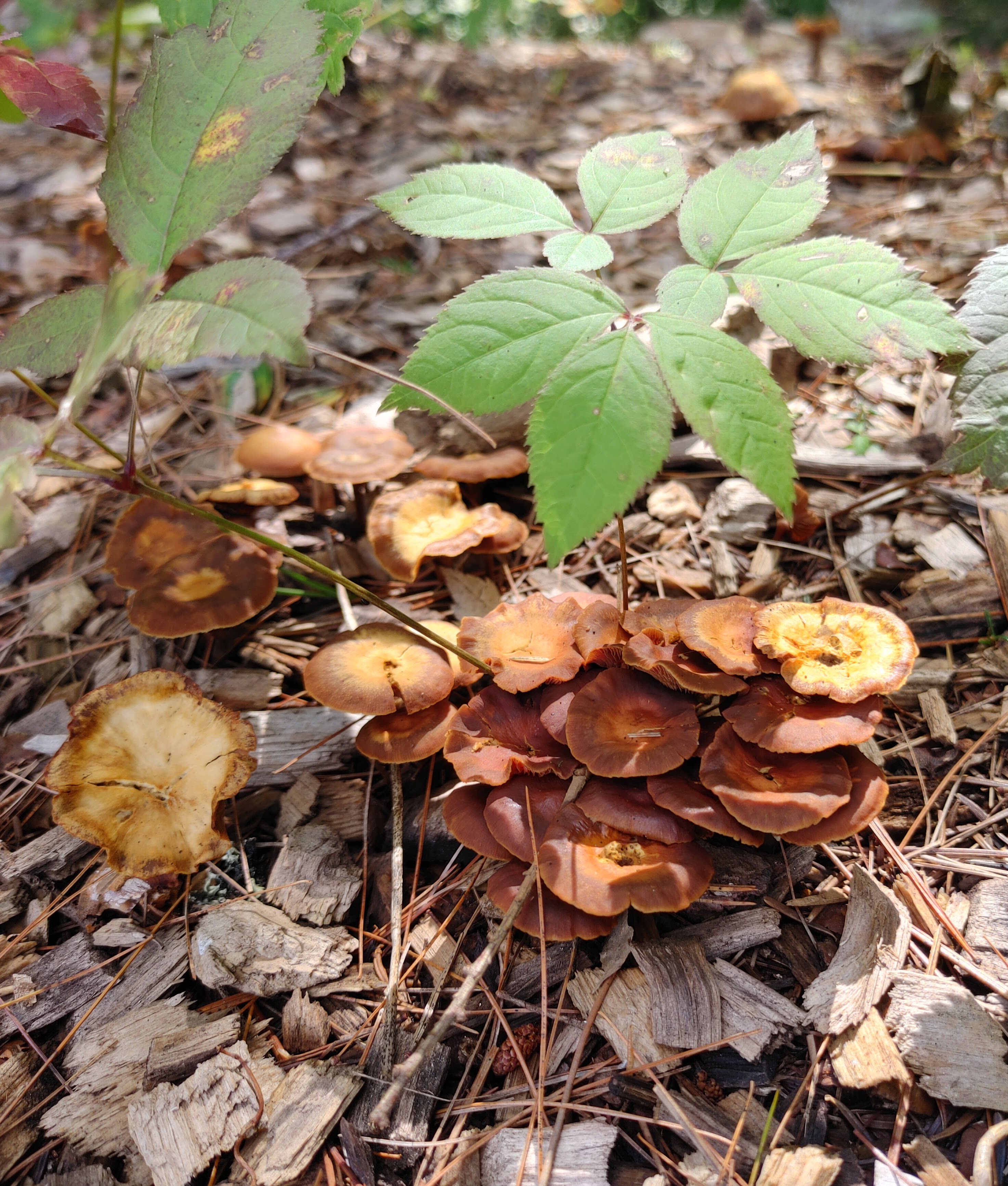
A wet July has made for an explosion of mushrooms. A walk in the woods can dazzle the eye with a bold assortment of mycelial life underfoot. According to Dianna Smith, a New Hampshire-based naturalist and mushroom enthusiast, mushrooms and trees have symbiotic relationships. Trees give mushrooms the sugars that they need to survive while mushrooms release valuable nutrients from the materials they decompose. The mushrooms that we spy along the trail are a bit like flowers, emerging from a vast underground network that has been compared to the Internet (aka the Wood-wide Web). This underlying mycelium can be long-lived and massive. A colony of Armillaria solidipes mushrooms in the Malheur National Forest of Eastern Oregon is believed to be 2,400 years old and spans an estimated 2,200 acres. I’m not sure how old or vast the mycelial network is here in the Adirondacks, but these trailside finds made for a fascinating walk. The heavens may sing the glory of God, but on a warm August day, so can the forest floor.


Mushrooms

by Sylvia Plath

Overnight, very
Whitely, discreetly,
Very quietly

Our toes, our noses
Take hold on the loam,
Acquire the air.

Nobody sees us,
Stops us, betrays us;
The small grains make room.

Soft fists insist on
Heaving the needles,
The leafy bedding,

Even the paving.
Our hammers, our rams,
Earless and eyeless,

Perfectly voiceless,
Widen the crannies,
Shoulder through holes. We

Diet on water,
On crumbs of shadow,
Bland-mannered, asking

Little or nothing.
So many of us!
So many of us!

We are shelves, we are
Tables, we are meek,
We are edible,

Nudgers and shovers
In spite of ourselves.
Our kind multiplies:

We shall by morning
Inherit the earth.
Our foot’s in the door.

from Sylvia Plath’s first collection: The Colossus and Other Poems, published by Vintage, New York (1998, ed.)