Sabbath Day Thoughts — “The Healing Trees” Ezekiel 47:6b-12 and Revelation 22:1-5
The Fortingall yew is the oldest tree in Scotland, and perhaps all of Europe. At 5,000 years old, the tree was already ancient when the Prophet Ezekiel languished in exile in Babylon and Jesus strode out of Galilee and shook things up in the Jerusalem Temple. The tree has long been considered a sacred place. Druids once worshipped beneath its branches. In the seventh century, Colomba sent monks from the Isle of Iona to preach the gospel in its shadow. In the 19th century, Presbyterians built a church there and have been caretaking the tree ever since. If you visit today, you’ll find that the Fortingall yew has been enclosed behind a stone wall for its own protection. Visitors, looking to capitalize on the tree’s longevity and notoriety, like to cut off large branches and pieces of the trunk to carve drinking-cups and other curiosities.
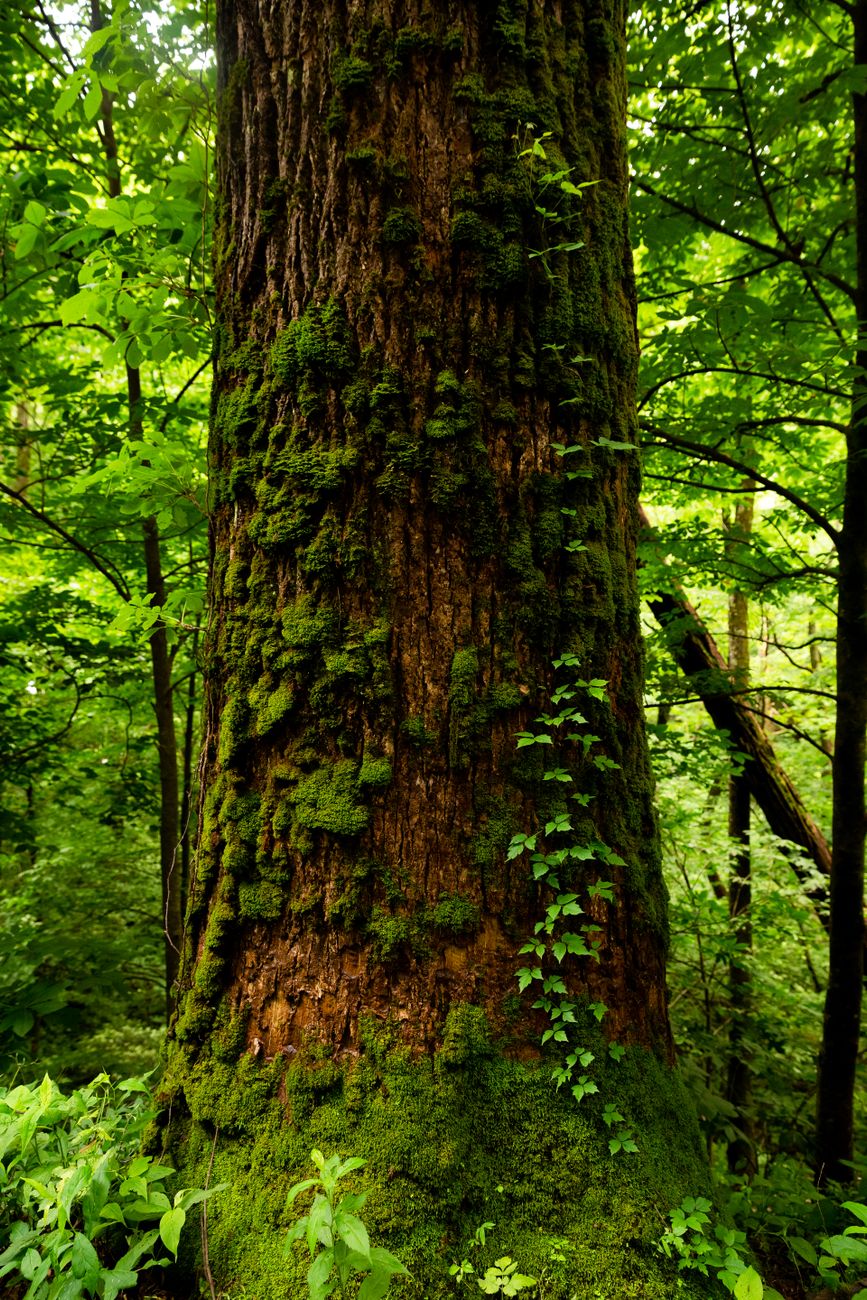
If you are looking to visit old trees closer to home, you could come with me to the Elder Grove in Paul Smiths. The trail is intentionally unmarked. Up a hill, under a power line, and through dense woodland, your boots rattle through inches of leaf litter and debris. The fifty or so Eastern White Pines of the Elder Grove germinated around 1665 when a fire or windstorm cleared the area and allowed the pines to out-compete other trees. Visiting the Elder Grove feels like an otherworldly pilgrimage. To be surrounded by those aging giants is a journey back in time to the virgin wilderness of pre-colonial America. It’s a master class in the epic scale of creation, taught by none other than the great Creator.
In our readings from Ezekiel and Revelation, God spoke through the prophets, revealing future plans for a renewed creation. The new Jerusalem descends from above as God Almighty comes to us. Heaven and earth become one, and all creation is renewed. It’s a return to the primeval paradise of Eden—with trees front and center. Fed by the river of the water of life, the trees bear fruit that will satisfy our deepest hunger and leaves that will bring healing to the nations. People of every ethnicity, speaking every language, representing every country will dwell together in peace and wholeness before the throne of God and the lamb.
It’s a beautiful vision granted to faithful people in times of crisis. When God spoke to the Prophet Ezekiel, he was in Babylon. Once a priest serving in the Jerusalem Temple, Ezekiel accompanied his people into exile. The Promised Land was lost, the Temple destroyed, their best hopes for tomorrow dashed. Similarly, when God spoke to John of Patmos, the seven churches of the Revelation teetered on the brink of extinction. Rejected and expelled by their Jewish kinfolk, persecuted by the Roman Empire, mistrusted by their pagan neighbors, those first Christians sought to hold fast to their faith despite hardship. They needed a Word from God. When things seem at their worst, God holds out a hopeful vision to God’s people and invites them to dream of that better tomorrow.
Dendrologists, scientists who study trees, affirm the healing power of trees that was promised by the prophets. Our forests are the great lungs of the earth. While we breathe in oxygen and breathe out carbon dioxide, God in God’s infinite wisdom created trees to breathe in carbon dioxide and breathe out oxygen. Trees are also natural air filters that absorb pollutants. Every year, US trees remove 17.4 million tons of pollutants from the air. Trees play a crucial role in preventing soil erosion, water pollution, and flooding. A single large tree can lift 100 gallons of water from the ground and discharge it into the air in just one day. Time in the woods has a big impact on our physical and mental well-being, too—reducing stress, lifting mood, and giving our immune system a boost.
Old growth forests, like the remnant of the Elder Grove, have a unique role to play in the help and healing of our world. A single old growth tree with deeply fissured bark, hollow cavities, dead branches, massive crown, and vast subterranean root system may harbor up to 2,300 species—plants, animals, birds, insects, fungi, mosses, lichen, and more. Those old trees play a key role in stemming climate change. They are far superior to second growth forests at storing carbon, sequestering it over centuries in massive trunks, branches, and roots. Old growth stands actually create their own microclimate where shade and cooler temperatures provide refuge for animals and plants in a warming world. The leaves of the trees are, indeed, for healing.
Dendrologists tell us that only one percent of the old growth forests in the eastern US remain. In the west, about five percent persist. Worldwide, only one-third of our virgin forests have escaped logging. Trees may be a renewable resource, but science shows that second-growth forests will take centuries to develop the carbon storage capacity of their elders. Young forests are more vulnerable to invasive pests and disease, like the Hemlock woolly adelgid, emerald ash borer, and beech-scale insect that plague our Adirondack woods. The science shows that climate change is having a disproportionate effect on our northern forests, with temperatures rising here much faster than the global average. Reduced snow cover, increases in extreme weather, and rising average temperatures are putting our forests at increased risk. The frequency and extent of forest fires have been higher in recent years than in any time in the last 10,000 years. The leaves of the trees may be for healing, but they face unprecedented challenge in a warming world.
When things seem at their worst, God holds out a hopeful vision to God’s people and invites them to dream of that better tomorrow. Botanists use the term refugia to describe the little pockets of plants and animals that repopulate areas after big changes in the environment, like after the last ice age when the glaciers receded and remaining animal and plant populations surged to fill new territory. In a warming world, those areas of refugia will be found in places like the Adirondacks, where the northern slopes of mountains and remnants of old growth forests will preserve habitat for threatened ecosystems. The possibility of a healed world on the far side of the climate crisis is right here. Like Ezekiel and John of Patmos, we are in the right place at the right time to speak God’s hopeful vision to the world.
We also have a role to play in safe-guarding and preserving those remnant places from which renewed life will spring to heal the planet. In her book Refugia Faith: Seeking Hidden Shelters, Ordinary Wonders, and the Healing of the Earth, professor, author, and speaker Debra Rienstra teaches that, in an age of climate change, Christians are called to be a refugia. Our churches are to be welcoming places that provide “life giving nourishment,” the spiritual water that can sustain us and allow us to thrive amid change. Together, we can lean into that vision of the Kingdom that God shared with Ezekiel and John the Revelator, the vision of a creation where the waters flow in abundance, the forests thrive, and the world is healed. As we lean into that vision, we can trust that God will be in our midst, working through community and inspiring our dreams. We are called to be a people and place of refuge in a warming world.
What does a refugia church look like? We put on the orange vests and do highway clean-up. We gather to read and reflect in the Earth Care Book Group. We improve the energy footprint of our building. We raise funds and awareness to protect our waterways through the Earth Care Coffee House. We get outdoors with picnics and Sermons on the Trail and paddles. We stand in places like the Elder Grove with awe and gratitude for God the Creator and Jesus Christ through whom all things came into being. Will you be a place of refuge with me?
Earlier this year, we had good news for our old growth forests. It has long been the common belief that perhaps only 50,000 acres of our 6.1-million-acre park have not been logged. But new researched, supported by a $1.3 million study by New York state, suggests that those numbers are wrong. We have more old growth trees, more refugia, than we thought—perhaps as many as 270,000 to 440,000 acres of forest that, like the Elder Grove, are hidden in plain sight. The study documented 500-year-old red spruce and eastern hemlocks, 400-year-old sugar maples and yellow birches, and forests with five species of trees older than 300 years. Much of that old growth remnant is in our backyard, like the woods around Polliwog Pond near Fish Creek Campground. That’s good news for us, our forests, and our efforts to mitigate climate change.
When things seem at their worst, God holds out a hopeful vision to God’s people and invites them to dream of that better tomorrow. Let’s dream together as a people and place of refuge.
Resources
Ella McKendrick. “The Fortingall Yew: A Complete Visitor’s Guide” June 4, 2025. Accessed online at https://ellamckendrick.com/fortingall-yew/
Amy Feiereisel. “Inside the 350-year-old ‘Elder Grove’ of Paul Smiths,” Sept. 1, 2023. Accessed online at https://www.northcountrypublicradio.org/news/story/48366/20230901/inside-the-350-year-old-elder-grove-of-paul-smiths
Dalia Kellou, Alexander Nauels, Uta Klönne. “Climate impacts in northern forests” in Climate Analytics, March 21, 2024. Accessed online at https://climateanalytics.org/publications/climate-impacts-in-northern-forests
Mike Lynch. “Study reveals 400K acres of old growth forest, hiding in plain sight” in Adirondack Explorer, March 15, 2026. Accessed online at https://www.adirondackexplorer.org/environment/natural-history/adirondack-old-growth-forest-in-the-adirondacks-more-than-expected/
Steven Bouma-Prediger. “The Leaves of the Trees Are for the Healing of the Nations,” in Reformed Journal, April 5, 2020.
Debra Rienstra, “Little Pockets: Refugia Basics” in Reformed Journal, August 17, 2019.
Melinda Baker. “Old Growth Forests nd Large Old Trees as Critical Organisms Connecting Ecosystems and Human Health” in Springer Nature, Jan. 5, 2022.
Chad Rimmer, Carol Marples, Pauline Mumia & Johanan Celine Valeriano. “Living Waters: Season of Creation 2026” in Season of Creation, Fall 2026.
Debra Rienstra. Refugia Faith: Seeking Hidden Shelters, Ordinary Wonders, and the Healing of the Earth, Tantor Media, 2022.
Ezekiel 47:6b-12
Then he led me back along the bank of the river. 7 As I came back, I saw on the bank of the river a great many trees on the one side and on the other. 8 He said to me, “This water flows toward the eastern region and goes down into the Arabah, and when it enters the sea, the sea of stagnant waters, the water will become fresh. 9 Wherever the river goes, every living creature that swarms will live, and there will be very many fish once these waters reach there. It will become fresh, and everything will live where the river goes. 10 People will stand fishing beside the sea from En-gedi to En-eglaim; it will be a place for the spreading of nets; its fish will be of a great many kinds, like the fish of the Great Sea. 11 But its swamps and marshes will not become fresh; they are to be left for salt. 12 On the banks, on both sides of the river, there will grow all kinds of trees for food. Their leaves will not wither nor their fruit fail, but they will bear fresh fruit every month, because the water for them flows from the sanctuary. Their fruit will be for food and their leaves for healing.”
Revelation 22:1-5
Then the angel showed me the river of the water of life, bright as crystal, flowing from the throne of God and of the Lamb 2 through the middle of the street of the city. On either side of the river is the tree of life with its twelve kinds of fruit, producing its fruit each month, and the leaves of the tree are for the healing of the nations. 3 Nothing accursed will be found there any more. But the throne of God and of the Lamb will be in it, and his servants will worship him; 4 they will see his face, and his name will be on their foreheads. 5 And there will be no more night; they need no light of lamp or sun, for the Lord God will be their light, and they will reign forever and ever.