From Saranac Lake to Mzuzu — Stories in Celebration of Our 136th Anniversary

Sabbath Day Thoughts — “From Saranac Lake to Mzuzu” Matthew 14:22-33

On Friday evening, July 25, 1890, the First Presbyterian Church of Saranac Lake, New York celebrated an organizing service in a brand-new church building. It was so new, in fact, that there were no windows; and instead of pews, the worshippers were seated on simple plank benches. Seventeen people—thirteen women and four men—with the Rev. Richard McCarthy, signed their names to a new leather-bound Session book, below the words, “We the undersigned original members organized as the First Presbyterian Church of Saranac Lake, N.Y. subscribe our names as a memorial of the occasion and as a pledge of our Christian fellowship.” 

In celebration of the one hundred and thirty-sixth birthday of the First Presbyterian Church of Saranac Lake, today I’ll be sharing stories from the history of our church.

“The White Plague”

Like many institutions in Saranac Lake, the “White Plague” of tuberculosis played a powerful role in shaping our church as people from around the world flocked to our mountain village to seek Dr. Trudeau’s cold air cure.  The lives of a number of our earliest pastors were touched by the disease. Our second minister, Rev. Henry A. Lewis, who served the church from 1893-1894, came to Saranac Lake in the company of his wife who suffered from TB. In 1895, young Rev. Armitage Beardsley came to our church fresh from seminary and promptly contracted tuberculosis.  By July 1897, Beardsley was too ill to moderate the session. In a touching, hand-written note dated Sept. 2, 1897, the young minister resigned. He died within two weeks and the ladies of the church draped the pulpit in black as a memorial. Our fifth, Rev. Dr. Edwin H. Dickinson, also came to town in the company of a sick spouse. Mrs. Dickinson died in the church manse in March of 1903. One of our longest serving ministers, Rev. Hiram Lyon, who served at the height of the TB days from 1927-1937, first came to Saranac Lake in 1925 to cure after his graduation from Union Seminary in NYC.  Lyon’s experience as a patient inspired him to make care and visitation a core component of the church’s ministry.  He was the driving force in the hiring of Miss Christine Burdick, our parish visitor, who made as many as 2,000 visits to TB patients each year from 1928—1932.

Of course, our membership was also profoundly affected by the “White Plague.”  Many TB patients became church members, even if they never set foot on church property. Session minutes of 1897 relate that two elders went to the O’Malley Cottage to receive a Miss Fletcher into church membership. Elders and pastors took communion out to shut-ins. Poor boxes to benefit the “sick poor” were stationed at the rear of the church to help patients in need. Many members worked in the cure industry. Some owned cure cottages. Some drove taxis.  Some were tray boys and girls. Many were health care professionals. 

TB doctors played an important role in governing the church.  The first doctor to affiliate with us was Dr. E.R. Baldwin in 1895, a graduate of Yale, who was one of Dr. Trudeau’s closest colleagues. He was soon followed by Dr. Hugh Kinghorn, a pillar of the church until his death. By 1949, we had six doctors serving as active elders on session: Doctors Kinghorn, Bellaire, Merkel, Mitchell, Woodruff, and White. Dr. Karl Merkel was especially remembered for his “generosity, gruff kindness, and impatience.” He would frequently leave a meeting before it was over if he had morning commitments. One evening, the elders were engrossed in church business during a session meeting when a loud bell rang at 9PM. Dr. Merkel retrieved his alarm clock from under the table, stood up, and “quickly left amid peals of laughter.”

“Women’s Work”

When our church was founded in 1890, American women were thirty years away from having the right to vote, and so it should come as no surprise that women were likewise unable to vote or hold elected office in the church. Yet women were a powerful behind-the-scenes force in shaping our congregation.  They raised money, supported missions, studied the Bible, and cared for the church building and the manse. The Women’s League, organized in the first decade of our church, was charged in 1897 by the Board of Trustees with assuming “care of cleaning and heating the church ‘til further notice.” When US women won the vote in 1920, the church was slow to follow. Instead in 1920, the Trustees’ minutes note, “Ask the ladies to get up some entertainment to help defray our debt.” The same year, the women provided for refinishing of the church floors and prepared food for the annual meeting and dinner at a cost of $0.50 per person.

In 1928, the church finally resolved to elect three women to serve as Trustees of the church, overseeing matters of care for the building. At one of those early meetings, the women Trustees voiced their discontent with the status quo. “It has been brought to my attention,” stated Miss Gertrude Hugo, “that it is not the sexton’s duty to keep the church clean and dusted, but that the women’s organizations had assumed that responsibility. Why should they?”

Our first women elders Gertrude Woodruff and Julia Norton were elected in 1958, twenty-nine years after our denomination had approved the right of women to hold that office.  Perhaps the session was inspired to change by the first ordination of women as Presbyterian pastors in 1957.  Although our first women elders served on session and prepared communion, they were not permitted to serve communion until the 1960’s when Evelyn Outcalt became the first woman to bravely go forth with the bread and the cup.  Evelyn recalled that not everyone was happy. On the first communion Sunday, one female parishioner indignantly said, “I don’t like it!” and refused to accept the plate as Evelyn tried to serve her. I wonder how that woman would feel about a woman in the pulpit nowadays.

“The Church Bell”

You may have noticed the bell that hangs in the tower at the side entrance of the church. The bell was made by Meneely & Company of West Troy, New York (now Watervliet).  Our church bell is inscribed with the words of Mark 16:15, “Go Ye Into the World and Preach the Gospel to Every One.”  It also has a dedicatory inscription, “Presented by Col. Elliott F. Shepard New York City August 18, 1891.”  Col. Shepherd, a New York City publisher, was an early benefactor of the church. 

It is estimated that the bell weighs about 2,000 pounds, a heavy load for our small wooden sanctuary and its elegant original belfry.  For many years, the church bell was rung each Sunday morning at the beginning of worship.  A long rope hung from the belfry down through a hole and onto the open front porch of the church.  In 2010 at our 120th anniversary, older church members still remembered boys out on the “porches” ringing the bell with much enthusiasm on Sunday mornings. 

By 1937, members had begun to express concern about the size of the bell and the stability of the church’s belfry. That year, an architect was hired to inspect the belfry and offer a report to the Trustees. If any further action was taken, it is not recorded in the session minutes. Eight years later in 1945, the belfry was reconstructed to provide better support for the bell. The original belfry was a “two-story,” open structure. The belfry was shortened to one story and the structure was reinforced. 

The weight of the bell continued to compromise the structural integrity of our small wooden sanctuary. Members began to notice that the walls had moved, pushed out of square by the weight of the bell. It was feared that, eventually, the belfry and bell would collapse, crashing down through the roof of the sanctuary. When the porches were enclosed in 1965, it was proposed that the bell be moved to a cement pad on the front lawn of the church. Unfortunately, there wasn’t enough room. The church needed fourteen more inches of churchyard to satisfy the village code.  In 1967, the bell was removed from the belfry and placed in storage with Maddens. In 1969, the session voted to give Col. Shepard’s bell to North Country Community College where it remained in storage for seven more years.

In 1976, at the initiative of the Presbyterian Women, a plan was enacted to retrieve and house the bell in a wooden tower at the side entrance of the church.  A fund was established in memory of David and Miles (Mickey) Ferree, the late sons of Elder Anna Ferree.  Elder George Schaefer managed the project, and Dick Grebe designed the tower. By October 1977, the project was complete. The tower was dedicated in a service of worship, followed by a reception with cider and donuts. The bell was rung by all.

“Many Missions”

From our earliest years, the church was interested in foreign mission. In 1896, the Women’s Missionary Society was formed by fifty women, each pledging $0.02 a week in mission giving.  By the turn of the century, our Women’s League was supporting Presbyterian Missionaries in India and China. In 1920, the church accepted partial responsibility for the salary of Dr. Winfield Scott Dudgeon, who taught at Ewing Christian College in Allahabad City in northwestern India. The college was founded in 1902 as a joint venture of the Presbyterian Church and the British East India Company. The church’s commitment to Dr. Dudgeon was $1,200 each year, which in today’s world would be about $17,000. That’s no small commitment.

Dr. Dudgeon earned his doctorate at the University of Chicago and married his hometown sweetheart from Iowa—Grace Evans. The two itinerated to India in 1912 where they had two children. Dr. Dudgeon was a botanist. He taught biology at the college and established the first laboratory course in botany in all of India. He was the founder and first president of the Indian Botanical Society. He trained and mentored India’s leading botanist of the 20th century, Pontaman Maheswari. Between 1928 and 1930, Dudgeon served as the acting president of the college.

In a letter to the church from the same period, he described his vision of himself and his colleagues as academics and ambassadors of Christ in Hindu-dominated northwest India, saying, “Surely India needs Christ. Politically where else can unity be found; socially where else can relief be found for the degraded and neglected; individually where else can the burdened soul find relief from sin and its consequences?  I can only say that we are striving to maintain a college at such a high scholastic level that young men will continue to be attracted in large numbers and that when they do come to us, we endeavor to persuade them to take Christ as their Savior.”

Dr. Dudgeon had a scheduled visit to Saranac Lake planned during his sabbatical year in 1932. Sadly, he never had the opportunity to meet the members who had so fervently supported him with prayers and gifts. He died suddenly, shortly after returning to America.  He was forty-five years old.

Our passion for foreign mission persists. Over the past two decades, we have supported the itineration of the Hellers at the Mzuzu Crisis Care Nursery in Malawi, the outreach of Grace Chiumia and Sam Chirwa through the Women of Grace Widow’s Fund, the educational efforts of the Malawi Early Literacy Fund, and the work of Rev. Tyler Holm and Dr. Rochelle Holm to equip pastors for ministry and to improve access to clean water and sanitation in Malawi. Each year, our Christmas gifts to Africa—received for the benefit of the Marion Medical Mission—provide the life-saving gift of clean water to remote villages in Malawi, Tanzania, and Zambia. Many missions, indeed.

Please join me in prayer. Almighty God, as we celebrate our 136th year of ministry, we remember your steadfast love for us, made known in your Son, Our Lord Jesus. Today we dedicate ourselves anew to the way of Christ, remembering where we have been and anticipating with joy the many years to come; in Jesus’ name we pray.  Amen.


Matthew 14:22-33

22 Immediately he made the disciples get into a boat and go on ahead to the other side, while he dismissed the crowds. 23 And after he had dismissed the crowds, he went up the mountain by himself to pray. When evening came, he was there alone, 24 but by this time the boat, battered by the waves, was far from the land, for the wind was against them. 25 And early in the morning he came walking toward them on the sea. 26 But when the disciples saw him walking on the sea, they were terrified, saying, “It is a ghost!” And they cried out in fear. 27 But immediately Jesus spoke to them and said, “Take heart, it is I; do not be afraid.”

28 Peter answered him, “Lord, if it is you, command me to come to you on the water.” 29 He said, “Come.” So Peter got out of the boat, started walking on the water, and came toward Jesus. 30 But when he noticed the strong wind, he became frightened, and, beginning to sink, he cried out, “Lord, save me!” 31 Jesus immediately reached out his hand and caught him, saying to him, “You of little faith, why did you doubt?” 32 When they got into the boat, the wind ceased. 33 And those in the boat worshiped him, saying, “Truly you are the Son of God.”


Lazarus, Then and Now

Sabbath Day Thoughts — “Lazareth, Then and Now” Luke 16:19-31

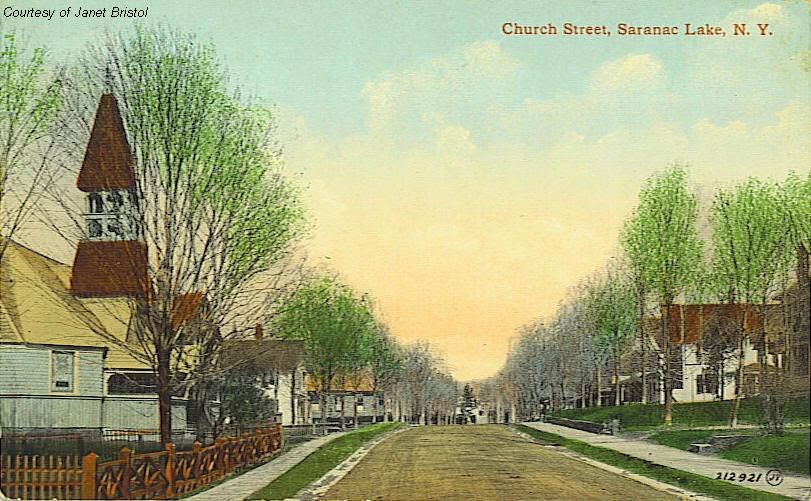
Imagine Saranac Lake on July 25, 1890 when an organizing service of worship took place right here, the sanctuary so new that it lacked windows and seats. Rough wooden benches held worshipers, and hymns were sung a cappella, the sounds of Presbyterian harmonies gently drifting across the village. Church Street was unpaved, the street alternately dusty or muddy, dotted with riders and horse-drawn wagons. The village’s ten-block commercial district was two years away from its first phase of construction. The surrounding hills of Pisgah, Dewey, and Baker were clear cut, the trees sent down the Hudson to build New York City. Helen Hill was a grassy knoll called the Sheep Meadow, but it would soon undergo a residential building boom. The local population had swelled to 1,582 permanent residents, tripling in size over the past few years. In the next decade, it would quadruple.

Everywhere, the sounds of construction rang out. That summer, the Adirondack Cottage Sanitarium built three cure cottages and a large open-air amusement pavilion. Local residents were adding additions to their homes, tacking on porches, and taking in borders. New homes were rented at a premium that enabled owners to pay off their building debt within two years. With our short Adirondack building season, even Sunday mornings would have been punctuated by the sounds of hammers and saws, workman’s shouts and teams of horses hauling wagons.

We were booming, thanks to the “White Plague” of tuberculosis.  The crowded living conditions, poor air quality, and squalid poverty of American cities were a breeding ground for the disease. In those days before antibiotics, a tuberculosis diagnosis felt like a death sentence. It started with coughing, night sweats, fever, weight loss, and bloody sputum.  It progressed to organ failure and death. By 1907, 400 Americans were dying of tuberculosis every day. Dr. E.L. Trudeau spurred the hopes of patients everywhere that a miracle cure had been found in Saranac Lake when he publicized that the cold air, rest, good food, and leisure of the Adirondacks had put his TB into remission. Hurting people from across the nation and around the world, desperate for healing, rode the new railroad to the village looking for renewed health. These TB patients, desperate, sick, and far from home, would have been among the most isolated and vulnerable people that we could possibly imagine.

In our reading from Luke’s gospel, Jesus told a story about a rich man and the desperately ill neighbor who languished at his gate. Jesus used the Greek word plousios to describe the rich man, meaning a wealthy landowner who did not labor for a living. He lived large, clotheded in royal purple and fine linen, feasting on sumptuous food, and hosting lavish parties. Jesus described the sick man, Lazarus, with the Greek word ptoxos, meaning the abject poor, a homeless beggar without the support of property, friends, or family. He was so weakened that he couldn’t even shoo away the dogs drawn to his festering wounds. Although they were neighbors, the rich man didn’t seem to see Lazarus, while the sick man dreamt of eating the crumbs that fell from his rich neighbor’s table. Jesus painted a stark and uncomfortable picture of the extremes of our human condition.

According to Jesus’ parable, death brought a great reversal. Lazarus, who suffered so in life, found a privileged position in death, seated by the Patriarch Abraham at the heavenly banquet. The rich man, on the other hand, was in Hades, tormented by flames and an unquenchable thirst. It comes as a surprise to hear that the rich man not only knew Lazarus, he also felt he could order him around: come and relieve my thirst with a glass of cold water; go and tell my brothers to change their ways. We can imagine the shock that the rich man felt when he learned that his indifference to the suffering of his neighbor, his flagrant disregard for the requirements of scripture, had built a great chasm, not only between himself and Lazarus, but also between himself and God.

When our seventeen original members signed their names to the church’s brand-new, leather-bound session ledger on July 25, 1890, they made a bold commitment to love and worship God right here. They also made a sincere commitment to their vulnerable neighbors whom they knew to be at their gate. Jane “Jennie” Conklin came to Saranac Lake from Rochester in the spring of 1890 with her husband John as he sought the cold air cure for tuberculosis. By year’s end, John was dead, leaving Jennie with three young children and a small sum that she used to build the Conklin Cottage at the corner of Main and Church Streets. There she tended patients in need of compassion and care, much as she had tended her husband. Likewise, the Podmore and Lattrell families, who were also among our founding members, were proprietors of cure cottages.

By 1893, the church had created what was known as the Fellowship Fund, which benefited neighbors in need through personal pledges. Poor boxes to receive donations for the relief of the “sick poor” were installed inside the church door. The church welcomed tubercular patients that never entered this sanctuary and certainly never made a pledge to the church, like Miss Fletcher, who was received into the membership of the church by two elders, dispatched to her bedside at the O’Malley Cottage. Our third pastor, the Rev. Armitage Beardsley, came to us in 1895 fresh from seminary. He saw the sanitoriums and cure cottages of the village as his mission field. He soon contracted TB, and by September 1897 was so ill that he was forced to resign. His touching letter of farewell is pasted into the session minutes of the time. News of his death followed within weeks.

Without question, our most dedicated advocate of the “sick poor” was Rev. Hiram Lyon, who served the church from 1927 to 1937. He came to Saranac Lake in 1925 in need of the cold air cure, following his graduation from Union Seminary in New York City. When our pastor Rev. George Kennedy Newell died of pneumonia shortly before Christmas in 1926, the church looked to young Hiram to fill the pulpit. Afraid that his newfound health wouldn’t last, he agreed to serve for a one-year trial period, and against all odds, he thrived. Hiram believed that God had placed this congregation in a unique position to care for vulnerable neighbors with tuberculosis. He cast the vision for the church to hire a Parish Visitor, who would travel to cure cottages, sanitoriums, and local hospitals to bring patients hope, cheer, and the love of Christ.  In October 1928, the job went to Miss Christine Burdick a recent graduate of the Boston University School of Religious Education and Social Service. Christine made as many as 2,000 visits in a year, offering compassionate listening, caring presence, and fervent prayers. Walls of loneliness, isolation, and fear came tumbling down as Christine shared the love of Christ with neighbors who must have felt every bit as vulnerable as Lazarus at the gate.

Jesus’ parable of the rich man and his desperate neighbor is a story about a failure to love. The rich man failed to love God with all his heart and mind and soul and strength. He also failed to love his neighbors as himself. The rich man saw Lazarus as a blight on his landscape, not as a brother, a fellow child of Abraham, deserving of love and compassion, mercy and care. It never occurred to the rich man that his abundance was a gift from God, meant to be shared for the common good and the particular care of his vulnerable neighbor. Today as we commemorate our anniversary, we celebrate our ancestors in the faith, those saints who gathered on Sunday mornings to express their heartfelt love for God and then went forth into the week to love their neighbors, especially the most vulnerable ones.

Today, we are called to claim that legacy for ourselves. We honor Jane Conklin and Armitage Beardsley, Hiram Lyon and Christine Burdick when we dare to go forth and do likewise, expressing our love for God with our worship and music, and opening our hearts and hands to care for those who need it most.

I want to wrap up my message by naming some of the ways that we bless neighbors in times of vulnerability. Now, if you have ever participated in any of these ministries or perhaps been blessed by these ministries, let me know with an “Uh-huh,” an “Amen,” or perhaps a clap offering. Ready?

We knit prayer shawls, lap robes, and baby blankets to bless those in need of blessing.

We give generously to our Deacons Fund, to help neighbors pay rent or make car repairs, cover medical bills or make essential purchases.

We visit folks who are hospitalized, homebound, or live at Will Rogers and Elderwood, sharing love and communion.

We cook delicious meals and deliver them to those who are bouncing back from surgery, illness, or grief.

We grow beautiful produce to feed our Food Pantry friends, and we bring in paper goods for neighbors at Grace Pantry.

We raise funds and awareness about hunger in the CROP Walk.

We partner with our ecumenical friends to house the homeless and help them transition to independent living.

We pray our hearts out on the prayer chain.

We love and welcome immigrants and refugees.

I could say more, but brunch is waiting. Thank you to those bold seventeen original members who launched this great endeavor to love. Thank you to all of you, who so boldly claim that legacy with care and compassion, near and far. Lazarus is at the gate, my friends. May we go forth to love.


Luke 16:19-31

19 “There was a rich man who was dressed in purple and fine linen and who feasted sumptuously every day. 20 And at his gate lay a poor man named Lazarus, covered with sores, 21 who longed to satisfy his hunger with what fell from the rich man’s table; even the dogs would come and lick his sores. 22 The poor man died and was carried away by the angels to be with Abraham. The rich man also died and was buried. 23 In Hades, where he was being tormented, he lifted up his eyes and saw Abraham far away with Lazarus by his side. 24 He called out, ‘Father Abraham, have mercy on me, and send Lazarus to dip the tip of his finger in water and cool my tongue, for I am in agony in these flames.’ 25 But Abraham said, ‘Child, remember that during your lifetime you received your good things and Lazarus in like manner evil things, but now he is comforted here, and you are in agony. 26 Besides all this, between you and us a great chasm has been fixed, so that those who might want to pass from here to you cannot do so, and no one can cross from there to us.’ 27 He said, ‘Then I beg you, father, to send him to my father’s house— 28 for I have five brothers—that he may warn them, so that they will not also come into this place of torment.’ 29 Abraham replied, ‘They have Moses and the prophets; they should listen to them.’ 30 He said, ‘No, father Abraham, but if someone from the dead goes to them, they will repent.’ 31 He said to him, ‘If they do not listen to Moses and the prophets, neither will they be convinced even if someone rises from the dead.’ ”


First Presbyterian Church of Saranac Lake

No One Knows

Sabbath Day Thoughts — “No One Knows” Mark 13:24-37

Christians have been trying to determine the date of the second coming ever since the first coming.

Irenaeus, the second century Bishop of Lyon, was an influential leader of the early church.  He believed that the world was created 5,500 years before Christ, and creation would come to an end after 6,000 years. According to Irenaeus, the Son of Man would return with great power and glory in the year 500. He was wrong.

In the seventeenth century, the English mathematician, physicist, astronomer, alchemist, and theologian Sir Isaac Newton believed that the number “1260” had particular significance in the prophetic books of the Bible. Newton theorized that the world would come to an end in the year 2060; that’s 1,260 years after the creation of the Holy Roman Empire. Proponents of Newton’s theory abandoned his point of view in 1806 when the last Holy Roman Emperor, Francis II of the House of Habsburg-Lorraine, abdicated his title and released all Imperial states and officials from their oaths and obligations to the empire.

William Miller was a 19th century American Baptist minister. He proclaimed that the Lord would return on October 22, 1844. His teaching was wildly popular, launching a religious movement known as Millerism. When Miller’s world-ending prophecy failed, his followers called it the Great Disappointment. Hiram Edson, who would go on to establish the Seventh Day Adventist Church, said, “Our fondest hopes and expectations were blasted, and such a spirit of weeping came over us as I never experienced before… We wept, and wept, till the day dawn.”

Jesus warned his followers that “no one knows” when the fateful return of the Son of Man will come. Neither the angels in heaven, nor the Son, but only the Father knows. Bible scholars like to call today’s reading from the thirteenth chapter of Mark’s gospel the “Little Apocalypse.”  As Jesus spoke these scary words, he was surrounded by his disciples.  From the Mount of Olives, they looked across the Kidron Valley to the Holy City of Jerusalem and the splendor of the Temple.  Jesus anticipated the sack of the city and the destruction of the Holy of Holies by the Romans in just a few decades, during the Jewish Rebellion against the empire.  In a coming world that would feel like the heavens were falling and the very fabric of creation was coming apart at the seams, Jesus knew that his followers would need purpose and a long view of God’s work in the world if they were going to endure.

To guide his disciples through the dark days to come, Jesus told a parable. He described a wealthy landowner preparing to depart on a long journey. Before leaving, he entrusted the care of his property to his slaves, knowing that each would be busy with his work until the watchful doorkeeper heralded the master’s return. In the first century world of the Mediterranean, slaves were essential in managing estates.  Cleaning house, tending animals, working fields, preparing meals, nurturing children, keeping accounts, and producing wine and olive oil, all depended upon the work of slaves.  Slaves were considered a part of the landowner’s family. In fact, the Latin word for the extended household of landowners and slaves together was familias—family. The intimacy and affection of the familias is preserved to this day in the ruins of Pompeii, which was destroyed by the eruption of Mt. Vesuvius in the year seventy-nine.  There we can read the words of a prayer inscribed on the walls of a household shrine, asking God for the safe return of a beloved master from a journey.

When we consider that social and historical context of slaves, masters, and the familias, we see that in today’s reading, Jesus was characterizing himself as the landowner. His arrest and execution were imminent. Before the week was out, Jesus would be betrayed, convicted, tortured, and executed. Although Jesus would rise and promise to come again in glory, for the disciples it would feel as if Jesus had gone on a very long journey, with no end in sight. In the coming years of watching and waiting, Jesus hoped that his friends would continue to faithfully and conscientiously serve him.  Just as a familias anticipated a master’s impending return with loyalty and service, the disciples would need to keep the faith and keep up the good work.  He trusted his friends to preach the gospel, heal the sick, tend to the vulnerable, and pray always for his speedy return, saying, “Maranatha!”  Come soon, Lord!

Many of us struggle with today’s reading because it is apocalyptic in tone – there is a sense of the immediacy of the Day of Judgment and a nearness of the return of Jesus in glory. Let’s face it. Almost 2,000 years is a long wait. We’re not feeling especially vigilant this Advent. For most of us, we are pretty comfortable with the way things are here and now. We have three square meals a day. We have enough, maybe more than enough. We live in safety in a beautiful part of the world. It’s not a problem for us that the second coming seems to be slow in arriving.

That attitude shifts, though, when we stir some chaos and pain into the recipe of our lives. Just ask the Christians in Gaza and the West Bank. They are praying, “Come, Lord Jesus.” Just ask the neighbor whose spouse has died a few weeks before Christmas—they would like to tear open the heavens so that God might come down. Just ask the friend who is reeling with that unexpected, bleak diagnosis, she wouldn’t mind seeing the Son of Man coming in glory. While we wait for the Second Coming, there are plenty of little apocalypses. There is an abundance of those frightening and unwanted world-changing, life-threatening, perspective-altering events. Those little apocalypses leave us longing for the Lord to be here now.

The Rev. Tracy Daub, who wrote our book study for Advent Holy Disruption, reminds us that the world-changing work of the End Times has already begun. We saw it in Jesus, who showed us what it looks like to live with compassion, forgiveness, inclusion, and love. Jesus called for an essential reordering of our world, an in-breaking of God’s Kingdom, that is yet to be fully realized. That’s where we find ourselves, between the two Advents, the first and second coming. Our work as members of Jesus’ familias is to serve the Kingdom that is “already but not yet.”

What is the work that the Master would have us do in this waiting time? It looks a lot like what Jesus and his faithful servants did. It’s feeding the hungry and welcoming the outsider. It’s forgiving those who have wronged us and praying for those who feel short on hope. It’s sharing the good news with the everyday words and actions of our lives. It’s working for a world where Israelis and Palestinians break bread together. It’s inviting to supper that mournful neighbor who feels lost in grief. It’s holding the hand and walking alongside the friend who feels lousy. We live with bold hope and compassionate love. And if we are very faithful servants of the Master, this world may even sense the coming of the Son of Man as we work with hope and love amid the little apocalypses of our world.

Frank J. Tipler, who teaches math and physics at Tulane University, published a book in 2007 called The Physics of Christianity. In the first chapter, Tipler maintains that the Second Coming of Christ will occur within 50 years—by 2057. I suspect that Tipler, like Irenaeus, Sir Isaac Newton, and William Miller, will be proven wrong by the passage of time. After all, Jesus told us, we “do not know when the time will come.”

We do know that while we wait there is work to be done. Let’s get busy, my friends. Amen.

Resources

Buggs, Courtney.  “Commentary on Mark 13:24-37” in Preaching This Week, Nov. 29, 2020.  Accessed online at workingpreacher.org.

Daub, Tracy S. Holy Disruption: Discovering Advent in the Gospel of Mark, (Louisville: Westminster John Knox Press, 2002).

Siker, Judy Yates. “Exegetical Perspective on Mark 13:24-27” in Feasting on the Word, Year B, vol. 1. Louisville: Westminster John Knox Press, 2008.

Sheldon, Natasha. “Roman Domestic Slavery” accessed online at Ancient History and Archaeology.com.


Mark 13:24-37

24“But in those days, after that suffering,

the sun will be darkened,and the moon will not give its light,
25and the stars will be falling from heaven,and the powers in the heavens will be shaken.

26Then they will see ‘the Son of Man coming in clouds’ with great power and glory. 27Then he will send out the angels, and gather his elect from the four winds, from the ends of the earth to the ends of heaven.

28“From the fig tree learn its lesson: as soon as its branch becomes tender and puts forth its leaves, you know that summer is near. 29So also, when you see these things taking place, you know that he is near, at the very gates. 30Truly I tell you, this generation will not pass away until all these things have taken place. 31Heaven and earth will pass away, but my words will not pass away.

32“But about that day or hour no one knows, neither the angels in heaven, nor the Son, but only the Father. 33Beware, keep alert; for you do not know when the time will come. 34It is like a man going on a journey, when he leaves home and puts his slaves in charge, each with his work, and commands the doorkeeper to be on the watch. 35Therefore, keep awake—for you do not know when the master of the house will come, in the evening, or at midnight, or at cockcrow, or at dawn, 36or else he may find you asleep when he comes suddenly. 37And what I say to you I say to all: Keep awake.”


Portrait of Sir Isaac Newton by Godfrey Kneller, 1702. Public domain, via Wikimedia Commons.