Sabbath Day Thoughts — “The Crossing” Joshua 3:7-17
When the Rev. Jim Erdman moved his young family to Saranac Lake in 1958 to serve as our pastor, he found a rapidly changing community. The advent of antibiotics had brought an end to the cold air cure for tuberculosis, the source of local prosperity for more than seventy years. The local population was dropping. Although the roadside sign that welcomed Jim to the village in 1958 said that our village population was 7,000, by 1960, that number had fallen to 6,000. Our sanctuary, which still had the enormous church bell hanging from a shored-up belfry, was noticeably sagging. The Christian Education building in the backyard, which was built in 1893 as a horse barn, needed a new heating system.
Money was tight here at the church. No repairs had been made to the manse, where Jim and his family would live, in seven years. Plaster was cracked, paint peeled, a rickety cure porch had to be torn off, and floor joists needed replacing. The pastor’s pay was often delayed because there wasn’t any money. The church rolls claimed 286 members, but most were inactive or had moved away. In his annual report of 1960, Jim wrote, “This year has found a relatively few members and friends vitally concerned with the work and witness of the church, both here in the community and around the world.” In 1960, the Methodist Church next door offered to buy our property with plans to tear down the building for a parking lot. It must have been a lowball offer, because the session said, “No.”
We struggled with whether or not we could continue. From 1970 to 1972 when Phil Zebley was pastor, Ann Boutilier’s late husband Bill was charged by session with chairing a committee to explore the possibility of a merger with our Methodist neighbors. We tried combined Sunday School classes, shared worship at 8:30am here and 10am there. We even considered having our Holtkamp pipe organ, which had been donated but not yet built, installed next door. Repeated surveys of the congregation showed we were ambivalent about the changes that financial prudence might demand. The exploratory committee on merging asked, “Do you want to see the shared ministry continue?” 46 voted yes, 46 voted no, and 18 people abstained. Times were tough and we were having a hard time seeing what the future might look like.
Our Israelite ancestors knew all about daunting challenges and unsure futures. Forty years of wilderness wandering had at last brought them to the Jordan River and the backdoor to Canaan. There on the far side of the river was the land of their ancestors Abraham, Isaac, and Jacob. There was the land flowing with milk and honey and the promise of descendants as many as the stars in the sky. God was bidding them to cross, but they weren’t so sure about that.
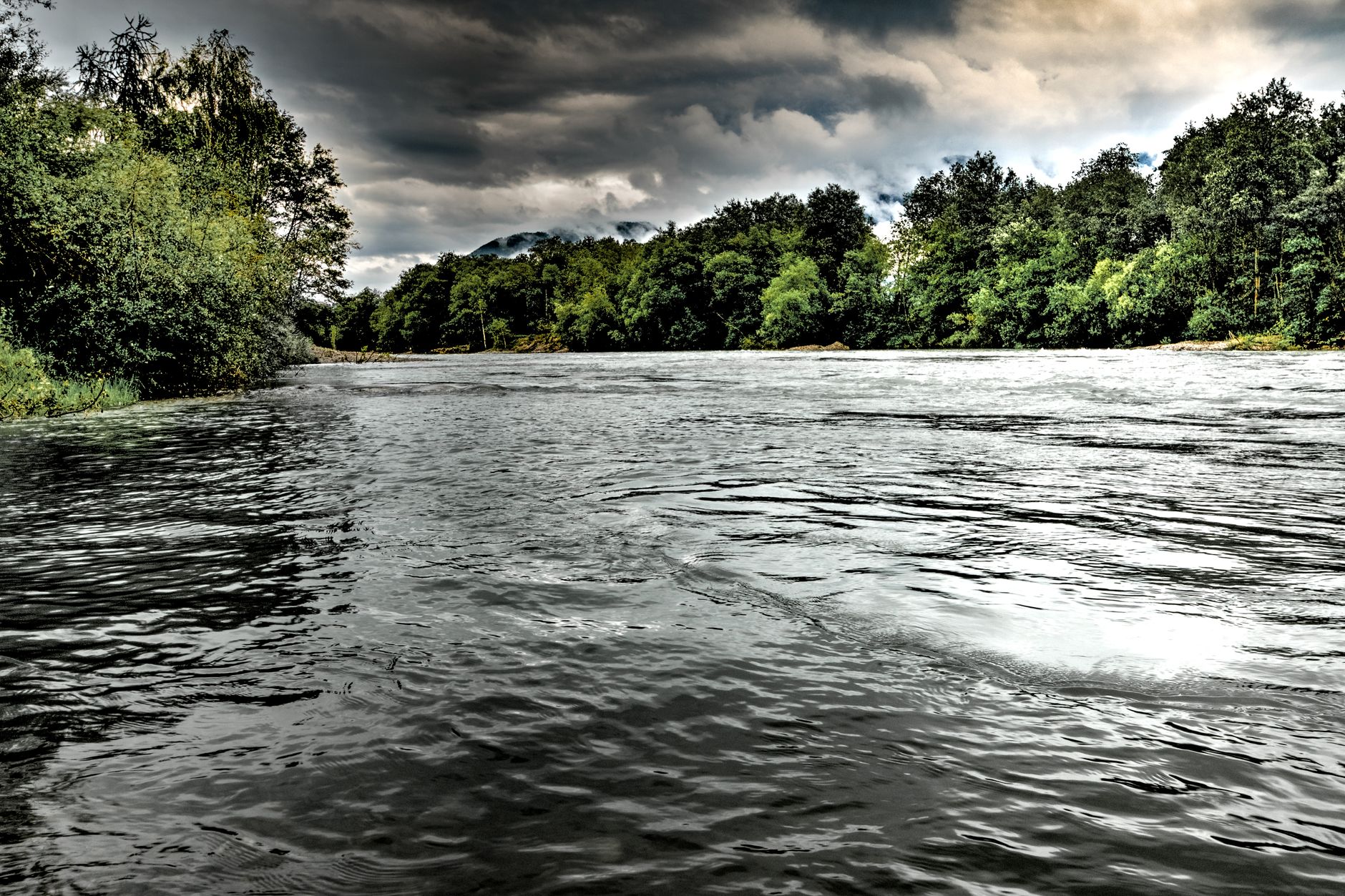
There were big obstacles. The river itself was overflowing and swift, surging with spring snowmelt from the mountains of Lebanon. How could they cross with their children and seniors, flocks and herds? Who would lead? Moses, who took on Pharaoh and won! Moses, who split the Reed Sea! Moses, who shepherded them in the desert! Moses, who spoke with God and gave them the law to guide their community! Moses was dead. Joshua, a brash, young, untried leader may have stepped into Moses’ sandals, but could he fill them? That land on the far side of the Jordan was hardly vacant, but occupied by Canaanites, Hittites, Hivites and more. The spies, whom Joshua sent ahead, cautioned that the people of the land were numerous and strong. The cities were fortified and well-defended. It would be easier to remain on that other side of the Jordan as a wilderness people.
Joshua and the Israelites found the courage to cross the Jordan because they knew that God would be with them. That’s what God promised the young Joshua, “I will be with you just as I was with Moses.” Still, it took a lot of courage for the people to muster on the banks of the surging river. But as they looked across to the other side, they remembered forty years earlier, when they had stood on the shores of the Reed Sea with Pharoah’s army in hot pursuit. God had made a way forward then. They decided to trust that God would make a way forward now.
As the toes of the twelve priests bearing the Ark of the Covenant touched the flood, the people left the wilderness as they had entered it, with God holding back the waters. The Israelites left the wilderness behind, knowing that God was in their midst. God called them to a future that they couldn’t quite imagine. Daunting. Uncertain. Unsure. Yet God was faithful still and would be faithful in all the years to come.
It should come as no surprise that the question of merging with the Methodists continued to trouble the waters here at the Presbyterian Church, especially as the Christian Education building (Gurley Hall) became increasingly dilapidated and in need of major capital investment. In 1984 a delegation of church members appealed to session to again approach our neighbors about the possibility of a shared ministry. Indeed, we might be worshipping next door at the Presbydist Methodterian church if a competing vision hadn’t arisen among the people, a vision for a radically different building: two stories with Christian Education classrooms downstairs and a commercial kitchen and Great Hall upstairs. We weren’t too sure about that though. In an initial vote at a congregational meeting in September 1983, 36 voted for the new addition and 25 against.
There were daunting challenges to be faced. First and foremost was money, which remained a persistent problem. We struggled to balance our budget, and the cost for the addition would ultimately reach $265,000—that’s about $869,000 in today’s money. There were questions of leadership, with three different pastors serving the church over the course of two crucial years of discernment between 1983 and 1985. Then, when the choice to build was made, there were other conundrums to face. A contractor botched the concrete foundation. Floods repeatedly soaked the basement. The builder erred by two feet in the measurement of the plans for the new wing.
Despite, the difficulties, we knew that God was calling us to a bigger and better building that would serve us and the community. We put our toes in the water, and miracle of miracles, an elaborate scheme of pledges, loans, and the sale of the manse made the money work. Miracle of miracles, Sally’s late husband Bill Plumb, caught the vision and agreed to spearhead that Fellowship Wing Committee and building efforts. Miracle of miracles, Skip Outcalt worked out a drainage system that would keep the downstairs dry—most of the time. Miracle of miracles, the contractor made good on their measuring mistake by installing distinctive cedar siding for the whole church.
We crossed over into that future that God held ready. We trusted that we could do it because the Lord would be with us, just as the Lord was with the Israelites and Joshua and Moses. When the “new” building was dedicated on November 15, 1987, it was already in use—not only by us, but also by Alcoholics Anonymous, Prime Time Nursery School, Boy Scouts, and Bobbi Damp’s dance studio. I’m told that the possibility of merging with our neighbors was permanently dropped.
On All Saints—Stewardship Commitment Sunday, God calls us to step into the future that God holds ready. We live in challenging times. The rising cost of living inclines us to tighten our belts and close our fists to generous giving. In the lead up to Tuesday’s election, the powers that be—on both sides of the aisle—tell us to see our neighbors as enemies, undeserving of our help or business or friendship. The rise of cultural secularism, which has pushed churches to the margins of society, and the surge in Christian Nationalism, which sells a distorted notion of the gospel as the American Dream, these fundamental cultural shifts have made church unappealing for many of our neighbors. It’s tempting to play it safe. It’s tempting to limit our commitment of time, talent, and treasure. It’s tempting to stay put in the wilderness.
But this morning, Joshua and his Israelite friends, this morning, our ancestors in the faith, right here at the First Presbyterian Church, bid us to consider a different kind of future. It’s a future where we truly see that God is with us. The challenges may be real. The future may feel daunting. Uncertain. Unsure. But the Lord is faithful still. The Lord our God is in our midst. The future calls, my friends. Let’s step out.
Resources
Carolyn Sharp. “Commentary on Joshua 3:7-17” in Preaching This Week, Oct. 30, 2011. Accessed online at https://www.workingpreacher.org/commentaries/revised-common-lectionary/ordinary-31/commentary-on-joshua-37-17-2
Dennis Olson. “Commentary on Joshua 3:7-17” in Preaching This Week, Nov. 5, 2017. Accessed online at https://www.workingpreacher.org/commentaries/revised-common-lectionary/ordinary-31/commentary-on-joshua-37-17-4
Bryan J. Whitfield. “Commentary on Joshua 3:7-17” in Preaching This Week, Nov. 5, 2023. Accessed online at https://www.workingpreacher.org/commentaries/revised-common-lectionary/ordinary-31/commentary-on-joshua-37-17-6
Evelyn Outcalt and Judith Kratts. A History of the First Presbyterian Church of Saranac Lake, 1890-1990. Self-published, 1990.
Joshua 3:7-17
7 The Lord said to Joshua, “This day I will begin to exalt you in the sight of all Israel, so that they may know that I will be with you as I was with Moses. 8 You are the one who shall command the priests who bear the ark of the covenant, ‘When you come to the edge of the waters of the Jordan, you shall stand still in the Jordan.’ ” 9 Joshua then said to the Israelites, “Draw near and hear the words of the Lord your God.” 10 Joshua said, “By this you shall know that among you is the living God who without fail will drive out from before you the Canaanites, Hittites, Hivites, Perizzites, Girgashites, Amorites, and Jebusites: 11 the ark of the covenant of the Lord of all the earth is going to pass before you into the Jordan. 12 So now select twelve men from the tribes of Israel, one from each tribe. 13 When the soles of the feet of the priests who bear the ark of the Lord, the Lord of all the earth, come to rest in the waters of the Jordan, the waters of the Jordan flowing from above shall be cut off; they shall stand in a single heap.”
14 When the people set out from their tents to cross over the Jordan, the priests bearing the ark of the covenant were in front of the people. 15 Now the Jordan overflows all its banks throughout the time of harvest. So when those who bore the ark had come to the Jordan and the feet of the priests bearing the ark were dipped in the edge of the water, 16 the waters flowing from above stood still, rising up in a single heap far off at Adam, the city that is beside Zarethan, while those flowing toward the sea of the Arabah, the Dead Sea,[a] were wholly cut off. Then the people crossed over opposite Jericho. 17 While all Israel were crossing over on dry ground, the priests who bore the ark of the covenant of the Lord stood firmly on dry ground in the middle of the Jordan, until the entire nation finished crossing over the Jordan.