Sabbath Day Thoughts — “Something to Eat” Matthew 14:13-21
If your last trip to the grocery store left you scratching your head and wondering where the money goes, you are not alone. U.S. consumer prices rose 3.4% between August 2025 and August 2026 with a number of economic factors contributing to that spike. Gasoline prices were up 27.4%. The median U.S. rent is now $1,965 a month. That’s 44% higher than in January 2019. Grocery prices have climbed roughly 32% since early 2020, just before the start of the COVID-19 pandemic.
Those rising costs are a contributing factor when it comes to hunger across the country and in our community. Almost 48 million Americans are food insecure. That means family meals are regularly skipped because they lack the resources to put food on the table. That’s driven by those higher food prices and the loss of Supplemental Nutrition Assistance Program benefits. 3.5 million Americans lost SNAP benefits due to budgetary cuts in 2025—the steepest decline in thirty years. 14 million children in our country are food insecure. 12 million older adults and seniors also face food insecurity. Twenty-five million people are food insecure because they work in low wage jobs—they earn too much to qualify for assistance, but they can’t put food on the table. Fifty million people each year depend upon food banks and local food pantries, like the Saranac Lake Interfaith Food Pantry downstairs. In Franklin County, 15.1% of our neighbors and 20% of our children are food insecure.
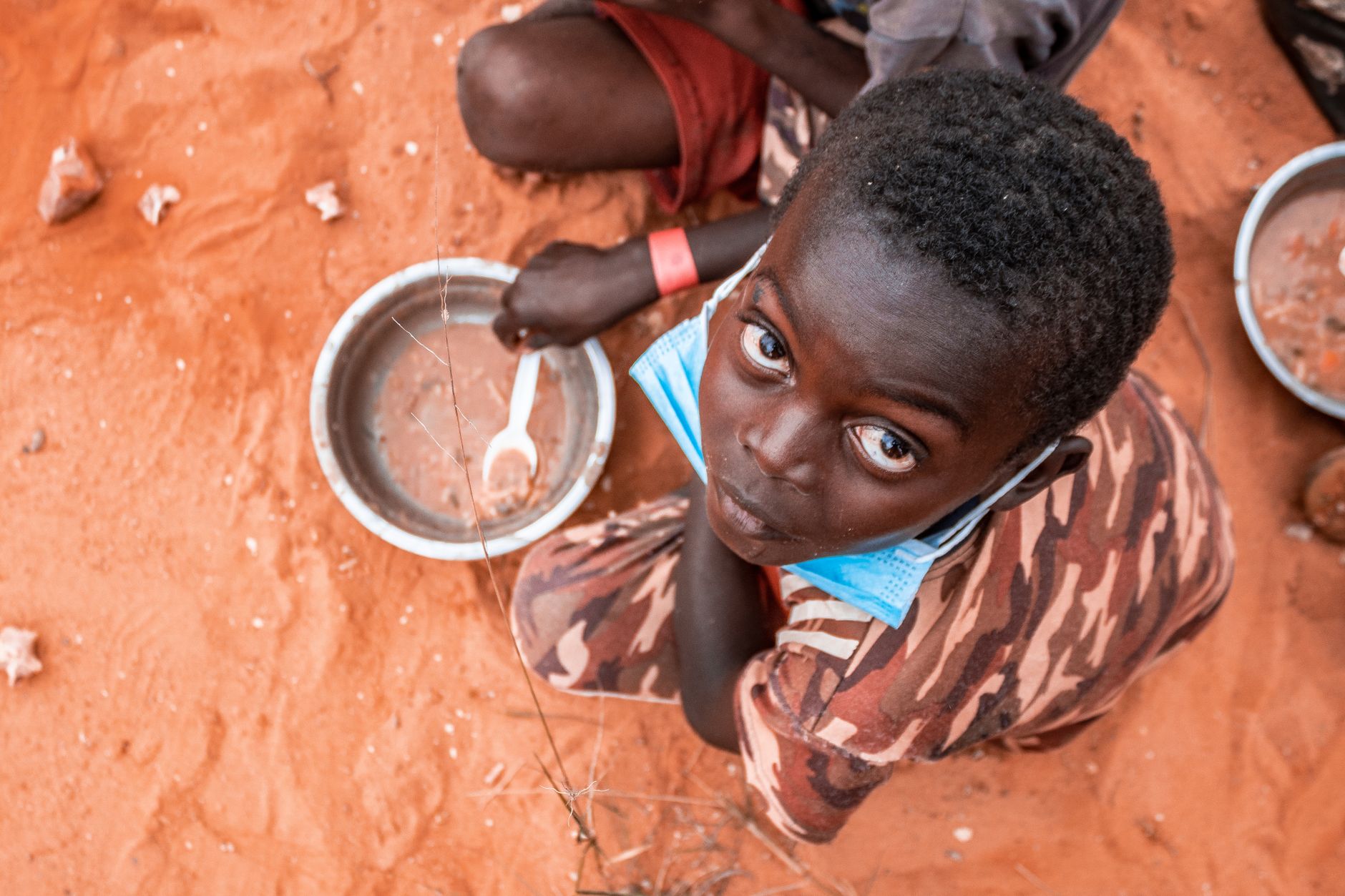
Hunger is a global problem. Two billion people in our world are food-insecure. 266 million of them are “extremely hungry”—that means they cannot get enough food to meet their most basic nutritional needs. 65% of those hungry people live in conflict afflicted areas, from the 1.4 million people of Gaza to the 19 million Sudanese who have been driven from their homes by civil war to the 2 million Ukrainians who need food assistance due to the ongoing war with Russia. The majority of hungry people in our world—60%—are women and girls because they eat last and get least. Drastic cuts to global humanitarian funding have exacerbated the problem. U.S. support for hunger relief dropped from approximately $14 billion to only $3.7 billion between 2024 and 2025.
Whether we are feeling the pinch at the grocery checkout, or we are volunteering at the food pantry, or we simply keep an eye on the world news, we know that hunger is a problem, right here at home and for our global neighbors.
Jesus had something to say about hungry neighbors. The Lord was in search of a quiet place to pray and mourn the death of his cousin John the Baptist when his day was hijacked by the needs of the crowd. On foot they followed him to a deserted place. They needed his help. All day long, he compassionately ministered to them. He returned mobility to paralyzed limbs, restored sight to blind eyes, cast out demons, and cleansed lepers. All who came were welcomed and blessed and healed.
But as sun sank and the shadows grew long over the land, the disciples saw a problem. All those people in such a remote place needed to eat. “Jesus,” they appealed to their master, “let’s dismiss them with your blessing so that they can return home or seek food elsewhere.” It was a good idea, but Jesus had an even better one. He pointed to his twelve disciples saying, “They need not go away; you give them something to eat.”
There wasn’t enough. Five barley loaves, two dried fish. The disciples couldn’t feed themselves, let alone 5,000 guests. But they placed their meager provisions in the hands of Jesus and trusted that something good could happen. Like a host presiding at a banquet, Jesus blessed their little bit. Then, he put them to work as servants, going forth into the expectant and hungry crowd.
Somehow, there was enough. The more they shared, the more there was! Later, as night fell in that wilderness place, the people reclined with full bellies around their camp fires and rejoiced in the Lord who helps and heals and feeds. The disciples rejoiced, too, as they gathered up the miraculous leftovers—12 baskets full—and celebrated that their little bit and their helping hands made a difference.
The people of Church World Service have more than seventy years of experience in answering the invitation of Jesus to give hungry people something to eat. It started in the wake of the Second World War, when there was mass hunger across the conflict-devastated global landscape. Seventeen Christian denominations came together to do in partnership what they could not do alone. In those early days, they mobilized more than 11 million pounds of food, clothing, and medical supplies to help neighbors in Europe and Asia. Once that need was met, they kept going, responding to hunger crises across the decades in places like Cuba, Ethiopia, and Haiti. Over the years, their focus has grown from meeting immediate food crises to equipping families all over the world to put food on the table, connect to clean water, and build the businesses they need to thrive.
One of the places that Church World Service is at work to equip people to meet their nutritional needs is the Nyarugusu Refugee Camp in Tanzania. The camp was established in 1996 by the U.N. and the Tanzanian government to house Congolese refugees fleeing civil war. Nyarugusu is home to 137,000 people who contend with hunger and instability. One of those residents is 34-year-old Francois, who earned his living as a fisherman on Lake Kivu before being forced to flee with his eleven family members. There are no waters to fish in the refugee camp, but Francois has found a new way to support his family through sustainable agriculture programs offered by Church World Service. Francois learned to plant and tend crops, many of which he had never tried in Congo. His wife joined him in their new business. They produced both vegetables and seeds, which they ate and sold to neighbors and local restaurant owners to earn additional income. With the support of CWS, Francois and his family went from fishermen to farmers and became leaders in their community as they shared what they learned and trained others to garden.
Another neighbor in the Nyarugusu Refugee Camp is Matisho Justina. Matisho participated in the CWS Wezesha Project, an initiative that equips refugees with essential skills in agriculture, nutrition, and tree planting. Because of her love for fresh fruit and the scarcity of it in the camp, Matisho decided to focus her efforts on training in arbor culture—planting and tending trees. She learned in a tree nursery, where seedlings are cultivated and later distributed to participants. With patience and dedication, Matisho planted the little trees she received. Just nine months later, her once-barren garden transformed into a thriving orchard. Her success had a ripple effect on the community. Neighbors, motivated by the abundance in Matisho’s garden and the high cost of fruit in the camp, are now learning from her how to plant and tend their own trees. Matisho says, “Thanks to CWS… I am not only feeding my family with fresh homegrown fruits but also contributing to a shift in my community’s approach to sustainable agriculture.”
From fresh vegetables to fruit and beyond, Church World Service is answering the call of Jesus to give our global neighbors something to eat.
This church has partnered with Church World Service through the Saranac Lake CROP Walk for forty years. Today after church, walkers will take to the streets to raise awareness and funds to address local and global hunger. One-quarter of funds raised will stay local to feed our hungry neighbors through the Saranac Lake Interfaith Food Pantry. Three-quarters will benefit those 266 million world neighbors who are extremely hungry. Beyond meeting immediate hunger, we’ll be enhancing the capacity of those global neighbors to feed themselves, equipping them to thrive. Who is planning to walk today?
Church World Service won’t be the only one we’ll be partnering with today. We’ll be joining Jesus, who reminds us this morning that it is the call of faithful disciples to give our hungry neighbors something to eat. We trust that our little bit and our helping hands can make a surprising difference when placed in the hands of Jesus. Let’s lace up our shoes, hit the streets, and do just that.
Resources
Matt Skinner. “Commentary on Matthew 14:13-21” in Preaching This Week, August 2, 2026. Accessed online at https://www.workingpreacher.org/commentaries/revised-common-lectionary/ordinary-18/commentary-on-matthew-1413-21-7
Marilyn Salmon. “Commentary on Matthew 14:13-21” in Preaching This Week, August 2, 2026. Accessed online at https://www.workingpreacher.org/commentaries/revised-common-lectionary/ordinary-18/commentary-on-matthew-1413-21-3
World Data Staff. “US Prices Statistics 2026 | Inflation, Groceries, Rent, Gas, Food, Housing & Everyday Costs” in The World Data Insight Hub: Finance, Sept. 21, 2026. Accessed online at https://theworlddata.com/us-prices-statistics/
Northeast Regional Food Bank staff. “Food Insecurity by County.” Accessed online at https://regionalfoodbank.net/food-insecurity-by-county/
CWS Staff. “From Fisherman to Farmer: Rebuilding Food Security During the Lean Season in Tanzania” in CWS Stories, Sept. 8, 2026. Accessed online at https://cwsglobal.org/stories/from-fisherman-to-farmer-rebuilding-food-security-during-the-lean-season-in-tanzania/
CWS Staff. “From Seed to Sustenance: Matisho Justina’s Journey Toward a Thriving Future” in CWS Stories, June 12, 2025. Accessed online at https://cwsglobal.org/stories/from-seed-to-sustenance-matisho-justinas-journey-toward-a-thriving-future/
UN World Food Programme. “Causes of World Hunger.” Accessed online at https://wfpuse.org/hunger
Feeding America. “Hunger in America.” Accessed online at https://www.feedingamerica.org/hunger-in-america
Matthew 14:13-21
13 Now when Jesus heard this, he withdrew from there in a boat to a deserted place by himself. But when the crowds heard it, they followed him on foot from the towns. 14 When he went ashore, he saw a great crowd, and he had compassion for them and cured their sick. 15 When it was evening, the disciples came to him and said, “This is a deserted place, and the hour is now late; send the crowds away so that they may go into the villages and buy food for themselves.” 16 Jesus said to them, “They need not go away; you give them something to eat.” 17 They replied, “We have nothing here but five loaves and two fish.” 18 And he said, “Bring them here to me.” 19 Then he ordered the crowds to sit down on the grass. Taking the five loaves and the two fish, he looked up to heaven and blessed and broke the loaves and gave them to the disciples, and the disciples gave them to the crowds. 20 And all ate and were filled, and they took up what was left over of the broken pieces, twelve baskets full. 21 And those who ate were about five thousand men, besides women and children.