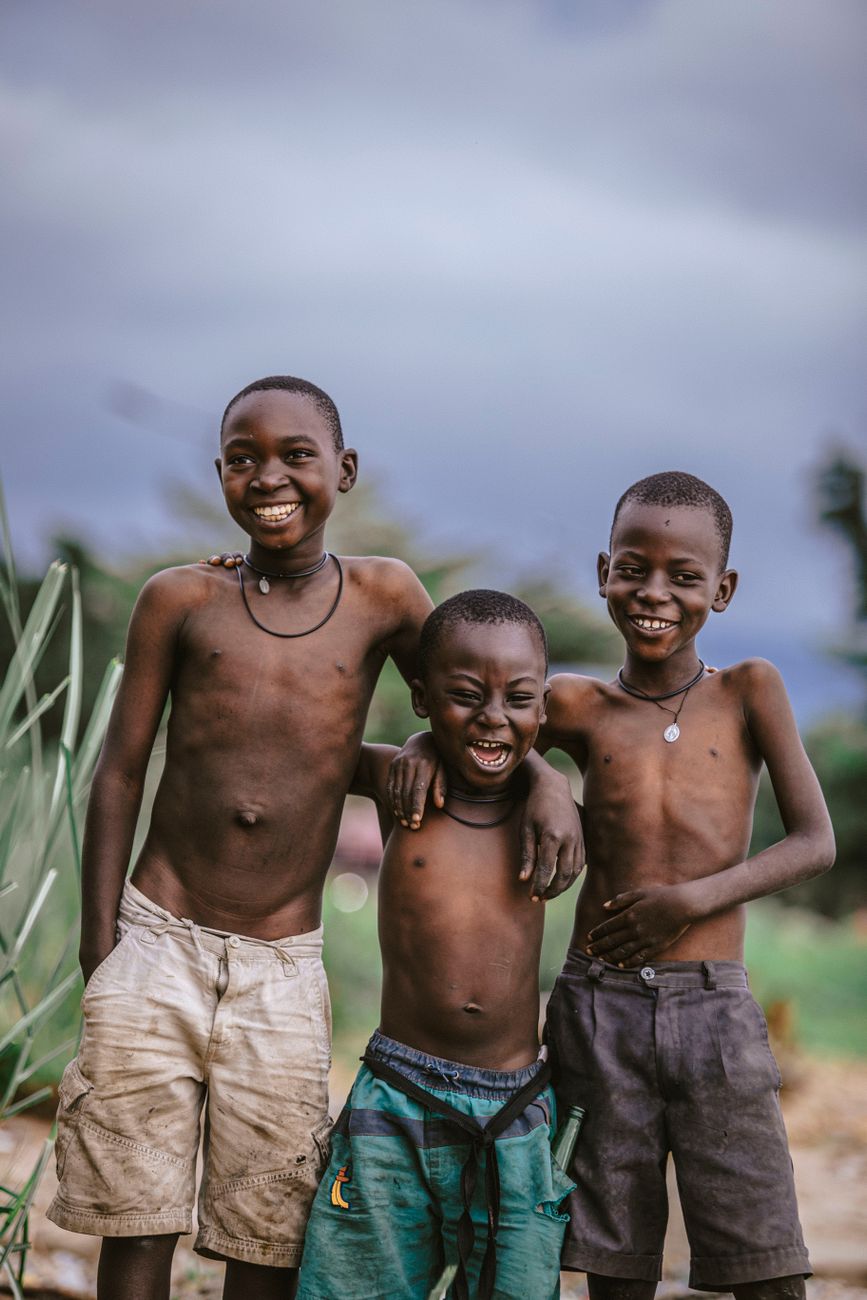
Sabbath Day Thoughts — “God Who Hears” Genesis 21:8-21
Children are crying.
Children are crying in Malawi this morning. One of the least developed nations in the world, more than 70% of Malawi’s people live in poverty. 69% of Malawians have access to clean water, thanks to initiatives like the shallow well program, but the country lags woefully behind in sanitation. Only 26% of Malawians have access to essential sanitation, like toilets and sewers. Only 9% have access to resources for basic hygiene, like running water, showers, or baths.
For many children, food scarcity means chronic hunger. 37% of Malawi’s children experience stunting—they don’t receive sufficient nutrition for the development of their bodies and brains. Malnutrition affects health. 40,000 of Malawi’s children under five die each year from preventable and treatable diseases. 39% of Malawi’s children, some as young as 5-years-old, work to help provide for their families. Economic pressure means that children are pushed into early marriages. About half of all girls are married before their 18th birthday. That may explain why Malawi’s premature births and maternal deaths are among the highest in the world.
Children are crying.
Children are crying in our nation this morning. 10.35 million of America’s children live in poverty—that’s 14.3% of our children. Even more children—14.1 million—live in families that contend with food insecurity—not enough monthly income to ensure that nutritious food is consistently on the table. They depend on local food pantries and school lunch programs. Those numbers are worse here in the North Country. 20.1% of Franklin County’s children—that’s one in five kids—live in poverty.
Poverty detrimentally shapes the future of our children. They do not receive adequate medical care and have poorer health outcomes that will affect their well-being for a lifetime. 70% of fourth graders who live in poverty are unable to read at their grade level. 73% of eighth graders who live in poverty are not proficient in math. They are significantly less likely to graduate from high school. As adults, they will earn less money than their prosperous peers, perpetuating a cycle of generational poverty.
Mothers living in poverty in America often describe their struggle as a constant, invisible battle that shapes their children’s lives. In the documentary Born Poor, one mother told her 10-year-old daughter, “When we can’t afford to pay our bills, like, our house bills and stuff, I’m afraid, like, we’ll get homeless… You never know what’ll happen in your life.” Children living in poverty often know exactly when bills are due or when food is scarce. They describe “always worrying” about whether the electricity will get cut off or if there will be enough dinner. They feel embarrassed and hide their living situation from peers. They miss out on typical childhood experiences—sports, camps, and family vacations.
Ishmael was crying.
In our reading from Genesis 21, God heard the cry of young Ishmael. Just the day before, the child was celebrating the weaning of his little brother Isaac. As the firstborn son by Abraham’s lesser wife Hagar, Ishmael was his father’s heir, destined to inherit a double-share of property, possessions, and blessing. But as the family rejoiced and the boys played, Sarah, Abraham’s first wife, watched Ishmael and Isaac laughing together. One boy was already strong and bold; the other boy was just taking his first steps toward independence. As Sarah watched, jealousy like a dark beast rose within her heart. God’s promise didn’t seem big enough for both children. Why should her child Isaac, the child long-promised by God, share with the child of her maidservant Hagar? Sarah asserted her authority as first wife. Hagar and Ishmael had to go.
Scripture tells us that Abraham found the matter—this banishment and disowning of Ishmael and Hagar—“very distressing” (v. 11). A closer reading of the Hebrew here suggests that Abraham found Sarah’s ultimatum “very bad” or “morally wrong” in his eyes. Abraham knew that what Sarah asked him to do was not right, yet he did it anyway. He sent Hagar and Ishmael into the Wilderness of Beer-sheba. When the food was gone and the water ran out, Hagar despaired and Ishmael cried.
In a world where Sarah wished to claim God’s blessing for Isaac alone, we learn that God hears the cries of people like Ishmael, like Hagar, people who have been pushed out of the blessing and sent forth to live at the margins. Prof. Carolyn Helsel, who teaches at Austin Presbyterian Seminary, points out that the Hebrew verb used for “hear”—shema—describes a listening that leads to action. God heard Ishmael’s cries and took action in response, making of him a great nation. God hears, God acts, God blesses.
Children are crying.
Do we hear the children crying, my friends? It’s “very distressing,” the cries of Malawi’s children. It’s “very distressing,” the day-to-day circumstances of a country where 70% of people live in poverty, children are stunted, and basic sanitation is a luxury unknown to most households. Tyler Holm and Rochelle Holm have lived in Malawi for 14 years. They first began serving there through short-term mission trips in 2008, but they fell in love with the land and the people. They moved to Malawi permanently at the end of 2012 as Presbyterian Mission Co-workers, serving at Mzuzu University and the Church of Central Africa Presbyterian (CCAP). The next year, they adopted their daughter Mphatso, one of Malawi’s orphans. Tyler teaches at the University of Livingstonia and Rochelle manages the Centre of Excellence in Water and Sanitation at Mzuzu University. The Holms are deeply committed to making a helping and healing difference in Malawi through education and improved sanitation. They hear the cries of Malawi’s children and believe that God provides enough blessing for all people, even the vulnerable children of Malawi. Our Father’s Day offering today will support their life-changing work.
Children are crying.
It’s “very distressing,” you might say morally wrong, that in this nation of amazing bounty more than ten million of our children live in poverty. It’s “very distressing” that right here in Franklin County 20% of our kids face the everyday worry, fear, and shame that come from growing up in homes with more month than money. If we are feeling the pinch at the gas pump and the grocery checkout, imagine how families that were already struggling feel. Our friends in the Community Schools program report that the number of Petrova kids who participate in the weekly backpack program (taking home food to help on the weekends when they don’t have school lunches) has soared this school year from 49 households in the fall to 89 as the school year ends.
Can we hear the children crying? Can we believe that in this land of goodness, God’s blessing is for all children, even the Ishmael’s, even our neighbors who live in poverty? Or will we insist that there isn’t enough blessing to go around and some are meant to wander in the wilderness?
I know we believe that God’s blessing is for all. That’s why we set aside two-cents-a-meal for the Food Pantry, and we have made a beautiful home for the pantry, right here at church. That’s why we grow those healthy, organic vegetables at the Jubilee Garden and host a free farm stand in the churchyard. That’s why Coral keeps the little food pantry in Bloomingdale well-stocked. That’s why we cook for the Community lunchbox, play music at the Wednesday supper, and deliver meals for Meals on Wheels.
One of the surprising learnings of the pandemic is that we can end childhood poverty in this country—if we want to. The expansion of the Child Tax Credit in 2021 dropped the national childhood poverty rate to 5.2% and lifted millions of children out of poverty. When the credit expired, childhood poverty returned to pre-pandemic levels with growing food insecurity, housing instability, and limited healthcare. We have the wherewithal to level the playing field and change the experience of our impoverished children, but we do not have the national will.
Children are crying.
Jesus who welcomes and blesses the children, God who hears the cries of Ishmael, the Lord who continues to listen and act on behalf of those who are cast out might tell us that our complacency with child poverty is “greatly distressing.” God might even say it is morally wrong. God still listens for the voices of children who bear the burden of want and need, and God calls us to stand with them. There is plenty of love and blessing to go around, my friends. Will we hear, will we act, will we bless?
Resources
American Psychological Association. “Mental health effects of poverty, hunger, and homelessness on children and teens,” May 2024. Accessed online at https://www.apa.org/topics/socioeconomic-status/poverty-hunger-homelessness-children
“Child Poverty Statistics in US 2026 | Rates, States & Facts,” The World Data, April 28, 2026. Accessed online at https://theworlddata.com/child-poverty-statistics-in-us/
US Census Bureau. Small Area Income and Poverty Estimates, Accessed online at https://fred.stlouisfed.org/series/PPU18NY36033A156NCEN
Unicef. “The situation of children and women in Malawi.” Accessed online at https://www.unicef.org/malawi/situation-children-and-women-malawi
Amanda Benckhuysen. “Commentary on Genesis 21:8-21” in Preaching This Week, June 21, 2020. Accessed online at https://www.workingpreacher.org/commentaries/revised-common-lectionary/ordinary-12/commentary-on-genesis-218-21
Carolyn B. Helsel. “Commentary on Genesis 21:8-21” in Preaching This Week, June 25, 2023. Accessed online at https://www.workingpreacher.org/commentaries/revised-common-lectionary/ordinary-12/commentary-on-genesis-218-21-5
Vanessa Lovelace, “Commentary on Genesis 21:8-21” in Preaching This Week, June 21, 2026. Accessed online at https://www.workingpreacher.org/commentaries/revised-common-lectionary/ordinary-12/commentary-on-genesis-218-21-6
Genesis 21:8-21
8 The child grew and was weaned, and Abraham made a great feast on the day that Isaac was weaned. 9 But Sarah saw the son of Hagar the Egyptian, whom she had borne to Abraham, playing with her son Isaac. 10 So she said to Abraham, “Cast out this slave woman with her son, for the son of this slave woman shall not inherit along with my son Isaac.” 11 The matter was very distressing to Abraham on account of his son. 12 But God said to Abraham, “Do not be distressed because of the boy and because of your slave woman; whatever Sarah says to you, do as she tells you, for it is through Isaac that offspring shall be named for you. 13 As for the son of the slave woman, I will make a nation of him also, because he is your offspring.” 14 So Abraham rose early in the morning and took bread and a skin of water and gave it to Hagar, putting it on her shoulder, along with the child, and sent her away. And she departed and wandered about in the wilderness of Beer-sheba.
15 When the water in the skin was gone, she cast the child under one of the bushes. 16 Then she went and sat down opposite him a good way off, about the distance of a bowshot, for she said, “Do not let me look on the death of the child.” And as she sat opposite him, she lifted up her voice and wept. 17 And God heard the voice of the boy, and the angel of God called to Hagar from heaven and said to her, “What troubles you, Hagar? Do not be afraid, for God has heard the voice of the boy where he is. 18 Come, lift up the boy and hold him fast with your hand, for I will make a great nation of him.” 19 Then God opened her eyes, and she saw a well of water. She went and filled the skin with water and gave the boy a drink.
20 God was with the boy, and he grew up; he lived in the wilderness and became an expert with the bow. 21 He lived in the wilderness of Paran, and his mother got a wife for him from the land of Egypt.